Tag: CNN International

  • CNN International tops chart across Asia Pacific: survey

    CNN International tops chart across Asia Pacific: survey

    MUMBAI: CNN International has emerged as the undisputed number one international news brand in Asia-Pacific according to the latest Ipsos Affluent Survey released on 3 November, 2015.


    In India, CNN tops the chart of international news brand in total multi-platform reach. The channel also leads in both TV (monthly and daily) and digital (monthly) reach in the country. According to the survey, in terms of the multi-platform news brand, the channel gets three per cent monthly reach in Asia Pacific, while it has two per cent reach in India.


    The channel is also ranked number one in the TV news network by 29 per cent monthly, 20 per cent weekly and seven per cent daily reach in Asia Pacific, while it has a daily reach of 21 per cent monthly and six per cent in India. When it comes to digital news brand, the channel has 11 per cent monthly reach in Asia Pacific.


    CNN is also a top ranker with exclusive reach by at least three quarters (74 per cent+) of consumers of competing news brands also consume CNN, while between a half (46 per cent) and three quarters (73 per cent) of its consumers do not view/read competitor news brands in Asia Pacific.


    CNN is also titled as a growing genre leading the international news genre and growing in both TV and digital audiences as well as being number one in TV and digital. The channel also leads all international news/business brands in key target groups in monthly multi-platform reach.


    When it comes to business, it reaches 55 per cent of top management, 49 per cent of financial decision makers and 44 per cent of total business decision makers in Asia Pacific.


    CNN International vice president advertising sales for Asia Pacific Sunita Rajan said, “The survey results are clear: no matter how the figures are analyzed, whether it’s by platform, metric or major target group, no other news brand has a stronger reach than CNN. It proves our strategy to be where our audience wants us, on all platforms all of the time, is working. It’s also encouraging from an industry perspective that the international news genre as a whole is growing. The fact CNN is the clear leader in a growing market is a testament to the hard working team at CNN International.”

  • CNN International Commercial hires Laura Greally as digital account director APAC

    CNN International Commercial hires Laura Greally as digital account director APAC

    MUMBAI: CNN International Commercial has appointed Laura Greally to the newly created role of digital account director, Asia Pacific.


    With over a decade of digital marketing experience, Greally’s primary role is to identify and develop a range of solutions across CNN International’s digital portfolio from both direct sales and programmatic trading across Asia.


    Prior to joining CNN International, Greally worked for both BBC Worldwide as the APAC pricing and inventory manager, and Fox International Channels as the digital sales operations manager.


    Based in Singapore, Greally is part of a new team of specialists working under CNN International Commercial head of digital advertising sales and data Rob Bradley. She will also work closely with the APAC sales team, led by CNN International Commercial vice president of advertising sales, Asia Pacific Sunita Rajan.

  • CNN International to air special coverage on growing India

    CNN International to air special coverage on growing India

    MUMBAI: CNN International will be featuring a special coverage week starting from 20 September on Growing India.


    In this special programming week, CNN will look at the auto sector as a barometer of India’s growing consumerism, its indigenous Silicon Valley changing gears to become a front running technology hub, the revival of ancient art form for modern markets and e-commerce lessons from traditional dabbawallas.


    CNN International correspondent Mallika Kapur will explore how India has evolved in the last decade and examine its growth indicators.


    CNN International South Asia sales director Sonali Chatterjee said, “Special theme weeks garner immense interest from both audiences and advertisers. India is at a very crucial cusp in its growth trajectory and our viewers will get to see its many emerging facets, while our advertisers will have the opportunity to engage with an audience of decision makers and influencers. We are proud to have the Department of Industrial Policy and Promotion, Ministry of Commerce and Industry, as a major advertiser with Growing India on CNN’s linear and digital platforms.”


    Growing India’s stories will be aired from 20 – 24 September in Connect The World at 8:30 pm and from 21-25 September in The Business View at 3:30 pm.

  • CNN International explores India’s place on the modern ‘Silk Road’

    CNN International explores India’s place on the modern ‘Silk Road’

    MUMBAI: This month, ’Silk Road: Past, Present, Future’ continues an 8,000 kilometre journey across the ancient silk and spice routes, traveling south from Central Asia, across remote snow-topped mountains, to explore one of Asia’s most important corridors of commerce: India.


    Following the series’ first two episodes in China and Kazakhstan, this month’s show sees presenter Sumnima Udas explore India’s historic role in the world’s most important trade route and uncover the country’s place in the modern Silk Road. 


    India is one of the oldest civilizations on the planet; the birthplace of Hinduism, Buddhism, ancient medicines and even spicy curry. CNN’s Sumnima Udas explores one of the largest wholesale spice markets in Asia, in India’s national capital, New Delhi.  From coriander to pepper to turmeric, spices are a centuries-old staple of Indian heritage.  Decades ago, Indian cooks used to spend hours preparing their spices, manually grinding everything to make their own blends. Today, the process is much easier.  CNN meets India’s self-proclaimed ‘King of Spices’, the 93-years-old, Dharampal Gulati, and learn how his Delhi spice company, MDH,  started in the year of India’s independence, 1947, is making cooking easier for thousands of consumers.


    The program also travels south to India’s growing tech-hub, Bengaluru to discover how Indian technology firm Wipro is partnering with the American company GE to design and manufacture low-cost baby warmers for new-borns to help reduce the neonatal mortality rate.  The concept, often called ‘reverse innovation’, is to create and sell new technology for the Indian market at a fraction of the cost that they are normal sold around the world. Sumnima also examines how Ayurveda, an ancient system of healing based on balance and nature is enjoying a resurgence.


    India is the world’s second largest producer of tea in the world and drinking the beverage is a national pastime.  Udas treks through the hills and tea plantations of Darjeeling in North East India. This lush, mountainous region, near the borders of China, Bhutan, and Nepal, is world-famous for Darjeeling teas. The program meets Kaushal Dugar, a young Indian entrepreneur who is hoping his three-year-old e-commerce start-up, Teabox, will change the way tea is bought and sold around the globe by shipping tea straight from the field to the consumers, just days after it is plucked in the tea gardens.


    Following the India episode, The Silk Road: Past, Present, Future will visit the Arabian Peninsula as it makes its way across the old routes over nine episodes before completing its journey in Northern Italy.

  • CNN Freedom Project and Tony Maddox honoured by US State Department

    CNN Freedom Project and Tony Maddox honoured by US State Department

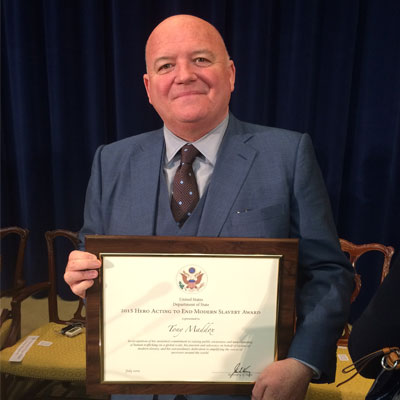
    MUMBAI: The U.S. State Department has honoured CNN International executive vice president and managing director Tony Maddox and the CNN Freedom Project as a 2015 Trafficking in Persons Report Hero.


    The eight Trafficking In Persons (TIP) Report Heroes are announced in conjunction with the annual TIP Report by the State Department, which assesses the response of 188 countries and territories to the crime of human slavery. Secretary of State John Kerry presented the honours at a ceremony in Washington D.C.


    “I am humbled by this recognition,” said Maddox. “I am proud of CNN using the full range of our international resources to track and highlight this important story,” he added.


    Spearheaded by Maddox, CNN International launched the CNN Freedom Project in 2011 to shine a spotlight on modern slavery. The project has sought to amplify the voices of survivors, highlight effective prevention and victim assistance efforts, and investigate the criminal enterprises involved. Now in its fifth year, the CNN Freedom Project is among the most successful and highly visible programming initiatives on CNN International. Under Maddox’s leadership, it has also become the longest running awareness and investigative campaign on modern slavery on television news.


    Under Maddox’s leadership, CNN International has enlisted dozens of correspondents and crews around the world, and has published more than 400 investigative stories. Various NGOs report that CNN Freedom Project stories have contributed to changing laws and corporate policies, led to more than 1,000 survivors receiving assistance and sparked over $24 million in donations to anti-trafficking organization. Additionally, the CNN Freedom Project has inspired new NGOs and grassroots campaigns around the world.

  • CNN International Commercial appoints Fox Sports’ Shradha Nair

    CNN International Commercial appoints Fox Sports’ Shradha Nair

    MUMBAI: CNN International Commercial has made a new appointment in the Asia Pacific region, boosting its advertising sales team.


    Shradha Nair joins the CNN ad sales team and will be responsible for developing, maintaining and increasing CNN’s commercial opportunities in the Singapore market.


    Nair has eight years of sales experience across industries including broadcast, recruitment and sports. Prior to joining CNN, she was part of Fox Sports’ regional advertising sales, partnerships and content team and was based in Singapore.


    Nair will report to CNN International sales director Southeast Asia Stacey Rabsatt. Her appointment takes effect immediately.

  • “CNN Digital’s goal for 2015 is to create personal & engaging mobile news experience:” Etan Horowitz

    “CNN Digital’s goal for 2015 is to create personal & engaging mobile news experience:” Etan Horowitz

    A former journalist, with experience in print, broadcast, online and mobile, Etan Horowitz is currently serving as CNN Digital senior mobile editor. Horowitz, throughout his career, has combined his love of technology with his passion for journalism.


    As the editorial lead for all of CNN’s mobile products, Horowitz works closely with CNN editorial teams to plan and publish news and information optimized for phones, tablets and other mobile devices. As a key member of the homepage team, Horowitz also drives awareness of mobile audience behavior through increased training and the use of analytics tools.


    He works closely with the mobile product, business and design teams on setting CNN’s global mobile strategy and updating CNN’s mobile apps. He also oversees CNN’s editorial strategy on news reading app Flipboard. During Horowitz’s tenure, CNN has continued to show substantial growth in mobile.


    Before CNN Digital, Horowitz worked as a digital media producer for CNN International. While there, he was responsible for producing content for TV that originated on digital or social platforms. He played an important role in the coverage of the 2010 Haiti earthquake, the 2010 World Cup in South Africa, the Arab Spring and the Royal Wedding.


    In a t?te-?-t?te with Indiantelevision.com, Horowitz talks about the journey of CNN apps so far, building of the mobile audience for CNN and more…


    Excerpts:


    What initiatives did CNN Digital undertake to cross the 50 per cent mobile audience mark?


    We had a three-part strategy focused on awareness, analytics and action. Awareness meant making sure our staffers were constantly looking at our mobile products as they did their jobs. So we made sure to put live views of our mobile website and apps on everyone’s computers as well as on big monitors throughout the newsroom. At key meetings, we made sure to always show our mobile products. We even devoted an entire week in May 2014 to raising awareness among the staff, which was a big success. 


    Once we had more people looking at our mobile site and apps, we focused on analytics to get a better understanding of how our audience was consuming our journalism on mobile devices. We made sure to have the same reports for mobile that we’ve always had for desktop and we also explored mobile only analytics reports, such as data on how many people tap on a breaking news app alert from the CNN apps. A big takeaway from this exercise was that our peak usage times for our desktop and mobile sites are different. Specifically, in the United States, between noon and 1 pm ET is the biggest usage period for our desktop website, while between about 8 and 11 pm ET is the peak usage time for our mobile site. These learnings helped us to focus our staffing and efforts appropriately. 


    Finally, “action” meant making sure that all of our staffers had the knowledge and skills to make changes and tweaks to our mobile platforms to ensure we were delivering the highest quality journalism to our audience. Without the awareness or analytics, this would not have been possible. When stories are commissioned or when headlines are being written, we keep the mobile audience at the top of our minds and always ask ourselves “what’s the best way to tell this story to someone reading it on a phone?”


    What happened after crossing that mark and what are CNN’s ongoing investments in mobile?


    Globally, we crossed the 50 per cent mark in the summer of 2014. Since we had already been preparing our staff for crossing that mark, nothing special happened once we passed it. However, passing that mark and our continued mobile growth has helped keep everyone focused on providing the best experience for our mobile users. Our executives have made mobile our top digital priority and we often share metrics and numbers to keep everyone up to date about our mobile growth. 


    Is there any special strategy to create editorial content primarily aimed at mobile audiences?


    The best strategy is to put yourself in the shoes of someone seeking news and information on a phone and thinking about what you would need. So mobile app push alerts are incredibly important to our strategy because they deliver important news to your pocket. This year we’ve been focusing even more on mobile-native storytelling with projects like Snapchat Discover and John Sutter’s Poor Kids of Silicon Valley interactive, both of which were designed primarily for a mobile audience. Video is a big focus for CNN and something that has been very popular with our mobile audience, so we always try to incorporate video into our mobile storytelling efforts.


    Personalization is a big focus for us this year, as evidenced by our recent CNN App for Apple Watch, which lets users choose the news sections they want to see. 


    Is there a special analysis to understand how CNN’s mobile consumption is different from consumption on other platforms and to implement plans based on audience patterns and habits?


    Yes, as mentioned earlier, we rely heavily on audience analytics to tell us how mobile audiences consume our journalism. For instance, users of our mobile apps tend to consume more stories and videos per visit than users of our other digital platforms.


    Are the mobile app push alerts a key driver when it comes to the long sustainability of apps?


    Mobile app push alerts are incredibly important to our mobile strategy as they serve as a utility for users of our apps. This year we are working to improve the alerts experience to offer more control and personalization to users of our apps.


    Don’t you think it is highly important to have journalists who understand the mobile platform?


    Any journalist working today needs to understand the rapidly changing ways that users are accessing news and information. We work hard to make sure our staffers know how our mobile sites and apps work, how users are consuming our content on them and what the latest trends in content consumption and delivery are. 


    How do mobile apps fit into your overall mobile strategy, especially when you have a responsive website?


    In January of this year we re-launched CNN.com as a responsive site. This was a huge improvement because it meant that all of our content was easily accessible to users on any device. Now that we have the responsive site, we are putting a lot of effort into rethinking our mobile apps to focus on being more engaging and personal. A top strategic pillar in 2015 for CNN Digital is to “create the world’s most personal and engaging mobile news experience,” and we think our mobile apps will play a big role in meeting that goal.  


    What role does social media play when it comes to content creation? Is it important to have a good social media base?


    Social media and mobile consumption are very closely linked together because the majority of social media consumption happens on mobile devices. So when someone taps on a link to a CNN.com story on Facebook, they are often opening our mobile website because they are using Facebook on a phone. Stories that perform well for us on social media also perform well for us on our mobile sites.


    We’ve recently added some features to our mobile site to further strengthen this connection. For instance, when you read a CNN.com article on your phone, we now have an icon to share that story directly to the WhatsApp messaging app. 


    Do you see mobile apps as the future when it comes to platforms for news gathering?


    There are many examples of journalists using mobile devices today to capture news as it is breaking. CNN does a great job of placing journalists in the field around the world, and our team is often well positioned to both live report through their mobile devices and connect with others who are capturing content. We have a Social Discovery department dedicated to finding and verifying content because it can be the first window into a story.


    Every news agency has a mobile app now. What is your strategy to stay ahead of the others?


    CNN’s mobile apps have been downloaded tens of millions of times and are widely praised as a top app to download across devices. We are really focusing on making our apps even more personal and engaging. One recent innovation was the launch of CNNgo in our CNN App for iPad, which puts users in control of how they watch CNN TV and offers related content to the stories they are watching. Were also making a big push onto wearable devices, as evidenced by the launch of our CNN App for Apple Watch. CNN was the only news provider featured on stage by Apple as the company unveiled the Apple Watch.

  • CNN International commercial makes senior level appointment

    CNN International commercial makes senior level appointment

    MUMBAI: Sunita Rajan is joining CNN International Commercial’s executive team under Chief Commercial Officer Rani R Raad with a remit to continue building CNN’s business growth trajectory in the Asia Pacific region.

    Joining from BBC Worldwide from March 2015, Rajan will oversee an extensive client base across the breadth of the Asia Pacific region and will lead teams based across 5 offices in Hong Kong, Singapore, Tokyo, Delhi and Mumbai and a network of representatives across Asia, overseeing the strategy to drive advertising revenue for CNN’s global portfolio of multi-platform products among Asia Pacific based advertisers. She will also be part of Raad’s management team which guides the brand’s international commercial strategy.

    With an emphasis on bespoke integrated advertiser solutions across the full range of CNN’s linear and non-linear properties, her focus will be on overseeing strategic relationships and brand partnerships across the Asia Pacific region. Her appointment comes at a time of particular momentum for the CNN brand: the leading international news brand continues to mark clear distance between its nearest competitor in all key independent viewing surveys both in Asia and worldwide and marks the second consecutive year as Asian TV Awards’ Cable & Satellite Channel of the Year and the Royal Television Society’s News Channel of the Year.

    “Sunita’s wealth of experience coupled with her dynamic leadership style will be a huge asset to CNN as we look to continue our growth path in the Asia Pacific region,” said Raad. “Her expertise fits perfectly with CNN’s multi-platform offering and she is ideally equipped to take CNN’s long-standing commercial success in the region to the next level.  She will undoubtedly prove a valued colleague to the entire Asia business across the full spectrum of our commercial activity in the region where CNN continues to enjoy a strong leadership position.”

    “This is a tremendous opportunity to build further growth for the global news leader across its extensive portfolio of tv and digital products in a region as exciting and dynamic as Asia Pacific,” said Rajan. “I’m looking forward to taking up this new role working with such a highly talented team.”

    Rajan will be supported in her new role by Sonali Chatterjee, Stacey Rabsatt, Atsushi Saito and Sally Young, directors respectively for South Asia, South East Asia, Japan and North Asia (including New Zealand & Australia.)

    Rajan’s media career has spanned 25 years and has included roles at Star Television, News Television (India) and BBC Worldwide, where she was most recently Executive Vice President Advertising Sales, Asia Pacific.

    Rajan joins CNN as the news provider continues to invest in all its platforms, including a recently re-launched CNN.com site and a suite of additional business programming for its international audiences.  Its ongoing leadership position in digital, social, and mobile news and information sits alongside the unrivalled TV offering which currently reaches over 385 million households around the world.

    “In welcoming her to my international executive team, I know Sunita will help shape our future success beyond her role as a senior ambassador for the business in Asia Pacific,” added Raad. “Her drive and expertise will help to further establish CNNI Commercial as the go-to home of innovative commercial propositions for those wanting to engage with our unique global audience across multiple platforms.”

    Rajan is another senior level appointment to Raad’s executive management team since CNNI Commercial was formed two years ago. In February 2013, parent company Turner International made the decision to align all of CNN’s international commercial activity – spanning advertising sales, content sales, affiliate relations, out of home distribution, business development, marketing and research – into a single operation under Raad’s leadership.

    CNNI Commercial currently oversees a global portfolio of world-class advertisers after a significant period of client retention and growth. It manages a dynamic content sales, affiliates and hotels business and has recently announced innovative new marketing initiatives to increase CNN’s reach to new audiences, including most recently the opening of the inaugural CNN Traveller Café in Abu Dhabi.

  • Narendra Modi speaks to Fareed Zakaria on India’s world relations

    Narendra Modi speaks to Fareed Zakaria on India’s world relations

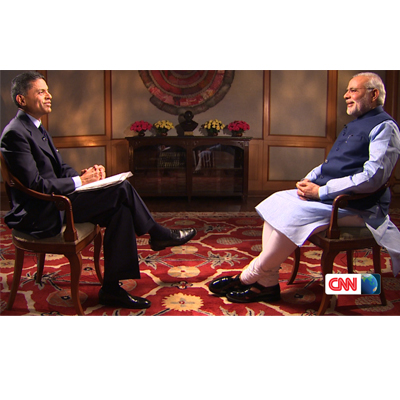
    MUMBAI: Narendra Modi’s much awaited interview with CNN International took place on 21 September 2014. Here is the transcript of the interview with CNN’s Fareed Zakaria.


    Fareed Zakaria, Host, CNN GPS: Prime Minister thank you so much for doing this.


    Narendra Modi, Prime Minister, India:  Thank you.


    Zakaria: After your election people have begun asking again a question that has been asked many times for the last two decades, which is, will India be the next China. Will India be able to grow at 8-9% a year consistently and transform itself and thus transform the world?


    Modi: See, India does not need to become anything else. India must become only India. This is a country that once upon a time was called ‘the golden bird’. We have fallen from where we were before. But now we have the chance to rise again. If you see the details of the last five or ten centuries, you will see that India and China have grown at similar paces. Their contributions to global GDP have risen in parallel, and fallen in parallel. Today’s era once again belongs to Asia. India and China are both growing rapidly, together.


    Zakaria: But people would still I think wonder can India achieve the kind of 8 & 9% growth rates that China has done consistently for 30 years and India has only done for a short period.


    Modi: It is my absolute belief that Indians have unlimited talent. I have no doubt about our capabilities. I have a lot of faith in the entrepreneurial nature of our 1.25 billion people. There is a lot of capability. And I have a clear road-map to channel it.


    Zakaria: China’s behavior in the East China Sea and the South China Sea over the last two years has worried many of its neighbors. The head of the governments in Philippines and Vietnam have made very sharp statements worrying about it. Do you worry about it?


    Modi: India is different. It is a country of 1.25 billion people. We can’t run our country if we get worried about every small thing. At the same time, we can’t close our eyes to problems. We are not living in the eighteenth century. This is an era of partnership. Everyone will have to seek and extend help mutually.  China is also a country with an ancient cultural heritage. Look at how it has focused on economic development. It’s hardly the sign of a country that wants to be isolated.  We should have trust in China’s understanding and have faith that it would accept global laws and will play its role in cooperating and moving forward.


    Zakaria: Do you look at China and feel that it has been able to develop as fast as it has, really the fastest development in human history, because it is an authoritarian government, because the government has the power to build great infrastructure, to create incentives for investment. Do you look at that and think to yourself that that would be — that there is a price to democracy that you have to do things a little bit more slowly.


    Modi: If China is one example, then democratic countries provide another example. They have also grown fast. You can’t say that growth is not possible because of democracy.  Democracy is our commitment. It is our great legacy, a legacy we simply cannot compromise. Democracy is in our DNA.


    Zakaria: So you don’t look at the power of the Chinese government and wish you had some of that authority.


    Modi: See, I have seen the strength of democracy. If there were no democracy then someone like me, Modi, a child born in a poor family, how would he sit here? This is the strength of democracy.


    Zakaria: From the strength of democracy to the strength or weakness of the crucial relationship between the US and India. Mr. Modi goes to the White House next week.  This after he was actually banned from even stepping on U.S. soil for many years. How does he see relations between the two nations?  Also, I ask about India’s recent record of terrible crimes against women. The Prime Minister will tell me what his government intends to do about it.


    ..BREAK..


    Zakaria: And we are back with more of my exclusive interview with India’s Prime Minister, Narendra Modi. Next week, he will make his first trip to the White House, warmly welcomed by the Obama administration. That’s quite a turnaround for a man who was placed on a blacklist by the George W. Bush administration in 2005 and, for many years, denied a visa to enter the United States. The ban stemmed from an incident in 2002, when he was chief minister of India’s state of Gujarat. Modi was criticized for failing to quell riots there, riots that, according to a U.S. government report, killed more than twelve-hundred people, the majority of the dead were Muslim.  Modi is Hindu.  Modi has been exonerated three times by India’s Supreme Court, notes the New York Times.  The Obama administration reversed the ban and has been courting Modi actively. Has Modi any qualms about warmer ties with India? I asked him.


    Zakaria: There are many people in the United States and some in India who wish that the United States and India were much closer allies. The world’s oldest democracy, the world’s biggest democracy, but somehow that has never happened and there have always been these frictions and difficulties. Do you think it is possible for the United States and India to develop a genuinely strategic alliance?


    Modi: I have a one word answer: Yes. And with great confidence I say “yes”. Let me explain. There are many similarities between India and America. If you look at the last few centuries, two things come to light. America has absorbed people from around the world and there is an Indian in every part of the world. This characterizes both the societies. Indians and Americans have coexistence in their natural temperament. Now, yes, for sure, there have been ups and downs in our relationship in the last century. But from the end of the 20th century to the first decade of the 21st century, we have witnessed a big change. Our ties have deepened. India and the United States of America are bound together, by history and by culture. These ties will deepen further.


    Zakaria: So far in your contacts with the Obama administration, you have had several cabinet members come here. Do you feel that there is a genuine desire from Washington to try to upgrade the relationship with India substantially?


    Modi: Relations between India and America should not be seen within the limits of just Delhi and Washington. It’s a much larger sphere. The good thing is that the mood of both Delhi and Washington is in harmony with this understanding. Both sides have played a role in this.


    Zakaria: With regard to Russia’s action in Ukraine. India has not been particularly active.  Do you, how do you view Russia’s annexation of the Crimea.


    Modi: Firstly, whatever happened there, innocent people died in a plane accident. That’s very saddening. These are not good things for humanity in this age. There is a saying in India that the person who should throw a stone first is the person who has not committed any sins. In the world right now, a lot of people want to give advice. But look within them, and they too have sinned in some way. Ultimately, India’s view point is that efforts need to be made to sit together and talk, and to resolve problems in an ongoing process.


    Zakaria: One of the areas that India has come on to the world scene or people have read about and heard about it, which has been unfortunate has been violence against women. This issue of rape. Why is it do you think that there is this problem of, it seems persistent discrimination and violence against women in India and what do you think can be done about it?


    Modi: Look, us political pundits shouldn’t tangle ourselves up in knots by searching for the root cause of this problem. More damage is done by statements from political pundits. Dignity of women is our collective responsibility. There should be no compromise in this matter. There should be no erosion in the law and order situation. We have to revive the family culture in which a woman is respected and considered equal, her dignity encouraged. The main thing here is girl child education. By doing so the possibility of empowerment will increase. On August 15, my government pushed ahead a movement called: educate the girl, save the girl.


    Zakaria: Next on GPS, the head of al Qaeda says he’s opening a franchise in India. What does Prime Minister Modi have to say about that? I’ll ask him.  Also, when you lead 1.25 billion people, the pressures mount.  How does Mr. Modi relax? You’ll find out, when we come back.


    ..BREAK..


    Zakaria: Earlier this month, Osama bin Laden’s successor as head of Al Qaeda – Ayman Al-Zawahiri – announced in an almost-hour long video that the terror organization was going to open a new branch in India. India’s Muslims are a minority – just over 13 percent of the population, versus more than 80 percent of the population that is Hindu. And, thus far, the cause of “jihad” amongst that Muslim minority in India hasn’t taken off at all, certainly not as it has across the border in Pakistan. At a time when terror is atop the headlines, I wanted to get Mr. Modi’s thoughts on al Qaeda’s plans for his country.


    Zakaria: Ayman al-Zawahiri the head of al Qaeda has issued a video and an appeal trying to create an al Qaeda really in India. In South Asia he says but the message was really directed towards India and he says he wants to free Muslims from the oppression they face in Gujarat, in Kashmir. Do you think, do you worry that something like this could succeed?


    Modi: My understanding is that they are doing injustice towards the Muslims of our country. If anyone thinks Indian Muslims will dance to their tune, they are delusional. Indian Muslims will live for India. They will die for India. They will not want anything bad for India.


    Zakaria: Why do you think it is that there is this remarkable phenomenon that you have a 170 million Muslims and there seem to be almost no or very few members of al-Qaeda. Even though al-Qaeda is in Afghanistan and of course there are many in Pakistan. What is it that has made this community not as susceptible?


    Modi: Firstly, I am not the authority for doing a psychological and religious analysis on this.  But the question is, whether or not humanity should be defended in the world? Whether or not believers in humanity should unite? This is a crisis against humanity, not a crisis against one country or one race.  So we have to frame this as a fight between humanity and inhumanity. Nothing else. 


    Zakaria: A year or two from now, what would you like people to say, that these are the things Narendra Modi has managed to accomplish in terms of actions in office.


    Modi: See the biggest thing is that the people of the country have faith. That trust should never break. If I can win the confidence of the people of India, not from my speeches, but by actions, then the power of 1.25 billion Indians will come together to take the country forward.


    Zakaria:  One final question. How do you relax? What do you enjoy doing when you are not working?


    Modi: Look, I’m not the “not-working” type. I derive pleasure from my work. Work gives me relaxation too. Every moment I am thinking of something new: making a new plan, new ways to work. In the same way that a scientist draws pleasure from long hours in the laboratory, I draw pleasure in governance, in doing new things and bringing people together. That pleasure is sufficient for me.


    Zakaria: Do you meditate? Do you do Yoga?


    Modi: I’m fortunate that I was introduced to the world of yoga. That has been very useful to me. I always advise everyone to make this a part of their lives


    Zakaria: You gave a long speech about the benefits of Yoga. Explain what you see them as.


    Modi: See, sometimes we notice our mind works on one thing, the body on another, and time brings us in conflict. Yoga synchronizes the heart, the mind, and the body. That is Yoga.


    Zakaria: And that was Narendra Modi, the new prime minister of India in his first interview in office.

  • “India is an incredibly important market for us with no dearth of stories to tell”:   Ravi Agrawal

    “India is an incredibly important market for us with no dearth of stories to tell”: Ravi Agrawal

    It has been just six months since he’s taken charge of CNN International operations from south Asia. As bureau chief from New Delhi, Ravi Agrawal has been associated with the media conglomerate since he stepped into the media fraternity eight years ago.


    First in London and then in New York, Agrawal has been producer for several shows including ‘Fareed Zakaria GPS’. Now in Delhi, he will be looking at increasing the coverage from the country with a new government at the helm. As the world’s focus shifts towards South Asia, Agrawal will lead the CNN team from India to deliver key stories for the global English audience.


    In conversation with indiantelevision.com’s Vishaka Chakrapani, he shares a few insights on the focus of CNN International in the country and what Indian stories mean to the world.


    Excerpts…


    How important is India in terms of world stories for CNN International?


    India is a great fascinating story now. It’s 1/6th of humanity. It has become an increasingly important force economically speaking and is demographically vibrant. In all our stories we emphasise that the median age of Indians is 27 which means half of all Indians are under 27 years of age which when compared to other countries shows India as a very young and vibrant country. It has immense potential to be a huge player. The spurt in growth of smartphones which will grow from 130 million users today to 250 million in the next five years will impact stories and the economy. This in turn will also impact how we as journalists cover stories. India is an incredibly important market for us and there is no dearth of stories to tell us. 


    What are the changes you’ve brought in the reporting teams?


    Historically, we have had a very strong presence in India and are looking at maintaining that with two correspondents in Mumbai and Delhi for politics and business. With producers and cameramen and now we are well positioned to attack not just breaking news but also trend stories.


    What stories from India interest your audience?


    Certainly demographics interest us as well as the growth of digital in the country. The reason why Flipkart raised $1 billion was because there was a feeling that with the growth of the smartphone industry, Indians are going to spend a lot of money online. Immediately after, Amazon announced its investment of $2 billion here. We are fascinated with this because it changes not just retail but also the media, banking and daily life of people.


    Politics is also of interest to us, especially with the arrival of a new government which has got a mandate after 30 years with absolute majority. A lot of businessmen we spoke to are optimistic about the opportunity India has in store. Our challenge is how will we cover the larger India narrative that is on the cusp of doing what China might have done 20 years ago which is high speed growth, big transformative change across country and as journalists we need to analyse whether this change will actually happen.


    We do have a commitment to doing strong people stories. For all of India’s economic advances, there are a number of social ills too. We have a show called Freedom Project where we tackle world issues but they have mostly led us back to south Asia.


    Have there been any changes in the reporting style?


    That’s a constantly evolving process. We use Live-U for reporting, which enables us to go anywhere and broadcast with just two people. In India, with widespread technology and 3G coverage, we get amazing signals and so we can be more mobile and live.


    We invest a lot of money and resources in our photographers. We shoot state of the art 16:9 HD and we broadcast in HD in the US and you can see that difference the way our shots are framed, the way we get to places that few others get to. Some examples are our coverage in Gaza, Africa for Ebola and the Ukraine crisis. We invest a lot in just reaching these places and reporting from there. It costs a lot to get there first, to ensure security and to be with experienced teams.


    Does CNN have any plan to produce shows from India anytime soon?


    We have a bureau where we have a number of places where we can go live from, but we don’t have a studio yet. However, we are committed to telling the India story. One of our shows, Connect the World has now shifted from London to Abu Dhabi that puts focus on the Middle East and South Asia. That’s a global story, watched in Latin America but it still nods to the fact that its 8:30pm in India when its telecast.


    During elections, Becky Anderson came to India and hosted her entire show from here.  We are well equipped to broadcast live from India by getting anchors here for breaking news. Indian elections were covered in both our International feed and the US feed. Americans love elections and so a number of shows did live and guest segments with Becky.


    Any plans for a regional focus in India?


    We are essentially an English channel catering to an English speaking audience that is the upper niche, outward looking, global traveller with business interests. The global viewer is English and India will soon be the biggest English speaking audience.


    How do you operate on digital? Is digital a precursor to TV for breaking news now?


    We’ve stopped distinguishing between TV and digital. We don’t think of a story as ‘this is a web story’ or ‘this is a TV story’.  The basic research needed for both is the same. CNN is truly one of those places where we think multi-platform for every story. When we take a picture we think of it in terms of the best TV imagery and also if it can be used online. The aim is to show it visually for TV and in a simple way for digital. We ensure that we aren’t just tweeting our stories but also engaging people and collecting news. When there is breaking news, we first verify and then put it out on multi platforms simultaneously.