Tag: Cinematograph

  • No middlemen in film certification process anymore

    NEW DELHI: The Indian Government has said that it has obviated the role for intermediaries/ agents in the existing as well as new online certification system.

    Minister of state for information and broadcasting Rajyavardhan Rathore has told the Parliament that the online system is user-friendly, and will be accessible to all the applicants.

    The Central Board of Film Certification (CBFC) certifies films in accordance with Cinematograph Act, 1952 and the Rules and the Guidelines made thereunder.

    CBFC is in an advanced stage of setting up the online film certification system which is likely to be made operational very soon.

    (Meanwhile, the government is still studying the two reports on film certification submitted by the Shyam Benegal Committee, a ministry source told indiantelevision.com.)

  • Govt defends UA certificate to ‘Jungle Book’ (3D)

    Govt defends UA certificate to ‘Jungle Book’ (3D)

    NEW DELHI: Even as it is still studying the recommendations of the Shyam Benegal Committee on film certification, the Government has justified the U/A certification to the English film “Jungle Book” (3D).

    The minister of state for information and broadcasting Rajyavardhan Rathore said in reply to a question in the Parliament that, though it was a children’s film, the Examining Committee of the Central Board of Film Certification judged it in its entirety from the viewpoint of its overall impact and felt that being in 3D technology, some of the visuals and sound effects could be scary for children below 12 years.

    Therefore, the film was recommended for “UA” certificate – universal viewing with parental guidance for children below 12 years. Similar grading was given for this film – “Parental Guidance” – in countries such as Australia, Canada, the U.S., the U.K., New Zealand, South Korea, Singapore, and the Philippines.

    CBFC certifies films for public exhibition in accordance with the Cinematograph Act 1952, Cinematograph (Certification) Rules, 1983 and guidelines issued thereunder.The Board issues certificates under the categories ‘U’, ‘UA’, ‘A’ or ‘S’ as applicable in accordance with Section 5A of the Cinematograph Act.

  • Govt defends UA certificate to ‘Jungle Book’ (3D)

    Govt defends UA certificate to ‘Jungle Book’ (3D)

    NEW DELHI: Even as it is still studying the recommendations of the Shyam Benegal Committee on film certification, the Government has justified the U/A certification to the English film “Jungle Book” (3D).

    The minister of state for information and broadcasting Rajyavardhan Rathore said in reply to a question in the Parliament that, though it was a children’s film, the Examining Committee of the Central Board of Film Certification judged it in its entirety from the viewpoint of its overall impact and felt that being in 3D technology, some of the visuals and sound effects could be scary for children below 12 years.

    Therefore, the film was recommended for “UA” certificate – universal viewing with parental guidance for children below 12 years. Similar grading was given for this film – “Parental Guidance” – in countries such as Australia, Canada, the U.S., the U.K., New Zealand, South Korea, Singapore, and the Philippines.

    CBFC certifies films for public exhibition in accordance with the Cinematograph Act 1952, Cinematograph (Certification) Rules, 1983 and guidelines issued thereunder.The Board issues certificates under the categories ‘U’, ‘UA’, ‘A’ or ‘S’ as applicable in accordance with Section 5A of the Cinematograph Act.

  • Allahabad High Court declines to act on Bhansalis Ramleela as it has not been certified

    Allahabad High Court declines to act on Bhansalis Ramleela as it has not been certified

    The Lucknow bench of the Allahabad High Court has said it is not appropriate to pass any directions to the Central Board of Film Certification at this stage because the Board has not taken any decision on the matter so far.


    The Bench of Justice Imtiyaz Murtaza and Justice Devendra Kumar Upadhyaya said the film has not yet been certified for public exhibition as required under Section 4 of the Cinematograph Act 1952 and hence the process of certification has not yet concluded.


    It said that at the time when CBFC examines the film for issuing certificate for public exhibition, it is expected that the Board will act in accordance with the provision of Cinematograph Act and other related laws.


    The Court order came on a writ petition against Sanjay Leela Bhansali’s film Ramleela on allegations that the title has religious connotations and hurts the religious sentiments of Hindus.


    Social activist Nutan Thakur said in the petition that the film slated for release on 15 November calls itself Ramleela of bullets. The official trailer of the film “shows abusive language and intimate scenes between Ranveer Singh and Deepika Padukone which are far away from the religious connotation the word ‘Ramleela’ carries”.


    The petitioner had prayed for immediate change of the name of the film and banning of Promos or non-grant of a certificate by the CBFC if the producer does not do so.


    Directed by Bhansali and produced by him and Kishore Lulla (Eros International), the film is loosely based on William Shakespeare’s ‘Romeo and Juliet’ but set in violent times. It stars Ranveer Singh, Deepika Padukone, Supriya Pathak, Richa Chadha, and Priyanka Chopra as guest artiste in an item number.
    Bhansali has said he is paying an ode to his mother’s name with this film.

  • Media should consider reasonable restrictions: Tewari

    Media should consider reasonable restrictions: Tewari

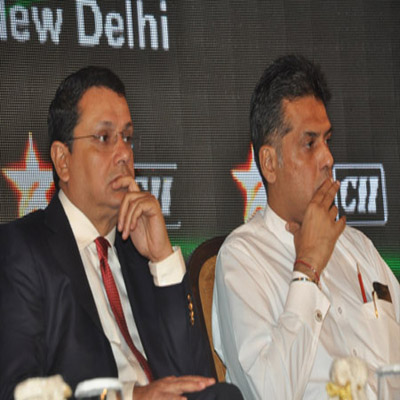
    NEW DELHI: Information and Broadcasting Minister (I &B) Manish Tewari today stressed that the government wanted the relationship with the media to be one of persuasion rather than regulation but the media should introspect about the reasonable restrictions laid down in the constitution to the freedom of speech.

    Making the inaugural address at the Big Picture Summit on Media and Entertainment organised by CII, the minister said the government will cooperate to ensure that the M & E sector is able to ‘unlock the potential of millions.’

    He stated that the phase III in FM radio will get underway next month with the e-auctions, adding that radio had seen a major resurgence thanks to mobile telephony.
    Manish Tewari believes that the industry must explore new avenues and technologies like mobile telephony and how it can be used to grow the sector

     The minister announced that the Justice Mudgal Committee which was going into the Cinematograph Act including film censorship was expected to give its report by mid-October. Tewari was responding to remarks made by previous speakers Star TV CEO Uday Shankar and Walt Disney MD Ronnie Screwvala about extra-constitutional authorities and even state governments raising voices even after a film had been cleared by the Central Board of Film Certification, and making a strong case for bringing cinema on the concurrent list.

    Tewari noted that despite the general slowdown the world over and in India, the M and E sector was expected to grow at a pace of 18.4 per cent CAGR to Rs 2,245 billion by 2017 from Rs 965 billion in 2012.

    He noted that the print and television sector comprised 48 per cent of this growth and the internet was expected to take over by 2017. He said the real success story was the print media since its growth continued at a rate of ten per cent per year when it was falling all over the world.

    Although India had the largest number of TV news channels in the world, it represented only 17 per cent of the M and E industry and therefore there was need to remove the bottlenecks in distribution.

    While the channels were not lagging in content, hardware was an area in which they were found lagging, he felt. The minister said that he wanted the industry to come up with ideas on how the number of cinema screens could be increased.

    Complimenting CII for its optimism in setting a target of USD 100 billion for the industry, he spoke of the opportunity that the sector presents in terms of innovation in content and non-content areas, adding that the government would partner the industry to put into place a system to see that the vision of USD 100 billion is translated into reality.

    He also mentioned that the industry must explore new avenues and technologies like mobile telephony and how it can be used to grow the sector, emphasising that the government would look to facilitate innovation and expansion.

    Screwvala in the keynote address said that although there have been challenges and a sense of gloom, there has been a fair amount of progress as well, especially in the movie industry, which has flourished.

    The M&E industry, he said, is seen as an industry of ‘high impact’ with the ability to bring about noteworthy transformation. Therefore, he felt that the time is right for the M&E industry, the government and other stakeholders to take time to deliberate upon the challenging issues that the industry faces such as dependency on advertising, inconsistent regulation, the need and ability to attract the best talent, unanimity and long-term thinking and then come up with a roadmap that will help the industry achieve the target of USD 100 billion.

    He hailed the progress in digitisation of cable TV and efforts to go on to better consumer TV viewing surveys, he said dependency on advertising remains a big problem and ways have to be found to make the consumer pay. There was need for unanimity and long-term thinking in the industry, a need to attract the best talent, and the need to recognise that new media needed a different kind of audience and talent.

    While India was among the least regulated countries in the world, he admitted that some regulation was necessary and this has to be consistent and not vary from state to state.

    He also wanted edutainment to be encouraged without being dependent on curriculum, sports to extend from just cricket as far as media was concerned, and the need for a greater bandwidth.

    He suggested setting up of a core group of the government and the industry which could work over the next 18 months or so to get over the bottlenecks, an issue supported by eminent filmmaker Amit Khanna.

    Khanna said the target of $100 billion for M &E was not unrealistic, if there was proper planning and greater cooperation between the government and the industry.

    He said it was unfortunate that the country was over-producing in cinema, considering the small number of screens.

    He suggested that the I & B ministry should change its name to the media ministry as new media was taking over.

    He regretted that there was no proper broadcasting regulator and the Telecom Regulatory Authority of India had been given this responsibility.

    India may have the largest number of TV news channels, but they were all getting ‘tabloidised’.

    He also felt the need for more trained professionals if the industry had to meet its targets.

     Delivering the theme address, Shankar said that openness to new ideas, capital and talent would unleash a fresh wave of growth, just as it did in the 1990s, when economic reforms ushered in a fresh wave of growth for the Indian economy.

    Earlier, in his welcome remarks, CII director general Chandrajit Banerjee spoke of the tremendous ‘soft power’ of the industry to bring about innumerable benefits to the Indian economy.
    A CII-PriceWaterhouse Coopers report on the M&E industry, titled ‘India Entertainment and Media Outlook 2013’ was also released on the occasion by Tewari.