Tag: Cineline India

  • Cineline India’s revenue from operations saw a 12.7 per cent steep decline

    Cineline India’s revenue from operations saw a 12.7 per cent steep decline

    Mumbai: Remember those carefree days when a weekend meant one thing—heading to the cinema, popcorn in hand, with family or friends by your side? Or the thrill of slipping out of a college lecture, knowing a movie adventure awaited? Those were the golden days of cinema. Yet, post-Covid, the big screen seems to have lost some of its allure, and Cineline India’s recent Q2 FY25 results tell a sobering story. Released today, the report reveals an industry grappling with the harsh realities of a shrinking audience base and mounting financial strain. For the quarter ending 30 September 2024, Cineline’s revenue from operations saw a steep 12.47 per cent drop, falling to Rs 5,583.66 lakhs from last year’s Rs 6,378.72 lakhs. As operational expenses climb and finance costs escalate, the road to profitability is riddled with challenges.

    The numbers reveal a company grappling with mounting expenses and shrinking profits. Total income for the quarter was Rs 5,617.60 lakhs, a decline from the previous year’s Rs 6,455.44 lakhs. Cineline’s movie exhibition cost—a significant operational component—reached Rs 1,583.38 lakhs, compared to Rs 1,931.11 lakhs last year. This reduction in costs was likely an attempt to mitigate the impact of lower revenues; however, it did not prove sufficient to offset other rising expenses. Notably, finance costs surged to Rs 727.95 lakhs, from Rs 716.53 lakhs in Q2 FY24, placing further pressure on profit margins.

    Cineline’s operating loss for continuing operations stood at Rs 607.30 lakhs, a sharp contrast to last year’s profit of Rs 702.36 lakhs. This swing into negative territory highlights Cineline’s current financial strain, driven by a combination of weaker income and heightened expenses. Although depreciation and impairment expenses rose to Rs 550.60 lakhs from Rs 489.09 lakhs, the overall expenses have grown notably, stressing the profitability margins.

    Further complicating Cineline’s financial landscape are discontinued operations associated with R&H Spaces Private Limited, its wholly-owned subsidiary classified as ‘Non-Current Assets held for sale’. This segment reported an after-tax loss of Rs 348.10 lakhs, exacerbating the company’s financial position. This negative outcome contrasts sharply with last year’s profit of Rs 15.51 lakhs, a downturn driven by market fluctuations and an inability to find prospective buyers swiftly enough to offset expenses.

    For stakeholders, Cineline’s Q2 FY25 results indicate an increasingly challenging environment in cinema exhibition. While the company has undertaken cost-cutting measures, the sharp decline in revenues and heightened financial costs have reduced the scope for quick turnaround. As Cineline aims to divest from non-core assets and consolidate its focus, the current financial constraints reflect a period of adjustment and realignment. However, the path to recovery may hinge on the company’s ability to attract new investment, manage rising operational costs, and secure strategic divestitures for better liquidity.

    Cineline India Q2 FY25 Financial Highlights:

    1.    Revenue Decline: Revenue from operations dropped by 12.47 per cent YoY to Rs 5,583.66 lakhs, down from Rs 6,378.72 lakhs in Q2 FY24.

    2.    Total Income: The total income stood at Rs 5,617.60 lakhs, a decrease from Rs 6,455.44 lakhs last year.

    3.    Operational Loss: Operating loss for continuing operations was Rs 607.30 lakhs, a reversal from last year’s profit of Rs 702.36 lakhs.

    4.    Increased Finance Costs: Finance costs rose to Rs 727.95 lakhs from Rs 716.53 lakhs in Q2 FY24.

    5.    Overall Profit/Loss: Net loss from continuing and discontinued operations was Rs 963.07 lakhs, reflecting the challenging operational environment.


  • Cineline India returns to film exhibition with nine properties across Maharashtra

    Cineline India returns to film exhibition with nine properties across Maharashtra

    Mumbai: Kanakia Group’s Cineline India has re-entered the film exhibition industry with the launch of nine properties at prime locations across Maharashtra.

    The nine locations of MovieMax Cinemas include Sion, Andheri, Goregaon, Kandivali, Mira Road in Mumbai; Eternity Mall and Wonder Mall in Thane; The Zone (Nashik), and Eternity Mall (Nagpur).

    The group was also active in the same business back in 1997 with their brand name Cinemax. Recently the brand was rechristened as MovieMax. They have forayed back into the film exhibition business with the launch of their first nine premium cinemas across Maharashtra.

    However, over the last two decades, the group established itself as a renowned real estate player in the MMRDA region.

    Speaking on this new venture, Kanakia Group chairman Rasesh Kanakia said, “We have a very strong history in the movie exhibition industry and are ready to step back into the game as a strong and experienced player. We are committed to giving our audience a premium experience and aim to build our brand as a consumer-oriented service. With a strong foothold in Maharashtra, we will be looking for opportunities to expand pan India as well.”

    The restrictions on theaters during the pandemic led to a striving period for the cinematic industry. However, the post-Covid era has given impetus to a huge demand for the film exhibition business. The film industry is witnessing a large pipeline of Hollywood, Bollywood, and regional content further strengthening the market. As restrictions have started lifting, the industry is booming with opportunity, and being a visionary and an organised player, Cineline India Ltd decided to tap into this opportunity so as to bring themselves in sync with consumer demand. 

    According to a statement, Cineline India Ltd has plans to expand pan India.

  • PVR-Inox deal: Consolidation to boost in-cinema advertising; steer advertiser segmentation for industry

    PVR-Inox deal: Consolidation to boost in-cinema advertising; steer advertiser segmentation for industry

    Mumbai: The all-stock merger between two of the country’s largest multiplex chains PVR and Inox Leisure announced earlier this week has been reckoned as positive for the industry on all counts. Led by PVR’s Ajay Bijli as MD, the combined entity PVR-Inox will have an invincible size advantage with its 1546 screens across 341 in 109 Indian cities, against Carnival and Cinepolis’ nearly 400 screens.

    Meanwhile, Kanakia Group-owned Cineline India has announced to re-enter the business after a decade in Q1FY23 with a total of 75 screens, of which 27 were acquired in February.

    Valued at 30-45 per cent higher than standalone entities Inox (~Rs 64 billion) and PVR (~Rs 110 billion), PVR-Inox will have a screen share of over 50 per cent within India multiplexes and 18 per cent within overall screens. Its combined box office share for Hindi and English content, which has a 65 per cent share in the overall box office, will be around 42 per cent, as per Elara Securities.

    Gaining from Premiumisation

    Weakening dynamics for the unorganised and single-screen film exhibition players, even before the pandemic hit, presented a tremendous opportunity for the organised ones to increase their foothold in the segment.

    Consolidation in the film exhibition sector started around 2014-15 with the buyout of Satyam Cineplex by Inox for Rs 240 crore, and Carnival’s mop-up of HDIL’s Broadway Cinemas for Rs 110 crore. In December 2014, Reliance Capital sold its multiplex business of Reliance MediaWorks (RMW) operating under the brand name ‘Big Cinemas’ to Carnival Cinemas for Rs 700 crore. The following year Mexican multiplex chain Cinepolis acquired Essel Group’s Fun Cinemas and PVR bought out DLF’s DT Cinemas for Rs 500 crore.

    Cineline India, which was present in the trade as Cinemax since 1997, sold its multiplex business along with Cinemax brand to PVR for Rs 395 crore under a non-compete clause in 2012. In light of the deal’s expiration on 31 March, the company is set to re-enter the business in the first quarter of FY’23.
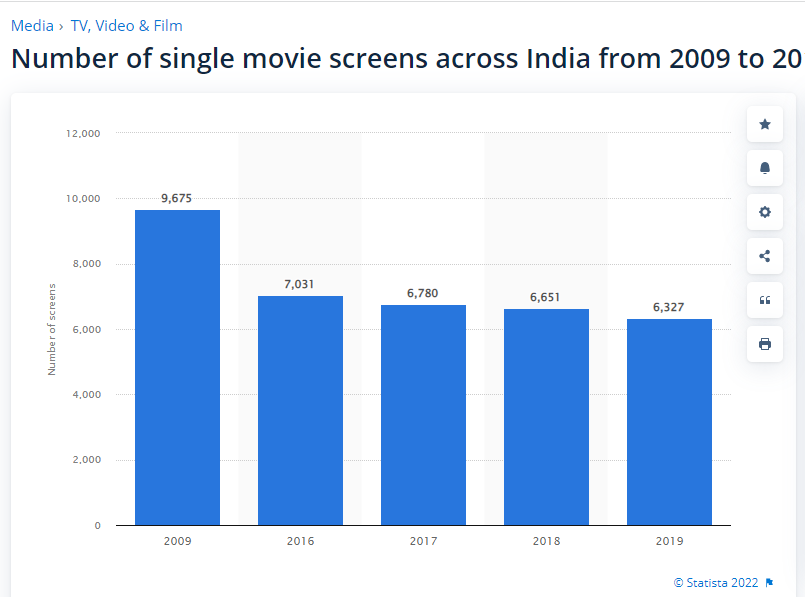
    From 9,600 screens in 2009, single cinema screens were reduced to just over 6,300 by 2019 in India. This decline is reflected in the country’s screen density which stood at 74 in 2019 (Statista). At an estimated overall screen count of 9,423 (FICCI-EY, March 2022), India is a largely underscreened country as compared to China which has around 70000 screens for comparable population size. Its ATP (Average Ticket Price) and SPH (Spends Per Head) are also among the lowest. Bridging the demand-supply gap in the Indian exhibition industry is expected to increase the box office collections by more than three times, as per Delloite’s 2018 report on screen density.

    Even as the economies of scale usher in revenue and cost benefits, rapid premiumisation in cinematic and customer experience led by technologies like 3D, 4DX, Imax, F&B, and other luxury offerings, as well as Covid-mandated hygiene standards, will drive ATP and SPH on one hand, and create more and better opportunities for advertisers on the other, thereby boosting advertising revenues for the new entity, and consequently for the industry at large.

    The merger will help in getting higher SPH (Rs 99 for PVR vs Rs 80 for Inox in FY20) on existing Inox screens. In FY ’20, Inox’s footfall of 6.6 crore gave additional F&B revenue of ~Rs 125 crore and net cost revenue of more than Rs 90 crore. The synergies may also result in substantial savings on manpower costs. On combined manpower costs of over Rs 600 crore, even a 20 per cent saving will result in savings of Rs 120 crore for the combined entity. Overall, the merger has the potential to add over Rs 300 crore to the bottom line of the combined entity, digital cinema distribution network and in-cinema advertising platform, UFO Moviez tells IndianTelevision.com.

    Boost to in-cinema advertising

    Last October as theatres began to reopen after 18 months of strict and partial lockdowns, in-cinema advertising which contributes 10-12 per cent to the overall revenue pie for cinemas, witnessed a slump of 25-30 per cent in rates. Studying the trend, Inox Leisure chief sales and revenue officer Anand Vishal had previously told IndianTelevision.com that “cinema is not going to be an easy sell” for quite some time hereafter.

    Cinema is not going to be an easy sell: Inox’s Anand Vishal

    This merger is expected to turn the tables in favour of the exhibitors sooner than previously estimated. According to UFO Moviez “the consolidation will be positive for overall in-cinema advertising in the country. In FY ’20, PVR was earning ad revenue of ~Rs 45 lacs per screen whereas Inox was at ~Rs 28.5 lakh, a difference of nearly Rs 17 lakh per screen. The combined entity should be able to get the same revenue as PVR for all screens. Thus, on around 650 screens of Inox, differential ad revenue of Rs 17 lakh per screen will translate into additional ad revenue of ~Rs 110 crore for the combined entity.”

    The segmentation of advertisers between big and smaller chains/single screens, which already existed by virtue of the players having differentiated TGs, will become more pronounced going forward.

    “PVR and Inox together have screens in around 110 cities whereas UFO has ad rights of over 3500 screens (smaller chains/single screens) spread across close to 1400 cities and towns. An advertiser/agency will now be required to deal with only two entities to advertise on a pan India network spread over 5000 screens. This will help in minimising admin work, which in turn will lead to faster closure of deals,” UFO Moviez observes.

    In spite of being among the hardest hit, the cinema exhibition industry is staging a phenomenal recovery with the success of films like “The Kashmir Files,” “RRR” and “Gangubai Kathiawadi.”

    dentsu Creative India CEO Amit Wadhwa points out that while “brands may have been circumspect regarding the above investments, in-cinema advertising will pick up henceforth, especially with the two big names coming together to form a much stronger brand. It has the possibility of creating better opportunities for brands to advertise and hence, in the bargain, the likelihood of charging a premium.”

    On the contrary

    Even though the “onslaught of OTT” has been ostensibly stated as the reason, the PVR-Inox merger was always on the cards. The surge in OTT consumption as a result of the pandemic may have only expedited it. As film producer Naveen Chandra opines, “We are in the initial stages of OTT growth in India so any responsive strategies based on the binging nature of consumers may be premature.”

    Commenting on its likely impact on distribution, he adds, “Any business that scales up to a near majority market share will have an advantage of charging a pricing premium for its products. The combined entity will hold nearly 60 per cent of the multiplex screens. That’s a great advantage whichever way you look at it. The programming muscle it provides is phenomenal as the entity negotiates its exhibition deals or exclusive release windows with platforms or theatrical shares with producers.”

    Irrespective of the assertions and speculations, OTT players have considered Cinemas an enabler rather than a competitor, even in the context of ‘windowing’ which became a ‘hot potato’ for the industry and media in the last couple of years.

    OTTs to benefit from the availability of price discovery platform as cinemas reopen

    Shemaroo Entertainment COO Kranti Gada asserts that “right from providing a barometer to assess a film’s worth, to unclogging the pandemic-paused film pipeline, and saving marketing costs for streaming platforms, the growth of cinemas will only be beneficial for OTT platforms.” Shemaroo Entertainment owns the video-on-demand service ShemarooMe.

    While OTTs are being projected as the eventual replacement of single screens, affordable cinema is here to stay, players and observers agree. The Southern anomaly where PVR and Inox hold six and three per cent share respectively stands testimony to it.  

  • Cineline India acquires 27 additional screens, tally reaches 75

    Cineline India acquires 27 additional screens, tally reaches 75

    Mumbai: Cineline India on Wednesday announced its acquisition of 27 additional screens on a lease basis, taking its overall tally to 75.  These include nine theatres in Uttar Pradesh, six in Rajasthan, five in Noida, five in Gujarat and two in Maharashtra. Together, they will have an aggregate seating capacity of more than 5,500 seats.

    Cineline’s current footprint now extends to 75 screens, and over 16500 seats in 14 cities. The company will continue to grow its film exhibition business aggressively in due course of time by acquiring theatre properties Pan India.

    Cineline India, part of MMRDA region-based real estate player Kanakia Group, re-entered the film exhibition business in December 2021.

    The company was present in the film exhibition business through its Cinemax brand since 1997. In 2012, it sold the multiplex business along with the Cinemax brand to PVR Ltd under a non-compete clause that has ended. The business will be relaunched under a new brand in Q1 FY23.


    “We are delighted to announce the tie-up of additional 27 screens Pan India. With this, we have tied up with 75 screens and over 16,500 seats in total,” said chairman Rakesh Kanakia. “We are seeing a huge opportunity for organised players to increase their foothold and plan to create a strong consumer-oriented brand in this segment.”

    “Over the next few months, we will continue to acquire additional screens Pan India. There is a strong pipeline of movies coming up and we see a huge opportunity to grow exponentially in this space,” he further said.