Tag: CII Big Picture Summit

  • India has potential to be largest OTT market in the world: Gaurav Gandhi

    India has potential to be largest OTT market in the world: Gaurav Gandhi

    Mumbai: The streaming boom has revolutionised the media and entertainment industry globally, and fuelled the creative economy of countries like India with its growing data usage. According to Amazon Prime Video India country head Gaurav Gandhi, this trend will only go upwards, and India has the potential to be the largest OTT market in the world.

    “This is because, the OTT segment in India has a huge base of consumers with an insatiable appetite for entertainment and disposable income to pursue the best experiences,” he elaborated. “Another reason is that it has a very rich pool of creators who have the power to create world-class entertainment experiences and thirdly, the deep penetration of connectivity via affordable broadband available ubiquitously across multiple devices.”

    Gandhi was speaking at the CII Big Picture Summit on Thursday, where he addressed a valedictory session titled ‘The Big Pitch: Is the Industry ready, What’s Next?’.

    Talking about the contribution of OTT Players in fuelling the growth of the media and entertainment industry, Gandhi said Prime Video is contributing to a prolific creative economy by addressing some of the most significant challenges that currently exist.

    “Amazon Prime is breaking the barrier of geographies, and addressing the challenge of reach or distribution. Today, it serves 99 per cent of pin codes of the nation and reaches 240 countries and territories across the world,” said Gandhi, adding that another barrier that it has addressed is the limitation of viewership imposed by language. “Good content travels across boundaries with subs and dubs. For example, movies in Malayalam, Telugu and Tamil are being viewed by mainstream audiences, evident from the fact that 50 per cent of the viewing of different language movies in India comes from outside the home state.”

    Gandhi also highlighted how the high calibre content from India is viewed by international audiences, and OTT platforms like Prime are not just presenting India to the rest of the world, but also showcasing its rich heritage and diverse culture. “We are also bringing India closer to itself as consumers view regional content outside its home state and gain a deeper appreciation of the rich diversity of our nation,” he remarked.

    The 10th edition of the CII Big Picture Summit 2021 was held virtually on 18-19 November and brought together key stakeholders from the media and entertainment industry to discuss and deliberate on the year gone by and the upcoming opportunities and trends to foresee.

    Ministry of information and broadcasting secretary Apurva Chandra, Roy Kapur Films founder and managing director Siddharth Roy Kapur, Technicolor country head for India Biren Ghose, Zee Entertainment Enterprises president content and international business Punit Misra, Tata Sky managing director and CEO Harit Nagpal, Bennett Coleman & Co chairman – executive committee Sivakumar Sundaram, MX Player CEO Karan Bedi, and The Indian Music Industry (association) president Blaise Fernandes were among others who attended the key event.

  • Need to create a new creative ecosystem for multiple platforms: Sameer Nair

    Need to create a new creative ecosystem for multiple platforms: Sameer Nair

    Mumbai: The OTT streaming business is not for the fainthearted and players with light wallets, said Applause Entertainment founder and chief executive officer Sameer Nair as he talks about the evolving streaming business at the CII Big Picture Summit.

    While there is an opportunity to make it big in the business, it’s important to ensure that it reaches a critical mass of subscribers. “And to do that you need to make investments,” said Nair, discussing how several OTT platforms turned out to be making losses.

    Elaborating on why he decided to enter the IP creation business, he said, “We are trying to work with a movie studio model. Attract a certain risk capital and produce some content. TV was funding IP creation and so the upside was being reaped by TV broadcasters. Producers did not get the upside of owning the IP. Today, there is an opportunity for content companies who take a degree of risk in content creation and license it to platforms.”

    Until now, TV was driving investments into original programming in India as it was catering to a mass audience. It was dominated by celebrity-led reality shows and daily soaps and that’s what consumers were watching for decades. But OTT has unlocked a new audience as it caters to a mass of niches. “For example, let’s say 10 per cent of the country likes the crime genre, that’s the size of a small European nation,” he said.

    But when it comes to paying for streaming services, then consumers look at the service that offers them the most value for money. “We never had HBO or Showtime in India in terms of producing original Indian content for a digitally-savvy audience. The creative ecosystem was catering to TV and films. We need to create a new ecosystem and content for multiple platforms,” he highlighted.

    According to Nair, OTT platforms also offer more data on consumers so decisions can become more informed, unlike TV where broadcasters always struggled to understand consumer behaviour because TRP was the only metric. The advantage for streamer is that can be “massy and classy”. A show can be created in a widespread spoken language but subbed or dubbed in multiple regional languages at the same time hence broadening its appeal.

    Talking about recommendation engines on OTT platforms Nair said that like any other algorithm the more you use it, the more you get out of it. “To say that I’m being shepherded by the recommendation engine and it is reducing my choice is not a fair comparison. Everyone knows that a consumer’s content viewing choices operate between new and comfort. That’s why Netflix has the ‘Play Something’ feature,” he said.

    There is a notion that TV is free and that the consumer has to pay for OTT. That’s why many consumers are still keen on ad-supported streaming services. Nair said that consumers were always paying cable distribution companies to watch TV. Similarly, today OTT services are built on top of broadband companies and telcos.

    Speaking about ad supported streaming, he said, “Every time you do anything regarding messaging and selling within a content experience, then it becomes an art.” There are all sorts of ways to monetise content and a lot of companies are trying to crack it. “Netflix has 214 million paid subscribers and it is the most premium streaming service globally. If five people are sharing a Netflix account then 200 million becomes one billion. If they’re watching Netflix two-three hours daily then that’s how many premium customers there are who don’t want to come into contact with regular advertising messages,” he observed.

    Nair said that the lockdown has been a uniform experience for nearly every human being on the planet. “We used to think TV is our window to the world but actually TV is only the window into your neighbourhood. The internet is the window to the world,” he said. The inevitable outcome of this is that the consumer has become used to the fact that there is a lot more content to watch.  

  • Policymakers should create single national policy for M&E sector: K Madhavan

    Policymakers should create single national policy for M&E sector: K Madhavan

    Mumbai: Policymakers should create a single national policy for the media and entertainment sector, said CII national committee chairman and The Walt Disney Company and Star India country manager and president K Madhavan at the 10th edition of the CII Big Picture Summit on Wednesday. “Regulations like new tariff order (NTO) 1 and 2 did not address the interests of any stakeholders including consumers,” Madhavan stated.

    The event was attended by Trai chairman Dr PD Vaghela and ministry of information and broadcasting secretary Apurva Chandra. The summit was a gathering of stakeholders in the media and entertainment industry to achieve the goal of reaching $100 billion.

    In his speech, Madhavan noted that given the “power and influence” of the TV broadcast industry, it is essential that it be allowed to “freely flourish” with the power to “self-regulate.” “Self-regulatory bodies for both TV and digital are working extremely well in India, and have proved that they can effectively handle complaints and concerns without any interference from policymakers and regulators,” he said.

    He acknowledged Dr Vaghela for taking a keen interest to address the concerns of the industry on priority and hoped for a “positive and proactive” approach from the regulator going forward. Madhavan stressed the need for a national policy that could guide regulators for years to come and ensure that consumers, the industry, and all stakeholders find certainty and clarity in equal measure.

    The Indian media and entertainment industry is creating 2500 hours of original content each year for OTT and over 100,000 hours of content for television. The gaming industry caters to 420 million casual gamers and the AVGC sector provides high-quality, cost-effective content for the global market. The M&E industry also promotes India’s soft power across the world, in addition to directly and indirectly employing 4.5 million people. Ancillary industries like education, tourism, and even software are all boosted as the creative economy grows.

    Madhavan observed, “Ten years back, television had started migrating customers to digital, and HD channels were just being launched. There were barely 13 million broadband subscribers, and users spent only eight hours a month watching videos online. Today, we have about 800 million broadband internet users and 600 million smartphone users, and Indians watch over five hours of online video content a day compared to the global average of four hours a day. India is a digitally active country with a massive and diverse consumer base with a very high level of appetite for entertainment.”

    “Our film industry is eager to bounce back from the pandemic. CII, working alongside the Government of India, will seek to represent India at all the major film festivals in the upcoming year,” he concluded.

  • Trai must focus on regulating process, not prices : Broadcasters at CII Big Picture Summit

    Trai must focus on regulating process, not prices : Broadcasters at CII Big Picture Summit

    Mumbai: As a regulator, the Telecom Regulatory Authority of India (Trai) must focus on regulating the process and not the prices, argued broadcast industry stakeholders at the CII Big Picture Summit held on Wednesday. The discussion was around the impact of new tariff order (NTO) 1.0 and 2.0 on linear TV broadcasting and the need for light touch regulation.

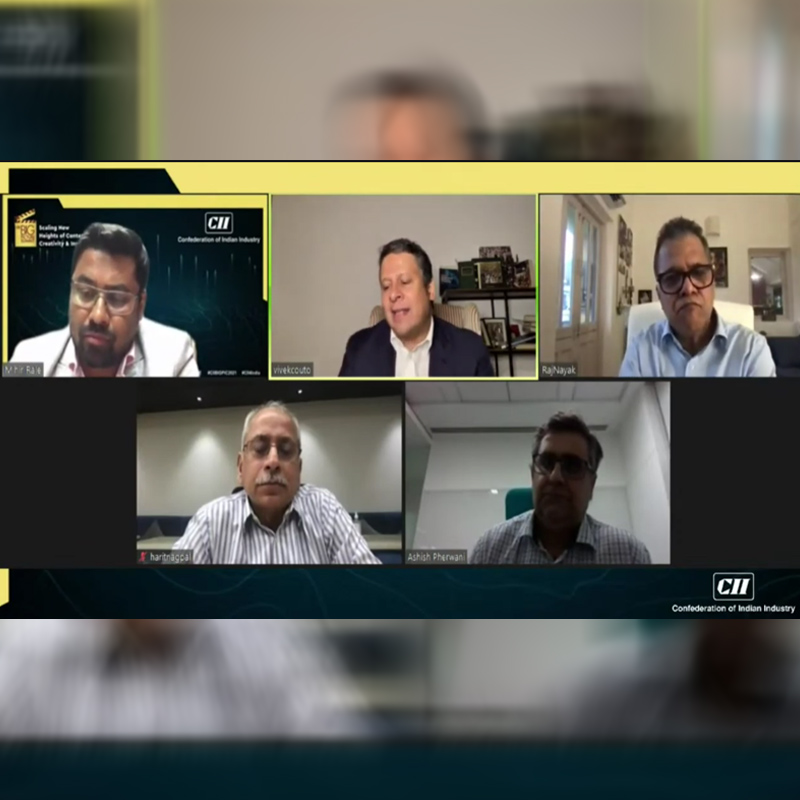
    The session was joined by Tata Sky managing director and CEO Harit Nagpal, Disney and Star India chief regional counsel Mihir Rale, House of Cheer Networks founder and managing director Raj Nayak, Ernst and Young Indian media and entertainment practice leader Ashish Pherwani and was moderated by Media Partners Asia co-founder and director Vivek Couto.

    The pay TV industry in India is the cheapest in the world and not by a small margin. Broadcasting is the largest contributor to India’s media and entertainment industry. India’s M&E industry accounts for 1.1 per cent of total GDP whereas in mature markets the contribution is usually 3-4 per cent. Panellists argued that excessive regulation by Trai is holding back the growth of the industry.

    “We belong to the service industry,” said Harit Nagpal. “A product like Tata Sky is aimed at customers who are willing to pay five to ten per cent extra to watch premium quality content. But when Trai regulates the prices, even if the customer is willing to pay extra, we can’t increase the prices. There is no incentive to invest in quality.”

    Trai’s intent seems noble on paper. The NTO regulations want to create parity in prices in linear TV broadcasting. However, there is a wide spectrum of customers in India that watch content. The players in the TV broadcast ecosystem understand the consumer’s needs and try to meet them with attractive prices. Trai’s regulation is akin to saying that a three BHK apartment must be priced the same whether you live in Cuffe Parade or the suburbs of Pune, remarked Raj Nayak.

    “When the regulator framed and implemented NTO 1.0 the stated objective was a-la-carte needs to be pushed in the interest of the consumer. Today, we know that if the consumer picks a-la-carte then his/her content costs will go up,” said Mihir Rale.

    Trai most contentious provisions in the NTO 2.0 were its twin conditions which mandated that average MRP prices of channels in a bouquet must not be more than 1.5 times the bouquet price. The second condition, which was struck down by a Bombay high court judgment, states that MRP of an individual channel in a bouquet should not exceed three times the average MRP of a channel in that bouquet.

    Rale said, “Linking a-la-carte pricing to bouquet pricing is a fundamentally flawed approach. The ability of the broadcaster to subsidise the cost to the consumer is important. Bouquets have an intrinsic value from an advertiser standpoint. We can customise and tailor our prices to everyone’s ability to pay. Why should that be taken away?”

    Stakeholders were of the view that Trai must step back and take a long hard look at the impact of NTO 1.0 regulation before implementing the amendment order. They said that consumer costs have gone up by 25-30 per cent and broadcasters have had to shut down a few of their channels. It was also noted that Trai must not assume every consumer is digitally savvy and will make the transition into the new regulatory mechanism easily. It is estimated that NTO 1.0 implementation resulted in the drop off of 12-15 million pay TV subscribers. 

    “We are in a free economy and the regulatory has come and put a price cap saying it is in the interest of the consumer. In fact, since there is a lot of competition in the linear broadcasting industry the fact is that broadcasters can’t raise prices indiscriminately without losing market share,” observed Raj Nayak.

    Trai has acknowledged that NTO implementation has yielded different results than what they expected. The need of the hour is for the industry to come together with the regulator and introspect on what’s best for the consumer.

    “The M&E industry is a creative industry. What we call different parts of the industry is just distribution. There are 130,000 digital influencers in India. How did this happen? Not by a regulated creative industry,” said Ashish Pherwnai. “The Indian media sector is $ 17 billion in size. How can regulation help us meet our targets in terms of percentage of GDP? Global companies like Disney and Lionsgate Universal get 50 per cent or more revenues from exports. In India that number is less than eight per cent.”

    Pherwani also talked about how the top studios in the US spend $20 billion on content, and in Europe, the top studios spend $40-45 billion. If 10 per cent of that market comes to us, then it is a $4 billion opportunity on a base of $17 billion, he said.

    The panellists hoped that the trust deficit between the regulator and broadcasting ecosystem can be dramatically reduced in the coming years and TV growth returns to 2017 levels.

  • Future lies in direct-to-mobile broadcasting: Prasar Bharati CEO Shashi Shekhar Vempati

    Future lies in direct-to-mobile broadcasting: Prasar Bharati CEO Shashi Shekhar Vempati

    New Delhi: Prasar Bharati CEO Shashi Shekhar Vempati on Wednesday batted for common shared infrastructure for both Television and radio to directly deliver broadcast content to smartphones in future. The public broadcaster’s top executive said convergence across content as well as infrastructure is needed to meet the demands of the future.

    Speaking the CII’s Big Picture Summit, Vempati said, the public broadcaster is already working on bringing convergence across TV and radio, so that a lot of content exclusively available on Radio can be made visually rich and available for TV audiences. “Prime Minister’s ‘Mann Ki Baat’ was the first such radio programme, that was made available for TV audiences. We followed the same format for another show Rangoli and even Vividh Bharti’s anniversary celebrations, where we put camera in the studio all-day long,” said Vempati.

    The Prasar Bharati CEO also talked about the digital transformation that Doordarshan and All India Radio has undergone in the recent years. Every DD channel and AIR station now has a digital presence spanning multiple platforms, like YouTube or social media or app. “Traditionally, Radio has never been measurable. But, now we have people tuning into AIR from everywhere, and choosing content of their liking. Digital an integral part of our network,” he said.

    Vempati said the public broadcaster is driving creativity and innovation on primarily several fronts. The most important being the conversion between TV and Radio. While the two have had a parallel journey of infrastructure and content creation, there was need to bring more convergence.

    “We have also collaborated with IIT Kanpur, and if our efforts bear fruits, we should be able to see smartphones directly receiving broadcast signals,” he said. “In the event of a high-viewership event like an IPL, there is no reason why millions of users need to receive that content on a unicast mode through the internet. If this works, all of the content can be delivered directly on broadcast frequencies to people on their smartphones or smart TVs.”

    Vempati also called for public private participation in developing critical algorithm, and sectors like AI, which will be needed to ensure content is available for multiple platforms, and made accessible to people across the country.

    “We are looking for more collaboration with private sector to identify these technology problems and address them, to create an intellectual capital in India, not only for content, but also for technology to power this content,” he added.

  • Govt working on draft national broadcast policy

    Govt working on draft national broadcast policy

    NEW DELHI: The ministry of information and broadcasting (MIB) is working towards creating a draft national broadcast policy and consultations on the animation, visual effects, gaming and comic (AVGC) policy will also be held soon, the government said at the ninth CII BIG Picture Summit.

    I&B ministry additional secretary (broadcasting) and CVO Neerja Sekhar mentioned that the Centre is close to creating a draft version of the policy. “Though consultations on the National Broadcasting Policy were held with stakeholders and industry, we have included emerging issues as well. We are close to a draft version. As an emerging sector with great potential, we are also working on AVCG and will hold consultations soon,” she added Sekhar.

    The media and entertainment sector is growing rapidly in India and is emerging as a key contributor to the Indian economy. Sekhar mentioned that different forms of media are growing simultaneously and offering consumers unique content across TV, print, radio, films, and digital platforms.

    She also sought the industry’s support in getting infrastructure status to the broadcasting industry, and help from industry bodies like CII in conducting “good periodic surveys and research” on media consumption patterns.

    “We work on data and what is happening in the market as there has to be a co-relation with the reality. But data is available on piecemeal basis. A good periodic survey will help us make policies, as our data is dispersed,” she said.

    Echoing the sentiment, I&B joint secretary Vikram Sahay shared that OTT platforms provided a huge opportunity for young artists, directors, actors, singers, musicians, and technicians to come up and present their skills to a larger audience and that the government is trying “to ensure that our consumers are protected in all ways” from fake news and other unacceptable content.

    “The concerns are uniform across the world. It has nothing to do with India, specifically it is concerned with protecting children from content not suitable for them. And therefore, we have been in touch with the industry to work out a model which is acceptable to all of us,” he added.

    The virtual event saw eminent speakers from all over the industry sharing their thoughts on how to make the sector progress faster. 

  • Govt extends support to M&E sector in fighting digital piracy

    Govt extends support to M&E sector in fighting digital piracy

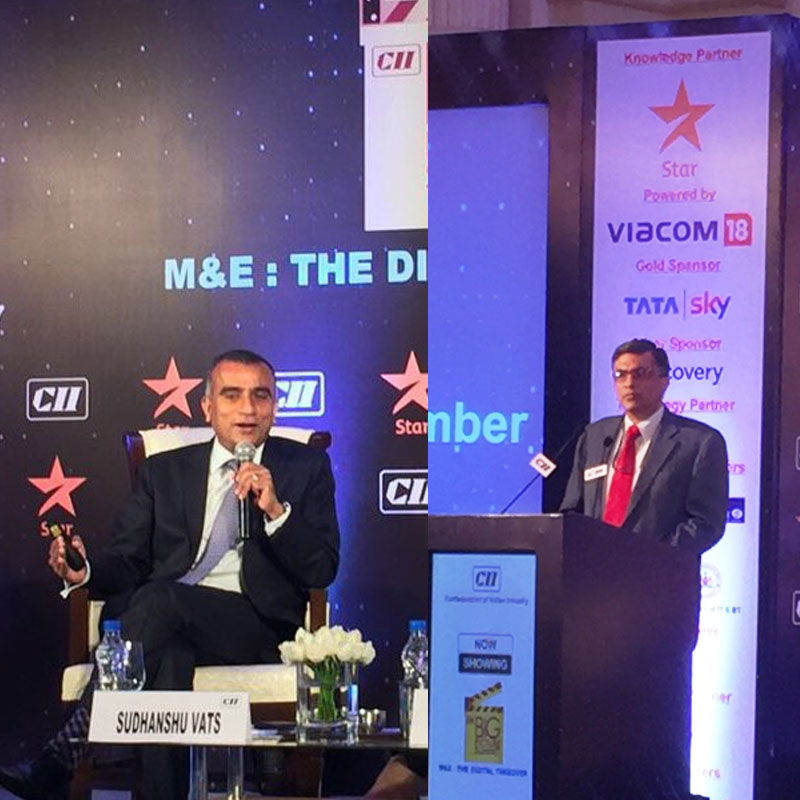
    NEW DELHI: The government of India yesterday stressed that it stood alongside the media and entertainment (M&E) industry in fighting digital piracy to safeguard loss of revenue and ease norms for doing business, while CII entertainment committee head and Viacom18 group CEO Sudhanshu Vats, on behalf of the industry, admitted that automation could result in loss of jobs leading to challenging times, but said the core of the industry will be ‘automation-proof’.

    “The government will stand with you on the issue of digital piracy,” department of industrial policy & promotion (DIPP) joint secretary Rajiv Aggarwal told the audience on Tuesday at the CII-organised Big Picture Summit here, adding that they were exploring a national anti-piracy regulation or regime and there was no need to get further into enacting complicated laws but finding solutions based on global experiences.

    Digital or online piracy is not only a big global challenge for the M&E industry, but has awakened stakeholders in India too who are feeling the heat of heavy loss of revenue due to rampant piracy of Indian content worldwide.

    Pointing out that the Indian government is alive to the issue of digital piracy and the potential of the M&E industry in being able to generate revenues and employment in the country, Aggarwal said that they were looking at how global and some local bodies (like PIPCU of the UK, TIPCU in Telangana and Maharashtra’s online anti-piracy unit) were addressing this challenge.

    Dwelling further on this issue, he exhorted the industry stakeholders to give feedback that will help India in forming a strong case and point of view for submission at WIPO where discussions are on to formulate standards for a global broadcast treaty.

    This year’s Big Picture Summit, an annual two-day conference on issues related to M&E industry, has been themed `The Digital Takeover’, which lays emphasis on the creeping digitisation in general and of delivery services like cable, HITS and OTT, and an impending automation (egged on by the likes of AI) of the various industry sectors.

    TRAI non-committal on exploring auctioning of TV licences

    SK Gupta, telecom regulatory authority of India (TRAI) secretary, which is the telecoms and broadcast regulator, while dwelling on various issues of the recently issued recommendations on net neutrality said the organisation’s efforts have always laid emphasis on consumer interest, while creating a level playing field for all players.

    Incidentally, at a time when the FCC has dismantled net neutrality norms in the US, put in place by the Obama regime earlier, favouring walled gardens of content and premium tiered pricing of various services, India’s TRAI has upheld net neutrality stating that all content should be made available to all distribution platforms on a non-discriminatory basis, apart from other level playing initiatives.

    Later, asked by journalists on the sidelines whether TRAI was exploring a consultation paper on auctioning of TV licences or permissions on the advice of the ministry of information and broadcasting (MIB), Gupta said he at least was not aware of any such move. He was non-committal when pressed on the issue.

    Asian Age newspaper a week back had reported that the government was exploring auctioning of television channel frequencies on the lines of telecoms spectrum, coal blocks and FM radio licences. Reason: bid to increase government revenues as presently permission to uplink and/or downlink TV channels cost a fixed amount with the applicant fulfilling certain set out financial norms, apart from getting clearances for satellite space and internal security. The newspaper report had added that MIB had sought advice from TRAI in this regard. What the report did not clarify was whether the auctioning was of TV licences pertained to DTT (digital terrestrial transmission) or satellite-delivered TV channels later distributed by cable and online.

    M&E industry holds key to creating future-proof, dynamic workforce: Vats

    Earlier in the morning, setting the agenda for the two-day conference, CII entertainment committee head and Viacom18 group CEO Sudhanshu Vats in his opening address said that the theme of ‘Digital Takeover’ was a topic that had “loads of nuances” that needed to be addressed in a proper perspective.

    “In my honest assessment, this is an extremely provocative theme – and one that can mean different things to different people. I can imagine some of my colleagues from the broadcast sector feeling upset. I can also imagine what some of my younger colleagues, who are already social media influencers thinking – this theme is passé, the takeover was complete a few years ago. I don’t want to pick a side at this stage and I’m certain that no definitive side can be picked,” Vats said, adding that he hoped the theme would help delegates form their own distinctive understanding of the future of the Indian industry in general.

    Pointing out that digital takeover could mean greater automation and fewer human jobs, a trend that could is likely to play out slowly in India because of availability of cheap labour, Vats said the Indian M&E sector directly employs between 1.1-1.2 million Indians and in the next five years one million more jobs would be added, thereby playing a role in “assuaging the challenge”. He added: “If we achieve breakout growth, that number can also touch five million. However, I would like to draw your attention not to the number of jobs but to their quality.”

    Explaining that skills, like creativity, story-telling, emotional intelligence and cognitive ability, in M&E sector were most ‘non-routine’ jobs, Vats said, “These are also the skills that can be transferred to other sectors, making us a part of the solution. Of course, we too will face our share of the burden. Some roles will be automated, and the media organisation might look very different in 2027, but our core will still be automation-proof.”

    Vats also pointed out that the private sector needed to be more ‘creator-friendly’ or ‘freelancer-friendly’, which also meant that the M&E sector could hold the key to “creating a future-proof, agile, dynamic workforce” that can take its skills and drive impact across industries even as the government continued to create a better business environment.

     ALSO READ:

    M&E industry to hit Rs8 trillion revenue by 2022: report


  • Bengali film viewing has dropped: CII & IMRB report

    Bengali film viewing has dropped: CII & IMRB report

    KOLKATA: Majority of Bengali film viewers in Kolkata have not been in theatres in the last one year to watch a Bengali film, despite proliferation of multiplexes. However, it is interesting to note that in the districts, around two thirds have visited movie theaters to catch a Bengali film, but the frequency of visits are quite low, not even three films in a year, reveals a report ‘Bengal Bioscope: A Big Picture Outlook for Sustainable Growth’ launched jointly by the Confederation of Indian Industry (CII) and IMRB.

    The report further reveals that around 30 per cent of Bengali cinema viewers do not contemplate watching a Bengali film in a hall in near future and an additional 10 per cent have stopped watching Bengali films on big screens in the last one year.

    This is further corroborated by IMRB’s primary survey of 35 single screen theatres across Kolkata and West Bengal revealing 30 per cent occupancy on weekends and around 20 per cent on weekdays.

    The tastes and preference of viewers in Kolkata and rest of Bengal are quite different which is echoed by only handful of releases successfully straddling both geographies.
    While original engaging content, a larger pool of good actors and directors and better in hall experience can drive Bengalis back to cinema halls.

    The report was launched at CII Big Picture Summit – Vision Bengal, 2014 on 12 December. The CII has partnered with IMRB International to conduct a study on Bengali film industry that focuses on understanding the emerging business models, importance of internet and innovative viewer engagement methods that are vital for the growth of the industry. 

    As a part of this project, IMRB conducted a first of its kind consumer survey across eight districts in urban West Bengal to learn the changing nature of film viewership and the general perception of Bengali films among its target audience. In addition to the consumer survey, a series of interviews were conducted to understand the trade insights of the film industry through in depth interactions with producers, actors, directors, distributors, exhibitors and broadcasters of Bengali cinema, it is further learnt.

    “With the increasing investment in infrastructure and production as well as growing consumer interest in regional cinema, we see a very bright future for Bengali film industry which has always been a flag bearer of creative excellence. The study encompasses the key constituents of the industry – producers, creative artists, distributors- as well the opinions of consumers who decide the fate of the creative products,” said IMRB International SVP media & retail Hemant Mehta.

    CII director General Chandrajit Banerjee said, “CII’s vision is to take the Indian Media and Entertainment sector towards achieving $100 billion by the year 2020. We expect that this growth will also come from regional media and entertainment markets across India.”

    “Regional is the new national and it fits well for the media and entertainment sector. Bengali Cinema has an enviable past and it continues to be one of the most vibrant regional film industries in the country,” Banerjee concluded.