Tag: Chyawanprash

  • Dabur consol. revenue up 6 per cent to Rs 2,986.5 cr for Q2 FY’ 23

    Dabur consol. revenue up 6 per cent to Rs 2,986.5 cr for Q2 FY’ 23

    Mumbai: Science-based Ayurveda company Dabur India, has reported a 6 per cent increase in consolidated revenue for Q2 FY’ 23. On a constant currency basis, revenue increased by 8.5 per cent in Q2 FY’ 23.

    Dabur India Ltd’s  (DIL) board of directors met to review the company’s unaudited financial results for the quarter ended 30 September 2022.

    The board of directors of Dabur India Ltd declared an interim dividend of 250 per cent for 2022-23.

    Dabur India chairman Mohit Burman said, “Continuing with our payout policy, the board has declared an interim dividend of Rs 2.50 per share, aggregating to a total payout of Rs 442.94 crore.”  

    Dabur demonstrated agility and resilience in delivering consistent organic growth in a challenging environment marked by unprecedented inflation and its impact on consumption. Despite the significant headwinds, Dabur reported consolidated revenue of Rs 2,986.5 crore in Q2 FY’ 23, up from Rs 2,817.6 crore in the same quarter the previous year.

    Dabur was able to mitigate the impact of unprecedented inflationary pressures through disciplined cost control, operational efficiencies, and prudent price increases across key product categories. Dabur reported a net profit of Rs 490.1 crore at the end of the second quarter.

    Dabur India CEO Mohit Malhotra said, “While the challenging economic environment continued to be a concern and impacted the purchasing power, we are seeing green shoots of recovery with the onset of the festive season. The impact of inflationary pressures was more pronounced in the rural markets with demand growth in hinterland lagging urban markets for the first time in five quarters. However, we are hopeful of rural demand reporting a smart recovery in the coming quarters and we are investing ahead of the curve to ride this demand recovery by expanding our rural footprint by adding nearly 9,000 villages in Q2 FY’ 23 to take our total coverage to over 100,000 villages,”

    Dabur is focused on creating shared value and is increasing capital expenditure, digitalization, and sustainability investments. Dabur has made rapid progress on the ESG front and has set ambitious goals for the future. In 2021-22, Dabur became the first Indian consumer goods company to become 100 per cent plastic waste neutral.

    “Not one to rest on our past laurels, this year we have targeted to become Plastic Waste Positive, by collecting, processing and recycling 35,000 MT of post-consumer plastic waste pan-India. We are committed to creating circularity in the value chain to achieve a positive balance by 2030, besides becoming water positive by 2030 and carbon neutral by 2040,” Malhotra said.

    Dabur’s brands have continued to outperform the market, gaining market share across 95 per cent of product portfolio. Dabur increased its market share in the juices & nectars category by 410 basis points, while share in the digestives category increased by 270 basis points.

    Chyawanprash market share increased by 120 basis points, and shampoo category share increased by 40 basis points. Dabur’s market share in hair oils increased by 20 basis points. Dabur’s strategy remains centred on innovation, with new product launches accounting for approximately 4 per cent of total sales.

    Dabur’s foods & beverages business reported a strong 30 per cent growth. The beverages business ended the quarter with a jump of over 30 per cent while the foods business reported a 21 per cent growth.

    The home care business was up nearly 21 per cent, while the toothpaste category, riding on strong performance of our flagship Dabur red paste, ended the quarter with an over 11 per cent growth.

    The shampoo & post-wash business ended the quarter up 9 per cent. Dabur’s Ayurvedic OTC business also reported a growth of over 9 per cent during the quarter.

    Dabur’s international business reported a 12.3 per cent jump in constant currency terms, led by strong constant currency growths in Turkey (86 per cent), Nepal (25 per cent ) and Egypt (23 per cent ).

  • Dabur dons Kovirakshak kit, as ASCI doffs Chyawanprash ad

    Dabur dons Kovirakshak kit, as ASCI doffs Chyawanprash ad

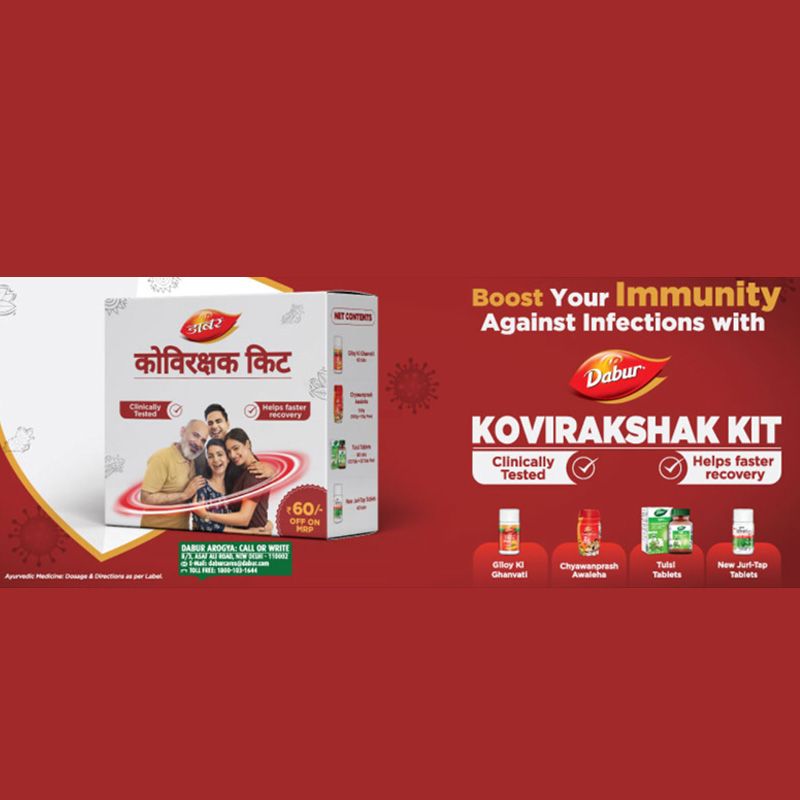
    Mumbai: India’s leading FMCG major Dabur India Limited Tuesday announced the launch of Dabur Kovirakshak Kit that includes Chyawanprash, Giloy, Tulsi and Juri-Tap products.

    A company message said the product is “A combination of time-trusted ayurvedic medicines to help in faster recovery from ongoing respiratory infections. Dabur KoviRakshak Kit was developed and launched based on (the) Indian Council of Medical Research (ICMR) guidelines and after (a) thorough study on infected patients”, the company has claimed.

    The company’s website also prominently claims: “Get your Dabur Kovirakshak kit – As part of our commitment to fight the COVID-19 pandemic, Dabur is distributing free Kovirakshak kits to the first 200 people who register with us. Sign up to get your immunity shield.”

    The new audience interactive advertisement comes only a day after the Advertising Standards Council of India (ASCI) pulled up the brand for making misleading claims through its advertisement for Dabur Chyawanprash. ASCI had asked the ayurveda major to modify or withdraw the Chyawanprash ad that claimed to offer protection against the Corona virus. The print ad published in March this year claimed that taking two spoons of the product daily provided protection against COVID-19.

    ASCI secretary general Manisha Kapoor told IndianTelevision that while she’s yet to see the new Dabur Kovirakshak ad, “Each product and advertisement will have to be examined on its own merit, if they are able to prove what they are claiming then its fine.” She added that they have not received any complaint about the newer advertisement so far. 

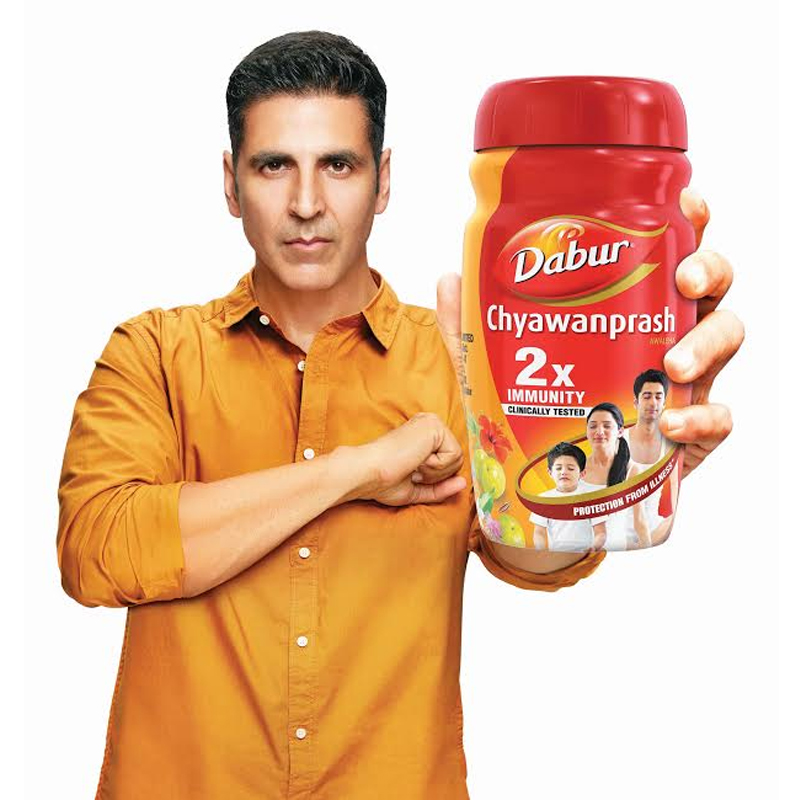
    The ad featuring actor Akshay Kumar stated that the claim is backed by “clinical studies conducted in 5 centres”.

    The advertisement ran into controversy on social media after several people tagged ASCI to look into the matter. Brand consultant & strategist, Ambi Parameswaran had also tweeted and alerted ASCI about a possible violation:

    ASCI launched an investigation after a formal complaint was lodged and noted, “Dabur Chyawanprash has immunity building properties, however, it is not established whether the product could protect one against (the) Corona virus.”

    In its report to Dabur, as reported by online media afaqs, ASCI stated that the claim made in the advertisement “could be construed literally by an ordinary consumer, that consuming the product would protect one from COVID-19”. Following the investigation of reports and data provided by Dabur, the Consumer Complaints Council (CCC) of ASCI in turn maintained that the “claim is misleading by ambiguity and exaggeration and is likely to lead to widespread disappointment in the minds of consumers.”

    ASCI has advised Dabur to suitably modify or withdraw the advertisement by June 4, 2021.

    The ad had attracted major trolling on social media after its brand ambassador Akshay Kumar announced that he has tested positive for covid-19.

    The irony of the situation was not lost on net users who trolled the brand as well as the actor over the apparently false COVID-19-protection claims.

    A section of the online community had also red flagged the actor and the company for being reckless while promoting products through incorrect claims.

    While the Covid-19 outbreak has brought some businesses to a grinding halt, it has also served as a business opportunity for others. Several FMCG giants cashed in on the health-related fear induced into the general public by the pandemic by launching a plethora of immunity-boosting products ranging from beverages comprising of juice, tea, coffee to probiotic shots and supplements in capsule form, mixes and powder, even food items.

    The Indian Immunity Boosting Packaged Products Market is projected to reach $ 347 million by FY 2026, as per a report, owing to increasing consciousness and focus among Indian consumers towards sickness preventing health foods.

    Major players operating in the immunity boosting packaged products market include The Himalaya Drug Company, Dabur India Ltd., Patanjali Ayurved, among others, which have capitalised on their ayurvedic lineage. Dabur India is a remarkable case in point, with the home-grown FMCG major overhauling its go-to-market strategy.  

    While Brand strategist Ambi Parameshwaran believes the brand has played it safe this time by avoiding any blatant mention of COVID-19 protection in the ad copy, he still feels the product name may get it into trouble once again. He said, “Just on the basis of the name Kovirakshak Kit they can be taken to ASCI again. Rakshak in Hindi means protector, which again implies COVID-19 protection, not just immunity. So, while the copy is correct, I still have an issue with the brand name. They could be hauled up once again.”  

    In either case, the controversy has meant piqued audience interest inadvertently for a second time, not necessarily in the interest of public health. Bad publicity is also good for publicity.

  • Akshay Kumar takes the immunity pledge with Dabur Chyawanprash

    Akshay Kumar takes the immunity pledge with Dabur Chyawanprash

    NEW DELHI: Embattled FMCG Dabur India, whose flagship product Dabur Honey was at the centre of a controversy after failing the NMR purity test, is now relying on star power to turn around its dented fortunes. The company has signed on A-list actor and fitness icon Akshay Kumar as the new face of its health supplements brand Dabur Chyawanprash.

    A new campaign featuring Kumar, a paragon of what it means to live healthy, calls on the nation to come together and pledge to build “inner strength and fighting spirit” in these uncertain times.

    “Strong immunity is the need of the hour with the threat of illnesses looming around us,” said Dabur India Ltd CEO Mohit Malhotra. “Dabur Chyawanprash, with the power of more than 40 herbs like Ashwagandha, Giloy  and Amla, has always stood for boosting immunity to fight illnesses. Dabur Chyawanprash has always celebrated and championed the cause of building the health of the nation. Akshay Kumar is emblematic of health, fitness and inner strength, the properties of Dabur Chyawanprash. We are happy to welcome him to the Dabur family.”

    The new campaign serves as a rallying cry, inviting Indians to keep their immunity strong for themselves and for the nation.

    “With this communication, Dabur Chyawanprash, along with the charismatic Akshay Kumar, are also establishing our strong sense of pride about ‘Made in India, by Indians, for Indians’, and caring for every Indian household’s immunity and well-being,” added Malhotra.

    Conceptualised by McCann Worldgroup India, the film attaches a deeper purpose to why each one of us needs to keep our immunity high. It takes the idea of immunity from safety for an individual to the strength for an entire nation. And it does that by inviting Indians to take a pledge for becoming strong from within so that we can support each other in this journey and emerge stronger.

    “Har ghar me, har kisi ko, leni he ek shapat khud ko strong banane ki, kyuki hum strong rahenge tabhi toh har mushkil se ladenge. Bharat kare vishwas, har din Dabur Chyawanprash.” Leading this pledge is Akshay Kumar, who helps galvanise the masses in joining this movement.

    Prasoon Joshi, chairman, McCann Worldgroup, Asia Pacific CEO & CCO McCann Worldgroup India, said: “Akshay is a fitness icon in our country and so is the brand Dabur Chyawanprash. I have always believed that there should be an inherent resonance between the brand and its endorser, which is absolutely so in this case. I have been part of Dabur’s communication for more than two decades and seen the journey to the top. This will be another great chapter in the brand’s journey and would strengthen the relationship with the consumers.”

    Akshay Kumar said: “I am immensely proud and happy to be a part of the Dabur family. Dabur has relentlessly nurtured the country’s health and fitness through the science of authentic Ayurveda. I really believe that together, Dabur and I, will take Dabur Chyawanprash to every household, every person – so that collectively our nation’s immunity becomes stronger and we can conquer every challenge.”

    The film’s essence is in activating and tapping into the power of immunity and collective action. It portrays Indians from different walks of life who are doing their bit to keep the nation going. And at the heart of it is their inner strength driven by the core of benefit of Dabur Chyawanprash – 2X immunity. 

  • Dabur ad spends subdued in fiscal 2017

    Dabur ad spends subdued in fiscal 2017

    BENGALURU: Indian FMCG major Dabur India Limited (Dabur) had opened this fiscal with the lowest advertising and publicity expenses (ASP) in the first quarter (Q1-17, quarter ended 30 June 2016, previous quarter) in four years. The trend continued in the current quarter (Q2-17, quarter ended 30 September 2016, current quarter) with the company spending the least amount towards ASP during a 16-quarter period starting Q3-14 as Indiantelevision.com has been tracking the trend.

    Dabur spent 9.8 percent less year on year (y-o-y) in the current quarter, and 24 per cent less quarter-over-quarter (q-o-q) towards ASP. ASP in Q2-17 was Rs 149.41 crore (7.5 percent of Total Income from Operations or TIO) as compared to Rs 165.72 crore (8.5 percent of TIO) in Q2-16 and Rs 196.52 crore in the immediate trailing quarter.

    In Q1-14, Q1-15, Q1-16, the company began the year with ASP of Rs 254.22 crore (15.4 percent of TIO), Rs 286.27 crore (15.3 percent of TIO) and Rs 330.61 crore (16 percent of TIO), respectively.

    About 63 percent of Dabur’s revenues are from domestic FMCG sales, while 34 percent are international sales. Dabur’s domestic FMCG business reported growth of 2.4 percent driven by volume growth of 4.5 percent. International business declined by 2.3 percent basis IND AS (Indian Accounting System).

    “The overall business environment continued to be challenging with consumer demand remaining slack in India, while overseas geographies like the Middle East and Africa hit by worsening geopolitical situation. We continue to invest behind our brands and are confident of our ability to report profitable growth, going forward. Even in a tough environment, we have navigated the external business environment well and our domestic FMCG business ended Q2 of 2016-17 with a volume growth of 4.5 percent,” Dabur CEO Sunil Duggal said.

    “The medium to long-term prospects, particularly for India, remain robust and we are optimistic that domestic consumer demand would gain pace in months to come, riding on good Monsoons and a slew of government initiatives announced recently. We are confident that our focused strategy and positioning as the ‘Science-based Ayurveda’ specialist will pave the way for future growth. We have lined up a flurry of many exciting initiatives and are committed to aggressively launch new products leveraging on our Ayurvedic heritage and cutting edge science,” Duggal added.

    public://Dabur-graph.jpg

    Trends

    The company’s ASP in Q3-2016 at Rs 350.01 crore  (16.5 per cent of TIO) was  the highest in terms of actual rupee spends as well as in terms of percentage of TIO during the sixteen quarter period under consideration in this report. As mentioned above, in the previous fiscal, in Q1-2016, the company had spent Rs 330.61 crore (16 percent of TIO) towards ASP, which is the second highest ASP in absolute rupees and in terms of percentage of TIO during the period under consideration.

    Also, over the 16 quarter period under consideration, Dabur’s ASP in absolute rupees and ASP in terms of percentage of TIO both show a linear declining trend.  Please refer to Fig1 above which indicates that ASP in terms of percentage of TIO follows a linearly declining zigzag line, with peaks in Q1 (school holiday period) and Q3 (festival season in the country) and valleys in Q2 and Q4 of a financial year. This fiscal, for a change, Q1-7 ASP was lower than spends in Q4-16.

    The company says in its earnings release that it braved strong headwinds in the form of a persistent listless demand environment in key consumer products categories and geopolitical disturbances in the overseas markets during Q2-17.It says that its continued focus on leveraging the science-based Ayurveda heritage, coupled with commodity tailwinds, helped Dabur end Q2-17 with a 1 percent growth in consolidated revenue at Rs 1,975.7 crore as compared to consolidated revenue for Q2-16 which stood at Rs 1,955.3 crore. Consolidated net Profit for the Q2-17 marked a 5 percent growth at Rs 357.3 crore, up from Rs 340.2 crore during corresponding year ago quarter.

    Dabur’s products

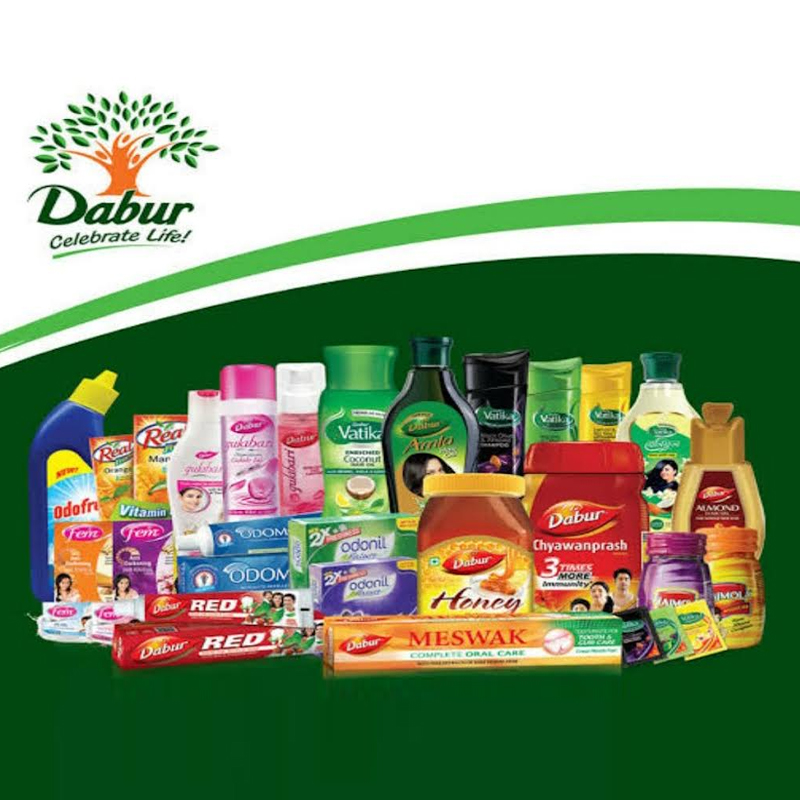
    Among the products that Dabur has include health supplements like Chyawanprash, Ratnaprash, Honey, Glucose; digestives like Hamjola – Hajmola Chuzkara and Natkhat Amrud, Pudin Hara Fizz; OTC and Ethicals such as Lal Tail, Honitus Syrup; Haircare products like Vatika, Vatika Brave and Beautiful digital, Anmol Jasmine Marks; Toothpaste brands like Dabur Red, Babool and Meswak; skincare products like Fem Natural Fairness, Gold Bleach, Gulabari; Homecare brands such as Odomos, Odonil and Sanifresh; Food brands such as Real and Real Active.

    Notes:

    (1.0)    Dabur has started reporting its numbers as per the Indian Accounting System (IND AS) since Q1-17 and hence the numbers in the charts may not be accurate – this report and the charts are meant as an approximate representation of the company’s numbers.

    (1.1)    All numbers are consolidated unless stated above.

    (2.0) The unit of currency in this report is the Indian rupee – Rs (also conventionally represented by INR). The Indian numbering system or the Vedic numbering system has been used to denote money values. The basic conversion to the international norm would be:
    (a) 100,00,000 = 100 lakh = 10,000,000 = 10 million = 1 crore.
    (b) 10,000 lakh = 100 crore = 1 arab = 1 billion.


  • Dabur ad spends subdued in fiscal 2017

    Dabur ad spends subdued in fiscal 2017

    BENGALURU: Indian FMCG major Dabur India Limited (Dabur) had opened this fiscal with the lowest advertising and publicity expenses (ASP) in the first quarter (Q1-17, quarter ended 30 June 2016, previous quarter) in four years. The trend continued in the current quarter (Q2-17, quarter ended 30 September 2016, current quarter) with the company spending the least amount towards ASP during a 16-quarter period starting Q3-14 as Indiantelevision.com has been tracking the trend.

    Dabur spent 9.8 percent less year on year (y-o-y) in the current quarter, and 24 per cent less quarter-over-quarter (q-o-q) towards ASP. ASP in Q2-17 was Rs 149.41 crore (7.5 percent of Total Income from Operations or TIO) as compared to Rs 165.72 crore (8.5 percent of TIO) in Q2-16 and Rs 196.52 crore in the immediate trailing quarter.

    In Q1-14, Q1-15, Q1-16, the company began the year with ASP of Rs 254.22 crore (15.4 percent of TIO), Rs 286.27 crore (15.3 percent of TIO) and Rs 330.61 crore (16 percent of TIO), respectively.

    About 63 percent of Dabur’s revenues are from domestic FMCG sales, while 34 percent are international sales. Dabur’s domestic FMCG business reported growth of 2.4 percent driven by volume growth of 4.5 percent. International business declined by 2.3 percent basis IND AS (Indian Accounting System).

    “The overall business environment continued to be challenging with consumer demand remaining slack in India, while overseas geographies like the Middle East and Africa hit by worsening geopolitical situation. We continue to invest behind our brands and are confident of our ability to report profitable growth, going forward. Even in a tough environment, we have navigated the external business environment well and our domestic FMCG business ended Q2 of 2016-17 with a volume growth of 4.5 percent,” Dabur CEO Sunil Duggal said.

    “The medium to long-term prospects, particularly for India, remain robust and we are optimistic that domestic consumer demand would gain pace in months to come, riding on good Monsoons and a slew of government initiatives announced recently. We are confident that our focused strategy and positioning as the ‘Science-based Ayurveda’ specialist will pave the way for future growth. We have lined up a flurry of many exciting initiatives and are committed to aggressively launch new products leveraging on our Ayurvedic heritage and cutting edge science,” Duggal added.

    public://Dabur-graph.jpg

    Trends

    The company’s ASP in Q3-2016 at Rs 350.01 crore  (16.5 per cent of TIO) was  the highest in terms of actual rupee spends as well as in terms of percentage of TIO during the sixteen quarter period under consideration in this report. As mentioned above, in the previous fiscal, in Q1-2016, the company had spent Rs 330.61 crore (16 percent of TIO) towards ASP, which is the second highest ASP in absolute rupees and in terms of percentage of TIO during the period under consideration.

    Also, over the 16 quarter period under consideration, Dabur’s ASP in absolute rupees and ASP in terms of percentage of TIO both show a linear declining trend.  Please refer to Fig1 above which indicates that ASP in terms of percentage of TIO follows a linearly declining zigzag line, with peaks in Q1 (school holiday period) and Q3 (festival season in the country) and valleys in Q2 and Q4 of a financial year. This fiscal, for a change, Q1-7 ASP was lower than spends in Q4-16.

    The company says in its earnings release that it braved strong headwinds in the form of a persistent listless demand environment in key consumer products categories and geopolitical disturbances in the overseas markets during Q2-17.It says that its continued focus on leveraging the science-based Ayurveda heritage, coupled with commodity tailwinds, helped Dabur end Q2-17 with a 1 percent growth in consolidated revenue at Rs 1,975.7 crore as compared to consolidated revenue for Q2-16 which stood at Rs 1,955.3 crore. Consolidated net Profit for the Q2-17 marked a 5 percent growth at Rs 357.3 crore, up from Rs 340.2 crore during corresponding year ago quarter.

    Dabur’s products

    Among the products that Dabur has include health supplements like Chyawanprash, Ratnaprash, Honey, Glucose; digestives like Hamjola – Hajmola Chuzkara and Natkhat Amrud, Pudin Hara Fizz; OTC and Ethicals such as Lal Tail, Honitus Syrup; Haircare products like Vatika, Vatika Brave and Beautiful digital, Anmol Jasmine Marks; Toothpaste brands like Dabur Red, Babool and Meswak; skincare products like Fem Natural Fairness, Gold Bleach, Gulabari; Homecare brands such as Odomos, Odonil and Sanifresh; Food brands such as Real and Real Active.

    Notes:

    (1.0)    Dabur has started reporting its numbers as per the Indian Accounting System (IND AS) since Q1-17 and hence the numbers in the charts may not be accurate – this report and the charts are meant as an approximate representation of the company’s numbers.

    (1.1)    All numbers are consolidated unless stated above.

    (2.0) The unit of currency in this report is the Indian rupee – Rs (also conventionally represented by INR). The Indian numbering system or the Vedic numbering system has been used to denote money values. The basic conversion to the international norm would be:
    (a) 100,00,000 = 100 lakh = 10,000,000 = 10 million = 1 crore.
    (b) 10,000 lakh = 100 crore = 1 arab = 1 billion.


  • Q3-2016: Dabur marketing spends up 9.6% at Rs 350 crore

    Q3-2016: Dabur marketing spends up 9.6% at Rs 350 crore

    BENGALURU: Dabur India Limited spent 9.6 per cent more year on year (YoY) towards advertising and publicity expenses (ASP) in the quarter ended 31 December, 2015 (Q3-2016, current quarter) at Rs 350.01 crore (16.5 per cent of Consolidated Net Sales or Total Income from Operations or TIO) as compared to Rs 319.38 crore (15.4 per cent of TIO) and 25.7 per cent more quarter-on quarter (QoQ) than the Rs 278.42 crore (13.3 per cent of TIO).

    Note: 100,00,000 = 100 lakh = 10 million = 1 crore

    All numbers are consolidated unless stated otherwise

    Dabur’s products

    Among the products that Dabur has include health supplements like Chyawanprash, Ratnaprash, Honey, Glucose; digestives like Hamjola – Hajmola Chuzkara and Natkhat Amrud, Pudin Hara Fizz; OTC and Ethicals such as Lal Tail, Honitus Syrup; Haircare products like Vatika, Vatika Brave and Beautiful digital, Anmol Jasmine Marks; toothpaste brands like Dabur Red, Babool and Meswak; skincare products like Fem Natural Fairness, Gold Bleach, Gulabari; homecare brands such as Odomos, Odonil and Sanifresh; food brands such as Real and Real Active.

    “The macroeconomic environment continues to be challenging and we faced several headwinds in the form of geo-political disturbances in key geographies in the Middle East and delayed winters in India. The ongoing political unrest in Nepal and blockade of the India-Nepal border severely impacted Dabur’s Foods business. However, we have taken steps to mitigate the impact by ramping up the production of juices in Sri Lanka and India to cater to our demand requirement, and are hopeful of reporting normal growths going forward,” said Dabur India CEO Sunil Duggal.

    “The overall demand environment remained tepid in the third quarter with some key segments showing deceleration while competitive intensity was at a high. We are pursuing a prudent growth strategy and have taken steps to efficiently manage the emerging risks and challenges. Despite a sharp fall in growth rates in most consumer products segments, Dabur continues to focus on brand-building and market expansion programmes that will pave the ground for future growth. Going forward, we will continue to pursue an aggressive growth strategy,” concluded Duggal.

    Trends

    The company’s ASP in Q3-2016 at Rs 350.01 crore (16.5 per cent of TIO) in the current quarter was the highest in terms of actual rupee spends as well as in terms of percentage of TIO during the 13 quarter period starting Q3-2013 until Q3-2016. In the current fiscal, in Q1-2016, the company had spent Rs 330.61 crore (16 per cent of TIO) towards ASP, which is the second highest ASP in absolute rupees and in terms of percentage of TIO during the period under consideration. It must be noted that in 9M-2016 (nine month period ended 31 December, 2016) the company’s ASP has already exceeded the total ASP in FY-2014. In 9M-2016, ASP was Rs 921.77 crore, while in FY-2014, it was Rs 913.92 crore.

    Also, over the 13 quarter period under consideration, Dabur’s ASP in absolute rupees and ASP in terms of percentage of TIO both show a linear increasing trend.

    Please refer to Fig 1 below, which indicates that ASP in terms of percentage of TIO follows a linearly increasing zigzag line, with peaks in Q1 (school holiday period) and Q3 (festival season in the country) and valleys in Q2 and Q4 of a financial year. This has been further substantiated by the company’s ASP in Q3-2016.

    Dabur’s TIO for the current quarter marked 2.1 per cent YoY growth at Rs 2,127.00 crore as compared to Rs 2079.02 crore and 1.3 per cent higher QoQ as compared to Rs 2,096.23 crore. The company’s TIO shows a linear increasing trend during the twelve quarter period under consideration in this report.

    Consolidated Net Profit for Q3-2016 reported a 12.6 per cent YoY jump to Rs 318.54 crore (15 per cent of TIO) as compared to Rs 282.78 crore (13.6 per cent of TIO) but was 6.6 per cent lower QoQ than Rs 341.1 crore (16.3 per cent margin). PAT in absolute rupees as well as in terms of percentage of TIO show linear increasing trends during the period under consideration in this report.

    Category Growths

    Dabur says that its oral care business led by Dabur Red Paste and Meswak, continued to grow ahead of the industry. The Skin Care business reported a near 10 per cent growth during the quarter, while the Home Care business grew by over eight per cent. The Over-The-Counter (OTC) & Ethicals category ended the third quarter of 2015-16 fiscal with a near eight per cent growth. The International Business Division for Dabur reported a 14.8 per cent growth during the third quarter of 2015-16.

  • Q3-2016: Dabur marketing spends up 9.6% at Rs 350 crore

    Q3-2016: Dabur marketing spends up 9.6% at Rs 350 crore

    BENGALURU: Dabur India Limited spent 9.6 per cent more year on year (YoY) towards advertising and publicity expenses (ASP) in the quarter ended 31 December, 2015 (Q3-2016, current quarter) at Rs 350.01 crore (16.5 per cent of Consolidated Net Sales or Total Income from Operations or TIO) as compared to Rs 319.38 crore (15.4 per cent of TIO) and 25.7 per cent more quarter-on quarter (QoQ) than the Rs 278.42 crore (13.3 per cent of TIO).

    Note: 100,00,000 = 100 lakh = 10 million = 1 crore

    All numbers are consolidated unless stated otherwise

    Dabur’s products

    Among the products that Dabur has include health supplements like Chyawanprash, Ratnaprash, Honey, Glucose; digestives like Hamjola – Hajmola Chuzkara and Natkhat Amrud, Pudin Hara Fizz; OTC and Ethicals such as Lal Tail, Honitus Syrup; Haircare products like Vatika, Vatika Brave and Beautiful digital, Anmol Jasmine Marks; toothpaste brands like Dabur Red, Babool and Meswak; skincare products like Fem Natural Fairness, Gold Bleach, Gulabari; homecare brands such as Odomos, Odonil and Sanifresh; food brands such as Real and Real Active.

    “The macroeconomic environment continues to be challenging and we faced several headwinds in the form of geo-political disturbances in key geographies in the Middle East and delayed winters in India. The ongoing political unrest in Nepal and blockade of the India-Nepal border severely impacted Dabur’s Foods business. However, we have taken steps to mitigate the impact by ramping up the production of juices in Sri Lanka and India to cater to our demand requirement, and are hopeful of reporting normal growths going forward,” said Dabur India CEO Sunil Duggal.

    “The overall demand environment remained tepid in the third quarter with some key segments showing deceleration while competitive intensity was at a high. We are pursuing a prudent growth strategy and have taken steps to efficiently manage the emerging risks and challenges. Despite a sharp fall in growth rates in most consumer products segments, Dabur continues to focus on brand-building and market expansion programmes that will pave the ground for future growth. Going forward, we will continue to pursue an aggressive growth strategy,” concluded Duggal.

    Trends

    The company’s ASP in Q3-2016 at Rs 350.01 crore (16.5 per cent of TIO) in the current quarter was the highest in terms of actual rupee spends as well as in terms of percentage of TIO during the 13 quarter period starting Q3-2013 until Q3-2016. In the current fiscal, in Q1-2016, the company had spent Rs 330.61 crore (16 per cent of TIO) towards ASP, which is the second highest ASP in absolute rupees and in terms of percentage of TIO during the period under consideration. It must be noted that in 9M-2016 (nine month period ended 31 December, 2016) the company’s ASP has already exceeded the total ASP in FY-2014. In 9M-2016, ASP was Rs 921.77 crore, while in FY-2014, it was Rs 913.92 crore.

    Also, over the 13 quarter period under consideration, Dabur’s ASP in absolute rupees and ASP in terms of percentage of TIO both show a linear increasing trend.

    Please refer to Fig 1 below, which indicates that ASP in terms of percentage of TIO follows a linearly increasing zigzag line, with peaks in Q1 (school holiday period) and Q3 (festival season in the country) and valleys in Q2 and Q4 of a financial year. This has been further substantiated by the company’s ASP in Q3-2016.

    Dabur’s TIO for the current quarter marked 2.1 per cent YoY growth at Rs 2,127.00 crore as compared to Rs 2079.02 crore and 1.3 per cent higher QoQ as compared to Rs 2,096.23 crore. The company’s TIO shows a linear increasing trend during the twelve quarter period under consideration in this report.

    Consolidated Net Profit for Q3-2016 reported a 12.6 per cent YoY jump to Rs 318.54 crore (15 per cent of TIO) as compared to Rs 282.78 crore (13.6 per cent of TIO) but was 6.6 per cent lower QoQ than Rs 341.1 crore (16.3 per cent margin). PAT in absolute rupees as well as in terms of percentage of TIO show linear increasing trends during the period under consideration in this report.

    Category Growths

    Dabur says that its oral care business led by Dabur Red Paste and Meswak, continued to grow ahead of the industry. The Skin Care business reported a near 10 per cent growth during the quarter, while the Home Care business grew by over eight per cent. The Over-The-Counter (OTC) & Ethicals category ended the third quarter of 2015-16 fiscal with a near eight per cent growth. The International Business Division for Dabur reported a 14.8 per cent growth during the third quarter of 2015-16.

  • Q2-2016: Dabur marketing spends up 9.9 percent

    Q2-2016: Dabur marketing spends up 9.9 percent

     BENGALURU: Dabur India Limited (Dabur) spent 9.9 percent more year on year (YoY) towards advertising and publicity expenses (ASP) in the quarter ended September 30, 2015 (Q2-2016, current quarter) at Rs 278.42 crore (13.3 percent of Consolidated Net Sales  or Total Income from Operations or TIO) as compared to Rs 253.35 crore (13.1 percent of TIO), but 15.8 percent lower quarter on quarter (QoQ) than the Rs 330.61 crore (16 percent of TIO).

    Note: 100,00,000 = 100 lakh = 10 million = 1 crore

    All numbers are consolidated unless stated otherwise

    Dabur’s products

    Among the products that Dabur has include health supplements like Chyawanprash, Ratnaprash, Honey, Glucose; digestives like Hamjola – Hajmola Chuzkara and Natkhat Amrud, Pudin Hara Fizz; OTC and Ethicals such as Lal Tail, Honitus Syrup; Haircare products like Vatika, Vatika Brave and Beautiful digital, Anmol Jasmine Marks; Toothpaste brands like Dabur Red, Babool and Meswak; skincare products like Fem Natural Fairness, Gold Bleach, Gulabari; Homecare brands such as Odomos, Odonil and Sanifresh; Food brands such as Real and Real Active.

     “In a low growth and challenging business environment where growth rates in most consumer products segments remained under pressure, Dabur remains committed to delivering profitable growth. Even in these uncertain times, we have continued to report good growth across key categories and grow ahead of the market. We continue to invest behind our brands and are confident of our ability to report sustainable and profitable growth, going forward,” Dabur India Ltd Chief Executive Officer Sunil Duggal said.

    Trends

    The company’s ASP in Q1-2016 at Rs 330.61 crore (16 percent of TIO) was  the highest in terms of actual rupee spends as well as in terms of percentage of TIO during the 12 quarter period starting Q3-2013 until Q2-2016. Over the 12 quarter period under consideration, Dabur’s ASP in absolute rupees and ASP in terms of percentage of TIO both show a linear increasing trend. Please refer to Fig 1 below.

    Fig 1 below indicates that ASP in terms of percentage of TIO follows a linearly increasing zigzag line, with peaks in Q1 and Q3 and valleys in Q2 and Q4 of a financial year. Based on this, it is quite likely that the company’s ASP in Q3-2016 (next quarter) which is also a festival quarter in India, may be higher in terms of percentage of TIO.

    Dabur’s TIO for the current quarter marked an 8.7 percent YoY growth at Rs 2,092.09 crore, up from Rs 1,924.09 crore and up 1.1 percent QoQ from Rs 2069.49. The company’s TIO shows a linear increasing trend during the twelve quarter period under consideration in this report.

    Consolidated Net Profit for Q2 2016 reported an 18.7 percent YoY jump to Rs 341.1 crore (16.3 percent margin) as compared to Rs 287.48 crore (14.9 percent margin) and was 30.2 percent higher QoQ as compared to 262.10 crore (12.7 percent of TIO) .PAT in abslute rupees as well as in terms of percentage of TIO show linear increasing trends during the period under consideration in this report.

    Category Growths

    Dabur says thatits oral care business led by Dabur Red Paste and Meswak, continued to move forward on its strong growth trajectory and ended the quarter with a near 19 percent growth. The hair oils business also reported an over 14 percentgrowth during the quarter. The home care business ended the quarter with an over 12 percent growth, while the OTC & Ethicals business ended the period with a near 11 percent growth.

    The quarter saw Dabur launch a number of new products and variants across geographies, all of which have received good response, the company says. During the quarter, Dabur extended the Hajmola brand to the beverage market with the launch of Hajmola Yoodley and also strengthened its presence in the professional skin care market with the launch of two new products under the OxyLife brand. In addition, the hair oil portfolio was expanded with the launch of Vatika Jasmine.

    Dabur’s International Business recorded good growth during the second quarter, despite disturbances in key geographies.

    Tags: Chyawanprash, Ratnaprash, Honey, Glucose; Hamjola ,Hajmola Chuzkara , Natkhat Amrud, Pudin Hara Fizz, Lal Tail, Honitus Syrup;,Vatika, Vatika Brave, Beautiful digital, Anmol Jasmine Marks; Dabur Red, Babool, Meswak,Fem Natural Fairness, Gold Bleach, Gulabari, Odomos, Odonil , Sanifresh; Real, Real Active.Hajmola Yoodley