Tag: Chrome DM

  • Chrome DM report on ‘Cable Dark’ areas

    Chrome DM report on ‘Cable Dark’ areas

    MUMBAI: The transition from analogue to digital in Phase 3 (all urban areas excluding those that were part of Phase 1 and 2 – municipal corporations/municipalities) has caused certain areas of the country to become ‘cable dark’. 

    There are several factors that need to be taken into consideration when understanding why certain states are witnessing a higher amount of cable dark penetration than others. In Uttar Pradesh for example, the majority of cities use DTH, and due to the lack of a dominant MSO, cable penetration is low in this state. 

    Gujarat and Punjab are experiencing a more structured approach because they have a dominant player (GTPL and Fastway, respectively). On the other hand, a state such as Maharashtra does not have one defined player; but at the same time has been facing a shortage of set-top boxes – from where the stay has stemmed.

    Similarly, governments in the south support cable operators, so in Andhra Pradesh, cable still exists and despite the digitization mandate, cities still receive analog feeds; Tamil Nadu witnesses penetration of Arasu in most cities, but digitization boxes have not reached these areas either. ‘

    Alongside this, the size of the state also needs to be taken into account: Mizoram’s cable dark city is one which has a large population, thus resulting in more than half the population beingcable dark.

    Another hurdle that cable dark cities face is the fact that cable operators in some dark areas make cable available to consumers during prime timehours, to cater to a TV starved audience, Chrome Data Analytics& Media’s on-ground coverage reports.

    It is essential to understand that there is no fixed or systematic pattern according to which cable is out and different states are facing different factors.The state-wise percentage of cable dark population can be seen in the table below:

    “Each time a transition takes place, some kind of ‘switch off’ is inevitable – be it an electric transformer replacement in your colony or a human operation. We need to remember that digitization was mooted,  in the first place, to address four major broadcasting issues – taxation, transparency, choice for consumers and the quality of content. So dark outs, irrespective of the reason, should be taken as the minor issue they are when compared to the greater good digitization promises for Indian broadcasting”, says Chrome Data Analytics & Media founder and CEO Pankaj Krishna.

    Overall, digitization has brought with it several hurdles that all states must collectively overcome. One must collaboratively focus on the larger picture and be patient to reap the benefits of digitization in the long run.
     

  • Chrome launches tool to study TV consumption pattern in rural India

    Chrome launches tool to study TV consumption pattern in rural India

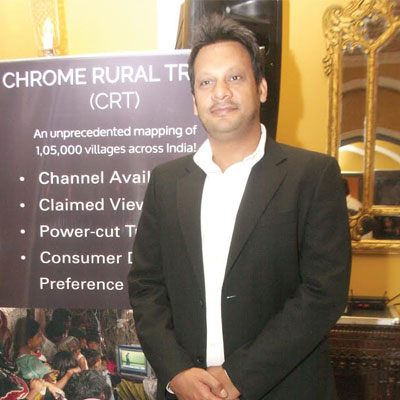
    MUMBAI: India’s TV research and analytics company Chrome DM has launched Chrome Rural Track. Every month, Chrome Rural Track will map 1,05,000 villages across India to study the consumption patterns in television viewing.

    The tracking will involve massive infrastructure of field staff and tele-callers, with knowledge of 22 languages, advanced technology, etc. through use of six proprietary tools.

    The field-work for Chrome Rural Track was initiated in April 2015 and the data compilation for Phase I comprising 25,484 villages is underway. Every month, Chrome Rural Track will encompass channel availability, claimed viewership, power-cut trends and consumer durable preference and ownership (colour TV, LPG stove, ceiling fan, car/jeep/van, two wheeler, refrigerator, washing machine, air conditioner, PC/laptop and agricultural land).

    The tracking will be categorised into four Chrome Rural Strata (CRS) based on population density. CRS 1 will be in villages with population greater than 20,000; CRS 2 between 10,001 – 20,000; CRS 3 between 5,000 – 10,000 and CRS 4 will track villages with population less than 5,000.

    The monthly tracking is aimed to assist the marketers in strategising for rural India. It will also help bring the issues affecting rural India into mainstream discussion, thus bridging the urban-rural divide in social and economical considerations too.

    Chrome DM CEO and founder Pankaj Krishna said, “The size and social-cultural complexity of India’s rural landscape warranted the tracking at such a scale. Despite constituting 69 per cent of the population, rural India remains considerably unmapped across segments. We believe that this is a part of our endeavour to bring rural representation on to the radar. Consumption patterns, consumer preferences and purchasing power of rural areas are significantly different from that of the cities. If we further dissect the data, there are radical differences in consumer behaviour within individual villages. Chrome Rural Track is our attempt to map the diversity that exists in our vast country and provide the industry/decision makers with rural data.”

    He further added, “Along with agriculture and simplicity of life – Rural India is today unfortunately synonymous with racism, gender inequality, honour killings and the highest rates of female foeticide across the globe. There are over 1000 female abortions in day in India. Any happening that does well for a story, genuine or non-serious makes it to the headlines across multiple media; however most of these stories are skewed to happenings in and around metros and urban centres. With the launch of Chrome Rural Track, across an unprecedented 105,000 villages of India, our endeavour is to bring Rural India on to the media radar.”

    Chrome Data Analytics & Media advisory board member Monica Tata asserted, “There is a huge gap in the understanding of India’s rural consumers. Marketers need information that is dissected to a village level across India. With television being the main tool to communicate with consumers, it is critical that the brands have a refined knowledge television viewing. Through Chrome Rural Track, we aim to bridge this gap. This data spanning 105,000 villages will be indispensable for both advertisers and agencies and help them take more informed decisions.”

    Some of the interesting findings from Chrome Rural Track include vast differences in the percentage between Cable, DTH and Terrestrial modes among various states. While 99.1 per cent of Kerala villages, 85.4 per cent of Gujarat villages and 70.3 per cent of Maharashtra villages get TV through cable, 62.4 per cent of villagers in Uttar Pradesh and Bihar access TV through DTH.

    Some of the other interesting findings are mentioned in the following table:

    Source – Chrome Rural Track August 2015

    Terming rural India as virtually a black hole in terms of available information on consumption habits, Chrome Data Analytics & Media member of advisory board Bharat Ranga said, “As part of the Zee Network and responsible for its multiple launches, I have actively used Chrome Data along with the highest levels of analytics. I am sure that Chrome Rural Track will help enhance our content production with a better understanding of rural tastes and lifestyle.”

    Mentioned below is a state-wise comparison of media preferences in rural areas across seven states:

  • Chrome DM advances data release of broadcast industry report

    Chrome DM advances data release of broadcast industry report

    MUMBAI: With the broadcast industry currently going through a transition phase with regards to its ratings currency, analytics measurement and distribution audit body Chrome DM has decided to advance its data delivery from Monday to Saturday.


    Correspondingly, the data collection week’s definition would shift from the earlier “Sunday-Saturday” to “Saturday-Friday.” For example: Week 16, data collection would move from “Sunday, 12 April to Saturday, 18 April,” to “Saturday, 11 April to Friday, 17 April.” 


    The advancement of the data release date is a radical shift for stakeholders as media agencies and broadcasters can now take immediate corrective measures with more lead time. This will not only give broadcasters sufficient time to predict reach numbers that would be released during the course of the week, but will also give them a head-start for planning the course for their respective channels.


    Speaking to Indiantelevision.com, Chrome DM CEO and founder Pankaj Krishna says, “The CEOs would prefer to have the data on their table on Saturday instead of Monday and our infrastructure enables us to generate real time data with supreme accuracy and hence we came with this decision.”


    Chrome has also launched a new tool named Chrome DTH, which enables broadcasters to scrutinize a comprehensive view of all-India DTH operations, including channel status, package information and on-ground market offers across markets and regions. “We are making constant efforts to grow and ensuring that we leave no stone unturned. With this new tool, we will provide quality analysis of DTH data, which will be generated after analyzing huge sum of reports acquired from the length and breadth of the country,” informs Krishna.


    Chrome Track 2.0 is an industry currency with over 300 channels detailing connectivity with weighted OTS (Opportunity-to-See) analytics as well as highlights that mark out the changes in channel placements on a daily basis.


    The Chrome DM methodology also addresses three key issues concerning the media universe:


    Sample Size: Chrome DM consolidates connectivity via scanning 101 million homes; through 24/7 surveillance supported by 3.6 lakh Chrome DM respondents & 12000+ Chrome Panel homes across multiple modes of Television Delivery.


    Swings in the ratings: 24×7 surveillance coupled with the fact that Chrome monitors ‘universes’ and not ‘samples’, thereby leaving no room for statistical aberrations. Unlike any other television monitoring service in the country today, Chrome Track provides access to data at a head-end level, thereby ensuring complete transparency in the system.


    Accurate representation in the East & South: Chrome is the only company to address eight markets (Arunachal Pradesh, Assam, Manipur, Meghalaya, Mizoram, Nagaland, Sikkim and Tripura) in the North-East and one of the few companies to cover 11 markets (Bangalore, Chennai, Hyderabad, AP+ Telangana .1 to 1Mn, AP-Rest 1Mn.+, Karnataka .1 to 1Mn, Kerala .1 to 1Mn., Kerala LC1, Kerala 1Mn. +, TN .1 to 1Mn., TN-Rest 1Mn.+ ) in the South, spanning 14+ million C&S homes.


    “Chrome DM has been working closely with the industry since 2009 and has to constantly live up to the analytic needs of 300+ channel partners. The industry, today, is going through a transition in the way we look at ratings and the currencies we adopt – there are millions of advertising bucks riding on the IPL and the corresponding pressures on placements across cable and DTH only gets higher. We recognize the importance of actionable data on a timely basis and hence the advancement of our data by two days,” Krishna concludes.