Tag: Chrome Data Analytics & Media

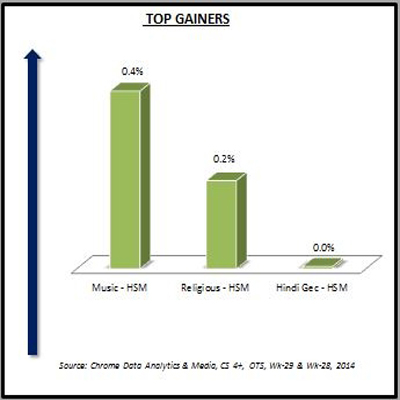
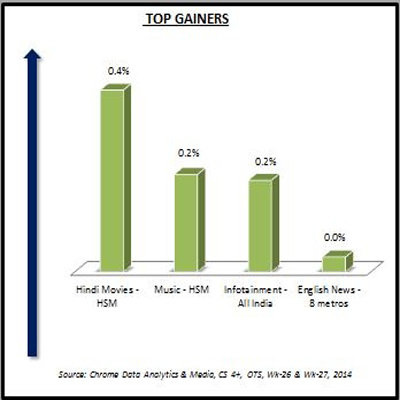
  • Hindi GEC genre slightly gains in Chrome DM week 28

    Hindi GEC genre slightly gains in Chrome DM week 28

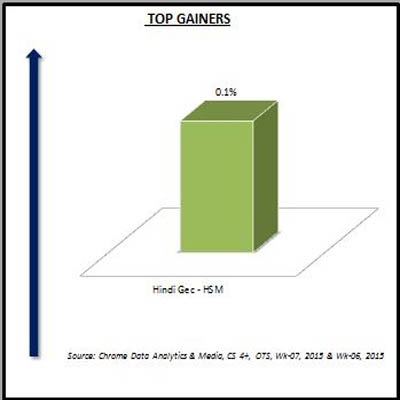
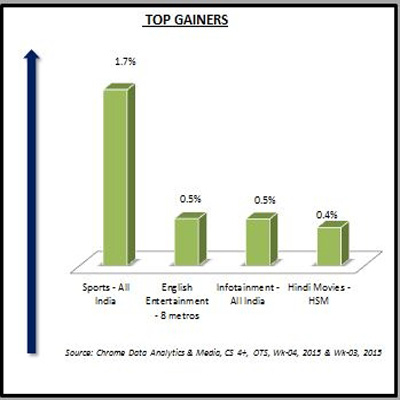
    MUMBAI: With less significant changes in week 28, 2020 of  Chrome Data Analytics and Media data, Hindi GEC has seen slight growth of 0.44 per cent.  In this genre, DD National gained highest OTS with 99.7 per cent in HSM excluding <1 lakh market.

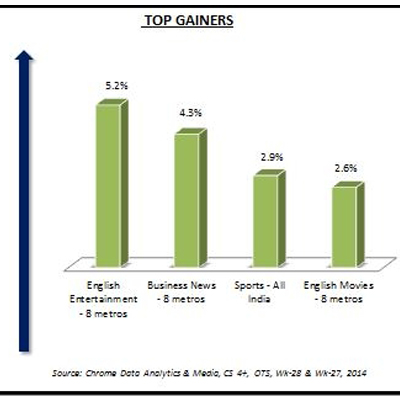
    Infotainment genre was the top gainer in the week 27. The genre grew by 0.44 per cent. In this genre, Animal Planet gained highest OTS with 89.0 per cent in all India 1 lakh+ market .

    OTS is the actual census-based percentage connectivity of a channel spread across 81 million homes, as reported by Chrome DM, across analogue cable, digital cable, and DTH.

    Last week, Hindi news gained the second position and grew by 0.37 per cent in   HSM excluding <1 lakh market. In this genre, ABP News gained the highest OTS with 100 per cent.

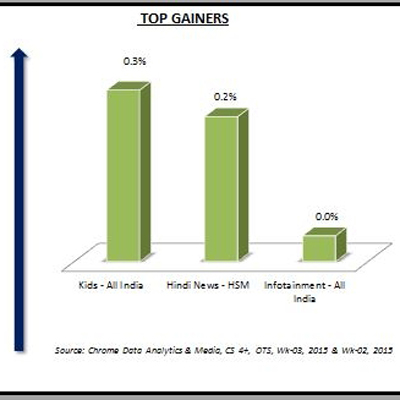
    Kids genre stood at the third position followed by religious genre at 0.34 per cent and 0.07 per cent respectively. 

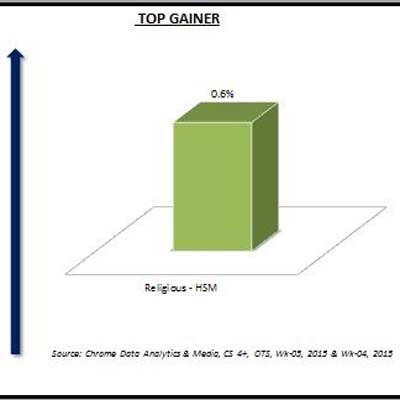
  • Hindi movies most benefited genre in Chrome DM week 43

    Hindi movies most benefited genre in Chrome DM week 43

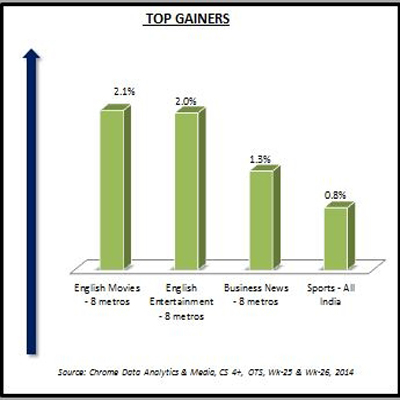
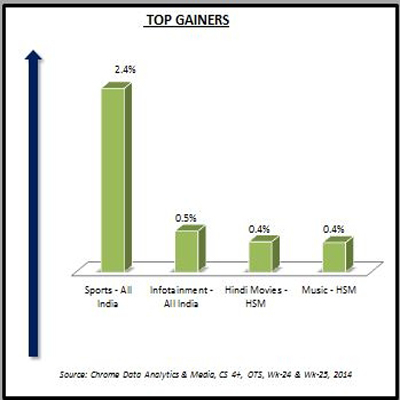
    MUMBAI: With a growth of 0.63 per cent as compared to last week (42), the Hindi movies genre, in HSM excluding the less than 1L-market, marked the highest opportunity to see (OTS) among all categories in week 43 of Chrome Data Analytics & Media. 

    In the Hindi movies genre, Rishtey Cineplex gained the highest OTS with 93.8 per cent in in HSM excluding the less than 1L-market.

    OTS is the actual census-based percentage connectivity of a channel spread across 81 million homes, as reported by Chrome DM, across analogue cable, digital cable and DTH. 

    The second position in the gainer’s list of OTS was grabbed by the sports genre in All India 1 Lakh+ market with 0.26 per cent OTS. DD Sports gained the highest OTS with 93.0 per cent. 

  • 63% of the respondents prefer watching movies with their friends than family, says study by Chrome Data Analytics & Media

    63% of the respondents prefer watching movies with their friends than family, says study by Chrome Data Analytics & Media

    MUMBAI: Indian cinema itself is considered to be one of the oldest cinema industries in the world. It is also one of the highest producers of movies in the world. It goes beyond Bollywood and has been entertaining viewers for many years now, across all walks of life.Forecasted to reach 3,000 screens by 2019, movie theatres hold a lot of traction, attracting movie lovers, in spite of growing online video streaming sites like Netflix and Amazon Prime.

    Chrome Data Analytics’ recent research analyses the movie watching story experience in India’s multiplexes.The study is based on a sample of 3,18 respondents. The respondents were selected from six metro cities- namely, Delhi, Mumbai, Kolkata, Chennai, Pune and Bangalore. The research data was collected through face- to – face interviews, where structured questionnaires with provision for open-ended questions were deployed for data collection.

    Following are some of the import highlights of the study:

    · 43% of the respondents preferred to watch a movie in theatres as compared to 31% who prefer downloading movies online.

    · 47% respondents consider the location of theatre important, as compared to 24% who consider price more important.

    · 38% prefer going to the movies on weekends. However, 8% prefer Thursday due to low prices.

    · Only 33% feel that having food and beverages at the theatre makes the overall experience better.

    · 63% of the respondents prefer watching movies with their friends

    · 43% of the respondents prefer PVR followed by carnival (25%) and cinepolis (13%).

    · 73% of the respondents like watching trailer at the beginning of the movies in a theatre.

  • 46% say social media easiest to spread fake news:Chrome Study

    46% say social media easiest to spread fake news:Chrome Study

    BENGALURU: It is easiest to spread fake news through social media says a Chrome Data Analytics & Media (Chrome) study – on the query ‘platform versus trust’.Moreover, 46 percent of 389 respondents felt that social media platforms were the easiest way to spread fake news against four percent that felt social media could be a trusted platform. However, the platform that earned the lowest trust quotient – just three percent, was magazines, as opposed to 6 percent that felt that fake news was easy to spread through magazines. Newsprint with a 27 percent trust quotient was the most trusted medium, but, thirteen percent of the respondents felt that it was a medium through which fake news could be spread. The medium least likely to be used for spread of fake news was said to be radio – just 5 percent of the respondents felt that it could be a medium that was easiest to spread fake news through. At the same time, just 7 percent voted for radio as a trusted source.

    Please refer to the figure below:

    public://F1_22.jpg

    Chrome undertook a study on fake news by interviewing 847 respondents comprising 46 percent females and 54 percent males. The age groups of the respondents were 18 to 24 years – 21 percent; 25 to 34 years – 24 percent; 35 to 44 years – 28 percent; 45 to 54 years – 15 percent and 55+ years 12 percent.

    Television was the most preferred platform for news consumption with 84 percent of the respondents using it. 61 percent used social media as a source of news, 58 percent used mobile apps; 47 percent newsprint and 13 percent radio for news.

    public://F2_13.jpg

    How do you identify fake news:Less than half the respondents – just 46 percent or 389 were aware of the term ‘fake news’. Of these 389 respondents,34 percent checked the source of the information to identify fake news; 26 percent decided on the basis of her/his knowledge; 21 percent searched for the related topic or headlines; 14 percent asked family members or friends; while just 10 percent asked experts/individuals who had knowledge of that domain.

    23 percent of the 389 respondents felt that Bollywood category contained the maximum fake news, while 10 percent felt that it was the spiritual category.

    public://F3_4.jpg

    59 percent of the 389 respondents said that they stopped following the page or any such groups where they encountered fake news, while 3 percent said that they drafted a complaint directly to the editor or the publisher.

    public://F4_0.jpg

    The top recall fake news, recalled by 44 percent of the 389 respondents was about the GPS chip in the new Rs 500 and Rs 2000 currency notes. Only 8 percent had a recall of the fake news claims about the real GurmeetRam Rahim being abroad and the fake one being inside the Rohtak jail.

    public://F5_0.jpg

    Chrome founder and CEO Pankaj Krishna said through a presentation, “Fake news, a type of yellow journalism, is like a plague and immunisation through education can help. The main challenge for consumers is to understand that fake and biased news are ubiquitous and further to be vigilant in detecting and then avoiding them. My advice is to consume news from multiple sources especially from those having a good track record of credibility and reliable reporting.”

  • Chrome Study: Colors, Amitabh most liked GEC channel, anchor among working individuals

    Chrome Study: Colors, Amitabh most liked GEC channel, anchor among working individuals

    BENGALURU: Colors is the most liked Hindi GEC channel among working individuals and KBC’s Amitabh Bachchan is the most liked anchor, according to a survey by Chrome Data & Analytics (Chrome) covering 1,957 working individuals in the HSM market.

    The most preferred genre – in order of preference – 92 percent were hooked to GECs; 56 percent preferred movies; 52 percent were addicted to music; 44 percent followed news; 19 percent liked infotainment; 17 percent preferred sports; 12 percent preferred the kids’ genre and 5 percent preferred the lifestyle genre.

    In terms of channels – in order of preference – 70 percent preferred Colors; 55 percent Sony Entertainment Television (SET); 53 percent preferred Star Plus; 41 percent preferred &TV; 37 percent preferred Zee TV and 31 percent preferred SAB TV.

    In terms of favourite channel – for 38 percent Colors was a favourite channel while Star Plus was a favourite channel for 21 percent; 20 percent found Sony TV as their favourite channel; Zee TV was a favourite for 10 percent; &TV was a favourite channel for 7 percent and 4 percent of the respondents found SAB TV to be their favourite channel.

    The Chrome study respondent universe was 22 percent in the age group of 15 to 20 years; 44 percent in the age group of 21 to 30 years; 27 percent in the age group of 31 to 50 and 7 percent that were 51 years old or more. 58 percent of the respondents were male and 42 percent were female.

    Please refer to the six charts below for the favourite programmes and characters on favourite channels

    public://11111111111111_3.jpg

    public://2222222222222_3.jpg

    public://33333333333333_1.jpg

    public://4444444444444.jpg

    public://555555555555555_0.jpg

    public://66666666666_1.jpg

    Writers note: Broadcast Audience Research Council of India (BARC) weekly data for top 10 channels that is freely accessible in the public domain indicates that it is Zee TV and its sibling and free to air channel Zee Anmol that have been topping ratings in the Hindi GEC markets over the past few weeks. Correspondingly, Kumkum Bhagya and its spinoff Kundali Bhagya generally and consistently are amongst the top 5 GEC programmes in BARC’s weekly lists. In the case of reality television there is limited amount of BARC data available in the public domain. It may be noted that BARC data covers the entire HSM urban and rural market, while Chrome data is limited to working individuals in the HSM market.

  • What viewers say about Bigg Boss: Chrome DM survey

    What viewers say about Bigg Boss: Chrome DM survey

    BENGALURU: Manveer Gurjar’s winning of the tenth season of Bigg Boss on Sunday 29 January 2017 was the second most watched primetime episode by the urban Hindi Speaking Market (HSM – urban) in week 5 of 2017 and probably had the highest rating among urbanites for any Hindi GEC programme for that day. Swami Om’s antics, the common man’s win, peccadilloes of the participants, maybe even the fact that demonetisation happened while the season was midway probably made season 10 the most liked season of Bigg Boss.

    Chrome Data Analytics & Media surveyed 3,257 respondents from HSM comprising of 31 percent respondents between the age group of 15 to 24 years, 29 percent between the age group of 25 to 34 years, 26 percent between the age group of 35 to 44 years and 15 percent of age 55 years and more. Sixty percent of the respondents were male and 40 percent were female. 98 percent of the respondents were aware about the Bigg Boss show. 90 percent of the respondents were aware of the current Big Boss season 11, while 10 percent didn’t know about it. Season 11 has the tagline Padosi Aa Rahein Hain Bajane Baarah.

    Season 10 was watched by 63 percent of the respondents as compared to 29 percent who had watched the first season of Bigg Boss. Among the 10 seasons so far, the second season was the least watched by 3,188 respondents – just 23 percent had watched it. Seasons 8 and 9 were the most watched seasons after season 10 – 52 percent of the respondents had watched them.

    Season 10 of Bigg Boss had the highest number of respondents who considered it their favourite season – 37 percent. Season 3 was probably the least liked with no one voting for it. After season 10, season 8 was the most liked – 15 percent of the respondents liked it. Only two percent each of the respondents considered three seasons – 2, 5 and 9 as their favourites. 10 percent of 3,188 respondents said that the first season was their favourite season.

    public://Untitled-3_20.jpg

    78 percent of 3,188 respondents had watched promos of season 11, while 22 percent hadn’t. 74 percent of the respondents who had watched promos had seen them on television, while 26 percent had seen the promos online.                                          

    About the concept of season 11 –  Padosi, 37 percent felt that it was more interesting, 18 percent felt that it was not more interesting, while 45 percent felt that maybe it was more interesting, than the Aam Aadmi concept. Will the Padosi concept of Bigg Boss Season 11 be better and garner a larger audience? Time will only tell.

    ALSO READ :

    MTV, HD+ to air ‘Bigg Boss Extra Dose’ for youth on weekdays from 9 Oct

    Highest rated Hindi GEC primetime programmes in rural India

    Viacom18’s social expt ‘Bigg Boss’ has ‘Super Bowl’-like fandom, says Raj Nayak, Salman to play ‘peacemaker’

    TV content: Madras HC seeks Centre’s clarification on regulatory mechanism

  • Unethical viewership enhancing has spiralling effect, leads to carriage fee hike, says Chrome DM

    Unethical viewership enhancing has spiralling effect, leads to carriage fee hike, says Chrome DM

    MUMBAI:  Whether or not a measuring agency or a ratings body approve of members who indulge in unethical means of doing business? Whether or not the business is doing well is only their mandate – however.

    MIB has directed BARC India to stop generating ratings of those channels that use landing pages to boost viewership through high sampling and reach for their channels. On earlier occasions, when a broadcasters body had sought BARC to stop measuring a new channel’s ratings, the platform-agnostic measurement agency did not heed the advice.

    Going by the past trends, broadcasters have been actively using landing pages to boost viewership. The logic is simple – a landing page ensures higher probability of the channel being watched, much like a supermarket where higher visibility of a product leads to impulse buying. Similarly, the channel with higher availability increases the chances of higher visibility, which eventually increases viewership.

    Commenting on MIB’s decision, Chrome Data Analytics & Media CEO Pankaj Krishna said: “We support MIB’s decision of preventing channels using unethical routes to enhance their viewership, for e.g., if a channel opts for dual LCN, the others are compelled to follow it to safeguard their numbers, consequently causing the spiralling effect of increased carriage fees. However, a landing page is purely a promotional exercise. As long as a channel is not running on dual LCN, there is nothing unethical about the concept of channels using landing pages.”

    As per the Chrome DM Landing Page Report- Week 36, 2017, there are over 400 landing pages active as on 05-09-2017 and are spread across channels and genres all over cable and DTH platforms.

    Source: Chrome DM Landing Channel Report, Wk-35, 2017
    Source: Chrome DM Landing Channel Report, Wk-35, 2017

    Dual LCN denotes a channel running on two separate LCN#s within the same cable operator’s/DTH platforms feed.

    He further added, “A channel’s presence on the landing page does not denote it being present on Dual LCN. All landing pages do not constitute dual LCN.”

    Typically, there are, according to Chrome, three cases of landing pages that can arise:

    CASE 1: Channel LCN as a landing page – So for e.g. if a channel is running on LCN #234 – and the set-top box switches on to LCN#234 hosting that Channel, the channel becomes the landing page.   

    CASE 2: Dual LCN with one LCN being a Landing Page – If a channel is running on LCN#234 – but the set-top box initiates a switches on to another LCN#, e.g. LCN#001, also hosting the same channel (as the landing page), that constitutes to a Dual LCN.

    CASE 3: Dual LCN with neither being a Landing Page – When a channel is present on two different LCN#s e.g. LCN#234 & LCN#675 within different genres of the EPG, where neither is a landing page.

    Chrome DM believes that there could be a concern in the latter 2 cases – as they constitute to Dual LCNs leading to an unsustainable model of boosting viewership through higher sampling and reach for these channels.

    Landing pages are simple marketing exercises – mirroring an FMCG company placing its products at the entry/exit cash counters to boost sales. We believe MSOs have been monetizing landing pages as a source of additional revenue stream by running promos and commercials.

    As per the Chrome DM Distribution Investment Index – “The yearly generated revenue ranges from Rs 50 million to as high as Rs 200 million for major MSOs and is all accounted for.

    What is more important as an industry endeavour is to focus more on achieving 100 per cent digitisation in India, which missed its 31 March, 2017 deadline. Interestingly, analogue signals continue to be carried out in many parts of the country, indicating a lack of addressability and transparency that only digitisation can solve.

    It will be interesting to see how BARC India, armed with software to primarily measure viewership for television channels and programmes in different geographies, will deal with the diktat to detect viewership from a particular distribution platform.

  • Nickelodeon emerges leader in top kids genre: Chrome

    MUMBAI: ‘Kids – All-India’ was the most benefitted genre with 1.10 per cent wherein Nickelodeon topped the chart with 87.9 per cent opportunity to see (OTS) in week 31, Chrome Data Analytics & Media reported. 

    Next in the tally was ‘Religious’ genre Exd with a growth of 0.97 per cent with Sanskar leading the genre with 96.3 per cent OTS on an HSM Excel <1L market basis. 

    ‘Business News’ genre was third in the row with a growth of 0.88 per cent in six metros and led by Zee Business with 84.2 per cent OTS. This was followed by ‘Infotainment’ genre on the fourth position with 0.61 per cent in six metros with NGC leading the chart with 91.6 per cent OTS. 

    Last, but not the least, ‘English GEC’ genre was on the fourth position with 0.45 per cent in six metros with Colors Infinity leading the chart with 47.6 per cent OTS. 

    Among the losers this week, the ‘Hindi GEC’ genre recorded a fall of 0.07 per cent in HSM Excel <1L market. DD National was the most affected channel in the genre with 99.3 per cent. 


    public://top-geners1.jpg


    OTS in ‘English movies’ genre in six metros decreased by 0.06 per cent with Movies Now being the most affected channel in the genre with 49.0 per cent.

    Also Read :

    English GEC genre grew by 0.24%, CNBC Awaaz most hit: Chrome

    Hindi Movies genre grew by 1.36%, Sony Max tops with 93.9% OTS: Chrome

  • Ashok Venkatramani joins Chrome Data Analytics & Media

    MUMBAI: Ashok Venkatramani, the former CEO of ABP news Network, has joined Chrome Data Analytics & Media Private Limited as a director in a consulting capacity. He brings with him an experience of over 25 years in sales, marketing and general management roles in the FMCG and broadcasting sectors.

    Chrome DM has been a pioneer for over eight years in broadcast distribution audits and primary media research in India. Over the years, the company has built strengths across big data and primary consumer research & analytics. In his role, he will be working closely with the group’s leadership team.

    Chrome DM has recently launched a new “Consumer & Market Research Services” vertical.

    This business vertical leverages Chrome’s nationwide field force and proprietary technology tools for primary consumer research. Within a short span of six months, it has already bagged accounts of leading brands & a wide spectrum of clients. Venkatramani’s engagement would further strengthen this initiative. While he would be based out of Mumbai, he would be equally involved with the Delhi team.

    “Chrome has witnessed unprecedented growth over the years, and is today an accepted currency for over 600+ TV channels,” said Venkatramani.

    Commenting, Chrome Data Analytics & Media founder & managing director Pankaj Krishna said, “As a young company, Ashok’s years of experience make for the perfect fit for us. He has been the driving force in his previous roles at Unilever and ABP, and we’re looking forward to the value he will add with his inputs.”

  • “Dual LCNs is not the best thing to do” — Chrome Data CEO Pankaj Krishna

    The dual and multiple LCNs issue has sparked off a furore with English news television channels after Republic TV announced eye-popping numbers in week one of its launch.  The media has been buffeted with leaked complaints to the regulator by news channels against one another and the viewership monitoring agency – the Broadcast Audience Research Council of India (BARC India).

    Chrome Data  Analytics & Media has been monitoring cable TV and DTH networks with its own household panels. And, its founder & CEO Pankaj Krishna has been on the frontlines where the action is. We got in touch with him to get his views on the English news channel fracas and what it all means.

    Excerpts from the interview:

    Q. What’s your take on Republic TV’s distribution?

    As per the Chrome data released on 15 May, Republic had already managed the highest OTS at 65 per cent as per Chrome track 2.0, in Week 19 (6 May – 12 May), All India Urban Market, in the English News genre.

    TABLE

    MARKET

    REPUBLIC TV  

    CNN NEWS 18  

    INDIA TODAY  

    TIMES NOW  

    NDTV 24X7  

    ALL INDIA Urban

    64.7

    64.7

    61.0

    61.8

    59.3

    Source: Chrome Track 2.0, Week 19, Market: All India Urban

    Further, if you were to factor in the impact of distribution on the BARC Reach/Coverage – as per our predictive DPi (a Chrome proprietary tool which gives the direct impact of distribution on channel trials) taking into account Chrome Data released on Monday, that is, 15   May, 2017, Republic TV was well headed to take on the number one slot across India on the ratings panel.

    Chrome Predictive DPi


    OTS (%)

    Conversion

    Reach (%)

    Times Now

    61.8

    4.9%

    3.01

    Republic TV

    64.7

    5.6%

    3.64

    NDTV 24*7

    59.3

    1.89%

    1.12

    India Today

    61.0

    1.78%

    1.09

    CNN News18

    64.7

    1.54%

    1.00

    Source: Chrome Predictive DPi, Market: All India (Urban), TG: All 22+ Male ABC, Wk 19’17

    In fact in the current week 20, with a Dual LCN count 43 headends, translating to dual OTS viewer, OTS of 68.2 per cent (Part data captured Chrome OTS Data till Thursday, 18 May, 7 PM), Republic TV is well on its way to making trade headlines for week 20 as well (Saturday 13 to Friday 19 May).

    According to you, does dual LCN help channels increase their viewership?

    Yes, it does. The objective of dual LCN could be to monetise the simplest law of probability on the ratings. For example, if you were to visit a supermarket, higher visibility of a product leads to impulse buying. Similarly, the channel with higher availability increases the chances of higher visibility, which eventually escalates viewership.


    public://republic_0.jpg

    Source: Chrome SES, Week 20 (13 May-19 May 2017)

    So, is it ethical?

    Whether it is ethical or unethical is a call that should be taken by the regulators. It is beyond our purview. Looking at the larger picture, I probably would say it is not the best thing to do because if one channel opts for dual/multiple LCNs, others are compelled to follow it to safeguard their numbers, consequently causing a spiralling effect on the carriage fees. We track 1277 channels as on 18  May, 2017 (available for downlink in India), however, in linear TV, the operators can carry only 106 channels on analogue, and approximately 300 on digital – resulting in a gap in supply and demand. Dual LCNs add to this gap by further blocking LCNs.

    What else is Republic doing to escalate viewership?

    There are primarily two ways of impacting channel trials – consumer pull led by content affinity, and broadcaster push led by distribution initiatives. Republic TV had made it in both. So yes, dual LCNS do have a direct positive impact on the viewership. Consumer pull clubbed with strategic distribution planning has a huge impact on the overall performance of a channel.

    There are several other factors that boost ratings of a channel, such as the content, on-air-presentation and many more. As per Chrome OAP track (anchor delivery, graphical interaction with expert panel members, treatment to live coverage, type of stories, screen-packaging etc.), Republic TV has outscored its competition average. 

    Chrome OAP Parameters

    Republic TV

    Average of Top 3 Channels

    Anchor Affinity

    7.24

    5.19

    All day Stories covered

    5.53

    5.41

    Screen Look & Feel

    5.62

    5.25

    Breaking News & Packaging

    6.86

    4.96

    Source: Chrome On-Air Presentation Track

    Period: 6 to 11 May 2017

    Sample: 9,874

    Market: All India Urban

    Chrome OAP is a proprietary tool that helps broadcasters to optimise factors determining viewers’ behaviour and engagement with on–air screen elements. The scores are given on a scale of 1 to 10.

    As per your findings, who all are engaged in dual/multiple LCNs?

    To a great extent, it happens across the industry including all the genres. Whether a broadcaster does it, or it happens on-ground by a cable operator to fill the blank LCNs is beyond our audits.

    However, owing to bandwidth constraints, the former seems to be more likely. A number of TV channels across India are seen available on dual LCNs to reach out to more audience. Dual/multiple LCNs are mostly seen during blockbuster events (such as budgets for the business news genre) and during new launches as a part of the channel’s marketing exercise.