Tag: Chrome Data Analytics and Media

  • Rampant cord cutting on cable continues: Chrome Data Study

    Rampant cord cutting on cable continues: Chrome Data Study

    Mumbai: The new findings from Chrome Data Analytics and Media’s July Subscriber Establishment Survey (SES) reported a significant drop in cable and satellite (C&S) homes, where the subscriber base has dropped from 201.2 million to 165.1 million households since 2019.

    This is based on a pan India ground survey that was done between January and July 2022; the sample included one out of every 175 households and included over 219 million TV households across the nation.

    Chrome DM surveys regularly, and it plays an important role in shaping our understanding of the changing TV landscape.

    Speaking on these findings, Chrome DM CEO and founder Pankaj Krishna said, “The reason for the decline is that the medium is changing. In television, in terms of content, it will keep booming, but the modes of consumption are changing so it is affecting Cable and Satellite (C&S) homes.”

    He further added, “This is the great race to entertainment, and OTT looks to be the reigning champion. I believe this trend will continue till ‘streaming’ is cemented as the new alternative in this turn of transition.”

    Pankaj believes with 5G coming in, we will witness a lot of disruption as well on how people consume content. “So the reason for the decline in cable and satellite homes is that the homes are wired through a cable and satellite connection but the overall consumption is increasing through the broadband internet (Connected TV) consumption. TV shows are increasing as well,” he added.

    Pay DTH and digital cable

    According to the Chrome Data Analytics and Media July report, pay DTH has a market share of nearly 38 per cent and digital cable is close to over 37 per cent.

    Digital cable experienced a significant decline of 18.5 per cent, whilst Pay DTH experienced a more restrained decline of 5.1 percent in the same findings. Pay DTH continues to have a significant presence in southern markets, where Andhra Pradesh reigned supreme with considerable share growth of 11.9 per cent.

     In terms of its total subscriber base, Tamizhaga Cable TV Communication (TCCL) was the leading gainer by a sizable margin of 33.2 per cent.

    Covid Impact

    The report stated that it would be an understatement to say that Covid-19 disturbed the market economy. The pandemic ushered in a new period of hesitation and unpredictability when any fleeting sense of assurance was purchased on the cheap.

    The markets fell, and the major players warned that the economy was on the verge of a devastating downturn.

    According to the report, the commercial sector was completely destroyed by the Covid-19 outbreak, and the cable and satellite industries were just one of the numerous victims.
     
    Before the first economic downturn, the profits appeared to be guaranteed, but after Covid, it served as a foreshadowing of what was to come. The numbers foretold the end of this once-dominant sector.

    The pandemic caused changes in social and cultural dynamics, which quickly followed as the economy began to slow down in the backdrop. The lockdowns forced a lot of migratory workers to return to their small rural villages, which caused a huge flood of subscribers to leave urban marketplaces, the report mentioned.

    The report found that to combat rising inflation and the economic slump, many people unsubscribed to curtail domestic expenditure, which includes keeping a TV set and paying for cable subscriptions.

    Freedish

    Freedish was the only one to experience a positive increase of 5.4 per cent while continuing to ascend north in rural areas.

    The other transmissions were impacted by the pandemic’s dwindling market share, but Freedish managed to hold onto its lead while the others did not.

    Again, this was largely the result of it being provided for free and having a substantial market share in rural India, which was untouched by the migrant issue. Odisha continued to be a top gainer, with its rural market growing by only about 16.8 per cent throughout this time.

    OTT impact

    Similar to this, urban residents were losing interest in cable TV and rapidly shifting their viewing preferences online. Many people have joined the growing number of cord-cutters and are now satisfying their watching needs online. Thus, the cord-cutting epidemic has ushered in a streaming-era digital revolution.

    The report stated that cable and satellite subscriptions have consistently decreased as viewers’ interest in traditional linear TV has declined, but a further rise in streaming usage is increasing.

    According to the survey, many cord-cutters still find this to be an appealing alternative because they don’t want to pay extra for the cable or digital subscriptions that are usually included with standard TV equipment.

  • Business news most benefited genre in Chrome DM week 44

    Business news most benefited genre in Chrome DM week 44

    MUMBAI: With a growth of 0.99 per cent, the business news genre in six metros, marked the highest opportunity to see (OTS) among all categories in week 44 of Chrome Data Analytics and Media. 

    In the business news genre, Zee Business gained the highest OTS with 86.3 per cent growth in six metros, followed by sports genre garnering second position in All India 1 Lakh+ market with 0.91 per cent growth. DD Sports garnered the highest OTS in the sports genre with 93.5 per cent.

    OTS is the actual census-based percentage connectivity of a channel spread across 81 million homes, as reported by Chrome DM, across analogue cable, digital cable and DTH. 

    The third position in the gainer’s list of OTS was grabbed by English news in six metros with 0.69 per cent. Loksabha TV raked in the highest OTS in the English news genre with 97.6 per cent. English GECs stood at fourth position in six metros with 0.36 per cent by Colors Infinity gaining the highest OTS with 59.3 per cent. In the fifth position, religious genre secured 0.30 per cent growth in the HSM excluding less than one lakh market. Aastha channel garnered the highest OTS with 98.2 per cent. 

  • Republic TV complains to TRAI, BARC on Times Now’s genre slotting

    Republic TV complains to TRAI, BARC on Times Now’s genre slotting

    MUMBAI: The ever-competitive business of TV news is set to witness another round of slugfest. Republic TV has complained to Telecom Regulatory Authority of India (TRAI) and Broadcast Audience Research Council (BARC) of India about English news channel Times Now getting the channel re-slotted under Hindi news genre on distribution platforms, which may impact viewership data.

    A letter written by Republic TV earlier this month, reviewed by Indiantelevision.com, accused Times Now of getting some of the distribution platforms to place the channel “among the Hindi news sub-genre” as some of the programmes broadcast had “substantial Hindi content” as claimed by Times.

    “This is a confusing development as BARC will report Times Now [viewership data] as part of the English news channel list,” the Republic complaint highlighted, adding, “if its proximity/neighbourhood is significantly among the Hindi news channels, it stands to distort viewership data.”

    Republic has also exhorted BARC India, which is set to release soon its fresh and updated television-related annual data, to take note of distribution changes relating to Times Now as not an English-language news channel but “preferably” a Hindi channel.

    However, changing of genres to boost sampling among viewers or resorting to dual or multiple LCNs are some issues not new to the Indian broadcast business. Nor is the animosity. that has prevailed between Times Now, former employer of Republic TV’s chief editor Arnab Goswami.

    When Republic TV debuted last year, a clutch of news channels, later backed by News Broadcasters Association (NBA), had alleged the new entrant was resorting to dual LCN or multiple feed tactic to boost viewership. BARC had also been petitioned to suspend publishing of Republic TV’s data.

    Times Now had also taken Goswami, promoter of Republic TV’s parent company, to the courts to desist him from using the phrase `nation wants to know’ claiming IPR over it as it was started when the flamboyant news anchor was with the Times group. Though Republic TV later became a member of NBA, Goswami had taken a swipe at Times Now calling it a cry baby.

    Since then both the TV news channels had been making news off-air, while slugging it out to corner viewers’ attention in a continuing see-saw battle.

    Asked about the issue of multiple feeds-strategy used by TV channels, TV market research company Chrome Data Analytics and Media CEO Pankaj Krishna told Indiantelevision.com that the unethical tactic was “still very much prevalent” despite a directive against it by regulator TRAI.

    “According to Chrome, there were some 1,433 instances of dual LCN across all genres across the country as of last week, Krishna explained, adding, “The practice is mostly seen during blockbuster events like presentation of Union Budget (for business news genre) and during new launches as part of a channel’s marketing exercise. But such tactics have limited time impact.”  

    TV Today Network managing editor Supriya Prasad was of the opinion if a TV channel was resorting to “unethical practices” to boost viewership, then it meant it didn’t have full faith in its own content. Aaj Tak is the leader of Hindi news genre as per BARC India Week 27 data.

    Another industry observer felt as HSM or Hindi-speaking market is a big one, getting slotted in that category in the EPG “opens up reach of a channel”. However, the observer was critical of such attempts to boost reach and viewership: “If an English TV channel is present in the Hindi news genre, simply informing TRAI and the operator to keep within the right side of the law as it was doing small amount of Hindi content is cheating the system. It gains importance if BARC too is not made aware of such a development.”

    It now remains to be seen how the regulator and BARC India will respond to the Republic TV complaint.

  • OTT spreading in India, but 50% still prefer TV as first screen: Chrome

    OTT spreading in India, but 50% still prefer TV as first screen: Chrome

    MUMBAI: Six per cent of urban India accesses OTT services on a daily basis and 24 per cent of the population do so on weekly basis. However, what is more interesting is that more than 50 per cent of the viewers still prefer TV as the first screen for viewing, according to a latest study done by Chrome Data Analytics and Media.

    The study, titled ‘Now Streaming: OTT’, examines the rise and penetration of OTT players in India and covers key aspects of the tech’s evolution, which primarily gives broadcasters, advertisers and the industry, in general, an insight into key target markets. The report further captures profiling nuances of an OTT content consumer.

    Some of the highlights of the report are the following:

    # Exclusivity of content helps increase awareness and eyeballs for an OTT platform.

    # User experience on smart phones plays a vital role in driving penetration. Currently, smart phones account for 29 per cent penetration.

    # More than 75 per cent of the audience prefers free services with ads as they are already paying for Internet services.

    # If the above is taken into account, rest of the population is ready to pay for the services with subscription amount varying on the basis of gender, age group and geography.

    # The potential of ‘Offline’ mode in India is quite high because of inadequate infrastructure and high cost of unlimited Internet.

    # The potential of ‘Offline’ mode varies with gender, age group and geography of the consumer.

    # The same viewer behaves differently over television and OTT. Solo viewing is not the only reason for pushing viewers to an OTT platform.

    # OTT players should focus on regional content as inclination or demand for (Indian) regional content is increasing.

    Talking about the growth potential of OTT, Chrome DM founder and CEO Pankaj Krishna said, “The entire Internet base, which is 464 million today, qualifies for OTT’s growth potential. However, infrastructure enhancement and low cost unlimited internet plans are the key drivers that will exponentially help in reaching and further increasing the potential base itself.”

    The OTT study also outlines the consumer profiles in detail by classifying them into broad segments. The characteristics defined for each of them gives consumer insights.

  • OTT spreading in India, but 50% still prefer TV as first screen: Chrome

    OTT spreading in India, but 50% still prefer TV as first screen: Chrome

    MUMBAI: Six per cent of urban India accesses OTT services on a daily basis and 24 per cent of the population do so on weekly basis. However, what is more interesting is that more than 50 per cent of the viewers still prefer TV as the first screen for viewing, according to a latest study done by Chrome Data Analytics and Media.

    The study, titled ‘Now Streaming: OTT’, examines the rise and penetration of OTT players in India and covers key aspects of the tech’s evolution, which primarily gives broadcasters, advertisers and the industry, in general, an insight into key target markets. The report further captures profiling nuances of an OTT content consumer.

    Some of the highlights of the report are the following:

    # Exclusivity of content helps increase awareness and eyeballs for an OTT platform.

    # User experience on smart phones plays a vital role in driving penetration. Currently, smart phones account for 29 per cent penetration.

    # More than 75 per cent of the audience prefers free services with ads as they are already paying for Internet services.

    # If the above is taken into account, rest of the population is ready to pay for the services with subscription amount varying on the basis of gender, age group and geography.

    # The potential of ‘Offline’ mode in India is quite high because of inadequate infrastructure and high cost of unlimited Internet.

    # The potential of ‘Offline’ mode varies with gender, age group and geography of the consumer.

    # The same viewer behaves differently over television and OTT. Solo viewing is not the only reason for pushing viewers to an OTT platform.

    # OTT players should focus on regional content as inclination or demand for (Indian) regional content is increasing.

    Talking about the growth potential of OTT, Chrome DM founder and CEO Pankaj Krishna said, “The entire Internet base, which is 464 million today, qualifies for OTT’s growth potential. However, infrastructure enhancement and low cost unlimited internet plans are the key drivers that will exponentially help in reaching and further increasing the potential base itself.”

    The OTT study also outlines the consumer profiles in detail by classifying them into broad segments. The characteristics defined for each of them gives consumer insights.

  • Chrome DM to track channels, competition etc. in hotels

    Chrome DM to track channels, competition etc. in hotels

    MUMBAI: Chrome Data Analytics and Media, India’s largest Primary Research and Data Analytics Company, has launched Hotel Track for Broadcasters and Distribution Service Providers to track their channel availability across premium hotels in India.

    Chrome Hotel Track covers 156 Five Star Hotels, as well as 203 Four Star and 257 Three star Hotelsspread across India. With the report, broadcasters will be able to get access to the following insights:

    ·Channel Availability

    ·Competition Channel Availability

    ·Neighbourhood Insights

    ·Total Rooms and Average Room Occupancy

    ·OTS Insights for Your Channel v/s Competition

    Speaking at the launch, Chrome Data Analytics and Media founder and CEO Pankaj Krishna said, “Chrome Hotel Track is a platform for broadcasters to monitor their channel performance in the hotel sector, which makes up for a large chunk of their viewership but goes ignored. Hotel Track will fill that gap.”

    Founded in 2008, Chrome DM is today India’s largest primary research and data analytics company. As of November, 2016, the organization had a team of over 650 field staff, over 150 managerial team and 450 tele-callers speaking over 22 languages to gather data from 3300 towns and 2,15,000 villages.

    The Group operates in the fields of broadcast distribution audit & monitoring, market research and media services. The company currently has six proprietary tools which have gained wide industry acceptance and usage in the past seven years, leading to over 400 clients.

  • Chrome DM to track channels, competition etc. in hotels

    Chrome DM to track channels, competition etc. in hotels

    MUMBAI: Chrome Data Analytics and Media, India’s largest Primary Research and Data Analytics Company, has launched Hotel Track for Broadcasters and Distribution Service Providers to track their channel availability across premium hotels in India.

    Chrome Hotel Track covers 156 Five Star Hotels, as well as 203 Four Star and 257 Three star Hotelsspread across India. With the report, broadcasters will be able to get access to the following insights:

    ·Channel Availability

    ·Competition Channel Availability

    ·Neighbourhood Insights

    ·Total Rooms and Average Room Occupancy

    ·OTS Insights for Your Channel v/s Competition

    Speaking at the launch, Chrome Data Analytics and Media founder and CEO Pankaj Krishna said, “Chrome Hotel Track is a platform for broadcasters to monitor their channel performance in the hotel sector, which makes up for a large chunk of their viewership but goes ignored. Hotel Track will fill that gap.”

    Founded in 2008, Chrome DM is today India’s largest primary research and data analytics company. As of November, 2016, the organization had a team of over 650 field staff, over 150 managerial team and 450 tele-callers speaking over 22 languages to gather data from 3300 towns and 2,15,000 villages.

    The Group operates in the fields of broadcast distribution audit & monitoring, market research and media services. The company currently has six proprietary tools which have gained wide industry acceptance and usage in the past seven years, leading to over 400 clients.

  • 25% of Rural Maharashtra Uses Internet Services on their Phones reveals Chrome survey

    25% of Rural Maharashtra Uses Internet Services on their Phones reveals Chrome survey

    MUMBAI: Post a successful execution of the world’s largest rural survey by Chrome Data Analytics and Media, the company has revealed some game- changing numbers for FMCG brands.

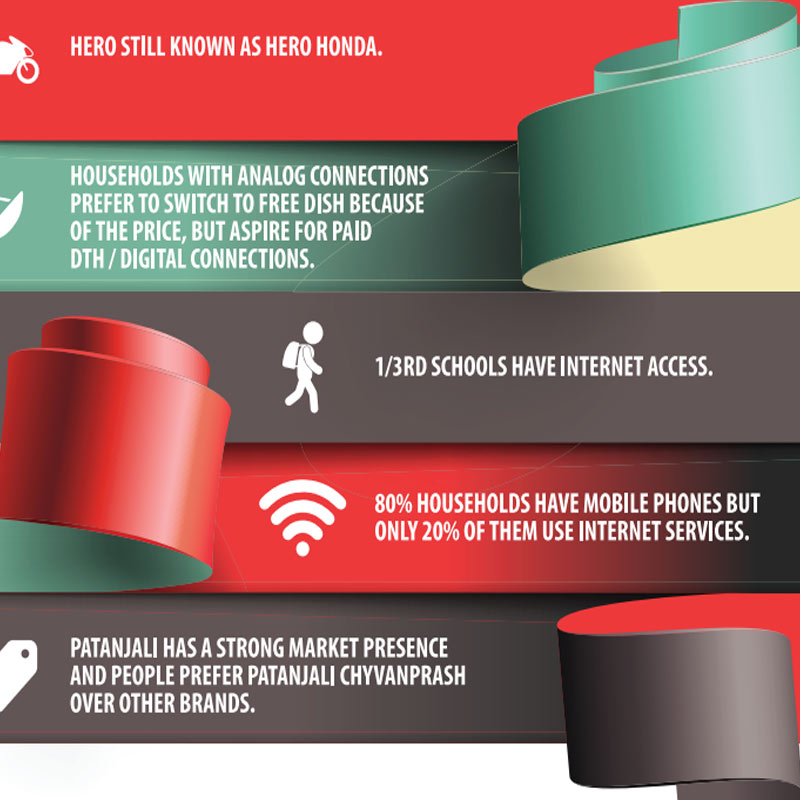
    Amongst other findings, the Rural Establishment Survey states that while 80% of rural Maharashtra uses mobile phones, only 20% are actually using internet services on them. The extensive survey that was spread across a period of 15 months, has also reported a number of other interesting insights that will change the way FMCG brands are targeting their user base.

    When it comes to educational infrastructure, the rural institutions seem to be moving in the right direction. According to the report, 1/3rd of schools in the area have access to the internet. The report also goes into marketing and branding effectiveness through the questionnaire. For example, one of the country’s largest selling two-wheeler companies is still known by its former name, years after breaking up with its Japanese collaborator.

    On speaking to Chrome DM CEO Pankaj Krishna about the impact of this study he stated that ‘The study has taken a deep dive into rural India’s consumer behavior and habits, which is a sure shot solution for FMCG brands to redirect their sales and marketing strategies.’

    Further to this, the report is aimed at assisting companies to tap the untapped market. Especially since 74% of the Indian population still resides in rural areas, there is a huge opportunity for companies to scale up their sales to the next level.

  • 25% of Rural Maharashtra Uses Internet Services on their Phones reveals Chrome survey

    25% of Rural Maharashtra Uses Internet Services on their Phones reveals Chrome survey

    MUMBAI: Post a successful execution of the world’s largest rural survey by Chrome Data Analytics and Media, the company has revealed some game- changing numbers for FMCG brands.

    Amongst other findings, the Rural Establishment Survey states that while 80% of rural Maharashtra uses mobile phones, only 20% are actually using internet services on them. The extensive survey that was spread across a period of 15 months, has also reported a number of other interesting insights that will change the way FMCG brands are targeting their user base.

    When it comes to educational infrastructure, the rural institutions seem to be moving in the right direction. According to the report, 1/3rd of schools in the area have access to the internet. The report also goes into marketing and branding effectiveness through the questionnaire. For example, one of the country’s largest selling two-wheeler companies is still known by its former name, years after breaking up with its Japanese collaborator.

    On speaking to Chrome DM CEO Pankaj Krishna about the impact of this study he stated that ‘The study has taken a deep dive into rural India’s consumer behavior and habits, which is a sure shot solution for FMCG brands to redirect their sales and marketing strategies.’

    Further to this, the report is aimed at assisting companies to tap the untapped market. Especially since 74% of the Indian population still resides in rural areas, there is a huge opportunity for companies to scale up their sales to the next level.

  • Chrome Data: English News gains most in week 40

    Chrome Data: English News gains most in week 40

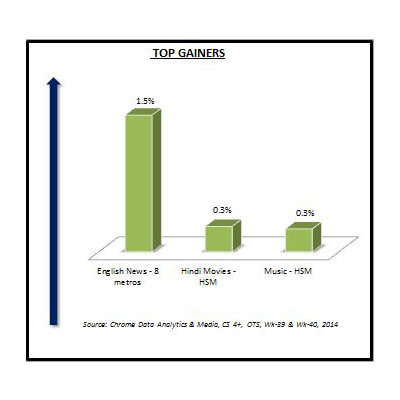
    MUMBAI: English news in the eight metros gained the most opportunity to see (OTS) collated by Chrome Data Analytics and Media for the week 40.

    The genre grew by 1.5 per cent wherein Times Now continued its reign with 85.0 per cent OTS. Hindi movies and Music in the Hindi speaking market (HSM) shared the second position with 0.3 per cent. In the Hindi movies genre, Max was at number one position with 97.1 per cent OTS, whereas in the Music genre, 9XM remained on top with 88.1 per cent OTS.

    English Entertainment in the eight metros witnessed a significant drop of 10.3 per cent. AXN with 67.8 per cent OTS gained in the most in the category. English movies in the eight metros came in second and saw a drop of 4.1 per cent. Pix lead the chart with 74.6 per cent OTS.

    Infotainment channels across India saw a fall of 2.7 per cent. Discovery topped in the category with 86.5 per cent OTS.