Tag: China

  • Fox International productions, Ivanhoe Pictures in co-finance deal for Asian films

    Fox International productions, Ivanhoe Pictures in co-finance deal for Asian films

    MUMBAI: Production company Ivanhoe Pictures was launched in Toronto earlier this year by Ivanhoe Capital Corporation principal Robert Friedland, GreeneStreet president and co-founder John Penotti, and Beijing-based Ray Chen, founder and chairman of Beijing Premiere Media Company. At launch, the company said it would finance and produce film and TV projects that have broad global audience appeal, initially seeding opportunities in America and Asia, focusing on China, India, Korea and Japan.


    Fox International Productions, which has a lucrative local-language business in Asia and elsewhere, is now teaming with Ivanhoe in a four-year, multi-picture co-financing deal for homegrown movies in India, Korea, China, Japan and Taiwan. The pact will kick off with Ivanhoe investing in 10 FIP-produced films in varying stages of production. The investment from Ivanhoe signifies the strength of FIP’s local-language business which is also active in Latin America and Europe.
     

  • Microsoft to Skype in China later this month

    Microsoft to Skype in China later this month

    NEW DELHI: Microsoft, which had officially acquired Skype in 2011, is taking over Skype’s operations in China from 24 November.

    Skype China is still being run by TOM Online – part of Tom Group – a mobile internet company in the country. Skype describes TOM as a majority joint venture partner that helps to provide access to Skype for Chinese customers, “using a modified version that follows Chinese regulations, called TOM-Skype.”


    TOM-Skype’s website says that TOM will be handing over Skype to Microsoft on November 24.


    In the announcement, it was also revealed that Skype has currently surpassed 100 million users in China.


    When Skype turned 10 earlier this year, it announced that the service has helped connect more than 300 million people around the world, letting them talk for more than 1.4 trillion minutes (2.6 million years of conversations). It is not clear if the 300 million figure refers to registered users, but China’s users stand at one-third of the number of people Skype has ever connected.

    There is growing usage of messaging apps in China including WeChat, China Telecom’s Yixin and Alibaba’s Laiwang. 

  • Global ad spend goes upward in the first half of 2013

    Global ad spend goes upward in the first half of 2013

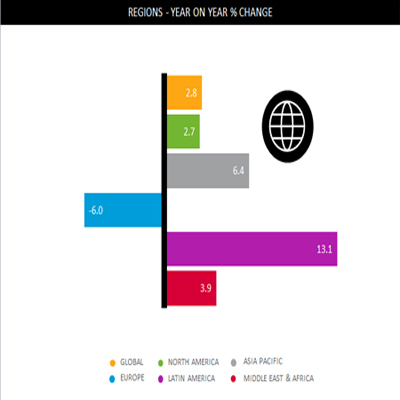
    NEW DELHI: Ad spends grew by a substantial 6.4 per cent in the first half of 2013, making it the largest growth among different regions of the world.


    Marketers continue to gradually increase their global ad spending, as expenditures grew 3.5 per cent in the second quarter of 2013 and 2.8 percent on a year-over-year basis for the January-June periods of 2013 and 2012, according to Nielsen’s quarterly Global AdView Pulse report.


    Although many marketers remain conservative with advertising budgets, those in Latin America continue to buck the norm, increasing their expenditures by 13.1 percent (to $13.5 billion) for the January-June period.


    All regions contributed to global growth for the first half of the year except Europe, where marketers remain modest with their ad budgets amid the regions’ continued fiscal crisis, resulting in a six percent decline for the period. Ad spend continued to recover after slumping during the economic downturn, with growth of 3.9 percent in the Middle East and Africa, and 2.7 percent in North America.


    Argentina contributed significantly to growth for the Latin America region with nearly 30 per cent growth. Indonesia, China and the Philippines all contributed to double-digit ad growth in Asia-Pacific for the first half of 2013, with expenditures reaching $51 billion. In Europe, ad spend increased in Norway, Switzerland, and Greece (2.5 per cent, 0.6 per cent, and 7.4 per cent respectively), while expenditures declined in all other countries in the region.


    Nielsen Global AdView Pulse measures ad spending for TV, newspapers, magazines, radio, outdoor, cinema and Internet display advertising. Ad spend is based mainly on published rate-cards. Some markets may exclude select media due to data availability.


    The external data sources for the other countries included in the report are:


    Argentina: IBOPE
    Brazil: IBOPE
    Croatia: Nielsen in association with Ipsos
    Egypt: PARC (Pan Arab Research Centre)
    France: Yacast
    Greece: Media Services
    Hong Kong: admanGo
    Japan: Nihon Daily Tsushinsha
    Kuwait: PARC (Pan Arab Research Centre)
    Lebanon: PARC (Pan Arab Research Centre)
    Mexico: IBOPE
    Pan-Arab Media: PARC (Pan Arab Research Centre)
    Portugal: Mediamonitor
    Saudi Arabia: PARC (Pan Arab Research Centre)
    Spain: Arce Media
    Switzerland: Nielsen in association with Media Focus
    UAE: PARC (Pan Arab Research Centre)

  • Chinese domestic movie market sees 35 per cent growth

    Chinese domestic movie market sees 35 per cent growth

    NEW DELHI: Even as India continues to produce the largest number of films, China has shown a major growth with total box office revenue for the first nine months of the year at RMB16.4 billion (US$2.7 billion), a year-on-year growth of 34.9 per cent.


    With a market share of approximately 58 per cent, domestic films continue to rule the market with RMB9.56 billion (US$1.57 billion) in total revenue, a year-on-year growth of 93.8 per cent, according to China’s State Administration of Press, Publication, Radio, Film and Television (SAPPRFT) in the third quarter box office statistics.


    Five of the top ten grossing films of the first nine months of the year are domestic films that include Journey to the West: Conquering the Demons (RMB1.24 billion), So Young (RMB 715 million), American Dreams in China (RMB 538 million), Finding Mr. Right (RMB 518 million) and Tiny Times 1 (RMB 488 million).


    Opening at the end of September, Young Detective Dee: Rise of the Sea Dragon has already surpassed American Dreams as the third top grossing domestic film of the year. By last week, it had taken RMB 583 million.


    Several major releases set for December are expected to further lift domestic films:
    Benny Chan’s The White Storm, Feng Xiaogang’s Personal Tailor, Alan Yuen’s Firestorm, and Ding Sheng’s Police Story 2013.


    Foreign films made RMB 6.87 billion (US$1.13 billion) in total revenue, a year-on-year decline of 5.2 per cent. This represents somewhat of a recovery over the summer. In the first half of the year, foreign films were recorded as experiencing a year-on-year decline in box office revenue of 21.3 per cent.


    The top five grossing foreign films of the first nine months of the years — three of which were in cinemas during the third quarter are: Iron Man 3 (RMB 751 million), Pacific Rim (RMB 694 million), Furious 6 (RMB 412 million), The Croods (RMB 394.8 million) and Man of Steel (RMB 394.6 million).

  • US-based FCC seeks to open up FDI norms for broadcasting

    US-based FCC seeks to open up FDI norms for broadcasting

    MUMBAI: Are the winds of change blowing in probably what is the most hypercompetitive and protected media market in the world after China? It looks likely that they are.


    The US Federal Communications Commission announced over the weekend that it is considering relaxing foreign investment norms in broadcast TV and radio stations in the US. Current norms restrict foreign holdings in companies holding broadcast licences at 25 per cent.


    The FCC is scheduled to have an open discussion on this when it meets on 14 November under Acting Chairwoman Mignon Clyburn. Clayburn says once its proposal is approved, the FCC will take decisions on proposals on a case by case basis. An official statement quoted her saying: “I circulated a declaratory ruling that clears the way for increased access to capital and potential new investors for the broadcast sector. Approval of this item will clarify the Commission’s intention to review, on a case-by-case basis, proposed transactions that would exceed the 25 per cent benchmark that restricts foreign ownership in companies holding broadcast licenses.”


    FCC Commissioner Ajit Pai added while speaking to a wire service that there is a great disparity in the fact that foreign companies can indirectly invest more than 25 per cent in wireless telecom, internet, cable TV ventures while draconian restrictions continue to hamper the flow of capital in the US broadcast sector which is going through turbulent times.


    The proposal has been welcomed by many in the broadcast sector including the National Association of Broadcasters and The Minority Media and Telecommunications Council (MMTC), which has in the past stated that the rules framed in 1912 need to be changed.


    In a statement, MMTC explained its advocacy for the measure: “MMTC, along with over 50 national civil rights, intergovernmental, entrepreneur, and professional groups, has petitioned the Commission to amend the rules for eight years. The organisations have cited the lack of domestic investment in diverse radio stations and the relief foreign investment capital would provide to American broadcasters, especially minority entrepreneurs. The move would also facilitate American broadcasters’ reciprocal entry into diverse overseas markets hungry for African-American, Hispanic-American, and Asian-American music and culture.”


    It may be recalled that News Corp boss Rupert Murdoch had to become an American citizen and give up his Australian citizenship in September 1985 in order to buy a network of independent television stations. He went to buy 50 per cent of 20th Century Fox Film Corp. (21st Century Fox) and had plans to purchase Metromedia, the nation’s largest group of independent television stations, including KTTV in Los Angeles.


    The change in thinking brings to mind the fact that TRAI has been recommending a freeing up of foreign investment norms in cable TV, television – news and current affairs channel (in the uplinking guidelines may be increased from 26 per cent to 49 per cent through the FIPB route), radio (the FDI limits may be enhanced from 26 per cent to 49 per cent through FIPB route for the FM radio sector), DTH, and putting it on par with telecom. Hopefully, there will finally be some movement in that direction.


    We don’t know if Indian firms are smelling opportunity, but it well could be. Zee TV already owns a wellness TV service in the US under the brand of Veria and several other Indian broadcasters have launched versions of their Indian channels and delivered them to south Asian diaspora via satellite in the US. Sure, it will provide India’s going-global media firms a chance to put in investments and acquire broadcasting firms – even though they may be local TV stations – in the US. Yes, it will take big money, but for the risk takers the rewards will be big too when they work out.

  • CareerBuilder Releases Striking Differences in Typical Workdays Around the World

    CareerBuilder Releases Striking Differences in Typical Workdays Around the World

    MUMBAI :  A new global study from CareerBuilder shows that a typical day in the office is not so typical across the globe: When you look at the average workday in the 10 largest economies around the world, you begin to see how alike workers can be—and also where they differ the most. The global survey, conducted online by Harris Interactive© from May 9 to June 5, 2013, included more than 5,000 hiring managers and human resource professionals in countries with the largest gross domestic product.

    INFOGRAPHIC:http://cb.com/1gnMhxK

    Driving vs. Public Transportation

    While the 10 countries surveyed have the largest economies on the planet, they also have some of the largest populations, but instead of taking public transportation or using other ways of getting to work, the majority of workers indicate they drive themselves to work every day,
    •    U.S. 82%
    •    Brazil: 74%
    •    China: 69%
    •    Germany: 63%
    •    France: 62%
    •    Italy: 60%
    •    Russia: 60%
    •    U.K.: 58%
    •    India: 52%
    •    Japan: 44%

    Suit and tie optional

    Of the 10 surveyed countries, India is the only place you’ll see the majority of workers in business formal attire (50 percent), such as suits. In every other surveyed country, business casual (e.g., slacks, button-down shirts, sweaters) is the standard dress code as below
    •    U.S. 64%
    •    Brazil: 57%
    •    Italy 51%
    •    UK: 51%
    •    Russia: 50%
    •    China: 49%
    •    France: 45%
    •    Germany: 45%
    •    Japan: 42%
    •    India: 36%

    Communication preference

    Although everyone might seem to be glued to their smartphones, tablets and laptops these days, face-to-face conversations still rule the workplace. In all 10 surveyed countries, in-person communication beat electronic messages such as emails, texts and instant messages by large margins, with phone conversations being the least used.

    •    U.S.: 
    o    Face-to-face: 59%
    o    Digital: 30%
    o    Phone: 10%
    •    UK:
    o    Face-to-face: 68%
    o    Digital: 20%
    o    Phone: 11%
    •    France:
    o    Face-to-face: 79%
    o    Digital: 15%
    o    Phone: 6%
    •    Germany:
    o    Face-to-face: 73%
    o    Digital: 15%
    o    Phone: 13%
    •    Italy:
    o    Face-to-face: 66%
    o    Digital: 23%
    o    Phone: 11%
    •    Russia:
    o    Face-to-face: 80%
    o    Digital: 10%
    o    Phone: 9%
    •    India:
    o    Face-to-face: 60%
    o    Digital: 23%
    o    Phone: 17%
    •    China:
    o    Face-to-face: 81%
    o    Digital: 16%
    o    Phone: 2%
    •    Japan:
    o    Face-to-face: 42%
    o    Digital: 32%
    o    Phone: 27%
    •    Brazil:
    o    Face-to-face: 45%
    o    Digital: 32%
    o    Phone: 23%

    Socializing with coworkers

    Socializing with coworkers outside of office hours can be a good way to learn about your colleagues or relax after a hard day at work. Yet, not everyone is eager to participate. Workers in China and India are more than twice as likely to attend social events than workers in Germany and the U.S.When asked do you socialize with coworkers, the following said yes,
    •    China: 98%
    •    India: 93%
    •    Brazil: 76%
    •    Russia: 68%
    •    Japan: 66%
    •    France: 64%
    •    UK: 55%
    •    Italy: 53%
    •    US: 41% 
    •    Germany: 38%

    Hours spent at work each week

    The number of hours workers spend at work is pretty consistent around the world, but while Chinese workers spend slightly less time at work each week, they report (29 percent) bringing work home with them at least once a week, higher than the other countries.
    How many hours do you work each week?
    •    31-40: U.K. (47%), China (46%)
    •    41-50: Japan (48%), U.S. (47%), India (46%), Germany (44%), Brazil (43%), Italy (42%), Russia (40%), France (37%)


    How often are youbringing work home?
    •    US: 
    o    1 Day a week: 18%
    o    Never: 26%
    •    UK:
    o    1 Day a week: 17%
    o    Never: 30%
    •    France:
    o    1 Day a week: 19%
    o    Never: 32%
    •    Germany:
    o    1 Day a week: 19%
    o    Never: 39%
    •    Italy:
    o    1 Day a week: 25%
    o    Never: 43%
    •    Russia:
    o    1 Day a week: 25%
    o    Never: 39%
    •    India:
    o    1 Day a week: 26%
    o    Never: 29%
    •    China:
    o    1 Day a week: 29%
    o    Never: 30%
    •    Japan:
    o    1 Day a week: 18%
    o    Never: 59%
    •    Brazil:
    o    1 Day a week: 22%
    o    Never: 30%

    Taking vacation

    When asked how many days they took off from vacation, workers had strikingly different answers depending on where they live. Italian workers took off the fewest days, with the nearly two-thirds majority taking 7 days or fewer (64%). Forty-six percent of Japanese workers took more than 35 days off, more than workers in any other countries.
    •    0-7 days:
    o    Italy: 64%
    o    UK: 29%
    o    Brazil: 20%
    •    8-14 days:
    o    India: 34%
    o    U.S.: 27%
    •    15-21 days:
    o    China: 28%
    •    22-28 days:
    o    Russia: 35%
    o    France: 25%
    •    29-35 days:
    o    Germany: 30%
    •    35+ days: 
    o    Japan: 46%

    Survey Methodology

    This survey was conducted online within the U.S., Brazil, China, France, Germany, India, Italy, Japan, Russia and the U.K. by Harris Interactive©on behalf of CareerBuilder among400 to 2,279 hiring managers and human resource professionals (employed full-time, not self-employed, government and non-government) in each country between May 9 and June 5, 2013 (percentages for some questions are based on a subset, based on their responses to certain questions). With pure probability samples ranging from 400 to 2,279, one could say with a 95 percent probability that the overall results have a sampling error between +/- 4.9 and +/-2.05 percentage points. Sampling error for data from sub-samples is higher and varies.


  • ‘Best Corporate Consultancy in the World 2013

    ‘Best Corporate Consultancy in the World 2013

    MSLGROUP, Publicis Groupe’s strategic communications and engagement consultancy, was named the ‘Best Corporate Consultancy in the World 2013’ by The Holmes Report, one of the most authoritative commentators in the communications industry. The recognition is a testimony to the consultancy’s strengths in helping its clients establish, protect and expand their business through strategic reputation management and corporate advisory practices.


    Paul Holmes, editor of The Holmes Report, said of the award, “MSLGROUP has quietly pulled together one of the most formidable corporate capabilities in the world…providing an impressive range of financial communications and corporate and public affairs counsel.” This highly prestigious acknowledgment comes within weeks after The Holmes Report appointed MSLGROUP as ‘Asia-Pacific Consultancy of the Year.’


    Glenn Osaki, Asia President, MSLGROUP, said: “In Asia, more and more of our clients are turning to MSLGROUP for higher value communications advisory. This has given us the opportunities to provide counsel beyond communicating a business strategy but for the shaping of it. To ensure that we stay close to our clients’ business, we have focused on strengthening our Strategic Communications Advisory in Asia, including investing to ensure that we have the strongest talent in public affairs and government relations in China, India and Singapore, as well as establishing our regional Financial Communications practice in Hong Kong in 2012.”


    Highlights from MSLGROUP in Asia include multiple high-level and cross-market advisory work across the region for clients including P&G, Coca-Cola, Walmart, Business Software Alliance, and Invest in France Agency. MSLGROUP is playing a large role to provide integrated communications for leading companies in India, including Dell and United Technologies (UTC). The China team regularly advises C-suite executives on all issues related to communications with significant impact on business strategy, including its 15+ year client, IKEA. Since 1997, Genedigi Group in China has been providing strategic public affairs and corporate communications counsel to a large number of Fortune 500 companies and Chinese firms.


    On the global scale, examples of MSLGROUP’s world-class advisory includes its strategic corporate counsel for UTC across its diversified aerospace and building systems industries, which has helped UTC to become one of the most admired companies in the world; a 15-market thought leadership and public affairs campaign for the World Gold Council; Kekst’s work on the American Airlines bankruptcy and subsequent merger with US Airways; reputation and issues management for Google in Germany and Italy; and CNC’s work on the Vodafone/KDG takeover and Lufthansa’s sale of BMI to British Airways.


    Olivier Fleurot, CEO of MSLGROUP commented, “We have long believed in the power of a holistic and truly global group offering that is based around the expertise of best-in-class regional entrepreneurs. Knitting these units together with our dynamic teams in the fast-growing economies of India and Brazil is providing us with a leading edge for our clients worldwide today.”

  • India short of trained manpower to tackle cyber crime

    India short of trained manpower to tackle cyber crime

    NEW DELHI: Even as India ranks third in terms of the highest number of internet users in the world after US and China and the number is projected to grow six-fold between 2012 and 2017 with a compound annual growth rate of 44 per cent, it is among the top 10 spam-sending countries in the world alongside the United States.

    According to a whitepaper launched by ASSOCHAM-KPMG, highlighted that India has a huge shortage of cyber security specialists with the number of trained manpower only accounting for 556 compared to 1.25 lakh in China and 91,080 in the US. This is despite the fact that cyber crime cases in the country registered under the Information Technology Act last year rose by about 61 per cent to 2,876 with Maharashtra recording the most number of cases.

    To check cyber crime and hacking of systems, the government launched the National Cyber Security Policy of India (NCSP) followed by the release of guidelines by the National Critical Information Infrastructure Protection Centre of the National Technical Research Organization (NTRO) in July this year.

    One of the key agendas of the National Cyber Security Policy of India is to create a taskforce of 500,000 cyber security professionals in the next five years. Public and private sector partnership (PPP) is also seen as a key step to counter cyber crime.

    The whitepaper asserts that there is need for enterprises, SMEs and the government bodies to not only adopt the various guidelines and advisories issued by the security agencies but also to regularly review the implementation of the same. There needs to be a timely review of the IT act to keep pace with the developments and sophistications in cyber crime.

    Apart from consulting private sectors and cyber security equipment manufacturers, international coordination is also something that India needs to consider in the days to come to counter cyber attacks more effectively and efficiently. The implementation of all these aspects together will be a challenge that needs to be dealt with precision to secure the critical infrastructure of the country. 

  • Fashion Designer Gareth Pugh Revealed The Inspiration behind his first piece of fine jewellery

    Fashion Designer Gareth Pugh Revealed The Inspiration behind his first piece of fine jewellery

    Forevermark, the diamond brand from the De Beers Group of Companies, announced its collaboration with British fashion designer, Gareth Pugh today. On the occasion, Mr. Sachin Jain, President, Forevermark India unveiled Gareth’s first fine jewellery piece at The Palladium Hotel, Mumbai along with actress Jacqueline Fernandez.


    Featuring over a hundred natural and untreated precious Forevermark diamonds, this armour-like piece has been designed as a part of the Forevermark Promise Campaign. Gareth spoke about the inspiration and journey behind his design where he learnt about the unique promise inscribed on every Forevermark diamond. Set in stainless steel and Titanium, this piece was brought to life with cutting-edge digital mapping and 3D technology. The neckpiece has about 5600 diamonds, adding upto 91.98 carats.


    THE INSPIRATION


    The design process for Gareth began earlier this year during his trip to the Orapa diamond mine in Botswana, where he came to understand the incredible story behind each Forevermark diamond. From seeing and handling rough diamonds, Gareth witnessed their transformation into beautiful polished gems at an Authorised Forevermark Diamantaires cutting and polishing factory. One part of the operation that he found particularly compelling was the alliance between age-old craft and advanced technology. Gareth knew immediately that he wanted that relationship to be part of the story of this piece.


    THE CREATION


    Following this creative path, Gareth developed the idea of working with a unique set of contradictions. “The design was brought into existence in a most innovative way: utilising the power of technology – through digital body-mapping and 3D printing – combined with the knowledge and authority of experienced craftsmanship,” said Pugh. And the paradoxes continue with natural and untreated Forevermark diamonds, which are billions of years old, being set within a stainless steel base, built using completely new technology.


    Pugh also explained, “The inspiration behind the neck-piece comes from my idea of what a promise is – an unbreakable bond. Coming back to Forevermark, it’s about the reciprocal relationship that they have with the communities they support. It’s not about taking, it’s about giving something back. The piece closes with a titanium pin which is set with a diamond on the top. I really liked the idea of using that as a signifier of an unbreakable bond.”


    Sachin Jain, President, Forevermark India commented, “Forevermark prides itself on working with experts who are as passionate about their area of expertise as we are about diamonds. Gareth is undoubtedly one of the world’s great fashion talents and we are honoured that he has chosen to work with Forevermark diamonds for his first fine jewellery piece. Gareth has realised an extraordinary vision in the piece and we are thrilled, both with the creative inspiration and the iconic aesthetic of the neckpiece itself.”


    This spectacular design was unveiled for the first time in Hong Kong on the 8th of August at an event attended by Gareth. The neck-piece will soon be revealed in China, Japan and the U.S.


    THE CAMPAIGN


    Forevermark holds firm the belief that all promises should be as unbreakable as theirs. Consequently, their unique 2013 Promise campaign reflects that. www.forevermark.com/promise features the news, promises and stories from Pugh’s personal journey with Forevermark as well as updates from a variety of international events hosted around the world, in honour of the campaign. Visitors will be able to design their very own piece of jewellery featuring a Forevermark diamond – the finished image of which can be sent to a loved one bearing its very own, personal promise.


    The campaign also features online interactions at www.forevermark.com/promise allowing consumers to make a promise to a loved one connected to a specific location and place. The recipient will receive a personal note informing them of the very special promise that awaits them when in the relevant location.


    Building on the success of the 2012 Promises and Pledges Exhibition and the corresponding website, designers and celebrities from all over the world are joining the Forevermark 2013 Promise campaign with each learning more about the unique way in which Forevermark diamonds are not only responsibly sourced, but also actively benefit the communities from which they come.

  • Nielsen: Global ad spend up in first half of 2013

    Nielsen: Global ad spend up in first half of 2013

    MUMBAI: Global ad spend has hiked 2.8 per cent on a year-over-year basis for the first half of 2013, according to Nielsen’s Global AdView Pulse report, which finds that marketers in Latin America had the highest increase in spending for the period.


    For the second quarter of 2013, expenditures grew 3.5 per cent.


    All regions contributed to the global growth, except Europe, where there was a six per cent decline for the period from January to June. Latin America was booming, with gains of 13.1 per cent to $13.5 billion. There was a quarterly growth of 3.9 per cent in the Middle East and Africa. The Asia Pacific had growth of 6.4 per cent and North America of 2.7 per cent.


    Within Latin America, Argentina contributed significantly to the growth in the region, with a nearly 30 per cent increase in ad spending. Indonesia, China and the Philippines all contributed double-digit growth in the Asia Pacific for the first half of the year, with expenditures reaching $51 billion. In Europe, ad spending was up in Norway (2.5 per cent), Switzerland (0.6 per cent) and Greece (7.4 per cent), though all other countries in the region saw a decline.