Tag: China

  • AsiaPac leads global ad growth: Nielsen

    AsiaPac leads global ad growth: Nielsen

    MUMBAI: Global advertising expenditures were up 3.2 per cent in the third quarter of 2013 for year-over-year period, driven largely by Asia Pacific’s expanding powerhouse ad market, as well as a bottoming out of Europe’s contracting ad market.


    According to Nielsen’s latest Global AdView Pulse report, Asia Pacific ad revenues surged seven per cent in the first nine months of 2013. China was up 16.7 per cent, Indonesia 22.1 per cent and Malaysia 15.7 per cent. The gains offset declines in Australia and South Korea.


    Television continues to be the favourite medium through which advertisers attempt to reach their consumers, commanding a 57.6 per cent share of all spending and growing 4.3 per cent. Display Internet, though representing a smaller share of spends at 4.5 per cent grew significantly by 32.4 per cent.


    Macro sectors contributing to the growth include FMCG, which saw a 5.9 per cent increase in ad spending for the year-to-date, and Industry & Services, which grew 11.3 per cent.


    The period also saw a slight improvement in Europe, with the market down just 0.4 per cent in Q3. Nielsen notes that the region’s ad market appears to be bottoming out. Indeed, Italy and Spain, among the hardest hit, may have the worst behind them, the report notes, and Greece saw its ad revenues gain 10.3 per cent.


    In the US the market was up 1.7 per cent by the end of September, even though it fell 1.3 per cent in the third quarter itself. And in Latin America, the year-on-year change was 13 per cent.

  • ‘Despicable Me 3’ set for June 2017 release

    ‘Despicable Me 3’ set for June 2017 release

    MUMBAI: Universal Pictures has announced dates on three upcoming high-profile projects and it means more Minions in the coming years, along with Grinch; the third installment of its incredibly successful animated franchise Despicable Me 3, and a “newly imagined” version of Dr. Suess’ How the Grinch Stole Christmas and an untitled animated comedy from Despicable Me makers Illumination Entertainment.


    Universal today announced a 30 June, 2017, date for Despicable Me 3, the follow-up to last year’s first sequel, which has grossed $935.8 mn worldwide and just opened in it last territory, China. The studio also revealed dates for two other Illumination Entertainment toons: a new version of Dr. Seuss’ How The Grinch Stole Christmas (17 November, 2017) and Untitled Illumination Project (21 December, 2016).

  • China to launch high-definition terrestrial digital TV broadcast in 2008

    China to launch high-definition terrestrial digital TV broadcast in 2008

    MUMBAI: China will launch high-definition terrestrial digital TV broadcasts in 2008. A five-year (2006-2010) guideline on cultural development has been published.

    Media reports inform that China also aims to replace the existing analog cable television with digital cable television in all the cities in its eastern and central regions and most of those in the western area by 2010.”

    A report in Xinhua states that China will adopt a terrestrial digital TV broadcast standard – the mandatory broadcast signal for Chinese broadcasters – on 1 August next year. A study by Research and Markets further notes that China plans to stop the transmission of analogue television by 2015. With the rise of DTV, China has established relevant policies to gradually eliminate analogue TV and enter the era of DTV.

    Though compared with developed countries, China is lagged far behind in the field of digital TV, yet it made rapid progress in 2005; altogether 4.13 million Chinese subscribed digital TV, increasing by over twofold compared to the previous year. Among them, 3.97million were digital cable digital TV subscribers.

    Also, problems can be found in Chinas DTV industry. They are backward standard, difficulties in network consolidation, deficient terminal, immature market, serious shortage of content, deep-rooted receiving habit, want of price system, immature core technology, incomplete DTV industrial chain, need of further probe in business modes and systems. All these factors severely restrict the development of the DTV industry in China.

    It can be seen from the development trend that DTV is bound to substitute for analog TV,. However, as to digital pay TV, China is still exploring a suitable operation mode and there is still a long period of time before its maturity. SARFT (The State Administration of Radio Film and Television) of P.R.C. is always vigorously popularizing DTV in China. The Chinese government, along with channel suppliers, channel integrators and cable network operators is zealous about the popularisation of DTV, offering a fairly good and unique circumstance for the development of digital pay TV.

  • NationalChip’s STB solutions for Indian digitisation

    NationalChip’s STB solutions for Indian digitisation

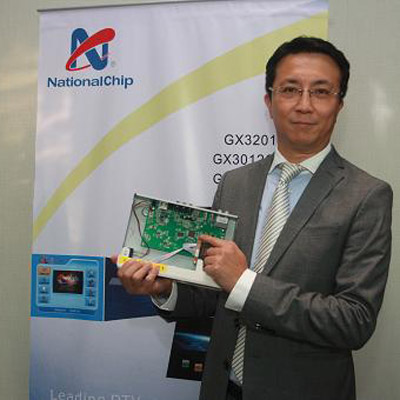
    MUMBAI: When it comes to technology, China is one of the leading Asian countries in the world that comes to mind. So it’s no surprise when leading China based IC developer and manufacturer of digital TV solutions, NationalChip, launched new set top box chips (system-on-chip) for the Indian market.

    The company is looking to increase its market share in India’s fast-growing set-top box (STB) chip manufacturing market. As part of its growth plans, NationalChip has launched new set-top box chips (system-on-chip) for the Indian market.

    The company’s new HD STB chip is based on GX3201 that delivers HD content at over 1000 MIPS CPU performance, 1080P HD decoding and security implementation. To cater to the mid to lower end subscribers that forms the major chunk of the Indian cable TV universe, the company has launched SD STB chip based on GX3001R or GX3012Q that offers high speed CPU for user experience as well as true colour display for enhanced picture quality.

    According to NationalChip, these chips can support advanced security implementation that are demanded by most prominent conditional access vendors (CAS) and MSOs.

    “India has nearly 6,000 MSOs whereas there are only 300 MSOs in China. There is a huge opportunity for us to tap into this large cable TV market and we have the resources, the name and the technological advancement to cater to it,” says NationalChip VP Patrick Dou.

    NationalChip’s HD solution also supports OTT application that will allow subscribers to access online video content through home network internet. Currently the chip allows the viewer to use Wi-Fi connectivity to access sites such as YouTube to experience HD videos on their larger screens.

    “We are telling the MSOs here that they can secure subscription revenue and at the same time provide value added services to their subscribers with our HD solution that supports OTT application,” adds Dou.

    After having been in the industry since its inception in 2001 the chip manufacturer is looking to expand into new markets. It has identified India as one of the key markets apart from southeast Asia and Europe, Middle East & Africa (EMEA). NationalChip, which began operations in India from 2011, is working with local Indian STB manufacturers by providing them with software support to develop STBs locally.

    The company claims that its chips have been officially authorised by many CAS companies including NDS (Now under Cisco), Sumavision, NSTV, ABV, Logic Eastern, Ensurity, E-CAS, and Only One CAS. With the new product offering, the STB chip manufacturer is looking to work with other major CAS vendors in the Indian market.

    “We have a leading product lineup, turnkey solutions, track record and technical capability to support sustainable development of the Indian market,” says an optimistic Dou. On the business front, Dou says that the company has shipped 1.5 million chips to the Indian market in the last two years.

    “This might not seem like a big number but for a company which has been in the market for just two years, it’s quite an achievement,” stresses Dou. Dou is looking to up NationalChip’s market share to 30-35 per cent in the next four years, up from the current five per cent share.

    However, that will be a tough task as the STB chips market is currently dominated by big players like French Italian MNC STMicroelectronics, America’s Broadcom, and Taiwan’s ALi Corporation.

    To achieve this growth, the company is expanding to other cities in the country. Currently having its office only in Delhi it soon has plans to branch out to Mumbai, Pune, Hyderabad, Bengaluru, Ahmadabad and Chennai. The company currently has Pune-headquartered Millennium Semiconductors as its only distributor in India.

    “We have been in this business for nearly two decades now and have the right know how to take NationalChip and its advanced technology to the leading MSOs in the country. We are sure that with its advanced security feature as well as great capability to showcase HD content all leading MSOs will be more than willing to join hands with NationalChip and us,” says Millennium Semiconductor Sr.GM Technical Operation Sunil Deshmukh.

    Being the first local Chinese company to develop digital TV IC solutions since 2001, NationalChip is also the first and only Chinese IC company to achieve big deployment to support digitalisation phases in India.


  • Sohu to stream Nickelodeon programs in China

    Sohu to stream Nickelodeon programs in China

    MUMBAI: For a few years now, animated shows like SpongeBob SquarePants, have entertained the young viewers almost across the world. Now, many such popular Nickelodeon children’s programs will be dubbed into Mandarin and available to watch free online in China over the next 12 months in the latest deal to give a foreign entertainment company more access to China’s vast market.

    Sohu Video, a unit of popular Chinese Web portal Sohu.com, recently announced an online video-on-demand and video syndication collaboration in China with Viacom International Media Networks, a unit of Viacom Inc.

    The government in China restricts foreign access to the country’s television audience and bars most of its cable operators from carrying foreign channels. However, it’s the online video platforms that give the audience an access to foreign productions.


    In a joint statement, the companies said the deal will enable an estimated 389 million Chinese online video users to watch Mandarin-dubbed and subtitled Nickelodeon programming on Sohu’s site, however the details of the deal hasn’t been revealed.

    Sohu Video started offering more than 200 hours of Nickelodeon programming, including SpongeBob SquarePants, Teenage Mutant Ninja Turtles and Avatar Sunday onwards.

    Sohu’s video site is populated with American TV shows, Japanese animation series, Chinese variety shows and in-house programs. It obtained the exclusive online broadcast rights for the second season of hit reality talent show The Voice of China, shown earlier this year, generating nearly 2 billion video views, according to Sohu.

  • Indias economic confidence revives says Ipsos study

    Indias economic confidence revives says Ipsos study

    MUMBAI: India’s economic confidence revived substantially due to healthy farm output, a sharp boost in exports and narrowing of current account deficit, according to a report by global research firm Ipsos.


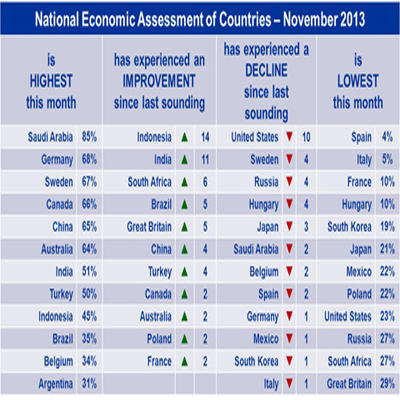
    According to the “Ipsos Economic Pulse of the World” study, India’s economic confidence jumped sharply by 11 points to 51 per cent in the month of November compared to the month of October 2013. India now stands as the seventh most economically confident country in the world after Saudi Arabia, Germany, Sweden, Canada, China, and Australia.


    Three in ten (32 per cent) Indians believe a health increase of five points. Indians are very hopeful about stability and growth in future with general election in the first half of 2014; four in ten (42 per cent) people expects that the economy in their local area will be stronger in next six months, a slender rise of one point.


    “Indian economy has bottomed out after a two-year slump and it is likely to see a positive growth trend from here on with positive indicators like narrowing CAD, revival of exports, growth of manufacturing sector and increasing investor confidence,” said Ipsos in India CEO Mick Gordon.


    “Good Monsoon resulted in bumper crop output, which in turn generated rural demand for goods such as tractors, motorcycles and consumer goods leading to growth of the manufacturing sector,” added Gordon.


    The online Ipsos Economic Pulse of the World survey was conducted in October 2013 among 18,083 people in 24 countries.


    After a significant decline last month, the average global economic assessment of national economies surveyed in 24 countries took a one-point turn for the better this month as 37 per cent of global citizens rate their national economies to be “good.”


    Saudi Arabia (85 per cent) continued to dominate the global ratings of national economies, followed in a distance by Germany (68 per cent), Sweden (67 per cent), Canada (66 per cent), China (65 per cent) and Australia (64 per cent). Once again, only a handful of those in Spain (four per cent) rate their national economies as ‘good’, followed by Italy (five per cent), Hungary (10 per cent), France (10 per cent), and South Korea (19 per cent).


    Countries with the greatest improvements in this wave were Indonesia (45 per cent, 14 points), India (51 per cent, 11 points), South Africa (27 per cent, six points), Brazil (35per cent, five points), Great Britain (29 per cent, five points) and China (65 per cent, four points).


    Those from Brazil (62 per cent), once again, hold the strongest future outlook for their local economy in the next six months. The other high-ranking countries, which followed at a distance, were: Saudi Arabia (48 per cent), India (42 per cent), China (39 per cent), Indonesia (37 per cent) and Argentina (37 per cent).

  • India fourth in phishing attacks

    India fourth in phishing attacks

    NEW DELHI: India has ranked fourth in phishing attacks in the third quarter of 2013, said RSA, a division of EMC.

    India received three per cent of the total attack volume, said  RSA  in a statement.
    Other countries targeted by phishing attacks were US (53 per cent), Germany (17 per cent), UK (eight per cent) and South Africa (three per cent). In top countries by attacked brands’ India ranked third with seven per cent of the total phishing volume worldwide. The US with 27 per cent and UK with 12 per cent topped the chart.

    RSA identified 46,119 phishing attacks in September globally with a rise in 36 per cent increase as compared to the month of August (33, 861). Phishing attacks in the month of September also mark the highest number of attacks in this quarter while July 2013 saw 45,232 numbers of attacks. Top countries to host these phishing attacks include US (42 per cent), Canada (nine per cent), Germany (five per cent) and UK (four per cent).

    The total amount of losses incurred in third Quarter of 2013 was $1.66 billion. 

    Brands in the US, UK, India, and Australia were targeted by almost 50 per cent of phishing attacks in Q3 2013.

    US remained the top country on the chart, targeted with 53 per cent of the total phishing volume in Q3 2013.

    US incurred a loss of over $882 million followed by Germany with $294 million and UK with $133 million.

    Meanwhile, cyber attack is likely to cost the average home user $418 in multimedia files, but a lot of this loss could be prevented if users purchase digital content after checking that the content is secure.

    Kaspersky Lab in a statement that users can lose files in a number of different ways: losing a device, having a device stolen, or falling victim to malicious users.

    According to the B2B International survey, 27 per cent of respondents encountered a cyber attack in the last one year. At the same time, over 60 per cent of users who were victims of malware that either damaged or destroyed data admitted that they had not been able to fully restore their files. During the same period, approximately 14 per cent of users dealt with the loss, theft or crash of their device.

    Respondents in the 16-24 age group would face an average loss of $670, while those in the 25-34 group would incur an average loss of $455; users aged 45 and older would lose an average of $227.

    Residents of China and Russia were likely to incur the highest average losses at $816 and $807 per user, respectively. This figure is considerably lower in Europe ($378) and North America ($342).

    In order to protect digital assets, users not only need to back up their data on a regular basis – they also need to secure their personal devices against malicious attacks designed to steal or extort data. Smartphones and tablets should also have additional tools to help locate a lost device or to mitigate the potential damages of device theft.

  • Bing releases the top search trends of 2013

    Bing releases the top search trends of 2013

    MUMBAI: Women are on top, literally! The 2013 search trends released by Bing that includes search data from Australia, Brazil, Canada, China, France, Germany, India, Italy, Japan, Spain, the U.K. and the U.S, reveal that women ruled and were in the top searches. In eight of the 12 participating countries around the world, women were the most searched. Beyoncé reigned in the US, while Miley Cyrus’s highly publicised twerking made her the top-searched person in both Australia and Canada.

    Former flames Justin Bieber and Selena Gomez were the most-searched people in the U.K. and Germany, respectively. Actress and actors Bruna Marquezine, Wen Zhang and Salman Khan were the most-searched people in Brazil, China and India, while singers Rihanna and David Bisbal ranked at the top for France and Spain, and gorgeous TV personalities Danmitsu and Belen Rodriguez were favorites in Japan and Italy.

    It was also a year of American songs, superhero movies, Facebook love, high-end designer brands, controversial sports stars, European getaways and fierce women.

    Bing search trends, found at  www.BingTrends.com, indicate what has most captivated people around the world in 2013.

    However, when it came to the top searches in India, surprisingly, it was not the master blaster Sachin Tendulkar, who bid adieu to international cricket in 2013, who was searched the most. He was at number four, only after Salman Khan, Shah Rukh Khan and Katrina Kaif. 

    While he may have led the search among actors, Salman’s films did not feature in the top ten most searched films. The fast paced action flick Race 2 bagged top honours followed by Shahrukh starrer Chennai Express. And the surprise package among the top 10 Hindi movies was Nasha, starring Poonam Pandey. And Shah Rukh Khan may have missed top spot in the most searched actor and film, but his Lungi Dance from Chennai Express made it to the top of charts as the most searched song in India. This was followed by Party on My Mind from Race 2 and Challa from Jab Tak Hai Jaan.

    Sports stars too were popular. While Sachin Tendulkar was the most searched among sports stars, young and feisty Virat Kohli too made it to the top ten. However, the surprise entry was sprinter Milkha Singh, proving that the biopic on him did arouse curiosity about him in the country. Shuttlers Jwala Gutta and Saina Nehwal made sure that their sport was represented in the top ten dominated by cricketers.

  • Pay TV growth spurred by BRIC nations, says ABI Research

    Pay TV growth spurred by BRIC nations, says ABI Research

    MUMBAI: India is just a year into the process of digitisation, and, in another year, it is quite likely all of the nation’s 100-odd million cable TV homes will be having a set top box (STB) perched on top of their TV sets. The rapid spread of the STB and pay TV is ensuring that India increasingly pops up in research reports on pay TV as a major contributor of growth. Other countries which are also helping spike pay TV growth are Brazil, Russia and China.


    Take a dekko at the latest report released by international research firm ABI Research. It states that the pay TV subscriber base across the world surpassed 886.5 million at the end of Q3 2013, a six per cent YoY increase and generated $ 62.6 billion service revenue. Maintaining its Q2 2013 status, BRIC (Brazil Russia India China) nations were a major contributor and will continue to be in the future years, ABI has stated.


    The research predicts that by 2018, global pay TV subscribers will shoot to more than 1 billion out of which BRIC countries will be responsible for 68 per cent of total net additional subscribers.


    “Emerging markets are key drivers of global growth in pay-TV subscribers as developed markets are experiencing flat growth rates,” said ABI Research VP and practice director Jake Saunders.


    The US Pay TV market grew at less than one per cent as compared to Q3 2012, due to increasing cord cutting by cable TV subscribers who are switching over to cheaper OTT services such as Netflix and Hulu. According to the report, approximately 1.7 million subscribers were lost from cable TV last year in North America. However, revenues increased due to high ARPUs (Average Revenue per User) driven by increasing HD and advanced DVR (Digital Video Recorder) subscribers.


    European countries also showed marginal growth with less than two per cent increase than Q3 last year. Service providers in Spain lost over seven per cent of their pay TV subscribers and Italy over two per cent as compared to a year ago due to the weak economic environment. However, markets such as the UK, France and Germany along with other Western Europe countries saw IPTV subscribers increase by 1.9 million from Q3 2012 to Q3 2013.


    According to a 2012 report by the Singapore-based Media Partners Asia (MPA) overall pay TV subscribers in India were expected to cross 170 million in five years. Much like the US, India is also set to see revenue increase due to HD TV sets. India has one of the lowest ARPUs in the world at approximately Rs 140 ($ 2.2) but the industry is optimistic that it will grow to Rs 550 ($ 8.73) once digitisation is complete.

  • Digital Asia Festival 2013 announces shortlist

    Digital Asia Festival 2013 announces shortlist

    MUMBAI: The Digital Asia Festival Awards, honouring the best digital marketing communications across Asia Pacific, has announced this year’s shortlist.


    Chaired by Jason Kuperman, vice president of Omnicom Digital Asia Pacific, India, Middle East and Africa, the jury consists of 40 industry professionals with a mix of leading client marketers, digital media practitioners and agency strategists, judged 506 pieces of work based on strategy, creativity and innovation, execution and results with a total of 80 entries making it onto the shortlist. Japan leads with the most shortlisted entries (14), followed by Australia (13), New Zealand (10), China (9), Hong Kong (9), India (7), Singapore (7), The Philippines (5), Malaysia (4) and Thailand (2).


    Commenting on the judging process so far and the quality of the work, some jury members had the following to say in a release:  


    “I found this year’s entries seamlessly integrating technology into the creative leap turning the communication into truly refreshing and engaging consumer experiences. Several of the shortlists had started with a fabulous consumer insight and market/media opportunity that had never been explored before. We saw a lot of first-of-its-kind innovations and we could see technology playing along beautifully with the big idea. That’s a very encouraging sign,” said Tigress Tigress founder, CEO and CCO Meera Sharath Chandra.


    “Judging the DAF awards this year demonstrates that the region is thinking big and acting big in digital.  It’s no longer just an add-on to a TV campaign, but brands and agencies are genuinely looking at how they can build participation throughout their initiatives.  In a world where we often seem to be obsessed with daily posts on Facebook, it’s brilliant to see how much scale and impact can be really achieved with digital innovation,” said Iris Worldwide planning director, APAC regional Paul Gage.


    “The work that stood out for me was based on a single sharp insight and a strong idea – simply presented and well executed. Several entries made me go, Aha, wish I had thought of it,” said Infosys global head – digital marketing Ashok Lalla.
    The winners of the 2013 awards will be announced online through www.digitalasiafestival.com on 18 November.