Tag: Charu Sharma

  • Pro Kabaddi League wins ‘Best Sports League of the Year’ at CII Sports Business Awards 2024

    Pro Kabaddi League wins ‘Best Sports League of the Year’ at CII Sports Business Awards 2024

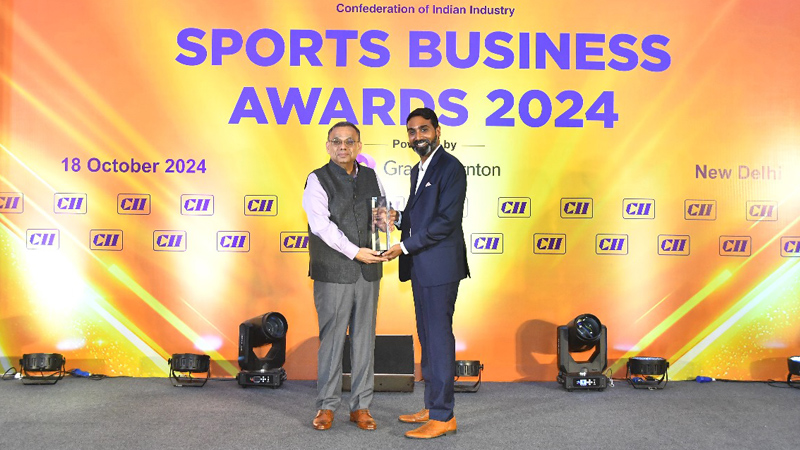
    New Delhi: Mashal Sports, the organisers of Pro Kabaddi League (PKL), announced that PKL has been honoured with the ‘Best Sports League of the Year’ award at CII Sports Business Awards 2024.

    The award ceremony was held as part of the Confederation of Indian Industry (CII) Score Card 2024 event in New Delhi on Friday, 18 October, which was also the day that the 11th   edition of the PKL took flight.

    Pro Kabaddi League league commissioner Anupam Goswami expressed his excitement about the award, “We are thrilled to receive this recognition from CII. This award is a testament to the hard work and dedication of everyone involved in making Pro Kabaddi League a resounding success since its inception in 2014. As we look to the future, we are committed to taking PKL to even greater heights, further popularizing kabaddi and contributing to India’s vision of becoming a global sporting powerhouse.”

    Pro Kabaddi League director Charu Sharma added by saying, “India’s unique heritage sport – which went international many decades ago – has catapulted into a highly visible, reputed, professional league 10 years ago thanks to the PKL. The story of Kabaddi is truly fascinating. I am delighted that India’s premier corporate agency, the CII, has appreciated the extreme attention Mashal Sports showers on good governance, earning the PKL respect and sustainability. Winning CII’s award for ‘Best Sports League of the Year at the Sports Business Awards is a truly gratifying recognition of all the hard work contributed by the entire Mashal Sports team, led by Anupam Goswami.”

  • Pro Kabaddi League makes first ever player auction of Rs 10 mn

    Pro Kabaddi League makes first ever player auction of Rs 10 mn

    MUMBAI: India’s second most watched sporting league –Pro Kabaddi League (PKL) – has entered its sixth season auctions. Riding on the back of five phenomenal seasons, the auctions are taking place on 30 and 31 May 2018 in Mumbai.

    The salary purse of the franchise remains the same as Rs 4 crore per team with a minimum of 18 players mandatory in the squad. The teams are strategising to build their strongest teams.

    A total of 422 players will be drafted into the auction pool of which 58 are overseas players and 87 are players from the Future Kabaddi Heroes Programme (FKH), a nationwide talent scouting programme. The auctions will witness player representation from 14 other countries including Iran, Bangladesh, Japan, Kenya, Republic of Korea, Malaysia and Sri Lanka.

    iQuest CEO Nitin Kukreja came in for the support of Tamil Thalaivvas and said, “Previously there was not enough economic opportunity for people but with the likes of IPL and PKL the opportunities have been unlocked. We are setting up our first local residential academy in which we will provide free education to 70 children with the training which might help them to play for any franchise in PKL.”

    Mashal Sports director Charu Sharma said, “I’m very mesmerised with the response we got in the first five seasons of this league. We have a long way to go and need to be patient to take this revolution forward.”

    Jaipur Pink Panthers owner Abhishek Bachchan pointed out that the viewership goals were surpassed over 10 times till the past season and so have auction rates. “Last season we thought Rs 70 lakh will be the highest bid but it went till Rs 93 lakh. This season there will be 2-3 players crossing the Rs 1 crore mark.”

    Fazel Atrachali the costliest player bought for Rs 1 crore said, “I’m happy to be back in my second home UMumba after two seasons.”

    On day one six players crossed the Rs 1 crore mark out of which five are Indian domestic player.

    The bigs buys of day one from the domestic list is lead by Monu Goyat who was bought by Haryana Steelers for Rs 1.51 crore. The franchise has put Kabaddi in the rich and elite professional sports league with Rs 1.51 crore for the 26-year-old.

    Rahul Chaudhari is retained by using Final Bid Match (FBM) by Telugu Titans at Rs 1.29 crore. Deepak Nivas Hooda is the third player in the crorepati list with Rs 1.15 crore to Jaipur Pink Panthers. Nitin Tomar previous years highest earner was sold for Rs 1.15 crore to Puneri Paltans followed by Rishank Devadiga for Rs 1.11 crore to UP Yoddhas.

    The first player auctioned for season six was Irani defender Abozar Mohajermighani who was sold to Telugu Titans for Rs 76 lakh and the second was Atrachali.

    USports co-founder Ronnie Screwvala also thinks that three to four players will cross the Rs 1 crore mark. UMumba has not retained a single player from its previous squad.

    PKL league commissioner Anupam Goswami said, “It has been a historic day for VIVO Pro Kabaddi and it’s wonderful to see so many talented players who are under the radar, make such a difference to franchisee decisions at VIVO Pro Kabaddi S6 auctions. Kabaddi has proven to be a viable career option for emerging talent and with 6 players crossing the Rs 1 crore mark, it is a defining moment in VIVO Pro Kabaddi history, setting a benchmark for inspiring youngsters who look to make a difference in the game.”

    UMumba CEO Supratik Sen told Indiantelevision.com that they are going to focus on Defender and Raiders after the day 2 lunch. Staying true to what Supratik said, UMumba bought some C category raiders at a higher price. Siddharth Desai went for Rs 36.4 Lakh and Abhishek Singh at Rs 42.8 Lakh to name a few.

    Monu Goyat commentating on being the highest bid player said “I am extremely happy to be the highest paid player this season, there is a huge responsibility to deliver and I am glad to receive this opportunity. I will now focus on increasing the standard of my game and playing the best, I can.

    Rahul Chaudhari speaking on being retained with Telugu Titans said “I am very happy that my team has retained me and I am glad to be back to Telugu Titans. Every year the league witnesses’ massive jumps along with a tremendous growth in fan following and I am extremely happy to be a part of the Pro Kabaddi family. I have started my training and am looking forward to this season. It is a growing period for kabaddi and I think by the time the younger generation will step into the auctions, the bid may start at 6-7 crores. Kabaddi is only going to grow and I urge parents to send their children to play kabaddi.”

    Speaking on the anticipated outcome of the auctions, Patna Pirates owner Rajesh Shah said, “Being three-time champions we are looking forward to building a team that will retain the trophy again this year. We are looking at players who will complement the four retained players and bring in their strengths to build a strong winning team this season. I am very proud to be associated with Patna Pirates and am ecstatic that they won. But most importantly I am happy to be a part of this club of 12 teams owned and managed by people I know and respect. It’s a unique opportunity to be part of this group not only promoting Kabaddi but a great sense of competition in the game as well.

    Also Read :

    VIVO Pro Kabaddi Season 6 gives fans the power to choose their players

    PKL franchises retain 21 elite players for season 6

  • 60 crore ad revenue, 36% viewership hike: Pro Kabaddi League a hat-trick of success

    60 crore ad revenue, 36% viewership hike: Pro Kabaddi League a hat-trick of success

    MUMBAI: The third season did not make fans wait for the too long a period of a year. After a gap of merely a few months Star Sports Pro Kabaddi league was back in action. The mats were the same and there was no change in the number of teams or formats. The only change was the sport had become popular and the tournament had to deal with the burden of expectation. 

    “Star India is a champion when it comes to dealing with expectations” says a franchisee owner on condition of anonymity. He further adds, “Many media people will tell you about the marketing and packaging, but the distribution push that they have given has done a world of good for the sport. Only Star Sports would have got them 40 per cent of the reach they have got. Star Gold and other channels is what has done the trick.” 

    The broadcaster has roped in six associate sponsors for season 3 in Bajaj, TVS, Flipkart, State Bank of India, Gionee and Idea, while Fair & Lovely, Nissin and Mountain Dew are associated as partners. “The ad revenue generated this time would easily count to Rs 60 crore, which is a twenty per cent growth compared to the last edition. This signifies the smart way of monetising that Star has adopted” asserts a media sports media planning expert.

    The broadcaster did not sell the title sponsor slot as that takes away majority of the inventory, and instead decided to keep it to itself. “The biggest reason why it’s successful is because the broadcaster is the primary owner and the selling is packaged. The brands get the ROI by having presence both on ground and on television, hence they show immense interest.” opines a senior media planning expert.

    The 20 per cent hike in revenue is well complemented by a 36 per cent rise in viewership.  While viewership at All India Urban level increased by 36 per cent from 54.5 TVMs in season 2 to 74 TVMs in season 3, Rural India also joined the Star Sports Pro Kabaddi fan bandwagon, delivering a staggering 135 TVMs according to the BARC CS4+ Rural for its first week in season 3. 

    On the rise of viewership Star India CEO Uday Shankar had said in a media statement, “No other sport has grown so fast and gained such wide and deep following with fans across urban and rural India, across audience segments – men, women and kids and across screens (television and digital). The sport has truly become a unifier in its appeal, second only to cricket. This brings us a great sense of pride and is a reflection of our commitment to promote a multi-sports-culture in India.”

    The moment the twice a year concept was unveiled, critics started prophesising, possibilities of fatigue were magnified, and the quality of matches was questioned. “The seasons so far have answered all those questions, I believe” says Mashal Sports director Charu Sharma. He further adds, “The debate of exploitation does not exist in the case of Kabaddi because we are not there for a good 40 weeks time. The nature of the game is such that we need to be there twice at least for our fans.”

    The organisers are also toying with the idea of roping in more teams to make it a 12 team format. The new franchises will certainly be sold at a higher price when compared to the first set of buyers. “The game is now established and evolved, but all this will at least take more than a year. The plan is to make it a longer running tournament and then we might have a once a year outing” adds Sharma.

    Defending champion, U-Mumba is again in the semis and this makes a 100 per cent success ratio for the team. For all the three, seasons U-Mamba has managed to reach the semis which twice before they have won to qualify for the finals. “They are a formidable force with quality players in the team. The way it is managed, Ronnie and his team also plays a vital role behind their progress. I am happy with the fact that Bengal has made it to the semis, Earlier, Bengal was lacking when it comes to Kabaddi and this is a success of the tournament that new teams are reaching the knockouts” explains Sharma.

    “There has been no evidence of fatigue and the wear and tear that are common in any sport and to reach the final stages takes hard work. We had a great season and now we are looking ahead towards the semis,” says UMumba CEO Supratik Sen 

    Now steps taken by the franchises will determine the next level of success for the league.

  • 60 crore ad revenue, 36% viewership hike: Pro Kabaddi League a hat-trick of success

    60 crore ad revenue, 36% viewership hike: Pro Kabaddi League a hat-trick of success

    MUMBAI: The third season did not make fans wait for the too long a period of a year. After a gap of merely a few months Star Sports Pro Kabaddi league was back in action. The mats were the same and there was no change in the number of teams or formats. The only change was the sport had become popular and the tournament had to deal with the burden of expectation. 

    “Star India is a champion when it comes to dealing with expectations” says a franchisee owner on condition of anonymity. He further adds, “Many media people will tell you about the marketing and packaging, but the distribution push that they have given has done a world of good for the sport. Only Star Sports would have got them 40 per cent of the reach they have got. Star Gold and other channels is what has done the trick.” 

    The broadcaster has roped in six associate sponsors for season 3 in Bajaj, TVS, Flipkart, State Bank of India, Gionee and Idea, while Fair & Lovely, Nissin and Mountain Dew are associated as partners. “The ad revenue generated this time would easily count to Rs 60 crore, which is a twenty per cent growth compared to the last edition. This signifies the smart way of monetising that Star has adopted” asserts a media sports media planning expert.

    The broadcaster did not sell the title sponsor slot as that takes away majority of the inventory, and instead decided to keep it to itself. “The biggest reason why it’s successful is because the broadcaster is the primary owner and the selling is packaged. The brands get the ROI by having presence both on ground and on television, hence they show immense interest.” opines a senior media planning expert.

    The 20 per cent hike in revenue is well complemented by a 36 per cent rise in viewership.  While viewership at All India Urban level increased by 36 per cent from 54.5 TVMs in season 2 to 74 TVMs in season 3, Rural India also joined the Star Sports Pro Kabaddi fan bandwagon, delivering a staggering 135 TVMs according to the BARC CS4+ Rural for its first week in season 3. 

    On the rise of viewership Star India CEO Uday Shankar had said in a media statement, “No other sport has grown so fast and gained such wide and deep following with fans across urban and rural India, across audience segments – men, women and kids and across screens (television and digital). The sport has truly become a unifier in its appeal, second only to cricket. This brings us a great sense of pride and is a reflection of our commitment to promote a multi-sports-culture in India.”

    The moment the twice a year concept was unveiled, critics started prophesising, possibilities of fatigue were magnified, and the quality of matches was questioned. “The seasons so far have answered all those questions, I believe” says Mashal Sports director Charu Sharma. He further adds, “The debate of exploitation does not exist in the case of Kabaddi because we are not there for a good 40 weeks time. The nature of the game is such that we need to be there twice at least for our fans.”

    The organisers are also toying with the idea of roping in more teams to make it a 12 team format. The new franchises will certainly be sold at a higher price when compared to the first set of buyers. “The game is now established and evolved, but all this will at least take more than a year. The plan is to make it a longer running tournament and then we might have a once a year outing” adds Sharma.

    Defending champion, U-Mumba is again in the semis and this makes a 100 per cent success ratio for the team. For all the three, seasons U-Mamba has managed to reach the semis which twice before they have won to qualify for the finals. “They are a formidable force with quality players in the team. The way it is managed, Ronnie and his team also plays a vital role behind their progress. I am happy with the fact that Bengal has made it to the semis, Earlier, Bengal was lacking when it comes to Kabaddi and this is a success of the tournament that new teams are reaching the knockouts” explains Sharma.

    “There has been no evidence of fatigue and the wear and tear that are common in any sport and to reach the final stages takes hard work. We had a great season and now we are looking ahead towards the semis,” says UMumba CEO Supratik Sen 

    Now steps taken by the franchises will determine the next level of success for the league.

  • Star India & franchises set for Pro Kabaddi League season 3

    Star India & franchises set for Pro Kabaddi League season 3

    MUMBAI: What Star India did for the Indian sport of Kabbadi is unprecedented. With the success that Pro Kabaddi League (PKL) has seen in a short span of time, it almost seems as if the game was a dark horse waiting to be saddled. From a flying bubble to an established entity, Star India CEO Uday Shankar and Mashal Sports director Charu Sharma’s PKL, which is all set for its third season, has clearly emerged as the undisputed second after cricket when it comes to sports in India.


    Even as the maiden season in 2014 got a first-rate response, with the second season in 2015, the interest level had only escalated amongst fans and advertisers alike. Unrecognised names and faces suddenly became household names as Kabaddi players from various PKL franchises posed for selfies with fans. Such prodigious was the response that stakeholders didn’t bat an eyelid before making the tourney a bi-yearly proposition.


    Smelling an attractive proposition, advertisers too queued up briskly. While the first season did not see brands on board, the second season snagged a hefty Rs 55 crore by roping in as many as eight associate sponsors and two partners.


    PKL franchises also saw the benefits with Ronnie Screwvala’s UMumba breaking even before the team’s first raid.


    With PKL season 3 set to kick-start from 3 February, the official broadcaster and title sponsor Star Sports has started unveiled its marketing trump cards. Amitabh Bachchan is back with the Le-Panga anthem with a few modifications. Salman Khan was spotted talking about the tournament getting bigger and better. Last year every match kick-started with a famous dignitary singing the Indian National Anthem. This year too, the trend will continue.


    Aamir Khan will mark open the third edition of PKL by singing the National Anthem. “The entire Le-panga campaign has been orchestrated by Star Sports’ in-house team. We are associating with  brand ambassadors and will have specific videos with specific brand ambassadors,” a source close to the development tells Indiantelevision.com.


    Multi-lingual telecast feed will also continue this year. However, the sportscaster has dropped the number of languages from five to four. While the English, Hindi, Kannada and Telegu feeds will continue, the Marathi coverage, which was there last year, has been dropped this year.


    Brands like TVS, Bajaj, Flipkart, State Bank of India and Gionee have been roped in as associate sponsors. Fair and Lovely Men has also come on board as a partner.


    “We are in talks with a few more brands and will soon be in a position to disclose more names. The brand interaction this year has been very good and we are expecting good numbers,” said a senior Star India official.


    Speaking on the advertising dynamics for PKL, a media planning expert on condition of anonymity says, “Anything equal to what they raked in last year will be a great achievement, because PKL will now be held twice a year. The ad revenue from this year’s tourney will be somewhere between Rs 40 – 50 crore. An associate sponsor inventory will be between Rs 3 – 5 crore, whereas ad rates for a 10 second slot will be somewhere in the range of Rs 60,000 to 65,000.”


    CAA KWAN COO Indranil Das Blah is of the opinion that the twice a year proposition is a progressive one. “The nature of the league is such that it ends very fast. So having such an expedition twice a year is a good move. It gives broadcasters as well as the franchises added room of monetisation. It is a positive move and will be beneficiary for all the stakeholders.”


    The franchises too welcome the decision of making PKL a bi-yearly affair. “We are very happy that it’s happening twice a year now. It gives an added advantage of building the connect, both with brands and the audience. Apart from the associations, with the tournament becoming a bi-yearly proposition, now we can have various value adds for brands associated with us, our team as well as fans. We plan to travel to various regions this year along with our team,” informs UMumba CEO Supratik Sen.


    UMumba is the defending champion of the tournament and the franchise’s performance has been equally good on the commercial front too. “This year we are eying a 140 per cent growth in our sponsorship revenues. Global player Adidas has associated with us as apparel partner. This only goes to show that the tournament is garnering global attention,” adds Sen.


    Close to 60 per cent of UMumba’s revenue comes from sponsorships, while ticketing contributes to 10 per cent of the overall revenue. The remaining 30 per cent comes from central revenue. 


    A sports media planning expert says, “Ronnie and his team have done a fantastic job to uplift their brand value. Any brand associating with them knows for a fact that there will be high ROI and that’s why they get considerably high sponsorship revenue. Smart monetisation is what they practice. When they know they charge more, they enhance the inventory. To my knowledge, for a chest spot UMumba would be charging somewhere close to Rs 3 crore, which is a great figure. Overall from this edition they can rake in close to Rs 12 crore, which is a great return given the investments are not more than Rs 4 crore.”


    Another franchise, which is optimistic about breaking even this year and has demonstrated constant growth is Bengaluru Bulls. The franchise rakes in 45 per cent of its revenue from sponsorship and ticketing, while the rest comes from central sponsorship. For a chest spot, the team charges close to Rs 2 crore. Bengaluru Bulls CEO Uday Sinh Wala says, “We are witnessing a 20 per cent growth, which I think should have been more but we have to understand the subdued nature of our economy at this stage and the enormous high profile cricket happening around us. However, I am sure that it will grow rapidly in the future.”


    “The response to the bi-yearly proposition will be clearer when more seasons unfold but at this stage I can say that it’s a great move as it gives us an opportunity to endeavour into long term association with our clients,” he adds.


    How the PKL juggernaut continues its sojourn over the coming years will be interesting to watch.

  • Star India & franchises set for Pro Kabaddi League season 3

    Star India & franchises set for Pro Kabaddi League season 3

    MUMBAI: What Star India did for the Indian sport of Kabbadi is unprecedented. With the success that Pro Kabaddi League (PKL) has seen in a short span of time, it almost seems as if the game was a dark horse waiting to be saddled. From a flying bubble to an established entity, Star India CEO Uday Shankar and Mashal Sports director Charu Sharma’s PKL, which is all set for its third season, has clearly emerged as the undisputed second after cricket when it comes to sports in India.


    Even as the maiden season in 2014 got a first-rate response, with the second season in 2015, the interest level had only escalated amongst fans and advertisers alike. Unrecognised names and faces suddenly became household names as Kabaddi players from various PKL franchises posed for selfies with fans. Such prodigious was the response that stakeholders didn’t bat an eyelid before making the tourney a bi-yearly proposition.


    Smelling an attractive proposition, advertisers too queued up briskly. While the first season did not see brands on board, the second season snagged a hefty Rs 55 crore by roping in as many as eight associate sponsors and two partners.


    PKL franchises also saw the benefits with Ronnie Screwvala’s UMumba breaking even before the team’s first raid.


    With PKL season 3 set to kick-start from 3 February, the official broadcaster and title sponsor Star Sports has started unveiled its marketing trump cards. Amitabh Bachchan is back with the Le-Panga anthem with a few modifications. Salman Khan was spotted talking about the tournament getting bigger and better. Last year every match kick-started with a famous dignitary singing the Indian National Anthem. This year too, the trend will continue.


    Aamir Khan will mark open the third edition of PKL by singing the National Anthem. “The entire Le-panga campaign has been orchestrated by Star Sports’ in-house team. We are associating with  brand ambassadors and will have specific videos with specific brand ambassadors,” a source close to the development tells Indiantelevision.com.


    Multi-lingual telecast feed will also continue this year. However, the sportscaster has dropped the number of languages from five to four. While the English, Hindi, Kannada and Telegu feeds will continue, the Marathi coverage, which was there last year, has been dropped this year.


    Brands like TVS, Bajaj, Flipkart, State Bank of India and Gionee have been roped in as associate sponsors. Fair and Lovely Men has also come on board as a partner.


    “We are in talks with a few more brands and will soon be in a position to disclose more names. The brand interaction this year has been very good and we are expecting good numbers,” said a senior Star India official.


    Speaking on the advertising dynamics for PKL, a media planning expert on condition of anonymity says, “Anything equal to what they raked in last year will be a great achievement, because PKL will now be held twice a year. The ad revenue from this year’s tourney will be somewhere between Rs 40 – 50 crore. An associate sponsor inventory will be between Rs 3 – 5 crore, whereas ad rates for a 10 second slot will be somewhere in the range of Rs 60,000 to 65,000.”


    CAA KWAN COO Indranil Das Blah is of the opinion that the twice a year proposition is a progressive one. “The nature of the league is such that it ends very fast. So having such an expedition twice a year is a good move. It gives broadcasters as well as the franchises added room of monetisation. It is a positive move and will be beneficiary for all the stakeholders.”


    The franchises too welcome the decision of making PKL a bi-yearly affair. “We are very happy that it’s happening twice a year now. It gives an added advantage of building the connect, both with brands and the audience. Apart from the associations, with the tournament becoming a bi-yearly proposition, now we can have various value adds for brands associated with us, our team as well as fans. We plan to travel to various regions this year along with our team,” informs UMumba CEO Supratik Sen.


    UMumba is the defending champion of the tournament and the franchise’s performance has been equally good on the commercial front too. “This year we are eying a 140 per cent growth in our sponsorship revenues. Global player Adidas has associated with us as apparel partner. This only goes to show that the tournament is garnering global attention,” adds Sen.


    Close to 60 per cent of UMumba’s revenue comes from sponsorships, while ticketing contributes to 10 per cent of the overall revenue. The remaining 30 per cent comes from central revenue. 


    A sports media planning expert says, “Ronnie and his team have done a fantastic job to uplift their brand value. Any brand associating with them knows for a fact that there will be high ROI and that’s why they get considerably high sponsorship revenue. Smart monetisation is what they practice. When they know they charge more, they enhance the inventory. To my knowledge, for a chest spot UMumba would be charging somewhere close to Rs 3 crore, which is a great figure. Overall from this edition they can rake in close to Rs 12 crore, which is a great return given the investments are not more than Rs 4 crore.”


    Another franchise, which is optimistic about breaking even this year and has demonstrated constant growth is Bengaluru Bulls. The franchise rakes in 45 per cent of its revenue from sponsorship and ticketing, while the rest comes from central sponsorship. For a chest spot, the team charges close to Rs 2 crore. Bengaluru Bulls CEO Uday Sinh Wala says, “We are witnessing a 20 per cent growth, which I think should have been more but we have to understand the subdued nature of our economy at this stage and the enormous high profile cricket happening around us. However, I am sure that it will grow rapidly in the future.”


    “The response to the bi-yearly proposition will be clearer when more seasons unfold but at this stage I can say that it’s a great move as it gives us an opportunity to endeavour into long term association with our clients,” he adds.


    How the PKL juggernaut continues its sojourn over the coming years will be interesting to watch.

  • Ronnie Screwvala’s grand plans for Kabaddi

    Ronnie Screwvala’s grand plans for Kabaddi

    MUMBAI: If you’ve got to invest in sport in India, then it has to be the multibillion cricketing extravaganza the Indian Premier League (IPL) which attracted audiences like a zillion bees to a honeypot. Nothing else comes even close to it. Well at least that was the perception a couple of years back.


    But cricket’s hypnotic influence is waning, as other sports have begun to attract a following. And that’s mainly because game changing innovators have got into develop the business of sports. Amongst them figure Mashal Sports promoter and TV commentator Charu Sharma, Star India boss Uday Shankar and firm believers in disruption like Ronnie Screwvala. The trio picked up a game you and I have all played at some time or the other during our school days.


    A game that is played in each and every part of India, a game which the national team has emerged triumphant in each and every level it has participated; a game that we all know but did not talk about much. In no time, it has  emerged as the second most popular sport on television.


    We are talking about the game called kabaddi which has flowered as the Star Sports Pro Kabaddi League, a tourney that Screwvala’s Unilazer Sports had an eye on from day one. The entrepreneur invested and acquired the Mumbai franchise and named it U Mumba. The first season saw his team play well. Well enough to reach the finals. But not well enough to take home the gold and the trophy; second place was all that it could manage.


    But second best was not good enough for Ronnie. Came ProKabaddi League Season II, and Ronnie’s boys took home the gold.  What helped them across the winning line?


     “It’s teamwork. From day one we focused on teamwork, and it has worked for us,” pat comes Screwvala’s response. “Ours was the only consistent team which reached the finals in both the seasons. In sport, talent nurturing, morale and teamwork are most important things, so once you get that right – the body language, the aura around it, and the perfection falls in place.”


    The success of U Mumba was not limited to the ground. It was reflected in the number of sponsors on the team jersey, in the full houses at the arena when the team played, and in the balance sheet as well in terms of revenue generation.


    “I think we had a very focused approach to winning, to perform and that’s what sport is all about, and I feel that’s what has worked for us,” explains Ronnie.  “So when people look at it and say this is the organization which is committed to take sports further, it is committed to its people. It is unlike any other organization when you see the body language and when you see the culture of the company; people invest in the culture of the company. We want to win.”


     He has been working on another level too: that of building the franchise of kabaddi. Like other team owners he realized that there were limitations with the ProKabaddi League. Being a once-a-year competition played over a few days, it could not stack up against other sports like cricket or tennis or football that are played throughout the year and have large mind spaces amongst sports lovers. Hence, sustaining its brand value would be difficult[ – forget about enhancing it – which is what most team owners want: an appreciation in the value of their investment in their teams.


    So he initiated a discussion with the other stakeholders and they came up with an answer, make the ProKabaddi League a twice a year proposition.


     “The thought we had was very clear and I think it came from everybody saying that we should have a longer season or two seasons. In cricket you can have a six weeks league and it still captures people’s minds as the sport is played throughout the year. Our point was that if you want to make a  sport a national interest sport and build it up into an even bigger property, you can’t play it just six days a year. We were pushing everyone and proposing to everyone that we should have two seasons a year and that was our goal. It took all of a year but fortunately now we will we will have season three in January 2016,”  says Screwvala.


    The ingredients are all there to make kabaddi a national phenomenon like cricket. The sport has its popularity across India but it was considered to be a non-glamorous sport played on the streets or on dusty grounds by the not so-well-off Indians; not something the rich or the upper middle-class could enjoy. Earlier coverage of the sport on television, especially Doordarshan, had also made it look unappealing.


    Hence, kabaddi needed many an innovation to make it look exquisite on television. And there came the great collaboration between Mashal Sports, Star India and the Kabaddi federations. Making the game compact was an important first step, explains Screwvala,  


    Says he: “I think what Star and Mashal have done to the sport is incredible. What Mashal did is put the sport on a platform that would make everyone look good. And that’s where the line, time, mat came into picture. If the game was played on mitti (soil) in an open field the compactness would have been missing. The sport would be even more engaging when the spectators were close enough to feel like they were a part of the action.”


     Star India too brought its production and creative skill sets to the table and made the sport look larger than life. Ronnie highlights out that Star did not film the league like they would cover a local sport, rather they went the Full Monty, with all the bells and whistles to make it look like a global spectaclur sport.


    “Indians like action. The action genre is very big here and the gladiator feel that Star’s coverage has brought is incredible” says Ronnie praising Star India. 


    Having tasted success and taking home the booty with his team U Mumba as the champ, Ronnie is brewing further plans relating to ProKabaddi.  


    “The sport needs to become aspirational. And we can do that through an animation series, TV series, movies and games. At least two of them will be unveiled in the coming one year,” says the billionaire media baron turned investor. “We have a plan drawn out for the next 18 months and we will do everything possible to make kabaddi an aspirational and regular sport in India. We are investing in a national hunt for new talent, so that we have future stars ready. This is a program to develop kabaddi at the grassroots level. It is an initiative to discover 100-200 Kabaddi talents across pan India. The interaction in rural area has been quite magical so far.”


    He is pretty happy with the returns he has got. “Last year we had revenues of Rs 12 crore,” he reveals with a wide smile on his face. “In 2016 we are targeting Rs 40-50 crore.  Mashal kept the acquisition price low and reasonable and thanks to that break even has already happened.”


    In terms of sources of revenue, despite the ticket prices being high, sponsorships and alliances lead the tally, followed by gate collections and TV revenue.


    “We did decently well in first season but now we are looking for a FourX jump,” he clarifies.” We cannot undersell Kabaddi rather we should not undersell Kabaddi. It is the number 2 sport in the country in terms of viewership…above football so it cannot be the number 4 sport in terms of advertising. It is watched by urban as much it is watched by rural so why do we under sell it?”


    He believes a lot more can be achieved if advertisers and agencies correct their perceptions about kabaddi.  Says he with a lot of passion in his voice:  “My only problem is certain advertisers who are in complete la la land.. the complete dinosaurs in my opinion. They still ask questions like:  are urban people watching it? Lets do a research and see who is watching it. And my answer to them is that we will find urban is as much into it kabaddi as rural is. So these perceptions are amateurish.”  


    Indeed this is a man who has made it a business to build enterprises and then finding customers who buy into them. And making a fat packet in the process for himself. Not once but several times over. The last one was when he got a very stringent media and entertainment major, the mouse house, Disney to buy out his interests in UTV. Kabaddi is definitely going to be a lot easier. 

  • Five reasons why Pro Kabaddi League is a hit and not a hype

    Five reasons why Pro Kabaddi League is a hit and not a hype

    MUMBAI: When the first edition Pro Kabaddi League (PKL) garnered enormous fan following, many a naysayers pooh-poohed it as a one-time wonder. Media pundits even predicted an out of mind – out of sight situation. However, PKL’s second season has certainly managed to zip the lips of the killjoys and their critical analysis.


    While Ronnie Screwvala’s UMumba won against hard fought Bengaluru Bulls to win the tourney, the larger victory was of the format as PKL season 2 saw constant acceleration in each and every rating parameter. In the first edition of the tournament, there were no brands involved. However, the second edition saw multiple brands associating with the game, which only goes on to prove that the league was not only acknowledged by sport enthusiasts but also saw commercial interest peaking.


    Based on an interaction with various people involved in the execution of PKL, Indiantelvision.com lists five broad reasons as to why PKL is a hit format and not just buoyed temporarily by hype.


    Star India and its 360 degree packaging


    Broadcaster and owning partner of the league Star India left no stone unturned to make it an extraordinary exhibition. From special point of view commentators to multilingual feed, from quality pre and post match programming to timely highlights, Star was right up to the mark on every aspect. “You cannot ask for anything more when it comes to TV presentation, Star has covered it all,” says Mashal Sports director Charu Sharma.


    Not just TV, thanks to Star’s OTT platform Hotstar, the league matches were easily available for streaming on mobile platforms too. Star created Kabaddi based original content featuring Ranvijay Singha in Le Panga and Javed Jafri in Jabaddi to keep the buzz going on digital platforms.


    To the point Marketing


    All marketing and promotional steps that were taken before and during the league had a clear purpose and concise message. Kabaddi is a native sport played all across the country by a certain group of people and it was very important to connect to them. PKL’s TVCs that were launched this year had mass connect and social impact. The journey began with Le Panga where a young boy litters in the middle of the road. Seeing that, a few senior citizens approach him in a deadly way chanting ‘Kabaddi Kabaddi.’ The young boy picks the trash up and gently throws it into the dustbin.


    This year’s campaign actually kick-started with Bollywood legend Amitabh Bachchan singing PKL season 2’s anthem Le Panga. The social and emotional connect was kept intact even during the matches as every match started with the National Anthem. Indians follow their heroes and like to talk about them and Star made full use of that very philosophy. Every city saw an icon singing the national anthem, Bachchan in Mumbai, Sourav Ganguly in Kolkata, Sunidhi Chauhan, Allu Arjun in South India and Alia Bhatt in the finals. The organisers also teamed up with Prime Minister Narendra Modi’s hygiene campaign ‘Swachh Bharat’ to give it a boost and enhance social connect.


    Strong Revenue Generation


    While the broadcaster did not have any brands on board in the first edition of the tournament, this time round as many as eight associate sponsors and two partners were on board. The broadcaster is said to have made more than Rs 55 crore from season 2. “From 0 to Rs 55 crore is a big jump forward. If the format will stay or not, is now out of question. The question now is on how big will it grow. If the fundamentals are not struck by an unwanted force, I see the sport creating history in the near future,” says an expert on condition of anonymity.


    At this stage the league looks to be a profitable proposition not just for the broadcaster but for the franchises too. If sources are to be believed, UMumba has already broken even in terms of revenue generation. 


    Even Bengaluru Bulls is close to breaking even. Bengaluru Bulls promoting company Kosmik Global CEO Uday Sinh Wala says, “We are close to breaking even. We would have drawn level this year if only we had not refused to sell cheap. There are not many leagues in the world where you can think of drawing level at the end of the second season.”


    UMumba generated maximum revenue from sponsorships followed by Bangaluru Bulls who charged Rs 1.5 crore for the title sponsor’s slot. Franchises are looking towards a 15 per cent increase in their revenue generation next season, which will definitely get them closer to level.


    Twice a year proposition


    With more and more sporting actions springing up month on month, the one year wait might turn out to be a tad too much. Hence Star India has now decided to hold the league twice a year. “While the wait is good, too much action is bad. However, too much wait may lead to out of mind – out of sight situation, which is dangerous. Why take the dangerous route? The twice a year proposition looks promising as the sport will have way more exposure. I believe the interest level will go up, and people will enjoy the tournament with same enthusiasm twice a year,” says Sinh Wala, welcoming the move.


    Close association between Federation and League owners


    Star India and Mashal Sports work very closely with International Kabaddi Federation (IKF) and Amateur Kabaddi Federation of India (AKFI) to ensure smooth processing. A conflict between the two can often take the flair out of the game but for PKL, it’s not an issue. Moreover, there isn’t a situation where players are not available to play or are restricted by the authorities.


    According to Sharma, PKL’s biggest success lies in the success of the honest and humble Kabaddi players. “The players are now known to everybody in the entire country. They have an identity. They always made India proud, yet no one ever tried to know them. We are number one in Kabaddi and still no one bothered to talk about it. Now the entire world wants to take part in this event and that’s the outcome of PKL,” he adds.


  • Swachh Bharat, National Anthem, Amitabh Bachchan to dominate Pro Kabaddi 2 marketing blitzkrieg

    Swachh Bharat, National Anthem, Amitabh Bachchan to dominate Pro Kabaddi 2 marketing blitzkrieg

    MUMBAI: Bollywood’s quintessential superstar Amitabh Bachchan is emerging as the flag bearer of Star Sports’ Pro Kabaddi League season 2 marketing blitzkrieg. It all began with Bachchan composing and singing the anthem song ‘Le Panga’ for the league. Star India converted the entire recording studio voyage to a television commercial (TVC) and is telecasting it across its network.


    However, Bachchan’s contribution to the marketing campaign of Pro Kabaddi League season 2 is not just limited to the anthem that he composed and sung. This year, the tournament has integrated with many national awareness initiatives and special importance has been given to the Indian National Anthem. Bachchan will mark the beginning of Pro Kabaddi League season 2 not by lighting lamp but by crooning the National Anthem of the country.


    “Every match will start with the Indian National Anthem and we are delighted to announce that in the first match MrBachchan will sing the national anthem and mark the opening of the tournament. Kabaddi is a homegrown sport and pride and honour is deeply associated with the sport,” said Star Sports head NitinKukreja.


    Speaking to Indiantelevision.com Pro Kabaddi initiator and Mashal Sports director Charu Sharma said, “Last year also we wanted to have renowned singers on board to start matches by singing National Anthem, but it wasn’t possible and we played the instrumental version of it. This year, we will have many significant dignitaries and Amitabh Bachchan is one of them. To start with him was pre-planned and his personality is one of the reasons behind it.”


    International Kabaddi Federation president Janardhan Singh Ghelot opined, “For every Indian whenever the national anthem is sung in a sports event, it’s a matter of pride and honour and Kabaddi is a sport with pride and honour enthralled in it throughout. So the National Anthem is the best way to kickstart the league. Kabaddi always made India proud but no one was aware of the achievements of Indian Kabaddi players. Thanks to Mashal Sports, Charu Sharma, Nitin Kukreja, Star India Team and all their initiatives that the sport and the players got global recognition. The day Kabaddi will find a spot in Olympics, my dreams will turn true.”


    According to a source close to the development, Star India is said to have paid Bachchan approximately Rs 2.5 crore for the ‘Le Panga’ campaign. However, the source also informed that Bachchan did not charge for the National Anthem appearance.


    The tournament also stretched its arm to shake hands with Prime Minister Narendra Modi’s ‘Swachh Bharat’ campaign. In a silent support to the campaign last year, Star in one of its TVCs opposed throwing waste on the roads in a creative way. “This year, we are actively part of it. We decided to join the campaign and push it actively. We need a cleaner India, we need to stop throwing waste in the middle of the road. There are waste paper baskets to throw garbage and so we decided to talk about it more this year. We will talk about the campaign across every medium,” added Sharma.


    The tournament’s last year record may emerge as the biggest challenge this year. If Pro Kabaddi League 2 fails to garner more than 435 million viewers, will it affect the brand value and pose a question mark over the sustainability? Terming last year’s record as a compliment rather than a challenge, Sharma said, “I don’t take it as a challenge. Last year the tournament was over before people got into it. This year, people are waiting for it so I expect it to grow bigger and better.”

  • Star to air Pro Kabaddi League across 8 channels in 5 languages; ropes in 10 sponsors

    Star to air Pro Kabaddi League across 8 channels in 5 languages; ropes in 10 sponsors

    MUMBAI: Kabaddi! Kabaddi! Kabaddi! The age old Indian game of Kabaddi is back on Star Sports and in its second season, the Pro Kabaddi League is bigger and better.


    What’s more, Star India has roped in as many as 10 sponsors for the second season, which will be telecast across eight of its channels in five languages. This time round, Star has also increased the pool of players to 25 from 14 last year.


    Additionally, Star is also mulling to hold the tournament twice a year, with the next tournament scheduled as early as January 2016.


    After creating history in the first edition by garnering cumulative reach of over 435 million, the second season of Star Sports Pro Kabaddi League is set to kick start from 18 July, 2015. Official broadcaster and one of the stakeholders in the tournament, Star Sports has held on to the title sponsorship in the second season too but has managed to bundle in a host of associate sponsors.


    The List of Sponsors:


    While the title sponsorship remains with Star Sports, the eight associate sponsors on board are:  TVS, VIP Frenzie, Bajaj Electricals, Thums Up, State Bank Of India, Flipkart, Government of India Department of Atomic Energy (DAE) and Mahindra Jeeto. On the other hand, Radio Mirchi has associated with Pro Kabaddi as radio partners, whereas Britannia is the referee partner.


    Star Sports head Nitin Kukreja said, “Kabaddi is back and so are the players. They are bigger, better, fitter, stronger and raring to go. We are increasing the pool of players and making it 25 this year compared to 14 of last. We have a set of international players coming in specially from Iran, which is India’s closest competitor in Kabaddi at a global level. In terms of broadcasting too we are going to reach to a larger audience this time with eight channels covering the event in five different languages. Enhanced graphics, analytics and the newly introduced in-vision commentary will make sure that the viewer experience is much more inclusive in season 2.”


    Kukreja further added, “At Star, we are committed to reinvent the great Indian sport of Kabaddi and set it in today’s context. The task is to make the game relevant and aspirational for the millions of young and passionate fans across India. Our objective this season is to make Star Sports Pro Kabaddi bigger and better in terms of play, broadcast and reach.”


    Mashal Sports director Charu Sharma, who came up with the idea after watching and covering live Kabaddi matches in 2006 Asian Games, was of the opinion that Pro Kabaddi has added ‘Pride and Respect’ to the honest and homegrown sport. He said, “The primary motive behind creating a league such as Star Sports Pro Kabaddi was to showcase the spectacular athleticism of the top players and give these players their due. The new international competitive and sophisticated face of the game, was appreciated equally by all sects of society, with an absence of a rural and urban divide. When it came to following Kabaddi, everybody was equally drawn to it. I have no doubt in my mind that armed with the continued commitment and encouragement extended by the federation, the team owners, the media and of course the Star Network, all of us can look forward to another blockbuster soon.”


    Broadcast expansion, Multi Lingual Feed


    Pro Kabaddi will reach out to a huge global audience by reaching over 109 countries. The tourney will be relayed in five different languages namely Hindi, English, Kannada, Telugu and Marathi.


    Revenue Model


    The money generated from ticketing goes to the home franchise and is the prime source of revenue for team owners. Apart from that, the revenue also comes from sponsorships as brands buy spots on various parts of the jerseys. Additionally, broadcaster Star Sports also pays a certain percentile to the franchises. The first edition of the tournament was not monetized as it was an experimental move. Moreover, Kukreja tells Indiantelevision.com that even in the second season monetization is not the prime focus, “Going forward we might explore various opportunities and launch other possible add-ons but at this point of time we want to give viewers an exquisite experience and that’s our main focus,” he said.


    Team Owners’ Reaction


    Team owners are buoyed by the progress so far. A franchise owner on condition of anonymity asserted, “Pro Kabaddi League is the most secure venture to invest in and in my opinion many have already drawn level. We will definitely break even this year. It will keep going to newer heights as Star and Mashal Sports are leaving no stones unturned. Sustainability is out of question and this year we plan to reach 60 crore (600 million) viewers. In the first year we were calling brands and pitching but this year there is a long queue waiting for us and that shows just where we’re headed.”


    Future roadmap


    Another team owner said that the tournament will be organised twice a year. “Fans won’t have to wait for one whole year anymore. The next season will be hosted in January 2016 and there are even possibilities of having a women’s Kabaddi league. So Kabaddi will no longer be a once-a-year sport. Moreover, more editions will popularize the sport and enhance participation, which automatically opens up more scope of revenue generation. So I believe we will have good time ahead if we manage to keep the flair alive and not let corruption play spoilsport.”


    After the unprecedented success in the first edition, it remains to be seen if Pro Kabaddi season two manages to successfully live up to expectations.