Tag: Channels

  • DTH could push HD penetration in next one year: MPA

    DTH could push HD penetration in next one year: MPA

    MUMBAI: As the year comes to an end, the multi system operators (MSOs) have finally come out with their packages and the pricing module for the Star India channels, after the broadcaster decided to give its channels only on Reference Interconnect Offer (RIO) basis.


    But according to Media Partners Asia (MPA) while Star has the right intent, it has to remain flexible on the incentives offered for better ground adoption. From the operator’s viewpoint, the Star scheme needs to address the following issues:


    1. Despite availing of the maximum discount on the scheme, the content cost for operators remains higher than previous CPS deals, exacerbated as operators are not receiving any carriage fees.


    2. The scheme does not factor in volume discounts on the basis of an absolute number of subscribers offered through a given operator network.


    3. Channel pricing is based on filed RIO rates. These are not reflective of consumer preferences. For instance, Star Plus which enjoys 2x the viewership of Life OK, has a lower price than Life OK.


    4. To generate higher discounts, the scheme demands carrying maximum channels with 90 per cent penetration. This will result in a rich basic pack offering which will disincentivise future upselling to an operator’s high value packages.


    5. Even if operators are able to pass through content costs to subscribers, MSOs face the risk of paying more and collecting less as the current backend systems for operators are not robust and transparent enough to collect and pass on revenues for channels on an a-la carte basis.


    6. The scheme does not factor in HD channels. MSO action plan and execution risk Star has been transparent on rates and discounts for its channels. Some national MSOs have accordingly started to work on their blueprint of tiering channels through a broad revenue share arrangement with local cable operators (LCOs). On the backend, according to MPA, the operators now critically need to have their technology systems in sync with consumer preferences, collected through KYC (Know Your Customer) forms. They will also need to decentralise control by extending their consumer databases to respective LCOs to enable the upgrading and downgrading of packages as per consumer choice. As backend systems get re-engineered, MSOs will need to concurrently conduct roadshows and training programmes for LCOs. MSOs will also need to undertake marketing campaigns to create awareness on a consumer’s need to make choices on revised cable packages.


    MPA also feels that MSOs intend to pass their increase in net content cost to consumers by undertaking an average price hike of Rs 40-60 ($0.7-1) per month. Even if consumers accept the price increase, the risk to MSOs lies in collecting their legitimate share of incremental revenues from LCOs. In order to offset this, MSOs plan to shift to trade prepaid services, which should have positive consequences.


    Long term implications for the Pay TV industry


    Broadcasters: Currently, all broadcasters are looking to reduce carriage fees and bring it to parity with DTH in terms of total payout. A number of broadcast networks are taking a wait-and-see approach. Having already eliminated carriage in DAS markets, if Star manages to obtain reasonable viewership for its driver channels with a nominal growth in subscription revenues, MPA believes that others too will broadly follow Star’s approach.


    According to MPA, non-carriage discounted rate schemes could become the template for future content deals. This will have direct implications on several advertisement-skewed and reach-dependent genres, such as news and music. Channels in such genres might then remain feasible by converting to free-to-air. Launching new channels will become difficult and as a result, the industry could see rebranding and a frequent change in the programming mix of existing channels.


    MSOs: As carriage and placement revenues start to dry up, the priority for MSOs for the next 12 months will be to shift to establishing robust back-end systems for better subscription monetisation in phases I and II. Consequently, voluntary digitisation and reach expansion in phases III and IV could take a back seat. MPA in its report also points out that national MSOs have already invested and outsourced backend systems to renowned IT vendors, which need to now streamline the secondary point network in order to attain authenticated customer information and deliver strong customer support services.


    “Critical is the increasingly important need to successfully rollout trade prepaid services and rationalising content cost by identifying active paying subscribers which will address the current cash flow crisis and determine the future feasibility of an MSOs business model.


    As the industry shifts gears, we may see more consolidation of cable players which fail to invest and execute on establishing B2C processes,” says MPA.


    DTH: Over the last 30 months, the DTH industry had implemented a 53 per cent increase in its base pack pricing. Just when it seemed that rate hikes on base packs had hit a ceiling, the price hikes implemented by MSOs provided the DTH industry with additional headroom to undertake further price increases. In addition, with tiering of channels on cable, the value gap in the form of realisation per channel between cable and DTH operators will narrow, feels MPA.


    As per MPA, a lighter base pack for both cable and DTH will gradually result in the upselling of subscribers to high value packs, thereby boosting ARPU growth.


    Moreover, Star’s entertainment and sports channels have been key drivers for HD in India.


    MPA in its concluding remarks points out that acquiring Star’s HD channels on RIO makes it unfeasible for cable and thus enables DTH operators to push HD penetration aggressively for the next one year. Through attractive pricing and marketing, DTH operators could leverage HD to win some subscribers from cable.
  • Chrome Data: Marginal gain in week 49

    Chrome Data: Marginal gain in week 49

    MUMBAI: Continuing with its downward trend, the week 49 of opportunity to see (OTS) collated by Chrome Media Analytics and Media didn’t see much gain.

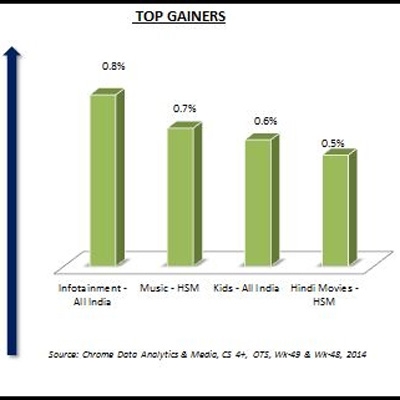
    With 0.8 per cent growth, Infotainment channels across India led the pack of gainers for the week. Discovery with 85.5 per cent OTS continued its reign in the genre.

    It was followed by Music in the Hindi speaking markets (HSM) with 0.7 per cent jump, Kids across India with 0.6 per cent and Hindi Movies in HSM with 0.5 per cent hike. In their respective genres, the channels which topped were MTV with 89.8 per cent OTS, Cartoon Network with 83.6 per cent OTS and Max with 95.9 per cent OTS.

    As for the losers, Business News in the eight metros saw a fall of 1.7 per cent. CNBC Awaaz with 82 per cent OTS gained the most in the genre.

    Sports across India too fell by 1.1 per cent with DD Sports topping the category with 73.2 per cent OTS.

    In the eight metros, English Entertainment and English Movies saw a drop of 1 per cent and 0.7 per cent, respectively. AXN with 63.9 per cent OTS and Movies Now with 68.3 per cent OTS gained the maximum in their respective genres.


  • No MSO carrying more than 386 TV channels in first quarter of fiscal 2014-15: TRAI

    No MSO carrying more than 386 TV channels in first quarter of fiscal 2014-15: TRAI

    NEW DELHI: The maximum number of TV channels being carried by any reporting multi-system operator in the first quarter ending June 2014 of the current fiscal is 386, according to a report by the Telecom Regulatory Authority of India.

     In conventional analogue form, the maximum number of channels being carried by any reporting MSO is 100.

     There were a total of 186 pay channels as reported by broadcasters for which the wholesale channels rates have been taken on record.

     During the quarter ending June 2014, the distribution of “Fox Sports News” channel was discontinued by the broadcaster.

     Apart from All India Radio, there are 243 private FM Radio stations in operation at the quarter ending June, 2014, according to information supplied by the Information and Broadcasting Ministry.

     TRAI said no new DTH license was issued during the quarter ending June 2014.

     At present apart from the Freedish DTH service of Doordarshan, there are six private DTH Operators. All the six private DTH Operators are offering pay DTH services.

     The total number of registered subscribers and active subscribers being served by these six private DTH operators, as reported to TRAI, are 67.57 million and 38.24 million respectively as on 30 June 2014.

     The total number of Internet subscribers has increased from 251.59 million at the end of Mar-14 to 259.14 million at the end of Jun-14 there has been a quarterly growth of 3.00 per cent. Out of which wired internet subscribers are 18.55 million and wireless internet subscribers are 240.60 million.

     Number of broadband internet subscribers increased from 60.87 million at the end of March to 68.83 million at the end of June with quarter growth of 13.07 per cent.

     The number of narrowband internet subscribers has slightly declined from 190.72 million at the end of March to 190.31 million at the end of June with quarterly growth of -0.21 per cent.

     The license fee increased from Rs 3286 crore for the QE March to Rs 3503 crore for the QE June. The quarterly and the year-on-year (Y-O-Y) growth rates of license fee are 6.62% and 13.30 per cent, respectively in this quarter.

     Access services contributed 78.48  per cent of the total Adjusted Gross Revenue of telecom services. In access services, gross revenue, adjusted gross revenue (AGR), license fee and spectrum usage charges increased by 4.64 per cent, 7.81 per cent, 7.62 per cent and 8.61 per cent,  respectively, whereas Pass Through Charges decreased by 2.96 per cent in QE June.


    The Monthly Average Revenue per User (ARPU) for Access Services based on AGR increased from Rs 115.28 in QE March to Rs122.39 in QE June.

     Monthly Average Revenue Per User (ARPU) for GSM service increased by 4.84%, from Rs113 in QE March to Rs 119 in QE June, whereas Y-O-Y increase of 6.72%.

     Prepaid ARPU for GSM service per month increased from Rs 99 in QE March to Rs 104 in QE June, and Postpaid ARPU per month increased from Rs 453 in QE March to Rs 469 in QE June.

     On an all India average, the overall MOU per subscriber per month for GSM service increased by 0.42% from 389 in QE March to Rs 390 in QE June.

    Prepaid MOU per subscriber for GSM service increased from 365 in QE March to 366 in QE June and postpaid MOUs increased from Rs 957 in QE March to Rs 961 in QE June.

     The Monthly ARPU for CDMA full mobility service increased by 6.22%, from Rs 105 in QE March to Rs 112 in QE June. ARPU for CDMA has increased by 13.4% on Y-O-Y basis in this


  • Chrome Data: Week 43 sees marginal gain

    Chrome Data: Week 43 sees marginal gain

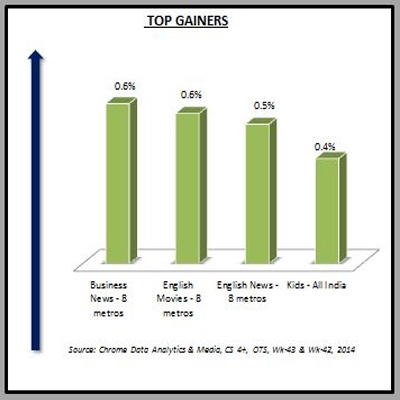
    MUMBAI: The week 43 of opportunity to see (OTS) collated by Chrome Data Analytics & Media had little to rejoice this festive season as it saw a marginal upward trend.


    Business News and English Movie channels in the eight metros saw a jump of 0.6 per cent. CNBC Awaaz with 78.7 per cent OTS and Pix with 75 per cent OTS, topped their genres respectively.


    The two were closely followed by English News channels in the eight metros with 0.5 per cent hike. Times Now with 85.5 per cent OTS continued its reign in the genre.


    Kids channels across India too saw a jump of 0.4 per cent. As usual, Cartoon Network with 76.5 per cent OTS topped the chart.


    The highest loss was witnessed by English Entertainment channels of 1.9 per cent in the eight metros. AXN with 68.7 per cent OTS was on top of the genre.


    Hindi News, Hindi Movies and Hindi GECs in the Hindi speaking market (HSM) saw a drop of 0.6 per cent, 0.05 per cent and 0.04 per cent respectively.


    ABP News with 95.2 per cent OTS, Max with 96.8 per cent OTS and Sab with 97.7 per cent OTS gained in their respective categories.

  • Star’s incentives to MSOs

    Star’s incentives to MSOs

    MUMBAI: The industry could now move to a whole new module of distribution, if Star India is able to successfully attract MSOs to its new formula of distribution.

     
    The national broadcaster has from today decided to give incentives to the multi system operators (MSOs) for carrying its channels. The move will empower the viewer and platforms, usher in a new era of transparency, and boost the entire digitisation eco-system.

     
    Star India, which over the next three to four days will talk to all the platform operators for getting the deals in place, hopes it see the light of the day soon.


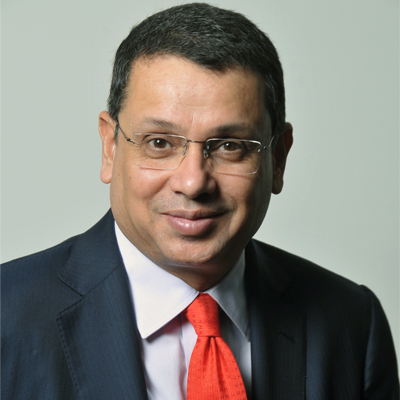
    According to Star India CEO Uday Shankar, the platforms and subscribers have one goal: to save money, while the broadcaster’s aim is to ensure that its content is available to as many people as possible. “We want to create an alignment between both the goals and so have created an attractive incentive plan,” says Shankar.


    The broadcaster has decided to incentivise platform operators, if they meet the three criteria: Firstly, provide more Star channels on its platform, secondly. give it to as many subscribers as it can and thirdly. give easy access by placing the channels in the top LCN on its platform. “The greater the reach of the channel, the cheaper the content would become for the operator,” informs Shankar.


    So why come up with this incentive? Answers Shankar, “Earlier, RIO was the default price on which negotiations took place between the broadcaster and platform operator. Negotiations are a process of give and take. However, because of some of the issues that cropped up in the TDSAT, the Tribunal said that broadcasters must make non-discriminatory deals. But how do you do deals which is equal in a scenario when two parties are completely different, in terms of size, importance of market etc. Hence, we decided that we will offer our content only on RIO.”


    RIO for the first time has been made the trading currency for deals between the broadcaster (Star) and the platform. “And now, in order to make sure that costs for the platform and the subscribers remain in control and manageable, we have decided to give incentives to platforms that help us achieve our goal of maximum reach,” he says.


     “We have done two things. One, made RIO the trading currency and because it is the common currency, it is non-discriminatory and secondly, have created a very transparent alignment between Star’s objectives and the platforms’ goals,” he adds.


    The revised RIO will be in force for one year with digital platforms in DAS areas. And as per the DAS Act, the broadcaster has the right to audit the subscriber details provided by the platform. This will help Star ensure that the MSOs are complying by the figures they present while doing the deal. 


    The one big question now is will the MSOs accept the new system? “The concept has been proven by the DTH operators over the years. They do not sell everything to every customer and instead make sharp packages. The consumer picks the package which is what is offered to them. At a broadcaster level, this is what we are aiming at doing. I think this will work for MSOs as well, if they were to make the packages and sell them.”


    Shankar expects the module to take off soon. “The only way to have Star content on one’s platform is through RIO and so I am sure the MSOs will take this up.”


    The MSO, if accepts all the three conditions: Of taking as many channels, of providing it to all its subscribers and give it on a certain LCN, the incentives could add up to giving the platform a discount of up to 60 per cent.


    “We need to understand that not all the channels will be taken by everyone. So if we take that, then some channels will have 100 per cent penetration, while some may have 80 per cent or 60 per cent penetration and on top of that if you layer it with LCN incentives, then the total benefit to the platform will be very lucrative,” informs Shankar.


    The MSOs, with these incentives, can put the Star channels back in their existing packages.


    So do we see this becoming an industry norm? Says Shankar, “This is a pricing issue and one cannot work as a group on this. We are doing it because of a set of issues that came to us. There were too many litigations and as Star we are clear that we want to be totally transparent of how we do business.”


    Platforms that still opt out of the revised RIO will have the option to choose and take channels as per the original list price.


    Click here to read the full RIO


    Click here to read about the rate card

  • 786 licensed Indian channels as on 31 January

    786 licensed Indian channels as on 31 January

    MUMBAI: The MIB has released the list of permitted private satellite TV channels in India as on 31 January, 2014.

    According to a report published by the Information & Broadcasting Ministry (I&B Ministry), as of 31 January, 2014, the number of permitted private satellite TV channels in the country stands at 786; out of which 389 are news and current affairs channels, while the remaining 397 are non-news and current affairs ones.

    An earlier report published by the I&B Ministry pegged the number of permitted private satellite TV channels in India as on 2 December, 2013 at 784, with 395 of these being non-news and current affairs channels, implying two non-news and current affairs channels have been added to the list between 2 December, 2013 and 31 January, 2014.

    Out of the 786 channels, 664 TV channels have been permitted for uplink as well as downlink from India. 31 TV channels permitted for uplink but not downlink in India and 91 channels have been permitted only to downlink into India (uplinked from aboard).


    Of the 786 permitted private satellite TV channels in the country, 369 news channels and 295 non-news channels have both up-linking and down-linking permission, four news and 27 non-news channels have permission only to uplink, while 16 news and 75 non-news channels have permission just to down-link

    Sometime ago, indiantelevision.com had reported how the I&B Ministry – already under the scanner for being too liberal in issuing licenses to broadcasters – was exercising restraint in a damage control exercise of sorts.

    It doesn’t come as a surprise that the Ministry official list released on 20 December, 2012 had 848 permitted private satellite TV channels which has gone down to 786 in the latest list.

  • Ministry of Home Affairs gives security clearance lifeline

    Ministry of Home Affairs gives security clearance lifeline

    MUMBAI: In a positive move, news broadcasters got a new lease on life when the Indian Home Ministry extended the current three year term of security clearance given to broadcasters to cover the entire duration of the channel’s licence. Currently, licences given to TV channels are for 10 years.

    According to a PTI report, the Home Ministry also mentioned to the Ministry of Information and Broadcasting (MIB) that this was a temporary measure and the issue will be relooked by a committee of secretaries that will then give its final recommendations.

    This comes as a major relief for broadcasters who had been stumped suddely last year when it came to be known that security licences
    given to companies running channels were only valid for three years.
     

    News broadcasters approached the MIB through the News Broadcasters Association (NBA) then to consider the extension of the clearance to 10 years which then wrote to the Home Ministry.
     

    So for now channels can be rest assured that their security clearances will be ‘co-terminus’  with the channel licence.


    However, existing companies will have to seek approval from the Home Ministry  if they want to start a new channel or add a new director to the board.
     

  • India’s Doordarshan selects Harris Broadcast for nationwide digital transition

    India’s Doordarshan selects Harris Broadcast for nationwide digital transition

    NEW DELHI: Harris Broadcast, a market share leader of content management and network infrastructure solutions serving the global broadcast, communication service provider, government and enterprise markets, today announced it has been selected by national broadcaster Doordarshan to deploy a new DVB-T2 transmission infrastructure across the country.


    The government of India is pushing ahead with plans to complete the move from analogue to digital television transmission by 2017. As the leading public service broadcaster in India, Doordarshan has an obligation to cover the whole country and to reflect the diversity of Indian society, including content in the more than 40 languages. At the same time, it is promoting a boost in quality and viewer engagement by rolling out high definition channels, as well as delivering its multi-lingual content across multiple platforms including mobile devices in the future.


    “This is not only a large-scale project for Doordarshan, but it is also one of the most high profile and important projects the broadcaster has undertaken,” said Joe Khodeir, senior vice president Asia at Harris Broadcast. “Our DVB-T2 solution maximises spectrum capacity, allowing Doordarshan to roll out multiple channels serving different communities as well as offer multiple HD channels. For a project of this scope and significance, Doordarshan looked for a partner with a strong local service commitment and presence along with best-in-class technologies that delivered the lowest lifecycle costs.  Our Maxiva™ ULX architecture provides the best power efficiency in the market, which was a critical consideration for Doordarshan when energy consumption is such a large part of the operating cost.”


    The first of two transmission contracts awarded to Harris Broadcast adds HD channels to digital multiplexes in four major metropolitan areas. Each facility will be served with a new 6kW Harris Broadcast Maxiva ULX DVB-T2 transmitter. The second contract is for 19 Maxiva ULX transmitters, which will be used to roll out digital transmission to the regions of India. In the first instance, these will carry standard definition channels in their multiplexes, but the flexibility of the transmitter and infrastructure design allows for an easy upgrade to HD when the time comes.


    The Maxiva ULX is a liquid-cooled, solid-state transmitter built on a modular architecture for maximum flexibility in inputs, transmission standards and power outputs. By incorporating Harris Broadcast PowerSmart® technology, the Maxiva ULX uses the minimum energy for the radiated power, produces less heat and occupies the smallest footprint in the industry. Together, this provides simplified installation, easier maintenance and reduced total cost of ownership over the lifetime of the transmitter.

  • Zee TV and Sony witness a dip in Week 51

    Zee TV and Sony witness a dip in Week 51

    MUMBAI: We are almost nearing the year end and interestingly there hasn’t been much change in the TAM TV ratings through the year. However, the Week 51 has been a good week overall for the general entertainment channels (GECs) as almost all the channels have witnessed a growth in its viewership.

    As per the TVT data sourced from the channel for week 51, Star Plus remains at the first position with 599,179 GVTs (579,369). The new show on the channel Yeh Hai Mohabbatein maintains stable position with 2,836 TVTs (2,821). However, its celebrity dance reality show Nach Baliye 6 saw a drop with 3,766 TVTs (3,918). The epic series Mahabharat continues to grab eyeballs and reported 7,662 TVTs (7,412).

    Colors too maintained its second position with 488,005 GVTs (448,658). The channel has witnessed a hike in almost all its properties. While Bigg Boss seven reported 5,989 TVTs (5,706), 24 scored 3,493 TVTs (2,862) and Comedy Nights with Kapil garnered 8,818 TVTs (7,425).

    At the third position, Zee TV saw a fall in its viewership and marked 408,807 GVTs (439,271). The channel’s sitcom Bh se Bhade witnessed a drop in its viewership and reported 1,459 TVTs (2,021). Its popular dance reality show Dance India Dance 4 lost on its viewership on Saturday and scored 4,061 TVTs (6,304) and remained almost stable at 3,870 TVTs (3,821) on Sunday.

    Life OK stood at number four with 325,759 GVTs (312,956) followed by Sab with 308,658 GVTs (291,060). Sony witnessed a drop in the number of GVTs and scored 254,912 GVTs (266,525). Its non-fiction property, Boogie Woogie Kids Championship saw a drop in its second week and marked at 3,232 TVTs (3,612).

    Sahara One is still lagging behind and is at the bottom of the ratings list with 36,673 GVTs (36,001).

    In the movie channel genre, Zee Cinema reported 222,208 GVTs (208,530); Star Gold registered 163,219 GVTs (167,279) and Movies OK scored 125,734 GVTs (123,361). On the other hand, &pictures notched up and scored 79,261 GVTs (70,567), Zee Anmol marked 64,638 GVTs (65,618) and Max scored 214,123 GVTs (172,165).

  • Chrome Data: Infotainment genre sees a rise

    Chrome Data: Infotainment genre sees a rise

    MUMBAI: While we thought it’s the news stories that the masses are interested in, the fact seems to be something different. While the TV viewers want to munch on news, it seems they also want it to be packaged in a way that’s entertaining and insightful. That’s the reason we assume that the infotainment genre is becoming popular by the day. At least that is what the data in week 51 of Chrome opportunity to see (OTS) reveals.

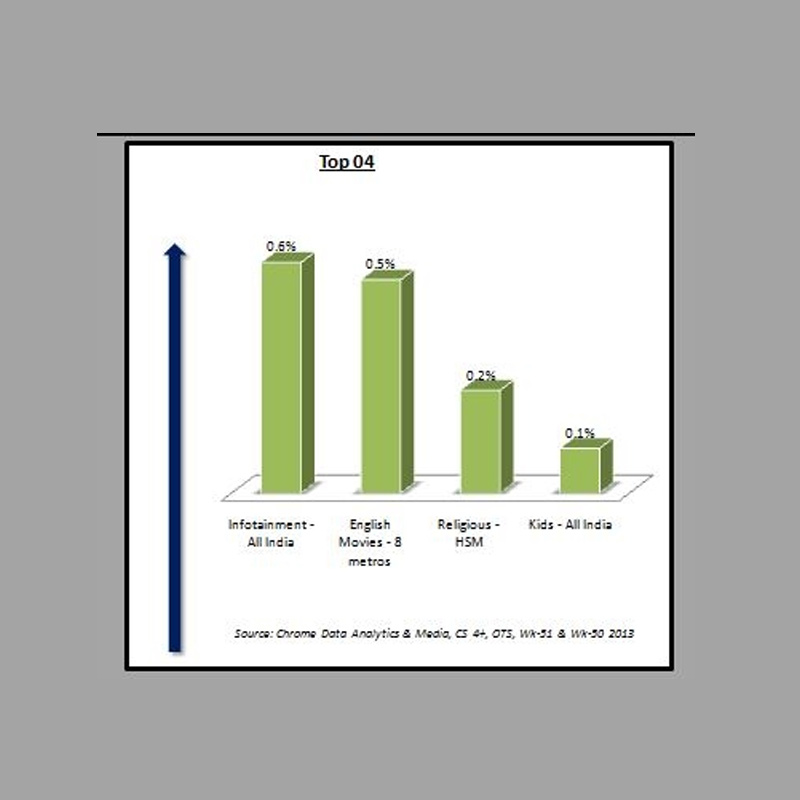
    For the second consecutive week in a row, the infotainment channels have seen a rise. According to the data provided by Chrome Data Analytics & Media, the genre witnessed a 0.6 per cent rise with Discovery Channel garnering the highest OTS among the players in the segment with 88.2 per cent OTS on a national level.

    While last week we thought it was the demise of Nelson Mandela that pulled viewers to the infotainment channels that were airing special features on this magnificent leader, this time there seems to be no specific reason for the genre to be popular. However, the genre is on a roll even at a time when a lot of interesting things are unfolding in the news space. Possibly, the launch of new and interesting shows and new seasons of popular shows is the reason behind bringing audience’s attention to the genre.

    However, movies still seem to be an enticing genre with English movie channels being the second in the list. The genre witnessed a 0.5 per cent rise in the eight metros as Sony Pix continued to woo its target audience and once again remained on top by getting 89.3 per cent OTS.

    The performance of religious channels also bettered as from being in the bottom four, the genre rose up and came at the third position in the Hindi speaking market (HSM). It rose by 0.2 per cent. Spirituality, it seems, is the way to the viewers’ heart; Aastha with its diverse line-up on spiritual shows topped the chart with 98.1 per cent OTS.

    The charm of the holiday season on kids is also reflective in this week’s data as the kid’s genre has witnessed a 0.1 per cent gain on an all India basis. One of the oldest channels in the genre, Cartoon Network, got 87.7 per cent OTS on an all India basis.

    As for the bottom four, English entertainment genre saw a drop of 5.4 per cent in the eight metros. AXN registered 82.9 per cent OTS while others lagged behind.

    Music channels also saw a drop of 0.8 per cent with Sony Mix garnering 87.7 per cent in the HSM. 

    Both English news channels as well as Hindi movie channels witnessed a decline of 0.6 per cent in eight metros and HSM respectively. Times Now ruled among the news channels with 91.6 per cent OTS, while Star Gold got 96.8 per cent OTS.