Tag: Castle Media

  • MAELS 2017: Free traditional media from regulations, don’t impose these on OTT services

    MAELS 2017: Free traditional media from regulations, don’t impose these on OTT services

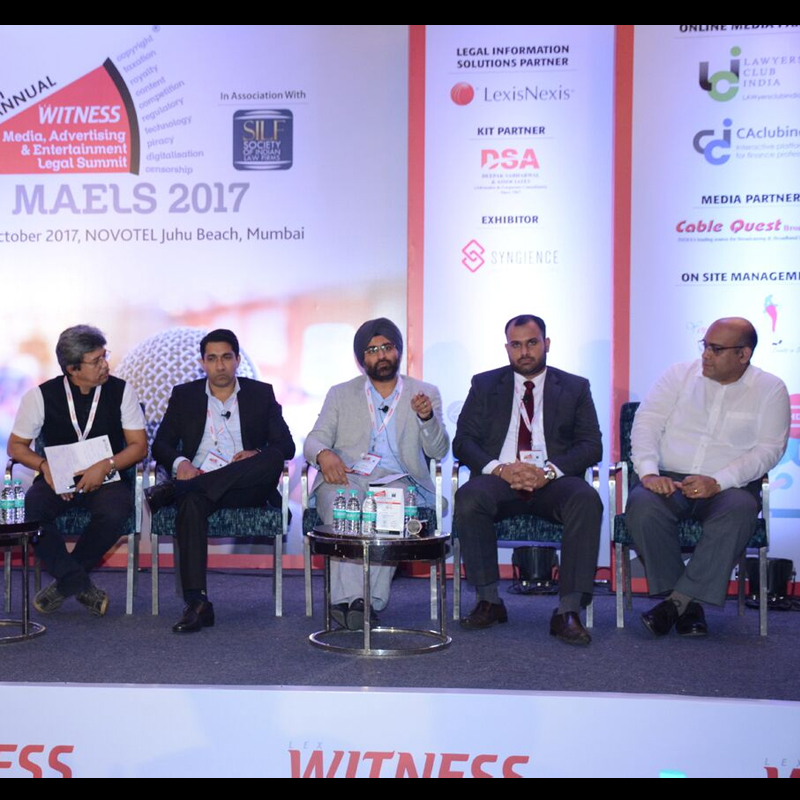
    MUMBAI: Traditional linear television needs to be free from the chains of regulations, and OTT entertainment platforms need to be left clear from any fresh legislation. That was the conclusion of the second panel at the sixth annual Media, Advertising and Entertainment legal summit 2017 which focused on whether the fresh emerging digital communication and entertainment should be allowed to function unfettered.

    The panel discussion on “The New Digital India Wave – An Untamed Beast” moderated by Castle Media CEO Vynsley Fernandes featured Indiantelevision.com founder, CEO and editor-in-chief Anil Wanvari, Alpha Partners associate partner Kunal Arora, Viacom 18 senior vice-president head business and legal affairs Anil Lale, Dhir & Dhir Associates’ partner KPS Kohli and Sony Pictures Entertainment head legal Ayan Roy Chowdhury.

    Wanvari began the discussion by giving a lay of the OTT landscape, emphasising that streaming services, social media platforms, and communication tools such as Snapchat, Skype, Whatsapp, Hike and Messenger, among other, are here to stay and they have seen very rapid uptake.

    “The next six months to a year are really going to see their adoption accelerating even further, courtesy dropping bandwidth prices – which are going to be shaved even further because of competition amongst the telcos,” said Wanvari. “This is going to lead to video consumption becoming more affordable for the masses and the explosion in data consumption will be like we never even imagined.”

    Wanvari pointed out that many of the OTT services have been promoted by broadcasters the services of which are already governed by the Programme Code, the Copyright Act, the Cable TV Regulations Act, and they adhere to strict standards and practices to ensure that they don’t go afoul of the law.

    “Broadcasters rely on self-regulation, and if there is a violation, the Broadcast Complaints Council ensures that the violator is brought in line,” added Lale.

    Arora stated that, as of now, there are no specific regulations governing OTT services – especially the communications services, though a consultation paper was floated by the Telecommunications Regulatory Authority of India (TRAI) in 2015.

    “One concern that I hear from the industry for the non-communication space that content can’t be regulated absolutely, while, for the communication-based OTT, it becomes quite essential to govern the content. For non-communication space, regulation is important from the pricing perspective. Just to keep things moving in the same direction, regulation should be drafted to make sure that the growth of the OTT sector doesn’t hamper or restrict the growth of the traditional sector, ” he added. “Also, with the amount of content flowing over the internet and on OTT services, monitoring and policing each one’s content could be very challenging for any government.”

    Fernandes interjected here saying that technology can intervene here, especially in cases of national security. “In the valley, the government could ask all traditional media to shut down during the time of crisis,” he said. “But, can digital media be controlled so as the servers are located outside India and don’t fall under the country’s jurisdiction?” he questioned.

    To this, Wanvari stated that the controls lie with the authorities as an order from either the TRAI or the home ministry or telecom ministry to the telecom and internet service providers can result in the complete shutdown of the internet in a geographical area which is under threat and totally defuse it.

    “There is this argument of a lack of a level-playing field between traditional media and digital media. There are two kinds of players,” said Arora. “Those which are international, and those which are promoted by indigenous players or groups. You see the more edgy content on the international OTT players, whereas the Indian ones are relatively adhering to the programming and content regulations as mandated for TV.”

    Kohli said, “For digital media there is no regulation. Their content is far more attractive to at least the younger generation because there is a little more skin and possibly abusive language. The traditional media is bound by rules and regulations, and hence it is controlled.”

    Lale mentioned that television has very few controls at the subscriber end, and the Indian families, as a whole, have to watch a little mature content, hence broadcasters have to be more careful. “On digital, because the content is available on your phone or laptop, the content is under your control. If you look at the AVoD service, you will not find content which is more mature – exactly as on TV – but, while on SVoD, you will get content like Games of Thrones. Hence, the payment also comes in this matter. GoT is the example that how regulations should be separated for digital and linear TV,” he said.

    Chowdhury said, “In India, whether we are paying to the service provider or we are paying to the government, in the form of direct-indirect taxes, levy or premiums, we pay for everything. So, there is no reason for the consumer to not shift from non-paying audience to paying audience. Also, the access cost is very less, so it is happening.”

    The panel was totally in agreement that there are enough regulations in place right from the Indian Penal Code, the Copyright Act, to haul up violators, if any, even on the piracy front. “The basic issue of piracy is enforcement. We don’t need a separate regulatory body for OTT services. We have self-regulation,” said Kohli. The government has the EMMC and IPC and various acts to stop the piracy on the web. But, the issue is who’s going to execute, whether you go to the police and enforce it, or is there any technical way of enforcement.”

    Roy Chowdhary proferred that, “Basically, enforcement should come from technology but telecom providers don’t want any controls as more data that is consumed the more they earn. But, if they are not open to cracking down on it, we can turn to blockchain which has an answer to it, which to a large extent curtails piracy.”

  • Friend MTS-Castle Media to tackle Bollywood’s digital piracy using unique watermark tech

    Friend MTS-Castle Media to tackle Bollywood’s digital piracy using unique watermark tech

    MUMBAI: Piracy is a serious challenge to the entertainment industry in India. In fact, according to the Motion Pictures Distributors Association of India (MPDA), India country is infamous for having one of the highest rate of video piracy in the world. Lack of stringent IP protection laws to counter exponential growth of online piracy has made matters worse. In 2008 alone, the industry lost close to USD 4 billion (Rs 27,000 crore) to piracy, going by Ernst & Young estimates. By 2016, the figure may have doubled by conservative extrapolation.

    Birmingham-based content protection service Friend MTS sees a business opportunity in bringing back this large sum of non-monetised revenue back to the content-owners in India. Friend MTS is leading a delegation to India that will investigate the escalating problem of digital piracy.

    “As pioneers in the creation and provision of content protection services, already used by many of the world’s Pay-TV operators, rights holders and broadcasters, we want to engage with the country’s movie producers and work with them to effectively fight the increasing threat to the revenue of premium channels and rights holders,” said Friend MTS’ global sales & marketing EVP Paul Hastings.

    Friend MTS has already established the company’s base in Chennai, with Rahul Nehra overseeing its India operations. He works with India’s film studios, broadcasters and content owners to help protect them from unauthorised redistribution of their live and premium on-demand content.

    Film producers and content rights owners such as Kollywood’s Venkat Prabhu is excited “at the prospects of having FMTS track and contain on-line piracy” and are hopeful this will give them a significant upside in local and global revenues. Tamil Film Producers Council secretary T Siva, a film producer at Amma Creation, said, “The industry welcomes these initiatives on digital anti-piracy.” Friend MTS had already helped secure Bollywood movies like Baahubali and Pink against piracy.

    India is the biggest film producer in the world making between 1500 and 2000 movies each year, including the cult Bollywood movies.

    “By teaming up with our local partner, Rahul Nehra, a well-known face in the Indian broadcast, satellite, content and OTT markets, and growth consultants from Frost Sullivan, the event and our delegation will be an unprecedented forum for discussing India’s spiraling digital piracy problems and how together we can work to stop it,” Hastings shared.

    To help the international player understand the complex Indian media ecosystem, it has made an alliance with Castle Media. To guide its penetration in the southern market, it is relying on Novacom. Friend MTS’s flagship service titled ‘Studio’ is designed to identify instances of pirated movies on the internet, and is being used by some of the largest content-owners in the world.

    In 2012 India was added to an ‘International Piracy Watch List’ by a U.S. government panel looking to highlight countries not taking sufficient action to address high rates of digital piracy. According to a 2013 article in WIPO Magazine (the journal of the World Intellectual Property Organization), the Indian film industry loses around US$3.34 billion and some 60,000 jobs every year because of piracy.

    Identifying each copyright violator by generating unique watermark within the content for each user is what Hastings calls is the technology’s USP. “It uses a sophisticated but lightweight fingerprinting technology, coupled with our global monitoring platform and network forensics, to identify and enforce against websites and apps that are being used deliver illegal content,” he added.

    In India Friend MTS is already operational for a leading broadcaster, and in talks with pay TV platforms, OTT service providers, and content makers, to ensure it catches up to its vibrant international clientele. “We deliver digital anti-piracy services for a wide range of customers including content owners such as Viacom and Paramount, sports rights holders such as the English Premier League, Serie A (Italian Football League), UFC, WWE, the International Olympic Committee and leading Hollywood studios. We also protect tier one pay-TV operators such as Sky, BT, nc+ (Poland) and OTE (Greece) delivered via satellite, cable and OTT,” Hastings added in parting.

  • Friend MTS-Castle Media to tackle Bollywood’s digital piracy using unique watermark tech

    Friend MTS-Castle Media to tackle Bollywood’s digital piracy using unique watermark tech

    MUMBAI: Piracy is a serious challenge to the entertainment industry in India. In fact, according to the Motion Pictures Distributors Association of India (MPDA), India country is infamous for having one of the highest rate of video piracy in the world. Lack of stringent IP protection laws to counter exponential growth of online piracy has made matters worse. In 2008 alone, the industry lost close to USD 4 billion (Rs 27,000 crore) to piracy, going by Ernst & Young estimates. By 2016, the figure may have doubled by conservative extrapolation.

    Birmingham-based content protection service Friend MTS sees a business opportunity in bringing back this large sum of non-monetised revenue back to the content-owners in India. Friend MTS is leading a delegation to India that will investigate the escalating problem of digital piracy.

    “As pioneers in the creation and provision of content protection services, already used by many of the world’s Pay-TV operators, rights holders and broadcasters, we want to engage with the country’s movie producers and work with them to effectively fight the increasing threat to the revenue of premium channels and rights holders,” said Friend MTS’ global sales & marketing EVP Paul Hastings.

    Friend MTS has already established the company’s base in Chennai, with Rahul Nehra overseeing its India operations. He works with India’s film studios, broadcasters and content owners to help protect them from unauthorised redistribution of their live and premium on-demand content.

    Film producers and content rights owners such as Kollywood’s Venkat Prabhu is excited “at the prospects of having FMTS track and contain on-line piracy” and are hopeful this will give them a significant upside in local and global revenues. Tamil Film Producers Council secretary T Siva, a film producer at Amma Creation, said, “The industry welcomes these initiatives on digital anti-piracy.” Friend MTS had already helped secure Bollywood movies like Baahubali and Pink against piracy.

    India is the biggest film producer in the world making between 1500 and 2000 movies each year, including the cult Bollywood movies.

    “By teaming up with our local partner, Rahul Nehra, a well-known face in the Indian broadcast, satellite, content and OTT markets, and growth consultants from Frost Sullivan, the event and our delegation will be an unprecedented forum for discussing India’s spiraling digital piracy problems and how together we can work to stop it,” Hastings shared.

    To help the international player understand the complex Indian media ecosystem, it has made an alliance with Castle Media. To guide its penetration in the southern market, it is relying on Novacom. Friend MTS’s flagship service titled ‘Studio’ is designed to identify instances of pirated movies on the internet, and is being used by some of the largest content-owners in the world.

    In 2012 India was added to an ‘International Piracy Watch List’ by a U.S. government panel looking to highlight countries not taking sufficient action to address high rates of digital piracy. According to a 2013 article in WIPO Magazine (the journal of the World Intellectual Property Organization), the Indian film industry loses around US$3.34 billion and some 60,000 jobs every year because of piracy.

    Identifying each copyright violator by generating unique watermark within the content for each user is what Hastings calls is the technology’s USP. “It uses a sophisticated but lightweight fingerprinting technology, coupled with our global monitoring platform and network forensics, to identify and enforce against websites and apps that are being used deliver illegal content,” he added.

    In India Friend MTS is already operational for a leading broadcaster, and in talks with pay TV platforms, OTT service providers, and content makers, to ensure it catches up to its vibrant international clientele. “We deliver digital anti-piracy services for a wide range of customers including content owners such as Viacom and Paramount, sports rights holders such as the English Premier League, Serie A (Italian Football League), UFC, WWE, the International Olympic Committee and leading Hollywood studios. We also protect tier one pay-TV operators such as Sky, BT, nc+ (Poland) and OTE (Greece) delivered via satellite, cable and OTT,” Hastings added in parting.

  • Change in investor mindset needed for MSOs to chart growth path

    Change in investor mindset needed for MSOs to chart growth path

    GOA: While the direct-to-home (DTH) sector has managed to attract investment from private investors because of its growth, the cable industry will be able to do so only if multi-system operators (MSOs) add broadband to their services.


    This was the general consensus of a session on ‘Investing in Digital assets – Gems and long bets’ at the ongoing Indian Digital Operators Summit (IDOS) 2015 organised by Indiantelevision.com and Media Partners Asia.


    HSBC Securities and Capital Markets (India) Pvt Ltd director of analyst telecoms, media and Internet Rajiv Sharma said that DTH had gained as it has shown growth in terms of average revenue per user (ARPU), and innovation.


    While the stocks of cable industry initially went down, a reading of the figures of both cable and DTH showed that there was some recovery towards the end of the year. “The MSOs have not matched up to expectations, partly because of MSO-local cable operator problems,” Sharma said.


    In the session moderated by Castle Media ED Vynsley Fernandes, Sharma said that broadband can be the catalyst, which can bring in growth but only one or two MSOs have entered the broadband space.


    “The scale of growth is directly linked to attracting investments. If LCOs (local cable operators) can show that they own subscribers, they will get investment,” Sharma said. However, he was quick to add that broadband infrastructure and broadband compliant STBs (set top boxes) would help.


    Asked about collaborations, Sharma said that the media can learn a lot from telecom where networking and collaborations led to the government thinking in terms of letting them sell or share spectrum. “Telecoms focus on revenues to share, while the cable industry wants finance for set top boxes,” he said.


    Replying to a question about the slow growth of broadband in the country, he said, “Anything that is wireline will grow slowly whereas wireless will grow much faster. The consumer is willing to pay but it is for the government to facilitate this.”


    Sharma also added that the quality of management, profitability and network will attract investments. He regretted that the cable industry had failed to learn any lessons from the first two phases of the Digital Addressable Systems (DAS).


    Concurring with Sharma, MPA executive director Vivek Couto added, “Investors reward growth and DTH did exactly that.” However, he was of the opinion that the last mile operator (LMO) will consolidate under the Headend In The Sky (HITS) platform and that may change the situation. “The results will begin to show in the three to four years,” he said.


    Referring to NXT Digital, which was prepared to offer funding, he said that LMOs may now come forward.


    Couto added that while organized MSOs were doing well, investment in broadband in the short term would bring in benefits in the long term.


    In reply to a question, he said that India was the only country where content generation was growing. “But in all this, the cable industry was feeling lost,” he opined.


    Indiantelevision.com founder CEO and editor-in-chief Anil Wanvari had the last word when he said that the mindset of investors had to change as few MSOs in India could today afford the kind of growth their counterparts had shown in foreign countries.


    In another session, Maharashtra Cable Operators Foundation president Arvind Prabhoo and Sagar E-Technologies executive director Sudhish Kumar agreed that the cable industry had to organise itself better if it was to attract investments and grow in the digital era.


    Prabhoo said he had succeeded to an extent in this by getting the LCOs to be seen as the last mile operator (LMO). In an example of how the LMOs can grow, he said, “30 LMOs in Nagpur have joined together to form an MSME and were not prepared to invest in other LMOs,” he said.


    He added that if investors put in money to help create model services, there will be a major change in the next six months or so. “If cable operators offer other services through their STBs, there will be a churn in the industry,” he said.


    Kumar, who has a headend in Bangalore, lamented that finance was a major problem. “One STB cost around Rs 1500, but some of the larger MSOs sell boxes for around Rs 1000 and this forced others to sell at lower rates, which in turn results in a loss,” he said.


    Emphasising on the fact that MSOs were not concentrating on marketing, he said that if they did, it would help in consolidating the industry.


    Citing his own example, he said that he had not lost a single LMO despite having had ups and downs in his company because of the faith reposed in the company.

  • NXT Digital to use Thomson Video Networks’ compression technology

    NXT Digital to use Thomson Video Networks’ compression technology

    MUMBAI: Hinduja Group’s headend in the sky (HITS) platform NXT Digital will use Thomson Video Networks’ compression technology.


    Thomson Video Networks has provided a wide range of equipment and solutions for the broadcast centre and master headend platform, including its Vibe SD and HD broadcast encoders and its multiplexing and network management system.


    “We designed our HITS system to deliver best-in-class picture quality with a robust architecture and the highest level of uptime. To make that design a reality, we needed a world-class digital delivery platform to reach the network operators across India from a centralised location, and Thomson met our requirements,” said Grant Investrade managing director Tony D’Silva.


    “NXT Digital is here to help the distribution community in analog markets make a smooth and timely transition to digital, and we are hopeful it will help write what could perhaps be the biggest chapter in the ‘Made in India’ story,” he added.  


    “Thomson Video Networks’ compression technology with advanced statmux features will give us pristine broadcast picture quality at lower bandwidth consumption. The solution is flexible and future-proof, and Thomson Video Networks has a strong local presence, which is an important requirement of the project,” said Castle Media executive director Vynsley Fernandes.


    NXT Digital is scheduled to roll out pan-India services in 2015, and tests of various components of the business are underway.


    “The Hinduja Group is one of the leading business houses in India and one with a global footprint. GIL’s selection of our compression chain will increase Thomson Video Networks’ market share in the satellite segment in India, push the company to among the top compression vendors in the region, and also boost overall market share substantially. This significant project will further strengthen our presence in Southeast Asia,” said Thomson Video Networks vice president, worldwide sales Eric Louvet.

  • MCOF conclave stresses on importance of broadband for LMOs

    MCOF conclave stresses on importance of broadband for LMOs

    MUMBAI:  It has been touted as one of the leading get together of the last mile owners (LMOs) in Maharashtra. The Maharashtra Cable Operators Federation (MCOF) National Conclave on Broadband and Cable (NCBC) 2014 saw its president Arvind Prabhoo put his best foot forward in trying to get the LMOs to buy into his vision of a digitised cable TV India where they are also prospering. Apart from formally launching Synergy Cable Operators Private Limited (SCOPE), the first Cable Virtual Networks Operator (CVNO), Prabhoo and a handful of industry vets and consultants, stressed on the importance of broadband and how LMOs could increase their business five-fold, using this tool.


    Prabhoo pointed out that number of active broadband subscribers in India is expected double in the next two to three years according to a Telecom Regulatory Authority of India report.  In Mumbai alone, the figure is expected to go up from the current 1.2 million to 4.5 million in the next couple of years. “Broadband will grow, and we need to utilize this opportunity,” Prabhoo said.


    Drawing comparisons with the US where 50 per cent of broadband services are provided by cable operators, he said, “We need to implement the same in India. As things stand, only a fraction of the broadband subscriber base is delivered by cable operators.”


    Apart from the emphasis on broadband, day one of NCBC 2014 saw heated debate over the existing three models i.e. MSO:LMO, HITS and the newly-minted CVNO, which seeks to provide white label cable TV services to smaller operators in phase III and phase IV.


    Presided over by indiantelevision.com founder, CEO and editor-in-chief Anil Wanvari, the session had all parties putting forth their points of view. The panel comprised Kulbhushan Puri of BR Cable Network, Atul Saraf of ABS Seven Star, Vynsley Fernandes of Castle Media, and Prabhoo.


    During the discussion, Wanvari expressed the view that the full rewards of digitisation have yet to trickle down to the broadcaster, MSO or LMO – as they viewed each other with suspicion, though things have improved in recent times. “There is a need for greater communication and understanding among the stakeholders,” said Wanvari. “The LMOs and MSOs need to understand that broadcasters are investing in content and they need to recoup that investment.  Broadcasters need to understand MSOs are investing in setting up infrastructure and that LMOs want a sustainable future. The cable ecosystem also needs to understand that broadband can be extremely rewarding as compared to simple video signals where subscribers tend to be wary of price increases.”


    To this, Prabhoo invited all stakeholders to come together to discuss issues and take the industry forward while benefitting everyone. “Proper constructive pricing model can be worked out if broadcasters, MSOs and LMOs discuss issues on the same platform,” he said.


    Fernandes, who is involved in the upcoming HITS project of the Hinduja Group, said, “Packaging of content should be in the hands of the LMOs. Additionally, the LMOs need to invest in set top boxes which they will deliver to their subscribers so that ownership stays with them. And this is what the HITS project is set to do.”


    Prabhoo said that while there will be areas covered by the CVNO in phase III and IV of DAS called Headend on the Ground (HOGS), there would be some covered by HITS (Headend In The Sky). “There could also be areas where HITS and HOGS can work together to take digitisation forward,” proposed Prabhoo.


     Saraf said the future of DAS phase III and IV lay in MPEG4 and not MPEG2 STBs that were currently being seeded by operators. On the issue of low ARPUs in phase I and II, he said, “ARPUs can go up only by introducing value added services like Video on Demand (VOD), Movie on Demand and YouTube. We need hybrid STBs, which can provide both cable and internet services.”