MUMBAI: Shrachi Sports Entertainment Network (SSEN), a dedicated sports OTT platform, has placed a bid for the broadcasting rights of the FIFA World Cup 2026 and 2030, valued at roughly 2 million dollars (Rs 18-20 crore). If successful, SSEN intends to stream both tournaments entirely free to viewers in India, Bangladesh, Sri Lanka, Bhutan, Nepal and the Maldives.
The bid signals a shift in sports broadcasting strategy, prioritising accessibility over subscription revenue. “This is more than a business move. It is a commitment to inclusivity and reshaping football consumption in the region. By offering the FIFA World Cup free to fans, we are democratising access and laying the foundation for a long-term legacy,” said SSEN chairman Tamal Ghosal.
SSEN already streams marquee events including the Calcutta Football League and the I-League, and is the first Indian platform to cover the Women’s Bundesliga and the German Handball Bundesliga. The network’s move positions India as an emerging hub in the global football narrative while placing fan access at the centre of its strategy.
MUMBAI: The outpour of ecstasy and glamour in the first edition of Indian Super League (ISL) easily outclassed the other existing Football leagues in India. Subsequently, pundits and authorities began debating if other leagues should stay or be merged into one.
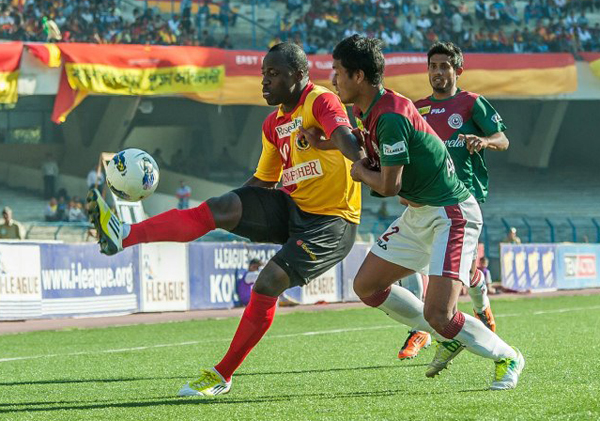
Silencing all cynics are the ratings of the Calcutta Football League (CFL) derby match between Mohun Bagan FC VS East Bengal. Aired on Star India’s regional channel Star Jalsha, the derby match garnered highest ever ratings for a CFL match.
Approximately 82,000 spectators were at the edge of their seats in the stadium for the match’s entire 90 minutes duration, while 16.3 lakh people tuned in to Star Jalsha to watch it live. The average time spent was a whopping 58.4 minutes. The match garnered a rating of 4.45 per cent in NCCS 4+, in M 15+ ABC marker the match clocked six per cent ratings while the reach garnered is 10.2 per cent in NCCS 4+.
Star India gives much importance to the production quality and that’s one of the reasons why ratings are going up. “I believe that the ratings will go even higher the next time,” says Grey Mind productions founder Anilava Chatterjee. “We deployed 14 cameras this year and we are improving the production quality every match thanks to Star. The quality of football is getting better. Overall, the league has a great future,” he adds.
A football commentator, on condition of anonymity, said, “I have no doubt that the domestic leagues in India in some regions have more fan following than ISL. Sports now is a matter of packaging and Star is a master in that. That’s why ISL looks so colourful. Spend the same amount of money in local football and that will also look glamorous. From a football follower’s perspective, I feel India needs both and a merger can turn out to be a debacle.”
“Local football has potential of revenue generation if and only if it is packaged properly. Also the domestic leagues can be of huge benefit for broadcasters as the acquisition costs are low. Now it’s for IMG and the authority to decide if a merger is the solution,” added a veteran in media selling fraternity.
Football in India has failed to attract the youth and one of the main reasons behind it is lack of ideologies. Former Indian skipper Sourav Ganguly has often made a point at various public gatherings, “Youth in the country, while growing up wants to be like Gavaskar, Sachin and Dravid. When they will have idols in football, the sport will grow enormously.”
Recently former India football skipper Baichung Bhutia also expressed his disagreement on a merger. Now it remains to be seen if high ratings saves the domestic leagues from getting diminished.
MUMBAI: Sports is a lucrative genre for broadcasters as advertisers fritter huge sums of money for both on-ground and on-air sponsorships. However, the bang for their buck is received only when the camera lens captures their brand. Moreover, viewers too expect an exquisite exhibition of imagery on their television screen for sporting events. All this and more is tirelessly taken care of by the sports production unit deployed on the field.
At a time when ‘sports’ in India is synonymous with ‘cricket’ as ‘photocopy’ is to ‘Xerox,’ Kolkata based Greymind Communications aspires to be the lenses covering all the football matches in the Indian sub-continent as well as in South East Asia.
Greymind Communications founded by Anilava Chatterjee and Aniruddha Goharoy kicked off its journey in 2006 by producing the live telecast of Sahara Kolkata Premier League. The matches were shown on the Bengali news channel 24 Ghanta for two consecutive years (2006 and 2007). Greymind also produced 33 live matches of Calcutta Football League (CFL) for Star Network and matches were shown on Jalsa Movies this year. Last year, the company produced 65 live matches for same network in CFL and IFA Shield.
Speaking exclusively to Indiantelevision.com, Chatterjee asserts, “We have traveled a long distance since our inception and there are miles to go as we have high aspirations. When we started our journey in 2006, the scenario was different in India. Now it’s getting better everyday, which is a huge encouragement for us. Last year we covered CFL for Star India and I must say Star has raised the bar with their quality conscious quotient. The experience with CFL 2014 – 15 was a morale booster for us. The matches had thrill and the crowd liked it. We managed to get highest ever television ratings for the sport.”
Having their share of covering big-ticket matches of international magnitude, Greymind also shot the Argentina VS Venezuela match featuring Lionel Messi in Salt Lake Stadium Kolkata. “The stadium had more than one lakh spectators screaming Messi’s name and there were billions across the globe sitting in front of television screens to see Messi dribbling and dodging. We covered the Argentina VS Venezuela match in 2011 in HD and it was indeed a great experience. We deployed 16 cameras with one fixed on Messi. The match was going to be covered worldwide and there was no room for a glitch. I am happy to say that we successfully covered the match,” Chaterjee adds.
While 16 cameras in a football match is not that big a figure as the UEFA Champions League, English Premier League and other important football tournament matches are covered by as many as 32 – 40 HD cameras with a camera fixed on each player. On the other hand, a few of them focus on the crowd, managers, staffs and officials. In that sense, there is a lot yet to be done in India. Greymind produced I League 2014-15 with 11 cameras whereas IMG covered Indian Super League (ISL) with 17 cameras.
Speaking on the difference in production quality, Chatterjee says, “The quality is directly proportional to the production investment, which is gradually increasing with time in India. This year I League’s production was better than previous year’s. Also, besides production investment, there are a few relevant factors too, on which the quality depends. For example, a match in Salt Lake stadium with lesser crowd will look bad on screen no matter what. So a Kolkata Derby with the same number of cameras in the same stadium looks way better than any other match because of the house full stadiums. In Europe or America. the stands are always full.”
Besides camera there are other technical aspects too which makes football look the way it does on screen feels Chatterjee sharing his experience he asserts, “I went to Brazil to see the world cup matches both how teams are playing as well as how it is produced, they use an analytical software called Deltatray which gives live analysis of how much a player ran and other individual statistics the cost of that software is more than the entire production cost in India.”
In India production cost for an I League, CFL or an international match is around Rs 7 lakhs for Standard Definition (SD) coverage and can go up to Rs 10 lakhs for High Definition (HD) coverage. IMG produced ISL’s production cost goes as high up as Rs 30 lakh per match.
“ISL has rejuvenated the entire football fraternity and I expect it to grow bigger and better with time. The tournament garnered huge viewership on television and the stadiums were also houseful. If football becomes big in India, production standards will also go up,” says Chatterjee.
Stepping up on their game, Greymind’s will be producing India’s World Cup qualifiers (four matches) on behalf of IMG this year. The first match is scheduled to be played against Oman on 11 June, 2015 in Bengaluru.
“This would be a huge challenge for us and we are really looking forward to this event. Getting to cover on behalf of IMG is a big achievement for us and it’s also an opportunity to make a mark on the international market. It will be a high definition coverage and will be aired on Sony Six,” informs Chatterjee.
When queried as to whether there was a gap in skill, which effects the execution, Chatterjee says, “I don’t think there is a huge difference in skill. It’s the investment that’s different. We deploy around 70 skilled technicians who have the potential to work on numerous systems and cameras. It’s the basic that matters. Technicians equipped with strong basic will be able to work on any system.”
Quality TV production in Indian Super League has already created a major impact on Indian football and the same stands true for I League and West Bengal State League (aka Sahara Kolkata Premier League). Last year, TVR for Kolkata Derby, which was produced for Star Sports and aired on Jalsa Movies, was higher than World Cup Football final in this market. Efforts are made to enhance the standard of TV production through innovations and expertise. This year, Greymind used super slow motion camera and drone camera to add more values in I League matches.
Looking ahead, the company aspires to emerge as a strong player in South East Asian market and is also looking to strengthen its digital production by launching a website and promote shows like Extra Time.
“Our goal is to make the sports competitive, widely watched, media and sponsor friendly through high quality TV production and build up stars who would be the iconic faces for football in India. Our primary target is to produce quality live football shows in South Asia. We firmly believe that quality and standard of football largely depends on quality of TV production. So the South Asian countries, who are not doing well in terms of FIFA ranking and domestic league, can be given best quality TV production,” Chatterjee concludes.