
Tag: CAGR

  • Premium content to drive mobile industry

    Premium content to drive mobile industry

    MUMBAI: Mobile data services are the next wave of growth for the mobile communications industry amid the increasingly saturated subscriber base.

    While messaging will continue to be the main revenue contributor in most emerging and developing mobile data markets, much of the growth potential also lies in premium content. Greater 3G (third generation) coverage and deployment, expanding regional subscriber base, declining cost of advanced multimedia handsets, and the race to secure a continuous stream of content through partnerships are likely to drive growth of mobile data revenues.

    New analysis from global growth consulting company, Frost & Sullivan Asia Pacific Premium Content Market, reveals that the market – covering 13 major Asia-Pac economies – earned revenues of $9.4 billion in 2005 and is estimated to reach $32.9 billion by end-2011.

    Frost & Sullivan industry manager Janice Chong says, “Subscribers in most Asia-Pac countries have strong preference for local content, which creates the impetus for the fast-growing mobile content market. The pace of 3G adoption, to a certain extent, influences the development of premium content applications by providing greater bandwidth and faster data transmission.”

    The Asia Pacific mobile data market is forecast to grow at a CAGR (compound annual growth rate) of 17.9 percent between 2005 and 2011. Messaging revenues still constitute the majority of operator-generated data revenues. In 2005, messaging accounted for approximately 39.6 percent of total operators’ data revenues (excluding revenue share of third-party content providers).

    The total premium content market, which includes both operator and third-party content provider revenues, held 29.5 percent of total mobile data revenues in 2005, and is expected to register a CAGR of 23.2 percent from 2005 to 2011.

    In certain Asia Pacific countries, the revenue share ratio skews in favour of mobile operators. As a result, content providers receive a small revenue split. Moreover, content providers are required to pay hefty royalties for applications to music label companies and associations. These factors have in some ways hindered the growth of the premium content industry in selected countries. While the revenue share model employed in Japan, South Korea and China may seem relatively favourable to content providers, similar business models may not apply to other countries across the region.

    Chong adds, “In markets such as Indonesia and the Philippines, mobile operators typically retain 60 to 70 per cent of the revenue from sale of content, while content providers receive the remaining smaller portion.

    “Content providers in such countries believe that they deserve a larger revenue share considering that the cost of content development is entirely borne by them.”

    This however is inherently characteristic in markets outside of Japan and South Korea, primarily due to the high use of SMS (short messaging services) based applications which contribute to low data traffic usage. The lack of a satisfactory level of revenue from data traffic usage would mean that operators will tend to seek a higher revenue share from content downloads to compensate for the low data traffic revenue.

  • Zee Telefilms to launch Marathi news channel ’24 Tas’

    Zee Telefilms to launch Marathi news channel ’24 Tas’

    MUMBAI: Zee Telefilms Ltd. chairman Subhash Chandra is giving his news business a big push. His latest plan of action: to launch a Marathi news channel by the end of this year.

    Zee News Ltd (ZNL), the company which houses the news and regional channels, plans to invest Rs 1 billion over three years for this venture. 24 Tas (24 hours), as such, will become the first channel in the Marathi news space.

    “We plan to launch the Marathi news channel by December-end. Our projected investment for this is Rs 1 billion over a three-year period. We are putting the equipment in place,” says Zee News Ltd. director Laxmi Goel.

    More local language news channels are on the agenda. Goel had earlier told Indiantelevision.com that the company would launch news channels in the southern languages. Zee already runs a Bengali news channel through a joint venture with Akash Bangla.

    ZNL, will also be appointing a chief executive officer soon, said Goel. The company is also planning to launch a Tamil and a Malayalam channel to cover up all the southern language states.

    The company expects to post a 33 per cent compound annual growth rate (CAGR) over the next five years to touch revenue of Rs 8.7 billion by FY 2011, up from Rs 2.01 billion in FY 2005-06. ZNL’s operating margins, which stood at 16 per cent, are expected to expand to around 30 per cent during this period.

    ZNL has a networth of Rs 1.7 billion. The capital employed (as of 1 April 2006) is Rs 2.31 billion with loan funds standing at Rs 612 million.

    Chandra’s expansive news plans include the recent acquisition of a majority stake in United News of India (UNI), a news wire agency, which will give him access to a widely spread out infrastructure.

  • IPTV subscriber base set for explosive growth: iSuppli

    IPTV subscriber base set for explosive growth: iSuppli

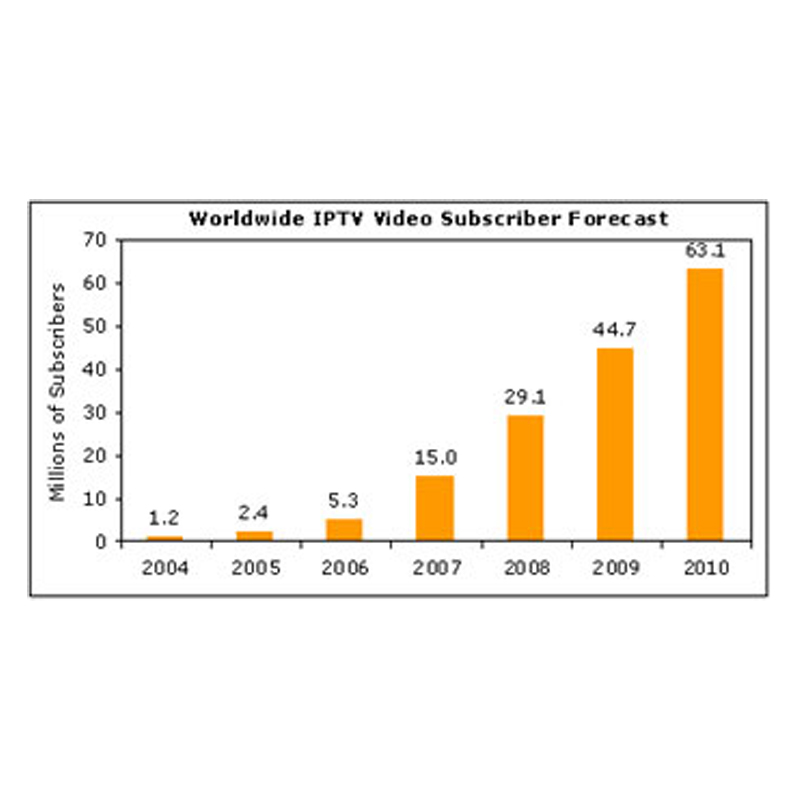
    MUMBAI: The worldwide subscriber base for Internet Protocol Television (IPTV) services is expected to expand by a factor of more than 26 from 2005 to 2010, spurring a competitive battle between video providers both old and new, iSuppli Corp. predicts.

    Global IPTV subscribers will grow to slightly more than 63 million in 2010, rising at a stunning Compound Annual Growth Rate (CAGR) of 92.1 per cent from 2.4 million in 2005, as presented in the figure below.

    The IPTV subscriber base will generate more than $27 billion in overall IPTV services revenue in 2010. While video services will account for the largest portion of these dollars, value-added media services and IPTV operator advertising will combine to represent more than 14 per cent of IPTV services revenue in 2010. Furthermore, across all IPTV services, the corresponding content licensing revenue will reach $11 billion in 2010.

    “The fight to capture the expanding base of IPTV subscribers will put telecom operators on a collision course with existing pay-TV market competitors and with a new class of broadband video portals as they roll-out progressively more sophisticated offerings,” said iSuppli vice president multimedia content and services Mark Kirstein.

    iSuppli categorises market deployment of IPTV services in three phases. The current global IPTV market is early in its first phase: basic service deployment. The second phase will add an array of value-added and interactive services. Phase three will bring dramatic improvements in integration and interactivity.

    Thus, in this pending battle for subscribers, providing a competitive video offering is merely the cost of entry for IPTV operators. Differentiation of IPTV services will be essential to bringing new capabilities to TV-based entertainment and attracting subscribers.

    Areas of differentiation will include:

    Interactivity, such as communication, community, voting, interactive advertising and television commerce (t-commerce).

    Integration across multiple platforms, across voice and data services and across content types, i.e. video, voice, music, gaming, data services and user content.
    Personalisation, including intelligent TV recommendations, individualised advertising and non-linear video programming, such as Video on Demand (VoD) and Digital Video Recording (DVR).

    Value-added services, including on-demand gaming, music, media applications, home networking management, security and data.

    Beyond the video service providers themselves, an array of companies will benefit from new opportunities arising from their roles as the “arms suppliers” for the battle over the next generation of television distribution. These companies include infrastructure gear manufacturers, set-top box makers, software vendors and semiconductor suppliers, iSuppli predicts.

    On a geographic basis, the European market has taken the early lead in the global IPTV market, both for subscribers and for revenue. However, Asia will generate faster growth than the other regions and will achieve the largest subscriber base by the end of this year. The Americas region will lead the world in terms of IPTV dollars starting this year because it will yield the highest Average Revenue Per User (ARPU).

  • Indian media Rs. 837 bn by 2010: Ficci

    Indian media Rs. 837 bn by 2010: Ficci

    DELHI: The Indian entertainment and media (E&M) industry is poised to grow at 19 per cent compound annual growth rate (CAGR) to reach Rs 837.4 billion by 2010 from Rs. 353 billion (Rs 35,300 crore), according to a new study.

    The television segment is slated to grow from its present size of Rs 148 billion to Rs 427 billion by 2010, according to a Federation of Indian Chambers of Commerce and Industry ( FICCI) and PricewaterhouseCoopers (PwC) report titled Indian Entertainment and Media Industry — Unravelling the potential.

    The radio sector is projected to grow four times to Rs.12,000 million by 2010, while filmed entertainment is slated to reach Rs 153 billion during.

    The print medium, according to the study is poised to grow from the present size of Rs 109 billion to Rs 195 billion.

    Economic growth, rising income levels, consumerism, coupled with technological advancements and policy initiatives taken by the Indian government, which are encouraging the inflow of investment, will prove to be the key drivers for the entertainment and media industry.

    The industry has been forecast to outperform the economic growth in each year till 2010.

    Two factors that will contribute to the growth of the industry are low media penetration in lower socio-economic classes and low ad spends a statement quoted Deepak Kapoor, executive director of PwC and leader for the organisations Entertainment & Media Practice in India, as saying.

    Today media penetration is poor in lower socio-economic classes, but efforts to increase it even slightly are likely to deliver much higher results, simply due to the absolute numbers being large, he added.

    Strong economic growth, rising consumer spending and regulatory corrections are drawing foreign investments in most segments of the E&M industry, especially the print media.