Tag: CAGR

  • New media to lead growth for south Indian media and entertainment industry

    New media to lead growth for south Indian media and entertainment industry

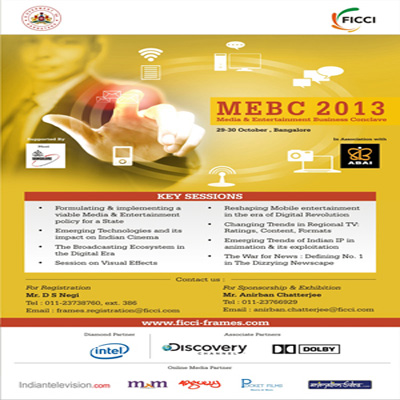
    BENGALURU: The Digital March-Media and Entertainment in South India, a Deloitte-FICCI report was released on the eve of FICCI-MEBC 2013 in Bengaluru. The two day event commences on 29 October.


    Note: This is for the year ended 31 March 2013.


     The report says that the South Indian Media and Entertainment (SIM&E) industry is slated to grow from its current estimated size for FY-2013 of Rs 23,900 crore to Rs 43,600 crore in FY-2013 at an CAGR of 16 per cent.


    The internet continues to have a profound effect on consumers’ viewing habits and the proliferation of devices is altering their media consumption behavior. With the increasing popularity of mobile broadband (3G) and the impending launch of 4G LTE services, mobile phones are expected to emerge as the preferred platform for consuming content. India already has over 65 million smartphone users currently.


    In south India, new media, with an estimated size of Rs 690 crore in FY-2013 will grow at 23 per cent CAGR to reach Rs 1600 crore in size by FY-2017, followed by television which will grow at a CAGR of 20 per cent from a present estimated size of Rs 13,470 crore to Rs 27,960 crore.


     The television industry in south India is on a transformation path, driven by the government’s digitisation mandate, says the report. It is one of the most flourishing regional media segment in terms of availability of content, reach and distribution. Over the years, it has seen increased action from regional as well as national advertisers. In fact, regional advertisers now contribute almost 40 per cent of the TV industry’s advertisement revenues in states such as Tamil Nadu and Kerala.


     Radio will grow at a CAGR of 19 per cent from an estimated present size of Rs 420 crore to Rs 830 crore by FY-2017. The radio industry enjoys greater acceptance in the south than in the rest of the country and thus stands out amongst its peers. This is indicated by relatively higher average radio listenership in cities like Bengaluru where people spend about 20 hours / week on radio while those in Delhi and Mumbai spend 13-14 hours / week says the report.


    Films with a present estimated size of Rs 2,680 crore will grow at a CAGR of 12 per cent to reach Rs 4,220 crore by FY- 2017.  The report says that the south Indian film industry with 831 films, accounted for over 50 per cent of total films certified across India. The number of films certified increased by 36 per cent over 2011, primarily driven by a spike in cable  and satellite (C&S) rights’ prices. However, the number of films released increased by only eight per cent during the same period as some producers chose not to release their films due to the high marketing costs associated, and as a result of a correction in the C&S rights’ prices in some of the markets.


     Print, a laggard relatively, will grow at eight per cent from the present Rs 6,880 crore to Rs 9,020 crore by FY-2017. South India, driven by a high literacy rate and a sizable vernacular readership base (30 per cent of total readership in India) is one of the strongholds of the Indian print industry. Amongst the four regional states, Tamil Nadu and Andhra Pradesh account for about 58 per cent of the total revenue. Most of the markets in the region are dominated by English print in terms of revenue except Kerala, where vernacular prints accounts for nearly 90 per cent of the revenue. However, the advertising revenue from vernacular print in the region is estimated to grow at twice the pace of that of English, largely driven by local advertisers and increasing focus of national advertiser’s beyond tier I cities.


    Among the four southern states or southern sisters as they are known, Tamil Nadu with a FY-2013 SIM&E estimated size of Rs 8,420 crore will grow at a CAGR of 17 per cent to reach Rs15,850 crore by FY-2017. SIM&E in Andhra Pradesh with a FY-2013 estimated size of Rs 7,140 crore will reach an estimated size of Rs 12,740 crore by FY-2017 at a CAGR of 16 per cent.


    SIM&E in Karnataka with an estimated FY-2013 size of Rs 4,340 crore will grow at a CAGR of 15 per cent to reach Rs 7,710 crore by FY-2017. The smallest in terms of size of SIM&E, Kerala with a FY-2013 estimated size of Rs 3,350 crore will grow to Rs 5,7,30 crore by FY-2017 at a CAGR of 14 per cent.


  • Vocational training Generating Employable India

    Vocational training Generating Employable India

    NEW DELHI : Around 38-40 per cent of Indian population, between the age group of 14 and 25, who are on the verge of entering different skill level jobs do not possess marketable skills which are an impediment in getting decent employment and improving their economic condition. To counter this challenge, they require tailored short-term courses which directly lead to employment. This need is boosting the vocational education sector and opening numerous investment opportunities to investors as well.

    The major segments in vocational education and training businesses in India include the various trades related to restaurant, retail, IT training, airlines, and so on. Vocational education in India aims to develop skilled manpower through diversified courses to meet the requirements of mainly the unorganised sector. Also, the education aims to impart selfemployment skills in people through a large number of self-employment oriented courses.

    Gaurav Marya, Chairman, Franchise India, “The role of vocational education in facilitating social and economic development has long been recognized by the Indian government. Vocational education improves functional and analytical skills and, in turn, opens up opportunities for persons to achieve greater access in the industry.”

    There are various educational institutes participating at India Franchise Show 2013 to expand further franchisees at bigger platform. Few of them are Jaipuria, Aisect, Gras academy, Learning place and many more.

    The vocational education market in India is anticipated to grow at a CAGR of around 25 per cent during 2011-2015. The current market size is of USD 4.8 billion and is forecasted to scale up to USD 7.3 billion by the end of 2015.

  • Lex Witness Presents The 2nd Annual Edition of Media, Advertising & Entertainment Legal Summit

    Lex Witness Presents The 2nd Annual Edition of Media, Advertising & Entertainment Legal Summit

    Lex Witness- India’s 1st Magazine on Legal and Corporate Affairs today hosted a well-conceptualized The 2nd Annual Edition of Media, Advertising & Entertainment Legal Summit (MAELS) 2013 at Hotel Le Mridien in New Delhi. The daylong summit saw over a 100 proficient industry veterans including media professionals, Law Firm partners and teams, In House Counsels and stakeholders engaging in an interactive discussion on increasing business complexities being faced by the Media, Advertising and Entertainment sectors rising due to changes in and regulations.


    In an official message sent for the initiative;


    Kapil Sibal, Honble Minister of Law and Justice, shared that the Indian Media, Advertising and Entertainment industry plays a pivotal role in India’s economic growth through its magnificent channel of reach. However, the industry has been subject to various strides of regulations which affect the businesses and require discussions and debates to understand their impact. Further Mr. Kapil Sibal conveyed his greetings and best wishes for the success of the Summit.


    With all the media and legal professionals under one roof, Mr. Amarjit Singh Chandhiok, Additional Solicitor General of India felicitated Dr. Lalit Bhasin, President, SILF; for his outstanding contributions to the legal industry of India. Mr. Bhasin is one of the most respected authorities on legal matters in India and has recently completed 50 years as a successful personality in the fraternity.


    Over the past few years, the alignment of entertainment, information and telecommunication have increasingly affected India’s Media, Advertising and Entertainment business. According to the latest CII-PwC Industry report, release on 13th Sept 2013, India’s Entertainment & Media sector is expected to exceed INR 224,500 Cr growing at a CAGR of 18% from 2012 to 2017. However, despite of the growth patterns the M&E fraternity is witnessing various regulations and grey areas in the law revealing a different set of challenges to its members.


    Lack of clarity on the practical and commercial implications of the amended Copyright Act 2012, absence of direction on the issue related to royalty, its payment and distribution has left all the industry in a state of perplexity. Also, the regulatory changes have made it difficult for the existing business ecosystems to sustain with Telecom Regulatory Authority of India’s (TRAI) ad cap mandate, high carriage fees and below par subscription revenues. Furthermore, the process of regulation regarding content and over objectionable advertisement for TV, Radio and Internet too falls under grey area and has no apex body to monitor or dictate guidelines.


    Speaking on the occasion, PBA Srinivasan, Editor-in-Chief, Lex Witness said, Though the Indian media and entertainment industry is eyeing robust growth, yet there are legal challenges affecting the big business. Areas like contract management and arbitration in media fraternity, Technological and IPR issues associated with entertainment and advertising sectors require special attention.


    The summit gave a stage to all the panelists to share their expert viewpoints on implications of The Copyright Amendment Act 2012, its impact on business due to Royalty Payments, Change in Tax Laws, Business and Legal solutions for Performers, Authors, Producers, Broadcasters and Content Aggregators, Regulation of content and Advertisement Perspective and views from Regulators, Current challenges and issues, Proposed amendments to Cinematograph Act and impact, Carriage and Distribution Regulation Revenue squeeze with ad caps, Resolution on current differences between LCO, MSO & Broadcasters, Competition Act Implication for Media and Entertainment Industry, Contracts and Dispute Resolution, Arbitration Clauses and Industry Practices and other regulations passed.


    The expert speaker’s panel at MAELS 2013 included, Vir Sanghvi, Member, BCCC Shailesh Shah, Secretary General, IBF Nishith Desai, Founder & Managing Partner, Nishith Desai Associates Amarjit Singh Chandhiok, Additional Solicitor General of India, Supreme Court of India Vineet Magan, Regional Tax Manager, BBC Gowree Gokhale, Partner, Nishith Desai Associates Abhishek Malhotra, Partner, TMT Law Practice Avnindra Mohan, President (Legal & Regulatory), Zee Network Ajay Thomas, Registrar, LCIA India Amit Arora, Executive Vice President, IndiaCast Media Distribution Private Limited Narayan Ranjan, Chief Financial Officer, Viacom 18 Anil Lale, Associate Vice President Legal, Viacom 18 Lalit Bhasin, President, SILF Preet Dhupar, CEO, BBC Zameer Nathani, Head Legal, Balaji Telefilms Limited and Balaji Motion Pictures Limited Ayan Roy Chowdhury, Senior Manager Legal, Sony Entertainment Television Rajesh Simhan, Head International Tax Practice, Nishith Desai Associates Ashish Chandra, Head Media & Technology, Reliance Industries Rajiv Khattar, President Projects, Dish TV M.M. Sharma, Head-Competition Law and Policy, Vaish Associates Advocates Kunal Rajpal, AVP Legal & Secretarial, Viacom 18 Kaushik Moitra, Partner, TMT Law Practice


    Commenting on the significance of the Summit, Shyam Grover, Group Editor & CEO, Lex Witness said, The Indian Media & Entertainment industry is essentially being driven by augmented digitization, growth of regional media and emergence of new media for content virality. But at each stage, the industry is facing challenges affecting their future growth. MAELS 2013 is our attempt to bring the thought leaders together to interact and confer on these issues and develop their legal and business response strategies.


    The 2nd Annual MAELS 2013 initiative was supported by IBF as Principal Partner, SEPC as Official Summit Council, TMT Law Practice as Gold Partner, Nishith Desai Associates as Legal Partner, Vaish Associates Advocates as Associate Partner, Deepak Sabharwal & Associates as Kit Sponsor, Blackpen LCC as Litcom Partner DMAI, SILF, LCIA India, ICCA as Fraternity Partners, Ad Gully as digital Partner, Lawyers Club India as Online Media Partner and Indian Law Journal, Indian National Bar Association, NAI Press, IOD as Supporting Partners.

  • Entertainment &Media sectors to grow steadily: CII-PwC

    Entertainment &Media sectors to grow steadily: CII-PwC

    MUMBAI:  India’s Entertainment & Media sector is expected to grow steadily over the next five years as per Confederation of Indian Industry-Price Waterhouse Cooper (CII-PwC) latest report titled ‘India Entertainment & Media Outlook 2013’.

    The industry is expected to exceed Rs 224,500 crore growing at a CAGR of 18 per cent from 2012 to 2017. The CII-PwC report was released today at the second edition of the CII Big Picture Summit held in New Delhi.

    The Summit which brought together the finest business and creative minds of the E&M industry with `Embracing Innovation in Media’ was themed towards achieving $100 billion by the end of this decade.  Over 70 M&E leaders spoke at the two-day summit organised by the CII.

    Today, the size of the Indian M&E sector has increased from about Rs 805 billion in 2011 to almost Rs 965 billion in 2012 representing a year-on-year growth of 20 per cent. This growth was achieved in spite of a relative slowdown in the broader economy, underlining the resilience of the E&M sector. It is expected to grow at about 18 per cent CAGR over 2012-2017 and reach revenues of about Rs 2,245 billion in 2017.

     “This growth is driven by the introduction of cable TV digitisation, continued growth of regional media, continued strength of the filmed entertainment sector, fast increasing new media businesses and transparency,’’ said CII director general Chandrajit Banerjee. “We believe that innovation – faster, better, more efficient, thinking out of the box (and within the box) – would be one of the game changers in this space,’’ he added.

    An entire chapter on “The Innovation Imperative in the rapidly evolving E&M sector’’ has documented strategies for E&M companies in the CII-PwC report.  Indian E&M businesses, like its peers abroad, needs to raise its game in operational agility and customer insight.

     “To achieve this successfully, every industry participant will need to invest in constant innovation that encompasses products and services, business and operating models and most importantly, customer experience and engagement. Innovation should be seen as an important enabler to get closer to consumers and profitably deliver relevant content and services,” said the report.

     India’s television market grew at 13 per cent with revenues increasing from Rs 340 billion in 2011 to Rs 383 billion in 2012. Filmed entertainment also demonstrated stellar growth in 2012 with sector revenues increasing by about 17 per cent from Rs 96 billion in 2011 to Rs 112 billion in 2012. The print sector revenues are expected to increase at over nine per cent CAGR to reach Rs 331 billion in 2017 from Rs 212 billion in 2012.

    Year-on-year sectors such as internet access (30 per cent), internet advertising (29 per cent), gaming (19 per cent), and music (15 per cent) are expected to continue on their high growth trajectory. The radio sector is also expected to receive a fillip with the successful conclusion of Phase III license auctions and it is expected to grow at a robust CAGR of about 16 per cent.

     The rapid rise of Internet usage, high penetration of smart phones, digital advertising, wireless broadband, digital content consumption, regulatory interventions have had a significant impact on the E&M sector.

    The television and print sectors dominate the industry with about 40 per cent and 22 per cent contribution to industry revenues respectively in 2012. Internet access now commands about 18 per cent share and films 12 per cent of industry revenues.

     Nonetheless, in 2017, television will continue to lead the industry in terms of revenue contribution with 39 per cent share, followed by internet access with 28% share. The share of print and films are likely to decrease 15 per cent and nine per cent in 2017.

    If we take the E&M growth without taking internet access and internet advertising into account the size of the Indian M&E sector increased from about Rs 690 billion in 2011 to almost Rs 795 billion in 2012. It is expected to grow at about 15 per cent CAGR over 2012-2017 and reach revenues of about Rs 1,615 billion in 2017.

     Overall, the Indian E&M industry is on the cusp of a strong phase of growth, backed by rising consumer payments and advertising revenues across all sectors.

  • Broadcasting and video equipment to show sizable increase in 2013

    Broadcasting and video equipment to show sizable increase in 2013

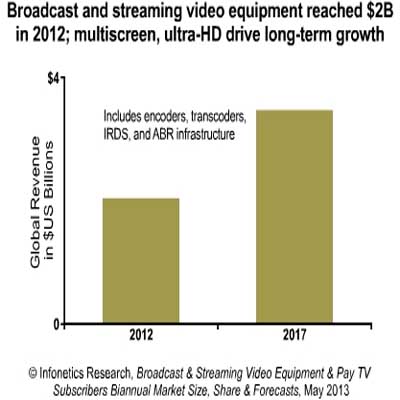
    NEW DELHI: Broadcast and streaming video equipment market is likely to grow 12 per cent in 2013 from two billion dollars in 2012.


    According to Infonetics Research, the market is projected to grow by more than 1/3 by 2017, and adaptive bitrate (ABR) origin and packaging servers are key components in the efficient delivery of over-the-top (OTT) content, especially as more pay-TV providers and content delivery networks move to ABR streaming.


    More and more, transcoders are being used to prepare linear broadcast and file-based content for distribution directly to subscribers.


    Telco IPTV subscribers have the highest 2012-2017 CAGR (17 per cent) of any pay-TV subscriber segment.


    With competition and content heating up, pay-TV providers are transitioning their traditional, broadcast-focused video processing environments to ones that can ingest, process, deliver, and decode video content from multiple sources.


    Jeff Heynen, principal analyst for broadband access and pay TV at Infonetics Research, said: “Content owners and studios are also adjusting their workflow and video output to support multiscreen and streaming services.”


    Infonetics Research noted that the net result of these transitions is steady investment in the platforms necessary to optimise video streams for a growing list of end devices and formats.

  • Digital Commerce Market to spike by 33% in 2013

    Digital Commerce Market to spike by 33% in 2013

    MUMBAI: The total digital commerce market in India was valued at Rs 473.49 billion in December 2012 and is expected to grow by 33 per cent to achieve Rs 629.67 billion by the end of 2013. This is according to the latest Digital Commerce Report, by the Internet and Mobile Association of India (IAMAI) and IMRB International, released today.


    Source: IAMAI-IMRB International

    The report claims that while Online Travel, which includes booking rail, air, bus tickets, hotel accommodations and tour packages comprised a majority 71 per cent of the whole Digital-Commerce pie in 2012, E-Tailing, which includes purchases of various consumer products or services such as electronics, apparels, footwear, jewellery, home & kitchen appliances, consumer durables, furnishings, constituted 16 per cent of the overall share.

    Financial Services, which include services such as paying insurance premiums and renewals, paying utility and mobile bills, trading shares and securities amounted to 6 per cent of the overall share. B2B and B2C Classifieds (jobs, matrimony, car, real estate etc.) contributed 5 per cent, whereas other online services such as online entertainment ticketing, online food delivery, buying discounts/deals/vouchers etc. constituted 2 per cent of the overall digital commerce market in 2012.

    Source: IAMAI-IMRB International

    According to the report, online travel industry has on an average grown by 32 per cent from Rs 149.53 billion in 2009 to Rs 345.44 billion in 2012 and is estimated to grow by another 30 per cent and be valued at Rs 449.07 billion by the end of December. The E-Tailing category has grown from Rs 15.5 billion in the year 2009 to INR 64.54 billion in year 2012. This category is estimated to grow by 55 per cent and cross 100 billion by the end of this year.

    Financial services market was valued at Rs 28.86 billion in 2012 and is expected to grow by 25 per cent and reach to Rs 36.07 billion by the end of the year. According to the report, Classifieds market has seen a significant growth and has reached Rs 23.54 billion in 2012. Classifieds as a category has grown with a CAGR of 45 per cent growth from 2009 and is expected to grow by another 30 per cent to Rs 30.61 billion by end of the year.

  • Digitisation to propel pay-TV revenue to $17 billion by 2017 , MPA report

    Digitisation to propel pay-TV revenue to $17 billion by 2017 , MPA report

    MUMBAI: Propelled by the government’s digitisation drive, pay TV revenues in India are projected to reach $17 billion by 2020 as opposed to the $7.8 billion in 2012, according to a new report by Singapore-based pay-TV research firm Media Partners Asia (MPA).

    According to India Pay-TV & Broadband Markets, pay TV revenues are expected to grow at a compounded annual growth rate (CAGR) of 11.4 per cent from 2012-17 and 10.2 per cent between 2012 and 2020.

    MPA forecasts indicate that total digital pay-TV homes will grow from 47 million in 2012 to 110 million by 2017 and 130 million by 2020.

    The digital penetration of total pay-TV homes in the country is expected to double to almost 70 per cent by 2020 from 35 per cent in 2012. The digital pay-TV penetration of TV homes in India will grow from 28 per cent in 2012 to 54 per cent by 2017, and reach 60 per cent by 2020.

    On the other hand, the total pay-TV homes are expected to grow from 128 million 2012 to 167 million by 2017, and 183 million by 2020. Pay-TV penetration of TV homes will grow from 80 per cent to 85 per cent between 2012 and 2020, adjusted for multiple connections in a household.

    This implies that the pay-TV industry will remain in a prolonged investment mode, with significant capital intensity. With two more phase of digitisation to go, both DTH and cable operators already have high levels of debt. The majority of additional funding will have to come through equity, via IPOs and M&A, the MPA report states.

    “A successful start for the roll-out of digital addressable systems (DAS) has revived interest in pay-TV among strategic and financial investors,” says MPA executive director Vivek Couto.

    “The real benefits will become clearer in 2H 2013 and beyond, as multi-system operators (MSOs) drive addressability and work with last mile local cable operators (LCOs) to ramp up tiering, billing and collections. Regulators are committed to curbing delays in the next phases of DAS, while the DTH industry is keen to revive growth by capitalising on digital transition.”

    Cable impact: Over the medium term, the majority of cable investments will be directed towards digital infrastructure, helping to build operator scale and improved addressability. In the long run, investments will be more focused towards acquiring primary subscriber points and the expansion of high-ARPU products such as broadband and HDTV.

    According to MPA, the total proportion of cable households with DAS climb from 15 per cent in 2012 to 50 per cent by 2020.

    DTH growth: In the DTH space, concerns focus on the growth of active subs (i.e. paying customers, net of churn and subscriber suspension), which has moderated in recent times. MPA says that the growth in active subs will rebound however, as more markets undergo analog switch-off. MPA forecasts indicate that active DTH subs will grow from 32 million in 2012 to 64 million by 2017, and 77 million by 2020.

    Broadcasters: Subscription fees for pay-TV channels crossed US$1 billion in 2012, driven by the growing strength of aggregators. This growth has yet to factor in digitalisation, which will result in a bigger share of subscription revenue for broadcasters. Operating margins will remain under pressure in the short-to-medium term, due to heavy investments in content for existing channels and gestation losses on new channel launches.

    MPA expects total pay-TV channel revenues, including advertising and subscription to grow from $3.6 billion in 2012 to $6.6 billion by 2017 and to $8.6 billion by 2020. The pay-TV ad market is expected to grow at a 10 per cent CAGR over 2012-20, while broadcaster subscription revenues are expected to grow at 15 per cent over the same period.

  • America’s local media ad revenue to reach $148.8 bn in 2017

    MUMBAI: America‘s independent media research company BIA/Kelsey has forecasted the local media advertising revenues to climb from $132.5 billion in 2012 to $148.8 billion in 2017 representing a compound annual growth rate (CAGR) of 2.3 per cent.

    In its newly released U.S. Local Media Forecast (2012-2017), the firm reports national brands accounted for 32.1 per cent or $42.5 billion of the $132.5 billion spent on local media advertising in 2012. National‘s share of local ad spending is expected to grow to nearly $51 billion by 2017.

    “Local media has become a key channel, not only for local small businesses, but for regional businesses, national franchises and national brands targeting locally. This is clearly seen in our tracking of market shifts in mobile, social, search, promotions, coupons and deals, native ads and sales transformation,” said BIA/Kelsey VP and chief economist Mark Fratrik.

    Digital media continues to increase its share of total local media revenues, growing from 17.4 per cent in 2012 to 27.6 per cent in 2017.

    The firm expects traditional local media revenues to decrease from $109.4 billion in 2012 to $107.6 billion in 2017 (CAGR: -0.3 percent). As anticipated, traditional media revenues experienced a bump in 2012 from political advertising.

    The political ad spend cycle contributes to a drop in revenues in odd-numbered years. Despite the year-over-year political advertising seesaw effect, traditional media revenues remain remarkably steady throughout the forecast period.

  • Console gaming dominance to reduce gradually in India

    Console gaming dominance to reduce gradually in India

    MUMBAI: Console continues to be the largest segment of the Indian gaming market. However, the Ficci KPMG report notes that its dominance is expected to reduce gradually as mobile gaming gains significance.

    While growth rates of 28 per cent were forecast over 2011- 2012, actual growth came in at 8 per cent primarily due to overall sluggishness in the economy impacting both unit sales and attach ratios. The growth was also impacted by sluggishness in ad rates and significant inventory overhang in the internet gaming space.

    Growth estimates for the console market have been further moderated going forward. This is primarily due to the fact that Sony‘s PS2 console is expected to be phased out in India this year and upsides from attach growth in PSP, PS3 and Microsoft Xbox 360 sales will only partially offset PS2 sales. A fall in software sales earlier associated with PS2 consoles will also impact the market.

    Consequently, the overall market is likely to grow at a 19 per cent CAGR to reach Rs 19 billion by 2017. For the console segment, a lot will depend on how the PS4 launch fares in India and how quickly the gaming experience on mobiles and tablets comes closer.
    Overall the gaming industry in India grew 16 per cent over last year and is expected to grow at a 22 per cent CAGR to reach Rs 42 bn by 2017.

    Mobile Gaming: This category continued to see sustained growth in smartphone and tablet device penetration, and regular uptake of gaming content.

    IAMAI estimates that nearly 50 per cent of mobile users regularly access gaming content. Although telecom operators such as Vodafone are increasingly recognising the importance of developing a vibrant gaming ecosystem on-deck and are rationalising revenue share terms (now offer 70 per cent revenue shares to several large publishers), the off-deck segment is expected to eclipse the on-deck segment in value terms by 2014.

    Monetisation currently remains a challenge for Indian publishers, as the majority of game downloads are ad-funded. However, given that most Indian smartphone users have access to content published by global content providers and the fact that the gaming universe is highly fragmented, the spend gets spread across a large number of developers and private publishers.

    PC and TV Gaming: The PC gaming market grew nominally over this period consistent with last year‘s report. It is not expected to be a significant contributor to growth over the coming years.

    While the TV gaming is a relatively small market, the segment holds some potential for growth going forward as digital cable operators attempt to offer compelling value added services to curb erosion in subscribers with the onset of mandatory digitisation. This is, however, expected to be largely a lower income audience.

    Set top device functionality, currently a major bottleneck to delivery of quality gaming content, is also expected to improve over time, allowing providers to transmit richer, interactive content.

  • C&S shows double-digit growth in 2012: IRS Q3

    C&S shows double-digit growth in 2012: IRS Q3

    MUMBAI: Cable and satellite (C&S) television has posted double-digital growth in 2012, according to the latest figures by Indian Readership Survey (IRS).

    The C&S sector‘s reach grew from 488.642 million in second quarter 2012 to 499.437 million in the third quarter. It saw a 10.5 per cent compounded annual growth rate (CAGR) from Q1 to Q3 in the calendar year of 2012, according to the findings of IRS Q3 2012, released by the Media Research Users Council (MRUC) and Hansa Research.

    Media consumption for Internet continued to show the fastest growth at 27.5 per cent CAGR from 2012 Q1 to 2012 Q3. The users climbed from 39.94 million in Q2 to 42.32 million in Q3 of 2012.

    The reach of television also showed positive growth from the second quarter’s 563.43 million to 571.426 million in the third quarter. The CAGR of the reach of television for the same time period is 6.1 per cent (Q1-Q3).

    Radio saw a CAGR of 6.4 per cent, with increase in listenership from 158.165 million in Q2 to 159.820 million in Q3.

    Meanwhile, cinemagoers grew at a CAGR of 17.2 per cent to 81.4 million in quarter three as compared to 79.25 million in the second quarter.

    Newspaper readership grew by just 0.7 per cent CAGR with its reach increasing from 352.004 million in Q2 2012 to 353.33 million in Q3 2012.