Tag: cable

  • By imposing digitisation, government is giving away the market to DTH: BP Rath

    By imposing digitisation, government is giving away the market to DTH: BP Rath

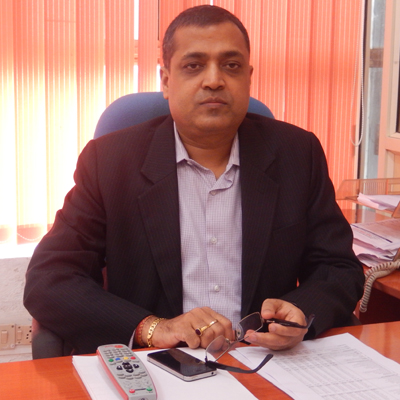
    When he is not actively focused on growing the business of the company, he is a family man.  He spent eight years at his current group’s parent company– Indian Metals and Ferro Alloys and then driving the group’s venture into cable and television in 1998. Currently the president and CEO of Ortel Communications, Bibhu Prasad Rath has ensured that the company not just grows, but becomes one of the big players in the country.


    From finance to marketing and then to the cable business, he has seen it all for the company headed by Jay Panda and Jagi Mangat Panda. By taking a cue from the US cable TV  biz, he and his team at Ortel looked at consolidating the fragmented mom-and-pop Indian cable TV industry.


    Rath took out some time to talk to indiantelevision.com’s Vishaka Chakrapani about Ortel’s future business plans, rollout of digitisation and the key areas of growth and development in the coming few years. Excerpts:


    What is the philosophy at Ortel?


    The core philosophy of Ortel is to have access to the consumers’ homes. We want to be a communication pipe to consumers’ homes which is capable of delivering a wide range of related services in future. To achieve this we decided right from the beginning that we would have last mile ownership, because in cable TV, video services are one way, and data is two way. Two way services are extremely sensitive to network parameters.


    In the traditional B2B model where the MSO reaches out to the LCO and then to the consumer, close to 80 per cent of the work is done by the LCO. The MSO does very little and so there is no quality uniformity and many times the LCO lacks the right equipment. Workmanship matters a lot in any communication network. It is a choice that we made from the beginning that we wouldn’t deal with any LCOs. Our business is B2C.


    Many people tell us that our model is unique. We, at Ortel, follow the international model by having a network that is capable of delivering both the services- cable and data.


    The biggest advantage of this model is that we can build a network and also provide data services.  The disadvantage is that because you are doing last mile, it is capex heavy. So you can’t do the kind of large spread operation that an MSO-LCO model can do.


    What is your reach?


    We are now operating in four states- Odisha, Chattisgarh, West Bengal and Andhra Pradesh. On an overall basis we have a network capacity of 800,000 homes but the subscriber base is 520,000 of which 80 per cent is concentrated in Odisha and the rest in the other states.


    We want to expand a lot more in other states but we haven’t been able to raise money. We look forward to raising capital in the next one year. Then our focus will be to expand in our existing and other neighbouring states such as Madhya Pradesh. Our focus is also to expand geographically to other states and more in Chattisgarh and Andhra Pradesh. Our idea is to build a regional last mile play. We do not intend to go national now.


    What is the status of your IPO?


    Right now, though the markets are improving and we hope that they continue to do so for next three to four years, we are not actively looking at it. We are looking at other means of fund raising such as private equity as well as international strategic options. The likelihood of opting for private equity is definitely higher.


    What has been your progress in digitisation?


    We have been digitising for nearly five years now, much before the mandate came in. We don’t have an under-declaration issue. We have to digitise because it enhances the capacity by getting more number of channels so that we can effectively compete with DTH operators.


    Odisha comes mostly in phase III and IV. Kolkata came in phase I and Vishakhapatnam (Vizag) in phase II. Our digital base is 15 per cent of our total subscribers. Analogue has always been a fixed price model. In every city you have different sections of consumers with different needs for content and different paying abilities. In digital you can offer customised products to customers. Digital is an important tool to tier the service. There are four markets in Odisha where we have been digitising- Bhubaneswar, Cuttack, Rourkela and Jharsuguda, apart from Kolkata and Raipur.


    Which are your key investment areas for digitisation?


    We are doing three kinds of investments. One is backend. We have five headends in Bhubaneswar, Jharsuguda, Rourkela, Kolkata and Raipur. We don’t intend to set up any more headends. What we are looking at now is intercity connect through infrastructure providers (IPs), mainly RailTel. Wherever we do digital we will take the feed from Bhubaneswar. At present, we give the feed to Vizag through RailTel.


    The next area for investment is the network. We have a fully digital network which is broadband ready so that isn’t an issue.


    The third cost is the set top boxes (STB). Currently we get a STB for Rs 1700. The box vendor asks for only half the amount and we pay the rest in installments, while we charge consumer only Rs 500 per box. We are looking at raising money for geographical expansion.


    What is your current ARPU?


    Our analogue ARPU is Rs 150 plus taxes, digital is about Rs 185 plus taxes and broadband is about Rs 375 plus taxes.


    Then we also get 15 per cent to 20 per cent incremental customers.


    How digitisation ready are you?


    In our case, SMS, encryption, billing, tiering and CAF for every digital customer and encryption, billing, and CAF for analogue customers is already in place since the past 15 years. We have a billing database where every customer’s data is entered. A collection team of nearly 700 people on contract basis go to all the neighbourhoods at the beginning of the month and collect money by providing a bill and receipt. We have a call centre where customers can lodge complaints and the locally situated service centres take care of their complaints. So the entire B2C backend is already in place.


    Our main challenge now is to seed the STBs. It isn’t possible to complete that by 31 December at the pace at which it’s happening right now. Our current focus is not on spread but on depth. Our biggest market is Bhubaneswar which is already 65 per cent digital. By 31 December about half of our entire subscribers should be digital.


    What do you have to say about TRAI’s digitisation mandate?


    We don’t believe digitisation is mandatory, it needs to be voluntary. When you go to smaller markets, digitisation becomes unviable. The main issue is how do you take the signal to homes? It’s either by setting up a headend or RailTel.


    In smaller markets the number of people is less, so the cost per person increases and becomes unviable. We have spoken to regulators that going forward, smaller markets are going to be difficult and by imposing digitisation, they are giving away the market to DTH which isn’t fair to the cable industry.


    We also intend to explain this to the government. They need to do a further cut off for phase III and IV, say half or quarter million population. Below these population numbers, we require either an exemption from mandatory digitisation or even longer time until the market situation stabilises and costs come down and people start getting returns to invest for digitising the less populated areas.


    What is your subscriber churn?


    We are facing around 1 per cent churn every month but on net basis it is positive. Churn happens because people shift their house to another city or maybe in the same city, some due to timings such as exam time, and I’m sure some due to bad service. On an average we also get around 500 DTH converts per month.


    What is the status of your broadband offering and what are your plans for the same?


    Broadband has been a key focus area at least at a mental level. 10 years ago, TV was the only thing in life. Now people are slowly moving to browsing and watching videos on smartphones. The TV set as a device at home is going to see a reduced utility over a period of time and internet is going to be used more. Ultimately we see this business as a broadband business and not just as a TV business. Whether this will happen in 10 or 20 years, I don’t know but it’s going to be business of broadband, not so much of analogue or digital.


    Out of our entire network capacity, we can give broadband to 400,000 homes. But our actual subscriber base for broadband is 11 per cent of total TV subscribers, that’s about 55,000. This 11 per cent gives 20 per cent to 22 per cent of overall revenue.


    Our focus is to increase broadband penetration from 11 per cent to 25 per cent.


    What broadband services do you offer?


    We are currently operating on DOCSIS 2.0. The same cable that goes to a consumer’s house is split inside for TV and for PC. We also have wired and wireless modem services for using many devices. In retail we provide speeds ranging from 512 kbps to 2 mpbs.


    What is your main focus now for Ortel Communications?


    Our main focus for the next few years will be digital and broadband. Any other service rides on broadband or digital. The only other service we have been trying to get in the past also, but it isn’t working out due to regulatory issue, is the voice service.


    Our aim is to go from the current subscriber base to 30,00,000 in the next three to five years.


    How has your growth come? Organically or through LCO acquisitions?


    We have acquired about 1000 LCOs since 2008. Half of our growth is organic and half is inorganic.


    Initially our growth was only organic and in competition with LCOs. Subsequently, since 2008, we switched to the LCO acquisition model. We acquire the LCO, dismantle the network and lay our own network.


    The LCO exits the business with a revenue share. We buy out the LCO with a structured payment where part of money is paid at the time of buying and the rest is given over a longer period of time ranging from 5 to 7 years. So the LCO owner gets more than what was originally committed because he gets a revenue share. The LCO’s owner does not go back and start competing with us.


    The key difference is that in the organic model when you are competing, you need a longer time to reach critical mass. If you are acquiring then it happens right at time of acquisition. Depending upon what works best for a situation, we follow either model.


    How has your revenue grown?


    Last year our revenue was Rs 132 crore, while this year we expect it to reach Rs 155 crore. The EBIDTA margins are usually 32 per cent to 33 per cent.
  • Kolkata MSOs to increase channel package rates

    Kolkata MSOs to increase channel package rates

    KOLKATA: A revision in channel package rates is on the cards following the Telecom Regulatory Authority of India’s (TRAI) directions to multi system operators (MSOs) last week to ensure delivery of bills to subscribers by hand, post or email as opted for by them, and provide within 45 days an online payment option in their subscriber management system (SMS) for subscribers to pay their bills in the first phase of the digital addressable system (DAS).


    However, the percentage by which channel package rates will go up is not exactly known.


    Kolkata has nearly 30 lakh cable homes and till mid-January, MSOs were issuing ad-hoc bills to subscribers. According to several LCOs, despite having implemented gross (consumer) billing in the Kolkata Municipal Area (KMA) since January, end consumers are not willing to pay billed amounts to LCOs.


    When contacted, Siticable Kolkata director Suresh Sethia said, “Package rates will soon be revised. There are instances where consumers are not getting bills from LCOs. The law of the land is the same for everyone. So, we have to courier bills to end users and this involves costs.”


    “We are happy that TRAI is trying to make the system more transparent,” Sethia added.


    An MSO on condition of anonymity said, “We will have to depute collection agents and provide them with a salary or collection commission, whatever they think is better as LCOs are not able to collect money from end consumers. But we can’t use this as an excuse and will ensure we adhere to the TRAI rules, however cash-strapped we are.”


    A cable expert expressed the view that package rates will have to be increased as post implementation of DAS broadcasters have started bargaining a lot and have proposed to charge a much higher rate than before.


    “MSOs are bound to increase the price as they have to show the bill and pay the tax on that. Also, to follow the new bill delivery system of the TRAI, additional costs will be incurred in terms of software development and manpower. To justify that, they may increase the price,” said Incubators Group chairman Kaushlendra Singh Sengar.


    Sengar informed that the Regulator had also asked MSOs to ensure that an electronic acknowledgement is sent to subscribers on their registered mobile numbers or email addresses within 30 days of making the payment to the service provider.


    A cable analyst, Mrinal Chatterjee, begged to differ, “Cable TV operation is not telecom operation. Here, LCOs also work. MSOs have no network of their own but depend on last mile connectors. Customers are the clients of the LMO, so how can MSOs send bills to them?”


    Other industry sources argued that some MSOs didn’t even have an SMS in place so how could they start an online payment option in the SMS.


    Still other sources opined that MSOs and LCOs need to address the issues together. “Now it seems the authorities want to remove the LCOs from this trade altogether, but it is not that easy to do so,” said an LCO on condition of anonymity.

  • Week 20 sees the rise of Sports channels

    Week 20 sees the rise of Sports channels

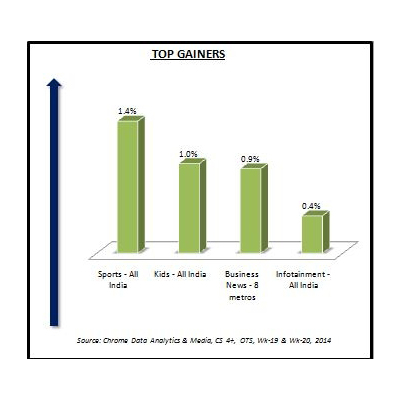
    MUMBAI: As per Chrome Data Analytics & Media’s opportunity to see (OTS) data, Sports channels were the top gainers for the week 20.


    The genre across India jumped 1.4 per cent with Ten Sports with 77.5 per cent OTS. Kids genre gained 1 per cent across the country with Cartoon Network continuing its reign with 84.6 per cent OTS.


    With a minor difference, Business News channels in the eight metros saw a gain of 0.9 per cent. Zee Business topped the genre with 80.4 per cent OTS. Discovery channel with 86.3 per cent OTS topped the Infotainment genre across India which jumped 0.4 per cent.


    As for the genres which plunged southwards, Hindi News channels in the Hindi speaking markets (HSM) fell 0.7 per cent. ABP News with 92.1 per cent OTS topped the genre.


    Hindi GECs in the HSM and English Entertainment channels in the eight metros saw a drop of 0.4 per cent. Star Plus with 96.8 per cent OTS and AXN with 72.5 per cent OTS, topped their respective genres.


    Hindi Movies in the HSM saw a minor drop of 0.1 per cent with Star Gold topping the charts with 95.9 per cent OTS.

  • Digitisation at one-third of the investments by MSOs, claims JAINHITS

    Digitisation at one-third of the investments by MSOs, claims JAINHITS

    NEW DELHI: A campaign “Cable ka Shahenshah, DTH ka Baap” has been launched by JAINHITS, India’s only HITS based Direct to Network (DTN) service, relating to quality of services and its ability to deliver digitised content across terrains, anywhere in India.


    JAINHITS technology in partnership with Motorola (now ARRIS) and IntelSat offers a unique proposition to the LCOs (local cable operators) of an overnight plug and play digitisation solution that comes for an investment as low as Rs 4.99 lakh only. This makes them fulfill Telecom Regulatory Authority of India’s (TRAI) guideline requirements of All India digitisation by 31 December 2014.


    The HITS platform claims that if the 6,000 odd MSOs were to digitise their networks, they would require an investment of up to Rs 3 crores per MSO, thereby costing approximately Rs 18,000 crores as mere investments. JAINHITS on the other hand can provide direct services to over 60,000 LCOs spread across India with average investment of only Rs. 10 lakh per operator, thereby digitising the country for just Rs 6,000 crore, which is one-third of the investment required by MSOs. Thus, the massive saving of Rs. 12,000 crore is being passed on to the customers by providing cheaper services with enhanced quality viewing.


    Moreover, JAINHITS “Go Digital” entry scheme strategy will help LCOs to increase their subscriber base manifold in a short span of time. Not only this, through this partnership model LCO will witness significant increase in their customers ARPUs which are likely to double in 2014-15 with broadband and other VAS product/service roll outs. All this put together will help JAINHITS LCO partners enhance their business and earnings.


    With a mere investment of Rs 4.99 Lakh, an LCO will get all the necessary help in terms of technology, content and Set Top Boxes that will enable them to operate independently. JAINHITS offers LCO’s new product/ service roadmaps to address the ever- evolving market and customer needs along with the full technology solution roadmap for cable TV network upgradation. In addition, LCO’s also receive all necessary training on technical, legal, product, consumer satisfaction, compliance aspects etc. which facilitates them to offer standardised services.


    JAINHITS is the only platform in the country, offering complete empowerment and ownership to even the smallest LCO by making him a Leader and Cable Owner and an ISO (Independent Service Operator).


    JAINHITS national sales head Jeet Narayan Singh said, “In our endeavor to enable 60,000 small and medium operators to become MSOs and go digital independently, we are offering end to end single window solutions. JAINHITS offerings are fully DAS compliant with wider choice of channels that are cost effective and fastest way to offer Digital Cable services in any part of India. Our Broadband offering gives additional edge to ISOs and helps them to increase their revenues.”


    Through this engagement, JAINHITS provides subscriber management system (SMS), which empowers LCOs to manage his own customer base and offer, customized packs to its subscribers. In addition to this, JAINHITS LCO will be able to manage billing and create his own subscriber records as required by regulators. The SMS also provides an inventory management system and MIS system which enables the LCO to operate his business, generate reports and manage taxation etc.

  • PwC report: content value, retransmission fees to boost E&M deals

    PwC report: content value, retransmission fees to boost E&M deals

    MUMBAI: If the new report released by PricewaterhouseCoopers (PwC) comes true, the media and entertainment sector could witness increasingly lucrative retransmission fees and high value for content having key influences on deal activity in the sector.


    The value of deals in the US entertainment, media and communications sector in 2013 more than doubled, driven by several “megadeals,” according to PwC’s year-end update.


    The deal volume year-to-year was relatively stable, the company reveals in its US Entertainment, Media & Communications Deal Insights report, rising by just three per cent to 866, while deal value soared from $96.2 billion to $222.7 billion.


    In broadcasting, deal volume rose from 71 to 87, with deal value soaring from $5.8 billion to $26.3 billion, driven by Comcast’s acquisition of GE’s interest in NBCUniversal. Going forward, deal activity in broadcasting is likely to be influenced by the increasing importance of retransmission revenues, as companies look to broaden their geographic reach.


    “PwC is beginning to see increased activity from US government regulators around anti-trust, intra-market media ownership and foreign media ownership regulations, which will likely be another market factor influencing deal volume,” the report says in its broadcasting 2014 outlook.


    Cable deal volume was stable at 16, but the value of deals fell year-to-year from $9 billion to $5 billion.


    Last year also saw 46 deals in film/content, up from 40, with a value of $0.5 billion, down from $9 billion in 2012. The previous year included Disney’s purchase of Lucasfilm.


    On the 2014 outlook for deals in film and content, PwC says, “The rising value of content has started an industry-wide race to acquire it. Buyers continue to look for ways to bridge the value gap and meet the premiums demanded by content providers through attractive deal structures, beneficial tax structuring and contingent consideration. Recent years have seen several major acquisitions of content assets, and despite the drop in deal value in 2013, the ongoing deal activity is likely to continue. Geographic location will hold no bar as U.S. participants look abroad and foreign players look to the United States for a means to acquire and monetize content.”

  • First Indian Digital TV Honours celebrates digitisation’s leading practices

    First Indian Digital TV Honours celebrates digitisation’s leading practices

    NEW DELHI: It was a day when the stalwarts of the Indian cable, broadcast and direct to home television industry converged to witness the best or leading practices of the industry being recognised at indiantelevision.com’s first ever Indian Digital TV Honors (IDTH).  The event, held at the Lalit  Hotel in Delhi late last eveing saw 15 professional/initiatives/organisations getting a citation for evolving best practices during phase I and phase II of digitisation over the past 18-24 months, ever since digital addressable system (DAS) was mandated by the government.


    An advisory panel comprising 13 professionals from broadcast, cable TV, consulting and technology , along with the editorial team of indiantelevision.com, helped finalise the honoraries after a tough round of discussion for over a month on the merits and demerits of those being sought to be honoured for their great work and innovations.


    The  event was attended by close to 200 professionals from the cable, DTH and broadcast industry and the regulatory body.


    The evening was anchored by Indian Television Dot Com Founder, CEO and editor-in-chief Anil Wanvari along with TV actor Prerna Wanvari  who hosted the two hour long proceedings.


    The First Indian Digital TV Honours, which were powered by leading Indian MSO DEN Networks began with Tata Sky being honoured for its obsessive focus on consumer service and product quality. The direct to home operator (DTH) has for long being spoken of excelling in the area of customer services, and this honour  only further supported that perception.


    India’s oldest DTH operator Dish TV  was honoured for its dervish like focus on its financial health and for protecting and creating shareholder value. The citation was received by CEO RC Venkateish, who shared the fact that he has to answer to public and other shareholders regularly, making  it imperative for the company to be bottom line focused. 


    “We have been generating free cash flow for quite sometime, and probably are the only Indian DTH company to do so,” said  Venkateish. “Things could be better if we could rationalise content costs which are still way too high.”


    Videocon d2h was recognised for its technological innovations and for the use of indigenous set top boxes which the group’s sister organisation manufactures indiegenously


    Additionally MSO Hathway Cable & Datacom was honoured for its pioneering push into broadband internet services, way before anyone else in the business. “With over 400,000 users we have gained a lot of experience which will only further help us as we move forward. Consumers are demanding a lot more bandwidth as they are guzzling a lot more online content,”  said  Hathway CFO G. Subramaniam. “We will be the best company providing  the broadband internet service in the future.”


    Tata Sky was also recognised for its its Value Added Services (VAS)  which it says is helping lure subscribers to them.


    DEN Networks, which had in 2013 attracted an investment of $160 million from Goldman Sachs at a time when every other MSO was being turned away, was honoured for becoming a beacon for the cable TV sector in the area of raising capital. Elated with the honour, DEN Network CFO Rajesh Kaushal said, “This is a very cash guzzling business and so there is a lot of investment and infrastructure that is needed. We have enough capital with us to see us through Phase I, II  and III  of DAS.”


    The Indian Broadcasting Foundation (IBF) was recognised for its marketing and promotional campaign to encourage the smooth spread of digitisation.  Almost every channel aired the commercial several times a day to push the message and educate consumers about digitisation and set top boxes. The same was recognised by the Indian Digital TV Honours advisory committee.


    “We wanted to incite consumers through the ad campaign. We had aired the promos for at least eight times a day on 150 channels,” said IBF secretary Shailesh Shah while receiving the honour.  Leading broadcaster Star India was also recognised  for its strategy to invest big money in sports. Sports TV worldwide is a big driver of pay TV and Star India’s early initiative to invest big money is only going to see a similar play being played out here.  And this in turn will likely encourage the process of digitsation.


    SitiCable Network was honoured for fostering Local Cable Operator (LCO) partnerships and being the first ones to give carriage fee revenue share to the LCOs. “We believe that LCOs are an integral part of the cable TV ecosystem and that is the reason we have given them the access to our subscriber management system and also are sharing the carriage fee revenue with them,” informed SitiCable COO Anil Malhotra.


    It was in 2013 that Doordarshan owned DTH service DD Direct Plus was rechristened as Freedish. The DTH player which introduced several innovations for its consumers in the year was recognised for catering to the needs of Indian consumers through Freedish. “Freedish is the most profitable venture of Prasar Bharti. Broadcasters are changing their business model for us, which is welcome change,” said Doordarshan additional director general Ranjan Thakur while receiving the honour.


    Two industry leaders have put their shoulder to the wheel and have played a major role in promoting digitsation over the past 18-24 months and have themselves invested heavily in it: Hathway Cable’s Raheja family led by Viren Raheja and DEN Networks’ founder Sameer Manchanda. “If you have patience, scale and execution one can excel in this field which holds a lot of scope. Cable will grow exactly how mobile grew in India, but you will have to wait minimum for five years to see results,” opined Manchanda. “You have to have the passion to see your belief in cable TV come true.”


    The evening also saw Seven Star Digital Network being honoured for effectively managing digitisation as an independent operator. Honours were also given to Ministry of Information and Broadcasting and Telecom Regulatory Authority of India for their push in making India a digitised nation. Most of industry has begun hearing of the Maharashtra Cable Operators Federation (MCOF), which represents the interests of the last mile owner.  In time, if it does manage to facilitate a feasible formula on revenues and shares with MSOs, then it stands a strong chance to be honoured  in next year’s Indian Digital TV Honours.


    More power to the industry’s elbow!  

  • DEN, Hathway and InCable get interim relief  on ent tax

    DEN, Hathway and InCable get interim relief on ent tax

    MUMBAI: The big four  of Indian cable TV – DEN Networks, Hathway Cable and Datacom, InCable and Siti Cable – heaved a sigh of relief as 21 January ended. The reason: the Delhi High Court – which was hearing their appeal seeking to restrain the state government’s entertainment tax authorities from taking any coercive action against them for not paying entertainment tax – gave them relief, if at least for some time. The  HC passed an interim order, forbidding the tax folks  from taking any steps  against  three of the MSOs – Den, Hathway and InCable.


    The cases that were heard in one day saw the appeals of  DEN and Hathway being joined  together while InCable and Siti Cable presented its case separately.  With the order coming into effect, MSOs have been relieved of the duty of collecting entertainment tax from the LCOs and submitting it to the government till the judgment on the case is passed. The next hearing will be on 13 March.


    The respondent (the entertainment tax collection authorities) have been given four weeks to file its reply to the case. In the meanwhile, its hands are tied. However, what was not clear at the time of writing whether  the onus is back on the LCOs to pay the tax to the government.


    Although the MSOs are receiving the tax from LCOs, they claim they aren’t getting the full amount. Hence, the balance amount normally has to be coughed up by the MSO whether it is paid the same or not by the LCO. This is pretty unfair, they have stated.


    The  MSOs approached the Delhi HC as  the inexplicable  pressure was being thrust on them to cough up taxes.

  • Four national MSOs file writ petition against Ent Tax

    Four national MSOs file writ petition against Ent Tax

    MUMBAI: Entertainment tax has become a bothersome issue for both MSOs and LCOs. Right from the amount of tax levied to ownership of collection, state government mandates have got the two cable TV factions locking horns. While government regulations mandate MSOs to collect tax from the LCOs and submit it, the LCOs would rather take the onus on themselves.


    Four Indian national MSOs – Den, Hathway, Siticable and InCable have filed separate writ petitions in the Delhi HC to challenge several aspects of the entertainment tax being imposed as well as the tax collecting authority’s stance towards the MSOs in the state of Delhi.  The cases are all set to be heard today in a joint hearing.


    While Hathway Cable & Datacom was put through an enquiry on its own premises, others have decided to legally protect themselves before something similar happens to them. Siticable claims that it has been fulfilling all duties effectively. An ex parte order was taken out against it for non compliance in April and May 2013 which Siticable had appealed against. When that didn’t go very far, it decided to lodge its writ petition seeking redressal and  justice.


    Siticable’s first hearing was yesterday when the lawyer on behalf of the tax authority asked for a day’s time to come up with its side of the case. “We had deposited the tax and had also filled the form 10 as per requirements. Yet the authorities were after us. So we went to court to request that no coercive action be taken by them ,” says Siticable CFO Sanjay Goyal.


    Hathway is of the opinion that entertainment tax collection is a duty that has been undertaken by the LCOs for several years now and that is how it should be. Its writ petition states that the order passed against it was unreasonable.


    MSOs say that they are alright with collecting the tax and passing it on to the department but traditionally it had been the job of the LCO to do that. However, in case of  a lapse of payment by the LCO, the MSO should not be asked to cough up the remaining money is what they say.


    The case will come up for hearing today. Who knows whether the Delhi High Court will give a stay order or decide on its fate tomorrow itself.

  • MIB orders WB to stop transmission for one day

    MIB orders WB to stop transmission for one day

    NEW DELHI: It seems the Ministry of Information & Broadcasting (MIB) keeps a close watch on channels that don’t follow the guidelines set for them. That is what is evident from a recent incident where the Ministry has cracked its whip on the international movie channel, WB (Warner Brothers). The Ministry has prohibited the transmission or retransmission of the of WB TV channel for one day throughout India later this month as a penalty for telecasting a V/UA certified film It’s a Boy Girl Thing on 7 January, 2013 at 11.51 am.


    The prohibition on any platform throughout India will be with effect from 00.01 am on 24 January till 00.01 am on 25 January.


    The action has been taken under in exercise of the powers conferred by sub-section (2) & (3) of Section 20 of the Cable Television Networks (Regulation) Act 1995 and under paras 6.1 and 6.2 of the Guidelines for Downlinking from India.


    The Ministry had issued a notice to the channel on 20 August last year as the telecast appeared to violate late Rule 6(l) (a), 6 (tXd), 6(l) (k) 6(l)(o) & 6 (5) of the Cable Television Networks Rules 1994 under the Cable Television Networks (Regulation) Act 1995 and the channel was asked to show cause within fifteen days.


    While asking for a personal opportunity to explain their position, M/s Turner International India, the parent company of WB channel, in their reply of 2 September said it was not aware about the Central Board of Film Certification (CBFC) suggesting 15 voluntary cuts and l6 compulsory cuts in the film until the Ministry issued the notice. It further said all content telecast on the channel was reviewed by its Standards and Practice Department which had very strict mechanism to ensure that only appropriate material was played out in accordance with Indian requirements.


    Turner further said that immediately upon receipt of the notice, the channel withdrew and stopped all further telecast of the film and indicated that the channel was willing to re-apply to the CBFC for re-certification of the film and would not telecast the same until a certificate was obtained by the CBFC. Furthermore, it said the CBFC Certificate available with it contained only the compulsory cuts without any reference to the voluntary cuts and that it had not questioned the completeness of the Censor Certificate and had made the edition and cuts based on the belief that the Censor Certificate available with them was the only, valid and complete Censor Certificate issued by the CBFC.


    In the personal hearing given by the Inter-Ministerial Committee, the Turner representative issued an unconditional apology for airing the film with offensive content on television and admitted that it was a mistake on the part of their programme team. The Committee previewed the CD containing the film, considered the reply of the channel and the personal submissions made by the representative of the channel.


    The Committee held that the channel had clearly violated the provisions of the Programme Code and observed that this kind of violation of the provisions of the 1995 Act and Rules framed there under was not acceptable. Though the channel had accepted their fault and apologised for their mistake, ‘they cannot escape the responsibility of ensuring that the content on their channel is in conformity with the Programme Code at all times. Moreover, before telecasting any film due diligence has to be done by the channel to assure that only certified version fully compliant with all necessary and voluntary deletions/editions is aired.


    The Ministry said the film telecast by the channel shows ‘highly objectionable visuals which denigrate Women’.


    ‘The Visuals shown are very offensive and obscene as the private parts of male and female are focused upon. The portrayal of the sex change is in bad taste and is indecent. The visuals are not fit to be viewed by children and also not suitable for unrestricted public exhibition. These visuals also denigrate women,’ remarks the notice.


    Rule 6 (1) (a) of the Programme Code contained in the Cable Television Networks Rules, 1994 provides that no programme should be carried in the Cable Service which offends good taste or decency. Rule 6 (l) (d) provides that no programme should be carried in the Cable Service which contains anything obscene, defamatory, deliberate, false and suggestive innuendos and half truth. Rule 6 (l) (K) provides that no programme should be carried in the Cable Service which denigrates women through the depiction in any manner of the figure of a women, her form or body or any part thereof in such a way as to have the effect of being indecent or derogatory to women. Rule 6 (l) (o) & 6 (5) provides that no programme should be carried in the Cable Service which is not suitable for unrestricted public exhibition and children viewing’.


    In view of the apology by the channel and its reply, the Committee recommended the prohibition of the transmission/re-transmission of the channel throughout India for one day.

  • TV ratings: Ownership & FDI questions

    TV ratings: Ownership & FDI questions

    MUMBAI: To have foreign direct investment (FDI) in TV ratings or not, that is the question. And the recently-cleared TV ratings guidelines by the Cabinet Committee of Economic Affairs (CCEA) have brought this to the fore by their silence on this score. While announcing that the CCEA had given the go ahead to the ministry of  information and broadcasting (MIB) last week to the Telecom Regulatory Authority of India (TRAI)-recommended  guidelines for a regulatory framework for TV ratings in India,  minister Manish Tewari had this to say.


    “In so far as FDI is concerned we would make a separate reference to TRAI with regard to the quantum and need of FDI that should be permitted in ratings agencies. After the TRAI recommendations, the question of allowing FDI would be looked at. So as we speak, no FDI will be permitted in TV ratings agencies till we don’t have a recommendation on it.”


    Although the 2013 recommendations do not have any mention of FDI, it is noteworthy to point out that TRAI’s 2008 consultation paper on TV ratings does. The paper says that stakeholders feel that FDI should be restricted to 20 per cent in a TV ratings agency.  It also goes on to suggest that since no security issues were involved and little or no competition was prevailing (only two agencies existed at that time – TAM and aMap  and no regulation existed), that it would be okay of no if no FDI limit was imposed.  “Generally FDI encourages world class technology and international best practices,” TRAI had stated in the paper.


    So even as the TRAI was of the opinion that FDI was all right in 2008, in 2013 it gave the issue an ignore. Currently FDI limits for broadcasters are 100 per cent  for non-news and current affairs channels, for news channels 26 per cent, for cable TV 74 per cent, for DTH 49 per cent, for print 26 per cent for general news etc.


    Tewari stated that the question of FDI would be looked at after the TV ratings guidelines are notified by the ministry. Could the earlier recommendation of 20 per cent work as a guideline today? Or is the government going to be averse to FDI totally?


    Let us take a look at the other major guideline of cross holding in the TV ratings provider. The guideline states very clearly:  ‘No single company/legal entity either directly or through its associates or interconnect undertakings shall have substantial equity holding that is, 10 per cent or more of paid up equity in both rating agencies and broadcasters/advertisers/advertising agencies.’


    If one looks at the holding pattern of Mediametrie – the French ratings agency – which is soon to be announced as the Broadcast Audience Research Council’s (BARC’s) ratings partner,  France Televisions holds 22.89 per cent equity in it, TF1  10.8 per cent, Radio France 13.5 per cent and Union des Annonceurs 11.77 per cent.


    France Televisions in turn owns 49 per cent of TV5 Monde while AEF (formerly called France Monde) that runs France 24 owns 12.6 per cent of France Televisions. Quite a convoluted holding structure, but clearly one where broadcasters could be owning more than 10 per cent equity in the TV ratings provider.


    However, BARC officials are quick to clarify that it is BARC which will be providing the ratings and not Mediametrie. The latter is only a technology supplier and ratings are being outsourced to it. It owns no equity in the ratings company which is BARC. Hence, the question of more than 10 per cent equity ownership by broadcasters in Mediametrie is irrelevant and there will be no violation of TRAI’s guidelines, they emphasise.


    BARC, on its part is a non-profit organisation under section 25 of the Companies Act, with nominated representatives from the Indian Broadcasting Foundation, Indian Society of Advertisers, and Advertising Agencies Association of India. In a response to TRAI’s consultation paper, BARC had stated that even though the three may have conflicting interests in the ratings process, its articles of incorporation clearly state that “each has an equal voice in the design, and monitoring of the rating system, and in the administration of BARC, irrespective of the funding pattern.”


    TAM, on the other hand, has woes on both fronts as it not only does not comply with the FDI guidelines it also is has issues on the cross holding guideline as it is owned jointly by the WPP group and AC Nielsen. It is even listed on the WPP site as one of its companies.


    The key question that everyone is asking at the time of writing is whether TAM Media will move court against the guidelines, as they have come into force so many years after it has been operating in India with the equity and cross holding structures that it has. Or will it give up the fight and pack up just like Coca-Cola did in the seventies, when the government ordered it to reduce the FDI in it to 40 per cent.