Tag: cable

  • Kolkata LMOs in talks with STB and headend vendors

    Kolkata LMOs in talks with STB and headend vendors

    KOLKATA: The last mile owners (LMOs) in Kolkata are gearing up to stake claim on their subscribers. Apart from uniting and setting up their own control room and tie-ups with existing DAS license holders, the LMOs have initiated talks with the STB and headend suppliers and other vendors in India and as well as abroad.


    The LMOs have already made an agreement with a DAS license holder, who will levy a minimum price against every set top box (STB). “Recently, more than 150 LMOs signed the deal. And thousands of LMOs from different MSOs are also showing interest to join in this mission,” says a LMO on the condition of anonymity.


    “The LMOs have already formed a company as they intend to counter the MSO business. We are also trying to take control over our business,” informs Cable Operators Sangram Committee general secretary Apurba Bhattacharya.


    He adds, “It is a survival battle; either we set up our own headend or partner with MSOs. As for the investment, every LMO will put in the amount according to their pockets. In fact, some financiers are also ready to invest in it.” He further explained that the investment would be based on the size of LMO’s network.


    Tying up with existing license holders ensures LMOs power of billing to subscribers, distribution of package according to the choice of subscribers, share of carriage fee and ownership of STBs.


    There are some DAS license holders who might go ahead and increase their topline and bottomline by strengthening their presence.


  • Chrome Data: The slowdown continues in week 47

    Chrome Data: The slowdown continues in week 47

    MUMBAI: The week 47 of opportunity to see (OTS) collated by Chrome Data Analytics and Media didn’t see much gain.

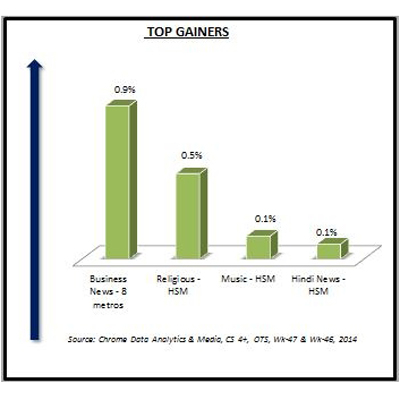
    Business News in the eight metros saw the maximum jump of 0.9 per cent. Zee Business with 82.3 per cent OTS topped the genre.

    Religious channels came in second with 0.5 per cent in the Hindi speaking market (HSM). Aastha continued its rein in the genre with 97 per cent OTS.

    Music and Hindi News channels in the HSM saw a 0.1 per cent growth. MTV with 91.2 per cent OTS and ABP News with 95.9 per cent OTS topped their respective genres.

    On the other hand, English Entertainment channels in the eight metros fell by 8.4 per cent. AXN with 67.5 per cent OTS continued to rule the chart.

    Across India, Infotainment and Sports channels dropped by 3.4 per cent and 2.3 per cent, respectively. Discovery with 86.2 per cent OTS and DD Sports with 72.7 per cent OTS topped their respective genres.

    English Movies in the eight metros saw a drop of 2 per cent with Movies Now gaining the most in the category with 73 per cent OTS.


  • Virgin Media reports lowest cable customer churn in Q3-2014

    Virgin Media reports lowest cable customer churn in Q3-2014

     BENGALURU:  Virgin Media Inc (Virgin Media), a wholly-owned subsidiary of Liberty Global plc (Liberty Global) and a leading cable operator in the United Kingdom (UK) reported lowest ever annual customer churn in Q3-2014 (Quarter  ended 30 September 2014), since Virgin Media was formed in 2007 at 14.9 per cent as compared to a churn of 15.3 per cent in Q3-2013. This churn record has contributed to cable customer growth more than doubling to 35,000, the highest quarterly customer additions since Q4 2012, says the company.


    Note: Currency mentioned in this report is ? or British Pound


    The company’s selected results for Q3-2014 say, ‘The number of subscribers to each of our cable products increased, with 88,000 organic RGUs (revenue generating units) added y-t-d (nine month period ended 30 September 2014 or 9M-2014) , including  70,000 in Q3, compared to declines of 16,000 and 7,000 in the respective prior year periods. This can be partially attributed to the successful launch of our “Big Bundles” in Q2 2014, which offer combinations of our cable products and resulted in the acquisition of more double- and triple-play customers than during the same period last year. Average Monthly Revenue per Customer Relationship increased 2 per cent to ? 48.98 year-over-year.’


    Virgin Media reported 2.3 per cent growth in revenue in Q3-2014 at ? 1046.8 million from ? 1022.8 million in Q3-2013. 9M-2014 revenue grew 1.7 per cent to ? 3145 million from ? 3092 million in 9M-2013.


    Four segments contribute to Virgin Media’s revenues – ‘Cable Subscription’, ‘Mobile Subscription’, ‘Business’ and ‘Other’


    Television subscription revenue in Q3-2014 fell 3.3 per cent to ? 234.7 million from ? 242.6 million in Q3-2013. Y-t-d, television subscription revenue fell 1.5 per cent to ? 717.9 million from ? 728.6 million in 9M-2013.


    Overall cable subscription revenue includes revenue from television, internet and telephony. Cable subscription revenue for the quarter grew 3 per cent to ? 724.5 million form ? 703.6 million in Q3-2013. Within cable subscription, internet revenue grew 19.8 per cent to ? 259.8 million in Q3-2014 from ? 216.9 million in Q3-2014. Telephony subscription revenue fell 5.8 per cent to ? 230 million in Q3-2014 from ? 244.1 million in Q3-2014.


    For 9M-2014, cable subscription revenue increased 3.3 per cent to ? 2188.9 million from ? 2119.0 million in 9M-2013. Internet revenue in 9M-2014 grew 16.2 per cent to ? 756.2 million from ? 650.7 million in 9M-2013. Telephony revenue for 9M-2014 fell 3.4 per cent to ? 714.8 million from ? 739.7 million in 9M-2013.


    Virgin Media says that it is the first provider of all four broadband, TV, mobile phone and home phone services in the UK. The Company’s cable network – the result of multi-billion pound private investment – delivers ultrafast broadband to over half of all U.K. homes, with speeds of up to 152 Mbps, as well as market-leading connectivity to thousands of public and private sector organisations across the country.


    Virgin Media says that it has developed UK’s most advanced interactive television service, and was the first to offer HD TV and access to connected services through the set-top box to millions of British households. It also launched the world’s first virtual mobile network and is one of the largest fixed-line home phone providers in the country.

  • Joining Airtel Digital TV, ID is now available on several DTH and analogue platforms

    Joining Airtel Digital TV, ID is now available on several DTH and analogue platforms

    NEW DELHI: ID-Investigation Discovery, the new 24-hour channel offering captivating true stories of investigation, crime and suspense in Hindi is now also available on Airtel Digital TV with immediate effect.

     
    Viewers can watch ID on Channel No. 133 on Airtel Digital TV.

     
    Aimed at the passionate Indian viewer, ID features provides fascinating true stories of human nature. The channel’s alluring series, in-depth specials and thought-provoking one-offs will challenge viewers’ perceptions on crime and investigation.

     
    In less than a month of its launch, ID has established a strong position in the Indian television industry and is experiencing increasing viewership across India. ID is available on leading digital and analogue platforms including Dish TV, Siti Cable, Hathway, DEN, GTPL, In-Digital, Digi Cable and now Airtel Digital TV.

     Discovery Networks Asia-Pacific executive vice president and general manager– south Asia & south east Asia Rahul Johri said, “ID has captured the imagination of the Indian viewer with its refreshing and differentiated programmes. We have prepared plans to maintain this trajectory and further enhance its entertainment quotient.”

     Some of the captivating series that will premiere on ID include ‘Disappeared’ that follows the unpredictable twists of missing person cases and tracks investigations aimed at solving how and why people simply vanish.


    These days, marriages are not always what they look like; explore the shocking hidden secrets of spouses in ‘Who the (Bleep) did I Marry?’


    In ‘I was Murdered’ revisit shocking cases through a first person perspective and witness the anguish of family and friends of victims as they peel the layers off each case. Recount real homicide investigations of the most horrific serial murderers in ‘Evil I.’ In India and across the world, women are known to fall for the wrong guy. Watch true stories of women who were swept off their feet by a member of the mafia in ‘I married a Mobster.’ In ‘Blood Relatives’ watch family members who get along very well on the outside but hide a lot more beneath the surface – jealousies, resentments and adultery that inevitably leads to the unthinkable – a murder.


  • Cisco powers Siti Cable’s DOCSIS 3.0 technology for broadband

    Cisco powers Siti Cable’s DOCSIS 3.0 technology for broadband

    MUMBAI: Siti Cable, that controls nearly 4.3 million digital cable TV subscribers, has chosen Cisco to boost its broadband. The tech company will provide DOCSIS 3.0 technology for its broadband service in the country.

    Through this, the MSO will be offering speed of up to 100 mbps. DOCSIS 3.0 can offer download speed of upto 300 mbps per subscriber and the upload capacity up to 100 mbps. As earlier reported by indiantelevision.com, this technology has been launched in Delhi and NCR.

    Speaking on the association, Siti Cable CEO VD Wadhwa said, “It is an absolute pleasure to be introducing our broadband service. We plan to accelerate the deployment to capitalise on the enormous business potential this market currently holds. With the deployment of this technology, we are uniquely positioned to offer superior Internet browsing, video streaming, video surveillance and rich media content on the same coaxial cable that delivers high-quality digital cable TV signals. We will offer much higher speed at highly competitive price. We are confident that Cisco’s technological expertise will help us in the achievement of this goal.”

    Cisco India and SAARC service provider sales managing director Sanjay Kaul said, “It is commendable to see Cisco’s vision, to be the leading enabler of ICT (Information and Communications Technology) and broadband acceleration in India, coming closer to reality. We believe that the cable TV industry has the potential to transform the broadband industry in India and would like to congratulate Siti Cable for marking an important milestone on this roadmap.”


  • So who does DAS benefit and what does RIO have to do with it?

    So who does DAS benefit and what does RIO have to do with it?

    When the BJP government was last in power with Ms Swaraj at the helm of the MIB, the digitisation process was first mooted in its original form of CAS. The populist notion was to bring down cable prices with the false concept of pay for what you want, so pay less. But little did the government realise that the customer’s cable bill was so significantly subsidised because of ‘under declaration’ that the ‘spoilt’ consumer in the cheapest cable market in the world would either have to reduce his current offering by half or more or if he wanted the same channel line up, would actually have to pay twice as much!

    At that time, the broadcasters were resentful as reduced reach was imminent in an advertising driven market and for DPOs it was definitely not favourable as they would need to reduce the number of analogue channels to piggyback digital cable on some of the frequencies which was otherwise used for analogue channels. (This was because both digital and analogue had to be offered on the same network). And this reduction of analogue channels impacted their carriage potential and hence revenues.

    So who won? None of the key stake holders- broadcaster, DPO or consumer.

    So who does DAS in its new avatar benefit?

    Certainly not the consumer from his cable bill point which was the original populist premise. Sure, the DPOs and broadcasters, once the dust settles down. With the transparency of set top boxes and doing away with ‘under declaration’, the MSO can now collect from the ground higher revenues and hence a bigger chunk eventually to the broadcaster. (Cable revenues were significantly lower than DTH revenues even though cable homes far exceeded DTH homes.) Who else benefits? The government, for sure, by way of higher taxes.

    And the losers of course in the value chain would be no doubt the consumer now shelling out higher ARPUs. And of course the LCO who till now reigned king keeping the bigger chunk of collections.
    So what’s wrong with DAS?

    Fundamentally, the current consumer pricing structure, the RIO rates and the business model. If DAS was to benefit the consumer why is there no B to C model, why are there no retail prices with direct offers from broadcasters to consumers with pipeline commissions to DPOs. Why are RIO rates unrealistic? Why are DPOs free to do retail pricing? The problem is RIO is a regulatory created framework and broadcasters have maxed out after years of price freeze not knowing what to expect.  

    If DAS has to succeed then this whole pricing scenario has to be re-looked. How can the broadcaster market his product if the DPO controls retail pricing? Or given the RIO pricing (which will now be used as a basis for negotiation) will the broadcaster really allow the DPO to play the role of a wholesaler and buy in bulk and retail at attractive customer offerings significantly lower than RIO.

    When regulation hinders market dynamics, it creates more absurdities. Any consumer product needs an MRP. Packages or stand alone. RIO is definitely not helping this process. It’s best the two beneficiaries – the DPOs and the broadcasters finally come together, see eye to eye and work out what is the magical pricing so that packaging and pricing is offered by both and directly to the consumer. If the DPO truly acts as a wholesaler he can surely better any packages the broadcaster directly offers unless of course the broadcaster/channel can go it alone which no doubt will be the true test of content and certainly a success yardstick to measure addressability.

    So can the government bury RIO and keep the consumer in mind!  TV entertainment is mass and needs to be looked at (retailed) as a service similar to that of consumer products! Let’s have an MRP, let’s also have a distributor pricing better than MRP. There is scope for both models to co-exist- DPOs mixing it up and offering multi-broadcaster packages and broadcasters also retailing with negotiated discounts to DPOs for pipeline usage and payment gateway.

    A 100 million plus pay TV homes is a very robust subscription market!

    Lastly, with the BJP now back surely we hope they will complete what they chaotically started. With the honourable I&B Minister Arun Jaitley and MoS Rajyavardhan Singh Rathore now at the helm it certainly looks like MIB is priority and our industry will definitely be both in competent hands and in their cross hairs!


    (These are purely personal views of consultant Sanjev Hiremath and indiantelevision.com does not necessarily subscribe to these views.)
  • “India is not yet mature for RIO deals”: Sanjev Hiremath

    “India is not yet mature for RIO deals”: Sanjev Hiremath

    The current scenario in India is not very viable to allow for reference interconnect offer (RIO) to take off. No broadcaster would want to be on a RIO agreement because the moment you are on RIO, your distribution is affected. Broadcasters want their channels to be carried by all operators and also in good packs for maximum reach.


    Subscription too would be lower at least initially. The RIO rate X subscribers on CPS basis will mostly likely be lower than the existing negotiated price for that channel.


    India is not yet an addressable pay TV subscription market and RIO deals will not work anytime soon; neither for the broadcaster nor for the DPO. The addressable billing system, consumer communication and B to C marketing needs to kick-in. 


    Currently, broadcasters want reach and DPO wants carriage or at the least it does not want to pay for the channel and keep its content cost down. There is competition among DPOs too and cost of content is critical to all. RIO is a regulatory mandate in the absence of a deal and a good basis for negotiations. Money saved on carriage on RIO (as there is no carriage) can be used for discounts to structure deals. 


    In the immediate future, some channels will get impacted due to poor uptake or because of it being a niche or premium channel. Some of these channels will likely go on RIO especially stand alone ones. As and when billing for content gets established we move to a more mature market where broadcasters will get decent subscription revenues, niche channels will be able to survive and premium channels will make more money being a-la-carte on a CPS deal.


    We are in a transition phase of moving to the real objective of DAS, pay as per channels viewed/subscribed – in short, ADDRESSABILITY!


    (These are purely personal views of consultant Sanjev Hiremath and indiantelevision.com does not necessarily subscribe to these views.)
  • I&B sets deadline for MSOs interested in DAS phase III

    I&B sets deadline for MSOs interested in DAS phase III

    NEW DELHI: All multi-system operators interested in distributing digital cable television services through the local cable operators in areas covered under phase III have been asked to apply by 21 December, this year.


    Phase III Digital Addressable System comes into effect from 31 December 2015, according to the revised deadlines.


     This phase will cover all remaining Municipal Corporations and Municipalities.


     The application in Form 6 (in triplicate) duly filled in and complete in all respects along with enclosures/documents and processing fee etc., has to be submitted to the Information and Broadcasting Ministry.


     It must contain details of the company/firm, directors/key executives and shareholding pattern etc in the prescribed Proforma.


     Application can also be submitted in person during Open House Meeting held on every Tuesday between 11 AM to 12 noon after sending request by email at das.mib@qmail.com or sobpandl@omail.com .


     The application form (Form 6) and Proforma for details of company etc can be downloaded from Ministry’s official websites: www.mib.nic.in or www. digitalindiamib.com.


     Applications received after 31 December 2014 will not be accepted/entertained for phase lll areas till cutoff date of phase lll is over. Incomplete applications will not be accepted.


     Queries in this regard can be addressed to das.mib@omail.com or contact Section Officer (DAS) on telephone no. 011-23381478.

  • Chrome Data: Week 44 sees fall in HSM

    Chrome Data: Week 44 sees fall in HSM

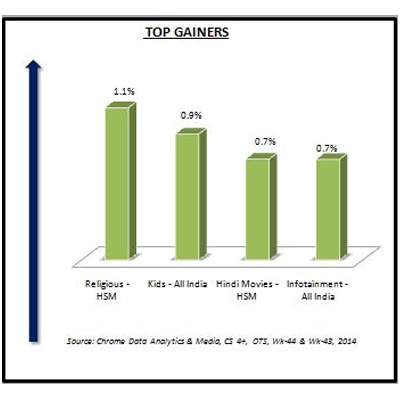
    MUMBAI: The week 44 of opportunity to see (OTS) collated by Chrome Data Analytics & Media saw Religious channels in the Hindi speaking market (HSM) gaining the most.


    The genre grew by 1.1 per cent with Aastha channel continuing its run at the top with 96.8 per cent OTS.


    It was closely followed by Kids genres across India which saw a jump of 0.9 per cent. Cartoon Network with 79.2 per cent OTS once again remained on top.


    Hindi Movies in the HSM and Infotainment channels across India witnessed a high of 0.7 per cent. Star Gold with 96.7 per cent OTS and Discovery with 87.3 per cent OTS topped their respective genres.


    The downward trend was witnessed by the eight metros with English Entertainment channels losing the most with a fall of 2.2 per cent.


    However, AXN with 68.8 per cent OTS continued with its winning trend in the genre.


    English News and Business News too dropped by 1.8 per cent and 1.2 per cent, respectively. Times Now with 84.9 per cent OTS and CNBC Awaaz 78.7 per cent OTS topped in their respective categories.


    English Movies too saw a drop of 1.2 per cent with Pix topping the chart with 72.8 per cent OTS.

  • Videocon d2h taps into the Star-MSO feud

    Videocon d2h taps into the Star-MSO feud

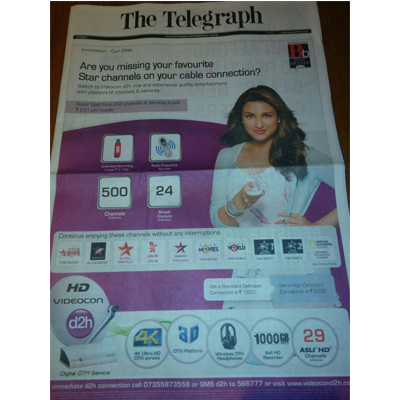
    MUMBAI: Star India’s incentives on its various channels on RIO has not gone down well with several MSOs in the country, who feel that this will actually raise consumer bills rather than make it easier, despite being on a-la-carte. However, the DTH industry sees a prized opportunity in the whole matter.


    Videocon d2h has taken out ads in several markets, concentrating in the east of the country, asking consumers to shift from cable to DTH. The ad asks consumers if they are ‘missing their favourite Star channels on your cable connection’ and if so then they should switch to Videocon d2h. The ad also lists the channels that the viewers can watch uninterrupted – Star Jalsha, Jalsha Movies, Star Plus, Life Ok, Star Sports, Star Gold, NGC, Star Movies, Star World etc.


    The ad also points out that viewers can avail 24 Bengali channels on the platform.


    Last week, Star India had come up with a new RIO agreement that it will be enforcing with MSOs across the country. According to Telecom Disputes Settlement Appellate Tribunal (TDSAT), the last date for undertaking the RIO will be 10 November after which the broadcaster can disconnect signals to MSOs.


    The network claims that up to now, nearly 33 per cent of independent MSOs have come forward to sign the RIO.