Tag: cable

  • “I may distribute a news channel. I just do not want to run one” : Kunal Dasgupta CEO SET

    “I may distribute a news channel. I just do not want to run one” : Kunal Dasgupta CEO SET

    It’s the festival of lights. And for many the festival of noise courtesy exploding fireworks. In the hope of reducing the number of those belonging to the latter tribe, we, at indiantelevision.com, decided to put a display of firecracker articles for visitors this Diwali. We have had many top journalists reporting, analysing, over the many years of indiantelevision.com’s existence.


    The articles we are presenting are representative of some of the best writing on the business of cable and satellite television and media for which we have gained renown. Read on to get a flavour and taste of indiantelevision.com over the years from some of its finest writers. And have a Happy and Safe Diwali!


    Written By: Thomas Abraham


    Sony Entertainment Television has secured the cable and satellite television rights for all ICC-designated One-Day cricket for the next seven years, which includes the next two World Cups. But with a reported $255 million acquisition tab, SET CEO Kunal Dasgupta has his task cut out to profit from it. At a media briefing last Friday, Sony presented the captain of India’s successful World Cup campaign of 1983, Kapil Dev, as its brand ambassador. Dasgupta talks of this and other issues like conditional access, DTH, uplinking from India to indiantelevision.com’s Thomas Abraham.


    What made you plump for Kapil Dev as your brand ambassador?


    The point is, just as Amitabh Bachchan is the icon of movies, Kapil Dev is the icon of cricket and we expect Kapil to do for Sony Entertainment what Bachchan did for Star.


    There is this huge investment of $255 million that has been pumped into getting the rights to ICC-designated One Day cricket tournaments. Recovering that is a tough ask any way you look at it. At least as far as the ICC tourney in September and the World Cup next March, are there any programming initiatives that you have in mind?

    There are a number of them we have lined up but I don’t want to talk about these initiatives at this juncture.


    What about an outline of your overall strategy? 


    First and foremost, we want to take the game beyond the male and offer it as family entertainment. The programming initiatives that we are working on will take cricket beyond the boundary and get the families in. There will certainly be a focus on women in our plans.


    Secondly, we have to generate interest beyond the matches India is playing. And we will have to create devices that provide for that.


    And the ICC rights that we have include under-19 cricket tournaments. There is no interest for this now but we will have to generate it.


    One way is to make the cricketers more media savvy. They will need to be groomed accordingly so as to give the proper sound bytes at the proper time. Tiger Woods is not just a sporting success story but a marketing one as well and this has been achieved by a great deal of coaching on how he conducts himself.


    Now that you have acquired this massive cricket property, have you thought of an IPO. Would this not be a good time to raise funds from the market?
    My board doesn’t think so.


    “The big question is, will the law make it mandatory to declare the subscriber management systems, which are in the hands of the cable operators? How do you control this is a big worry?”


    The big debate currently is around the government’s determination to introduce conditional access systems in the country. What is your stand on this?
    Well I would have to see how it is implemented. My principal concern is that there should not be a disruption of services which is something I am sure the government would ensure when CAS is introduced.


    The Cable TV Networks (Regulation) Amendment Bill, 2002 is almost certain to get cleared in the next session of Parliament in July. How long do you think the first phase of the rollout in the four metros will take? 

    It should take about a year or so at the very least, I would think.


    What will happen to DTH in this scenario? The whole concept of having tiers means that high-end services can be offered to consumers which would incorporate interactivity and other options like pay-per-view. Would this not make the DTH option a non starter?


    The introduction of CAS as is visualised would in fact speed up the entry of DTH. If the customer has any way to invest in a set top to access channels, the quality of service that DTH provides would make it quite a feasible option if the price is right. It should be noted that in India what we are talking about as far as CAS is concerned is an analog service. To digitise, massive investment is needed for cable TV headend upgradation as well as line upgradation. What we are looking at is costs of up to Rs 50,000 crores (Rs 500 billion). At the moment, it is only Reliance that is doing this kind of cabling.


    The introduction of CAS would certainly alter the dynamics of the business. What sort of scenarios do you visualise?


    Bundling of packages will certainly be there. It will ultimately boil down to who offers the best package. There will be possibilities of a number of currently rival networks like Sony, Star and Zee for instance coming together and offering a shared bundle. India is a unique market. Ultimately, market forces will settle the issue.


    What other options are there available to the broadcaster?


    One possibility is to supply boxes directly to the consumer. That way we bypass the cable operator altogether by entering into a direct relationship with the consumer.


    If you are talking packages, then strong bouquets will still be important. Have you earmarked any candidates for joining “The One Alliance” (what the addition of the Discovery and Animal Planet channels to the Sony Entertainment bouquet of SET, MAX, AXN and CNBC India is called)?
    An English movie channel is top of our wish list. Music and niche channels are our other options.


    “We will be continuously introducing new shows but they will be short duration series. The days of the long-running serial are numbered”

    _________

    (Inset) A 1983 file picture of Kapil Dev with the Prudential World Cup trophy.


    How many new channels can we expect on the platform by the end of the year?


    Ask me on 20 June.


    What about a news channel? There is a lot of buzz that a news channel is also on your list.


    As long as I am CEO, a news channel will not happen. We do not want to get into issues of editorial management as that would involve taking sides on issues. The issue we have with running a news channel is that we prefer to remain neutral. We have a lot of products that we promote in India besides our channels. There is the movie business, music and electronics goods that we have as well, so that is the position that we are comfortable with.


    That is not to say I cannot have a news channel on my platform. I can certainly distribute a channel. I just do not want to run one.


    Now that the government has liberalised uplinking, there is talk that broadcasters who uplink abroad will be looking at transferring operations to India so as to bring in new avenues for advertising. Is Sony considering such an option?


    Not for the near term at least. If at some later date, we feel there are clear advantages to be derived, then we would have to reassess the situation.


    What of programming? Is there anything new happening on Sony?


    We will be introducing a new blockbuster series slotted for the weekend prime time. The weekend has been associated with blockbuster movies. Now we are working on a blockbuster series that will run for 39 episodes. With it, we expect to carve out the weekend prime time slot.


    Balaji has said it is readying a 39-part weekend series that is going on air within the next two months, slated to run as a one-hour show on Fridays, Saturdays and Sundays. And the talk is that you are doing a big new show with Balaji. Is this that show?
    Yes it is.


    Still, it is the weekday programming that ultimately decides the success of a channel. What have you lined up for the weekdays?


    We will be continuously introducing new shows but they will be short duration series. The days of the long-running serial are numbered.


    Do you have any big ticket shows lined up?


    One show we are seriously looking at is a game show called Russian Roulette.


    From whom are you acquiring the rights?


    It is a Columbia Tristar property.


    (Russian Roulette, produced by Columbia TriStar Domestic Television [CTDT], is a game of chance where every question could cause a contestant to literally “drop out” of the game and has been a hit in countries as wide apart as Russia and Spain. In this knowledge test, four strangers challenge each other to answer a series of multiple-choice questions. If a contestant answers incorrectly, he must pull the lever potentially triggering one or more “drop zones”. When only one contestant is left standing, that person keeps all of the money won and proceeds to the final round. In the US version, the final winner takes home an additional $100,000.)


    What about Shubh Vivaah (Sony’s blockbuster marriage reality show)? When do you see it finally launching?


    There is a hearing scheduled for 8 July. After that, we will know for certain.


    But I thought the issue was settled. Didn’t the Delhi high court ruling (of 3 March) state that Taal (which went to court over claimed copyright violation) gets a lead time of two months if its own show Swayamvar launches on or before 30 June, otherwise Sony would be free to launch Shubh Vivaah?


    Well, Taal went in appeal of that ruling. So the judge has put 8 July as the date for final hearing of the case. Basically, Taal is only employing delaying tactics. In any case, we expect to have the show out in the next few months.


  • Q2-2016: Den Network’s QoQ revenue up 2.1%

    Q2-2016: Den Network’s QoQ revenue up 2.1%

    BENGALURU: Den Networks Ltd (Den Networks) reported 2.1 per cent growth in consolidated Total Income from operations (TIO) in the quarter ended 30 September, 2015 (Q2-2016, current quarter) at Rs 271.29 crore as compared to the Rs 265.60 crore in Q1-2016. TIO in the current quarter however was per cent per cent lower than the Rs 291.72 crore in the corresponding year ago quarter.


    Note: 100,00,000 = 100 lakh = 10 million = 1 crore


    The company’s consolidated net loss in Q2-2016 increased to Rs 75.23 crore as compared to the loss of Rs 51.89 crore in Q1-2016 and a loss of Rs 20.45 crore in Q2-2015.


    Cable Distribution Network revenue in Q2-2016 increased 1.4 per cent to Rs 263.06 crore as compared to Rs 259.46 crore in Q1-2016, but declined 9.4 per cent from Rs 290.28 crore in Q2-2015. This segment reported lower operating loss in Q2-2016 at Rs 32.11 crore as compared to the Rs 34.92 crore in Q1-2016 and an operating profit of Rs 8.64 crore in Q2-2015.


    Den’s Cable Subscription Revenue net of activation and LCO share in Q2-2016 declined three per cent QoQ to Rs 115 crore from Rs 119 crore and was flat YoY at Rs 115 crore. Placement Income in the current quarter declined six per cent QoQ and YoY to Rs 111 crore from Rs 118 crore. Activation revenues increased 80 per cent QoQ to Rs 27 crore from Rs 15 crore and increased 64 per cent from Rs 17 crore.


    Den’s Broadband revenue increased 58 per cent in the current quarter to Rs 8.23 crore as compared to the Rs 5.21 crore in Q1-2016 and Rs 1.44 crore in the corresponding year ago quarter. Operating loss from broadband however increased to Rs 23.07 crore in Q2-2016 as compared to the operating loss of Rs 19.67 crore in the immediate trailing quarter and an operating loss of Rs 10.7 crore in Q2-2015.


    Subscription Status and TV Shop


    The company says that it has seeded 3.5 lakh set top boxes (STB) in the current quarter as compared to 1.85 lakh in the previous quarter. Den has already seeded 26 lakh STBs in Digital Addressable Systems (DAS) Phase III areas. Its digital customer base at the end of the current quarter was 76 lakh as compared to 72 lakh in the previous quarter and 66 lakh in Q2-2015.


    In the case of broadband, the company added 21,000 subscribers in the current quarter as compared to 12,000 in Q1-2016. Its total broadband subscriber base in Q2-2016 was 57,000 as compared to 35,000 in Q1-2016 and 16,000 in Q2-2015.


    For its TV Shop, it has a reach of 380 lakh and added Videocon DTH to the distribution reach. Monthly GMV (Gross Merchandise Value) rate was Rs 17 crore as compared to the Rs 12 crore in the previous quarter.


    Let us look at the other numbers reported by Den:


    The company’s Total Expenses in Q2-2016 at Rs 335.04 crore (123.5 per cent of TIO) increased 4.6 per cent QoQ as compared to Rs 320.33 crore (120.6 per cent of TIO) and increased 12.5 per cent YoY from Rs 297.82 crore (102.1 per cent of TIO).


    Content cost in Q2-2016 at Rs 136.77 crore (50.4 per cent of TIO) was almost flat (increased 0.5 per cent) QoQ as compared to Rs 136.06 crore (51.2 per cent of TIO) was 25.6 per cent more than the Rs 108.91 crore (37.3 per cent of TIO) in Q2-2015.


    The company’s interest and finance costs in Q2-2016 increased 16.3 per cent QoQ to 21.25 crore (7.8 per cent of TIO) as compared to Rs 18.27 crore (6.9 per cent of TIO) but declined 6.4 per cent as compared to the Rs 22.90 crore (7.8 per cent of TIO) in Q2-2015.


    Employee Benefit Expense at Rs 34.15 crore (12.9 per cent of TIO) in Q1-2016 was 20 per cent more than the Rs 28.46 crore (9.5 per cent of TIO) in Q1-2015 and was 13.4 per cent more than the Rs 30.12 crore (11.1 per cent of TIO) in Q4-2015.


    Employee Benefit Expense in the current quarter increased 3.5 per cent QoQ to Rs 35.35 crore (13 per cent of TIO) from Rs 34.15 crore (12.9 per cent of TIO) and increased 36.9 per cent YoY from Rs 25.83 crore (8.9 per cent of TIO).

  • Shift to broadband in US cable industry will mitigate TV subscriber loss: Moody’s

    Shift to broadband in US cable industry will mitigate TV subscriber loss: Moody’s

    BENGALURU: Rising demand for broadband services will compensate for the loss in TV video subscribers and help sustain industry growth through 2016, says Moody’s Investors Service. As a result, the rating agency maintains its stable outlook on the US cable industry.


    Broadband gaining ground, video slides, voice stable


    Key takeaway:

    The key takeaway is that the broadband offset is substantial, and much higher than in the past couple of years. In 2013, for every video subscriber lost, cable signed up 1.4 broadband customers. In 2016, Moody’s are projecting a 2.4x multiple.


    Broadband subscribers outnumbered total video subscribers in Moody’s rated universe for the first time at the end of 2014, and the agency forecasts that this spread will widen to seven per cent by the end of 2016 as demand for broadband continues to grow.


    “This change in subscriber demand represents a fundamental shift in consumer appetite and the economics of the cable business model,” said Moody’s vice president and senior analyst Jason Cuomo. “The loss of video subscribers is a fundamental weakness, but broadband demand and pricing actions are more than fully offsetting the negative video trends.”


    The report says that broadband demand continues to grow faster than pay-TV subscriber losses. Companies in Moody’s rated universe had a little more than 126 million (12.6 crore) Revenue Generating Units (RGU – equal to the number of subscriptions at a service level) at the end of last year. Moody’s project that RGUs will grow to over 130 million (13 crore) by the end of 2016, representing a CAGR of approximately 1.7 per cent. Broadband is now the leading product, as video continues to slide and the number of phone customers holds steady.


    Moody’s says that the number of pay-TV subscribers in its universe has gone done from 50 million (5 crore) in 2013 at the rate of about 1 million (10 lakh) per year and its predicts that by 2016, the number will reduce to 46 million (4.6 crore). During the same period, broadband subscribers would increase from 49 million (4.9 crore) in 2013 to 57 million (5.7 crore) by 2016. Voice subscribers in 2013 at 25 million (2.5 crore) would increase to 27 million (2.7 crore) by 2016.


    Phone subscribers have also been growing between three – four per cent, but the report says that the pace is trending down and could moderate to below two per cent by 2016.


    Lower revenues, better margins


    This mix shift has changed the economics of the business, with the top line suffering from the loss in video revenues, while creating opportunities to grow EBITDA and margins that are better in broadband.


    The industry continues to raise prices for broadband services, driving average revenue per unit higher. Demand is being largely driven by video consumption, which requires more and faster bandwidth, positioning cable companies to further monetize their high-speed distribution system. At the centre of this transformation is streaming content “over-the-top” to deliver video-on-demand services, which is growing quickly, according to the report “Pricing, Broadband Demand Ease Pressure from TV Subscriber Losses.”


    The report says that Broadband generates much lower revenues than residential TV, (roughly half, on average) but much higher margins and EBITDA per customer. In addition, the business is growing much faster than the rate of loss in video subscribers (more than 2:1,) which supports both revenue and profits.


    Pay-TV produces the highest revenue per customer among the three main service offerings, significantly exposing the top line when subscribers defect. To put the risk in context, Charter’s annual video revenue per residential subscriber was $1,068 in 2014, much higher than the $540 for residential broadband and $235 for residential phone service. However, programming costs are high, and rising despite the loss of revenue, squeezing EBITDA and margins.


    The net effect of the mix shift is revenue growth of nearly four per cent, a rise in EBITDA of approximately three – four per cent, and relatively stable EBITDA margins of 38-39 per cent.


    “Despite the concerns that the cable industry is about to lose its competitive footing, it still maintains a steady share of the triple-play bundle — offering a package of video, broadband and phone services,” said Cuomo.


    Growth drivers are new subscribers, SMEs


    The large majority of growth is coming from new residential customers. Commercial is only a small contribution but growing quickly. Small to medium-sized business demand for broadband is growing and cable is attracting their business with competitive speeds. Time Warner Cable and Charter, for example, have reported growth rates over the last four years that average 15 per cent and 22 per cent, respectively.


    Although their commercial businesses are less than five per cent of total revenues, for both companies, new commercial broadband subscribers represented approximately eight per cent of all new broadband subscribers in 2014.


    Video going over-the-top, but on cable’s terms


    In video, the big story continues to be consumer demand for viewing content ‘Over-the-Top’ (OTT) on multiple devices — arguably the number one threat facing cable. OTT is the epicentre of risk in an industry at the very early stages of a rapid transformation. The speed of broadband, proliferation of devices, and emergence of content streamers such as Netflix Inc. have made this type of “non-linear” alternate possible. The pace is accelerating (Netflix now has over 40 million subscribers, starting from zero in 2007 when it was first introduced in the US) as the awareness of alternate viewing options grows. This may also be at least partially responsible for driving subscriber losses — although Moody’s believes the great majority of users are also pay-TV subscribers that migrated OTT as a complimentary service.


    Content companies facing huge challenge


    Rapid development of new content, more widely distributed through new media channels, over a larger number of devices, and at lower cost, is a huge challenge for content owners struggling to maintain market leverage by controlling content rights. Extracting value from every property they own is easier when it’s all sold in a bundle. This neat and simple packaging model is beginning to break down, however, as content is offered in skinnier bundles and a la carte. In this model, the value shifts to the highest-quality content assets, exposing those with lower viewer ratings and therefore lesser value.


    As the industry transforms, the friction of change could temporarily slow video-subscriber defections. The move to OTT can be stalled by a rise in broadband price or recognition that stacking OTT content is more costly than expected, especially when buying sports and other high-value content. Content unbundling and programming offered via apps may also create confusion and inconvenience for the customer. Issues including new bills to manage, more frequent ID authentications, and the need to search, find, and switch between apps may end up being more cumbersome than simply switching channels on a cable remote. Until addressed, these issues will help cable buy time.


    Cable’s pricing power is driving ARPU higher


    The industry has consistently raised prices as they continue to pass through most of the rising programming costs and charge higher rates for more services. This pricing power could rise further once pending acquisitions are completed. Based on Moody’s forecast for ARPU of $837 by the end of 2016, the CAGR will be approximately 2.5 per cent from 2013 with a slope in ARPU that has been essentially linear, despite the rise in competitive threats. This has been largely driven by the rise in content costs, but can also occur as owners attempt to reprice OTT programming on the same, or similar, terms as current pay-TV economics.


    Moody’s expect this trend to continue given cable’s strong market position. In particular, we think the cable industry is positioning itself to charge higher prices for broadband to offset the loss in video ARPU. This could come in the form of higher prices for more data consumption, faster speeds, data limits that force customers to pay for higher speeds, or a fee for the use of Wi-Fi hot spots, which so far has been free. Given the high cost of mobile broadband and limited coverage of mobile Wi-Fi, viewing streaming video in-home, on cable Wi-Fi is currently one of the lowest-cost/highest-quality experiences available — and ripe for price increases.


    While there is healthy growth in prices, competition will keep growth rational. Another major constraint to higher broadband pricing is regulation, now that broadband is subject to Title II of the Communications Act of 1934. Price hikes are likely to be tolerated by regulators, but only as long as they are reasonable and customary. The government has stated that they are disinterested in pricing regulation, but their position would likely change if prices rose aggressively and consumer complaints mount. Moody’s outlook assumes no regulatory intervention.


    Industry Consolidation


    Moody’s notes that industry consolidation resulted in a number of transformative deals over the past year, but further consolidation is unlikely through 2016 given the size and concentration of the largest and smaller players.

  • Videocon d2h reports higher EBITDA, revenues,  adds 0.2 mn net subs in Q2 FY 2016

    Videocon d2h reports higher EBITDA, revenues, adds 0.2 mn net subs in Q2 FY 2016

    MUMBAI: Indian pay TV platform and DTH operator Videocon d2h is slowly but surely getting its act together. At least if one goes by the financials for the quarter ended 30 September 2015 it has filed with Securities Exchange Commission in the US. The company is listed on the US Nasdaq.


    It has announced lower net losses, higher subscription and activation revenues, higher  EBITDA,  and an increase in both gross and net subscribers in the latest quarter as compared to the previous fiscal quarter and Q1 FY 2016.


    Net loss for the second quarter of the 2016 fiscal year at Rs 24.6 crore is a 59.9 per cent improvement over the net loss in the second quarter of the 2015 fiscal year which stood at Rs 61.4 core. It is, however,  marginally higher than the Rs 24.6 crore loss it suffered in Q1 FY 2016.


     It has reported a sales growth in both subscription and activation revenue and revenue from operations to Rs 629 crore (Rs 505 crore previous fiscal quarter – a growth of 24.6 per cent) and Rs 690 crore (Rs 507.30 crore  in Q2 FY 2016 – a growth of 20.3 per cent growth) respectively.  The comparitive Q1 FY 2016 figures for subscription and activation revenue  and overall revenues for Q1 FY 2016 were Rs 599.61 crore and 662.83 crore.


    The company notched up higher net subscribers (10.84 million in Q2 FY 2016 vs 9.46 million in Q2 FY 2015).  Average revenue per user (ARPU) growth  was higher at Rs 205 in Q2 2016 vs Rs 190 in Q2 FY 2015 but stagnated when compared to Rs 205.30 in Q1 FY 2016.


    It added 0.20 million net subscribers in this quarter, while adding 0.57 million gross subscribers to end Q2 FY 2016 with 14.27 million gross subscribers.


    As a comparitive, the  DTH service provider addded 0.61 million gross subscribers and 0.46 lakh net subscribers in Q1-FY 2016.


    Churn was higher in Q2 FY 2016 at 1.19 per cent as against 0.85 per cent in the previous corresponding fiscal quarter. 


    The company’s adjusted EBITDA has also improved 32.3 per cent to Rs 191 crore in the quarter ended 30 September 2015 as against Rs 145 crore for Q2 30 September 2014. This is a 2.50 per cent rise in adjusted EBITDA margin to 27.7 per cent in the latest quarter, despite significant increases in content costs as a percentage of revenue. Videocon d2h has clarified that the adjusted EBITDA is calculated after accounting for impact of its ESOP Plan 2014 which amounted to Rs 2.94 crore. The company’s EBIDTA in Q1-2016 was  Rs 187.43 crore (28.3 per cent margin).


    Videocon d2h says it began operating under new long term content agreements in the second half of the 2015 fiscal year. Content costs as a percentage of revenue in Q2 FY 2016 stood at 38.1 per as against 34.8 per cent in Q2 FY 2015.  Comparitively, content cost as a percentage of revenue in Q1 FY 2016 was  37 per cent. 


    Subscriber acquisition costs in the form of hardware subsidies were Rs 1,775 per subscriber during the second quarter of the 2016 fiscal year as against Rs 1,793 in Q1 FY 2016.


    Commenting on the results, Videocon d2h executive chairman Saurabh Dhoot said,  “I am happy to share that we have achieved EBITDA growth of 30.3 per cent in the first half of the current fiscal as against our guidance of 25-30 per cent growth. We are on track to deliver even stronger growth in the second half of this year, in line with the guidance shared earlier. During the quarter, we focused on enhancing our channel offering and added 14 Standard Definition and 4 High Definition channels. We have recently launched two proprietary services, namely d2h Hollywood HD and Darshan. With more than 50 million eye balls we also continue to gain traction on advertising revenue with marque advertisers coming on our platform.”


    Speaking on the near term subscriber growth outlook Videocon d2h CEO Anil Khera said,  “We estimate around 50 million television homes come under Phase III digitization, of which 24-25 million television homes are already on the digital platform. Thus, the target market under Phase III digitization is the remaining 25-26 million television homes that are currently on analog cable.”


    The company has also stated that its estimated market share stands at 21 per cent and it is among India’s fastest growing pay TV platforms.


    The Videocon d2h stock was trading at around $9.49  on Nasdaq at the time of writing as against $12.05 at the beginning of 2015.


  • ‘The more local digital advertising gets, the more effective it will be:’ Amagi co-founder KA Srinivasan

    ‘The more local digital advertising gets, the more effective it will be:’ Amagi co-founder KA Srinivasan

    In this era of digitisation, the advertisement ecosystem has taken a big leap with digital advertising entering the fray. There was a time when people used to read advertisements, and then with the advent of television came visual ads, which could only be shared by word of mouth. Now with access to internet, ads can be read, seen and shared with help of just one device.


    With brands choosing the digital platform to announce launches of new products with help of email marketing, search engine marketing mobile and web marketing, have now given ads a new dimension to reach people. Digital advertising has broken the limitation of time slot for ads and has increased reach by leaps and bounds.


    Amagi co-founder KA Srinvasan spoke to  Indiantelevision.com about geo-targeted marketing, brands shifting towards digital marketing and much more.


    Excerpts:


    Many channels are tying up with Amagi for geo targeting. Property Now from Times Network is one of them. Do you think split broadcasting will be the way forward?


    Hyper local advertising will be the future of broadcast and television; in general it is going to be more geo targeted. Customised content created as per consumer’s preference is going to have a lot of impact. With the concept of geo generic mass content, as content becomes more local, the ad’s visibility for viewers will increase. Nowadays, content is created based on country, city and regional level not just in India but across the globe. The original goal for over-the-top (OTT) in digital world is to personalise lifestyle and provide content depending on consumer’s interest, preferences and their past watching behavior.


    What do you think will define the new era of effective advertisement?


    The change that we have observed is the more local advertisements get, the more effective it will become. Many of our advertisers are targeting specific local audience. It is effective from both advertising and communications perspective. Viewers will identify the product and advertisers will have a much better brand name at regional levels. From a content owner’s perspective, more advertisers will be able to reach out and from a broadcaster’s perspective, the future is all about getting local in terms of content.


    Now after installation of your technology in multiple system operators’ (MSO) headend, how do you plan to seize digital?


    Keeping that in mind, we launched a product called Thunderstorm, which allows television content owners and television networks to provide personalised advertising in the digital space. Our customers will be able to deliver their content over mobiles, tablet, and television screens and on web. However, there is one problem with monetising the content as the ads, which are telecast on television and which go on the sites are the same. The same goes with handsets. Everyone is watching the same ad on mobile but it is not giving any revenue. We have built a platform that allows advertising networks to have completely different advertising depending on the targeted audience and geographical area.


    Is Amagi focusing more on the digital space now?


    We are enabling content on advertising for television and helping local network owners to ‘hyper local’ the ad content. As content viewing shifts more towards digital, we are trying to bring the product in a more personalised way in digital. Our aim is to personalise and localise cable, television and digital.


    From many years the ten second ad slot has been ruling television and continues to do so. What more will the digital medium adapt?


    Today, the digital media is used as a distribution platform by television networks. What we are trying to do is, using the same content in different versions and using the digital platform for distribution of these ads. In terms of distribution, digital can do much better experimentation and inter-activity than what traditional television offers. Many advertisers are not only creating one commercial but creating multiple versions of it. On the digital platform, attention time span is going to be very limited as compared to traditional television. And because of this broadcasters and advertisers are experimenting. They are trying to create content, which can get the brand name in just five seconds, so that the user does not skip it.

    Digital allows fine grain targeting and that is the reason why we are able to do a lot more interesting stories. It is going to evolve and shift the platform from television to digital. We will then see more of digital specific content. 


    How many broadcasters do you have on board right now?


    We have around 20 plus broadcasters and multiple television channels across many countries. And at the end of this financial year we will have 40 plus channels. And many of them are from traditional satellite and television that are shifting towards the digital platform.


    You talked about the product Thunderstorm for creating personalising content for advertising. What are the new innovations that Amagi is currently focusing on?


    We have partnered with television networks to conceptualise content better. Geo targeting is focusing on satellite to help advertisers in creating personal advertising. We aim to eliminate satellite completely and move to digital where they can use closed bar internet technology. By using that platform, they can deliver their content in fraction of the cost to operators and consumers not only in India but around the world. Many big platforms are leveraging ahead from traditional television and satellite. We see rapid growth in terms of digital advertising in future.

  • TDSAT asks Bangalore MSO not to cut signals of local association’s LCO members

    TDSAT asks Bangalore MSO not to cut signals of local association’s LCO members

    NEW DELHI: All Digital Network Ltd of Gandhi Nagar in Bangalore has been directed by the Telecom Disputes Settlement and Arbitration Tribunal (TDSAT) to main status quo and not to disconnect the signals to any member of the All Digital Cable TV Operations Welfare Association of Bangalore.


    The Tribunal said that in case there is any disconnection of the supply of signals by the respondent to any of the cable operators in this petition, All Digital Network will restore the connection till any order is passed.


    TDSAT chairman Aftab Alam and members Kuldip Singh and B B Srivastava listed the matter for 22 September.


    All Digital Network counsel Sharath Sampath has been given time to get proper instructions in the matter.

  • TDSAT asks Star India to not disconnect signals to Digi Guntur Network

    TDSAT asks Star India to not disconnect signals to Digi Guntur Network

    NEW DELHI: Star India has been directed by the Telecom Disputes Settlement and Arbitration Tribunal (TDSAT) to not disconection the signals to Digi Guntur Network India Ltd provided the petitoner pays Rs 24.10 lakh by 30 September. 
     
     
    Admitting the petition by the MSO challenging the disconnection notice, the Tribunal listed the matter for 28 October.
     
     
    TDSAT chairman Justice Aftab Alam and members Kuldip Singh and B B Srivastava said the payment will be without prejudice to the rights and contentions of the parties and the parties will abide by the final decision in this petition.
     
     
    Star India counsel Rajshekhar Rao accepted notice and was directed to file the reply within three weeks. Rejoinder, if any, may be filed within two weeks from the date of receipt of a copy of the reply.
  • Euronews boosts its presence in India on cable

    Euronews boosts its presence in India on cable

    MUMBAI: Making rapid advances in the country, Euronews has signed four distribution agreements with leading regional cable networks covering Delhi and the suburb of Noida.


    The English service of Euronews is now part of the basic digital line-up of the cable operators Star Broadband, Satellite Channels, Home Cable and Neo News Network, which are received in close to 1.1 million homes.


    Moreover, it began its distribution in India in 2013 through agreements with international hotel chains such as Radisson, Hyatt and Crown Plaza. Over 10,500 rooms in 50 hotels around the country receive Euronews.


    Euronews worldwide distribution director Arnaud Verlhac said, “Asia and the Indian sub-continent are a key geographic area for Euronews’ development. The obvious growth potential of India makes the country a strategic and necessary place to do business. These recent distribution agreements are the result of three years of work by the entire team and testify to the value of our objective editorial approach and the quality of our programmes and magazines.”


    Euronews regional distribution manager Asia-Pacific Sabrina Mimouni added, “Launching Euronews in the Delhi area is the first visible sign of Euronews’ arrival on this market which is particularly difficult to penetrate. I am delighted by the confidence the four big cable operators have shown in us. In just a few weeks, they put Euronews in their basic line-up so that the largest number of subscribers would have access.”


  • Chrome Data: Insignificant gain in week seven

    Chrome Data: Insignificant gain in week seven

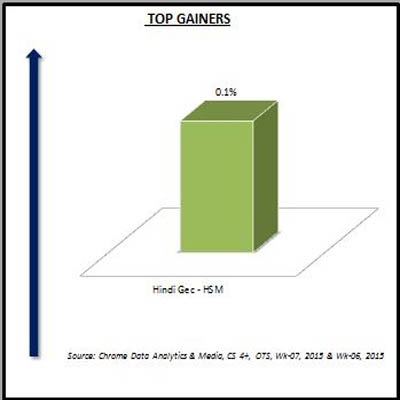
    MUMBAI: In week seven of opportunity to see (OTS) collated by Chrome Data Analytics & Media, the only gainer were Hindi general entertainment channels (GECs) in the Hindi speaking market (HSM). 


    The genre saw an insignificant jump of 0.1 per cent with DD National topping the chart with 96.7 per cent OTS.


    As for the losers, the eight metros saw the maximum fall. English Entertainment channels in the eight metros led the way with 2.7 per cent fall. Comedy Central with 55.1 OTS topped the genre.


    Kids channels across the country witnessed a drop of one per cent with Cartoon Network continuing its reign in the genre with 80.2 per cent OTS.


    English Movies and English News both saw a drop of 1.8 per cent in the eight metros. Movies Now with 65.5 per cent OTS and Times Now with 77.3 per cent OTS topped their respective genres.

  • Q3-2015: Hathway reports 2 per cent y-o-y revenue growth

    Q3-2015: Hathway reports 2 per cent y-o-y revenue growth

    BENGALURU: Indian multi system operator (MSO) Hathway Cable and Datacom Limited (Hathway) reported 1.9 per cent y-o-y growth in Q3-2015 with Total Income from Operations (TIO) of Rs 239.14 crore as compared to the Rs 234.78 crore but was 9.2 per cent lower than the Rs 263.51 crore in Q2-2015.


    The company reported a higher loss of Rs 58.05 crore in Q3-2015 than the loss of Rs 36.86 crore in the corresponding year ago quarter and the loss of Rs 39.26 crore reported in Q2-2015.


    Note: 100,00,000 = 100 lakh = 10 million = 1 crore


    Hathway’s EBIDTA calculated based on the figures submitted by the company (without other income) fell to Rs 24.58 crore (10.3 per cent of TIO) in the current quarter as compared to the Rs 36.74 crore (15.7 per cent of TIO) in Q3-2014 and also fell when compared to the Rs 40.03 crore (15.2 per cent of TIO) in the previous quarter.


    Hathway’s income from operations consists mainly of subscription income from cable TV and broadband business, carriage and placement business, advertisement income, activation income from STB and other operating income.


    In Q3-2015, the company’s cable business was 10.8 per cent lower at Rs 99 crore versus the Rs 111 crore in the previous quarter, placement income was down 8 per cent to Rs 75.8 crore from Rs 82.4 crore in Q2-2015, activation business at Rs 7.2 crore was less than a third of the Rs 22.2 crore in the immediate trailing, while broadband income, the only exception, was up 13 per cent at Rs 51.3 crore in the current quarter from Rs 45.4 crore in Q2-2015. The company says that placement revenues were affected due to content related issues in the current quarter that have since been resolved with the broadcasters.


    Let us look at the other figures reported by Hathway:


    Total Expenditure (TE) in Q3-2015 at Rs 274.39 crore (114.7 per cent of TIO) was 17.6 per cent more than the Rs 254.03 crore (108.2 per cent of TIO) in Q3-2014 and was almost same as the Rs 274.27 crore (104.1 per cent of TIO) in Q2-2015.


    A major fraction of TE is the pay channel cost for Hathway. The company’s pay channel cost in Q3-2015 at Rs 94.04 crore (39.3 per cent of TIO) was 12.3 per cent more than the Rs 83.72 crore (35.7 per cent of TIO) in Q3-2014 and was 2.9 per cent lower than the Rs 96.81 crore (36.7 per cent of TIO) in the immediate trailing quarter.


    The company reported 6.9 per cent higher depreciation and amortization expense (depreciation) in Q3-2015 at Rs 59.82 crore (25 per cent of TIO) versus the Rs 55.98 crore (23.9 per cent of TIO) and 17.8 per cent more than the Rs 50.78 crore (19.3 per cent of TIO) in Q2-2015.


    Hathway’s finance cost in Q3-2015 at Rs 26.86 crore (11.2 per cent of TIO) was 19.5 per cent more than the Rs 22.48 crore (9.6 per cent of TIO) and 11.6 per cent lower than the Rs 30.39 crore (11.5 per cent of TIO) in Q2-2015.


    Employee Benefit Expense (EBE) in Q3-2015 was Rs Rs 13.96 crore, in Q3-2014 EBE was Rs 13.79 crore and in Q2-2015 it was Rs 16.03 crore.


    While Hathway’s cable universe subscription numbers and cable paying subscribers remained stagnant at 1.17 crore  and 64 lakh respectively in Q3-2015 as compared to Q2-2015, Hathway has seeded 70000 set top boxes in Q3-2015, taking its digital subscription base to 85 lakh. Further, the company’s broadband home passed and broadband subscribers increased by 5000 and 10000 to 2 lakh and 4.3 lakh respectively, in Q3-2015 as compared to the previous quarter. Hathway also informs that it has about 600,000 STB’s in stock and plans to seed them at a rapid rate.


    Earlier, Hathway had informed BSE that the Board of Directors of the Company at its meeting held on 13 November, 2014, inter alia, has considered and approved the subdivision of face value of Equity Shares into Equity Shares of smaller amount than is fixed in the Memorandum of Association; i.e. to subdivide 1(One) equity share of Rs 10/- each to 5 (Five) equity shares of Rs 2/- each, subject to approval of shareholders.