Tag: cable TV

  • TDSAT & Ad cap: TRAI continues arguments

    TDSAT & Ad cap: TRAI continues arguments

    MUMBAI: Continuing to present its side to the Telecom Disputes Settlement Appellate Tribunal (TDSAT), the Telecom Regulatory Authority of India (TRAI) put forth its arguments to the bench consisting of Justice Aftab Alam and member Kuldip Singh.

    It started off continuing on yesterday’s argument trail saying that the law does not state that if the laying requirements are not fulfilled then it becomes void. That is, TRAI cannot execute its regulation on channels. That broadcasters are covered by both the Cable TV Networks Act and the TRAI act is a parliamentary mandate and there is nothing illegal in what it is doing. There are several precedents where a subject matter could be covered by more than one statute,  TRAI counsel  Rakesh Dwivedi stated.
        

    TRAI also claimed that it has a clear parliamentary mandate exercised through the central government to regulate advertisements. It contested the broadcasters’ arguments that TRAI has just a recommendatory role, by highlighting that it has an additional function under section 11 (1) (a) of the TRAI  Act and that does not mean its plenary functions under section (11) (1) (b) are taken away. Therefore, apart from its recommendatory function under (a), its powers also remain under (b). Both the sub clauses complement each other and there is no clash, the counsel stated.

    Reiterating that it has the authority, it said that what it is aiming to do is in perfect accordance with the powers the ministry and it has under section 7 (11) of the Cable TV Act. Likewise, the counsel, said it is not as if the government is seeking to have a higher allowance for advertising air time and is in disagreement with the limit of 12 minutes that the TRAI is seeking to impose.

    To support its argument, the counsel also read out various preceding judgments. According to the TRAI, broadcasters are licensees under the Telegraph Act and so the regulator has full power to ensure compliance within the licence term.
    Singh asked if TRAI can direct Google on the duration and number of ads it can run. To this, the TRAI counsel replied by saying: ‘I am the regulator and I will decide who, when and how much to regulate.

    Coming to the point raised yesterday about a statement TRAI had made in 2004 that “there should not be any regulation at present on advertisement on both FTA and Pay channels” it said that much water had flown under the bridge since it made its statement and the situation was different today. So, it can deem it appropriate to regulate since an expert opinion at one point of time does not mean that it will stay forever, the counsel stated.

  • Breaking news, the French way

    Breaking news, the French way

    MUMBAI: The French public news channel France 24 has been available on cable TV since December 2010. However, it is only now that the channel is going all out to announce its arrival to Indian audiences.

    Earlier this month, France 24 inked deals with two DTH platforms, Dish TV and DD Direct+ to increase its reach to 38 million viewers from just 7 million on cable TV.

    And soon, a slew of advertisements will appear in newspapers and out-of-home (OOH) media, with French major Gedeon as the creative agency of choice.

    The channel, which aims to offer India a glimpse of the world essentially through French eyes, has kicked-off promotional campaigns with the tagline ‘World news made in France’ in leading newspapers and magazines, including The Times of India, Hindustan Times, India Today and Time Out. Apart from this, outdoor hoardings will be seen at the Delhi Airport and Metro junctions for three months.

    Says France Monde Group CEO and chairwoman Marie-Christine Saragosse: “In terms of distribution, India represents a substantial and strategic market for us. Over the years, India has become a major player on the international scene and now it’s time for France 24 to be available to the largest possible audience across the country. That’s the reason why our long-term objective is to establish the channel as a reference and make its presence durable to Indian viewers. But to do so, we need to reach more and more TV households, increase the channel’s profile and the visibility of its programs.”

    Distributed across the country by Catvision, the FTA channel has also launched India-centric programmes to air till the end of this month.

    “France 24 is an international news channel, therefore our reports and coverage depend on the international agenda but one thing is sure, we’ll be increasing our coverage of all major news in India and in its region,” says Saragosse, adding that India has been quoted over 250 times on the website, either in articles or TV reports, since the beginning of the year.


    Saragosse feels that Indians will know the way the French see and present news

    “Our India-based journalists in the region are permanently on alert and covering every event related to the country live in our news bulletins and reports,” she says, informing that two teams have been operating from Delhi and Mumbai since the channel’s worldwide launch in 2006.

    The French diaspora in India is pegged at approximately 10,000 while according to the International Organization of the Francophonie, there are around 2.6 French-speaking people in India.

    So is France 24 mainly catering to this segment? “It is obviously important for us to target the French speakers and the French expatriates. Nevertheless, the biggest potential in the region remains the English-speaking market. That’s why we want to address the English speakers with our English version in India. Anyone with a connection to France is a plus, but our French perspective on news is quite universal and it is today making the difference: with 41.7 million TV viewers each week, France 24 has found its rightful place in the global news international concert. It gives a French perspective to international current events through diversity of opinions, debate, contradiction and confrontation of viewpoints,” says Saragosse.

    A media planner however pointed out that the ad campaign, while showing France 24’s POV, doesn’t really connect with Indian audiences. “It will not be easy for them to garner a mass audience. At the same time, BBC is an established brand already for international news. They might also be doing the same: building the brand name in the country,” he says.

    Another planner though felt the deals would add value to the channel by making it more visible to viewers in the country.

    Right now, France 24 isn’t earning any revenue from advertising as it is a foreign channel and an FTA. It has also burnt a hole in its pocket in carriage and advertising fees. “Discussing everything; that’s undoubtedly part of the French way of life. And I am pretty sure you’ll like it,” Saragosse signs off.

  • Pay TV growth spurred by BRIC nations, says ABI Research

    Pay TV growth spurred by BRIC nations, says ABI Research

    MUMBAI: India is just a year into the process of digitisation, and, in another year, it is quite likely all of the nation’s 100-odd million cable TV homes will be having a set top box (STB) perched on top of their TV sets. The rapid spread of the STB and pay TV is ensuring that India increasingly pops up in research reports on pay TV as a major contributor of growth. Other countries which are also helping spike pay TV growth are Brazil, Russia and China.


    Take a dekko at the latest report released by international research firm ABI Research. It states that the pay TV subscriber base across the world surpassed 886.5 million at the end of Q3 2013, a six per cent YoY increase and generated $ 62.6 billion service revenue. Maintaining its Q2 2013 status, BRIC (Brazil Russia India China) nations were a major contributor and will continue to be in the future years, ABI has stated.


    The research predicts that by 2018, global pay TV subscribers will shoot to more than 1 billion out of which BRIC countries will be responsible for 68 per cent of total net additional subscribers.


    “Emerging markets are key drivers of global growth in pay-TV subscribers as developed markets are experiencing flat growth rates,” said ABI Research VP and practice director Jake Saunders.


    The US Pay TV market grew at less than one per cent as compared to Q3 2012, due to increasing cord cutting by cable TV subscribers who are switching over to cheaper OTT services such as Netflix and Hulu. According to the report, approximately 1.7 million subscribers were lost from cable TV last year in North America. However, revenues increased due to high ARPUs (Average Revenue per User) driven by increasing HD and advanced DVR (Digital Video Recorder) subscribers.


    European countries also showed marginal growth with less than two per cent increase than Q3 last year. Service providers in Spain lost over seven per cent of their pay TV subscribers and Italy over two per cent as compared to a year ago due to the weak economic environment. However, markets such as the UK, France and Germany along with other Western Europe countries saw IPTV subscribers increase by 1.9 million from Q3 2012 to Q3 2013.


    According to a 2012 report by the Singapore-based Media Partners Asia (MPA) overall pay TV subscribers in India were expected to cross 170 million in five years. Much like the US, India is also set to see revenue increase due to HD TV sets. India has one of the lowest ARPUs in the world at approximately Rs 140 ($ 2.2) but the industry is optimistic that it will grow to Rs 550 ($ 8.73) once digitisation is complete.

  • TRAI issues supplementary consultation paper on DTH licensing

    TRAI issues supplementary consultation paper on DTH licensing

    MUMBAI: The Telecom Regulatory Authority of India (TRAI) issued a supplementary consultation paper on issues related to new DTH licences late 14 November evening.

    This follows up the consultation paper it had issued on 1 October on issue/extension of DTH licences at the behest of the Ministry of Information and Broadcasting (I&B).

    The new consultation paper seeks to get the views of industry stakeholders on the comprehensive review of the provisions in the existing DTH guidelines it is seeking to undertake.

    Among those are:

    Cross-holdings and control between a DTH licencee, broadcasting entities and TV channel distribution entities.

     
    It is seeking to modify clause 1.4 of the DTH guidelines from “The licencee shall not allow broadcasting companies and/or cable network companies to collectively hold 20 per cent of the total paid up equity in its company at any time during the licence period” to “the licencee shall not allow any entity controlling broadcasting and/or any TV channel distribution operator to control it…”

    Clause 1.5 is proposed to be changed from “The licencee company  not to hold or own more than 20 per cent equity share in a broadcasting and/or cable networking company”  to “any entity controlling the licencee should not control any broadcasting and/or any TV channel distribution operator.”

    The term TV channel distribution operator covers operators of cable TV, DTH, HITS, and IPTV.
    The consultation paper has defined what “control” can mean:

    *A company owns 20 per cent of another firm directly or indirectly though associate companies, subsidiaries and/or relatives

    * De jure control through having not less than 50 per cent of voting rights in second company; appointing 50 per cent of the members of the board of directors; controlling the management of affairs through decision-making in strategic affairs of the second company and appointment of key personnel.

    * Exercises de facto control by being a party to agreements, contracts or understandings…that enable it to control business decisions in the second company.

    The TRAI has said that if one were to go with this definition of control, then amendments will have to be made to laws relating to cable TV operators, broadcasters, HITS operators and some DTH operators will have to be given time to comply with the new provisions.
    Interoperability of DTH STBs

    The TRAI has stated that Clause 7.1 of the guidelines is open to interpretation. It states: “The open architecture (non-proprietary) set top box which will ensure technical compatibility and effective interoperability amongst different DTH providers shall have such specifications as laid down by the government from time to time.”

     
    It has emphasised that this could be modified to put the onus on the Bureau of Indian Standards and the government shall ensure that “the BIS specifications are based on open architecture and should incorporate the latest technological developments with respect to interoperability of DTH STBs taking into account its practicality as well as international experience.”

    Additionally, it states that “the BIS specifications should clearly specify the contours of interoperability between the STBs based on different technological standards.”

    Finally, it has pointed out that the licence conditions should be amended to mandate compliance to BIS specifications for the STB to be offered to all new subscribers within a suitable period of say six months.”

    Licence Fee:

    It has recommended that the licence fee and the definition of adjusted gross revenues (AGR) for the DTH sector be aligned with that specified in the Unified Licence. And that the licence fee may be charged at eight per cent of AGR. The AGR could be calculated “by excluding service tax on provision of service tax and sales tax actually paid to the government if gross revenue had included components of sales tax and service tax.”

    Under the current guidelines, DTH licencees have to pay an initial non-refundable entry fee of Rs 10 crore before the issue of the letter of intent by the licensor, and an annual fee of 10 per cent of its gross revenue in the particular financial year after the issue of the wireless operational licence by the WPC. The TRAI had in 2004 recommended that this be reduced by two per cent on AGR, and later to six per cent of gross revenues in 2008.

    Migration Fee:

    It has recommended an imposition of an entry fee on existing and new DTH operators moving to the unified licence regime. Existing operators should be given a rebate commensurate to the value of the licence for the remaining licence period, and that may be termed as the migration fee. The rebate could be calculated.

    The TRAI has asked stakeholders to give their views on the recommendations issued today by 25 November. Stakeholders also have to give their recommendations on the consultation paper dated 1 October 2013.

  • Q2-2014 Den Networks reports 35 per cent higher y-o-y cable revenues

    Q2-2014 Den Networks reports 35 per cent higher y-o-y cable revenues

    BENGALURU: Indian cable TV distribution company Den Networks Limited (Den Networks) continues to rake in the moolah with 32.4 per cent higher total revenue of Rs 271.88 crore for Q2-2014 as compared to the Rs 205.26 crore for Q2-2013 and almost flat (1.8 per cent higher) as compared to the Rs 268.69 crore for Q1-2014. The company reported a 35 per cent y-o-y jump in cable revenue for Q2-2014 at Rs 258.93 crore as compared to the Rs 192.51 crore in the corresponding quarter of last year (Q2-2013).


    Note:  
    Den Network claims that on account of a reporting policy change, w.e.f. Q2-2014, all revenue figures exclude ‘Other Income’ which is reported separately after EBITDA, and that past period figures have also been adjusted to this effect to make it comparable. Variance/s has/have been observed between the company’s investor updates of Q1-2014 and Q2-2014 and the statements filed by the company with the stock exchanges. The differences, if any between the financial analysis for Q1-2014 and Q2-2014 must be attributed to the varied accounting methodology/communications by the company. The current analysis is being done based on the updates for Q2-2014 received.


    The company reported a 35 per cent y-o-y jump in cable revenue for Q2-2014 at Rs 258.93 crore as compared to the Rs 192.51 crore in the corresponding quarter of last year (Q2-2013) on the back of strong growth in subscription revenues and higher placement revenues despite lower activation revenues in the current quarter.


    Q-o-q, the company’s investor update for Q2-2014 says that its cable business revenue was almost the same as the Rs 256.41 crore for Q1-2014, a figure that is Rs 6.44 crore (about 2.45 per cent) lower than the Rs 262.85 crore the company had reported in its Q1-2014 investor update (ref Note above).


    The company says that it has deployed about four lakh set top boxes (STBs) during Q2-2014 and claims a digital subscriber base of around five million in DAS phase I and II cities and about eight million analogue subscribers in DAS phase III and IV markets.


    Further, Den Networks believes that the next big opportunity after full digitisation of cable TV is offering high speed broadband services to its subscribers. The company announced plans to launch its broadband service offering by late Q4, FY 2013-14 (February 2014).


    Let us look at the other Q2-2014 figures announced by Den Networks


    The company has reported breakup of its cable revenue as Rs 99.11 crore as subscription revenue, Rs 119.90 crore as placement revenue and Rs 29.43 crore as digital activation revenue.


    Den Network’s consolidated EBITDA for Q2 -2014 was Rs 87.70 crore vs. Rs 38.73 crore in Q2-2013, a 126 per cent leap y-o-y, and eight per cent higher than the Rs 80.94 crore for Q1-2014.


    Correspondingly, its cable business EDITDA for Q2-2014 at Rs 85.05 crore was 134 per cent higher than the Rs 36.36 crore for Q2-2013 and seven per cent higher than the Rs 79.39 crore for Q1-2014.


    Consolidated PAT at Rs 11.18 crore for Q2-2014 was up by about 10 per cent higher as compared to the PAT of Rs 10.15 crore for Q1-2014. The company says that its cable business PAT stood at Rs 9.64 crore for Q2-2014.


    Consolidated expense at Rs 224.13 crore for Q2-2014 was 21.54 per cent higher than the Rs 184.66 crore for Q2-2013, and 2.3 per cent lower than the Rs 229.69 crore for Q1-2014. Den Network paid 18.4 per cent more towards content cost at Rs 90.54 crore for Q2-2014 as compared to the Rs 76.5 crore in Q2-2013 and the 6.5 per cent higher than the Rs 85.01 crore in Q1-2014.


    Depreciation and amortisation cost at Rs 37.04 crore for Q2-2013 was more than double (2.14 times) the Rs 17.29 crore for Q2-2013 and 11.47 per cent higher than the Rs 33.23 crore for Q1-2014. Den Networks has reported a foreign exchange loss of Rs 5.96 crore in its cable business for 2-2014.
    Den Networks claims that there is a significant demand for its digital cable services in its existing Phase III and IV markets. The pace of seeding is expected to pick up in the next few months. It also says that it is witnessing a lot of interest from smaller players (MSOs and LCOs) from Phases III and IV areas looking to align themselves with it and is receiving several such requests on a regular basis.

  • Howrah’s DAS travails

    Howrah’s DAS travails

    KOLKATA: To DAS or not to DAS? That is the question in West Bengal’s Howrah.
    Howrah, which is among those regions that are under phase II of DAS, has seen the implementation of DAS in only around 40 per cent of the million or so cable TV connections that dot the district.

    The remaining 60 per cent continues to be stuck watching analogue cable TV services. Subscribers have been loathe to pick up a set top box (STB) as local cable TV operators have clearly assured them that they fall under Howrah district and not Howrah city.

    A Howrah resident Rohan Das when contacted says: “I don’t mind buying the set top box (STB) but my operator has informed that it is not necessary to buy now.”

    Sources further add that not enough is being done to monitor or police how cable TV is making the transition to digital in Howrah. Cable Operators Digitisation Committee of the Association of Cable Operators convener Swapan Chowdhury confirmed that there is slackness in the DAS rollout.

    Manthan director Sudip Ghosh pointed out that things are doing well in “Howrah city which has around five lakh cable TV connections; most of these have been digitized. More over the CAF collection has also been completed by many, while some are doing it now.”

    Manthan has installed 20-25 per cent STBs in the region out of the four to five lakh STBs. Ghosh clarified that “Howrah district and Howrah city are different.”

    SitiCable Kolkata director Suresh Sethia also confirmed that the company has completed the work as mandated by TRAI. He however added, “TRAI has to define whether the border of Howrah falls under phase II or not. The regulator has to clarify the DAS area.”

    SitiCable controls a sizeable chunk of cable TV viewers in the region. It should be noted that broadcast regulator TRAI has extended the deadline for collection of Consumer Application Forms (CAF) in phase II cities including Howrah by MSOs to 15 November from its previous deadline of 30 September. MSOs operating in Howrah vicinity confirm that they will meet the deadline.

    While cable TV analysts say that CAF forms have not been received by many cable subscribers due to festive holidays – firstly, Durga Puja, and now Kali Puja followed by Diwali. “LCOs and MSOs will be back to work only after these are over.” 

  • Industry leaders’ thoughts on Independence Day

    Industry leaders’ thoughts on Independence Day

    Independence. We in India have had it for so many years that the India that is emerging does not know what it is like to not be free. For millions, the struggle to get freedom from the British, Portuguese and sundry other rulers are just chapters in their history books. But occasions like Independence Day and Republic Day remind us that we were once subservient and that we overcame bondage and won our freedom.

    15 August is the 67th year of our independence. For sure, the Indian flag will be hoisted in neighbourhoods all over India. Smaller flags will be mounted on cars, cycles and bikes. And even smaller ones pinned on our shirt pockets. Patriotic songs will be played out on radio and on TV.

    And hopefully for a day we will forget all our complaints against rising prices, economic upheaval, a political and administrative class that is showing little backbone for fair governance and well-being of its citizenry, corruption and the lack of respect that many in India have for women. Hopefully, we will remember the price that was paid for the valuable freedom that we enjoy today. And feel proud to be Indian. We, at indiantelevision.com surely are and even proudly carry it in our name.

    Indiantelevision.com’s young team of journalists spoke to senior professionals from the advertising, broadcasting, cable TV and marketing sectors to get a fix on their feelings on India’s 67th Independence Day. And also to gather from them on what their favourite patriotic song or movie is. Read on to feel patriotic:
    O&M India executive chairman & NCD Piyush Pandey

    I am very proud to be an Indian. I think India is a very significant country with many diverse cultures and we have come a long way. In the future, I wish the country to be in a much better shape than what it is currently.

    Mile Sur Mera Tumhara is my favourite patriotic song and truly depicts the light of Indian culture and unity amongst Indians.
    NDTV executive vice chairperson Narayan Rao

    I feel good that we live in an independent country but it shouldn’t be taken for granted.
    I’d like broadcasting to be world class and for journalism to have high standards, credibility and ethics.
    My favourite song is Saare Jahan Se Achchha.
    Publicis director, CCO south Asia Bobby Pawar

    Yes I am proud and happy as well that I am living in an independent country as an independent man.

    I really don’t have any ideas about where the industry is headed. If I did know, then I probably would make millions on it. However, I am very optimistic about the growth in the industry.

    My favourite movie is my friend’s Prasoon Joshi’s film Rang De Basanti and the title song from the same movie is my favourite song.
    Discovery Networks Asia Pacific, sr VP & GM, head of revenue, pan-regional ad sales & south asia, Rahul Johri

    I am proud of being an Indian and happy about it. I think in the coming years the broadcasting industry will evolve as the market evolves. I see many more options on offer for viewers and I see the broadcasting industry only growing further.

    My favourite patriotic song is the video Ye Mera India by Saleem and Suleiman which is on Animal Planet.

    Zee, chief content and creative officer Bharat Kumar Ranga
    I renamed myself from Mukesh to Bharat, when I was in the fourth standard. I fell in love with Manoj Kumar’s character as Bharat inUpkaar. So when I was filling my form for fifth standard, I renamed myself as Bharat. This is how deeply I feel about India. Though firangi competition is welcome, but in India only Indians will rule. I am among those, who believes in the country.

    It is in India, that media enjoys the stature of being the fourth pillar. It started with print and went on to books and films. There was a certain independence given to broadcasters, but that was not utilised to the maximum. Though India has done well in a lot of sectors, but growth in media has not been great. We need to break away from daily and weekly competitions to unleash the power of media.
    My favourite patriotic song is Mere Desh Ki Dharti from the movie Upkaar, I still get all 

    charged up hearing the song. Purab and Paschim was one movie which aptly brought out the power of India, and that is my favourite patriotic movie.

    Draftfcb+Ulka advertising ED & CEO Ambi M G Parameswaran
    I am proud to be an Indian. And I value my freedom. 

    As a nation, the change I would like to see is that the slowdown, which we are witnessing, goes away. I know it will be another 12-18 months before that happens, but then we will see double digit growth after that. The GDP growth needs to regain momentum, business confidence need to rise, rural development really needs to happen, and food prices need to come down.

    My favourite patriotic movie is the Tamil film Kappalottiya Thamizhan.
    Star Den Media Services, CEO Gurjeev Singh Kapoor
    We feel proud to be independent and we celebrated Independence Day at our workplace too on 14 August. Everyone was wearing small paper flags across their hearts proudly. We decked up the office with balloons and placed a small flag on every workstation.

    In broadcasting, freedom of expression is critical and this has rarely happened in the past, but it is witnessing a change. Things have gone through a revolutionary change and kudos to the industry for bringing in this welcome change.

    I love patriotic movies, but Saat Hindustani (1969) and Shaheed (1965) figure among my favourites.

    Zee News CEO Alok Agrawal
    I feel good as an Indian. We are living in a democratic country. There are lots of things we need to do to improve. We all have some amount of influence that we can use.
    We are launching an entire new initiative Bharat Bhagyavita. Our responsibility as media is to inform and empower people with knowledge and make them aware of their rights and encourage them to do something about what’s going on.

    Nothing comes to mind. I don’t go by defining a favourite. Any patriotic song is fine. I like almost all songs.

    Media Consultant, Sanjeev Hiremath
    For me patriotism is a feeling and cannot be defined in a song, though I really love the Hollywood movie ‘Independence Day’.

    In the 67th year of Independence, the biggest achievement for India is that it is no longer considered as a developing nation. A lot of Indian companies are now investing in overseas business. Our GDP is robust and we are above world average. I am proud to be an Indian and the reason is its diverse culture. My only concern is that though individually we are progressing, the country collectively isn’t. Even today 70 per cent of the population lives on 1.50 dollars a day. It makes me sad. The political scenario needs to improve.

    What is good about the cable and satellite industry is that we are not 10 years behind when we compare ourselves to other countries. We have been making gradual progress and now with DAS, in the next two years we will be up close with the world cable and satellite industry.
    Playtime Creations TV producer Hemal Thakakar

    As an Indian we feel proud that we had so many great men and women who gave their lives for freedom we enjoy today. Somewhere I think we have failed them and have misused freedom which they got for us. I hope, pray and wish we correct that.

    For broadcasters, future is shining. Digitisation is beginning of new horizon as our country gets hungry for more entertainment and infotainment. New avenues are discovered and looking at the Indian diaspora and the fact that we are a young nation, the broadcast industry is going to get a major boost.

    My favourite song is the title track from the film Swades and Kandho Se Milte Hain Kandhe.
  • The final word on cable TV digitisation

    The final word on cable TV digitisation

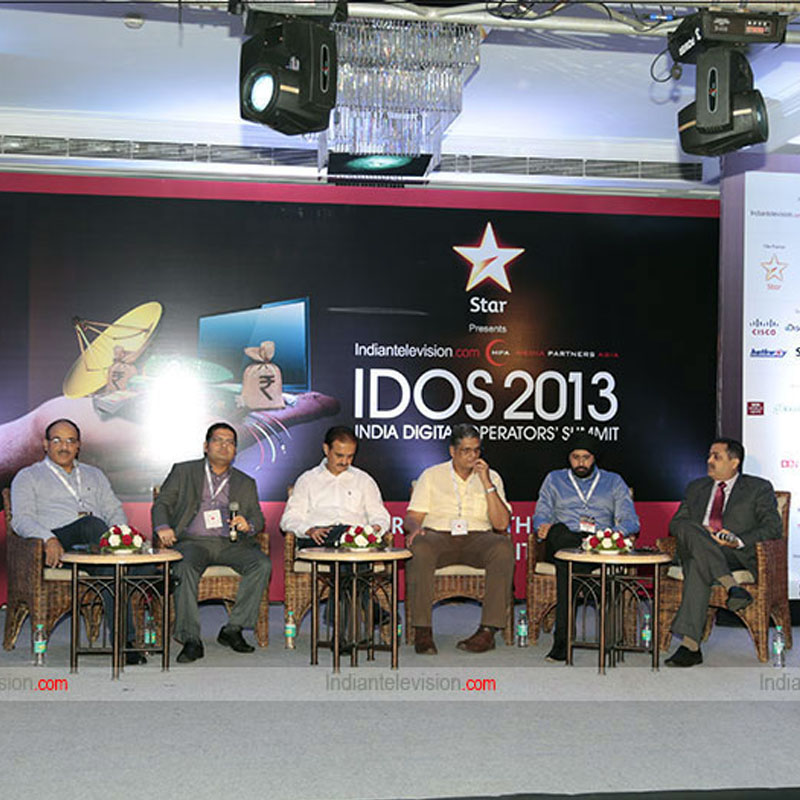
    GOA: With phase I and phase II on the cusp of completion, what are the lessons the digitising cable TV ecosystem has learned from their efforts? And how can this be put to use when industry moves into phase III and phase IV? This was the focus of the last session of the well-attended (it was houseful even on day two) IDOS 2013 in Goa.

    DEN Networks CEO SN Sharma said that his cable TV network was willing to take the punt and had enough investment to push into the territories it was targeting. “It won’t be easy but we are totally committed to doing it. Additionally, a lot of phase II was also done by local MSOs.  We see consolidation. In UK it happened. Five MSOs consolidated and are feeding around 90 per cent of the population there.”

    Hathway president Milind Karnik said that the last mile owner in many parts of phase III and phase IV has already upgraded and has awareness of and has already done some upgradation of infrastructure. “They will form cooperatives and consolidate and do what is needed. We too are going to move ahead forging relationships with local cable operators there, apart from serving some communities with our own headends.”

    Telecom Regulatory Authority of India (TRAI) principal advisor N Parameswaran said: “We expect like the telecom sector there will be some sharing of infrastructure.  We have learnt from phase I and phase II and there are many things we could have done better and will put those learnings in practice. There has to be some hygiene brought in terms of transparency and every other part of the process. Bill has to be generated to the subscriber. Service has to be provided. There will not be any looking back after that.”

    He urged MSOs and other players to understand that the dividends from phase I and phase II will start coming in with the addition of broadband delivery to subscribers. He further said a model has to be worked out between the MSOs and LCOs and TRAI would facilitate that.

    Also, in the wake of the continued depreciation of the Indian rupee against the dollar, the MSOs and LCOs feel that the government should give some subsidy to local manufacturers who are interested in setting up local units in the county to give a fillip to the industry.

    “We have got to come together. It has to be done together to resolve all the issues,” said Indian Broadcasting Foundation secretary general Shailesh Shah.

    Shah further added that the stakeholders would have to think how they can go deeper while addressing infrastructure problems. Carriage issue would also get resolved in a phased manner.

    Magnaquest CMO Ramakrishna Mashetty felt the landscape for the next phase of digitisation is different as compared to phase I and II as the cities are fragmented and low markets are there in the chart. “Most of the LCOs and market are unorganised,” he said.

    Telecom and Media lead analyst Rajiv Sharma said if the digitised headends start delivering incremental revenues in terms of services and ARPUs go up, return on investment (ROI) will improve. “Lot of external foreign investors are watching the space carefully,” he stated, adding that this imperative that some element of broadband be built in to the set top box so that the incremental revenues start accruing very quickly.

    Chrome Data Analytics & Media founder and MD Pankaj Krishna said the campaign in phase III and IV would be different. “The first two phases communicated and played on the principle of fear of blackout for consumers. The communications to the consumer during the third and fourth phase should focus on the benefits that a box can provide to users.”

    Parameswaran also addressed the issue of entertainment tax. “We have been working on understanding taxation levels which are a state subject versus a federal TDS or income tax,” he said. “But we are not averse to once again address this issue.”

    But what added spark to the panel discussion was the disclosure that the ministry of information and broadcasting was working with the department of telecommunications and MSOs to enable them to use already existing government and other infrastructure to help them as things start moving into phase III.

    The other good news is that bills – especially in Delhi – are slated to go out to subscribers in October, and online bills will follow later but interests of the LMO will be kept in mind.

    Parameswaran had the final word. Said he: “Digitisation will go ahead as planned. We are totally committed to it.”

  • Former I&B Secretary proposes fresh study into ad cap

    Former I&B Secretary proposes fresh study into ad cap

    NEW DELHI: It’s been a month and more since former Information & Broadcasting secretary Uday Kumar Varma relinquished his post to Bimal Jhulka. But you can’t get broadcasting  out of Varma’s blood. After all he and his team in the I&B almost single handedly forced a fragmented cable TV sector and a disbelieving television ecosystem to follow the government mandate for digitsation.  

    Now the former secretary has proposed that with the onset of digitisation, it is  possible for the Telecom Regulatory Authority of India (TRAI) to get all the data needed for a fresh look at the 12 minute ad cap which the regulator had mandated earlier this year.
    Uday Kumar Varma

    Speaking exclusively to indiantelevision.com Varma said  that the Telecom Disputes Settlement & Appellate Tribunal (TDSAT) has stayed the implementation  of the ad cap on news channels, and the TRAI should use this time to conduct a study on how much time is being devoted to advertising by the various television channels and determine how much can and should actually be devoted by them.  He stated that the regulator should be able to complete a thorough study in two or three months.

    Varma said that while the ad cap was sought to be enforced in view of the provisions of the Cable Television Networks (Regulation) Act 1995, the situation had changed considerably since with a much larger number of television channels than previously anticipated.

    He felt the 12-minute ad cap was in any case arbitrary as it was based on the experiences in other countries rather than in the Indian context.

    He agreed that there were some channels – particularly regional language ones – which aired up to 30 minute per hour of ads, but pointed out that the new regime under digitisation afforded TRAI the freedom to study the issue afresh.

    He said a method had to be found to enforce whatever ad cap is decided upon finally, since many channels are not members of either the News Broadcasters Association or the Indian Broadcasting Foundation. Even otherwise, he said all broadcasters were not on the same page on this issue.

    Asked about the demand that the ad cap be put off to December 2014 by when the entire country would have gone digital, Varma declined to comment as he said the matter was before the TDSAT.

    Merger of Phase III and IV of DAS

    On the topic of the merger of Phase III and IV of the digitisation process, Varma said it had been found this would work better since towns and rural areas in these two phases come under the jurisdiction of district collectors, and management would be easier.

    The merger would also give more time to stakeholders to put their infrastructure in place.

    Analogue Switch-off Justified

    Meanwhile, Varma said he stood by the decision to switch off analogue transmissions when resorting to digital addressable systems.

    He further added that permitting the co-existence of  both analogue and DAS, as had been done in the United States or the United Kingdom, would have led to a ‘warped policy’ in a country like ours.

    Digitisation should be seen as a means to make the broadcasting sector more transparent and give a better choice and viewing experience to the consumer, he said, adding that it  had also led to greater investments from India and overseas.

    The very fact that subscribers, who have switched over to DAS were not complaining and there were many others opting for the new system, meant the average Indian had become more conscious of what they were watching on TV.

    Affordability is not a major issue as those who have not yet bought digital set top boxes ‘will do so without being coerced’ once they see the advantages in terms of quality of picture, services, and value added services that may follow.

    Varma felt the method of collection and sharing of subscription fees too is undergoing a major change, and the consumer will be able to see the benefits of this. Furthermore, carriage fees charged by cable TV operators and MSOs had also come down and this would be reflected in the fee they charge subscribers.

    Varma believes that even the rural TV viewer will be in a position to partake of the fruits of cable TV digitisation. He pointed out that fatter wallet subscribers in metros and cities who will be paying  for value-added services and other benefits  will, in a sense, subsidise the rural consumer who is not so rich.

    As the adage goes, take from the rich to feed the poor. Even in television!

  • I&B ministry’s ad cap succor for broadcasters

    I&B ministry’s ad cap succor for broadcasters

    MUMBAI: On the one hand, the Telecom Regulatory Authority of India (TRAI) is putting the squeeze on broadcasters. On the other, the ministry of information and broadcasting (I&B) is proving to be an angel in disguise all ready to provide it with some succor. At least in the area of the 12 minute cap on advertising per hour allowed on television which TRAI activated earlier this year, and which is to be implemented next month.

    Reports are that the ministry is collecting data from broadcasters to ascertain the loss that they would incur on account of the TRAI-mandated ad cap.  It is then expected to prepare a consultation paper within the next 10 days, say these reports.

     
    Broadcasters – especially news broadcasters – have been yelping about how any reduction in air time would lead to a shriveling of revenues for them; in fact it might make it unviable for them to sustain their operations. Their constant wailing caught the attention of I&B minister Manish Tewari who last month requested the TRAI to post-pone the ad cap to end-2014 to coincide with the inflow of subscription revenues which are expected to accrue to broadcasters post the completion of cable TV digitisation.

    The Telecom Disputes Settlement & Appellate Tribunal (TDSAT) concurred with the news broadcasters’ appeal and put a freeze on the applicability of the ad cap, till their plea was heard on 11 November 2013. General entertainment channels have, however, agreed to comply with TRAI’s directions and have even gone ahead and reduced their commercial advertising air time.

    Says a media observer: “All the players – TRAI, I&B, broadcasters – need to get together to have a road map for the reduction of the ad cap gradually and periodically over time and not in one fell swoop as TRAI has been suggesting. It’s good that the I&B ministry and TDSAT have been supporting the broadcasting sector as far as the ad cap is concerned. It is imperative for its survival.”