Tag: cable TV

  • MSO InCableNet gets Rs 300 crore cash infusion

    MSO InCableNet gets Rs 300 crore cash infusion

    MUMBAI: The folks at the Hinduja group-owned cable TV MSO InCableNet and InDigital must be a happy bunch. The reason:  Grant Investrade Limited (GIL), a wholly owned subsidiary of Hinduja Ventures, has decided to invest Rs 300 crore in the cable distribution business managed by InCableNet and InDigital in India.

    The capital infusion, according to a press note released by the company, is happening to take advantage of opportunities government mandated digitisation of cable TV.

    “Phase I and phase II of the Digital Addressable System (DAS) have already been completed and several consolidation opportunities are coming up. The capital will be used to expand the digital base of IMCL and to improve customer services,” said the release.

    Hinduja Ventures director Ashok Mansukhani when contacted said, “The purpose of promoter infusion through GIL is to help IMCL stabilise phase I and II which has completed set top box installations. It is up to IMCL management to also grow in new geographies for phase III and IV which are due to be digitalised by 31 December, 2014 either organically or inorganically.”

    The investment has come in at a time when there is a lot of buzz on whether the MSO is in the running to acquire or partner the Kolkata-based MSO Manthan Broadband. Unwilling to confirm or deny anything Mansukhani said, “There are of course plans to expand our geographical presence. Kolkata is an interesting city to venture into, but nothing as of now has materialised.”

    He further added, “We already have 22 joint ventures and would obviously like to expand. These things keep happening in the cable TV business.”

    The infusion of cash couldn’t have been more timely. Industry observers have been watching closely waiting for the MSO to get active.

  • Chrome Data: Mandela helps Infotainment channels gain OTS

    Chrome Data: Mandela helps Infotainment channels gain OTS

    MUMBAI: Last week, the world woke up to the news of the demise of Madiba aka Nelson Mandela. As the world came to terms with the loss of the man who changed and helped shape the history of South Africa, social media and media went berserk.

    Leave aside news channels, even the infotainment channels competed with each other to come up with more special segments on the revolutionary-turned-prisoner-turned-president-turned-legendary.


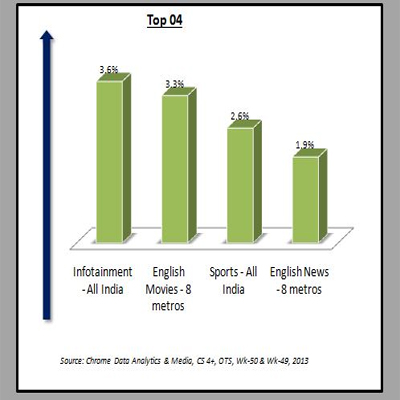
    And it shows in week 50’s  opportunity to see (OTS) data provided by Chrome Data Analytics & Media which keeps a tab on around 73 million TV homes nationally in analogue cable TV, digital cable TV and DTH. Infotainment channels were the biggest beneficiaries of the week with a gain of 3.6 per cent. Discovery Channel garnered the highest OTS among the players in the segment with its 89.1 per cent on an all India basis.


    Close behind was the English movies genre with a 3.3 per cent increase in the eight metros. As most channels gear up to air the biggest blockbusters to wrap up the year, movie buffs aren’t complaining. Sony Pix scored a 88.7 per cent in its OTS during week 50.


    Despite India losing to the Proteas in South Africa, sports buffs continued to tune into the action on the greens. The genre did appear in the top four categories with a  2.6 per cent gain. Ten Sports, the channel airing the matches, gained the most with 78.7 per cent OTS across India.


    The Delhi election aftermath did catch people’s attention with News channels in the eight metros seeing a jump of 1.9 per cent. Arnab Goswami’s Times Now topped the charts with 91.3 per cent OTS.  


    As for the bottom four categories, English entertainment channels saw a huge drop of 7.5 per cent in the eight metros. AXN registered 81.8 per cent OTS in the genre while others lagged behind.


    Religious channels saw a minor fall in the Hindi speaking market (HSM) at 0.6 per cent. Aastha channel continued to top the genre with a 97.9 per cent OTS.  Next in the line was the Hindi movie channel genre which sank 0.3 per cent with Star Gold continuing its golden run in the HSM with its 96.8 per cent OTS.


    Hindi News channels in the HSM region too saw a 0.3 per cent fall. Aaj Tak got the highest OTS at 93.6 per cent.

  • DAS: The Chennai conundrum

    DAS: The Chennai conundrum

    MUMBAI: The country may have entered the third and fourth phases of digitisation, but one of the major metros, Chennai, seems to be lagging behind in the digitisation process from phase one onwards. However, it is time for them to buck up as the Telecom Regulatory Authority of India (TRAI) may soon start cracking the whip on broadcasters, MSOs and LCOs in Chennai if they fail to comply with the digital addressable system (DAS) or digitisation norms, leading to severe repercussions.

    In a meeting organised on 9 December by the TRAI with the three stakeholders, the Regulator said that it has already notified the TV channels in Chennai that are still transmitting analogue signals. The deadline to implement DAS was 1 November 2012, but despite the entire framework such as interconnection, quality of service and consumer complaint redressal and tariff being in order, the stakeholders haven’t really followed the process,TRAI reiterated.

    One of the biggest hurdles in the implementation of digitisation is the dispute between the regulator, the information and broadcasting ministry and the Jayalalithaa-led Tamil Nadu government controlled Arasu Cable corporation that it should be given a DAS licence.

    Arasu Cable, that delivers cable TV services to almost half the subscribers in the city, was revived in 2011 and rapidly grew under the alleged patronage of the Jayalalithaa government.

    A TRAI consultation paper on monopoly in the cable TV sector released in June 2013 put it very aptly: “The Government of Tamil Nadu has incorporated Tamil Nadu Arasu Cable TV (TACTV) Corporation Ltd. on 02.09.2011 for distribution of cable TV in Tamil Nadu. It has taken over 27 Headends from the private MSOs. TACTV Corporation is providing cable TV services with most pay channels at a cost of Rs 70 per month to the public through local cable operators. Prior to this, another MSO, M/s KAL (Sumangali) Cable, which is a subsidiary of the Sun group, had dominance in the cable TV services in Tamil Nadu. However, KAL Cable continues to be dominant in Chennai city, where TACTV has not been registered as an MSO under DAS. Interestingly, channels of the Sun group, an integrated player providing both broadcasting and distribution services, were not available on the TACTV network for quite some time.”

    TRAI had then made it clear that Central and State government ministries, departments, companies and undertakings should not be allowed to enter into the business of broadcasting or distribution of television channels.

    The TRAI consultation paper had estimated that Tamil Nadu has 1.3 crore cable TV homes out of which 50 lakh are subscribers of Arasu. Other estimates are that Chennai has 38 lakh cable TV homes and seven lakh DTH homes. These estimates put Arasu’s subscriber base at 14 to 15 lakh.
    Recent reports claim that the dominant MSO had even ordered a large shipment of STBs in June this year, but has not gone ahead since it has not been issued a DAS licence. Since Arasu is still delivering analgoue signals, most other MSOs too have been tardy on switching over to DAS completely, fearing they would alienate their subscribers.

    In the meeting that the regulator had with the MSOs on 9 December, it ordered them to stop analogue signals and implement complete digitisation. It directed the MSOs to get the Subscriber Management System (SMS) in place with details of customers including their choice of channels.

    It also hurled another missive at broadcasters, clearly ordering them to provide their signals only to those MSOs that are registered for providing cable TV services through DAS. MSOs have been cautioned to ensure that only digital transmissions are provided through their network and Customer Application Forms (CAFs) are collected soon.

    TRAI has stated that it will closely monitor the progress of digitisation in the city and will also consider taking strict action against those who do not follow the protocol.
    Even customers have been advised to ensure that they receive cable TV connection only from operators supplying DAS signals or face a blackout of their TV screens.

    TRAI has also urged them to duly fill the CAFs at the earliest and submit them to their local operators. If they fail to do so, MSOs will be compelled to cut off transmission of those consumers, failing which they may will be in breach of law.

    In Chennai, out of the 38 lakh cable TV homes, only four lakh STBs have been seeded. This leaves nearly 34 lakh houses receiving analog signals.

    Will cable TV operators, broadcasters, and MSOs change the status quo and possibly face the ire of the state? They have not dared to challenge its might for the past year or so. On one side is the telecom regulator which is glaring down on them; on the other there is the state government has made its intentions clear when it asked the centre that Arasu be given a DAS licence. A conundrum if there ever was one.

    Will TRAI’s current warning turn out to be just what it is?

  • Music channels see uptick in OTS in week 49

    Music channels see uptick in OTS in week 49

    MUMBAI: From exit polls to winning speeches, week 49 should have been the week of news channels. However, the truth is far from it. According to the Delhi-based Chrome Data & Analytics which keeps a tab on around 73 million TV homes nationally in analogue cable TV, digital cable TV and DTH, it was the week for music.

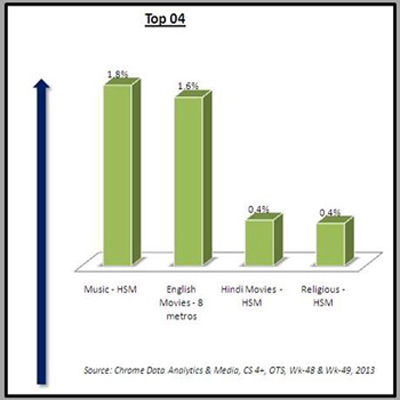
    Yes, you read it right. Music genre was the top gainer with a 1.8 per cent opportunity to see (OTS) gain.  For week 48, in Hindi speaking markets (HSM), the OTS was 47.4 per cent and in the following week reached 48.2 per cent. The music genre recovered what it lost in the previous week.

    Second in line is the English movie channel genre which saw an increase of 1.6 per cent in the eight metros. The year is coming to an end and as most channels air the biggest blockbusters of the year to wrap up the year, one can say that there are a lot of movie fans in the metropolitan cities.

    Next come the Hindi movie channels and religious channels with both seeing an increase of 0.4 per cent in the HSM. Star Gold continued to be the biggest gainer with 97.0 per cent OTS. In the religious genre, Aastha channel rose above all in the category with and OTS of 97.5 per cent.


    As for the bottom four genres, English Entertainment channels saw the biggest drop with 2.5 per cent in the eight metros. Star World topped the chart with 82.0 per cent. Even with elections in five states, the English news channels should have continued to gain but the genre failed to do so and saw a drop of 0.3 per cent unlike the previous week (week 48) where it was the highest gainer. Times Now was the leader in the genre with 88.3 per cent OTS in the eight metros.

    Next were Hindi GECs which dropped 1.0 per cent in HSM. The channel in the genre which saw the biggest drop is Colors; its  OTS was 95.7 per cent in week 49 as compared to 97.3 in week 48.

    The kids’ genre across the country and Hindi news in HSM too saw falls of 1.0 per cent and 0.8 per cent, respectively. Cartoon Network caught children’s attention and ranked number one in the category with 85.9 per cent while ABP News was the highest gainer with 92.7 per cent in the genre.

    The OTS numbers might be music for executives operating in  certain genres, but let’s wait and watch how things unfold for them in the coming week.

    Click here for the full analysis

  • Unbundling channel rates a danger to TV ecosystem?

    Unbundling channel rates a danger to TV ecosystem?

    MUMBAI: In the midst of the digitisation process in India, several issues continue to be left unanswered. One such being the matter of unbundling of channels for which the Telecom Regulatory Authority of India (TRAI) issued a consultation paper asking suggestions from stakeholders regarding the same but no decision was reached after that. There is however a rift between MSOs and aggregators on the issue with the MSOs favouring it and aggregators being against it.

    The real question is whether or not it will benefit everyone including the broadcasters, MSOs, aggregators and finally the consumer. 

    A report on the situation in the US by investment banking and asset management firm Needham and Co’s entertainment analyst and MD Laura Martin says, unbundling of cable TV rates could well be a recipe for disaster for all concerned. In the report, Martin has taken a look at the issue from the consumer’s perspective and its consequences for them and for the ecosystem. 

    Martin’s report reveals that US households pay about $720 per year for 180 channels out of which they watch just 18. Consumers would like to pay $30 per month to watch these 16-20 channels. As compared to this, in India, annual rates are a paltry $30-$60 per annum for anywhere between 120 channels to 200 plus channels. 

    Martin argues that if consumers wanted to have all 180 channels as a la carte, their annual spending would increase to $1260, i.e, 75 per cent higher than the current price. 

    Here’s how it goes: cable TV channels in the US generate $56 billion from advertising and $45 billion from subscribers, while pay TV distributors pocket $30 billion, if one goes by last year’s figures. She estimates that if there was unbundling about 124 channels out of these 180 would be wiped out as they would not be in a position to have an average of the 165,000 viewers which Martin estimates are needed to break even on each cable TV channel’s $280 million per annum investment. Her view is that niche channels would simply disappear.

    The decrease in channel choices, points out Martin, would also mean that approximately $80 to $113 billion would be lost in consumer value and the government would lose $20 billion in taxes. It will also put the US, which is already dealing with a high unemployment rate of 7.3 per cent in October 2013, at a risk of losing 1.4 million additional jobs.

    She also warns that if these 180 channels do not create content that is engaging young Americans in the 18-34 year age group, there might be no traditional linear television left in 10 years. Viewers are resorting to cord-cutting and migrating increasingly to online for their entertainment to services such as Hulu, Netflix, Big Frame, Defy Media, Fullscreen, Machinima, Maker Studios,etc. According to a statistics portal Statistica, 43 per cent of Americans between the ages of 18 and 34 preferred Netflix as compared to 46 per cent of paid subscribers who chose cable.

  • Close Kolkata LCOs appeal to MIB for 10 year license

    Close Kolkata LCOs appeal to MIB for 10 year license

    KOLKATA: Since the time the process of cable TV digitisation started, if any faction has been really troubled, it’s the local cable operators (LCOs). To make their future secure, they have raised their voice time and again.

    In an attempt to form a united front and take up the common issues troubling them, around 8,000 Kolkata LCOs, who claim that mandatory digitisation has adversely affected their livelihood, are requesting the Parliamentary Standing Committee of Information Technology for 10-year license from the Ministry of Information and Broadcasting (MIB).

    One of the reasons that worry the LCOs the most is that they are registered with the post office and get only a year’s license at a time.

    “But the Multi System Operators (MSOs) get a 10-year license from the MIB,” says Cable & Broadband Operators Welfare Association (CBOWA) general secretary Swapan Chowdhury, who thinks that the present condition of licensing is unfair and is making LCOs uncertain about their future.

    “We have requested the authority to recommend the licensing provisions made in the ‘Recommendations on Restructuring of Cable TV Services’ dated 25 July, 2008 to be implemented for LCOs and MSOs,” he adds.

    The body has also appealed to Member of Parliament and Member of Parliamentary Standing Committee of IT, Tapas Paul to review the arbitrary rule and act of Digital Addressable System (DAS) in order to protect the cable operator’s fundamental rights of livelihood.

    Chowdhury thinks that the current revenue sharing model between the MSOs and LCOs is not viable for the cable operators and in due course of time it may even compel the LCOs to quit the business. In the current scenario, as defined by the regulator, the ratio of revenue sharing between MSOs and LCOs is 55:45 for free-to-air (FTA) channels and 65:35 for the pay channels. “The business model should be reconsidered to protect the livelihood of lakhs of people,” says Chowdhury and adds that CBOWA believes that the model is discriminatory and thus they have put in a request for that as well.

    Another thing that is bothering the LCOs is that the MSOs are not executing the terms in the agreement even though DAS has been implemented since February this year. CBOWA has also put in a request about this so that these issues can be addressed in the winter session.

    A cable TV analyst, Namit Dave thinks that the digitisation process is a massive exercise and requires all stakeholders – broadcasters, MSO and LCOs to work in collaboration. “It would be difficult to execute the herculean task if any of these parties don’t cooperate,” he concludes.

  • Kolkata may bill cable TV consumers from 10 December

    Kolkata may bill cable TV consumers from 10 December

    KOLKATA: On 29 November,  indiantelevision.com  had reported that the Telecom Regulatory Authority of India (TRAI) pushed the deadline for MSOs to submit duly-filled CAFs (Consumer Application Forms) to 15 December, also asking them to implement gross/direct billing by December.

    The latest development is that Kolkata is likely to start the billing process from 10 December.
    Said Siticable Kolkata director Suresh Sethia: “We have been prepared for a long time but since some MSO’s were not ready, we had to wait.  Now, everyone has agreed to bill as per package from 10 November. We will put the bills on the system. The operators will distribute the same to subscribers. The bills will mention amusement tax and service tax components separately.”

    If all goes well, Kolkata will end up leading the pack as players in other metros are targeting January, in some cases even the last quarter of the current fiscal to start direct billing.
    Popular perception is that direct billing will bring transparency and order into an otherwise largely unorganised business.

    Director Manthan Broadband Sudip Ghosh said: “Billing is the first step to inform consumers of the changed ecosystem in a digitised environment.”

    However, several MSOs are opposing the process. Sources reveal that though Kolkata has some 30 lakh cable homes, MSOs like DEN and Digicable haven’t even started the package, let alone starting direct billing.

    Swapan Chowdhury, convener of the Cable Operators Digitalisation Committee of the Association of Cable Operators, too felt that with DAS not implemented properly in the city, packages not available and technical problems in the software and system used for direct billing, it could be said the government was simply putting pressure on the MSOs to collect taxes easily. “No one is concerned about the operators,” he said.

    Apurba Bhattacharya, general secretary, Cable Operators Sangram Committee too opined that everything was a hodge podge in DAS I.

    Cable TV analyst Mrinal Chatterjee pointed out that many customers weren’t paying the rentals. “Bill should be introduced. As the central and state government too is losing tax unless the bill is introduced. Some MSOs claim that they are ready with the bill and the backend system needed for it but they are not!” she said.

    Media analyst Namit Dave posed a very real question: “At a time when some CAFs are not filled in and customers are unable to see their favourite channels even after opting for the preferred bouquet as offered in the channel package, is the city ready to take on direct billing?”

  • TRAI cracks the whip again on DAS phase I MSOs

    TRAI cracks the whip again on DAS phase I MSOs

    MUMBAI: Consumer billing has been a major irritant for all those involved in the process of India’s cable TV digitisation. The Telecom Regulatory Authority of India (TRAI) has been hauling up all and sundry amongst the multi-system operators (MSOs) to issue bills to cable TV subscribers, but has not managed to get the process in motion as yet even in the DAS phase I metros of Mumbai, Delhi and Kolkata.

    Now it’s time for another warning from the TRAI. It has written to 29 MSOs in the DAS phase I areas, telling them that they have to get their act together on consumer billing for the month of November 2013. Bills should be dispatched to cable TV subscribers by either the MSOs or local cable TV operators by 15 December; and a compliance report submitted by 31 December. Earlier on 6 November, the TRAI had intervened asking the MSOs to send a compliance report for Delhi, Mumbai and Kolkata by 15 November.

    The direction comes from the powers conferred on the authority under section 13, read with sub clauses (i) and (v) of clause (b) of sub-section (1) of section 11, of the Telecom Regulatory Authority of India Act, 1997 (24 of 1997) and regulation 14, 15, 16 and 24 of the Standards of Quality of Service (Digital Addressable Cable TV Systems) Regulations, 2012 and to protect the interest of the consumer.

    As per the direction, the MSOs also need to ensure that a proper receipt is given by it or its linked LCO for every payment made by the subscriber. “The MSOs will have to offer cable TV services to its subscribers on both pre-paid and post-paid payment options and generate bills for subscriber. That apart, the MSO also has to provide to the pre-paid subscriber, at a reasonable cost, the information relating to the itemised usage charge showing actual usage of service,” states the TRAI direction.

    What is notable is that it is not mandatory for the MSOs or its linked LCO to provide to the subscriber the information for any period beyond six months, preceding the month in which the request is made by the subscriber. According to the direction, “Every MSO shall, on request from the subscriber, change his payment plan from pre-paid to post-paid or vice-versa, without any extra charge.”

    To make the billing process clearer, the regulator has, as per regulation 15 of the Standards of Quality of Service (Digital Addressable Cable TV Systems) Regulations, provided that every MSO should – either directly or through the LCO – “give to every subscriber the bill for charges due and payable by such subscriber for each month or for such other period as agreed between the parties, for which such charges become payable by the subscriber.”

    The subscriber will be billed, generally on a monthly basis, including the service tax registration number and the MSO’s entertainment tax registration number. “Every MSO or its linked LCO, shall give 15 days, from the date of the bill, to every subscriber for making payment of the bill and in case the subscriber fails to make payment after expiry of the due date of payment, the MSO or LCO may charge simple interest of 12 per cent per annum on the amount due for the delay in making payment,” states TRAI’s direction.

  • TDSAT-Ad cap: TRAI done; amicus curiae takes over

    TDSAT-Ad cap: TRAI done; amicus curiae takes over

    MUMBAI: The Telecom Regulatory Authority of India (TRAI) finally wound up its arguments on 25 November on broadcasting advertising cap regulations. Speaking for the third consecutive day, TRAI counsel Rakesh Dwivedi elaborated on Article 14 of the Constitution that talks about the fundamental right to equality.

    His point was that all channels are at a par. Although free-to-air (FTA) channels don’t get subscription revenues like others, they are benefited in some other way and thus they should also be treated as those that receive payments. Dwivedi also submitted data alleging that channels had grossly (highly) violated the ad regulation.

    With that the TRAI concluded its side of arguments and the first Amicus Curiae took over. Madhavi Divan started with the history of television and brought up many points like how TV was licensed, a few judgements, the Cable TV Networks Act, the TRAI act, the convergence bill that never saw the light of day as well as the fact that there was a bill to establish an independent authority. She argued that broadcasting services fall under the TRAI Act because originally they were planning to bring it under an independent act, which never happened.

    She also stated that duration of advertisements does not come under content. She read out a few important points from a book that gave insight in to the setting up of TRAI, how cable operators came into existence and other details about the industry. The bench wanted to know from her who is the enforcer of violation of the duration of advertisements. Divan said she would be attending to that tomorrow.

    Once she concludes her arguments in a day or two, the second amicus – Aman Ahluwalia would speak on the subject.

    The ad cap issue hearing appears to be entering its last round. It is just a matter of time – some say within two to three weeks that TDSAT will be ready to announce its verdict.

  • Cable TV digitisation: Parliamentary standing committee meets TV trade in Mumbai

    Cable TV digitisation: Parliamentary standing committee meets TV trade in Mumbai

    MUMBAI: There’s been a lot of press and media coverage about the process of cable TV digitisation over the past year or so. Most of it stated has been a mixed bag with opinions about its progress swinging from disastrous to a fabulous rollout. Hence, the political class decided to find out on their own what digitisation has meant for the industry.


    The parliamentary standing committee on information technology – headed by Rao Bhirendra Singh – has been making a whistle stop tour of different regions where digitisation has been implemented. 22 October 2013 saw it landing in Mumbai. Prior to this, it has had stopovers in Rajkot and Ahmedabad as well.


    The various constituents of the TV ecosystem were summoned to update the committee on the pace of digitisation and their individual specific concerns. “Phase I and II have been completed,” says a government representative. “The committee wanted to be apprised of the learnings from the first two phases by the various players and their preparedness for the next round of digitisation which is slated to be completed by December 2014.”


    Each of the players had meetings in camera with the committee and presented their positions. First, the last mile cable operators (LCOs) or last mile operators (LMOs). The Maharashtra Cable Operators Association (MCOF) and Cable Operators and Distributors Association (CODA) represented the LMOs and spoke about the issues faced by them.


    Among the concerns they raised were the fact that they had put in physical labour repeatedly during the process of delivering and installing set top boxes. They stated that it is the LCO which bears the brunt of the cable TV viewer’s ire when channels are switched off by the MSOs. But they were optimisitic about their role in phase III and phase IV.


    “Our representatives said that we want to be active players in these phases and we are happy to know that the government seems to be intent on having a clear way forward,” says a cable TV operator.


    The main bugbear raised by the national and local MSOs – Hathway, DEN, Siti Cable and InCable, apart from others – was the issue of entertainment tax. (Maharashtra and Uttar Pradesh have the highest rates.) Their demand: that the LMOs should be made responsible for collecting and paying this levy. Earlier, in the analogue regime, it was the MSOs who had to carry the burden and it is crippling them.


    Says an executive from a leading MSO: “Once the billing system is in place in a digitised India, LCOs can collect the tax and pay it and give the remainder amount to MSOs.”


    However, an LMO says a better option would be “splitting of bills between MSO and LMO and LMO to subscriber to avoid double taxation for the TV subscriber.”


    Broadcasters and aggregators – represented by the  NBA (News Broadcasters Association), a representative from Sony Entertainment Television, Indiacast, MediaPro and TheOneAlliance. The aggregators strangely stayed mum, while broadcasters harped on the usual complaints of carriage fees, lack of subscription revenues and the heavy dependence on advertising. The conversation also drifted to talks about content on television and how channels need to be careful about their content. “This is a major issue as there is no clarity about how the viewer and broadcaster are going to get value out of digitisation. If there is no elbow room for channelising of money for broadcasters then how are they going to focus on better content,” says a broadcasting industry representative.


    More such meetings are being planned according to industry sources. “Finally, we will prepare a report and submit it to the parliament for review,” says a source close to the committee.


    Hopefully, their reports and inputs will make things easier for all concerned as India’s cable TV ecosystem gears up for its most challenging phase – that of rolling out almost 80 million boxes in small towns and rural India.
    (Inputs from Meghna Sharma and Seema Singh)