Tag: cable TV

  • So who does DAS benefit and what does RIO have to do with it?

    So who does DAS benefit and what does RIO have to do with it?

    When the BJP government was last in power with Ms Swaraj at the helm of the MIB, the digitisation process was first mooted in its original form of CAS. The populist notion was to bring down cable prices with the false concept of pay for what you want, so pay less. But little did the government realise that the customer’s cable bill was so significantly subsidised because of ‘under declaration’ that the ‘spoilt’ consumer in the cheapest cable market in the world would either have to reduce his current offering by half or more or if he wanted the same channel line up, would actually have to pay twice as much!

    At that time, the broadcasters were resentful as reduced reach was imminent in an advertising driven market and for DPOs it was definitely not favourable as they would need to reduce the number of analogue channels to piggyback digital cable on some of the frequencies which was otherwise used for analogue channels. (This was because both digital and analogue had to be offered on the same network). And this reduction of analogue channels impacted their carriage potential and hence revenues.

    So who won? None of the key stake holders- broadcaster, DPO or consumer.

    So who does DAS in its new avatar benefit?

    Certainly not the consumer from his cable bill point which was the original populist premise. Sure, the DPOs and broadcasters, once the dust settles down. With the transparency of set top boxes and doing away with ‘under declaration’, the MSO can now collect from the ground higher revenues and hence a bigger chunk eventually to the broadcaster. (Cable revenues were significantly lower than DTH revenues even though cable homes far exceeded DTH homes.) Who else benefits? The government, for sure, by way of higher taxes.

    And the losers of course in the value chain would be no doubt the consumer now shelling out higher ARPUs. And of course the LCO who till now reigned king keeping the bigger chunk of collections.
    So what’s wrong with DAS?

    Fundamentally, the current consumer pricing structure, the RIO rates and the business model. If DAS was to benefit the consumer why is there no B to C model, why are there no retail prices with direct offers from broadcasters to consumers with pipeline commissions to DPOs. Why are RIO rates unrealistic? Why are DPOs free to do retail pricing? The problem is RIO is a regulatory created framework and broadcasters have maxed out after years of price freeze not knowing what to expect.  

    If DAS has to succeed then this whole pricing scenario has to be re-looked. How can the broadcaster market his product if the DPO controls retail pricing? Or given the RIO pricing (which will now be used as a basis for negotiation) will the broadcaster really allow the DPO to play the role of a wholesaler and buy in bulk and retail at attractive customer offerings significantly lower than RIO.

    When regulation hinders market dynamics, it creates more absurdities. Any consumer product needs an MRP. Packages or stand alone. RIO is definitely not helping this process. It’s best the two beneficiaries – the DPOs and the broadcasters finally come together, see eye to eye and work out what is the magical pricing so that packaging and pricing is offered by both and directly to the consumer. If the DPO truly acts as a wholesaler he can surely better any packages the broadcaster directly offers unless of course the broadcaster/channel can go it alone which no doubt will be the true test of content and certainly a success yardstick to measure addressability.

    So can the government bury RIO and keep the consumer in mind!  TV entertainment is mass and needs to be looked at (retailed) as a service similar to that of consumer products! Let’s have an MRP, let’s also have a distributor pricing better than MRP. There is scope for both models to co-exist- DPOs mixing it up and offering multi-broadcaster packages and broadcasters also retailing with negotiated discounts to DPOs for pipeline usage and payment gateway.

    A 100 million plus pay TV homes is a very robust subscription market!

    Lastly, with the BJP now back surely we hope they will complete what they chaotically started. With the honourable I&B Minister Arun Jaitley and MoS Rajyavardhan Singh Rathore now at the helm it certainly looks like MIB is priority and our industry will definitely be both in competent hands and in their cross hairs!


    (These are purely personal views of consultant Sanjev Hiremath and indiantelevision.com does not necessarily subscribe to these views.)

  • We are introducing the concept of packaging: Star India

    We are introducing the concept of packaging: Star India

    KOLKATA: Commending the decision of the Telecom Disputes Settlement Appellate Tribunal’s (TDSAT) to put Star India channels on a la carte, the network said with this it is likely to introduce the concept of packaging.


    Star India legal & regulatory senior vice president Pulak Bagchi and distribution strategy & marketing senior vice president Vivek Takalkar were in the city to explain the benefits of packaging.


    The officials from the network highlighted that even though a number of cable TV homes in phase I and II are digitised, the addressability of digitisation has not yet been completed.


    They further said that since the main aim of digitisation was to offer choice to the customers in terms of channels they want to subscribe, Star India would offer the bouquet of channels via different packs and thus, offer true benefits of digitisation.


    “Customers would get the real choice,” the star official said.


    Multi system operators (MSOs) have already met Star India representatives two or three times and are waiting for an “amicable solution”, and if they don’t hear from the Star in next 24 hours, the MSO are most likely to move to the RIO rates options, said Siticable Kolkata director Suresh Sethiya.


    “We met with Star India people to find a way out for the RIO rates. The rates should be fashioned in such a way that the broadcaster does not lose revenue and at the same time, consumers do not have to shell out huge amount to watch cable TV,” Sethiya said.


    When asked to comment on the TDSAT order which directs the MSOs to put Star channels on RIO from 10 November, Sethiya said the MSOs will have to sign the contract with Star. “MSO would do it in next couple of days and we will run campaign in every media and our channels so that the consumers are well informed,” he concluded.

  • Kolkata MSOs to meet Star officials on 30 Oct, again

    Kolkata MSOs to meet Star officials on 30 Oct, again

    KOLKATA: The cable TV industry is on its way to some major changes. While the industry got a shock, after Star India decided to provide its channels to multi system operators (MSOs) only on the basis of Reference Interconnect Offer (RIO), the immediate reaction that came was of increased prices of cable TV services.


    The decision of Star to provide channels on RIO, led to MSOs in Kolkata requesting for a meeting with the broadcaster in order to re-consider the decision as well as for increasing the time frame for implementation of RIO deals.


    The meeting which took place on 28 October saw Star India officials proposing their incentive scheme, which the broadcaster had announced on 27 October, to the platform operators in the state. The incentives, as earlier reported by indiantelevision.com will be based on three criteria: the number of channels the MSO takes, the number of subscribers it distributes the channel to and the ease of access that it provides to the consumers for the Star channels.


     “We will decide on Star’s incentive scheme in the next two-three days. We will do all the permutation and combination and then take a call on whether we should go with the incentive scheme or opt for normal RIO,” said Siti Cable Kolkata director Suresh Sethiya.


    The city based MSOs, who do not want to lose their subscriber base, are currently working on the various modules of the proposed incentive and will meet the Star officials again on 30 October, after thoroughly reading the new scheme internally.  


    Sethiya further said, “Star has a bouquet of channels and if a cable TV home in Kolkata, does not wish to watch Marathi channels, he may not pay for it. We are working on the price.”


    Another city-based MSO on condition of anonymity said that Star has offered an incentive of around 60 per cent for its Hindi GEC Life OK, 9 per cent for Star Plus and 15 per cent for Star Jhalsa.


    Star Network comprising Star Plus, Life OK, Star Jhalsa, Star Movies, Star Sports, National Geographic among others, could lose its viewers in Kolkata, if the MSOs fail to offer the channels at an attractive price. “The ground is not prepared for RIO rates. We will negotiate with Star on 30 October again,” said the MSO.


    A local cable operator said that the customers are worried as they will have to pay a hefty price for cable TV services again in a short span of 10 months.


    If the MSOs do not agree to the incentives being given by Star, based on the three conditions, the consumer could have to shell anywhere between Rs 35-40 for two Star channels, a source said adding that if the consumer wants more of the broadcasters’ channels they will definitely have to pay more.


    With most MSOs removing the Star channels from the different packages and providing the same on a-la-carte, the prices of the package will go down by Rs 9, Rs 12 and Rs18 respectively for their different packages.

  • Digitisation to offer great opportunity for advanced services, says CDAC

    Digitisation to offer great opportunity for advanced services, says CDAC


    MUMBAI: With the new government focusing on connecting every village with broadband and digitisation of analog cable TV, Centre for Development and Advanced Computing (CDAC) has come up with a number of opportunities for advanced interactive services.

    Set up in 1988, CDAC already provides a number of products and services catering to a large market ranging from health care systems, datawarehousing, multimedia and multilingual technologies, networking solutions to technical consultancy, training and e-governance solutions.

    The company set up a Graphics and Intelligence based Script Technology (GIST) group soon after its origin which built the Indian Language Computing Solutions. Porting of Indian languages onto the video medium with subtitles, this technology is being used by tickers and banners on TV stations, news channels, cable operators, etc.

    Now with the onset of digitisation in India, CDAC-GIST is coming up with new services to broaden the reach of channels by supplementing content in local languages.

    Speaking at Broadcast India conference, CDAC- GIST technical officer Shubhanshu Gupta said, “Digitisation has offered us a great opportunity for advanced services that will offer the viewers day to day information as and when it comes. Our main aim is to enrich the experience of Indian viewers in the grassroot level.”

     “Multilingual subtitle and caption will address the viewers with diverse linguistic background. We plan to transfer television into a multi-lingual university and provide a solution to educate the country in the most cost-effective way. The device will do sub-titling for national as well as some private channels.” he added.

    The company is also planning to facilitate distance learning, public information and alerts, health education on television.

    With a lot of education content already online on various platforms available for e-learning, CDAC will provide a way to re-use the content and disseminate it through television.

    “Our technology will provide the already available content on television through set top boxes. It would also include test whose results could be given to UGC for evaluation and analysis,” revealed Gupta.

    “We also propose getting information regarding the diseases, new medicine, and latest news in the health sector on television with the press of a button to improve the quality of healthcare in the country and keep the citizens more informed,” he added.

    Recently, Doordarshan launched a new channel, DD Kisan, dedicated to farmers, as an extension to their daily programme, Krishi Darshan. It provides full time updates on the latest news on farming. Gupta reckoned that CDAC-GIST will enable interactivity on the programmes.

    “Our technology will give the farmer all relevant information like local market prices, weather information etc in their local languages to help enhance the reach and to incentivize them to use the channel more,” he opined.
    “We are also doing pilot of our Language Independent Programme Subtitles (LIPS) on air digital at four Doordarshan metro DD centres to proliferate Indian language through broadcast media,” he adds.

    LIPS Live technology has made it possible to subtitle movies and programs in Indian languages. Several products like MOVE CG 2001 simplify the titling of video programs with high resolution aesthetic fonts.  

    Another CDAC product MultiPrompter is a solution for teleprompting in Indian languages for TV channels that are mushrooming in the Indian subcontinent.

    CDAC also helped government in launching the bharat domain name in devanagri script covering several languages including Hindi, Bodo, Dogri, Mailthali, Marathi, Konkani, Nepali and Sindhi.

    If a person from Maharashtra opens the website, the home page will automatically open in Marathi while if a person from Tamil Nadu tries, it will open in Tamil, he reveals.

    C-DAC has also helped in establishing standards such as ISCII, Unicode, ISFOC, etc. for Indian language applications on computers and electronic media. It is also working for standardization of W3C (Languages on Web), Internationalized Domain names, Governance, linguistics formats, storage, input, display fonts, etc.

    C-DAC was set up to built Supercomputers in context of denial of import of Supercomputers by USA. Since then C-DAC has been undertaking building of multiple generations of Supercomputer starting from PARAM with 1 GF in 1988.

    It set up National Centre for Software Technology (NCST) in 1985 that initiated work in Indian Language Computing around the same period.

    Similarly C-DAC started its education & training activities in 1994 as a spin-off with the passage of time and it grew to large efforts to meet the growing needs of Indian Industry for finishing schools.


  • Chrome Data: HSM sees the most gain in week 39

    Chrome Data: HSM sees the most gain in week 39

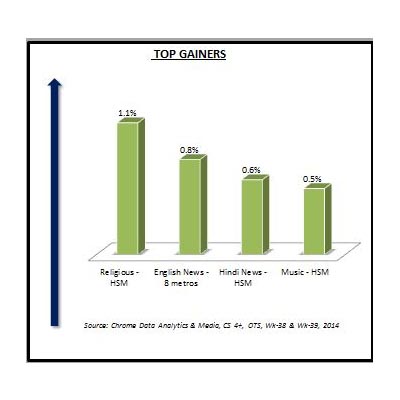
    MUMBAI: Religious channels in the Hindi speaking market (HSM) gained the most opportunity to see (OTS) collated by Chrome Data Analytics and Media for the week 39.


    The genre grew by 1.1 per cent wherein Aastha channel continued its reign with 97.3 per cent OTS.


    English News channels with 0.8 per cent hike came in second. In the genre, Times Now once again remained on top with 85.7 per cent OTS.


    Hindi News channels with 0.6 per cent and Music channels with 0.5 per cent gained in the HSM as well. ABP News with 95.6 per cent OTS and Mix with 88.8 per cent OTS topped their respective genres.


    English Movie channels in the eight metros saw a minor fall of 0.5 per cent. Pix with 72.6 per cent gained in the most in the category.


    Infotainment channels across India and English Entertainment in the eight metros saw negligible fall of 0.2 per cent and 0.1 per cent, respectively.


     National Geographic channel with 87.2 per cent OTS and Star World with 67.4 per cent OTS topped their respective categories.


  • IDOS 2014: HBO opening night party a grand success

    IDOS 2014: HBO opening night party a grand success

    GOA: Glitz, glamour and everything else. The most awaited opening night party of the India Digital Operators Summit (IDOS) 2014 at The Leela in Goa organised by HBO Hits and Defined premium channels has set the right tune for the next two days of the confab which will be attended by the leaders of pay TV, distribution,  cable TV and DTH industry. 


    Through the opening night party, the premium network has sent out a clear message: ‘It’s not TV, its HBO’.


    The party entertained those attending, with fabulous dances, stand-up comedy by Atul Khatri, some of the all time hits sung by the melodious Aditi Singh Sharma who has lent her voice for some of the hit songs including ‘Raabta’, ‘Dhoom Machale’, ‘Offo’ and great bollywood music, which forced everyone to shake their legs.


    The evening was well attended by the who’s who of the broadcast, cable TV and DTH industry.  


    Says HBO South Asia MD Monica Tata on the success of the party, “We are very excited to have partnered with IDOS 2014. This has helped us showcase our proposition to our consumers.”


    “The partnership has been fantastic. Through this, the HBO premium channels will connect with its key consumers, which are the platform owners. We expect them to push our channels further,” she adds.

    “More power to HBO channels and if you haven’t subscribed to it so far, do it now,” she concludes. 


  • I&B Ministry explains to PMO its reasons for postponing digitisation dates

    I&B Ministry explains to PMO its reasons for postponing digitisation dates

    NEW DELHI: The Information and Broadcasting Ministry feels that digitisation is a tool to empower the people and not create difficulties, and therefore does not agree that it will create any setback to the Digital India Plan.


    Ministry sources told indiantelevision.com that this had been conveyed by the Ministry to the Prime Minister’s Office (PMO) in response to the communication to PMO by Telecom Regulatory Authority of India chairman Rahul Khullar.


    The sources also pointed out that the pace of digitisation had slowed down over the past year due to lack of adequate publicity and paucity of fund allocation. 


    The Ministry said cable TV digitisation was only a small though major part of Digital India.


    The main purpose was not to delay digitisation of cable television networks but to encourage greater indigenisation of both set top boxes and other equipment, the sources informed.


    The dates proposed by the Ministry were only the outer limit and every effort would be made to ensure digitisation of cable TV is achieved before that. It was also pointed out that the consumer’s capacity to pay was of great importance in the last two phases which were reaching out to semi-urban or rural areas.


    It was also emphasised that TRAI was being consulted on the proposal about the new dates and the views of the regulator would be taken into account.


    Khullar in his note to the PMO has said staggering implementation of the cable TV digitisation plan will be a major setback to the Digital India plan.


    He said, “For the last six months, we have been working on phase-III and phase-IV. If implementation is now staggered, it will be a body blow to the project, primarily because momentum will be lost and it is truly very difficult to enforce compliance countrywide.”


    Under the current plan, the third phase of the cable TV digitisation plan is expected to end on 30 September, and phase IV by 31 December this year, while the Ministry feels the new dates should be December 2015 and December 2016 respectively.


    “Should this happen, it will be a major setback to digitisation in the country. Further, a huge effort was made by TRAI to enforce compliance. We encountered significant difficulties in ensuring that phase I and phase II were effectively completed,” the TRAI chief wrote.


    There are 100 million homes with cable TV connection of which 20 million are digital. In addition, there are 56 million DTH homes. This is more than the fixed line telephony subscriber base. Digitisation would enable cable TV networks to be used for two-way communications, a pre-requisite for internet services.


    TRAI said that digitisation offers much cheaper means of providing broadband to consumers compared to the National Optical Fibre Network project, which aims to roll out fibre cables across the country as broadband is the main supplier of TV signals in all developed countries. 

  • Digitisation extension 2015: MSOs, LMOs smile; broadcasters sigh

    Digitisation extension 2015: MSOs, LMOs smile; broadcasters sigh

    MUMBAI: It was a decision that most had been anticipating would be taken. But when it did come, it came as a bolt from the blue. Four months before cable TV digitisation had to be completed pan India, the government – through information and broadcasting (I&B) secretary Bimal Julka – announced to industry via indiantelevision.com that a decision had been taken to extend it to December 2015.


    (While this is what Julka has told us, certain sections in the industry have suggested that end-2015 is the analogue sunset date for phase III towns and villages; the date for phase IV regions may end up being December 2016.)


    Earlier this year, the previous UPA government’s Information and Broadcasting (I&B) Minister Manish Tewari had held a task force meet with all the stakeholders to state that digitisation was to go on as planned with phases III and IV being merged. The deadline was December 2014 to implement digitisation in digital addressable system (DAS) phase III and IV while simultaneously implementing billing in phase I and II, which was to have been done much earlier.


    However, the new advancement of the deadline by the current BJP government, comes across as a breather to the beleaguered and unprepared  cable TV industry that claims to be facing a shortage of funds to execute the seeding of 75 million boxes.


    The MSO and LCO fraternity is heaving a sigh of relief following the extension. Says Den Networks CEO SN Sharma: “After long, the government’s commitment is visible and there is clarity of date. For phase I and II we had built the tempo and campaign well in time and now with this announcement, things for phase III and IV will also fall in place. The government is also keen to push indigenous production of set top boxes which will bring out a 15 per cent reduction in prices. These next two phases constitute about 70 per cent of the cable TV base. We are now waiting for STB producers to tell us they can deliver the demand.”


    The new I&B Minister Prakash Javadekar has time and again reiterated the government’s intention to give a fillip to indigenously produced STBs.


    LCOs seem to be a happy lot. Says Maharashtra Cable Operators Foundation (MCOF) president Arvind Prabhoo, “This gives time for the last mile operator (LMO) to plan for a year and execute it as mandated by the Telecom Regulatory Authority of India. Our association will educate LMOs about the benefits of digitisation. We will be able to rope in more investors and manufacturers to come up with schemes for executing voluntary digitisation.”


    Digitisation in DAS I and II areas has also not yet been implemented in the way as had been envisaged. Billing and conditional access systems (CAS) have yet to take off in several DAS I and II towns.


    IMCL managing director and group CEO Tony D’silva feels that the extension does not make much of a difference if the government’s resolve is not strong enough. “Just by postponing or sticking to a date does not change the speed of digitisation. It has to be a much more detailed and flushed out action plan on how the MSO, LCO, broadcaster and the government will be brought together. It is great that they have clarified their position, now there needs to be an actionable plan by putting together a core committee,” he opines.


    However, the most unhappy of the lot are the broadcasters because it delays their dreams of getting higher subscription revenues from MSO, cable ops, and the subscriber by a year. Most feel that the one year delay will lead to everyone in the ecosystem slackening the pace, with delays hitting the process and spread of digitisation once again.


    Colors CEO Raj Nayak is of a similar opinion. Says he, “We were really looking forward to phase III and IV to be completed by December as after much delay and deliberation the sunset date was arrived at. Our business plans were geared accordingly. I am sure there must have been a good reason to postpone and a three month extension would have been understood, but postponement by one whole year is slightly disappointing.


    “Having said this we are glad that the digitisation process is on track and looking at it through a positive lens I am sure this would give the industry an opportunity to learn from the mistakes of phase I and II and hopefully put better systems and processes in place so that the respective stakeholders including the broadcasters get our fair share.”


    News broadcasters are most pained by the excessive carriage fees that are being demanded of them, even as revenues continue to sag. News Broadcasters Association president and NDTV executive vice chairperson KVL Narayan Rao is disappointed with the extension. “Complete digitisation will bring transparency to TV broadcast distribution while delays will only affect that goal,” he states.


    Various reports predict different dates of completion of digitisation in India. Amongst the most recent ones brought out by Singapore-based Media Partners Asia (Indiantelevision.com’s partner for the annual pay TV gathering India Digital Operators Summit)  has stated that by 2017 only 70 per cent of the pay TV market in India will be digitised. 


    We, at indiantelevision.com, believe there are several other measures that could be put in place by the government (read I&B ministry), the regulator, and the industry:


    *For starters, changing the mindset of the cable TV ecosystem that digitisation and true pay TV is useful to all those in it, and not harmful, needs to be communicated effectively.


    *Second, the government could set up a digitisation transition fund, which helps educate, train and provide seed capital to and rewards cable TV operators who walk that path.


    * Third, it puts in place policing and penalising measures to cane those who don’t.


    *Fourth, they need to ensure that valid and correct subscriber information is collected by every cable TV operator or MSO and recorded in their SMS and possibly made available to the authorities.


    * Fifth, once this is done, ensure that a legitimate bill is issued to every subscriber.


    * Sixth, the ministry, the TRAI and the government could announce future-proof (at least for a three to four year period) technical specifications and standards for set top boxes, so that garbage zapper boxes are not dumped on India and on an unknowing and unsuspecting home viewer.


    * Seventh, leave pricing to the market place, rather than mandating 10-15 per cent price increases. Sure broadcasters want to increase subscription revenues, but they would not be so foolish so as to price their channels so high that they drive away consumers, and in the process their collections. Some might choose to have stiff price tags, but their business plans, obviously, will have factored that in, to have a smaller niche subscriber base. Does the government mandate how much a pair of Armani jeans can be priced at?


    * Let cable TV operators be drawn in to deliver broadband – provide them technology, assistance, funding – so that they can be one of the constituents who will help fulfil the Modi government’s grand plan to digitise the country.

    While there are many other measures that could be drawn up and while some may not approve of what we have prescribed, we have decided to stick our necks out and made some suggestions. We would love to hear different perspectives from our readers. Please feel free to let us and others in the industry know by posting your comments below.

  • DAS deadline extended to December 2015

    DAS deadline extended to December 2015

    NEW DELHI: The deadline for the digitisation of cable television systems in the entire country has been put off to December 2015.


    While Phase I of digital addressable system (DAS) came into effect in March last year and Phase II later in the year, the entire process was supposed to be completed by December this year.


    Information & Broadcasting Ministry secretary Bimal Julka speaking exclusively to  indiantelevision.com said that the government had decided to delay the digitisation deadline by a full year in order to give all those involved enough opportunity to overcome all the unseen hurdles that had come up after the UPA government mandated  DAS and the various analogue sunset dates.


    He said that the previous UPA  government had failed to complete all the required work with regard to regulations, licences, permissions etc and so the current NDA government’s  I&B Minister Prakash Javadekar – after consulting all the stakeholders – has decided to put off the final date by one year.


    Julka was confident that digitisation would be completed  well before the end of 2015, but said the new last date had been set keeping in mind the various issues that need resolution.


    Earlier, the Ministry had said Phase III covering all urban areas (Municipal Corporations/Municipalities) would be digitised by 30 September 2014 and Phase IV covering the rest of India would be digitised by 31 December 2014.


    The DAS process had led to several problems including court cases in various parts of the country. In the first phase for the four metros, Chennai could not be covered because of a stay by the Madras High Court. The second phase covered 38 cities with populations of more than one million. However, reports say that analogue systems are still working not only in the metros but also in these cities.


    Furthermore, cable operators feel that the set top boxes being imported are of inferior quality with very few facilities for servicing. The MSOs went to the Telecom Disputes Settlement & Appellate Tribunal (TDSAT) challenging the ratio of profit sharing between the various stakeholders. And TDSAT has been flooded with litigation involving broadcasters, MSOs, LCOs and DTH operators over the past year and a half – coinciding with the government’s thrusting digitisation down the throats of those involved in India’s relatively unorganised cable TV ecosystem. 


    Julka said that all these issues had been taken into consideration before taking the decision to put off DAS by a year.

  • Commercial TV subscriber tariffs: Broadcasters, Star take battle to courts

    Commercial TV subscriber tariffs: Broadcasters, Star take battle to courts

    MUMBAI: It’s the battle of the bill – the commercial cable TV bill, that is. The Telecom Regulatory Authority of India (TRAI) on 16 July 2014 issued an amendment to its earlier 2004 broadcasting and cable TV tariff order. The amendment brought in new customer categories such as commercial establishments and commercial subscribers. And it also stated that as far as cable TV rates are concerned, there shouldn’t be any differentiation on an ordinary and commercial subscriber and charges for both should be on a per TV set basis.


    That amendment has not gone down well with the Indian broadcast community as they have been lobbying for differential rates for commercial subscribers for a long time and the global practice is that commercial establishment and subscribers pay more than common subscribers.


    Its representative body, the Indian Broadcasting Federation (IBF) decided to challenge the tariff order for non-digital addressable areas (DAS) in the Telecom Disputes Settlement Appellate Tribunal (TDSAT). And industry leader Star India decided to file a writ petition against the TRAI challenging the order for both non DAS and DAS and other addressable systems in the Delhi High Court.


    Coincidentally both the cases came up for hearing on the same day. While the HC declined to give a stay order on the 16 July 2014 tariff order amendment, it has served notices to both the TRAI and the Federation of Hotels and Restaurants Association of India (FHRAI).


    The matter has been posted for a full-fledged hearing on 26 September. Till then, the order is maintainable. Meanwhile, the TDSAT has said that it will wait till the HC decides on the case to take any further action.


    What Star India has challenged in the HC is that the 16 July 2014 amendment order denies broadcasters the right to directly deal with the hotels. Star India has also appealed that it will have to unnecessarily depend on distribution platform operators DPOs to strike content deals as for commercial establishments, which might be treated as ordinary subscribers unless they specifically charge customers for cable TV subscribers. The broadcaster can only give a differentiated rate to those hotels that categorically mention TV as one of the services, thereby being deeming it fit to be called a commercial subscriber.


    The TRAI and FHRAI have been asked to respond to notices by the next hearing.


    Click here for the High Court order