Tag: cable TV

  • GST: Both good and bad for the Indian cable TV sector

    GST: Both good and bad for the Indian cable TV sector

    MUMBAI: India’s most ambitious indirect tax reform, the Goods and Service Tax (GST) got the green flag from the Lok Sabah on 8 August.

    While, taxation rates under the GST regime are yet to be finalised, an indicative figure of 18 per cent is being talked of in various circles.

    Indiantelevision.com has already postulated that DTH companies like Dish TV could be beneficiaries when GST goes live. Broadcasters, however, could be slapped on their wrists as GST is likely to result in their tax payment going up.

    However, cable TV distribution sector is going to benefit like its country cousin – the DTH segment. Estimates are that multisystem operators could end up saving around five to 10 per cent in taxes in many Indian states. However, in some the tax payouts could likely go up courtesy GST.

    MSOs operating in states like Punjab (with up to Rs 15000 annual entertainment tax), and Gujarat (Rs 6 per cable TV sub per month), Harayana (no tax), Kerala (Rs 5), Orissa (Rs 3) are going to be impacted negatively with their tax bill climbing up once GST becomes applicable. Other states like Maharashtra (Rs 45 per month subscriber), Jharkhand with Rs 30-50 per month per subscriber, Rs 20 in Delhi, Bihar Rs 15 per month per subscriber, will see a lightening of their tax burden.

    Says a cable TV industry observer: “Cable operators normally maintain three sets of books. One for the tax folks, one for the content providers, and one which has the real facts about their business. Many of them are not tax payers at all. Under the new regime, they will have to clean up their acts, get their registration done, get their subscriber information all in order. And then pay their GST. That’s even if their margins keep coming under pressure on account of this.”

    Keep watching this space for further updates!

  • GST: Both good and bad for the Indian cable TV sector

    GST: Both good and bad for the Indian cable TV sector

    MUMBAI: India’s most ambitious indirect tax reform, the Goods and Service Tax (GST) got the green flag from the Lok Sabah on 8 August.

    While, taxation rates under the GST regime are yet to be finalised, an indicative figure of 18 per cent is being talked of in various circles.

    Indiantelevision.com has already postulated that DTH companies like Dish TV could be beneficiaries when GST goes live. Broadcasters, however, could be slapped on their wrists as GST is likely to result in their tax payment going up.

    However, cable TV distribution sector is going to benefit like its country cousin – the DTH segment. Estimates are that multisystem operators could end up saving around five to 10 per cent in taxes in many Indian states. However, in some the tax payouts could likely go up courtesy GST.

    MSOs operating in states like Punjab (with up to Rs 15000 annual entertainment tax), and Gujarat (Rs 6 per cable TV sub per month), Harayana (no tax), Kerala (Rs 5), Orissa (Rs 3) are going to be impacted negatively with their tax bill climbing up once GST becomes applicable. Other states like Maharashtra (Rs 45 per month subscriber), Jharkhand with Rs 30-50 per month per subscriber, Rs 20 in Delhi, Bihar Rs 15 per month per subscriber, will see a lightening of their tax burden.

    Says a cable TV industry observer: “Cable operators normally maintain three sets of books. One for the tax folks, one for the content providers, and one which has the real facts about their business. Many of them are not tax payers at all. Under the new regime, they will have to clean up their acts, get their registration done, get their subscriber information all in order. And then pay their GST. That’s even if their margins keep coming under pressure on account of this.”

    Keep watching this space for further updates!

  • What really happened at the 16th DAS Task Force meeting

    What really happened at the 16th DAS Task Force meeting

    NEW DELHI: Even as the government has once again reiterated that it is firm on Phase IV of digital addressable systems for cable television to commence on 31 December this year, the Information and Broadcasting Ministry (MIB) has for the first time admitted that the Law Ministry had observed that the order passed by the Andhra Pradesh High Court staying Phase III “appears to have all lndia applicability”.

    (The Ministry had sought this opinion in view of the Mumbai high court making a reference to the Kusum Ingots case which had said that if one high court gives an order, others can give similar orders if similar circumstances exist. indiantelevision.com had reported in January this year that the MIB had told the Punjab and Haryana high court that it had ‘decided not to press the requirement of having a STB as for now till the decision of the cases which are pending before various other high courts’).

    The MIB affirmed this at the 16th DAS IV Task Force meeting held on 26 July in Delhi. MIB secretary Ajay Mittal who presided over the meeting said digitisation is a process which cannot be stopped. He said that Ministry has been proactive in the matter of dealing with all the court cases filed by some MSOs for extension of cut-off date for phase lll. He suggested that the stakeholders should supplement the efforts made by Ministry to dispose off these cases.

    He cautioned that MSOs and LCOs should desist from transmitting or re-transmitting un-authorized TV channels which are not permitted by the Ministry. He informed that Ministry has written to all the district collectors/magistrates in this regard to take action under the law against those who are violating the law.

    Advisor DAS Yogendra Pal told the Task Force Meeting for DAS that there were no cases in twenty states but the MIB was not in a position to issue orders in view of the advice given by the law ministry.

    However, he said following the decision to transfer all DAS cases to the Delhi high court following a petition in the Supreme Court by the MIB, 29 cases have so far been transferred by various courts to Delhi and 18 cases are still left to be transferred.

    He said 62 cases had been filed by some multi-system operators (MSOs) in various courts in the country for extension in the deadline of Phase lll. Out of these 62 cases, 12 cases had been disposed off by respective courts and 3 cases had been withdrawn by the petitioners. Two months extension in the deadline was granted by the Andhra Pradesh high court. Both Mumbai high court and the Aurangabad Branch of that court had passed orders to the effect that the order passed by the Telengana bench of the high court of Andhra Pradesh had all India applicability in view of the Supreme Court judgment in Kusum Ingots case.

    Two cases are scheduled for hearing by the Delhi High Court on 13 September 2016. He added that the MIB as approached the Solicitor General to defend the cases and for an early hearing of the cases in Delhi high court. He added that a special leave petition (SLP) is also being drafted against the order of Aurangabad Branch of Mumbai high court.

    The Ministry had recently conducted one workshop with state level nodal officers in Delhi and three regional workshops with state and district level Nodal Officers at Dehradun, Shimla and lmphal.

    The Joint Secretary said that there were a reported 6000 MSOs in the country but only 965 MSO had got registrations so far and about 200 applications are under process in the Ministry.

    She requested the Indian Broadcasting Foundation, the News Broadcasters Association, and the ARTBI to tell their member broadcasters to check with all MSOs with whom they have interconnect agreements whether they were registered and if they have not applied for it so far, advise them to do so immediately. She said that broadcasters should be having the details of all MSOs operating in phase lV areas in their data base which can be crosschecked with the list of registered MSOs on MIB website to identify the MSOs who have not applied for registration so far. She asked the representatives of broadcasters to send a list of these MSOs operating in phase lV areas but who have not applied for MSO registration to Ministry by 7 August 2016. She added that as a next step the broadcasters should communicate with these MSOs and ask them to apply for MSO registration if they want to continue to operate as MSOs in DAS notified areas.

    A representative of the Telecom Regulatory Authority of India emphasized that broadcasters should start entering into interconnect agreements with MSOs and likewise MSOs should enter into interconnect agreements with LCOs for phase lV areas. He said that broadcasters should collect STB requirements from local cable operators in phase lV areas.

    The representative of IMCL said broadcasters have offered separate digital and analogue rates in phase lV market and suggested that TRAI may issue an advisory/directive that there should be only analogue rate till 31 December 2016.

    TRAI said no such advisory which is outside the regulations can be issued. He said put of 900 TV channels, about 600 channels are free to air (FTA) channels and operate through about 2000 LCOs from their head ends. He suggested that in their case the State Governments can asks these LCOs to apply for MSO registration.

    Joint secretary Jaya said MSOs had sought an extension from the courts on the plea that broadcasters had not signed interconnect agreement with them. She said agreements between broadcasters important for further signing of agreements between MSOs and LCOs. She said that broadcasters, MSOs and LCOs should prioritize this issue everywhere and make concerted efforts to seal the agreements for phase lV areas by August 2016.

    TRAI said all MSOs who have any issue with broadcasters with regard to signing of interconnect agreements should write to the TRAI. He added that TRAI would review the situation in this regard from time to time.

    A representative of a cable operator association from Maharashtra (MocF) mentioned that about 200 LCos have signed interconnect agreements with Hathway in Maharashtra. He suggested that other large MSOs like IMCL & Siticable may also enter into agreements with LCos there on the basis of model inter-connect agreement.

    He complained that the post offices in Maharashtra were asking for no objection certificates from the offices of the district magistrate for renewal of registration to LCOs. He was told that with regard to this issue, which was raised in the last meeting also, proper reference with details should be sent to MIB He also wanted to know whether an MSO registered with MIB and operating as an LCO also is required to obtain the LCO registration from local the post office.

    A representative of CEAMA mentioned that orders for STBs had peaked in October 2015. Thereafter, except for supply orders from DTH operators and some small MSOs, no major orders have been received by them. He suggested that the MSOs planning for procurement for phase lV should place the orders now for timely delivery of STBs. He re-confirmed that they have the capacity to meet the complete requirements of phase lV.

    Representatives of state nodal officers from the Himachal Pradesh, Telengana, UP, Uttarakhand, MP, Karnataka, Bihar and J & K briefed about the various measures undertaken by them to implement the last phase of digitisation in their states. Most of them confirmed that monitoring committees have been set up and they are holding regular meetings to monitor the progress.
  • What really happened at the 16th DAS Task Force meeting

    What really happened at the 16th DAS Task Force meeting

    NEW DELHI: Even as the government has once again reiterated that it is firm on Phase IV of digital addressable systems for cable television to commence on 31 December this year, the Information and Broadcasting Ministry (MIB) has for the first time admitted that the Law Ministry had observed that the order passed by the Andhra Pradesh High Court staying Phase III “appears to have all lndia applicability”.

    (The Ministry had sought this opinion in view of the Mumbai high court making a reference to the Kusum Ingots case which had said that if one high court gives an order, others can give similar orders if similar circumstances exist. indiantelevision.com had reported in January this year that the MIB had told the Punjab and Haryana high court that it had ‘decided not to press the requirement of having a STB as for now till the decision of the cases which are pending before various other high courts’).

    The MIB affirmed this at the 16th DAS IV Task Force meeting held on 26 July in Delhi. MIB secretary Ajay Mittal who presided over the meeting said digitisation is a process which cannot be stopped. He said that Ministry has been proactive in the matter of dealing with all the court cases filed by some MSOs for extension of cut-off date for phase lll. He suggested that the stakeholders should supplement the efforts made by Ministry to dispose off these cases.

    He cautioned that MSOs and LCOs should desist from transmitting or re-transmitting un-authorized TV channels which are not permitted by the Ministry. He informed that Ministry has written to all the district collectors/magistrates in this regard to take action under the law against those who are violating the law.

    Advisor DAS Yogendra Pal told the Task Force Meeting for DAS that there were no cases in twenty states but the MIB was not in a position to issue orders in view of the advice given by the law ministry.

    However, he said following the decision to transfer all DAS cases to the Delhi high court following a petition in the Supreme Court by the MIB, 29 cases have so far been transferred by various courts to Delhi and 18 cases are still left to be transferred.

    He said 62 cases had been filed by some multi-system operators (MSOs) in various courts in the country for extension in the deadline of Phase lll. Out of these 62 cases, 12 cases had been disposed off by respective courts and 3 cases had been withdrawn by the petitioners. Two months extension in the deadline was granted by the Andhra Pradesh high court. Both Mumbai high court and the Aurangabad Branch of that court had passed orders to the effect that the order passed by the Telengana bench of the high court of Andhra Pradesh had all India applicability in view of the Supreme Court judgment in Kusum Ingots case.

    Two cases are scheduled for hearing by the Delhi High Court on 13 September 2016. He added that the MIB as approached the Solicitor General to defend the cases and for an early hearing of the cases in Delhi high court. He added that a special leave petition (SLP) is also being drafted against the order of Aurangabad Branch of Mumbai high court.

    The Ministry had recently conducted one workshop with state level nodal officers in Delhi and three regional workshops with state and district level Nodal Officers at Dehradun, Shimla and lmphal.

    The Joint Secretary said that there were a reported 6000 MSOs in the country but only 965 MSO had got registrations so far and about 200 applications are under process in the Ministry.

    She requested the Indian Broadcasting Foundation, the News Broadcasters Association, and the ARTBI to tell their member broadcasters to check with all MSOs with whom they have interconnect agreements whether they were registered and if they have not applied for it so far, advise them to do so immediately. She said that broadcasters should be having the details of all MSOs operating in phase lV areas in their data base which can be crosschecked with the list of registered MSOs on MIB website to identify the MSOs who have not applied for registration so far. She asked the representatives of broadcasters to send a list of these MSOs operating in phase lV areas but who have not applied for MSO registration to Ministry by 7 August 2016. She added that as a next step the broadcasters should communicate with these MSOs and ask them to apply for MSO registration if they want to continue to operate as MSOs in DAS notified areas.

    A representative of the Telecom Regulatory Authority of India emphasized that broadcasters should start entering into interconnect agreements with MSOs and likewise MSOs should enter into interconnect agreements with LCOs for phase lV areas. He said that broadcasters should collect STB requirements from local cable operators in phase lV areas.

    The representative of IMCL said broadcasters have offered separate digital and analogue rates in phase lV market and suggested that TRAI may issue an advisory/directive that there should be only analogue rate till 31 December 2016.

    TRAI said no such advisory which is outside the regulations can be issued. He said put of 900 TV channels, about 600 channels are free to air (FTA) channels and operate through about 2000 LCOs from their head ends. He suggested that in their case the State Governments can asks these LCOs to apply for MSO registration.

    Joint secretary Jaya said MSOs had sought an extension from the courts on the plea that broadcasters had not signed interconnect agreement with them. She said agreements between broadcasters important for further signing of agreements between MSOs and LCOs. She said that broadcasters, MSOs and LCOs should prioritize this issue everywhere and make concerted efforts to seal the agreements for phase lV areas by August 2016.

    TRAI said all MSOs who have any issue with broadcasters with regard to signing of interconnect agreements should write to the TRAI. He added that TRAI would review the situation in this regard from time to time.

    A representative of a cable operator association from Maharashtra (MocF) mentioned that about 200 LCos have signed interconnect agreements with Hathway in Maharashtra. He suggested that other large MSOs like IMCL & Siticable may also enter into agreements with LCos there on the basis of model inter-connect agreement.

    He complained that the post offices in Maharashtra were asking for no objection certificates from the offices of the district magistrate for renewal of registration to LCOs. He was told that with regard to this issue, which was raised in the last meeting also, proper reference with details should be sent to MIB He also wanted to know whether an MSO registered with MIB and operating as an LCO also is required to obtain the LCO registration from local the post office.

    A representative of CEAMA mentioned that orders for STBs had peaked in October 2015. Thereafter, except for supply orders from DTH operators and some small MSOs, no major orders have been received by them. He suggested that the MSOs planning for procurement for phase lV should place the orders now for timely delivery of STBs. He re-confirmed that they have the capacity to meet the complete requirements of phase lV.

    Representatives of state nodal officers from the Himachal Pradesh, Telengana, UP, Uttarakhand, MP, Karnataka, Bihar and J & K briefed about the various measures undertaken by them to implement the last phase of digitisation in their states. Most of them confirmed that monitoring committees have been set up and they are holding regular meetings to monitor the progress.
  • 17.8 million STBs deployed in Phase IV areas: MIB

    17.8 million STBs deployed in Phase IV areas: MIB

    MUMBAI: The ministry of information and broadcasting says that close to 17.8 million set top boxes have been seeded in Phase IV areas. The figure was 138 million set top boxes during the fifteenth task force meeting held in end May this year.

    Speaking at the sixteenth task force meeting which was held on 26 July, the joint secretary R. Jaya stated that most of this is coming courtesy voluntarily digitization.

    She also urged representatives of the MSOs to finalise their procurement plans of STBs, and cautioned that “they should not let some disinterested players in phase IV areas delay digitization in phase IV areas on the grounds of non-availability of STB as it was done in phase III.”

    She added that except for some DTH operators the public awareness campaign for DAS Phase IV digitization has not come up to scratch. She urged the industry to develop its own creative and its own spots to spread the message of cable TV digitization in the phase IV regions.

    This is of course apart from the spots that have been developed by the ministry and which were playing out on the public broadcaster Doordarshan’s channels.

  • 17.8 million STBs deployed in Phase IV areas: MIB

    17.8 million STBs deployed in Phase IV areas: MIB

    MUMBAI: The ministry of information and broadcasting says that close to 17.8 million set top boxes have been seeded in Phase IV areas. The figure was 138 million set top boxes during the fifteenth task force meeting held in end May this year.

    Speaking at the sixteenth task force meeting which was held on 26 July, the joint secretary R. Jaya stated that most of this is coming courtesy voluntarily digitization.

    She also urged representatives of the MSOs to finalise their procurement plans of STBs, and cautioned that “they should not let some disinterested players in phase IV areas delay digitization in phase IV areas on the grounds of non-availability of STB as it was done in phase III.”

    She added that except for some DTH operators the public awareness campaign for DAS Phase IV digitization has not come up to scratch. She urged the industry to develop its own creative and its own spots to spread the message of cable TV digitization in the phase IV regions.

    This is of course apart from the spots that have been developed by the ministry and which were playing out on the public broadcaster Doordarshan’s channels.

  • Cable TV fraternity celebrates SN Sharma’s rejoining DEN

    Cable TV fraternity celebrates SN Sharma’s rejoining DEN

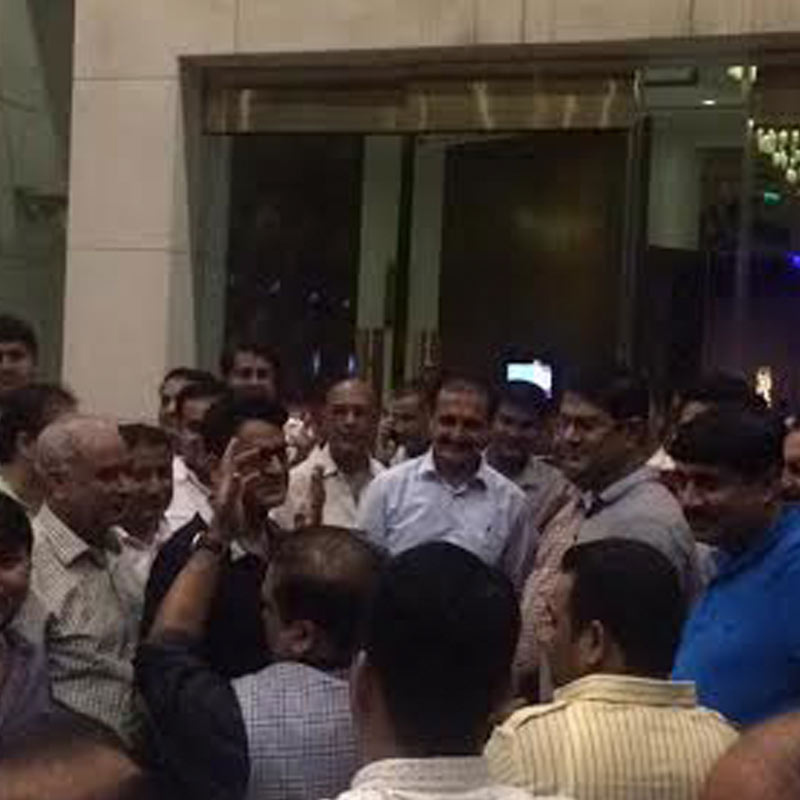
    DELHI: “The Tiger returns to his DEN” was the cry that went on through the night. It was a gathering of the cable TV fraternity to congratulate and celebrate SN Sharma’s return to the national MSO DEN Networks founded by Sameer Manchanda.

    Among those who attended the party at the Hotel Crowne Plaza in Okhla were about 150 representatives from DEN’s joint ventures in the north, small broadcasters, cable TV operators, industry pioneers, among others. A few of those who made it to the party included: Dr Anil Rastogi, Ravi Singh, Ravi Bali, Romi Shiv, Sanjeev Kapoor, Bhanu, Virender Gaur, among many others.

    The party went on late into the night . The food was lip smacking and everyone had a gala time.

  • Cable TV fraternity celebrates SN Sharma’s rejoining DEN

    Cable TV fraternity celebrates SN Sharma’s rejoining DEN

    DELHI: “The Tiger returns to his DEN” was the cry that went on through the night. It was a gathering of the cable TV fraternity to congratulate and celebrate SN Sharma’s return to the national MSO DEN Networks founded by Sameer Manchanda.

    Among those who attended the party at the Hotel Crowne Plaza in Okhla were about 150 representatives from DEN’s joint ventures in the north, small broadcasters, cable TV operators, industry pioneers, among others. A few of those who made it to the party included: Dr Anil Rastogi, Ravi Singh, Ravi Bali, Romi Shiv, Sanjeev Kapoor, Bhanu, Virender Gaur, among many others.

    The party went on late into the night . The food was lip smacking and everyone had a gala time.

  • Siticable partners dittoTV; to push OTT to cable TV and broadband subscribers

    Siticable partners dittoTV; to push OTT to cable TV and broadband subscribers

    MUMBAI: It was over the weekend that Zee Digital Convergence’s unleashed a TVC blitzkrieg, promoting its low priced over the top (OTT) service dittoTV. And now it has announced that it is partnering with Essel group cable TV MSO and sister company Siticable.

    As part of this, Siticable will be pushing the authentication and subscription to dittoTV from its portal to the subscribers of its cable TV service. Its broadband customers will be able to subscribe to OTT service at no extra cost to them. Siticable and dittoTV will do joint promotions on the ground even as last mile operators will also work on further distributing the OTT platform and servicing those who subscribe to it.

    Says dittoTV business head Archana Anand: “We are excited to be partnering with Siticable to give a push to our OTT service. We are looking at maximizing our distribution through the partnership. We launched our TVCs over the weekend and the response has been way beyond our expectations.”

    Adds SitiCable CEO V.D. Wadhwa: “The partnership is an exclusive one for Siticable as an MSO. And it is going to be a win win for both of us.”

    SitiCable has 12 million subscribers nationally to its cable TV service – an attractive potential captive audience for dittoTV.. Last mile operators who push the OTT service will benefit as a revenue share is being given to them.

    The 132,000 Siti Broadband users in Kolkata and Delhi are another lucrative bunch of potential subscribers for dittoTV, especially since it is being bundled with it and being given away free to them. In Delhi, SitiCable delivers broadband using Docsis 3,0 modems to its 30,000 odd subscribers while in Kolkata the number is in excess of 100,000 but the delivery mode is Ethernet on cable. Average revenue per user (ARPU), according to Wadhwa, in Delhi is at Rs 600 while in Kolkata it is Rs 500. While the average bandwidth consumption is 30 GB in Delhi, the figure is half that in the eastern city.

    “Broadband users will be able to watch dittoTV’s 100 channels on their laptops, tablets, and smart TVs in the comfort of their homes using our broadband,” says Wadhwa.

    That probably should lead to a lift in bandwidth consumption, say observers, and an increase in broadband ARPU for Siticable once customers start using the dittoTV app and streaming the linear 100-odd channels that it is providing.

    This apart, SitiCable’s cable TV subscribers, who are using other broadband services – dongles or Chromecast or what have you – will also be able to sign up and stream dittoTV on different devices.

    Anand says the two of them will observe how the partnership is panning out in its Delhi pilot before rolling it out into other towns. Overall she has already said ZDCL was looking at 6 million subscribers in FY-2017. Of these, she says about a million should come courtesy its SitiCable partnership.

    In all probability, dittoTV is going to serve as Siticable’s offering of an anywhere TV app – a la Tata Sky – as the operator says it is not interested in launching one of its own in the foreseeable future.

    As a recap, dittoTV was relaunched last month with an offer of 100 + Hindi, English and regional language channels (excepting Sun TV and Star India) encompassing general entertainment, sports, movies, news and lifestyle following its relaunch last month. It has come in as a low price warrior with its price tag being Rs 20 for a month, Rs 50 for three months, Rs 90 for six months and Rs 170 for a year.

    “We are definitely serious about OTT, hence we have priced it so low and are targeting large subscriber volumes,” says Anand. “We are investing in it for the future.”

  • Siticable partners dittoTV; to push OTT to cable TV and broadband subscribers

    Siticable partners dittoTV; to push OTT to cable TV and broadband subscribers

    MUMBAI: It was over the weekend that Zee Digital Convergence’s unleashed a TVC blitzkrieg, promoting its low priced over the top (OTT) service dittoTV. And now it has announced that it is partnering with Essel group cable TV MSO and sister company Siticable.

    As part of this, Siticable will be pushing the authentication and subscription to dittoTV from its portal to the subscribers of its cable TV service. Its broadband customers will be able to subscribe to OTT service at no extra cost to them. Siticable and dittoTV will do joint promotions on the ground even as last mile operators will also work on further distributing the OTT platform and servicing those who subscribe to it.

    Says dittoTV business head Archana Anand: “We are excited to be partnering with Siticable to give a push to our OTT service. We are looking at maximizing our distribution through the partnership. We launched our TVCs over the weekend and the response has been way beyond our expectations.”

    Adds SitiCable CEO V.D. Wadhwa: “The partnership is an exclusive one for Siticable as an MSO. And it is going to be a win win for both of us.”

    SitiCable has 12 million subscribers nationally to its cable TV service – an attractive potential captive audience for dittoTV.. Last mile operators who push the OTT service will benefit as a revenue share is being given to them.

    The 132,000 Siti Broadband users in Kolkata and Delhi are another lucrative bunch of potential subscribers for dittoTV, especially since it is being bundled with it and being given away free to them. In Delhi, SitiCable delivers broadband using Docsis 3,0 modems to its 30,000 odd subscribers while in Kolkata the number is in excess of 100,000 but the delivery mode is Ethernet on cable. Average revenue per user (ARPU), according to Wadhwa, in Delhi is at Rs 600 while in Kolkata it is Rs 500. While the average bandwidth consumption is 30 GB in Delhi, the figure is half that in the eastern city.

    “Broadband users will be able to watch dittoTV’s 100 channels on their laptops, tablets, and smart TVs in the comfort of their homes using our broadband,” says Wadhwa.

    That probably should lead to a lift in bandwidth consumption, say observers, and an increase in broadband ARPU for Siticable once customers start using the dittoTV app and streaming the linear 100-odd channels that it is providing.

    This apart, SitiCable’s cable TV subscribers, who are using other broadband services – dongles or Chromecast or what have you – will also be able to sign up and stream dittoTV on different devices.

    Anand says the two of them will observe how the partnership is panning out in its Delhi pilot before rolling it out into other towns. Overall she has already said ZDCL was looking at 6 million subscribers in FY-2017. Of these, she says about a million should come courtesy its SitiCable partnership.

    In all probability, dittoTV is going to serve as Siticable’s offering of an anywhere TV app – a la Tata Sky – as the operator says it is not interested in launching one of its own in the foreseeable future.

    As a recap, dittoTV was relaunched last month with an offer of 100 + Hindi, English and regional language channels (excepting Sun TV and Star India) encompassing general entertainment, sports, movies, news and lifestyle following its relaunch last month. It has come in as a low price warrior with its price tag being Rs 20 for a month, Rs 50 for three months, Rs 90 for six months and Rs 170 for a year.

    “We are definitely serious about OTT, hence we have priced it so low and are targeting large subscriber volumes,” says Anand. “We are investing in it for the future.”