Tag: cable TV business

  • GTPL Hathway is gearing up to make a major HIT

    GTPL Hathway is gearing up to make a major HIT

    MUMBAI: In India’s noisy and fragmented cable TV business, where margins are wafer-thin and infrastructure is patchy, a quiet revolution is taking place above our heads. Quite literally. India’s largest cable and broadband heavyweight ) GTPL Hathway is choosing to break free from the grid by betting Rs 100 crore on a satellite-led future—launching a full-scale headend-in-the-sky (HITS) operation designed to reach the parts of India that cable lines and fibre have long ignored.

    This isn’t just an upgrade—it’s a strategic reinvention. One that could upend the rules of TV distribution across Bharat.

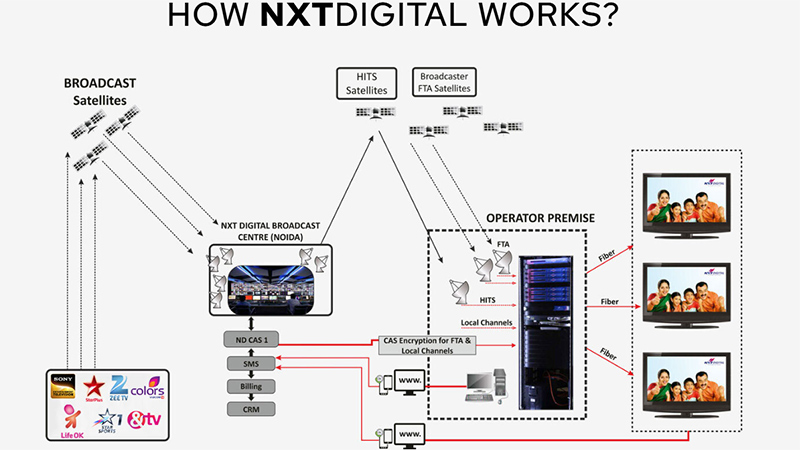
    From a sleek new uplink facility in Ahmedabad, GTPL is readying to transmit up to 900 encrypted, multiplexed channels using 12 leased C-band transponders from Indonesian satellite operator Telkomsat. The satellite signal is then beamed directly to local cable operators (LCOs), who deliver the final mile using existing coaxial or fibre lines.

    It’s a model that minimises capital investment on the ground while maximising reach—especially in India’s 130–135 million “TV-dark” homes, a figure larger than the total households of Japan and the UK combined.

    GTPL’s move brings it squarely into competition with the Hinduja-owned Nxt Digital, India’s sole HITS player until now, with a subscriber base of 2.4 million. Nxt has played a steady game—providing shared uplink infrastructure, cost-effective Cope (cable operator premises equipment) units priced between Rs 10.6–14 lakh, and STBs from Chinese OEMs like Changhong and Telesystems.

    Its model helped reduce per-subscriber costs dramatically—from Rs 17 to just Rs 7 in some cases—offering a lifeline to smaller MSOs (multi-system operators) struggling to comply with the regulatory shift to digital. But Nxt’s footprint, while impactful, has remained modest.

    GTPL is playing a different hand: scale. With 9.6 million cable TV subscribers already on its rolls and strongholds in Gujarat, Maharashtra, West Bengal and Bihar, the company intends to transition its entire base to HITS delivery over the next 24–36 months.

    The vision? To be India’s largest HITS network—leapfrogging not only NXT, but also traditional satellite and cable architectures in one swoop.

    This pivot is part of GTPL’s broader Rs 350 crore capex outlay for FY25, which also includes new broadband infrastructure and set-top boxes. The numbers make a compelling case: annual bandwidth costs, currently pegged at Rs 85–90 crore, are expected to drop by half.

    Projected revenues from the satellite platform are equally promising. At 750,000 subscribers, GTPL expects to generate Rs 99 crore annually. That rises to Rs 132 crore with 1 million users. Add Rs 12 crore more from leasing infra services to 50 smaller MSOs (each paying Rs 2 lakh per month), and the business case becomes hard to ignore. Even under conservative adoption rates, the Rs 100 crore investment could be recouped within 12 months.

    GTPL’s HITS play isn’t just about broadcast—it’s also about backend tech. The company is deploying a hybrid business model: retailing bundled TV channel packs to consumers via LCOs while offering platform-as-a-service tools to smaller MSOs. These include uplinking, encryption, conditional access system (CAS) and subscriber management system (SMS) solutions—effectively turning GTPL into a SaaS player for the cable industry.

    In a sector plagued by fragmentation, opaque billing, and outdated infrastructure, this modular model could be just the reset smaller operators need to stay compliant, competitive, and cost-efficient.

    India’s content delivery puzzle has long had three flawed pieces. OTT remains hobbled by poor last-mile broadband in rural areas, with even state-run BharatNet struggling to scale. DTH, while more pervasive, has long suffered from weather interference, installation costs, and churn. Cable TV, once the lifeline of urban India, is now chafing under regulatory pressure and infrastructure bottlenecks.

    Enter HITS—a model that combines the robustness of satellite delivery with the flexibility of LCO-based distribution. It’s weather-resistant, quick to deploy, and doesn’t require laying new wires in hard-to-reach zones.

    As a middle path, HITS may well become the delivery standard for Bharat—the vast, value-driven, and still under-connected expanse of Indian television.

    Surprisingly, GTPL’s skyward expansion has not been met with resistance. The All India Digital Cable Federation (AIDCF) has raised concerns around broader issues like OTT content regulation and fair play by broadcasters—but not specifically about the HITS model. Major networks such as Zee, Sony, and Disney Star have voiced concerns over the pricing dynamics introduced under TRAI’s NTO 3.0 framework, but formal objections to GTPL’s satellite platform are absent.

    The company, for its part, holds a valid grant of permission agreement (GOPA) from the ministry of information & broadcasting (MIB) and has participated in various TRAI and MIB consultations, signalling alignment with the regulatory ecosystem.

    GTPL’s pricing strategy will be region-specific, with affordability and adaptability built in. Final LCO-facing Cope and channel package rates will be finalised once broadcasters declare new pay channel prices. While margins may initially be tight, the long-term play is rooted in volume, retention, and backend monetisation.

    This isn’t a short-term stunt—it’s a structural realignment of India’s content delivery infrastructure.

    GTPL’s satellite push is more than just a tech upgrade—it’s a masterstroke of timing, vision, and market understanding. With one eye on underserved consumers and the other on the backend tech stack, the company is positioning itself as both a broadcaster and a platform.

    As India’s media future heads skyward, GTPL’s HITS move may well become the blueprint for digital inclusion across Bharat.

    (If you are an Anime fan and love Anime like Demon Slayer, Spy X Family, Hunter X Hunter, Tokyo Revengers, Dan Da Dan and Slime, Buy your favourite Anime merchandise on AnimeOriginals.com.)

  • GTPL Hathway to maintain FY22 revenue and EBIDTA growth in FY23

    GTPL Hathway to maintain FY22 revenue and EBIDTA growth in FY23

    Mumbai: GTPL Hathway saw 12 per cent growth in revenues at Rs 24,154 million and four per cent increase in EBITDA (earnings before interest, tax, depreciation and amortisation) to Rs 5,677 million year-on-year in FY22. The company expects to maintain this growth rate for the current financial year i.e., FY23.

    “The guidance is just that we are going to maintain our  compound annual growth rate (CAGR), 100 basis points here and there but we are going to maintain our CAGR in both revenue and EBITDA that’s the way as we look forward to our aggressive growth in both the businesses in this financial year,” said GTPL Hathway Ltd business head – CATV and chief strategy officer Piyush Pankaj during an investor call held recently.

    GTPL Hathway closed the year 2021 becoming the largest multi-system operator in the country with its cable TV (CATV) subscriber base growing to 8.40 million as per Telecom Regulatory Authority of India’s (Trai) performance indicator report. “Our CATV subscriber base has grown sharply by 2.3 times in the last six years and for FY2022 it has grown by five per cent,” observed Pankaj.

    ALSO READ | GTPL Hathway closes FY22 as largest MSO; revenue at Rs 24,154 million

    The company lost 7.5 lakh commercial customers when Covid-19 pandemic started and has seen the return of four lakh customers since then. The rate of returning customers has slowed down from 20-25 lakh in the last quarter to 20K average during the fourth quarter FY22.

    The majority of the company’s cable TV subscriptions come from the Gujarat market which has 95 per cent share with the remaining five per cent spread across markets such as Pune, Nagpur, Hyderabad, Jaipur, Patna and Varanasi.

    “Our CATV business expansion will gain momentum with organic and inorganic growth in the coming quarters,” said Pankaj. “After the new tariff order (NTO) , we said that growth will come from inorganic and organic. The first year of NTO has gone into stabilising the industry. Just as we were getting ready for acquisitions and going organic, Covid hit us in March 2020 and we were not able to do any inorganic growth. So, from this quarter onwards we have started both inorganic and organic growth.”

    The company’s capex for FY22 was Rs 363 crore which includes Rs 180 crore of CATV capex and Rs 183 crore of broadband capex. “Next year we are keeping the target of Rs 450 crore for the capex on which around Rs 180 crore is going to be cable capex and rest is going to be the broadband capex,” said Pankaj.

  • Hathway Cable and Datacom reports revenue of Rs 1,793 crore in FY22

    Hathway Cable and Datacom reports revenue of Rs 1,793 crore in FY22

    Mumbai: Hathway Cable and Datacom Ltd reported gross revenue of Rs 1,793 crore in FY22 an increase of four per cent over FY21. Its broadband revenue stood at Rs 621.9 crore while CATV revenue stood at Rs 1171.1 crore for the financial year. The company reported profit after tax of Rs 130.4 crore a decline of 49 per cent year-on-year.

    “The business model for the company was protected in spite of Covid-19 led movement restrictions and disrupted supply chains,” said the statement.

    In its fourth quarter results, the company saw gross revenues of Rs 448.8 crore, an increase of two per cent year-on-year. Broadband revenue for the quarter stood at 157.1 crore and CATV revenue at Rs 291.7 crore. It saw profit after tax of Rs 28.4 crore in the quarter, a 16 per cent decline quarter-on-quarter.

    CATV business highlights

    The company reported 5.4 million set-top-box connections and more than 109 cities and major towns. “In the last two years, the company has created an extensive incremental infrastructure for market share gain. We have connected over 250 new locations with IP links,” said the statement. “Our product/go-to-market strategy/infrastructure ready for taking benefit of a more conducive market and business scenario with pandemic becoming more manageable. Set top box procurement and market share gain plans being rolled out.”  

    It further added, “The casting of OTT apps through already seeded new generation HD boxes is being piloted. This unique feature can give access to OTT to millions of Hathway Cable TV customers without any need to buy an additional OTT box. We have also piloted TV Plug. Using this Hathway can provide the most reliable last mile cable TV connectivity from a mobile tower network.

    Hathway Cable has also launched a digital platform to enhance the competencies of partner local cable operators in the cable TV business.

    ISP business highlights

    The company’s subscription revenue stood at Rs 157.1 crore with an increase of 32K customers in Q4 FY22 led by strong FTTH customer acquisition. FTTH consumers now account for 70 per cent of overall ISP consumers. “The company saw subdued revenue growth on account of higher speed and unlimited data limits now available at lower ARPU plans at industry level,” said the statement.

    The company reported 1.11 million broadband subscribers at the end of the fourth quarter FY22. 

  • After Tamil Nadu, Karnataka state govt eyes cable TV business

    After Tamil Nadu, Karnataka state govt eyes cable TV business

    MUMBAI: Even though the demand for getting the Digital Addressable System (DAS) licence for J Jayalalithaa run Tamil Nadu Arasu Cable TV Corporation (TACTV) is still pending with the Information and Broadcasting Ministry (I&B), there is another state government that is looking at entering the cable TV industry.

    The Karnataka state government Minister for Information, Public Relations and Infrastructure R Roshan Baig has been making headlines after his conference where he expressed interest in setting up cable television system, provided the Centre permitted it.  In the meeting, the Minister said that the Ministry has been receiving complaints from consumers who have to pay Rs 400-Rs 500 for cable TV service.

    Baig in the conference, while applauding the model of Arasu Cable in Tamil Nadu, said that the Karnataka government will also apply the same module, where consumers won’t be paying more than Rs 100 per month for the cable TV channels.  
    In response to the statement, Karnataka State Cable TV Operators’ Association (KSCOA) met the Minister to apprise him of the situation. “We told him that in the Rs 70 that Arasu charges for its services, it gives only free to air and regional channels, while the others give all the leading channels, which is what the consumers want,” informs Karnataka State Cable TV Operators’ Association spokesperson Sudhish Kumar adding that they have also addressed the matter to Telecom Regulatory Authority of India (TRAI) chairman Rahul Khullar.

    “Khullar in his address to the media has already made it clear that any government body or agency getting into the cable TV or distribution business is against the rules,” adds Kumar.

    “But, if it still happens, we will move the court,” he states.

    The association has suggested that the government could through DD Freedish give cable services at a lower tariff.

    The multi system operators (MSOs) in the region are shocked with even the new Tamil Nadu Chief Minister O Panneerselvam backing the demand for DAS licence for Arasu Cable.

    In order to ensure that the Karnataka government does not get the nod from the Centre, the South Indian Federation will be meeting the I&B Minister Arun Jaitley. “We are seeking his appointment and could be meeting him between 21 January to 23 January,” informs Kumar while adding that they want the I&B Minister to come out with his clear statement on the matter.


  • IMCL in talks with PE firms to raise $75 mn

    IMCL in talks with PE firms to raise $75 mn

    MUMBAI: Hinduja-owned IndusInd Media and Communications (IMCL) is in talks with private equity investors to raise $75 million to fund the second phase of cable TV digitisation.

    IMCL has mandated Ernst & Young to find an investor for its funding requirement. "With India mandating digitisation, there is a huge appetite to invest in cable TV companies. We are looking at raising $75 million. E&Y has been given the mandate for this purpose," IndusInd Media & Communications chief executive officer Nagesh Chhabria tells Indiantelevision.com.

    IMCL, which operates its cable TV business under the Incablenet brand, will need Rs 6 billion as it is targeting four million set-top boxes (STBs). "We have existing lines of credit from banks for $15 million. We can raise $10 million of new debt," says Chhabria.

    IMCL has a debt of Rs 3 billion

    The multi-system operator (MSO) operates in 15 out of the 38 cities that fall under digitisation in the second phase. The plan is to also enter into 14 more markets. "We would require two million STBs from our existing cities. We anticipate another two million boxes from the new operations," says Chhabria.

    Will IMCL look at acquiring cable networks for entering these markets? "There are many operators who will find it difficult to fund digitisation. We are in talks with independent operators. We can also enter on our own," says Chhabria.

    IMCL has deployed 1.3 million boxes across three cities in the first phase. "Our target is 1.5 million STBs," Chhabria says.

    The government has mandated digitisation in 38 more cities by 31 March 2013, after switching to digital delivery of cable TV in Mumbai, Delhi and Kolkata from 1 November. The revised deadline for switchover to digital delivery in Chennai is likely to be decided by the Madras High Court.

  • ‘Buyout valuations will now be decided in terms of ARPU rather than carriage growth’ : IMCL MD and CEO Ravi Mansukhani

    ‘Buyout valuations will now be decided in terms of ARPU rather than carriage growth’ : IMCL MD and CEO Ravi Mansukhani

    IndusInd Media and Communications Ltd (IMCL), the media subsidiary company of Hinduja Ventures Ltd, plans to raise $100 million, a major chunk of which will be used to fund acquisitions.


    Operating its cable TV business under the InCablenet brand, IMCL had earlier planned an initial public offering (IPO) but changed its stance as the newly listed cable TV entities, Den Networks and Hathway Cable & Datacom, dropped in market value.


    Even on the acquisition front, IMCL has changed gears. Earlier, the focus was to buy small-sized cable TV networks and expand geographies. Now it targets big-ticket acquisitions, expecting the sector to consolidate as the government chalks out a schedule for digitisation across the country.


    Slow on the broadband path, IMCL is experimenting on new technologies where it will not have to entirely overhaul its network to load on broadband capability.


    In an interview with Indiantelevision.com’s Sibabrata Das, IMCL managing director and chief executive officer Ravi Mansukhani talks about how the acquisition game is going to move from carriage calculations to valuations based on ARPU (average revenue per user) growth as the cable TV sector transitions into the digital era.


    Excerpts:

    Why is IMCL taking so much time in readying its IPO?
    We are in the market to raise $100 million ahead of the IPO and have mandated Deutsche Bank for this. We want to first build a solid valuation base. We believe the value of the top-rung MSOs will get a significant boost once the government fixes up a schedule for digitisation. We want to also expand on our size before we go for a public float.


    We have separately raised Rs 1 billion of debt from General Electric. So funding is being taken care of. We are getting ready to move into top gear.

    Have you finalised on how you are going to raise this amount?
    We are weighing various options. We are looking at mezzanine structures. The final structuring will depend on what fund-raising instrument we select.

    Are we going to expect acquisitions or a drive to greater digitisation?
    We plan to use three-fourth of the amount raised for acquiring cable TV networks. We are looking at small and big-ticket acquisitions. We believe there is going to be consolidation in the industry. For digitisation, we have a separate funding plan to meet the capex requirements.

    Why has there been a change in stance as the earlier focus was to buy small-sized cable TV networks and expand geographies?
    We see an opportunity out there as the other leading MSOs like Hathway Cable & Datacom and Den Networks are not on a buying spree. The valuations have dropped and we are ready to make big-ticket acquisitions ahead of the government‘s digitisation schedule. The acquisition focus now will be not on expanding into new geographies but on consolidating and growing in existing operational cities.

    Will the acquisition game change even as the government lays out a roadmap for digitisation across the country?
    The game will definitely change. A few years back, when the pace was set by new entrants such as Den and Digicable, acquisitions were based on carriage calculations and TRP cities were favoured. Now, as digitisation creeps in, buyout valuations will be decided in terms of ARPU growth. So we have decided to consolidate and expand in areas where we already exist like Maharashtra. There is no point in spreading lean.

    “We are in the market to raise $100 mn ahead of the IPO. We want to first build a solid valuation base. We believe the value of the top-rung MSOs will get a significant boost once the govt fixes up a schedule for digitisation. We want to also expand on our size before we go for a public float”

    Do you see MSOs fighting amongst each other once the digitisation programme is announced?
    MSOs would rather consolidate and expand where they are strong; their focus would be on digitising their existing network. MSOs can‘t create a fight today without being attacked; too much is at stake.

    How will MSOs counter the DTH invasion?
    India will remain primarily a cable country. Yes, in a diversified and fragmented market, DTH will have space. But being the incumbent player, cable TV has a distinct advantage. Besides, it is cheaper priced, bandwidth is no issue and it can be interactive. MSOs will also start launching server-based local channels as in the digital era, space will open up for more channels. There will be need for local news and events. DTH can‘t offer these channels.

    How much of IMCL‘s network is digitised?
    We have over half a million digital set-top boxes (STBs) installed. Out of the 28 cities that we operate in, we provide digital services in 17 cities via 10 digital head-ends.


    If the government‘s digitisation plan is on stream, we will deploy close to two million additional boxes in Phase 1. We are going to fund our digitisation through lease and vendor financing.

    Why is IMCL‘s broadband story yet to emerge?
    Our focus has not been on broadband in the past because the franchisee operators have been providing it. Though we provide broadband in nine cities, our revenues from this segment stood at just Rs 50-60 million in FY‘11.


    We plan to have a strong broadband story once the digital path is properly spelt out. We are currently experimenting on new technologies where we will not have to entirely overhaul our network to load on broadband capability.


    We won‘t have a problem building up broadband revenues once we have pushed the digital STBs in. The script will change after the government announces the sunset date for the digitally notified areas. It is companies like You Telecom who will need to grow their cable TV presence in order to provide broadband.

    Hathway has announced it would launch its HD service in June. When are you getting into this segment?
    Our first priority is to offer digital service. We will then graduate to HD. The market is still not ready for it. HD boxes are on the anvil and we will introduce them into the market in the next few months.

    IMCL‘s total income jumped 23 per cent to Rs 4.03 billion in FY‘11. What growth do you estimate in FY‘12 and what is the outlook on carriage income?
    We expect revenue to grow between 20-25 per cent. This will be higher if we raise capital fast and make big-ticket acquisitions.


    We saw 18-20 per cent growth in carriage income in FY‘11. We expect strong growth from this stream as more and more channels get launched in the fiscal.

  • ‘Cable companies should start thinking like DTH operators’ : EVS Chakravarthy – You Telecom CEO

    ‘Cable companies should start thinking like DTH operators’ : EVS Chakravarthy – You Telecom CEO

    Having acquired a broadband company in 2006, Citigroup Venture Capital International has set its eyes on the cable TV business. You Telecom has floated a subsidiary to meet the FDI (foreign direct investment) guidelines for cable and acquired Bangalore-based Digital Infotainment, a small-sized cable network.


    You Telecom intends to invest Rs 7 billion over four years as it takes steps to enter the digital convergence space. Banking on building a Headend-In-The-Sky (HITS) platform, the company plans to invest Rs 1.2 billion in the first phase of infrastructure.


    In an interview with Indiantelevision.com’s Sibabrata Das, You Telecom CEO EVS Chakravarthy talks about the onslaught from direct-to-home (DTH) players to grab the digital space and the need for cable TV operators to up their services and invest in brand building.


    Excerpts:

    Since Citigroup Venture International holds 85 per cent in You Telecom India, how are you restructuring the foreign holding to stay within the regulatory cap of 49 per cent so as to kick start cable TV operations in India?
    We have set up a company called Digital Outsourcing where Citigroup holds 49 per cent. The balance 51 per cent is being held by high net worth individuals. We have done the capital restructuring in the cable TV company to meet the FDI guidelines.

    Did Citigroup buy out the Mumbai-based broadband company from British Gas in 2006 because it saw opportunity in expanding the footprint to cable TV?
    We will probably be the only pure broadband player to get into cable TV. Unlike Sify and the other ISP operators, we have built a cable-based infrastructure. So it is a logical extension for us.

    Are you looking at acquisition of cable networks as the entry route in different markets?
    Digital Outsourcing has bought 50 per cent stake in Bangalore-based Digital Infotainment. This is our entry into cable TV operations. We will be rolling out digital services in the next couple of weeks. In other markets, we are also looking at people who could partner with us through joint ventures where we will be offering multiple services.

    Why have you set up a headend in Delhi but not yet rolled out services? Is it that you don’t have a content tie-up with broadcasters?
    Though we have set up a headend in Delhi, we haven’t started operations. We are looking at opportunities like a JV or a 100 per cent buy out. We are also looking at an outsourced service model for digital solutions to cable operators as one option.

    You are banking heavily on the HITS model. How much are you going to invest in the venture?
    We will be investing Rs 1.2 billion in the first phase for setting up the HITS infrastructure. We are waiting for the government to come out with the regulations before we go ahead. We expect the Telecom Regulatory Authority of India (Trai) to come out with its recommendations on HITS in the next 2-3 weeks. For the digital solutions including set-top boxes, we will be using Scientific Atlanta. And for HITS, we will also be looking at Motorola.

    How much are you going to invest in the overall business?
    We plan to invest Rs 7 billion over four years. This will be in addition to Rs 4 billion that we have already put in for laying out the infrastructure for broadband. We will be doubling our footprint to 24 cities.

    Why are you so bullish on digital cable when there is a very low STB penetration in the Cas (conditional access system) belt?
    2008 will be the defining year for digital. After Reliance launches its DTH service, expect fireworks on the ground to start. The cable industry is not fully prepared to combat the DTH onslaught. Cable operators will have to figure out who is going to provide them with the right ammunition to fight DTH tomorrow.

    MSOs should have a one-million digital box seeding plan. Then everything will fall in place’

    What will you offer that will make cable operators come to you?
    It’s high time cable companies started thinking like DTH operators. Cable TV has to match DTH service standards – be it brand building, billing, marketing and services. Multi-system operators (MSOs) today are not concentrating on that. They will have to support the last mile operators with all these things. Otherwise, how are the operators going to fight DTH on behalf of the MSOs. The old mindset has to change. There has to be a complete revolution in digital cable and related services like broadband. If the old MSOs don’t do it, new players like us will show the way.

    Cable operators are willing to part with equity to those MSOs who are offering them more. Isn’t that the deciding factor?
    In the initial land grab situation, it is capital. But in the medium term, it will be quality of management and the systems and processes they work with. The valuations operators are asking for has gone up dramatically with new MSOs entering the field. But it is like the sensex; it will not last forever. We are not willing to pay exorbitantly just because we want to expand our size. In cable, it is important to remember that there is no case of first mover in the consumer’s mind. The future battle in cable will be for grabbing attention in the consumer space through brand building and quality of service. The MSOs have never thought of this as a strategy. And don’t forget that HITS will open up the smaller towns and networks. So the opportunities down close down for any new entrant.

    What brand building exercise you have put in place?
    We have an equity capital reserved for brand building. Bennett & Coleman Company Ltd (BCCL), the holding company of the Times of India, has a five per cent stake in You Telecom. We are looking at doing more such media deals. We are setting in a discipline by allocating equity for brand building.


    We have also invested in technology. We have introduced the Oracle-based billing system which we are willing to outsource to others. We have 170,000 broadband subscribers, spread across 12 cities including Mumbai, Bangalore, Chennai, Hyderabad, Gurgaon, Surat, Baroda, Ahmedabad, Rajkot and Pune. Our broadband ARPU (average revenue per user) is Rs 460. Our revenues will be Rs 1.10 billion this fiscal with just broadband in our business mix at this stage.

    Won’t the cable business require huge doses of capital?
    We realise that growth needs capital. Citigroup is committed to infusing capital to grow the business. We have a plan in place.

    But for a venture capital fund, isn’t analogue cable a matter of concern for its revenue leakages across the last mile?
    When Citigroup bought out the company from British Gas, they looked at the convergence space. We are uniquely positioned in that we already have a good broadband play. When we are in cable, we are only extending our laid out infrastructure to a new area of business. It is important to remember that a single service play is like an analogue video play. We see alliances emerging with broadcasters and cable networks across the value chain.

    What is the challenge for MSOs in digital cable?
    MSOs should have a one-million digital box seeding plan. It is possible with a well-evolved cable eco system. Once an MSO has such a deployment, then everything will fall in place. It will be like building a long lasting real estate value – with multiple services including broadband, cable TV, gaming and VoIP. Later we will see bigger cable companies converting carriage fee into equity in broadcasting networks.


    What are your views on Trai’s regulation for non-Cas areas?
    The regulator has given it some shape. If the MSOs had implemented Cas more successfully and effectively, then Trai perhaps would have been confident of extending it to other areas.

  • ‘Cable ARPUs in Cas areas to touch Rs 400 in five years’ : Jagjit Singh Kohli

    ‘Cable ARPUs in Cas areas to touch Rs 400 in five years’ : Jagjit Singh Kohli

    Subhash Chandra is betting big on his cable TV business. Wire & Wireless Ltd (WWIL), the demerged entity of Zee Group, plans to invest Rs 7.14 billion over two years. A major chunk of this will be consumed by set-top boxes (Rs 3.28 billion) and customer acquisition (Rs 1.14 billion) as he attempts to hold grip in the distribution business.


    When WWIL gets listed sometime in January-February, investors will have a touch and feel of the valuation that cable business will enjoy in the digital era.


    Launching the aggressive drive, WWIL CEO Jagjit Singh Kohli says he has ramped up 250,000 customers at an average valuation pegged at Rs 2000 per subscriber. The ambitious target in year five: 9.6 million.


    In an interview with Indiantelevision.com’s Sibabrata Das, Kohli elaborates on the steps WWIL is taking to emerge as a leading multi-system operator (MSO) with plans to launch Headend-In-The-Sky (HITS) and STBs that have internet and VoIP (Voice over Internet Protocol) capabilities.


    Excerpts:

    Is WWIL close to roping in a strategic investor?

    We are in talks with both strategic as well as financial investors. They have shown interest in our business. We would go with anybody who gives us the maximum valuation.

    What is the valuation WWIL is now getting?

    The investors are discussing of valuations in the range beyond $600 million. Our expectations are higher. We are likely to get listed by mid-January or early February. The true valuations will come out then.

    Are investors valuing the cable TV business based on the number of subscribers or future revenues?

    In India, it is too early for a subscriber-based valuation. Investors are using the discounted cash flow method. The valuations are obviously based on our future target of touching 9.6 million subscribers. There are two reasons why we will get valued more: we are doing Headend-In-The-Sky (HITS) and we are using set-top boxes (STBs) designed by Pacenet which will offer multiple usages like internet and VoIP (Voice over Internet Protocol).

    MSOs will have to make major investments on STBs. Is it going to comprise as high as 46 per cent of your overall investments?

    We are planning to invest Rs 7.14 billion in the business over two years. For STBs, our fund requirement could be Rs 3.28 billion. We are planning to pump in Rs 2.21 billion towards hardware. Another area where we will be aggressive is customer acquisition. We plan to put in Rs 1.14 billion for this.

    What is the debt to equity ratio and how are you meeting the initial fund requirement?

    The ratio will be firmed up once we know the price WWIL quotes after getting listed in the exchange. That in a way will determine how much debt component we would require to raise. Our initial fund requirement is Rs 5 billion. We have lined up a debt of Rs 2.15 billion. We have already got Rs 500 million from Infrastructure Development Finance Corporation (IDFC).

    WWIL is on a drive to acquire customers. What is the price of acquisition?

    We are offering to cable operators a valuation of Rs 2000-3000 per subscriber. While WWIL will be a 51 per cent partner, the balance 49 per cent will be with the operators. We have already ramped up 250,000 subscribers in recent months through aggressive acquisitions.

    What is the average valuation for acquiring 250,000 subscribers?

    The average valuation works out to Rs 2000 per subscriber.

    Won’t you have to handle too many operators by doing JVs with them?

    We are making proposals to networks with decent size. In Mumbai, for instance, 12 local operators are creating a company and entering into a JV with us. We want to reduce the number of JVs. Otherwise, it will be impossible to manage.


    In some of our acquisition models, we make MSOs buy out the local cable operators.


    We have set a target of ramping up our direct subsciber base to 9.6 million within five years. We expect 7.6 million to receive digital cable. Our aim is to have 4.4 million through our own digital cable service and an additional 3.2 million through our HITS platform. We will have two million through analogue acquisitions. We have expanded operations from 35 to 43 cities. We plan to be in 66 cities in three years.

    WWIL has a thin presence in Mumbai. Even in the lucrative market of South Mumbai, which is a Cas notified area, you have a negligible presence. What are you doing to correct this?

    We have linked up optic fibre and have commissioned a digital headend a few days back at Worli. We will be in the Cas notified area of south Mumbai and several operators from rival MSOs are joining us. We have acquired control over 5 Star which operates in Andheri, a western suburb of Mumbai. We have also poached a few operators from Incablenet in Andheri East and others from rival MSOs are joining us.

    The average valuation of acquiring 250,000 customers works out to Rs 2000 per subscriber.

    How are you expanding your footprint in Delhi?

    In Delhi, we have acquired a 51 per cent stake in Satellite Channels. We have also signed up with Spectranet and Sanjay Cable Network. All these MSOs were disqualified for Cas as they were found not ready by the Telecom Regulatory Authority of India (Trai) for making the switchover to addressable system by 31 December. As for Kolkata, we are very much a dominant player after buying out Indian Cable Net (formerly RPG Netcom), a leading MSO, in May 2005.

    What is the price of the STBs?

    While the cost of the basic box is Rs 2000, the one with internet is Rs 2500 and internet plus VoIP Rs 3000. Customers can enjoy interactive games and online share trading through this. We are looking at a monthly fee of Rs 70 for internet and Rs 75-100 for movie-on-demand. Subscribers will have to pay Rs 1499 as deposit and Rs 45 as monthly rent. We haven’t, though, arrived at the final pricing. We plan to introduce the internet-enabled boxes after two months and those with VoIP sometime in April.

    Who are your STB vendors?

    We have Korean and Chinese vendors who will be supplying us the boxes. We have also ordered 200000 STBs from Bharat Electronics Limited (BEL).

    Earlier, in 2003 when Cas was to be introduced, Pacenet had ordered STBs from TVS Electronics. Why haven’t you included them in the list?

    We are also considering them. But at this stage it makes more business sense to import the boxes.

    Were you doing some tests with BSNL for VoIP?

    We were testing out whether our technology would work on BSNL’s network. The tests were successful.

    Is WWIL serious on launching a HITS platform or is it a mere hype?

    We are going to do HITS and have expressed our intent to broadcasters. This will provide us a national footprint and hasten the pace for digitisation in the country. We can tap cable operators even in places where WWIL has no presence. We have booked four transponders on Thaicom satellite with effect from 1 January, with the option of taking three more. We plan to launch HITS before the end of February.

    Do you see ARPUs (average revenue per user) falling in a Cas regime?

    For one year, it may come down. Let us not forget that cable TV rates have been suppressed for artificial reasons for too long. But by deploying STBs, this scenario is going to change. We may start off with an ARPU of Rs 250 per month, but like in case of cinema theatres with the launch of multiplexes, this will go up. By year five, we may be looking at ARPUs in the region of Rs 400.

    Hathway Cable & Datacom has come out with bouquet packages along with the a la carte choices. Will you offer something similar?

    We will be introducing a combo package where consumers who buy STBs on outright purchase and take annual subscription will be offered an attractive subsidy. This scheme will make available 100 TV channels. We will be offering under this at least 20 pay channels. We will be subsiding the boxes.

    Unlike DTH, broadcasters will have to make their pay channels available on an a la carte basis at a maximum rate of Rs 5 on cable networks in Cas areas. Will this mean that they will do content deals where they give their bouquets to MSOs at lower cost than to DTH service providers? Otherwise, MSOs can create bouquets picking and choosing the best channels and dumping the weaker ones in the bouquet.

    Yes. If broadcasters don’t do that, they will always be faced with the dilemma that the MSOs can pick and choose the stronger channels in their bouquet while ignoring the rest. The other reason why we should get better costs than DTH is because we have to share the revenue with the distributors and local cable operators across the value chain.

    How does cable compare with telecom operators in triple play service?

    Indian cable systems are ready to do telephony. They have pipes already laid including ethernet. The cable architecture throughout the country is in a position to provide triple play. All that is required is the box and IP can provide the return path for voice, data and interactive services.


    The public sector telcos, on the other hand, require strong compression technologies and ADSL2+ signals are good only for distances up to 1.5 km. The private sector telcos do not have a system suitable for large scale deployment and will require a high capital cost of $300 per line, even if we take the fact that their network is ready for IPTV (which is not the case). IPTV could have happened in markets where ARPUs are high. But India is not a high ARPU market.

  • WWIL lines up Rs 2 billion debt, rebrands digital cable as Galaxzee

    WWIL lines up Rs 2 billion debt, rebrands digital cable as Galaxzee

    MUMBAI: Zee Network’s Wire & Wireless India Ltd. (WWIL) is in the process of lining up a debt of Rs 2 billion for funding its digital initiatives and acquisition of cable operators.

    “We have already got Rs 500 million from Infrastructure Development Finance Corporation (IDFC). We are already in the process of tieing up a debt of Rs 2 billion,” WWIL CEO Jagjit Singh Kohli tells Indiantelevision.com.

    The company plans to invest Rs 7.40 billion over two years and Rs 8.50 billion within five years. “The debt to equity ratio will be firmed up once we know the price it quotes after getting listed in the exchange by February-March 2007. That in a way will determine how much debt component we will require to raise,” Kohli says.

    The company is in talks with strategic and financial investors but conclusive agreement will take place only after the listing. “We are not necessarily looking at a strategic investor. We want somebody who will give us the maximum valuation,” Kohli says.

    WWIL, the de-merged entity of Zee Telefilms’ cable TV business, has set an ambitious target of ramping up its direct subsciber base to 9.6 million within five years. “We expect 7.6 million to receive digital cable. Our aim is to have 4.4 million through our own digital cable service and an additional 3.2 million through our Headend-In-The-Sky (HITS) platform. We will have two million through analogue acquisitions,” says Kohli.

    WWIL claims to have added 250,000 subscribers in recent months through aggressive acquisitions. The multi-system operator (MSO) has also expanded operations from 35 to 43 cities. “We plan to be in 66 cities in three years,” Kohli says.

    WWIL will deploy several models of set-top boxes (STBs) aimed at various subscribers. Apart from the basic box, it plans to introduce a STB which will enable internet facilities on TV. “Customers can enjoy interactive games and online share trading through this. We are looking at a monthly fee of Rs 70 for internet and Rs 75-100 for movie-on-demand. Subscribers will have to pay Rs 1499 as deposit and Rs 45 as monthly rent. We haven’t, though, arrived at the final pricing. We plan to introduce these boxes after two months,” says Kohli.

    The basic STB is available on a refundable deposit of Rs 250 and rent of Rs 45 per month or a refundable deposit of Rs 999 with a monthly rent of Rs 30.

    WWIL will also deploy a STB through which it can offer VoIP (Voice over Internet Protocol) sometime in April, according to Kohli. The MSO is also poised to offer HITS which will enable it to tap cable operators at a national level even in places where WWIL has no presence, he adds.

    GalaxZee will be the brand under which WWIL will offer its digital cable service. “We have commissioned a digital headend two days back at Worli. We will be in the Cas (conditional access system) notified area of south Mumbai and several operators from rival MSOs are joining us,” Kohli says.