Tag: Cable Television Networks Regulation Act 1995

  • MIB condemns reporting of Russia-Ukraine conflict and Delhi demolition in advisory

    MIB condemns reporting of Russia-Ukraine conflict and Delhi demolition in advisory

    Mumbai: The ministry of information and broadcasting (MIB) has issued an advisory prohibiting satellite TV channels to transmit programming that is violative of the Programme Code under Cable Television Networks (Regulation) Act 1995. The ministry observed that the reporting of the Ukraine-Russia conflict and recent demolition incident in North-West Delhi are “misleading, sensationalist and have communal overtones.”

    Relating to the Ukraine-Russia conflict, the I&B ministry highlighted that TV channels have been making false claims and frequently misquoting international agencies/actors. That they have been using ‘scandalous headlines/taglines’ that are completely unrelated to the news item. And that many of the journalists and news anchors of these channels made fabricated and hyperbolic statements intending to incite the audiences.

    Similarly, the reporting for the incident in North-West Delhi “made use of provocative headlines and videos of violence that may incite communal hatred among the communities and disrupt peace and law and order,” according to the ministry. The coverage disrupted the ongoing investigation process by playing scandalous and unverified CCTV footage. By showing footage of a specific community thus aggravating the communal tensions and fabricated headlines sensationalising and giving communal colours to the actions of authority.

    The ministry also stated that in the news, “some of the channels broadcast debates having unparliamentary, provocative and socially unacceptable language, communal remarks and derogatory references which may have a negative psychological impact on viewers and may also incite communal disharmony and disturb the peace at large.”

    As per the provisions of the Programme Code, no programme should be carried in the cable service which (a) offends against good taste or decency (b) contains criticisms of friendly countries (c) contains attack on religions or communities or visuals or words contemptuous of religious groups or which promote communal attitudes (d) contains anything, obscene, defamatory, deliberate, false and suggestive innuendos and half-truths.
  • MIB: No case of misleading ads in last three years

    NEW DELHI: Action was taken in only two cases of misleading advertisements for violation of the Advertising code in 2014 and there has been no action since, the minister of state for information and broadcasting Rajyavardhan Rathore said in the Parliament.

    He said that advertisements telecast on private satellite TV channels are regulated by the Ministry of Information and Broadcasting (MIB) under advertising code prescribed under the Cable Television Network Rules 1994 as listed out in the Cable Television Networks (Regulation) Act 1995.

    The code contains a whole range of parameters to regulate advertisements on TV channels. Rule 7 (5) of the advertising code specifically deals with misleading advertisements, which prescribes that no advertisement shall contain references which are likely to lead the public to infer that the product advertised or any of its ingredients has some special or miraculous or super-natural property or quality, which is difficult to prove.

    The Department of Consumer Affairs has not fixed any criteria for veracity of advertisements of products related to daily use of consumer goods. However, Section 2(1)(r) of the Consumer Protection Act, 1986 provides that the practice of making any statement, whether orally or in writing or by visible representation, which falsely represents that the goods are of a particular standard, quality, quantity, falls under unfair trade practices.

    A consumer can make a complaint against unfair trade practice in a consumer forum established under the Consumer Protection Act, 1986. If the complaint is upheld by the forum, it can issue restraining orders.

    In response to another question, Rathore refused any update from the government stating that the case was in the Delhi High Court and, hence, sub judice. Broadcasters had challenged in court a provision in the Cable Act for advertisements to be limited to twelve minutes per hour.

    He said Rule 7(11) of the Rules provides that “no programme shall carry advertisements exceeding 12 minutes per hour, which may include up to ten minutes per hour of commercial advertisements and up to two minutes per hour of the channel’s self-promotional programmes”.

    The Telecom Regulatory Authority of India (TRAI) notified the regulation ‘Standards of Quality of Service (Duration of Advertisements in Television Channels) (Amendment) Regulations 2013’ on 22 March 2013 further amplifying the regulation.

  • Exercise restraint, Bengaluru police tells news b’casters

    Exercise restraint, Bengaluru police tells news b’casters

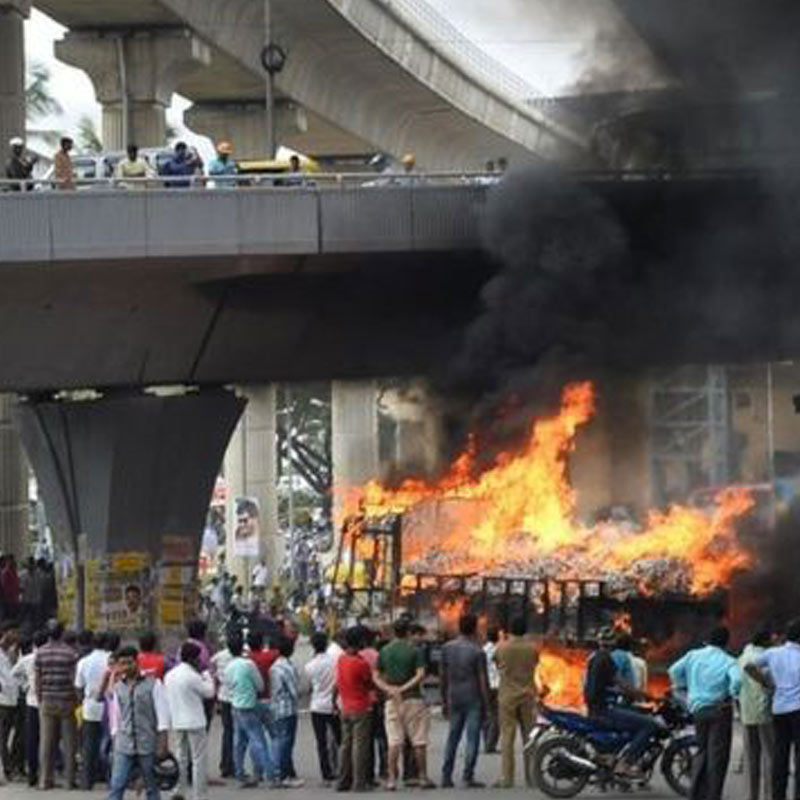
    NEW DELHI: Even as the Information and Broadcasting Ministry advised television channels to avoid life telecasts or file shots of violence or rioting linked to the Cauvery dispute, the Bengaluru Police has issued a similar directive for channels reporting from Karnataka.

    An order issued by Bengaluru police commissioner N S Megarikh yesterday advised television channels to follow the provisions of the Programme Code ‘scrupulously and exercise restraint and sensitivity while reporting such incidents and refrain from telecasting any material which  could ignite passions and create law and order problem in the city.’

    The directive also said that violation of its advisory may lead to prosecution of the offenders under the Cable Television Networks (Regulation) Act 1995.

    Noting that it had come to its notice that certain television channels had been telecasting provocative and inflammatory news / programmes relating to the Cauvery dispute including footage of violence, the advisory said that this may lead to further tension, resulting in a deterioration of the law and order situation.

    The Advisory quoted the relevant provisions in the Act as well as the uplinking and downlinking guidelines.

    Also read:
     

  • Exercise restraint, Bengaluru police tells news b’casters

    Exercise restraint, Bengaluru police tells news b’casters

    NEW DELHI: Even as the Information and Broadcasting Ministry advised television channels to avoid life telecasts or file shots of violence or rioting linked to the Cauvery dispute, the Bengaluru Police has issued a similar directive for channels reporting from Karnataka.

    An order issued by Bengaluru police commissioner N S Megarikh yesterday advised television channels to follow the provisions of the Programme Code ‘scrupulously and exercise restraint and sensitivity while reporting such incidents and refrain from telecasting any material which  could ignite passions and create law and order problem in the city.’

    The directive also said that violation of its advisory may lead to prosecution of the offenders under the Cable Television Networks (Regulation) Act 1995.

    Noting that it had come to its notice that certain television channels had been telecasting provocative and inflammatory news / programmes relating to the Cauvery dispute including footage of violence, the advisory said that this may lead to further tension, resulting in a deterioration of the law and order situation.

    The Advisory quoted the relevant provisions in the Act as well as the uplinking and downlinking guidelines.

    Also read: