Tag: Cable Television Networks

  • Govt orders private TV channels to strictly follow terror attack coverage guidelines

    Govt orders private TV channels to strictly follow terror attack coverage guidelines

    MUMBAI: In the wake of the recent terror attacks in Jammu & Kashmir, the government has issued an advisory to private TV channels to adhere to the guidelines that are issued for the coverage of terror attacks.

    A release from the Press Information Bureau asks channels to broadcast content that strictly adheres to the Programme and Advertising Code as prescribed in the Cable Television Networks (Regulations) Act, 1995 and its rules.

    TV Channels are advised to be particularly cautious with regard to any content which:

    (i)     is likely to encourage or incite violence or contains anything against maintenance of law and order or which promotes anti national attitudes: and /or

    (ii)    contains anything affecting the integrity of the nation: and ensure that no such content is telecast which is violative of these Codes.

  • MIB tells MSOs: Report on cable ops and subs grievance redressal mechanism

    MIB tells MSOs: Report on cable ops and subs grievance redressal mechanism

    NEW DELHI: All multi-system operators have been asked to send to the ministry of information and broadcasting (MIB) details of the grievance redressal mechanism drawn up by them to hear complaints of cable operators and subscribers.

    Pointing out that this is mandatory under Rule 12(2) of the Cable Television Networks Rules 1994 for every cable operator and multi-system operator, the ministry has sought a report by 25 September 2017 from all MSOs.

    At the outset, the note says that during the implementation of Digital Addressable System (DAS) which became operational from 1 April this year, a large number of complaints have been received on the following issues:

    i)                   Non-issuance of payment receipts/computer bills,

    ii)                Abrupt stoppage of services and/or channels by cable operators without any notice,

    iii)              No fixed price of STBs- different operators charge different rates,

    iv)              Non-filling up of CAF,

    v)                 Non-operationalisation of toll-free number for redressal of consumer grievances,

    vi)              Non-creation of web-site for logging of complaints

    vii)            Not providing a-la-carte choice of channels

    viii)         Nodal officer name not notified

    Rule 12(2) says MSOs and LCOs “shall devise a mechanism for grievance redressal of subscribers in respect of the services offered by them in such manner as may be specified by the Authority and inform the details thereof to the subscribers through the cable service or the website or any other appropriate means and such information shall also include the address and telephone number where a subscriber can file a complaint and the time period within which grievances are to be addressed, the manner of communication of the redressal to a subscriber and the feedback thereon from the subscriber.”

    It added that under the Telecom Regulatory Authority of India regulations on Consumers Complaint Redressal (Digital Addressable Cable TV Systems) Regulations 2012 dated 14 May 2012, every MSO and the linked LCOs should have to:

    i)      establish a ‘web-based complaint monitoring system’ to enable the consumers to monitor the status of their complaints

    ii)    establish a complaint centre in his service area and publicise the toll-free Consumer Care Number.

    iii)  appoint or designate one or more Nodal Officers in every state in which it is providing its service.

    ALSO READ :

    MIB directs states to ensure TV digitisation & action against defaulters

    MIB show-causes MSOs on incomplete digitisation info

    Arasu ‘monopolistic practices’ decried by LCOs, TN body seeks GST exemption

  • Govt formalising TV & radio complaints’ redressal mechanism

    NEW DELHI: The government is in the process of formalising the complaint redressal mechanism whereby viewers and listeners can file complaints against programmes they find offensive in television channels or radio stations, the Parliament has been told.

    This follows a judgment delivered on 12 January in the case of Common Cause Vs. UOI and Ors advising the government to formalize the complaint redressal mechanism, the information and broadcasting minister Smriti Zubin Irani said.

    However, she denied any increasing trend in filing of complaints against television channels or radio stations.

    The process of setting up a complaints redressal system includes the period of limitation within which a complaint can be filed and the concerned statutory authority which shall adjudicate upon the same including the appellate and other redressal mechanisms, leading to a final conclusive determination by suitably amending the Cable Television Networks Rules 1994 under the Cable Television Networks (Regulation) Act 1995.

    Also Read :

    Streamline media grievance redressal, SC asks govt

    ‘Inappropriate content’ on TV & radio to be regulated

    Govt takes video contest route to create consumer awareness


  • 11% TV & 7% digital ad growth in ’16, says Smriti Irani

    11% TV & 7% digital ad growth in ’16, says Smriti Irani

    NEW DELHI: The ministry of information and broadcasting received a total of 280 complaints on misleading advertisements during the period 2015 to 2017 as on 30 June, the Parliament has been told.

    Information and broadcasting minister Smriti Irani said an advisory had been issued by the ministry on 21 August 2014 advising all TV channels not to telecast advertisements, which were found to be violating provisions of Cable Television Networks Rules, 1994, the Advertising Standards Council of India Code and also Drugs & Magic Remedies (Objectionable Advertisement) Act 1954.

    Irani said the report of Indian media and entertainment industry 2017 released by Federation of Indian Chambers of Commerce and Industry (FICCI-KPMG) showed that there was a total growth of 11.2 per cent in 2016 as compared to 2015 in advertising in the industry. Of this, there was a growth of 11 per cent in television and seven per cent in digital advertising in 2016 over 2015.

    The Department of Consumer Affairs has established a ‘Grievances against Misleading Advertisement’ (GAMA) portal, through which a common man can lodge a complaint against misleading advertisements. These complaints are processed by Advertising Standards Council of India (ASCI) under an MoU with the department of consumer affairs.

    The total number of incidents/complaints received by department of consumers during the 2015-16 to 2016-17 is 3368.

    The ASCI self-regulates advertising content to monitor and decide on complaints against advertisements making misleading, false and unsubstantiated claims.

    Also Read:

    Smriti Irani gets additional charge as MIB minister

    Guest Column: M&E industry in India: 5 not-to-be-missed trends


  • Public authorities can deny cable laying permission to MSOs & LCOs

    NEW DELHI: Stressing that multi-system operators (MSOs) and local cable operators (LCOs) are required to lay and establish cables and erect posts from  time to time under, over, along, across, in or upon any immovable property  under the control or  management of a public authority, the operator can be directed to remove it or  shift it or alter its position, as the case may be, at  its own  cost in  the  time frame indicated by the  authority.

    In new Guidelines to enable the State Governments to put in place an appropriate mechanism for speedy clearances of requests by operators for Right of Way, the Information and Broadcasting Ministry has said that operators can be asked by the public authority in public interest to remove or shift or alter the position.

    In a letter sent to Chief Secretaries of all states, the Ministry said Cable Operators sometimes are required to lay and establish cables and erect posts from time to time under, over, along, across, in or upon any immovable property ever vested in or under the control or management of a public authority, after due permission.                                                            

    Section 48(5) of the Cable TV Networks (Regulation) Act 1995 specifies that the Central Government may lay down appropriate guidelines to enable the State Governments to put in place an appropriate mechanism for speedy clearance of requests from cable operators for laying cables or erecting posts in properties with a public authority.

    The Ministry has laid the basic guidelines for this purpose which covers the procedure and the obligations of both the operators and the public authority in this regard.

    It has also made it clear that no application by an operator can be rejected unless has been given an opportunity of being heard on the reasons for such rejection. The permission will be deemed to have been granted if the public authority fails to either grant permission or reject the applicationwithin 65 days of the receipt of the application.

    Where the  public  authority  accepts  the  undertaking  by  the licensee to discharge the  responsibility to  restore any damage that be cause, it may   seek a bank guarantee for  an amount in  lieu   of expenses for   restoration  of  such  damage, as  security for   performance  in   the discharge of the  responsibility.

    Any application to a public authority will be accompanied by a copy of the  registration granted by the  Government – by the Head Post Master for LCOs under Rule 5, and Central Government for MSOs under Rule 11C of  the Cable Television Networks Rules 1994;

    The extent of land required for establishment of the overground cable infrastructure will also have to be indicated.

    Also Read:

    LCOs to get unique TRAI number to ensure fair deals, says advisor Gupta

  • Prog & Advt Code violation: 30 channels faced action in 2015 & 2016

    NEW DELHI: Action was taken in 33 cases involving around 30 television channels during 2015 and 2016 for violation of the Programme and Advertising Codes of the Government.

    These include cases of seventeen violations in 2015 and 16 in 2016, the information and broadcasting minister M Venkaiah Naidu told the Parliament today.

    While most of these resulted in warnings or advisories along with apology scrolls to the channels, some channels were forced to stop transmission for fixed periods.

    In addition, the Government issued 15 general advisories to the television channels on various issues which included coverage of anti-terrorist operations, facilitating the differently-abled viewers, sports, communal riots, victims of violence such as rape, misleading advertisements, superstitions, and so on.

    Seven of these advisories were issued to news channels.

    He said that according to existing regulatory framework, private satellite TV channels are required to adhere to the Programme and Advertising Codes prescribed under the Cable Television Networks (Regulation) Act, 1995 and Cable Television Network Rules, 1994 framed thereunder which contain a gamut of criteria to be followed while carrying programmes and advertisement in such TV channels.

  • HC terms Care World TV ‘ban’ as illegal

    HC terms Care World TV ‘ban’ as illegal

    MUMBAI: The vigilant and democratic courts in India seem to be favouring justice more than regulation. The government apparently has been passing regulatory orders without studying the respective issues well and not doing sufficient homework before pleading their case/s. The Bombay High Court has termed as illegal the order of ministry of information and broadcasting imposing a week-long ban on Care World TV channel.

    Terming the order of the union government to prohibit transmission or retransmission of Care World TV channel for a week “completely illegal”, and a breach of elementary principles of natural justice, the court granted interim relief to Care World TV, stating that, till the disposal of the matter, no steps will be taken to implement the ban order. Justice A S Oka observed that, the larger issue of the power of the government of India of prohibiting the telecast of the TV channel, was, prima facie, illegal.

    The court held that the wider issue of power of the government to pass such a stern order would have to be looked into.

    The directions came recently while a bench of Justices Anuja Prabhudessai and A S Oka was hearing a plea filed by Seven Star Satellite Private that runs the channel. The channel had challenged the 2-November order of the ministry that ordered it to go completely off-air between 9 & 16 November.

    The order had stated that its inter-ministerial committee found that the channel had violated the programme code prescribed by the Cable Television Networks (Regulation) Act by showing “adult content”. The hearing after the issuance of show-cause notice was given by the IMC but the order was signed by the ministry director.

    The lawyer representing the channel said the order recorded that the competent authority had decided to impose the penalty. The show-cause notice dated 26 June, 2015, however, was issued by the director while only the ministry had the powers to issue the order. He added that the show was pulled off-air on 4 November when the ban order was received.

    Also Read:

    http://www.indiantelevision.com/regulators/high-court/stay-on-care-world-tv-ban-extended-till-28-november-161123

    http://www.indiantelevision.com/regulators/high-court/hc-seeks-detailed-govt-order-on-care-world-indias-week-long-ban-161128

  • HC terms Care World TV ‘ban’ as illegal

    HC terms Care World TV ‘ban’ as illegal

    MUMBAI: The vigilant and democratic courts in India seem to be favouring justice more than regulation. The government apparently has been passing regulatory orders without studying the respective issues well and not doing sufficient homework before pleading their case/s. The Bombay High Court has termed as illegal the order of ministry of information and broadcasting imposing a week-long ban on Care World TV channel.

    Terming the order of the union government to prohibit transmission or retransmission of Care World TV channel for a week “completely illegal”, and a breach of elementary principles of natural justice, the court granted interim relief to Care World TV, stating that, till the disposal of the matter, no steps will be taken to implement the ban order. Justice A S Oka observed that, the larger issue of the power of the government of India of prohibiting the telecast of the TV channel, was, prima facie, illegal.

    The court held that the wider issue of power of the government to pass such a stern order would have to be looked into.

    The directions came recently while a bench of Justices Anuja Prabhudessai and A S Oka was hearing a plea filed by Seven Star Satellite Private that runs the channel. The channel had challenged the 2-November order of the ministry that ordered it to go completely off-air between 9 & 16 November.

    The order had stated that its inter-ministerial committee found that the channel had violated the programme code prescribed by the Cable Television Networks (Regulation) Act by showing “adult content”. The hearing after the issuance of show-cause notice was given by the IMC but the order was signed by the ministry director.

    The lawyer representing the channel said the order recorded that the competent authority had decided to impose the penalty. The show-cause notice dated 26 June, 2015, however, was issued by the director while only the ministry had the powers to issue the order. He added that the show was pulled off-air on 4 November when the ban order was received.

    Also Read:

    http://www.indiantelevision.com/regulators/high-court/stay-on-care-world-tv-ban-extended-till-28-november-161123

    http://www.indiantelevision.com/regulators/high-court/hc-seeks-detailed-govt-order-on-care-world-indias-week-long-ban-161128

  • Don’t air live Cauvery violence: MIB to b’casters

    Don’t air live Cauvery violence: MIB to b’casters

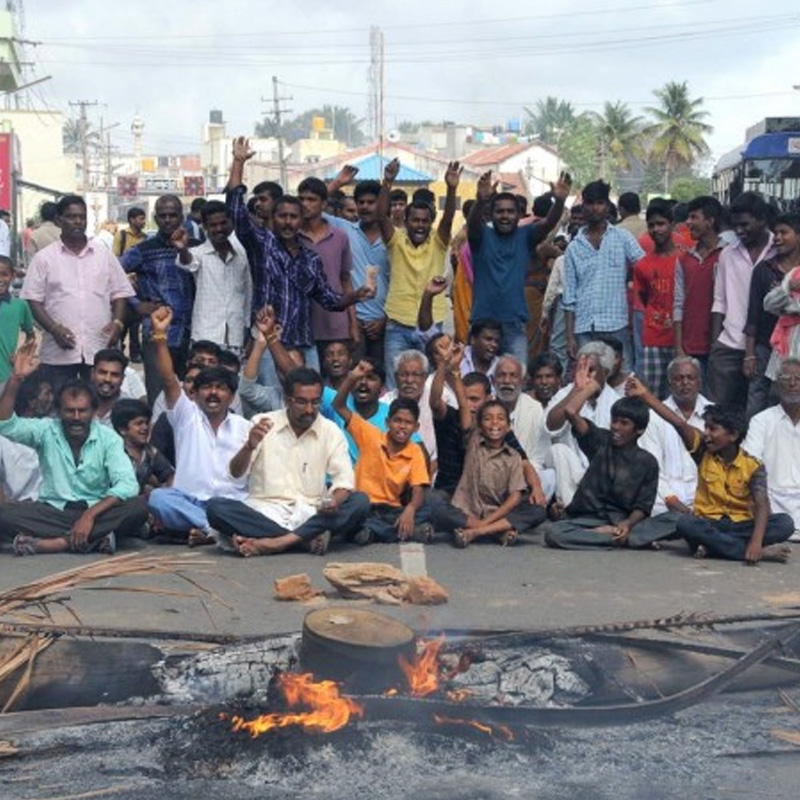
    NEW DELHI: Noting that it had come to its notice that certain television channels had been telecasting provocative news / programmes relating to the Cauvery dispute, the Government on Tuesday evening asked the media to avoid live telecasts or file shots of violence.

    A statement issued by the Information and Broadcasting Ministry said the reportage may use shots of the Cauvery river and security forces. It said news, views or comments relating to the dispute should be telecast only after proper verification of facts and presented with due caution.

    TV channels have been asked to exercise restraint while covering incidents of rioting. Cable TV and satellite channels have been asked not to carry news in such a way that it incites violence. Earlier, I&B Minister M Venkaiah Naidu urged the media to exercise restraint in coverage of such incidents.

    The note issued by Director (Broadcasting) Neeti Sarkar stated that, as per the conditions/obligations of permission / approval for uplinking / downlinking, the channels are bound to follow the Programme Code and Advertising Code prescribed under the Cable Television Networks (Regulation) Act 1995 and rules framed thereunder.

  • Don’t air live Cauvery violence: MIB to b’casters

    Don’t air live Cauvery violence: MIB to b’casters

    NEW DELHI: Noting that it had come to its notice that certain television channels had been telecasting provocative news / programmes relating to the Cauvery dispute, the Government on Tuesday evening asked the media to avoid live telecasts or file shots of violence.

    A statement issued by the Information and Broadcasting Ministry said the reportage may use shots of the Cauvery river and security forces. It said news, views or comments relating to the dispute should be telecast only after proper verification of facts and presented with due caution.

    TV channels have been asked to exercise restraint while covering incidents of rioting. Cable TV and satellite channels have been asked not to carry news in such a way that it incites violence. Earlier, I&B Minister M Venkaiah Naidu urged the media to exercise restraint in coverage of such incidents.

    The note issued by Director (Broadcasting) Neeti Sarkar stated that, as per the conditions/obligations of permission / approval for uplinking / downlinking, the channels are bound to follow the Programme Code and Advertising Code prescribed under the Cable Television Networks (Regulation) Act 1995 and rules framed thereunder.