Tag: cabinet

  • Union cabinet clears AVGC National Centre of Excellence

    Union cabinet clears AVGC National Centre of Excellence

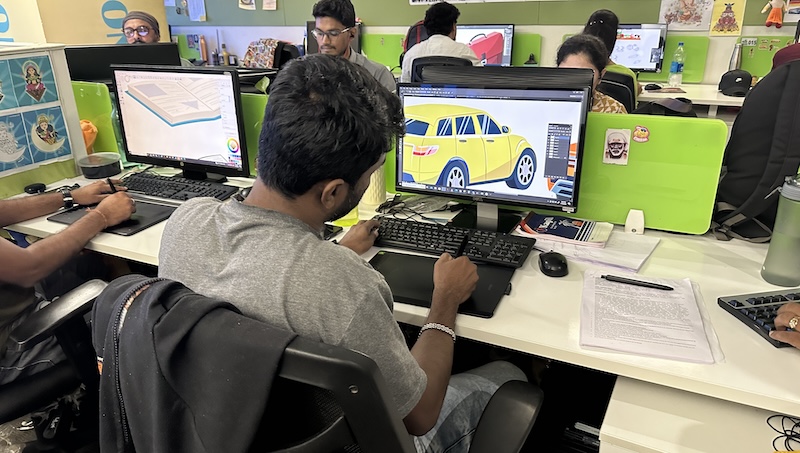
    MUMBAI: The Modi-led central government is putting its might behind the AVGC (animation, visual effects, gaming, comics &XR ) component of the media & entertainment sector. It has followed up its announcement a couple of weeks ago about the setting up of a National Centre of Excellence (NCoE)  in Mumbai by getting the plan cleared by the  union cabinet.

    The NCoE is planned to be set up as a section 8 company under the Companies Act 2013 with equity participation from the Federation of Indian Chambers of Commerce & industry  (Ficci) and the Confederation of Indian Industry (CII) and the Indian government. More than  Rs 500 crore is to be pumped into the centre by the government, possibly through the National Film Development Corporation (NFDC). .

    Provisionally named the Indian Institute for Immersive Creators (IIIC), the center aims to revolutionise the AVGC sector and foster innovation in immersive technologies. It is planned  to be modelled after the Indian Institutes of Technology (IITs) and Indian Institutes of Management (IIMs) with a sharp focus on creating content for India and the world.

    A press release issued by the ministry of information &  broadcasting on 29 September said that the idea is to create “a world class talent pool in India to cater to the Indian as well as global entertainment industry and make India a global hub for AVGC.”

    With rapidly evolving technology and increasing internet penetration all across the country, coupled with one of the cheapest data rates, the usage of AVGC-XR globally is poised to grow at an exponential pace.  This is bound to create abundant opportunities, particularly through the National Centre of Excellence (NCoE).

    Some of its key objectives are:

    * Focusing on creating Indian IP
    * Leveraging India’s cultural heritage in new age
    * Create a multiplier effect in the industry
    * An industry led initiative, in partnership with state and academia
    * Integrated focus on education, skilling industry, development, innovation
    * Hub and spoke model of development to be followed
    * IIIC as the hub and several centers as its spokes dedicated innovation and research fund to promote start-up ecosystem.

    The NCoE is being planned to provide a fertile platform for immersive tech – including virtual reality, augmented reality, mixed reality, 3D modelling, animation, comics and gaming – by offering cutting-edge training and integrate India’s rich cultural heritage with modern technology, fostering the creation of indigenous intellectual property (IP) and building the future of India’s digital creative economy.
    The target is to create an estimated 500,00 jobs,  with students gaining  practical experience through industry-driven courses, ensuring they are job-ready upon graduation. Those graduating will be provided with internships while start-ups will be mentored.  

    It may be recalled that union minister of finance & corporate affairs Nirmala Sitharaman had announced in the 2022-23 budget that an AVGC task force would to created. The NCoE is one of the recommendations of the task force.

  • Cabinet approves MoU cooperation between Prasar Bharati and Radio Television Malaysia

    Cabinet approves MoU cooperation between Prasar Bharati and Radio Television Malaysia

    Mumbai: The Union Cabinet chaired by the Prime Minister, Narendra Modi was apprised of the MoU/Agreement signed on 7 November, 2023 which has an immense potential to strengthen the cooperation in the field of broadcasting, exchange of news, and audio-visual programmes as well as significantly augment India’s friendly relations with the country. With this, the total number of MoUs signed by Prasar Bharati with different countries has increased to 46.

    Prasar Bharati plays a crucial role in nation building and lays continuous focus on providing meaningful and accurate content to one and all, both within the country and abroad. These MoUs are going to be crucial in distribution of content in other countries, in developing partnerships with international broadcasters and exploring new strategies to address the demands of new technologies.

    The major benefit arising out of signing of MoUs are exchange of programmes in the areas of Culture, Education, Science, Technology, Sports, News and other fields on gratis/non-gratis basis.

    India’s Public Service Broadcaster, Prasar Bharati has entered into a Memorandum of Understanding with Radio Televisyen Malaysia, the Public Service Broadcaster of Malaysia in order to promote cooperation in public broadcasting in the field of radio and television.

  • Centre approves amendments in FM Radio Phase-III Policy guidelines

    Centre approves amendments in FM Radio Phase-III Policy guidelines

    Mumbai: The central government has approved the amendments to certain provisions contained in the policy guidelines on the expansion of FM radio broadcasting services through private agencies (phase-III), referred to as the private FM phase-III policy guidelines.

    The decision was taken in a cabinet meeting chaired by Prime Minister Narendra Modi.

    The three-year window for restructuring FM radio permissions within the same management group throughout the licensing duration of 15 years has been eliminated by the government in order to move in this direction.

    The government has also agreed to remove the 15 per cent national cap on channel holdings, which has been a long-standing demand of the radio industry.

    Furthermore, as part of the FM radio policy’s simplification of financial eligibility norms, an applicant company can now participate in bidding for ‘C’ and ‘D’ category cities with a net worth of just Rs 1 crore, as opposed to Rs 1.5 crore previously.

    These three amendments will help the private FM radio industry fully leverage economies of scale and pave the way for further FM radio and entertainment expansion in tier-III cities across the country.

    This will not only create new job opportunities but will also ensure that music and entertainment are accessible to the general public in even the most remote parts of the country through FTA (free-to-air) radio media.

    To improve the ease of doing business in the country, the government has focused on simplifying and rationalising existing rules in order to make governance more efficient and effective, so that the benefits reach the common man.

  • Cabinet approves merger of four film units with NFDC

    Cabinet approves merger of four film units with NFDC

    NEW DELHI: The government has given its nod to the merger of four of its film media units with the national film development corporation (NFDC).

    The decision was taken in the Cabinet meeting chaired by PM Narendra Modi on Wednesday. As part of the plan, the four units namely films division, directorate of film festivals, national film archives of India, and children’s film society, India will now operate under the NFDC, which will then carry out all the activities hitherto performed by them.

    While this will lead to rationalisation of infrastructure and manpower, the government highlighted that interests of employees of all the concerned media units will be fully taken care of and no employees will be retrenched. A transaction advisor and legal advisor will be appointed to advise on the transfer of assets and employees, and to oversee all aspects of operationalisation of the merger.

    “There was a lot of duplication in activities and there was a need to bring synergy. However, all the work which is currently underway at each of the units will remain in progress. Our aim is to ensure good films reach masses,” said Union information and broadcasting minister Prakash Javadekar post the meeting.

    India is one of the largest film producers in the world with an industry led by the private sector. Over 3,000 films are produced every year. After the merger, all promotion, production and preservation of film content will come under one management.

    The films division, a subordinate office of the ministry of information and broadcasting, is among the oldest of the four media units. It was formed in 1948 to produce documentaries and news magazines for publicity of government programmes and cinematic record of Indian history.

    Formed in 1964, the national film archives is mainly responsible for acquiring and preserving Indian cinematic heritage, and the directorate of film festivals, set up in 1973, focuses on promoting Indian films and cultural exchange. The children’s film society, India is however, an autonomous organisation formed under the Societies Act in 1955 to specifically provide children and young people value-based entertainment through the medium of films.

    All the four media units will now operate as one unit under the NFDC – the central public sector undertaking  which was formed in 1975 for planning and promoting an organised, efficient and integrated development of the Indian film industry. “The vision of the new entity will be to ensure balanced and focused development of Indian cinema in all its genres – feature films, including films/content for the OTT platforms, children's content, animation, short films and documentaries,” stated the government.

  • DTH license to be issued for 20 years, 100% FDI allowed in the sector

    DTH license to be issued for 20 years, 100% FDI allowed in the sector

    KOLKATA: The ministry of information and broadcasting (MIB) announced major key decisions for the direct-to-home (DTH) segment on Wednesday. The cabinet has revised guidelines for providing DTH service in India as well as licensing norms.

    I&B minister Prakash Javadekar stated in a briefing that 100 per cent foreign direct investment (FDI) will be allowed for the DTH sector. He also added that the decision was taken earlier by the ministry of commerce and industry but the sector could not avail the benefits due to existing MIB guidelines.

    Moreover, DTH licenses will be issued for 20 years and license fee will be collected quarterly. Further, the period of license may be renewed by 10 years at a time. The cabinet has also approved the sharing of infrastructure between DTH operators. Distributors of TV channels will be permitted to share the common hardware for their subscriber management system (SMS) and conditional access system (CAS) applications. Javadekar said that the decision has been taken to create a level playing field.

    The other salient features of the decision are:

    DTH operators shall be permitted to operate to a maximum of five per cent of their total channel carrying capacity as permitted platform channels. A one-time non-refundable registration fee of Rs 10,000 per platform service channel shall be charged from a DTH operator.

    The cap of 49 per cent FDl in the existing DTH guidelines will be aligned with the extant government (DPIIT's) policy on FDl as amended from time to time. The decision will come into effect as per revised DTH guidelines issued by the ministry of information and broadcasting.

    "The proposed reduction is intended to align the license fee regime applicable to telecom sector and will be prospectively applied. The difference may also enable DTH service providers to invest for more coverage leading to increased operations and higher growth and thereby enhanced and regular payment of license fee by them. Registration fee for platform services is likely to bring a revenue of approximately Rs 12 lakh. Sharing of infrastructure by the DTH operators may bring in more efficient use of scarce satellite resources and reduce the costs borne by the consumers. Adoption of the extant FDI policy will bring in more foreign investment into the country," the government said in a press statement. 

    The authority also added that the DTH sector is a highly employment intensive sector that operates pan-India. It directly employs DTH operators as well as those in the call centres, besides indirectly employing a sizeable number of installers at the grass-root level. The amended guidelines, with longer license period and clarity on renewals, relaxed FDI limits, etc will ensure a fair degree of stability and new investments in the DTH sector along with employment opportunities.

  • Cabinet approves 26 per cent FDI in digital media

    Cabinet approves 26 per cent FDI in digital media

    MUMBAI: As the cabinet government amended the foreign direct investment (FDI) policy, it has also given the nod to 26 per cent overseas investment in digital media with government approval.

    "The extant FDI policy provides for 49 per cent FDI under approval route in up-linking of ''news & current affairs'' TV channels. It has been decided to permit 26 per cent FDI under government route for uploading/streaming of news and current affairs through digital media, on the lines of print media," an official statement said.

    While the FDI policy has not touched digital media for a long time, the cap has been introduced along the lines of print media where 26 per cent FDI is allowed through government approval route.

    “The scope of the impact will be determined by the wording of the provision in the FDI policy. News and current affairs are present on social media platforms, on digital platforms that are subsidiaries of foreign brands etc. How would you differentiate between TV channels which have 49 per cent and their online streams, which will effectively have 26 per cent?” Eros International group chief marketing officer Manav Sethi commented.

    The previous time when FDI norms in media were relaxed was in November 2015 to attract overseas funds. The FDI limit in news channels and private FM radio was raised to 49 per cent,up from 26 per cent, while 100 per cent foreign investment was allowed in entertainment channels.

    “FDI in digital media is a welcome development. Clarity around this fast-growing segment of the media industry will act as an enabler for capital infusion. Significant value will be unlocked going forward,” Deloitte partner Jehil Thakkar commented.

  • Government has no intentions to impose any regulations on the media: Javadekar

    Government has no intentions to impose any regulations on the media: Javadekar

    NEW DELHI: Newly appointed Information and Broadcasting Minister Prakash Javadekar said today that freedom of the press is the cornerstone of a democracy and his first aim in his new portfolio will be to find ways to strengthen this freedom.


    Speaking soon after taking charge of his portfolio, the Minister said that the media and politicians must work together to highlight the problems of the people and bring them before the government.


    Describing himself as ‘just a soldier’, he said he had always stood for freedom of the press and had suffered a 16-month imprisonment during the national emergency in 1975 in this fight as he belongs to a family of journalists.


    Noting that the press has conducted itself in a responsible manner and set up self-regulatory bodies, he said the government would not impose any regulations on the fourth estate.


    The media in its present form gives a ‘rainbow of choices’ and even dissent has its own place in a democratic system of functioning. Constructive criticism is therefore welcome.


    Asked about the frictions with Prasar Bharati, Javadekar said he had not had time to study the issues yet but would like to work in partnership with all the autonomous media units including Prasar Bharati.


    He said in reply to a question that he did not agree with his immediate predecessor that there was no need for an Information and Broadcasting Ministry in the present context.


    Referring to social media, he said that while it presently came under the Information Technology Act, but he would study it and see how it can be helped. He said he would meet all the officials of the Ministry, understand the issues involved and then make some suggestions to the Prime Minister.


    Soon after meeting the media, he met senior officials of the Ministry and also media units, apart from Prasar Bharati CEO Jawhar Sircar and Director of Film Festivals Shankar Mohan.


    Contrary to expectations, Prime Minister Narendra Modi has not upgraded the post of Information and Broadcasting to cabinet rank.


    Like his immediate predecessor Manish Tewari, Javadekar will be a Minister of State with independent charge of Information and Broadcasting Ministry. (He has also been given charge of Environment and Parliamentary Affairs). However, he has ample experience as far as dealing with the media and its problems are concerned, since he like Tewari has served as party spokesperson for the past few years.


    Javedekar has also been one of the nominated members from Parliament to the Press Council of India and hence has dealt with media issues such as paid news. A member of the Rajya Sabha from MaharashtraJavadekar was born in Pune on 30 January 1951 and became associated with the Akhil Bharatiya Vidyarthi Parishad in his young days.


    He commenced his professional life as an employee in the Bank of Maharashtra for 10 years from 1971 to 1981 and also worked in the Rural Development Department.


    His father Keshav Krishna Javadekar was a senior leader of Hindu Maha Sabha who worked as joint editor of Marathi Daily started by Lokmanya Tilak – Kesari before having stints with some other newspapers like Tarun Bharat and Kaal as journalist. He still occasionally writes his thoughts in some newspapers.


    Javadekar has been president of GLOBE India (Global Legislators Organisation for Balanced Environment); In-charge BJP Economic Forum and Cells related to Economy; President, NOINO (National Organisation of Insurance Officers) and president, KCKU (Khadi Commission Karmachari Union).


    As a member of Parliament, he has served as member of the Press Council of India; the Public Accounts Committee; Standing Committee on Human Resources and Development; Consultative Committee for Ministry of Power; Committee on Subordinate Legislation and Committee on Wakf.


    He has earlier served as executive president of the State Planning Board in Maharashtra (1995–1999); been a  member of the Maharashtra Legislative Council from Pune Division Graduate Constituency for 12 years from 1990; chairman of the Task Force on IT in Maharashtra (1977–1999) and chairman of the Working Group on ‘IT for Masses’ of the central government.


    He has also led a delegation to Boston to negotiate Media Lab Asia Project in 2000.

  • PM swearing in ceremony gets global reach through television and social media

    PM swearing in ceremony gets global reach through television and social media

    NEW DELHI: In a dignified function rarely seen, Indian television channels today globally beamed live the swearing in of Narendra Modi as the fifteenth Prime Minister of the country, along with his team of 44 Ministers and Ministers of State.


    Around 4,000 people including all the leaders of the SAARC countries and Mauritius were present in the front courtyard of Rashtrapati Bhavan where President Pranab Mukherjee swore in the Prime Minister and his team.


    Apart from the stars of Bollywood who have made it to the portals of Parliament House, others who were present included Anupam Kher, Dharmendra, Salman Khan with father Salim Khan, Bappie Lahiri, Suresh Oberoi and Vivek Oberoi.


    The winning stars seen at the ceremony included Vinod Khanna, Manoj Tiwari, Smriti Irani and Hema Malini.


    While all television channels were allowed to come to Rashtrapati Bhavan and were stationed at the back of the entire assembly, only Doordarshan was permitted to beam the oath taking ceremony from close quarters.  


    As a result, most channels beamed the ceremony by taking the feed from Doordarshan, though many had their own commentators and experts who spoke about the various persons as they were sworn in.


    While channels like Times Now preferred to show the commentary by Doordarshan’s Sanjeev Upadhyaya and Gaura Lal Dhawan before and after the swearing in, several other channels like NDTV 24×7 showed the visuals from DD but had its own experts speaking about each person as he/she came up to take the oath.


    DD, which had the live coverage on its national channel and DD News, also made arrangements for simultaneous translation into sign language for the hearing impaired. The live telecast was also beamed live on DD’s website and its channel on YouTube, President Pranab Mukherjee’s site presidentofindia.nic.in and on the Prime Minister’s website pmindia.nic.in.


    The telecast commenced around 40 minutes before the ceremony commenced, showing the arrival of various VIPs and leaders of different parties,  including Sonia Gandhi and Rahul Gandhi. 


    The last time that ceremonies of this nature – though smaller magnitude – were held in the front courtyard of Rashtrapati Bhavan was in 1990 and 1998 when Chandrashekhar and Atal Behari Vajpayee were sworn in as Prime Ministers.


    However, this was the first  time since 1991 (when Rajiv Gandhi was cremated) that all the SAARC leaders were seen together in India.


    Modi, who has been tweeting throughout the campaign and even after being elected, used the opportunity to send out a message to the people and the media through the Prime Minister’s website, pmindia.nic.in.


    Referring to the social media and the internet, he said: “I envision this website as a very important medium of direct communication between us. I am a firm believer in the power of technology and social media to communicate with people across the world. I hope this platform creates opportunities to listen, learn and share one’s views. 

    “Through this website you will also get all the latest information about my speeches, schedules, foreign visits and lot more. I will also keep informing you about innovative initiatives undertaken by the Government of India.” 


    A section has been inserted on the website to greet the Prime Minister or send him a message.


  • There  is no Plan B for TAM if we lose our appeal in court: Kantar’s Eric Salama

    There is no Plan B for TAM if we lose our appeal in court: Kantar’s Eric Salama

    The Indian television industry is possibly heading towards a crisis of an audience ratings blackout. TAM Media Research, a joint venture between Nielsen (India) and Kantar Media Research, is currently the only agency that provides television audience viewership measurement services to advertisers and broadcasters.


    TAM has hit a roadblock in India with the government issuing policy guidelines for television ratings agencies in mid-January. It has an impossible deadline of mid-February to ensure that the shareholding in TAM is in accordance with the new policy guidelines.


    Apart from having substantial (more than 10%) stakes in TAM, the joint venture partners in the Indian television ratings provider also own advertising agencies in India, which is prohibited in the policy guidelines’ cross-holding norms.


    Nielsen appears to have taken a back seat and decided to let Kantar lead the challenge against the government’s new regulations and  let TAM face the situation as it develops


    Kantar has filed a petition in the Delhi High Court to get a stay on the shareholding norms specified in the guidelines or at least get an extension on the deadline for meeting meet the norms. There’s less than a fortnight left for TAM to comply with them, and it does not like its shareholders will be able to do so in the short time that was given to them.


    The launch of television audience measurement by Broadcast Audience Research Council (BARC), an initiative of advertisers, advertising agencies and broadcasters in India, is likely only by October this year.


    If Kantar fails to get some relief from the court, TAM will have to stop releasing audience ratings by mid-February which will obviously result in the absence of viewership being metered and measured till BARC is ready with its own services. And that is something which is giving both advertisers and agencies palpitations. Television audience ratings is a key input based on which advertisers base their advertising plans on.


    In order to understand what the situation is and what could unfold, indiantelevision.com’s Vishaka Chakrapani spoke to Eric Salama, chairman and CEO of the Kantar group since 2007. Salama has been with global advertising agency WPP, the owner of Kantar, since 1996.


    During the interaction, Salama rued that television ratings has become a matter of public debate and a “cricket ball” for everyone to hit. Excerpts:


    How different is it operating in India as compared to other countries when it comes to television ratings?


    We operate in most countries with the exception of Iran, Cuba and North Korea.  We’ve never had problems in India before, IMRB is the oldest research agency in Asia and we see India as a key market for us going forward.  We have some of our most talented people here.  The TV ratings market is very different to other markets in that it has become a source for public debate and a cricket ball for people to hit.


    How do you see TV ratings agencies progressing in India?


    We’ll know soon enough!


    Do you believe a ratings blackout is likely to happen? What could happen in such a scenario and how will the industry respond?


    Unless the court rules in our favour on cross ownership, we are heading for a blackout which will be extremely damaging to broadcasters, programmers, agencies, advertisers and everyone who cares for the Indian media industry.


    Do you think there is space for two ratings agencies to coexist?


    It happens in some markets such as Philippines but it’s extremely rare as the industry generally wants one currency for trading.


    I believe TAM has also applied to BARC for panel management in the industry-driven television ratings service. How do you see your relations with BARC taking shape?


    Once BARC is established, TAM will either be a supplier to them for some services or not.


    Should the sample size for arriving at television ratings be far bigger?


    If people wanted us to expand our sample to 20,000 we would.  When BARC is established it will be up to them to decide what they do.


    Accusations have been hurled at TAM and its credibility has been questioned. Do you think TAM has been judged wrongly?


    Some of the comments have been libellous. Many of them have been poorly informed.  TAM has performed extremely well for a long period in a very difficult environment and under huge pressure.


    What is the plan B if TAM is not allowed to function?


    There is no plan B.