Tag: Budget 2020

  • News viewership grew by 60% during budget speech

    News viewership grew by 60% during budget speech

    MUMBAI: The biggest financial event of the country—Budget 2020 — has helped news channels, especially business news channels across segment to increase their viewership substantially, a data from Broadcast Audience Research Council (BARC) says.

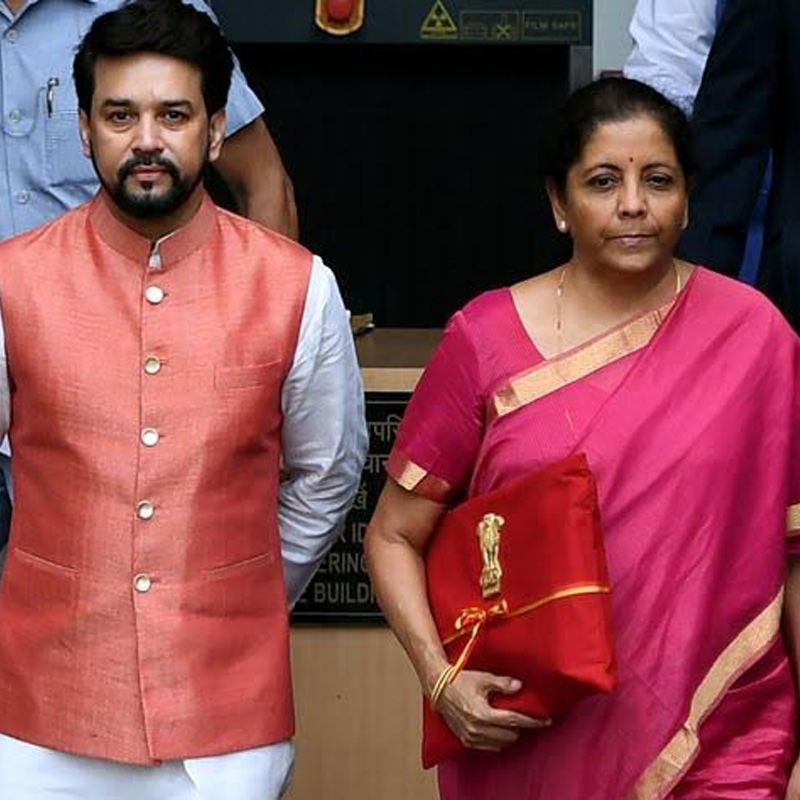
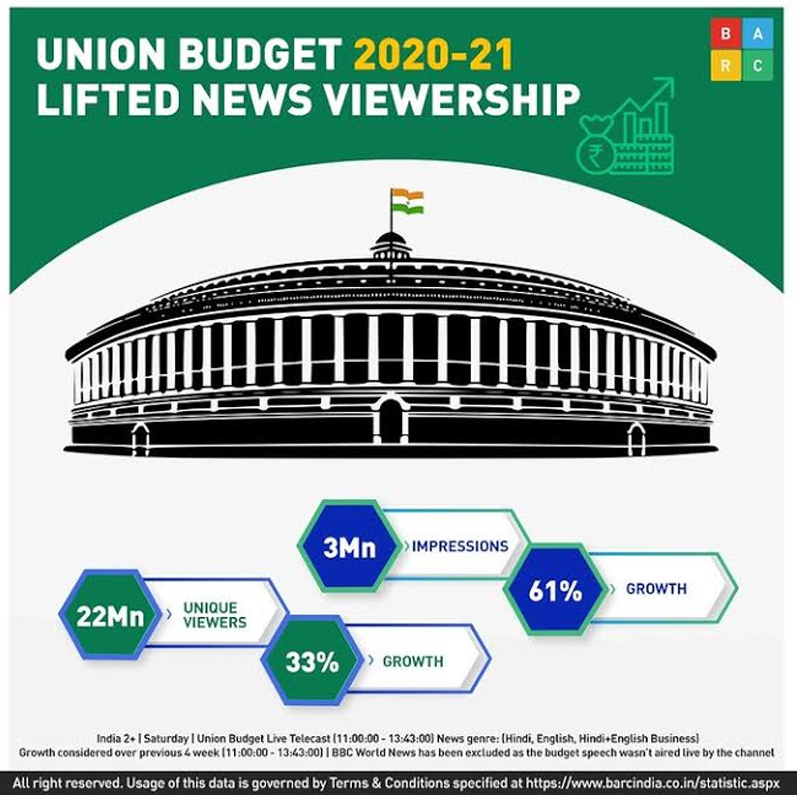
    Union finance minister Nirmala Sitharaman gave the longest budget speech from 11 am to 1.43 pm on 1 February. The Hindi, English and Hindi+English business news channels recorded a rise of over 60 per cent to 3 million impressions during these 2 hours and 43 minutes.

    Moreover, at least 22 million eyeballs of unique viewers were glued to the screen of business news channels across genre, which posted growth of over 30 per cent.

    BARC on its official twitter handle mentioned: “During #Budget2020, Indian news viewership saw an impressive growth with regards to impressions and unique viewers!”

    The budget viewership was recorded during week 5 of BARC that was compared to the same time slot of week 4 of the weekly impressions. BARC in its Twitter post said: “The growth in impressions were considered over the previous week 4 during the same time period from 11 am to 1.43 pm.”

    The audience measurement body also said in its micro-blogging post that BBC World News has been excluded as the budget speech wasn’t aired live by the channel.

    Despite Budget 2020, the viewership of general news channels across genre were slowed down in week 5 (1-7 February) as compared to week 4 (25-31january), the BARC mentioned on its website.

    However, the budget being the most important event for the business news channels, both CNBC TV18 of Network18 group and ET Now of Times News Network, in the English category, grew by over 100 per cent to 727 and 266 weekly impressions in week 5 respectively.

    The Reliance group-owned business news channel, CNBC TV18 being the leader in the business news channel in week 4 had garnered 275 weekly impressions. On the contrary, ET Now had received 123 weekly impressions in week 4.

    In the Hindi business news category, both Network18’s CNBC Awaaz, and Zee Entertainment Enterprise’s Zee Business grew by 21 per cent and 41 per cent respectively during Budget week. The former garnered 2492 weekly impressions, whereas the latter settled at 2131 impressions in week 5 as compared to 1965 and 1249 impressions in week 4 respectively.

    Week 5 was considered to be weak compared to week 4, as it had no major important event for news channels to keep viewers engaged except for the Budget 2020 and Delhi poll campaigns that concluded on February 6. Whereas, week 4 had seen many national importance events such as Republic Day, Delhi Assembly poll campaigns, and the Shaheen Bagh firing. 

  • All news channels, except biz news, see viewership slump in BARC week 5

    All news channels, except biz news, see viewership slump in BARC week 5

    MUMBAI: Despite the biggest financial event in the country – Budget 2020, the viewership of news channels of across genre, except business news channels, slowed down in week 5 (1-7 February) as compared to week 4, according to the data released by Broadcasting Audience Research Council India.

    Week 4 (25-31 January) had seen many national importance events such as Republic Day, Delhi Assembly poll campaigns, pre-budget preparation, and Shaheen Bagh firing. The news channels across genre had buzzing news information almost every day during week 4 of BARC.

    Hindi News

    The TV Today Group’s Hindi news channel Aaj Tak, leading the race in the viewership in the Hindi category, has retained its position at the top among peers. However, the viewership of the channel has dropped by 12.3 per cent to 117478 weekly impressions in week 5 as against 133942 in week 4.

    In week 5, news channels had no major or national importance event except budget 2020. However, the Delhi poll campaign being one of the buzzing events was concluded by the evening of 6 February as per the model code of conduct of Election Commission of India.

    Not just Aaj Tak, in the Hindi news segment, all other channels featured in the list of the week 5 saw a slump in viewership pattern as against week 4’s viewership. Zee News maintaining its second spot in the list of week 5 fell by 8 per cent to 97652 weekly impressions as compared to 106097 impressions in week 4.

    Moreover, News18 India, which also retained its spot on the third position, saw a drop by 5.2 per cent to 95139 weekly impressions in week 5 versus 100395 impressions in week 4. Whereas India TV maintaining its fourth position but fell by 3.3 per cent to 88477 weekly impressions as compared to 91481 weekly impressions in week 4.

    Replacing Republic Bharat, ABP News has bagged the fifth spot in the list of week 5 with weekly impressions of 87015. However, Republic Bharat tried to clinch a fifth spot in the urban segment of Hindi news channel with 51613 weekly impressions in week 5.

    English News

    In the English news category, Republic TV has maintained its lead in week 5, however, it slumped by over 12.5 per cent to 654 weekly impressions as compared to 749 impressions in week 4. Despite out throwing DD India from second spot, Times Now has also dropped by 3.3 per cent to 515 weekly impressions in week 5 compared to 534 impressions in week 4.

    Meanwhile, India Today Television, taking Times Now last week’s spot, has dropped by 17.7 per cent to 303 weekly impressions in week 5 versus 368 impressions in week 4. Moreover, DD India falling to fourth position this week has substantially dropped by 74.6 per cent to 181 weekly impressions in week 5 as against 713 impressions in week 4.

    DD India, a government-owned news broadcaster, was able to gain exponential impressions in week 4 due to 71st Republic Day event, which was authorised to show the exclusive footage of the event and also share it with other news channels by giving give courtesy to DD India.

    Similarly, CNN News18 maintaining its position at the last spot but also fell substantially by over 30 per cent to 163 weekly impressions in week 5 as compared to 237 weekly impressions in week 4.

    Business News

    Budget being the most important event for the business news channels, Both CNBC TV18 of Network18 group and ET Now of Times News Network, in the English category, grew by over 100 per cent to 727 and 266 weekly impressions in week 5 respectively. CNBC TV18, leading between the two, had garnered 275 weekly impressions and ET had achieved 123 weekly impressions in week 4.

    Similarly, in the Hindi business news category, Both CNBC Awaaz and Zee Business grew by 21 per cent and 41 per cent respectively. The former garnered 2492 weekly impressions, whereas the latter settled at 2131 impressions in week 5 as compared to 1965 and 1249 impressions in week 4 respectively.

  • Financial experts decode Budget 2020 at CNBC-TV18’s Townhall

    Financial experts decode Budget 2020 at CNBC-TV18’s Townhall

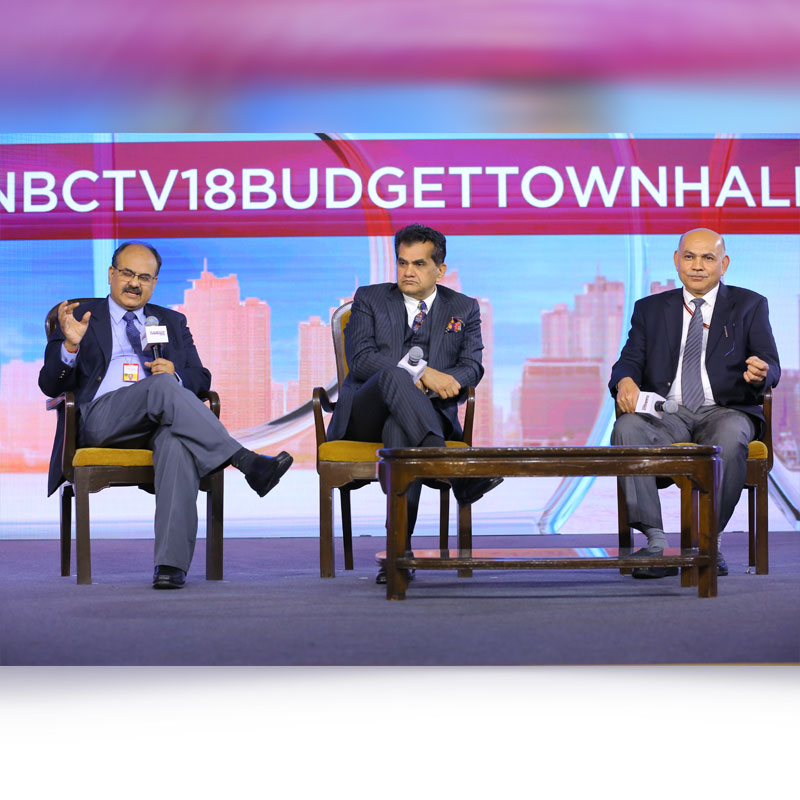
    MUMBAI: English business news channel — CNBC-TV18 of Network18 group held The Budget Townhall 2020 to analyse and have an open dialogue on the announcements made by the union finance minister Nirmala Sitharaman.

    The fourth edition of the townhall witnessed economic and financial stakeholders come together in New Delhi to offer their expert perspective and decode the biggest economic policy event in the country.

    The townhall panel moderated CNBC-TV18’s managing editor Shereen Bhan, comprised of policy architects and financial stakeholders such as NITI Aayog chief executive officer Amitabh Kant, revenue secretary Ajay Bhushan Pandey, CBIC member tax policy Dr John Joseph, CBDT chairman Pramod Chandra Mody, expenditure secretary TV Somanathan, chief economic advisor Dr. Krishnamurthy Subramanian, DPIIT chairman Guruprasad Mohapatra, DIPAM secretary Tuhin Kanta Pandey, finance secretary Rajeev Kumar among others. The closing address at the townhall was given by IDFC FIRST Bank managing director and chief executive officer V Vaidyanathan.

    The luminaries, together on a common platform, shared their in-depth analysis while evaluating the big-ticket announcements made across sectors.

  • Budget 2020: I&B Ministry allocation raised by over Rs 310 crore this fiscal

    Budget 2020: I&B Ministry allocation raised by over Rs 310 crore this fiscal

    MUMBAI: Union finance minister Nirmala Sitharaman in her second budget announced Rs 4375.21 crore for the Ministry Of Information And Broadcasting (MIB) for the financial year 2020-21, Press Trust of India report said. The revised budget estimate for the last fiscal was Rs 4064.76 crore.

    The finance minister has increased the funds to MIB by Rs 310 crore over the previous fiscal year. The allocation for Prasar Bharati has remained at Rs 2889.36 crore, same as the revised estimate of last financial year.

    The allocation, in the budget, for broadcasting under the social services has been upped to Rs 3218.56 crore from Rs 3067.26 crore in FY20. Meanwhile, a total of Rs 967.29 crore is allocated for information and publicity.

    The minister raised the allocation for the Film and Television Institute of India (FTII), Pune to Rs 49.4 crore from Rs 30.87 crore in 2019-20, and has doubled the Indian Institute of Mass Communication (IIMC) funds to Rs 61.30 crore in FY21 from Rs 25.69 crore in the last fiscal.

    Hailing the budget 2020 as most pragmatic, union information and broadcasting minister Prakash Javadekar said that India has not only managed a good growth rate but is also marching towards a better rate, adding that the budget will usher in all-round development.

  • Budget 2020 proposals offer few benefits to M&E industry: EY India

    Budget 2020 proposals offer few benefits to M&E industry: EY India

    MUMBAI: As always, the industry's hopes from union budget 2020 were high. According to a report from EY India while the budget proposals offer few benefits to the industry, some of the changes may have a material impact which will need to be assessed.

    “The budget proposals will provide relief to the foreign companies earning income such as license fees from making compliances in India, provide clarity and do away with avoidable tax litigation through reduction in withholding tax rate for technical fees as well as withholding tax provisions for e-commerce operators. New media and digital business qualifying under start up incentives will get additional impetus from the measures proposed. Reduction in newsprint import duties will help print industry which is going through a tough business cycle. Tax amnesty scheme for resolution of pending litigation offers an opportunity to reassess the tax game in the country,” the report adds.

    The report states that the proposed alternate personal tax regime will be relevant to mass employment by the industry in its content production processes, however, it is difficult to determine whether the regime will provide a material differential cash surplus to the employed.

    It also adds that expansion of domestic tax regime will lead to tax uncertainty for foreign companies with no resource to any credible advance ruling mechanism which will allow them to understand their tax position upfront.

    “Removal of exclusion relating to theatrical receipts would certainly put pressure on the finances of the film businesses with a 10 per cent withholding tax rate and increase their compliance burden. The uncertainty attached to film business certainly makes a strong case for a rate much lower than applicable 10 per cent withholding tax rate. Increase in import duties will lead to increased cost for businesses,” it adds.

    Key impacts:

    ·  Withholding tax rate on “fees for technical services” reduced from 10 per cent to 2 per cent, reducing potential litigation on withholding tax rate on content production services and certain other services which do not qualify as “professional services”.

    ·  Exclusion of consideration from “sale, distribution or exhibition of cinematographic films” removed from “royalty” definition that may make theatrical and other receipts from exploitation of cinematographic films taxable and subject to withholding tax at 10 per cent.

    ·  Expansion of domestic source rule will bring to tax income of a nonresident from (i) advertisements targeted at a customer located in India

    (ii) sale of data collected from a person in India and (iii) sale of goods or services using data of customer located in India.

    ·  The list of services subject to Equalisation Levy provisions remain unchanged.

    ·  Exemption provided to non-residents earning royalty and fees for technical services from the requirement of filing a return of income, subject to fulfilment of stated conditions.

    ·  Relief provided d to the print industry by reduction in customs duty on newsprint and paper.

  • Budget 2020: BharatNet boost to have positive impact on OTT platforms

    Budget 2020: BharatNet boost to have positive impact on OTT platforms

    MUMBAI: While the media and entertainment industry is heading towards a digital future on the back of streaming services, budget 2020 seems to bolster it. Finance minister Nirmala Sitharaman on Saturday proposed to allocate Rs 6,000 crore for the BharatNet programme in 2020-21. The boost to broadband connectivity in rural areas is making OTT platforms hopeful about uptake in online video consumption.

    "Our vision is that all public institutions at the gram panchayat level such as anganwadis, health and wellness centres, government schools, PDS outlets, post offices and police stations — all will be provided digital connectivity. The fibre to the home (FTTH) connection through BharatNet will link 100,000 gram panchayats this year itself," Sitharaman said.

    ALTBalaji CEO Nachiket Pantvaidya appreciates the step to promote digital connectivity through its BharatNet programme and connecting 100,000-gram panchayats through optical fibre network. According to him, this is one more important step taken in the direction of achieving the vision of a digital India where rural India gets placed on the digital map.

    The over-the-top platforms are heavily reliant on internet connectivity for better penetration. Moreover, numerous industry experts and reports have suggested that tier II and tier III cities, rural areas are the next frontier of growth for OTT platforms. Hence, the move will help them to expand more in those markets.

    "We appreciate the efforts of the government to boost the digital ecosystem in the country. The increased focus on improving connectivity under the BharatNet scheme and the emphasis on artificial intelligence will allow OTT players to offer bespoke and personalised solutions to consumers. Additionally, the impetus to the smartphone manufacturing industry will make internet consumption accessible to a wider section of Indian society that will expand the scope of revenues for OTT players. The allocation of Rs 8,000 crore for setting up the National Mission on Quantum Computing and Technology will also boost the development of the industry by making resources cost-effective," Gaana CEO Prashan Agarwal stated.

    “It is now a cliché – “data is the new oil” and it is true that analytics, fintech and internet of things (IOT) are changing the way we deal with our lives. To take advantage of this, I propose to bring out soon a policy to enable the private sector to build Data Centre parks throughout the country. It will enable our firms to skillfully incorporate data in every step of their value chains,” Sitharaman added.

    White Rivers Media chief executive officer and co-founder Shrenik Gandhi said that data and digital occupied the centre piece of the budget. He added that the focus on IoT, Data Parks, AI shall make India a strong contender amongst the top digital economies, globally and the ambitious fibre to home proposal should get the next 100 million in the digital universe soon.

    “75 per cent of the users that come on to the internet for the first time between now and the next few years are going to come from tier II and tier III cities as per various industry reports and the vast majority of them are regional language native speakers who don’t necessarily converse in English or Hindi as their language of preference. Anything that is done to bring them to the digital foray essentially allows regional platform like Hoichoi to influentially expand the addressable user base over time and this is a welcome move. Next set of users are to be brought in the digital fold and it not just the combination of digital apps that will benefit from this, it’s also the  information and social media apps that will benefit from wider availability of the internet at the grassroot level,” Hoichoi co-founder Vishnu Mohta commented.

    "Budget 2020's revised fiscal deficit target of 3.8 per cent of the GDP seems more realistic and focus on spends/ benefits was required to boost the economy. The thrust on entrepreneurship and tax regulations for both, startups and taxpayers is a move in the right direction. India is the third largest startup hub globally and the announcement of an investment clearance cell to provide end-to-end support to startup founders will encourage more youth to be job creators. Further, the ability to defer taxes on ESOPs will democratise wealth creation for startup employees, ensuring the right talent is benefitted. Finally, the decision to grant 100% tax exemptions to sovereign wealth funds on their investment in priority sectors will provide the much needed funding boost to the sector and create value in the longer run,” Pocket Aces VP of Finance and Operations Kunal Lakhara said.

  • Industry’s expectation from union budget 2020

    Industry’s expectation from union budget 2020

    MUMBAI: Amid ongoing economic tension in the country, finance Minister Nirmala Sitharaman is all set to present her second Union Budget on 1 February 2020.

    It is expected that Budget 2020-21 will put the economy back on track. One of the biggest challenges before the Modi government is to have a plan of action to combat the decreasing growth rate of the country. As the nation waits for the announcements, we spoke to industry experts, strategists and financial experts to know what they expect from the union budget.

    Although there won’t be any direct impact of union budget on the television industry, the economic boost in other sectors like FMCG, automobiles, retail, etc., could add to the pocket of consumers to spend more and lead to more advertising. Experts are expecting some kind of relief in these sectors so that there could be better ad growth.

    Apart from this, experts are also expecting some reduction in GST on cable and internet bill. Currently, 18 per cent GST is added on cable and internet bill and industry wants that to be brought down to 5 per cent.

    Read what people have to say:

    Maharashtra Cable Operators Federation president Arvind Ramesh Prabhoo 

    “We are expecting a reduction in the GST that is being levied on cable television because under the new NTO what we have seen is that the rates have not decreased which was envisaged by TRAI. According to the new NTO, they are expecting the cable operators and the DPOs to give a discount of 60 percent to the second television set but nowhere has the government said we will reduce the GST. We have been stating this now for a very long time that the GST should be reduced from 18 percent to 5 percent. Also what we are expecting is that on the goods of cable television and equipments of fiber to the home (FTTH)  if it is imported there should be a duty deduction or if it is being manufactured in India then there should be a reduction in GST for at least five years. So overall on the entire equipment required for fiber to the home to be incentivised there should be less taxation.”

    Zee Media Corporation Limited former managing director Ashok Venkatramani

    “The biggest worry for everyone is whether the government will use this opportunity to seek some of the issues in the Indian economy so that business starts picking up. The overall industry is feeling the effects of economic slowdown because people are not spending. So it is not what the budget does for the television industry as much as it does for the overall economy to bring income flow. I am not expecting a huge structural change in the media industry because the largest part of our issues is governed by TRAI. However, television industry will gain a lot mainly when the revenue starts pumping in and for that to happen we will have to look at how consumption grew, whether it is FMCG or retail and for that. If government could do something to put more money in the pocket of average Indian to spend the consumption will grow up and automatically brands will start advertising more.”

    UCN Cable Network head  of operations Debashis Mohanty 

    “We need GST to be 5 per cent flat. Apart from the GST, I don’t think so there is going to be an exemption in NTO and NTO 2.0. The industry is in a dilemma as the changes proposed in NTO and NTO 2 have not been implemented yet.”

    SBICAP securities head of institutional equity research Rajiv Sharma

    “I don’t think so there is going to be any direct announcement because you have separate regulators and separate policies for it but what has happened is any cut in income tax or any measures to boost the economy will have a positive impact on the ad growth which has taken a toll in the last 18 months. Any measure to boost tourism or give any announcements on the film making side if possible will result in a lot of employment directly and indirectly. Any policy that could bring down the cost of production of films or some relaxation to shoot outdoors will help in revenue generation. Beyond this I am not expecting anything from the media industry perspective.”

    GTPL Hathway  vice president Yatin Gupta

    Hope that government sometime soon should cut down GST on the cable industry. There should be relaxation in customs which impacts our industry.

    Elara Capital vice president- research analyst media Karan Taurani

    "The economy is already in a dry state, there are no major expectations from the budget as such. However, for the television industry, there could be some financial stimulus that can boost the consumer derivative. There is also the expectation in the GST cut as FMCG market place almost 35 percent of the overall aspect of the entire pie and for TV it is around 55 per cent which is quite a sizeable number. So, there should be some kind of relief for the FMCG sector that can lead to better sales growth and then it could turn into a better advertisement growth. This year FMCG TV advertising has been low on the television portion. There is a contribution of nearly 50 percent from the FMCG vertical so some kind of a revival there will lead to better ad growth. Because next year industry ad growth is expected to rise by 8 per cent for the TV industry so if some funds are diverted towards that segment, certain relaxation or some GST cut will certainly help. Rural demand is taking a major hit; it has seen a sharper volume decline as compared to urban decline. So some kind of measures to bring rural demand on track will have a big impact on advertisement growth.”

    Enterr10 Television co-promoter Fakt Marathi Shirish Pattanshetty 

    “If there is q deduction in the personal income tax maybe there should be additional flow in the market in terms of improving business. It might help FMCG companies and other companies to start spending on advertising which will help the industry to get out of the current scenario. While there is the discussion on NTO and NTO 2.0 what government can look at is how they can reduce the 18 per cent GST in the base price of Rs 130 to get it to 5 percent of tax. So, that while we are working so hard to get the consumer pricing down why not the GST pricing also should be reduced on cable and DTH base subscription. On the free channels, they are welcomed to charge 18 per cent but at least at the base price if they can amend anything it might help the cable industry. Also, I believe corporate taxes have already been reduced as a boost but none of the companies are using the corporate tax reduction for outflows. They are using this tax benefit to be more profitable so that they can get a better dividend. The ultimate solution could be the reduction in personal income tax which might help the end-user to use the additional funds for consumption purposes.”

    Madison media vice president Vandana Ramkrishna

    “My expectation from the union budget 2020 will be being dynamic reforms to increase consumption and drive demand. Simplify and liberalise laws that help companies source international funding. Also, educational tax benefits need to be enhanced so that the country is able to upskill. Over and above this rationalisation in GST for electronic media is something that has been in the ask for a while.”

    White Rivers Media chief executive officer and co-founder Shrenik Gandhi

    "India maintained its tag of being the world’s fastest-growing economy, despite grim global projections in 2019 as per IMF, which also projected India’s growth rate at 7 per cent in 2020. This bears testimony to its potential of spearheading global economic growth. Budget 2020 is, therefore, Sitharaman’s opportunity to make a difference not only to Indian but also the global economy. One of the key accelerators to this will be enhancing the net disposable income, which is directly proportional to the income tax cuts, affecting the demand for goods and services, finally snowballing into economic growth or slowdown. Budget 2020 should therefore, focus on expenditure boost by lowering the personal tax rates, leading to higher savings, to pump the economy."

    Alchemy Group CEO Karan Gupta

    "With Modi government 2.0 we hope to see support for Digital 2.0, after significant growth in digital penetration and digital literacy in the country, it's now time for the government to focus more on Tier 2/3 and rural sectors. From more internet penetration to better IT Infra and connectivity empowering the new consumer with content and commerce across categories. Working towards a Digital India dream we hope to see some support for digital-first businesses and other ones that are focused on making the life a consumer more convenient and fulfilled no matter where they are based."

    Digitalabs CMO Agam Chaudhary

    “It’s a near ritual for every industry to expect measures for monetary relief from the annual budget. However this year I’d want to make an exception and expect measures that revive the economy as a whole. Our revenues are tied with both demand and supply ends of consumption. If they have robust growth, so shall we.”

    Pixel Pictures  founder and CEO Prashanti Malisetti

    "Production industry is a labor-intensive field. The entrance of OTT platforms like Netflix and Amazon Prime have changed this industry drastically. We have an opportunity to create new forms of content and explore new genres. It would help to have some incentives to create a different kind of awareness content. The consumption of video content is increasing at a rapid rate and we need to encourage more talent in this industry. Incentives to film schools and students of visual arts would be encouraging."