
Tag: Bruce Almighty

  • Columbia Tristar encourages film exhibitors to reach for the stars

    Columbia Tristar encourages film exhibitors to reach for the stars

    MUMBAI: It does not get any bigger than this. Join us as we light up screens and earn rewards. That in a nutshell was the message that Columbia Tristar had for the strong gathering of motion picture exhibitors last evening. 

    The company had organised an exhibitors’ convention for the western region at Powai, in North Mumbai, to promote its wares and launch a programme “Reach for the stars”.

    The programme, which will be done online, gives exhibitors the chance to win points through five criteria. They are – sales increase, box office reporting, outstandings, display and promotions. The contest is open to all exhibitors and the criterion to win prizes is that the theatre should have done a minimum business of Rs 150,000 from 1 May 2004 till 30 April 2005.

    There are five prizes to be won starting from Rs 300,000. Of course, the theatre owner needs to have a computer in the vicinity so that he can keep filling data. Special points will also be awarded for daily and weekly entries. The company has developed software, which will automatically generate score sheets especially in the box office collection criteria. There are a total of 1000 points to be won.

    Speaking on the occasion, Columbia Tristar managing director Uday Singh said that the aim was to show that the studio was making a serious attempt to build relationships with the exhibition community, instead of just being a one trick pony. “With your support we have been the number one Hollywood studio in the country for the past four years. Nowhere else in the world can Columbia say that. We have thus managed to outperform our parent in the US.

    “We have over 50 per cent share of the foreign film market. In 2002, we had a 62 per cent share. This year we will be releasing around 35 titles. This allows us to handle 20 different genres, from suspense thrillers like Secret Window and M Night Shyamalan’s The Village to comedies like Raising Helen and 13 Going on 30.” The last three titles come from the Buena Vista stable.

    “We have invested substantially in IT and can thus constantly mine data to find out what works where. We have developed business intelligence models and can thus help our exhibitor partners improve their business,” Singh added.

    The exhaustive presentation, which clocked in at a little over three hours, saw representatives of Columbia Tristar and Buena Vista elaborating in-depth on each of the key products. Trailers and different kinds of posters were on display and the exhibitors gathered gave their views on what they felt would work. The saleability of each product was also pointed out.

    For instance, the Buena Vista representative pointed out that Shyamalan would put people in seats partly because he is an Indian and also because his other three films did well. “People will go for the film expecting that huge twist in the tale that he is associated with.”

    Also present at the convention were Columbia Tristar Films international distribution vice president Steve Bruno and Buena Vista international sales vice president Asia Pacific Jo Yan.

    Speaking to Indiantelevision.com, Bruno expressed confidence that if things went according to plan, Columbia Tristar would be able to match, if not do even better than 2002, both in India and abroad.

    “India has the potential to become one of the most important markets for Hollywood. For that to happen, multiplexes have to keep growing. The ratio of the contribution that multiplexes make to overall cinema revenue in India is not as high as in other Asian countries. However, I am delighted that the infrastructure is being put in place and that theatre owners in India are putting time and money into upgrading their facilities,” he offered.

    Talking about the business in general, Bruno added, “Last year was disappointing for us. We had the Gigli phenomenon, which was a disaster. Then you had films like The Missing, which failed to find an audience. I don’t think that it was a failure of marketing and promoting the product though. There are different factors that can turn off an audience. In this case it could have been the time period coupled with the fact people are not used to the Western. Of course one major hit can offset the impact of failures but that did not happen. This year we are optimistic not just about the fact that Spiderman is returning but also the fact that our other products are very healthy.”

    Yan was confident that the upcoming animated feature The Incredibles from the Disney Pixar team would be able to do big business. “Finding Nemo continues to run in select theatres. Pirates Of The Caribbean and Bruce Almighty also stood up very well to the local competition last year.

    “While it is sad that we will not be continuing our relationship with Pixar, we are confident that our own product will hold its own in the market place from next year. We are also working with new production houses, who are constantly coming up with fresh ideas as to how a concept can be tackled.”

    Coming back to the exhibitor programme, to get points on the sales increase criteria a film should have been running for at least five weeks. Of course, this should not be a problem for the bigger films like Spiderman 2. In addition to the sequel, the other movies that Columbia Tristar is pinning its hopes on to do business on the basis of in theatre displays are Hellboy, Anacondas, the thriller Ladder 49 with John Travolta and Joaquin Phoenix playing firemen and two Jerry Bruckheimer big budget films.

    The first is the big scale adventure film King Arthur, which along with Spiderman 2 could prove to be another huge hit this summer. It helps that some people are familiar with the tale of the character and his knights the round table. The other movie, which will be released in December, is the adventure film National Treasure with Nicholas Cage. In fact Columbia Tristar’s marketing manager Harshavardhan Ganghurde pointed out that Cage’s previous action films Con Air, The Rock and Gone In 60 Seconds had fared better overseas than they had in the US. It also does not hurt that the trailer of National Treasure reminded this writer of The Mummy to a certain degree.

  • Jim Carrey scores at Nickelodeon’s KCAs

    Jim Carrey scores at Nickelodeon’s KCAs

    MUMBAI: Comic movie star Jim Carrey Bruce Almighty was one of the winners at Nickelodeon’s 17th Annual Kids’ Choice Awards. The show aired live on 3 April in the US. In India the show will air on 6 June.

    The show will be seen in more than 281.5 million households in 162 territories worldwide

    The show was hosted by Shrek’s Cameron Diaz and Mike Myers at UCLA’s Pauley Pavilion in Los Angeles. Over 17 million kids participated in the voting on Nickelodeon Online (www.nick.com) which kicked off on 8 March. For the first time, kids also voted on their cell phones via text messaging provided by the wireless company Mobliss.

    Amanda Bynes won for favourite movie actress once again. The animated classic Finding Nemo was the best film while Ellen DeGeneres triumphed as favourite voice in an animated movie for that film’s forgetful character Dory.

    In a show highlight Nickelodeon contest winner 13 year old Kathleen Thomas presented Adam Sandler with the annual Wannabe Award. This honour is bestowed on a celebrity role model who kids most want to be.

    As usual there was a lot of green slime flung during the proceedings. Mike Myers turned green with glee, drenched from head to toe in a slime fest of massive sprays, a balloon drop and a ping-pong ball explosion. The twins Mary-Kate and Ashley Olsen got the goo too in another double-goo-ed mess. This year’s stars sloshed in the footsteps of previous years’ wearers of the green, including Carrey, Sandler and Tom Cruise.

    The other winners included the captain of the US women’s soccer team Mia Hamm and skateboarder Tony Hawk. The Harry Potter books were also cited. Nick’s Spongebob Squarepants was cited twice

  • “We can’t rest on our laurels. It’s easy for the public to get distracted by other products” : Uday Singh Columbia Tristar MD

    “We can’t rest on our laurels. It’s easy for the public to get distracted by other products” : Uday Singh Columbia Tristar MD

    Ever since last year’s Hollywood flick Spider-man set the box office records in India, there has been no looking back for Columbia Tristar.

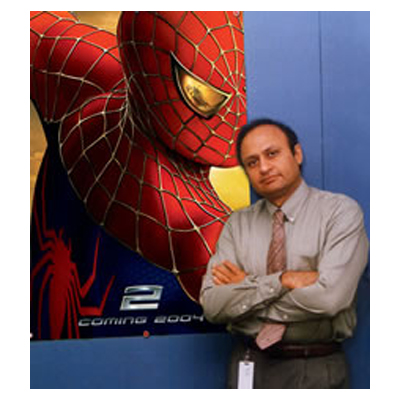
    This year, the distribution house expects to have at least five of the top 10 Hollywood films. Trailers of Spider-man 2 have started running in India’s movie theatre, even though the film is slated for release only in July 2004. The man at the helm is Columbia Tristar India’s MD Uday Singh.

    Singh joined Columbia in this capacity in April 1996. The primary task set before him was to restructure the Indian operations and make Columbia Tristar the leading Hollywood distribution house in India. His brief was to put India on the Asia map first, and then on the world map of Columbia TriStar.

    Under Singh’s leadership, Columbia India’s new team crafted out a brand new mission statement – ‘no market, no customer, no opportunities are out of reach’. In order to live up to its ideals, the team strategically went about establishing a grassroot distribution model that was founded on transparency and professionalism.

    In addition to this, Singh’s team has gone about building a world class marketing mechanism to exploit the potential of each film to its maximum. But as the saying goes the proof of the pudding lies in the eating. Last year, the company hit an all time high with a record box office performance when it crossed the Rs 1 billion mark in ticket sales. From a mere Rs 40 million operation to a Rs one billion operation the growth was tremendous.

    Indiantelevision.com’s correspondent Ashwin Pinto catches up with Singh who gives a low down on the company’s marketing strategies, how it has managed to achieve transparency, Hollywood’s growth in the country and what expansion plans are in store:

    How has 2003 been, as compared to last year, when had the Spider-man phenomenon?
    We are happy to announce that Columbia TriStar India will close the year with at least five films in the top 10 category.

    So far, if you look at the opening weekend performance, we have five films in the top 10 category. Terminator 3 is number one with Rs 170 million gross box office. It took in Rs 48 million in its opening weekend. The other films are Charlie’s Angels 2, Bad Boys 2, Welcome to the Jungle and Pirates of the Caribbean.

    With forthcoming films like Once Upon a Time in Mexico, our performance should be in line with what we achieved last year. However, the revenue may not go to the Rs one billion mark. It will be in the range of Rs 850 million. For a Hollywood studio to do this in a year that has seen huge number of local (Hindi) releases is a very commendable achievement.

    We were also helped by surprise hits such as Maid In Manhattan, Jungle Book 2 and Finding Nemo. The figure is less though this year, because the dubbed Hindi products were not as strong as what we had last year. We were one or two titles short.

    How has Columbia Tristar India managed to achieve transparency in its operations?
    We are basically committed to making our operations as transparent as possible. We have set up a system, which works across the country. It allows us to collect data on a 24×7 basis. As tickets are being sold across the country, we start collating that information. It goes into a central database. This can then be fed to the producer in exactly the same manner.

    The producer has his own password protected system. He can log in and see exactly what his collections are. This is something we do for our movies and the movies we distribute for others.

    “There’s a change taking place in the market. The multiplex audience is happy with urbane, well-heeled products. Now, one is able to segment audiences better

    What have recent studies signified about the Indian audience?
    There is a change taking place in the market. You have the multiplex audience, which is very happy with very urbane, well heeled products. Romantic comedies have started doing extremely well in recent times. Now, one is able to segment audiences a little better. Having said that, action still rules the roost. But there is more place for other content than there was before. You have a much better chance with them.

    We constantly attempt to understand the target consumer better. The data thrown up by the research helps us structure our strategy better and keeps the campaign from getting de-focussed. There is also an attempt to study the awareness of the consumer for our forthcoming products, as well as that coming out from competition.

    This tracking allows the sales and marketing departments to analyse the box office behaviour of the film.

    Could you elaborate on the innovative marketing strategies that were tried for products like Bruce Almighty and Charlie’s Angels 2?
    The first thing that we did with Bruce Almighty was to take the international campaign and localise it as much as we could. Jim Carey is a big star and is well-known in India. We positioned the film during a relatively softer period when the audience was more open to seeing a different kind of product. The film did well overseas and that helped.

    With Charlie’s Angels 2, the strategy was different. It released here just one week after it released in the US. The aim was to get the picture available for everyone ASAP (as soon as possible). With this film, we wanted to open it with extravaganza, even if there is a big dip after that. This is called front-loading your process and is a part of the saturation strategy. The picture opens big – with huge promos, which later taper off in a hurry. In this strategy, the money is made faster which is good for the cash flows.

    Usually, when we work out such marketing strategies, we keep in mind that new competition will enter in the following week. The entire campaign is usually worked with the aim of giving a film a huge opening, so that the film holds even after the promos are lifted – and even in front of stiff competition from Hindi films.

    This is one strategy we have been very good at, especially this year. The entire process of promoting a film starts at the retail level through a definite trailering and merchandising strategy. We use malls, eateries, restaurants where an incentive is offered. For instance, if people eat a particular dish, they are offered a free ticket.

    Our other way is to add to the flavour of a movie. For Spider-man, we had people dressed up as the action figure. For Monsoon Wedding, we did mock wedding processions. For Charlie’s Angels 2 we conducted a “hunt”. Three hep women were identified as ‘desi Charlie’s angels’. It worked amazingly well. The women spoke about what they thought entitled them to join the elite squad. An aspirational value was added. Plans like these are worked out for every product.

    The era of Bollywood v/s Hollywood has ended. It’s now an era of coexistence, courtesy multiplexes which have added capacities. Everyone wins

    What would be a good example of product localisation?
    In case of our latest release Once Upon A Time In Mexico, we are pushing it as a follow up to Desparado, which also starred Antonio Banderas and Salma Hayek. Desparado has played quite often on television.

    However, abroad, the positioning of Once Upon… would be the concluding part of a trilogy. The first movie was El Mariarchi which not many people in India are familiar with.

    Once Upon… also stars Johnny Depp who has become big with the Indian audiences because of Pirates Of The Carribean. The film also has elements of style and panache besides the action scenes. We are using the print route for publicity of this movie, and not so much the television.

    Usually, the national marketing team pitches with various brands which have the same positioning as that of the film for promotional tie-ups and with media houses for on-air/in-print and outdoor campaigns. Television is by far the most important medium. A lot of people take the decision on whether or not to watch a film on the basis of a trailer.

    Why do you have different marketing strategies for the North and South?
    In a market where there is so much media fragmentation, tastes differ quite substantially. One has to adapt and be more focussed on what works for a particular market. Our marketing teams understand the psyche of the audiences in the various locations. We tweak our campaigns accordingly.

    For example, Welcome to the Jungle did better in the hinterland than it did in Mumbai. The Hindi campaign was quite different from the Tamil and Telugu campaigns. The flavour of the film caught on with the vernacular audiences. The local advertising connects are different. Promotional lines have to be different.

    In the South, outdoors gained in prominence because there is a huge amount of postering that happens there. The regional language posters showcased the action-oriented nature of the film – because to catch the attention of Tamilians you have to get in their faces. All their products are crying out for attention and so you must stand out. The toned down approach will not work there.

    For the English audience you would have to talk about how the film is sleek and stylish. For the Hindi audience who are not familiar with ‘The Rock’ you have to show the outdoor setting, the adventure, the punches he lands.

    Since we are on the subject of Welcome To The Jungle, how was the film able to overcome negative reviews and perform well?
    A famous Indian film director once made a statement: “If the critic likes my product I will ride in an auto rickshaw; if the auto rickshaw driver likes my movie I will fly to Europe first class.”

    Welcome to the Jungle grossed at Rs 14 million at the box office in its opening weekend (12 to 14 December) 2003. It overcame reviews – that ranged from poor to medium – to scale the peak at the box office in its opening weekend. It emerged as the 8th biggest opening weekend film for this year.

    A huge opening is rare in the winter period. Normally, it is the summers that sees most blockbusters. This explains that it is the consumers who decide the fate of any film and not the critics.

    The opinions of the consumer and the critics are often divorced. In the past, we have had films like Anaconda and Godzilla doing well. Both got a single star rating from critics. I am perfectly happy with getting single stars for the movies I release, as long as they show me the money.

    We ran a great grass-root campaign for Welcome to the Jungle. The Rock has been very popular due to wrestling. Also his earlier two movies The Scorpion King and The Mummy Returns played well here. Since he is very saleable we went aggressively after the film.

    To what extent has the size of Hollywood market grown in India and what are the projections for next year?
    This year has been an exciting year for ‘big ticket’ entertainment. There was a good flow of products from all Hollywood studios. This reinforced the cinema going habit.

    If you look at the period last year – (January to July 2002) – and the same period in 2003, Hollywood has grown 30 times in India to 40 per cent. This year has also seen a larger number of films doing well as all the studios have had their share of big hits.

    The figure for January to July 2003 is estimated at Rs 280 million as opposed to Rs 200 million for the same period last year.

    In terms of grosses we are number 17, which is the same as last year. We are as big as Philippines

    What are the main factors fuelling this growth?
    Firstly, the growth of multiplexes has ensured that there is space for all. Both Hollywood and Bollywood have benefited. The era of Bollywood versus Hollywood has ended and it’s now an era of coexistence, courtesy multiplexes which have added capacities. Everyone wins. This should explain to you why Terminator 3 stood up to Darna Mana Hai; The Matrix to Chalte Chalte, Bad Boys 2 to Gangajal and Pirates of the Caribbean to Boom.

    Obviously, cinema’s magic is back! Everyone feeds off each other. However, having said all this Hollywood is still three to five per cent of the Indian film industry. In fact, I think the local Hindi films, which were released in large numbers, had a rub off effect on us. They are getting the urbane audiences in, especially the teenagers. I refer to films such as Ek Aur Ek Gyaarah, The Hero, Main Prem Ki Deewani Hoon and Koi Mil Gaya. Our films also target the same group.

    Also, the number of prints per movie has gone up. For Spider-man, we had issued 250 prints. Earlier, the maximum used to be 100-150. Secondly, the relaxation of certain laws has shrunk the gap between the US and India release dates. In fact, Charlie’s Angles 2 was the first film to be released here in just one week after it released in the US. The Matrix Revolutions was released on the same day.

    There has also been tremendous growth through dubbing. This way the studios were able to take Hollywood to the masses. To give you an example, in Terminator 3 Arnold Swarzenneger could easily be a Sunny Deol. In Welcome To The Jungle The Rock’s character could also be a Sunny. Even Finding Nemo was dubbed Kho Gaya Nemo.

    We are also slated to spend Rs 250 million on all our business activities relating to the channel over the next one year.

    What major merchandising and cross-promotional deals has Columbia Tristar put in place for its products?
    We monitor the publicity of visual merchandising activity at the retail level, the exhibition level and also at the retail programme that we take outside the normal exhibition level.

    In a competitive market, it is important to check that merchandising material like trailers are displayed in the right locations and are positioned to the best possible advantage compared to everybody else. As far as consumer products are concerned we do not yet have a representation for that in India.

    As for cross promotions, almost every product of ours has found a brand partner. Seagrams has been consistent at a national level for films like Charlie’s Angels 2 and Pirates Of The Carribean. We also have regional and local partners.

    In the initial phase it used to very tough to associate with brands. However, over a period of time, brands have recognised the huge promotional equity that a feature brings.

    Short-term contests raise the footfalls for the brand in a big way and thus translates into sales. Sometimes, the relationship is so great that companies have had to increase capacities. For Men In Black Rayban had to increase manufacturing of the sunglasses made popular by Will Smith and Tommy Lee Jones. McDonald’s associates with us all the time for our animated product. Finding Nemo toys were given away as value add ons to their meals. We had a relationship with BPL for A Bugs Life, a few years ago. A huge campaign was created.

    What are the main challenges faced when you have to create awareness about films belonging to different genres – like the animated Finding Nemo or the action film Terminator 3?
    It is finding the sweet spot with the right audience. It is matter of positioning the film and finding the audience as precisely as possible. The way we are structured is that different teams handle different products. The teams are able to focus in different ways without getting mixed up. Finding Nemo was a product that we had to wait out till the Diwali vacation when kids had time on their hands. We had relationships with a lot of corporates.

    We ran the campaign Aapne Dekha Kya? for the dubbed version. We wanted to break away and break out to get better results. Fortunately, even at Christmas, the film is still playing.

    Terminator 3 is what in market parlance is called a slam dunk. There is a big brand recall for Terminator as a property. We went out with 225 prints. Typically this is what the market likes the most and we exploited it to the maximum.

    What was the logic behind creating a buzz over Spider-man 2, when it is still over half-a-year away from release?
    This is the event film for 2004. We want to carve it out in stone and establish it very clearly in the minds of the movie going public. Spiderman 2 will hopefully be as big as the original one. However we cannot rest on our laurels. It is easy for the public to get distracted by other products. We want to let the public know that they should watch out for us next year.

    Even for Spider-man, we had started a campaign six-seven months earlier. We will do the same thing this time around. It is natural for a big product like this to have a long established marketing plan.

    Another big product for next year is Hellboy. While not well-known in India, abroad the comic strip has become a cult.

    We are hoping to land distribution rights to Miramax’s romantic epic Cold Mountain

    What was the budget allocated towards promotional spends in India this year?
    Budget varies from film to film. Ours is not a business where you are spending money in generic form. It basically depends on returns on investment.

    I will say that with the increased fragmentation in the market, you have to run that much faster to stay in the same place. For a four language film release, you have to spend that much more to make sure that more people get the message as opposed to a single language film.

    Besides mainstream blockbusters, do you think the Indian market is growing for niche English films like Seabiscuit?
    Seabiscuit is upscale and a bit difficult to market. However, products like Road to Perdition would have had a difficult time finding their way into the Indian markets, if multiplexes were not there. Yes, the audience that appreciates niche content is growing.

    What expansion plans have been lined up?
    We are trying to make our distribution as strong as possible. With distribution the job is never complete. You are constantly chopping, changing and revaluating the networks setup. We want to make sure that the partners we work with are falling in line with the kind of plans and dreams that we have envisaged.

    The growth in North India has been spectacular. We have also set up distribution hubs in new places like Gorakhpur. In the East, a multiplex has come up in Kolkata. The rest of the East is not strong for us. Bihar, Orissa, Assam have never been a strong market even for dubbed products.

    We have a long way to go before we can be counted as a major player in the global scheme of things. In terms of grosses, we are number 17, which is the same as last year. In Asia, you have bigger markets like Japan, Taiwan, Korea. We are as big as Philippines.

    At a suitable time, we will look at co-production if our involvement would make a difference and if it makes sense for us in terms of the return on investment
    What efforts were taken to cement relationships with exhibitors across India?
    Various initiatives have been put in place by our teams. It is like a customer relationship management programme. One initiative is our Good Morning Columbia programme. This allows the exhibitor to book morning shows in advance. Other programmes see exhibitors working with us as partners to add muscle to our products. The revenue sharing arrangement varies from place to place and picture to picture.

    How much money comes from the English version and how much from the dubbed versions of your products?
    Usually it is 50:50. There are always exceptions. The vernacular version of Welcome To The Jungle made more money than the English version. That was a situation we had been anticipating right from the start.

    34 movies were released by us this year out of which 11 were dubbed. Seven of them were dubbed in four languages. We have to be careful though about what to dub. Once Upon A Time… will not be dubbed.

    Now it’s the season for awards . Are there any films you are looking to push to coincide with the Golden Globes and the Oscars?
    Big Fish with Albert Finney is one film that we would push in the January to February period. It has already got a few Golden Globe nominations. This will go in the Oscar rally period.

    We are also hoping to land the distribution rights to Miramax’s romantic epic Cold Mountain. The Julia Roberts starrer Mona Lisa Smile is another film that we are pinning our hopes on.

    Are you looking at co-production for Indian films?
    Yes. This is an option we have been considering and will get there eventually. Right now while there are opportunities coming our way, we are not actively talking to any Bollywood producers.

    At a suitable time we would look at it if our involvement would make a difference and if it makes sense for us in terms of the return on investment.

    To what extent is your business being affected by piracy?
    Hugely! We are constantly fighting it. It is a never ending war. Films are shown on cable sometimes even before its release in the US. Video piracy is rampant. For every legitimate VCD that is being sold there are five illegitimate ones. We have an anti-piracy wing in Delhi. An attorney runs it on a retainer basis.