Tag: broadcasting network

  • Prasar Bharati and Radio-Television Slovenia sign a deal

    Prasar Bharati and Radio-Television Slovenia sign a deal

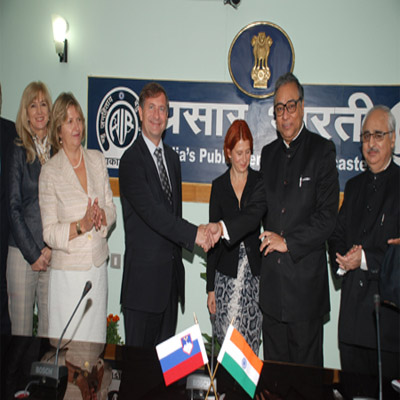
    NEW DELHI: India’s largest broadcasting network, Prasar Bharti has found a potential business partner in Radio-Television Slovenia (RTV SLO). The two got together recently and have agreed to explore further opportunities in potential projects of co-production of programmes along with significant cultural, economic, political, social and festive events in the respective countries.


    A Memorandum of Understanding (MOU) for cooperation in the field of broadcasting was signed between Prasar Bharati and RTV SLO. It aims at trading expertise of each of the broadcasters and entails exchange programmes in the fields of culture, education, science, entertainment, sports, and news on their respective networks, besides provision for personnel exchange and training of staff.


    To sign the deal, a high level delegation that included Slovenia led by Deputy Prime Minister and Minister of Foreign Affairs Karl Viktor Erjavec, along with his team of ministers and officials – Mrs. Darja Bavdaz Kuret, Vlasta Vivod, International Department (RTV SLO) Head Suzana Vidas Karoli, and Boris Jelovsek visited Prasar Bharti.  


    The agreement was signed between Karoli and Prasar Bharati Member (Personnel) Brig (Retd.) V.A.M. Hussain.


    In his speech, Erjavec emphasised the importance of the MoU and said: “In today’s world, TV is the medium with the most significant impact in the life of culture, education, science, entertainment, sports, and news. And I am sure this agreement will bring additional opportunities to strengthen so important people-to-people contacts and bring better understanding of our nations. Your contribution to these strengthened people-to-people contacts and better understanding of our nations will also lead to deepening of cooperation in economic, political, scientific, educational and cultural fields. And we thank you for that.”


    The RTV SLO director GM Marko Filli could not attend the meeting, but he sent across a message that was read out by Karoli. He remarked: “Cooperation between media organisations is crucial for their quality work and development of programmes for the public they serve. New technologies are diminishing the distances that used to be a barrier for cooperation. The world is changing in such a way that not only small media organisations can learn and benefit from bigger ones, but also big media organisations are able to discover new ways of working and possibilities of cooperation with the small ones. At the same time the public is interested in the quality and contemporary content of the programmes and not so much of where the content is coming from.”


    In his message, he also emphasised that the exchange of programmes in the fields of culture, education, science, entertainment, sports and news will help us to broaden content offer and make both parties stronger and more influential in their home lands. “I must point out this cooperation is of great importance especially for Slovenian public service and therefore we look forward for this first operational exchange. As the production of programme is depending more and more on technical knowledge, exchange of programme content can be and will be upgraded with exchange of expertise between personnel and providing the training with technical staff. We can learn from each other and certainly we will benefit from each other. The ultimate goal must always be satisfaction of our public,” he said in the message.


    Prasar Bharati CEO Jawhar Sircar pointed out that India has always given importance to friendship with Slovenia. He stressed that cooperation in exchange of programmes, participation in each other’s cultural events are far more effective tools that enrich the knowledge and perception about nations and that Prasar Bharati would strive to reach the heart of Slovenian people through heightened co-operation as envisaged in the MoU.

    This MoU is directed towards developing and strengthening friendly relations between the two countries through an increased co-operation in the field of broadcasting thus enabling the two countries to share their rich cultural heritage that includes a gamut of events and festivals.

  • ‘If you are up in the hierarchy, you will get pricing power’ : Star India president ad sales Kevin Vaz

    ‘If you are up in the hierarchy, you will get pricing power’ : Star India president ad sales Kevin Vaz

    Leading broadcasters will continue to post strong ad revenue growth while the long tail will be severely hurt as advertisers tend to consolidate their spends in a cautionary environment.


    Genre leaders will benefit as advertising monies get rejigged. It is the weaker performers that will not find support from advertisers; they will degrow.


    The television sector will see a 13-15 per cent growth in ad revenue this fiscal while print will be pushed back in a slowing economy.


    Star India, which has leader channels in most genres, has done more annual and network deals this year. Its top 10 clients, for instance, have done deals stretching from a minimum of 12 months to three years.


    The Hindi general entertainment channel (GEC) genre is on an upswing even as ad monies are moving away from cricket.


    The Hindi movie channel genre is set to grow at 15-20 per cent. The news genre will, however, continue to struggle this year.


    In an interview with Indiantelevision.com‘s Sibabrata Das, Star India president ad sales Kevin Vaz talks about the changing equations in the television advertising space.


    Excerpts:

    Is India‘s leading broadcasting network ready to announce that the advertising economy is slowing down?
    The ad market is not as buoyant as it was in January. The television sector will not see a 20-25 per cent growth in ad revenue this fiscal as was forecasted earlier. But it will still post a 13-15 per cent growth while print will be pushed back in a slowing economy. With print crawling at a 0-3 per cent growth rate, ad monies will move to television.

    Even then it is a slower growth for the TV broadcast segment. Is Star beginning to feel the heat?
    Leading broadcasters will continue to post healthy growth while the long tail will be severely hurt as advertisers tend to consolidate their spends in a cautionary environment.


    Genre leaders will benefit as advertising monies get rejigged. It is the weaker performers that will not find support from advertisers; they will degrow.

    Aren‘t Star‘s top advertisers noticing a slowdown?
    We have actually done more annual and network deals this year. Our top 10 clients, who account for 30 per cent of our revenues, have done deals stretching from a minimum of 12 months to 36 months. We will buck the trend and grow much faster than the industry. Having leader channels in most genres has helped us stitch long term deals.

    The fiscal first-quarter is indicating a slowdown for certain listed media companies. So isn‘t there a negative sentiment already prevailing in the market?
    The April-June quarter has been good for us. And the July-September quarter is even better. Of course, the channel performance has also improved. If you are up in the hierarchy, you will get pricing power.

    ‘The hard core press categories are shifting more to TV. The automobiles category is now spending 60 per cent of its ad budgets on
    TV, up from 30 per cent. The consumer durables segment is also
    following this trend‘

    But aren‘t we seeing a small dip in FMCG spending in the first quarter?
    The FMCG category is going to be aggressive this year. Some of them may have issues, but as a whole they will continue to spend more. P&G, Marico and ITC, for instance, will not shrink their promotional budgets. There are variants being launched and competition in the category is fierce. TV is the last thing they will cut down on as it is the most efficient medium for the category. And within TV, they will consolidate their spends.


    In a toughening economy, advertisers tend to flirt less; they commit their spends to the bigger players and keep aside a lesser amount for shopping with the rest.

    Are Hindi general entertainment channels going to benefit because cricket is not delivering due to India‘s poor performance?
    Cricket is hit in a big way. GECs are on an upswing even as ad monies are moving away from cricket. The Hindi GEC genre, pegged at Rs 37-40 billion, will grow at 12-15 per cent this year.


    It is important to note that cricket is losing out because of India‘s dismal performance; this has nothing to do with a slowdown. In fact, the Indian Premier League (IPL) will be tested next year; as ratings slip, there will be a churn.


    So what is working well for us? Cricket and print are on the losing side this fiscal.

    Are tentpole properties bringing in revenue spikes in GECs?
    Advertisers are supporting tentpole properties as they look at buying impact. Brands like Maruti and Cadbury, who are on cricket, are sponsors of Just Dance. Kaun Banega Crorepati has got Idea. If cricket was doing well, we could have come under some pressure. Even in regional language channels, we are seeing tentpole properties being created.

    What about the Hindi movie channel space?
    The ad revenue market for this genre is around Rs 8 billion. It is set to grow this year at 15-20 per cent.


    Star Gold will capitalise heavily as the channel is performing very well. We have cut the ad inventory time by 33 per cent with effect from 15 August to give it a Hindi GEC environment (Channel V saw a similar ad cut time from 1 January) and ramped up our investment on movie acquisitions.

    How will the launch of a Hindi movie channel by Viacom18 impact the market?
    We will see a huge erosion in viewership for some channels who have not invested in movies. But from a revenue perspective, we must remember that it is a very efficient genre.

    In the Bengali and Marathi regional markets, it is becoming a three-horse race with Star performing well. So how will this fragmentation impact?
    The successful launch of Star Jalsha has actually grown the market. The Bangla GEC advertising market has grown from Rs 3 billion two years ago to a size of Rs 6 billion. Even in Marathi, there will be a revenue expansion as we start monetising the growth of Star Pravah. In these stand-by-itself markets, advertisers had only limited GRPs to buy. Now that the supply has increased, we expect a 30-40 per cent expansion. National brands are going deeper and deeper and local brands are getting more aggressive.

    Now that Star is also handling ad sales of NDTV, how do you see the growth in the news genre?
    The news genre will continue to struggle this year. Banking, finance and automobile categories are seeing a huge hit; so news television will feel the impact. With the resurgence of GECs, the news genre has actually stagnated for the last few years.


    Regarding NDTV, we are selling it along with the network. So we are bringing in a wider range of advertisers.

    Do you see consortium selling growing as a concept?
    Yes, leading broadcasters will become the rallying point. It has happened in the case of distribution (Star and Zee merger) because they sensed value; we will see it in the advertising arena as well.

    Is the English entertainment segment under pressure?
    English general entertainment channels will benefit as the premium segment grows. High-end cars, for instance, will increase their exposure to TV. The English GEC genre will see a 30 per cent growth this fiscal.

    So is TV gaining at the cost of print?
    The hard core press categories are shifting more to TV. The
    automobiles category is now spending 60 per cent of its ad budgets on TV, up from 30 per cent. The consumer durables segment is also following this trend.