Tag: BroadcastAsia

  • “India is the strongest media market in APAC”: Intelsat’s Bill O’Hara & Terry Bleakley

    “India is the strongest media market in APAC”: Intelsat’s Bill O’Hara & Terry Bleakley

    Bill O’Hara and Terry Bleakley make for an odd couple – they are as different as chalk and cheese. O’Hara is a true blood American, while Bleakley is from that distant land called New Zealand, and is a Kiwi. But they have one thing in common between them: the company they work for – global satellite major Intelsat. 

    As general manager of media, O’Hara leads global sales/revenue, marketing and product management. He has also been charged with increasing its $700 million a year top line while keeping a sharp eye on the bottomline. An industry veteran with nearly six years at his current firm, O’Hara has taken a stab at turning into an entrepreneur when for three years from 2013 onwards he ran a direct-to-consumer streaming service called KlowdTV. 

    Bleakley , on the other hand, has been a bird man for almost all of his working career, with organisations such as Panmsat, Intelsat, and then Measat., following which he came back to Intelsat to grow its Asian business. 

    The organisation is well positioned to grow, even more robustly, not just in Asia, but globally. With a fleet of more than 50 satellites in the sky, teleport gateways, terrestrial networking infrastructure and robust managed services, Intelsat claims that it offers the world’s most extensive and secure communications network. Its focus now is on building the future of global communications with the world’s first hybrid, multi-orbit, software-defined 5G network designed for simple, seamless, and secure coverage precisely when and where customers most need it. 

    Indiantelevision.com founder & editor-in-chief Anil Wanvari caught up with Bill and Terry during last month’s BroadcastAsia conference in Singapore to get insights on how Intelsat is gearing for the requirements of a data and IP-driven media industry going forward. 

    Edited Excerpts:

    On how the company is structured today.

    Terry: We went through financial restructuring and came out of it about two or three months ago. We shed about $8 billion of debt. We took our debt from $16 billion to about $7billion. We are receiving $4.8 billion for the clearing spectrum for the US government. We have received $1 billion of that payment already. And we are also owed $1 billion for the cost of clearing that spectrum. And those payments come by the timeline that has been set which is by end-2023. That takes our balance sheet down about $2 billion in debt, way down from when we hit $16 billion of debt. We bring in about $2 billion in revenue. That’s a really low debt structure for an organisation. You normally want a ratio of 3 to 4:1. So our balance sheet has been as strong as it has been since 2002. As we emerged from our financial restructuring from a public company to a private company, the creditors whose debt was shared got new equity. So it is now a private company from being a public company.  

    On how Intelsat evolved in response to move toward IP delivery for video customers.

    Bill: I think that while there are a lot of changes in this industry, the satellite is still central to distribution, regardless of whether the content originates as IP or is delivered as IP to the end consumer. We recognise this and our strategy is very much to be IP native, to plug ourselves into different parts of the ecosystem, where our customers are going. We are a very customer-focused company – always trying to move with our customers as they move along. For example, as our customers have moved to the cloud with greater velocity, we too have been forging cloud partnerships so that we can source content directly from the cloud, directly from folks like AWS. With it, we have a public partnership so that we can bring content either to the cloud or take it away from the cloud and distribute it to our customer base. 

    Our value position as a media business, however, is connecting an audience with content. And we do that today with cable TV distribution and direct-to-home. But tomorrow, especially with the acquisition and integration of our commercial aviation business, we can connect new viewers with other types of content, perhaps on board planes. So streaming partnerships with many of our content owners today, and our customers could be the way we distribute OTT content tomorrow to a new audience we have not capitalised on serving in the past. 

    Terry: Further let me give you some numbers on this. Go-Go Commercial Aviation, which we acquired around 18 months ago, has around 1700 connected commercially around the world. They have 1300 on the backlog, and they are getting an antenna put on top of them as Covid goes away. That represented, in 2019, precovid, 200 million passengers a year. That’s an audience that was not tapped into with the media. If you look at 2019, how many people travelled on airlines globally, it is 4.5 billion people a year. So if we can stream content, whether it is some of our broadcast partners who are going direct to consumers, and start reaching this audience for them, we think there’s a lot of value in that. 

    And there’s another play with telcos. We are also building a 5G core for our network going forward, and we are going open standards. We call it a unified network. And as we develop this 5G core satellite network that can run with other networks like Jio and Airtel and others, then the idea is that the experience of a person with a mobile phone, when they get on a plan, then it’s like roaming to another country. It’s a 5G native infrastructure that we have got there, they don’t have to put an SSID number, they connect and they don’t realise they are paying for a service to their provider, a roaming charge. So you get past the issue of payment to an aircraft which is expensive. They feel like they are getting it for free because they are roaming on to our service which is our roaming 5G core that is sitting on the aircraft. And a whole new audience comes in from there too. 

    Bill: So fundamentally when you put these ideas together: the content owner who is going direct to consumer, like any one of them have done – Paramount+, Discovery+, Disney+, any of these major players. Or it is with an MNO. By controlling the ecosystem that is on board the plane – both for connectivity and the end user experience – that is an audience that is highly desirable and hard to capture. That we have the exclusive ability to deliver through satellite. 

    On how the airlines’ in-house entertainment system will be impacted.

    Bill: I think this will be determined on an airline to airline basis. It’s a three-way partnership: the MNO, the content owner, us, and the airline. And different airlines have different strategies. 

    Terry: They pay a lot for those entertainment systems to get the content. So technically, if people can access their content when they get on board then they can reduce the cost of an airline to get content. We already are seeing hybrid systems in play in airlines wherein you have inflight entertainment, you have live TV as an option. So you can watch sports live. And this is being made thanks to advancements in connectivity to aircraft through satellites. In a high throughput satellite, the antenna can take a lot more megabits. It’s a lot more efficient in delivering real-time internet to an aircraft that you can now do these services. We think there’s a play where we can do streaming services. 

    On the strategic plan going forward.

    Bill: Our five-year strategic plan is to be an aggregator of networks. Somebody has to sit in the middle of all this. And with a universal terminal – with multi-orbit, multi-band capabilities to integrate low earth orbit (Leos), medium orbit (Meos) and geostationary earth orbit satellites (GEOs) – that is operating via standards – open standards – integrated into a 5G core, 3GPP compliant. All of these things add up to a scalable system that develops the right kind of connectivity at the right time for the right application with one terminal, one modem, and one integration into the broader telecom infrastructure. I believe that’s a very powerful place to be. And I think it takes a very specific entity to do it. I think we are in the best position to do so with our infrastructure and our geo play. 

    Terry: As far as open standards are concerned, you have to remember satellites in the past, and I am talking telecom, not broadcast…and now the two are converging again…and it’s happening greater today than it ever was thanks to the internet and video…Satellites have tended to be heterogeneous. Satellites have tended to be on the side of a network, with their standards, its proprietary hardware. And it’s not homogenous like the telecom industry. We have been pushing a standard to adopt within 3GPP to have satellites included in that so that we are no longer a pimple on the landscape. 

    And release 17 of 3Gpp which comes out in the next few weeks, they have got a thing called NTN which is non-terrestrial networks. That allows satellites to be a part of the 5G core going forward. So that’s massive because the benefits of that as we start getting economies of scale of mass silicon production for 5G chipsets. So a Snapdragon chipset for a mobile phone is $30 today. We pay $300 for the same silicon in satellite modems because they don’t have the same scale that a mobile phone has. Once we get 5G in there we can reduce our silicon costs by ten-fold. That makes us more relevant there and we stream into the network a lot more efficiently. 

    But two other standards are more relevant: Meth (metro ethernet). We are the first satellite operator to be accredited with Meth. The other part is a thing called Digital IF. Today, our IF is all analogue and there’s no open standard around how we can take it from an analogue play to a digital one. We chaired the forum and Digital IF has created its first standard and Microsoft has come on board, SES has come along. All of the antenna manufacturers have joined up. And we are an open standard that takes analogue IF (intermediate frequency) and converts it into digital. 

    We are a homogenous network and what can this translate into: today the annual spends on telecoms and pay TV is $1.6 trillion annually. We only have one per cent of that. As a satellite operator we represent a whole selling capacity of $1 billion a year. So with our unified network and what we are developing around that if we can go from a one per cent share to two per cent…it’s huge and it’s not that hard to do. And we believe that that’s what is about to come with the adoption of the 5G core that we are developing which will be able to interface with MNOs, which are these giants we want to be part of.

    On how the geo play will pan out.

    Terry: We are at 52 geostationary satellites. Six of these are high throughput. We are all around the globe. We have 30 in the Asia Pacific. Our satellites are in the spectrum of one year old to 15 year old. We have also been putting some into inclination. And for two others we performed scientific feats like using missing extension vehicles to extend their life. Part of our $2 billion build out to our unified network is a virtualisation of the network, software defined satellites. So we have ordered four software defined satellites – two with Airbus, two with Thales. They are being built at the moment. Two will sit over Asia, Indian Ocean. Two over the American region. And they will be online 2025. We also have eight satellites in the factory which are going to be used as part of our clearance for spectrum for 5G in North America. We have 12 satellites in the factory.  

    On their view about India. 

    Terry: We have three very large neighbourhoods in India. So IS-17 and IS-20 are two of the satellites that are covering India. We have high MSO penetration to cable TV headends, which is still a very strong business. We saw a shift of some channels to Insat, but the tier one channels resisted that. Our business in India is stable. However, we did see a growth in movement from SD to HD from 2018 to 2021. We still see potential there. So then we got NXT Digital from Thaicom. And they are kind of loving it because we can do so much more throughout per transponder. We have got HITs, SunTV, and Viacom18. Thanks to Covid some other channels could not sustain themselves because of the lack of advertising revenue and the content crunch. Overall channel count decreased. Some of them were forced to look at distribution options. 

    I believe we have seen a great big rebound. India, we believe it is the strongest media market in the Asia Pacific. 

  • BroadcastAsia2015 Unveils New TV Everywhere! Zone

    BroadcastAsia2015 Unveils New TV Everywhere! Zone

    MUMBAI: BroadcastAsia2015, slated for 2 – 5 June 2015 will unveil its new TV Everywhere! Zone as increasing consumer expectations place new challenges on the industry to provide more convenient and reliable access to content. With the  proliferation  of  digital  devices  and  today’s  ever-changing  market  of  always-on connectivity, content broadcasters are starting to look beyond TV to stream and monetise their content.


    This brings the launch of the new zone, which will be a key attraction at BroadcastAsia2015 and will explore the entire value chain of non-linear broadcasting.


    Need for new technologies driven by shift in consumer demands


    Recent years have witnessed a dramatic increase in competition in the broadcast industry as providers continue to develop new technologies in meeting consumer demands, to offer a social,  personalised  and flexible TV and video experience. With the evolution of  linear channel brands already underway in Asia, the region continues to grow at an exponential rate and is witnessing an increasing number of traditional broadcasters entering the IPTV, OTT space. This is also emphasised by the growth and influence of aggregated services, such as Netflix, Hulu, AmazonPrime, YouTube and Apple TV.


    The recent Multiscreen TV & Video Forecasts report published by Digital TV Research reveals that the number of viewers watching TV and video content on multiple screens will climb from 5.60 billion in 2010 to 11.32 billion by 2020, with TV sets’ share of total viewers falling from 73 per cent to 42 per cent during this same period.


    The report also predicts that by 2020, 3.98 billion people will watch content via a PC or laptop over a fixed broadband connection, an increase of 80 per cent on 2013; and smartphones viewers will reach 1.53 billion, triple the number in 2013. Tablet viewers will amount to 1.10 billion by 2020, an impressive five times the 2013 total.


    “There is continuous interest in the broadcast industry especially in the areas of OTT, second screen, non-linear broadcasting and social media – all to meet consumers’ demands and enhance users’ experience. BroadcastAsia is already fuelling this space in Asia and with the introduction of our new TV Everywhere!, we hope to bring together even more case studies on how new entrants are adapting to competition, and how incumbents are maturing their  offerings  to  differentiate  themselves  amongst  competitors,”  says  Mr.  Calvin  Koh, Assistant Project Director of BroadcastAsia, from organiser  Singapore Exhibition Services.

    International collaboration

    Regional broadcasting regulators play a vital role in helping to shape the future of the industry, as highlighted by the support shown from the Asia-Pacific Broadcasting Union (ABU), the International Telecommunication Union (ITU), and the National Broadcasting and Telecommunications Commission of Thailand (NBTC). This symposium initiated and jointly implemented an initiative aimed at studying the trends and market analysis in the broadcasting industry while promoting international cooperation among policy makers, regulators, and Asia’s industry players.

    Healthy industry response to new feature area

    With the opportunity to reach key buyers from the industry, confirmed participants include major players from across the world and region, such as Ali Corp, Aveco, Brightcove, Montage Tech, Quick Play, SPB TV and Vimond among others. TV Everywhere! will place a
    focus on the following technologies:


    • Authentication
    • Archive Management
    • Content Delivery Network
    • Connected / Hybrid TV
     

    • Delivery
    • Integration
    • Ingest
    • Interactive TV Apps
     
    • Monetisation
    • Network & Device Management
    • Playout Automation
    • Storage / Security
    • Workflow Glue Application
     

    “Clearly the media industry is in transformation with consumers being able to access content across multi-screens, fuelling unprecedented demand for online video content. The investments being made in bringing TV Everywhere solutions to market is a strong sign that broadcasters and content owners are moving up the adoption curve,” says  Mr. Dennis Rose, Senior Vice President, Asia-Pacific and Japan, Brightcove.


    “For those who want to launch and capitalise the TV Everywhere business model, Brightcove’s powerful suite of cloud based online video streaming, trans-coding and monetisation solutions deliver compelling consumer experiences that work across every screen,” he adds.


    BroadcastAsia2015, Asia’s definitive exhibition and knowledge platform for the international broadcasting, film and digital multimedia industry, will showcase the newest innovations and cutting edge technologies in 4K / UHD, NextGen Broadcasting – OTT / Hybrid / LTE / IP / Broadband / Cloud, Multi-Platform Streaming, Professional Audio and more.


    The BroadcastAsia2015 International Conference and Creative Content Production Conference 2015 will bring together thought leaders and like-minded professionals from the broadcasting and media arenas to share business strategies for future broadcasting and content production.


    Both   exhibition   and   conferences   will   be   held   alongside   CommunicAsia2015   and EnterpriseIT2015 in Singapore at the Marina Bay Sands.


  • Discovery Communications bags two Apollo Award

    Discovery Communications bags two Apollo Award

    NEW DELHI: Three entries from India including two from Discovery Communications India featured in the award-winners list of the 2014 Apollo Awards organised by Asia Image.


    Discovery Communications India bagged two awards for the same programme – ‘Himalayan Tsunami’ produced by Beach House Pictures. It received the awards for Colour Grading by Karen Ng and Sound Design category- Long Form by Jerry Teo.


    The third Indian award went to Merzin Tavaria and Alex Pejic for Visual Effects/ CGI – Long Form for two films ‘White House Down’ by Prime Focus.


    The awards were given away last night at the Marina Bay Sands in Singapore, alongside BroadcastAsia at the 19th International Digital Multimedia & Entertainment Technology Exhibition & Conference. 


    Out of 165 submissions received, 42 entries made the final cut after being judged by a panel of judges that combines extensive technical knowledge, critically acclaimed creativity, and years of experience in the media and entertainment industry. The results are tabulated and audited by international auditing firm PriceWaterhouseCoopers. 


    Seven Indian entries had been shortlisted. While ‘Kai Po Che!’ had been shortlisted for Colour Grading for Merzin Tavaria and Paresh Acharya of Prime Focus, Discovery Communications India made it to the list for Cinematography – Long Form for Sanjay Agarwal filming ‘Everest: India Army Women’s Expedition’ produced by Robin Roy Films. The other Indian entries were: Sandeep Shelar & Ashok in Art Direction for ‘Ixigo’ by Studio Eeksaurus Productions Pvt. Ltd; and Merzin Tavaria for Visual Effects/ CGI – Long Form for ‘The Great Gatsby’ by Prime Focus. 

    “We will continue to evolve and remain relevant to provide industry players with a driving force that truly celebrates excellent performance. All our winners have made major contributions towards their respective fields, and we are proud to honour their achievements,” said Apollo Awards organiser Raymond Wong.

    “Also, we thank our sponsors and partners for your generosity and contributions. The Awards wouldn’t have been so momentous without your kind support, endorsement and presence,” added Wong.

    The ceremony brought together around 150 industry professionals, who celebrated the joyous occasion with all the award winners. First launched in 2005, the Asia Image Apollo Awards is an initiative aimed at honouring the best in production and post-production across Asia Pacific, with a strong focus on the creative and technical mastery behind the scenes.

  • Global industry leaders come together at Trade Fair in Singapore

    Global industry leaders come together at Trade Fair in Singapore

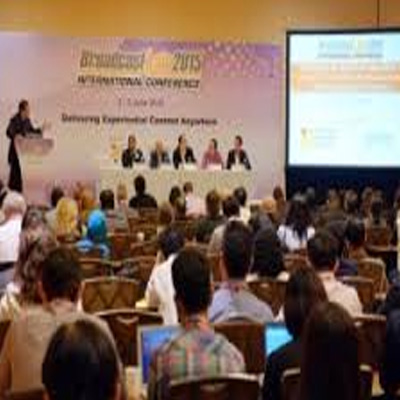
    MUMBAI: Fulfilling business interactions and knowledge exchange amongst like-minded industry professionals marked CommunicAsia2013, EnterpriseIT2013 and BroadcastAsia2013, a one of its kind industry event in Asia. The four day event, starting 18 June, got global industry leaders together to showcase latest technologies and solutions for information and communications technology (ICT) and digital media industries.

    The event which was held at a uniquely spectacular venue, Marina Bay Sands, Singapore saw 51,000 attendees from 100 countries/regions. Unlike past years, CommunicAsia/ EnterpriseIT and BroadcastAsia this year was conducted under one roof. While CommunicAsia was held at basement 2 and level 1, BroadcastAsia was organised on level 3, 4 and 5. The arrangement proved advantageous to visitors as they had to only climb different levels, instead of different venues.

    This year, while CommunicAsia had 1,328 exhibitors, of which 82 per cent was from overseas, BroadcastAsia had 716 exhibitors of which the overseas exhibitors comprised 86 per cent.

    Themed ‘The Next Wave: Empowered Customer‘, CommunicAsia focused on the central information requirements and featured 8 tracks and 2 interactive workshops. The BroadCastAsia international conference was designed on the theme ‘Enhancing User Experience, Monetising Content.‘

    What marred the excellent organisation was the heavy smog, which made visibility difficult even at 100 metres.

    “The show has done extremely well this year. All the attendees, including exhibitors, conference speakers, delegates as well as members of the press, have expressed satisfaction in terms of the content of the show. For us, this is testament to our success,” said Singapore Exhibition Services (SES) Chief Executive, Stephen Tan. SES is the organiser of CommunicAsia2013, EnterpriseIT2013 and BroadcastAsia2013.

    “By holding all the shows under one roof, we could leverage the increasing convergence of technologies across both sectors, and still have each show maintain its own appeal,” he added.

    Unveiling of Panasonic Toughpad JT-B1, a 7-inch Android rugged tablet designed for Asian customers, Huawei‘s- P6 Ascend, world‘s slimmest smartphone and Thuraya‘s innovative phone sleeve, that converts ordinary iPhone into a satellite phone for mobile communications almost anywhere in the world, by connecting the phone to Thuraya‘s satellites, were among the major highlights of Enterprise and Communic Asia 2013.

    Retail Juice chief executive officer Richard Jones said, “This is our first experience with exhibiting at CommunicAsia and it has been fantastic. It has exceeded our expectations both with the number of visitors and leads we have generated, and also the quality and diversity of opportunities we have created.” Jones through the exhibition has developed new relationships with potential customers and partners in Asia, Europe and America. “We will be returning next year and also recommending the event as a great business investment,” he opined.

    CommunicAsia2013 also brought together its largest ever contingent of more than 130 satellite communications companies. Asia Broadcast Satellite, APT Satellite, Asia Satellite Telecommunications, China Satcom, Eutelsat, Intelsat, Inmarsat, MEASAT, SES, SKY Perfect JSAT and THAICOM among others showcased their latest satellite communication solutions and applications in broadband, HD content delivery and remote area connectivity for government, military and maritime sectors as well as innovations that will bridge the gap between the ICT and broadcasting industries.

    Adding to the list of many of the firsts, the tradeshow also streamed live ultra high-definition content to an Ultra HD TV screen over MEASAT‘s satellite network, using Ericsson‘s compression technology.

    “There is a good representation of international exhibitors at CommunicAsia2013 and I‘m impressed with the show. In particular, the solutions provided by the exhibitors from China attracted my attention because of their competitive pricing. I am here to find suppliers for fibre optic deployment and I have found useful contacts for future partnerships,” said PT. Ketrosden Triasmitra of Indonesia business and risk analysis manager Irene Mayarani.

  • BroadcastAsia2013 returns with an integrated offering for the Indian broadcast industry

    BroadcastAsia2013 returns with an integrated offering for the Indian broadcast industry

    MUMBAI: BroadcastAsia2013, a media and communications event is set to feature “groundbreaking” technologies, and spotlight hottest industry trends for the broadcast and film value chain. It is to be held at the Marina Bay Sands Singapore from 18 – 21 June.

    The Indian Media and Entertainment industry grew from Rs 728 billion in 2011 to Rs 820 billion in 2012, registering an overall growth of 12.6 per cent. Given the impetus introduced by digitisation, continued growth of regional media, upcoming elections, continued strength in the film sector and fast increasing new media businesses, the industry is estimated to achieve a growth of 11.8 per cent in 2013 to Rs 917 billion. Going forward, the sector is projected to grow at a healthy CAGR of 15.2 per cent to Rs 1,661 billion by 2017, according to the FICCI – KPMG Media & Entertainment 2013 report.

    The report also states that although television will continue to be the dominant segment, strong growth is posted by new media sectors, animation/ VFX and a comeback in the Films and Music sectors on the back of strong content and the benefits of digitisation.

    Film digitisation and TV distribution infrastructure, growth in new media like increase in mobile and wireless connections; greater sophistication of and segmentation in content with digitisation and finally encouraging regulatory and policy support has been a key enabler of growth for the Indian media sector. The continued cable DAS rollout, Phase III licensing for Radio and 4G rollout this year will spur growth from the medium term.

    The report further stated that by 2017, newer media segments such as digital advertising, gaming, animation and visual effects will post double-digit growth. While digital advertising at present accounts for Rs 2,170 billion, it is expected to increase to Rs 87.20 billion by 2017. The Indian film industry is also expected to grow from Rs 112.40 billion to Rs 193 billion by 2017.

    BroadcastAsia2013 registers strong Indian participation.

    Speaking at the press conference held in Mumbai Calvin Koh, who is assistant project director for BroadcastAsia from organiser Singapore Exhibition Services (SES) said, “With the advent of innovative technology and the recent large scale digitisation, Indian broadcasters and consumers are both at a threshold of a technology revolution. As demand grows for advanced technology and content for the dynamic Indian audiences, the industry, like never before, is embracing world class practices and formats. BroadcastAsia2013 is an ideal platform for the Indian players to partner with world leaders as well as reach out to clients beyond India.”

    The Indian companies exhibiting at BroadcastAsia2013 include Further Broadcast Automation Systems, Canara Lighting Industries, Diversified Communications India, Essel Shyam Communication, Indiasign, Rudraksha Technology and WASP3D.

    Indian experts including Zeel business head – new media Vishal Malhotra and Shemaroo Entertainment director, owner Jai Maroo will be part of a panel at the BroadcastAsia2013 International Conference.

    With the rise of Smart TVs and the blurring of the boundaries between TV and social networks, consumers will be watching TV within social networks and vice versa, impacting the way they engage with TV. BroadcastAsia2013 will be addressing this latest phenomenon with showcases from leading industry bigwigs, as well as up-to-date conference topics, such as 4K TV, OTT, Multi-Screen Streaming, DVB-T2, Satellite/Terrestrial/Cable Broadcasting, Production and Post-Production Software.

    New and returning top-notch exhibitors, including Axon, Dalet, Canon, Envivo, Evertz, Ericsson TV, GoPro, GrassValley, Harmonic, Harris, Hitachi, Ikegami, Miranda, Orad, Panasonic, PCCW, Playbox Technology, Quantel, Sennheiser, Snell, Sony, Quantel, Wasp3D, Yamaha will demonstrate their competencies in: future tv / ott / cloud broadcasting, multi-platform broadcasting, satellite / terrestrial / cable broadcasting, digital media asset management / file-based production, DVB-T2, digital tv / hbbtv / hdtv / internettv, broadcast automation, infrastructure and facilities, production / post production software, content editing / colouring restoration, pro audio technology, video content delivery network, broadcast it networking and security.

    To complete the entire value chain, ProfessionalAudioTechnology2013 will see professional audio companies showcasing the latest audio products and services for the broadcasting and film ecosystem.

    The highly anticipated Cinematography/Film/Production Zone will once again return this year to provide visitors with comprehensive updates on featured technologies such as Animation and Video Effects, Motion and Film Production, Camera, Lenses and Tripods and beyond.

    As Asia‘s film and TV industry continues to flourish, the BroadcastAsia2013 International Conference progresses to the next level with four new tracks, four specialised sessions and for the first time, a half day workshop. This will focus on the shift in consumer demand for high quality content on-the-go, on multiple platforms and the emerging business opportunities for OTT in Asia. More than 100 speakers from 31 countries/regions will lead the numerous discussions over four days.

    Some of the key confirmed speakers include Peter Hutton (managing director of ESPN Star Sports), Dato Amrin Awaluddin (group managing director of Media Prima Berhad), Graham Kill (CEO of Irdeto), Kurt Hoppe (director of Smart TV Innovation of LG Electronics), Benjamin Grubbs (APAC head of partner marketing of YouTube) and Jay Fulcher (CEO of Ooyala).

    The Creative Content Production Conference, back for its fourth successful year, is themed “Producing and Distributing Successful Content in Asia.” The conference will address the challenge of producing appealing and high-quality content for global audiences. Numerous industry stalwarts – AETN All Asia Network, Fox International Channels, Lucas film Singapore, Sony Pictures Television and Viacom International Media Networks will provide their insights on the future of the industry at the two-day conference. A series of new topics and speakers including a ‘Producers Dialogue‘ have been developed to serve as additional forums for participants to address and anticipate the upcoming trends and demands of the industry.

    CommunicAsia2013 and EnterpriseIT2013, held alongside BroadcastAsia2013 at the Marina Bay Sands, will feature a complete range of key technologies, such as cloud computing, enterprise mobility, mobile broadband and applications, developments in LTE/4G as well as Over-the-Top (OTT) and more. EnterpriseIT2013 will also highlight the latest technology solutions for enterprises from different vertical industries such as banking and finance, education, government, healthcare, hospitality, and logistics and transportation.

    The last edition of BroadcastAsia, together with CommunicAsia, attracted close to 2,000 exhibitors and over 50,000 professional attendees from around the globe.

  • BroadcastAsia to return with bigger offerings in Singapore

    BroadcastAsia to return with bigger offerings in Singapore

    MUMBAI: Asian exhibition and knowledge platform for the broadcasting, film and digital multimedia industry, BroadcastAsia2013, will once again showcase innovations, technologies, and present ideas and insights from leading industry professionals come 18-21 June.

    Located together with CommunicAsia2013 and EnterpriseIT2013 at Marina Bay Sands in Singapore, the event will unveil the latest technology displays and new technology zones.

    No broadcasting or film ecosystem is complete without the sonorous support of audio that gives any production a dramatic, resonant lift. Incorporated with BroadcastAsia2013, ProfessionalAudioTechnology2013, an international showcase for professional audio equipment, services and technology, will draw industry professionals hailing from radio broadcasting, audio production / post-production, and live event and entertainment production.

    The BroadcastAsia International Conference and Creative Content Production Conference will bring together industry experts and thought leaders in the broadcasting industries to highlight business strategies for future broadcasting and content production.

  • BroadcastAsia to highlight digital convergence technologies

    BroadcastAsia to highlight digital convergence technologies

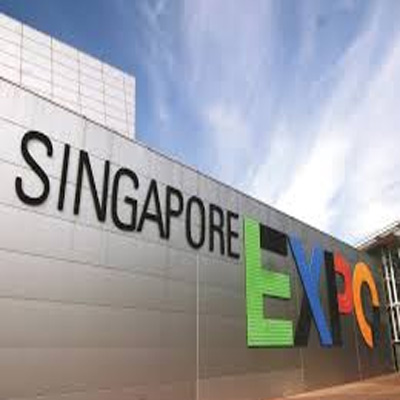
    MUMBAI: Asia’s digital multimedia and entertainment technology event, BroadcastAsia, will return to Singapore Expo from 19-22 June 2007 to showcase the latest digital technology, professional equipment and services.

    Over 800 exhibiting companies including Harris, Sennheiser, Miranda, Vizrt, Magna, Innoxius, Conax and Qualcomm will demonstrate a full spectrum of products and applications from media content creation to delivery including new technologies birthed as a result of digital convergence.

     
    Strong group participation is also expected at BroadcastAsia2007 with pavilions from Singapore , China , France , Germany , Italy , Korea , USA and UK . More than 80 per cent of the show floor has already been filled.

    This year’s BroadcastAsia will also feature a high definition (HD) studio demonstrating a full suite of high definition production workflow – from production to final content output. Industry professionals will be on hand to explain the features and processes of the studio as well as highlight the differences in quality between standard definition and HD transmissions to visitors.

     
    Over the years, BroadcastAsia has proven to be a one-stop sourcing ground for broadcasters, production and post-production companies as well as network with the industry. BroadcastAsia2007 expected to attract over 10,000 industry professionals, decision makers, vendors and buyers from 50 countries.

    Adding greater depth to event is the BroadcastAsia International Conference. In partnership with various industry organisations, the conference features a series of sessions focussing on critical industry issues and will bring greater clarity to the new technological and business opportunities within the industry.

    Addressing the “how”, “what”, “where” and “why”, the BroadcastAsia2007 International Conference will cover areas in file-based production, media production & development, digital multimedia, IPTV, content delivery to creating new opportunities.

    Calvin Koh who is the project manager for communications events with organizer Singapore Exhibition Services “This year’s conference saw over 60 representatives who responded to its call for contribution. The overwhelming response was an indication of the industry’s enthusiasm to use the conference to share and update fellow professionals”.

    Spread over a total of eight halls, BroadcastAsia, alongside with CommunicAsia, EnterpriseIT, InteractiveDME and ComputerGraphics Overdrive — will see the gathering of over 2,400 companies as they come together to demonstrate the transforming powers of digital technologies that are redefining the boundaries of traditionally-segmented telecommunications, networks, enterprise solutions and entertainment arenas.

    Reflecting the growing importance of the interactive digital media industry in Singapore , which had been identified as a key growth sector for the local economy, interactive and digitised media and entertainment content will be a highlight on the show floor.

    The convergence of media, communications and IT has dramatically changed the landscape of the media and entertainment industry, and is revolutionising the way we think, live, work and play. According to industry observers, the estimated size of the global media and entertainment industry in 2009 is expected to hit $1.78 trillion, while the Asia-Pacific market is predicted to reach $431 billion in the same period. Some ‘hot’ converged applications include digital cinema, IP TV, connected digital home devices and online gaming, amongst others.

    Some ‘hot’ converged applications that visitors can expect to see include mobile entertainment, IPTV, connected digital home devices, as well as mobile and online gaming, amongst others.

    Some of the key enabling technologies that will occupy top prominence on the show floor this year are:

    Wireless — covering 3G, HSDPA, WiMax/ WiBro, Fixed-Mobile Convergence (FMC), as well as Radio Frequency Identification (RFID) and Embedded technologies Broadcasting — covering Satellite, Digital Multimedia Broadcasting (DMB) and Digital Video Broadcasting (DVB) Digital Networks — covering Next Generation Networks (NGN), Voice over IP (VoIP) and Information Security.

    CG Overdrive will also be held alongside BroadcastAsia for the first time, to answer the growing interest in animation and demand for Asian animated content. Despite being a relatively young trade show, CG Overdrive has built a reputation as a must-see event for computer graphics and animation enthusiasts in the Asia-Pacific region.

    One of the main highlights of CG Overdrive is a knowledge-centric conference that will address topics such as character animation techniques, character modelling and production of CG cinematics for gamers. Fringe activities like digital film screenings, digital art gallery and networking parties will be staged to connect CG enthusiasts to the gurus.

  • Casbaa to organise satellite industry forum in Singapore in June

    Casbaa to organise satellite industry forum in Singapore in June

    MUMBAI: The Cable and Satellite Broadcasting Association of Asia (Casbaa) will stage the seventh annual Casbaa Satellite Industry Forum in Singapore on 18 June 2007.

    The Casbaa Satellite Industry Forum traditionally acts as a curtain-raiser for the CommunicAsia and BroadcastAsia trade shows in Singapore.

    Themed Converging on Satellite, issues to be addressed during the e meeting of global and regional industry leaders include the impact on satellite markets of proposed Wimax deployments, the real story behind the satellite-to-mobile TV opportunity and the demand drivers for HDTV services.

    Invited satellite industry leaders include International Telecommunications Union (ITU) Secretary General Hamadoun Toure, Intelsat CEO David McGlade and Telesat CEO Dan Goldberg.

    There will be a focus on satellite market development within Asia, with leading speakers drawn from some of the fastest growing markets in the world – India, Indonesia, Thailand, Japan and Malaysia – sharing their insights.

    Meanwhile, the regulatory environment underpins our industry and a close examination of that environment will provide new insights on the future of the Asia-Pacific market.

    Casbaa Satellite Industry Committee chairman David ball says, “Given the opportunities provided by the changing Asian landscape and the challenges from new technologies, we are seeing unprecedented development within Asia”.

    Casbaa CEO Simon Twiston Davies says, “The Casbaa Satellite Industry Forum is the premier forum in Asia for satellite market strategy discussions. This year will be a banner year for Asia Pacific satellite services as their value as primary carriers for video and back up for data services is reinforced.”

  • Countdown begins for CommunicAsia2006 and EnterpriseIT2006

    Countdown begins for CommunicAsia2006 and EnterpriseIT2006

    MUMBAI: CommunicAsia and Enterprise IT, the region’s foremost technology shows, will be returning once again to the Singapore Expo from the 20 to 23 June.

    CommunicAsia, EnterpriseIT and BroadcastAsia are key components of the five-day Infocomm Media Business Exchange (imbX) which is held annually in Singapore in the month of June.

    Reflecting the buoyant market and the latest trends, some of the key technologies addressed on the show floor include mobile entertainment, IPTV, 3G, VoIP, NGN, WiMAX, information security and embedded technologies, states an official release.

    Visitors from India can expect to see the latest innovations from the most influential world vendors and operators, including Ericsson, Huawei, ZTE, NTT Docomo, Lucent, Motorola, Siemens, Sony Ericsson, Samsung and LG among many others. The event will also feature 21 international group pavilions including Thailand, US, Korea, the European Union and China among others, in addition to the ESC-led Indian pavilion.

    India continues to have the fastest growing ICT market in the world, with a predicted combined annual growth rate (CAGR) of 19 percent from 2004 through 2008, according to research house Gartner. Gartner estimates that ICT spending in India will surpass US$54.8 billion by 2008, a rise from US$29.5 billion in 2004. Reflecting the surge in ICT demand in India, a total of 555 Indian visitors attended CommunicAsia and EnterpriseIT in 2005, posting a 25 per cent increase over 2004.

    The focus of the high-powered CommunicAsia Summit this year turns towards mobile applications, broadband and next generation networks as the industry’s three key growth areas Some of the top-notch speakers include Andrew Sukawaty, CEO and chairman of Inmarsat, Joseph Anton Aliagas, CEO of Arena Mobile Music, Skuli Mogensen, CEO & founder of OZ, Craig Wilson, IBM’s Asia Pacific director for Digital Media and Telecommunications, Craig Farrill, CEO of Kodiak Networks and Thorsten Heinz, Siemens CTO.

    Making its presence felt on the international market through CommunicAsia and EnterpriseIT are home-grown companies including Acceltree Software, Kaveri Telecom Products, Matrix Telecom and MRO-TEK, as well as companies under the Indian national pavilion led by the Electronics and Computer Software Export Promotion Council (ESC). These include BSMC Power Systems, Elitecore Technologies, Euclid Infotech, Lepton Software Export & Research, Svarn Telecom and Toshniwal Enterprises Controls. Indian telco giant Shyam Telecom will also be exhibiting at the event, the release adds.

    Victor Wong, project director of CommunicAsia and EnterpriseIT said, “CommunicAsia, alongside EnterpriseIT, is the most established ICT show in Asia and the ideal platform to launch and showcase new technologies and services to the world that will transform the way we live. Not only is CommunicAsia a highly relevant event to the needs of Indian visitors to the event, it is an important platform for India to showcase its ICT capabilities to the world and to forge international business links.”

    According to International Data Corp (IDC), new technologies entering the telecommunications marketplace are redefining the industry. The telecom services market in Asia Pacific (excluding Japan) is projected to exceed US$170 billion, posting a growth of seven percent compared to last year. This growth is likely to come from VoIP, broadband and 3G services.

  • BroadcastAsia2006 to focus on latest technologies

    BroadcastAsia2006 to focus on latest technologies

    MUMBAI: BroadcastAsia 2006, the Asian International Electronic Media Technology Exhibition & Conference, will take place from 20 June to 23 June 2006 at the Singapore Expo.

    Organised by Singapore Exhibition Services (SES), the event promises a bigger and more comprehensive platform for India to source for the latest broadcast technologies and solutions to meet the growth of its media industry. IPTV, HD Technologies, and digital audio broadcasting (DAB) will be the highlights of this year’s show.

    Indian participation at this year’s BroadcastAsia2OO6 exhibition include All India Radio, Monarch Computers, Essel Shyam Communications and Cicada Broadcast Solutions.

    Geared to meet India’s demand, BroadcastAsia2OO6 is expected to gather over 750 international companies, with nine group pavilions from countries such as China, France, Germany, Italy, Korea, Spain, Singapore, UK and USA.

    Highlights at this year’s exhibition include the latest in Professional Audio Technology, IPTV, computer graphics and animation, HD Technology, broadcasting to handhelds, video on demand, personal video recording, and digital audio broadcasting (DAB).

    Director and CEO of Cicada Broadcast Solutions Pvt Limited Prasanta kumar Ghatak said, “It is our desire to extend our reach beyond India and obtain a foothold in the Asia Pacific region. We believe that our participation in BroadcastAsia2OO6 will give us the opportunity to reach out to our target customers effectively. Cicada Broadcast Solutions is committed to bringing the same quality of service and dedication to customers beyond our shores, and BroadcastAsia2OO6 is a fantastic platform from which to do so.”

    In view of this, animation buffs will not be disappointed as ComGraphics&Animation2006 (CGA), held in conjunction with BroadcastAsia2OO6, will feature the latest hardware, software and services designed especially for the computer graphics and animation industry, film and motion picture industry. A number of conferences and masters classes will also be held for developers and professionals to exchange ideas & expertise learn and network.

    “With India’s healthy growth in movie and film output, significant market opportunities are now available for those within the broadcasting industry. BroadcastAsia2006 complements India’s remarkable industry growth by offering not only the latest, but most relevant technologies and solutions to meet the media expansion plans that are set to take place in India” said Jackson Yeoh, project director with event organiser Singapore Exhibition Services.