Tag: broadcast industry

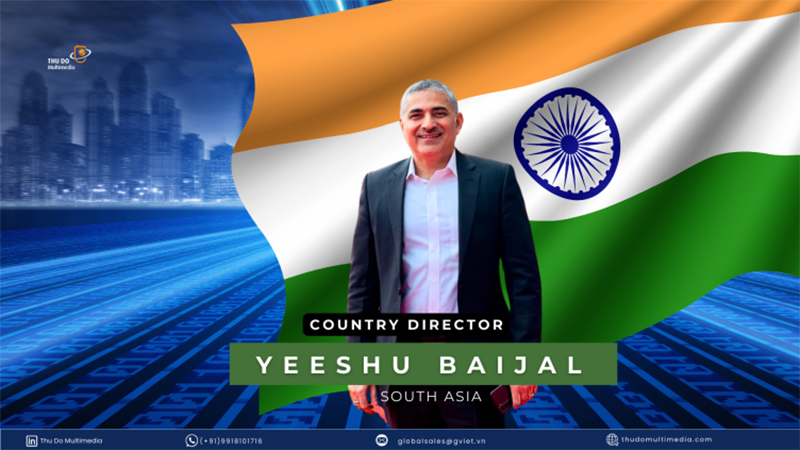
  • ThuDo Multimedia welcomes Yeeshu Baijal as country director

    ThuDo Multimedia welcomes Yeeshu Baijal as country director

    MUMBAI: Two decades – long enough for a fledgling to become a master.

    For Yeeshu Baijal, 20 years have been a journey of mastering the art of broadcast, shaping trends, and redefining industry standards.

    Now, this seasoned leader steps into the spotlight as ThuDo Multimedia India appoints him as country director, entrusting him with the helm to steer their growth and innovation in the ever-evolving Indian OTT multimedia landscape.

    Baijal’s extensive career includes significant roles at leading firms such as ABV International, where he served as sales head for SAARC countries. In this capacity, he was instrumental in driving business development and establishing strategic partnerships across the region. His leadership was pivotal in expanding ABV International’s footprint and enhancing its market presence.

    Prior to his tenure at ABV International, Baijal held key positions at various organisations like TRIAX A/S regional manager; Viacom18 Media Pvt Ltd manager- network sales & development; Zee Turner Ltd area sales manager; Disney Star territory manager, contributing to their growth and success through his deep understanding of the broadcast and media landscape. His career trajectory reflects a consistent commitment to innovation and excellence in service delivery.

    At ThuDo Multimedia India, Baijal will oversee the deployment of Sigma OTT—a comprehensive solution designed to meet the diverse needs of broadcast and media operators worldwide. Sigma OTT’s suite of products addresses critical challenges, including content protection through Sigma DRM and revenue generation via Sigma Interactive, a value-added portal for broadcasters.

  • SC upholds TRAI Act over Copyright Act in tariff order case

    SC upholds TRAI Act over Copyright Act in tariff order case

    MUMBAI: The two-judge bench of the apex court with Justices Rohinton Fali Nariman and Navin Sinha dismissed the Star India’s appeal against Telecom Regulatory Authority of India’s (TRAI) recent tariff order. The principal area of the argument by the broadcaster was that the pricing of the content cannot be regulated by TRAI as it comes under the Copyright act. The verdict has clearly pronounced that the as TRAI Act is in public interest, it should prevail over the Copyright Act.

    “The best way in which both statutes can be harmonised is to state that the TRAI Act, being a statute conceived in public interest, which is to serve the interest of both broadcasters and consumers, must prevail, to the extent of any inconsistency, over the Copyright Act which is an act which protects the property rights of broadcasters. We are, therefore, of the view that, to the extent royalties/compensation payable to the broadcasters under the Copyright Act are regulated in public interest by TRAI under the TRAI Act, the former shall give way to the latter,” the Supreme Court order said.

    The 123-page judgment read that a copyright is meant to protect an owner’s work (original or re-broadcasted) and isn’t concerned with the interest of the end user or consumer and hence does not fall under the purview of the Copyright Act. It is the TRAI Act that needs to focus on the consumers’ interest.

    The Supreme Court added that the Copyright Act will operate within its own sphere giving broadcasters full flexibility to change royalty or compensation. On the other hand, TRAI does not, in substance, impinge upon these acts. It even observed that broadcasters have freedom to provide their own choice of content and arrange their own pricing as long as they aren’t discriminatory or force subscribers to choose either bouquets or a-la-carte.

    In the Supreme Court order, it was also noted that one of the functions of the authority, is to “facilitate competition and promote efficiency in the operation of telecommunication services (which includes broadcasting services) so as to facilitate growth in such services.”

    The tariff order has been the subject matter of extensive discussions between TRAI, all stakeholders and consumers. The order read further that the focus of TRAI has always been to provide a level playing field to both broadcaster and subscriber.

    Though the impending ruling led to lack of clarity, all the major broadcasters published their Reference Interconnect Offers along with the line of the order. As Star India was the petitioner, it did not publish its RIO.

    “The SC order has empowered consumers across the nation. While the overall media and entertainment landscape has been evolving rapidly, it is for the first time in 26 years that such a strong and positive step has been taken to eradicate the lack of transparency in the cable and broadcast value chain,” ZEE and Essel Group chairman Subhash Chandra commented.

    “This is the watershed moment we have all been waiting for. We feel that the new framework will bring in much needed transparency, parity, promote exercising of choice for the consumer and ensure orderly growth of the sector. The onus is now on all service providers to put their best foot forward and keep consumer interest in mind by complying with the required initial timelines and activities at the earliest,” AIDCF president Rajan Gupta said.

    While along the same line TRAI chairman RS Sharma said it is a big win for consumers as per a PTI report, the verdict undoubtedly has far-reaching impact in broadcast industry.

    Earlier in the Madras High Court, division bench consisting of Justice M Sundar J and Chief Justice Indira Banerjee gave a spilt verdict. While M Sundar’s ruling was in favour of Star India, a third judge upheld the tariff order except certain riders.

  • At Zee, we dont believe in growth without profitability : Punit Goenka MD & CEO Zeel

    At Zee, we dont believe in growth without profitability : Punit Goenka MD & CEO Zeel

    Mipcom is the biggest event for all those in the broadcast industry. But this years Mipcom was even more special. For the first time in the history of Mipcom, an Indian addressed the gathering as a key note speaker. Present today was Zeel MD and CEO Punit Goenka, who elaborated on Zee, the changing Indian broadcast industry and the role of digitisation and the growth of new media.

    Digitisation is one big opportunity that everyone is looking at. It will also impact the advertising market positively. If you look at the advertising market; the growth in the past five years has been roughly nine per cent and television has been growing at 15 to 16 per cent. The advertising industry will see a great boost whether it is captured on traditional media or new media.

    Zee Entertainment Television was started in 1992 with just two hours of programming scheduled at that point of time; today we have 34 channels in India, 29 on a global basis.
    Our journey outside India started in 1995 so the international business is now 18 years old, but truly, the international business started only a few years back. In the first 15 years, we concentrated on the Indian diaspora.

    In the international market, to start with, we picked up the Middle East, Russia and Malaysia, where our content is re-purposed and re-formatted to suit the local audience. Our goal is to reach one billion audiences by 2020, thereby taking Zee to the top ten channels. These markets have a lot of connection with India, especially on the Bollywood side.


    Opportunities ahead of digitisation in India


    In the traditional analogue market, there was huge piracy, approximately 70 per cent. So a broadcaster like Zee did not get its fair share of valuation. This will change with digitisation.

    The second opportunity is that India is still the cheapest content market. The ARPUs that the consumers pay is $ 3 per month for almost 200 channels. I feel this number will go up to $ 10-12 with digitisation. So the opportunity is two-fold.

    Digitisation is one big opportunity that everyone is looking at. It will also impact the advertising market positively. If you look at the advertising market; the growth in the past five years has been roughly nine per cent and television has been growing at 15 to 16 per cent. The advertising industry will see a great boost whether it is captured on traditional media or new media.

    Another development taking shape in India is the new measuring body called Broadcast Audience Research Council (BARC). The advertisers, broadcasters and agencies have come together to form this measurement system. Currently, the sample size in India is less than 10,000 homes, which in the next five years will go up to 100,000 sample households. This again will prove beneficial for advertisers who can find the right consumers.


    The profit mantra…


    Revenue growth is first and profitability comes in later. But at Zee, we have always followed the mantra that growth without profitability is not good. So according to us, any investment on a sustained basis that does not give a 20-25 per cent return on the capital invested is a bad investment. So when the Indian broadcast industry operates at an average of seven to eight per cent, Zee operates at a healthy 25 per cent plus.


    Viewer segmentation…


    Going forward, both digitisation and the need of advertisers will lead to further segmentation. Also, fragmentation is the order of the day. We are continually developing more content and more products to further segment the audience and grow and reach the billion mark.

    As long as there are consumers at the end of it; yes, we will move to the second screen. In India, the concept of second screen is at an early stage. It is largely the same content that is being reformatted. For example a show which is 40 minutes on traditional media, is shortened to 15 minutes for the small screen or second screen. There have been some investments specifically for this content, largely to get the youth. But, this is still at an early stage. 


    Content creation…


    We have a strong internal team working towards ideation and content creation for shows. India is traditionally known for importing formats, Zee was the first one to develop local formats in India. A lot of credit goes to the in-house team, but the credit also goes to the execution department, because investing in formats is not easy, it is expensive and the returns come in only after three or four years. So we have to continuously innovate in terms of our content and formats. The taste changes and so we have to adapt to the changing needs.


    Criteria for choosing international partners…


    The first thing we see is if my partner shares the same passion and vision. The world today is moving towards more co-operation than competition. We are actually collaborating with our competitors to see how we can mutually create content. So we have partnered with our key competitors in India. So as long as the industry grows, a company like Zee will grow.


    Indian talent pool…


    India has a dearth of talent in this industry and this is because there are no specialised schools to train people. We at Zee recruit fresh talent every year and put them through rigorous training through institutes that we have partnered with. We have created an environment where people are given the right to decide and build a culture of entrepreneurship. And therefore they take ownership which leads to positive results. I have been talking to schools as well to see if a programme can be created to develop this pool.


    Attrition rate in the Indian broadcast industry…


    Being a traded organisation, we can give equity stock options to people and that has worked for us. Currently, almost three per cent of the company is owned by the people and this combined with the environment that we create helps us keep the attrition rate as low as possible. In India, people are still moving within the Indian broadcast industry. We are not really seeing too many attritions happening from Indian companies to international markets, but the day isnt far.


    Moving towards second screen…


    As long as there are consumers at the end of it; yes, we will move to the second screen. In India, the concept of second screen is at an early stage. It is largely the same content that is being reformatted. For example a show which is 40 minutes on traditional media, is shortened to 15 minutes for the small screen or second screen. There have been some investments specifically for this content, largely to get the youth. But, this is still at an early stage. As a content creator, we will catch up soon. We were the first in the country to launch a Video on Demand service on mobile called Ditto TV, under a subscription model. Today we have 200,000 subscribers for it. I think the biggest hindrance is lack of a good broadband service. As the infrastructure improves, in the next three to five years, we will grow in this segment as well.

  • Cameron Pace Group rolls out new 3D technology

    Cameron Pace Group rolls out new 3D technology

    MUMBAI: The Cameron Pace Group debuted new 5D technology at the 2013 Winter X Games that made an irreversible dent in the barriers that have traditionally limited 3D growth.

    In the spirit of the Games, well known for their tradition of breaking records and defying limits, CAMERON | PACE Group (CPG) rolled out new technology that effectively integrates 2D and 3D content production using cost-competitive, scalable methods to improve image quality and overall viewer experience.

    Specifically, this technology addresses the broadcast industry‘s central challenge – to produce multi-format live footage without multiplying production costs. CPG co-chairman, CEO Vince Pace said, “Our engineering efforts always focus on ways to enable broadcasters to do more with less. The X Games were a milestone in demonstrating that 3D innovation can also directly augment 2D production.”

    The debut of CPG‘s new broadcast solutions built on the company‘s efforts in producing the technology and methodologies necessary to make integrated 2D and 3D (known as 5D) productions attractive and scalable options for mainstream broadcasts. To accomplish this, CPG developed products that embed 3D functionality into existing 2D production models without sacrificing flexibility or mobility.

    “Our goal at CPG is to enable broadcasters to generate top quality footage under any circumstances, adapting to any approach they select. For this year‘s X Games, we were able to do just that” explains Pace.

    The Technology: To service the X Games, CPG deployed two Shadow mobile units, each equipped with newly engineered MaxRemote automated camera rigs. MaxRemote™ technology is at the core of CPG‘s new suite of production tools and puts total control of all camera rigs in the hands of the mobile unit production team. This technology also facilitates critical functions including matching back focus and vertical lens tracking, features that are being looked at for use in standard 2D production. MaxRemote reduces the amount of personnel needed to staff cameras in the field and facilitates centralized command of 3D image acquisition and quality control

    This technology was critical for coverage of the X Games, a complex live production with camera placements in hard-to-access locations. CPG CTO Patrick Campbell said, “The key to MaxRemote™ is you can place the camera anywhere and never have to physically visit during the production. At the X Games, the cameras were essentially only visited when they were bagged for the night and unbagged in the morning.”

    CPG‘s MaxRemote technology complemented its three additional innovations in 3D image capture and playback. One of these innovations, CPG‘s Dual Convergence Controller system, facilitated more precise alignment of camera rigs, an essential capability for optimizing 3D images, while halving dependency on gear. CPG also upgraded its handheld rigs to newer, more compact and lightweight beam splitter models which use larger imagers than previous designs to provide higher quality 3D images and lens performance.

    Finally, CPG debuted a custom-built, 3D high-speed camera integrated with its latest slow motion replay technology. This system captured shots at 420 fps and produced such high quality replay footage that the X Games judges used it for scoring purposes.

  • The more or less challenge – the role of outsourcing

    The more or less challenge – the role of outsourcing

     SINGAPORE: With the broadcast industry rapidly going digital, broadcasters need to provide new services on their existing cost bases to achieve operational efficiencies to drive in business changes.

    So, besides other seminars on going digital, the third day’s afternoon session at Broadcast Asia focused on how broadcasters need to focus on their core competencies by outsourcing in other areas.

    Some of the important issues that were raised included – why outsourcing is relevant to the broadcast industry and what benefits it can bring. And most importantly what are some of the ways in which outsourcing can be delivered.

    Throwing light on the rapidly accelerating changes in the broadcast industry, Siemens Business Services Media head Saleha Williams said, “Broadcasters have to grow out of their traditional operating models which are no longer working, because of rapid technological changes and business models. Outsourcing can also save us from various revenue pressures which have come in with lots of competition with more platforms, audience fragmentation and increasing churn and new advertising models.”
    The seminar brought out five core elements to the technology change

    o Broadband

    o Mobile

    o PVR

    o HDTV

    o Increasing competition from gaming and other forms of non broadcast entertainment

    Some of the regulatory-led change are:

    o Digital broadcasting (analogue switch off)

    o Deregulation

    Willaims gave out some pointers on how outsourcing can help broadcasters

    o Outsourcing in broadcast markets as much about innovation as cost savings.

    o Solving new problems, such as distribution to emerging platforms.

    o Outsourcers act as a catalyst, enabling broadcasters to transform ways of working. At heart of every outsourcing relationship.

    o Economies of scale, improved operational effectiveness and off shoring.

    o Typically savings of 20-30%, but depends totally on the nature of the service.

    Williams also listed out some of the benefits achieved by outsourcing other parts of the world.

    o Outsourcing in broadcast markets as much about innovation as cost savings.

    o Solving new problems, such as distribution to emerging platforms.

    o Outsourcers act as a catalyst, enabling broadcasters to transform ways of working.

    · Significant technology investment needed to compete in changing broadcast market.

    o Outsourcers can help broadcasters smooth their investment profile.

    o Pay an annual charge i.e. from capex to opex.

    o Outsourcers and their partners provide greater specialisation.

    o Apply learning from working with other broadcast organisations.

    o Sometimes easier to measure and incentivise services provided externally.

    o At heart of every outsourcing relationship .Economies of scale, improved operational effectiveness and off shoring.

    o Typically savings of 20-30%, but depends totally on the nature of the service.

    o Allows broadcaster to concentrate more effectively on its business strategy.

    o Reduces the level of management attention required for non core activities.

    o Hands problem over to a third party.

    · Driven by cost savings and risk transfer / reduction.

    · Embeds outsource provider in broadcaster’s organisation.

    o Provides transformational change.

    o Driven by risk sharing / reduction and cost savings.

    o Flexibility

    Three Principal Issues

    o Not understood initial cost base or level of savings achievable in house

    o Not factored all costs into deal e.g. transition, management and termination

    o Maintain outsourced services in house (pay twice over)

    o Efficiencies change over time i.e. cost efficient process in 2006 may be an expensive one by 2010

    Reasons and Observations

    o Both actual falls and perception that service levels have fallen are important

    o Broadcaster culture – problems need solving at once even if not “on air”

    o Require realistic service levels to be agreed and communicated to all users

    o Broadcaster and outsourcer need to understand each other’s business drivers

    o Need to protect competitive strengths and strategic identity. For instance, a company outsourcing technology may decide to keep enough of its technology strategists in house to be in control of its technology vision.

  • Trai issues paper on cable tariffs for commercial purposes

    Trai issues paper on cable tariffs for commercial purposes

    NEW DELHI: In a bid to bring about a semblance of difference between cable TV pricing for commercial purpose (like in Hotels) and home subscribers, Telecom Regulatory Authority of India (Trai) today issued a consultation paper to discuss the issue before finalizing some recommendations.

    The Trai paper on commercial tariff seeks to discuss issues like whether there is a need to fix tariffs for commercial purposes and its methodology, definitions of commercial consumers and how they can be differentiated from non-commercial consumers.

    A tariff order of 1 October 2004 did not distinguish between commercial and other services.
    However, while dealing with a batch of petitions filed by the hotel and restaurant industry, the TDSAT (disputes tribunal) in its judgment of 17 January, 2006 had pointed out that the regulator’s earlier order did not cover commercial services.

    Accordingly, after careful examination Trai decided as an interim measure to amend the tariff order and provide for a ceiling for commercial tariff also.

    The present consultation paper is part of an exercise to discuss the issue in detail with broadcast industry stakeholders and those representing the hotels and restaurants.