Tag: Brazil

  • Keshet International has Asia Singing

    Keshet International has Asia Singing

    MUMBAI: Keshet International has sold its trailblazing interactive talent format RISING STAR and its high-rating children’s singing format MASTER CLASS into Asia. The deals mark a first for each format in terms of geographical reach.


    RISING STAR will air on Indonesia’s largest private broadcaster RCTI (Indonesian Idol, Masterchef) which reaches a gigantic potential audience of 180 million viewers. An initial 24 x 2 hr episodes have been commissioned and will be produced by RCTI to air in late Summer/early Fall 2014. ABC’s US version of the show will air on June 22 and is available to buyers at MIPTV as a finished 10 episode tape.


    Keshet International has closed deals for RISING STAR in more than 25 territories since its launch at MIPCOM 2013, making it the fastest-selling talent format on record (source: The WIT). Sales include the US (ABC), UK (ITV), Argentina (Telefe), Brazil (Rede Globo), Spain (Atresmedia), Portugal (TVI), Italy (Toro), France (M6 Group) Russia (Rossiya1), Germany (RTL), the Nordics (Nordisk), Hungary (TV2), Ukraine (1+1), Greece (MEGA) and Turkey (Acun Medya). Interest in the format continues to grow worldwide following unprecedented ratings for the show’s original series in Israel, the season finale of which peaked with a 58% share of the total domestic audience.


    MASTER CLASS will find a home in China on Jiangsu Satellite TV, launching in the last quarter of 2014 with a first season of 12 x 90’ episodes. The show is being adapted into a local version done through a co-development deal with Beijing-based production company 3C Media.  


    The original Israeli version of MASTER CLASS is a show in which children sing all-time classics with only positive reviews and no eliminations. It is currently the highest performing talent show on Keshet’s Channel 2. It has also performed extremely well in Hungary where its ratings exceeded TV2’s average for the timeslot by 250%.


    Kanti Mirdiati, Managing Director of RCTI, said, “It is an honor for RCTI to cooperate with Keshet International and be the first TV Station in Asia that will telecast Rising Star. This is a singing talent search program with a very interesting concept and totally interactive format, where the audiences at home can vote at a real time and decide who will stay or who will leave. We can’t wait to see how great this program will be. It will bring a new reality and voting sensation through the new platform called Mobile App.”


    Mr. Liu, CEO of 3C Media, said “We are very happy to be working with Keshet in co-developing this format into a version that’s more suitable to the Chinese audience and market. The core elements of the show remains intact while we bringing in a special local twist to it. We hope to establish a long-term relationship with Keshet in co-developing many future hit shows for China.”


    Keshet International CEO, Alon Shtruzman, said, “We’re delighted to see two more jewels in the Keshet crown airing in Asia. Having a strong presence in such rapid growth regions feels like a great frontier to have conquered.”


    Elsewhere in Asia, Keshet International has sold its hidden camera game show Deal With It to Mediacorp Channel 5.


    RISING STAR is a trailblazing interactive talent format which hails a new era in home entertainment. It enables the first real-time voting by viewers via an innovative free app ‘TV app to you’ which is fully integrated into the show. Making their debut on stage alone, behind a giant wall of TV screens, a performer can only make his or her entry to the studio by securing more than 70% of the viewers’, judges’ and live audiences’ vote. If the bar is met, the screen (which lights up with the face of each voting viewer in real-time) will slowly rise to expose the hopeful to their new fans and the judging panel. From the very first minute of the very first episode, viewers will play an integral role in every decision made on the show and continue to do so throughout the entire season.


    RISING STAR, produced by Tedy Productions for Keshet Broadcasting, marked a record-breaking debut on Keshet’s Channel 2 from September to December 2013, maintaining its audience throughout the full first season as the highest-rated show in 10 of its 15 weeks on air. Over 10 million votes were cast through the app during season one, which has been downloaded more than 1.5 million times. RISING STAR has far outperformed all second screen data ever recorded in Israel, with an activity rate 10 times higher than its nearest competitor. It maintained high ratings and conversion rates (i.e. viewers to second screen participation), in excess of 30%, throughout the series.


    MASTER CLASS is a talent show full of heart, and no heartbreak! It is a music talent show for children singing old classics with only positive reviews and without elimination. It has become a critically acclaimed program that taps into the global trend of family viewing because of its warm and humane approach. MASTER CLASS avoids the intrigue and harsh judgment of a ruthless competition, focusing on the nurturing relationships formed between the teachers and their young students, as they become familiar with the country’s rich musical history and cultural heritage.


    The sixteen stars of the show are children aged 8-14, with the most promising voices in the country. Four teachers – leading artists in the music industry – train them to make the most of their potential and become the best singers they can. The program is set at the music school and its auditorium, where the weekly performances take place. Towards the end of the season the best student in each performance is awarded a place in the graduation show. In this way, the six will sing for the last time in front of the committee, where one will be selected as the best in the class. Still, all the students continue their studies and perform at every show, including the final one.


    Entitled School of Music in Israel, MASTER CLASS became a breakthrough hit oh Keshet Broadcasting Channel 2 – it was the 2nd highest rated show in in 2011, with a season average of 48.1% share and 32.5% rating.


  • UK TV ad market reached record high in 2013

    UK TV ad market reached record high in 2013

    MUMBAI: According to last year’s complete revenue figures released by Thinkbox – compiled on the basis of figures provided by UK’s commercial broadcasters – the total TV advertising revenue in UK rose 3.5 per cent in 2013 to ?4.63 billion ($7.75 billion).


    Last year marked the fourth consecutive year that TV ad revenue had growth in the UK. TV ad investment is forecast to increase again this year, boosted by the World Cup in Brazil. The Advertising Association/Warc predicts growth in revenue for the TV ad market of six per cent in 2014.


    There were 737 new or returning advertisers to TV for the year, accounting for two per cent of total TV ad revenues. TV advertising prices for the year were also the cheapest on record, some 38.5 per cent less expensive than 20 years ago.


    Commercial impressions (the number of TV ads watched at normal speed) during 2013 were up 1.6 per cent on 2012, and have grown by 10.4 per cent over the last five years. The average viewer watched 47 ads a day. This is four ads more a day than five years ago. Collectively UK watched an average of 2.8 billion ads a day in the first half of the year.

  • Al Jazeera Sport rebrands as beIN Sports

    Al Jazeera Sport rebrands as beIN Sports


    MUMBAI: Qatar based network Al Jazeera has rebranded its sport channel from Al Jazeera Sport to beIN Sports. The move will see Al Jazeera Media Network uniting its global sport channels under one name ahead of the 2014 World Cup in Brazil.

     “As excitement builds ahead of the FIFA 2014 World Cup Finals, beIN SPORTS guarantees front row seats to all the live action in Brazil as well as live coverage from other popular worldwide sporting events,” beIN said in the statement.

    Subscribers will now have access to 19 HD channels with 12 in Arabic that were formerly called Al Jazeera 1 to 10 and will now be called beIN Sports 1 to 10. The rebranding will provided viewers more opportunities to watch their favourite sports across the globe.

  • Bing releases the top search trends of 2013

    Bing releases the top search trends of 2013

    MUMBAI: Women are on top, literally! The 2013 search trends released by Bing that includes search data from Australia, Brazil, Canada, China, France, Germany, India, Italy, Japan, Spain, the U.K. and the U.S, reveal that women ruled and were in the top searches. In eight of the 12 participating countries around the world, women were the most searched. Beyoncé reigned in the US, while Miley Cyrus’s highly publicised twerking made her the top-searched person in both Australia and Canada.

    Former flames Justin Bieber and Selena Gomez were the most-searched people in the U.K. and Germany, respectively. Actress and actors Bruna Marquezine, Wen Zhang and Salman Khan were the most-searched people in Brazil, China and India, while singers Rihanna and David Bisbal ranked at the top for France and Spain, and gorgeous TV personalities Danmitsu and Belen Rodriguez were favorites in Japan and Italy.

    It was also a year of American songs, superhero movies, Facebook love, high-end designer brands, controversial sports stars, European getaways and fierce women.

    Bing search trends, found at  www.BingTrends.com, indicate what has most captivated people around the world in 2013.

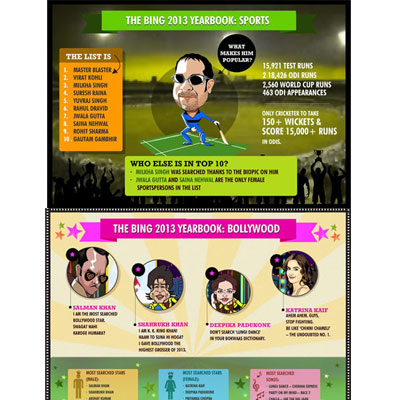
    However, when it came to the top searches in India, surprisingly, it was not the master blaster Sachin Tendulkar, who bid adieu to international cricket in 2013, who was searched the most. He was at number four, only after Salman Khan, Shah Rukh Khan and Katrina Kaif. 

    While he may have led the search among actors, Salman’s films did not feature in the top ten most searched films. The fast paced action flick Race 2 bagged top honours followed by Shahrukh starrer Chennai Express. And the surprise package among the top 10 Hindi movies was Nasha, starring Poonam Pandey. And Shah Rukh Khan may have missed top spot in the most searched actor and film, but his Lungi Dance from Chennai Express made it to the top of charts as the most searched song in India. This was followed by Party on My Mind from Race 2 and Challa from Jab Tak Hai Jaan.

    Sports stars too were popular. While Sachin Tendulkar was the most searched among sports stars, young and feisty Virat Kohli too made it to the top ten. However, the surprise entry was sprinter Milkha Singh, proving that the biopic on him did arouse curiosity about him in the country. Shuttlers Jwala Gutta and Saina Nehwal made sure that their sport was represented in the top ten dominated by cricketers.

  • International filmmakers pick B/W films

    International filmmakers pick B/W films

    KOLKATA: Black-and-white movies are a rarity today, but there are some international filmmakers who have opted to make their feature film debuts with black-and-white cinema that exquisitely weaves in light and shadow effects to create magic from monochrome.


    Brazil’s Eduardo Nunes and Poland’s Rafael Stemplewski’s maiden productions had their Indian premiere recently as part of the ‘Shades of Black and White’ segment of the just-concluded 19th Kolkata International Film Festival. Both had to field the curiosity of audiences about the restricted palette.


    “Some said why not colour as it was a fairy tale. Others appreciated it. I had to make my first film and the decision was not whether it would be great to do something different in black-and-white…I just did it as I felt it would be better that way,” Stemplewski said in Kolkata.


    His film ‘Dendrologium’ (2013), co-directed with Amin Azam, explores the character on his journey around the world trying to discover the myth about the secret of the Sweet Fruit.


    On the other hand Nunes’s ‘Southwest’ (2011) revolves around the life of protagonist Clarice, which lasts for a single day. “Why not black and white…it is just a medium of expression,” Nunes said.


    The pull-factor towards monochrome for Stemplewski was an “artistic decision” and had nothing to do with giving it an aged look. “It created a certain kind of atmosphere and we didn’t want to disrupt this atmosphere. We always wanted to create a unique climate and black-and-white just fitted the story,” said Nunes.


    Moreover, Nunes felt the lack of colour creates a “distance from reality” for the audiences, thereby pulling them closer to the film’s content.


    Usually black-and-white is attempted by ambitious young filmmakers or veterans with enough industry pull, said a Kolkata based movie critic. “Modern black-and-white movies stand out for their classical photography and their willful connection to an earlier period of filmmaking,” he said.


    While reputed Polish filmmaker Joanna Kos-Krauze, who made ‘Papusza’ with husband and co-director Krzysztof Krauze, agreed. But, she also noted that for them, the lack of colour also heightened the sense of the film as a “historical fresco.”


    “Our film is a like a visual poem and so the blacks, whites and grays gave that impression of a different era,” Kos-Krauze said.


    ‘Papusza’ (2013) is a biographical piece on Romany poet Bronislawa Wajs (1908-1987), known as Papusza. She is hailed as Poland’s first gypsy poet. Kos-Krauze and her husband have chronicled Wajs’ life through century-old photographs and other images, thereby giving it a “period look”.


    “We used the latest (digital) technology…red epics…we used photographs almost a century old and the rest we added during post-production. There were no close-ups… that was the hardest decision.”


    “It did not have good distribution because some people did not want to sell a black and white film. It’s a hard decision making a black-and-white film,” she said.


    According to some media reports for actress Katia O’ Wallis, who has starred in the critically acclaimed black-and-white production ‘Big Hit’ directed by noted Greek filmmaker Karolos Zonaras, the “journey was enriching”.


    “The concentration is more on the acting in such movies,” said O’ Wallis, who is of French origin and has starred in several Greek films.

    Also Alexander Payne’s ‘Nebraska’ which released recently followed notable films this year that have opted for monochrome over color, including Noah Baumbach’s New York tale ‘Frances Ha’ and Joss Whedon’s Shakespeare-on-the-cheap “Much Ado About Nothing.”

  • Pay TV growth spurred by BRIC nations, says ABI Research

    Pay TV growth spurred by BRIC nations, says ABI Research

    MUMBAI: India is just a year into the process of digitisation, and, in another year, it is quite likely all of the nation’s 100-odd million cable TV homes will be having a set top box (STB) perched on top of their TV sets. The rapid spread of the STB and pay TV is ensuring that India increasingly pops up in research reports on pay TV as a major contributor of growth. Other countries which are also helping spike pay TV growth are Brazil, Russia and China.


    Take a dekko at the latest report released by international research firm ABI Research. It states that the pay TV subscriber base across the world surpassed 886.5 million at the end of Q3 2013, a six per cent YoY increase and generated $ 62.6 billion service revenue. Maintaining its Q2 2013 status, BRIC (Brazil Russia India China) nations were a major contributor and will continue to be in the future years, ABI has stated.


    The research predicts that by 2018, global pay TV subscribers will shoot to more than 1 billion out of which BRIC countries will be responsible for 68 per cent of total net additional subscribers.


    “Emerging markets are key drivers of global growth in pay-TV subscribers as developed markets are experiencing flat growth rates,” said ABI Research VP and practice director Jake Saunders.


    The US Pay TV market grew at less than one per cent as compared to Q3 2012, due to increasing cord cutting by cable TV subscribers who are switching over to cheaper OTT services such as Netflix and Hulu. According to the report, approximately 1.7 million subscribers were lost from cable TV last year in North America. However, revenues increased due to high ARPUs (Average Revenue per User) driven by increasing HD and advanced DVR (Digital Video Recorder) subscribers.


    European countries also showed marginal growth with less than two per cent increase than Q3 last year. Service providers in Spain lost over seven per cent of their pay TV subscribers and Italy over two per cent as compared to a year ago due to the weak economic environment. However, markets such as the UK, France and Germany along with other Western Europe countries saw IPTV subscribers increase by 1.9 million from Q3 2012 to Q3 2013.


    According to a 2012 report by the Singapore-based Media Partners Asia (MPA) overall pay TV subscribers in India were expected to cross 170 million in five years. Much like the US, India is also set to see revenue increase due to HD TV sets. India has one of the lowest ARPUs in the world at approximately Rs 140 ($ 2.2) but the industry is optimistic that it will grow to Rs 550 ($ 8.73) once digitisation is complete.

  • India leads in those using video conferencing for new businesses

    India leads in those using video conferencing for new businesses

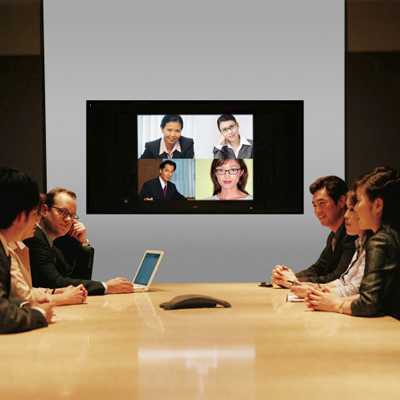
    NEW DELHI: Polycom, has announced that almost all (96 per cent) business decision makers believe video conferencing removes distance barriers and improves productivity between teams in different cities and countries, with India, Brazil and Singapore showing significant usage.

    According to the “Global View: Business Video Conferencing Usage and Trends” survey of more than 1,200 business decision makers, conducted by Redshift Research and commissioned by Polycom, video conferencing is an essential tool helping improve team collaboration and closing the physical and cultural gap between colleagues doing business across distances. 

    India leads the way in using video conferencing for new business with 60 per cent of respondents saying they use or would use video conferencing for new business. This was followed by Russia and Brazil at 49 and 44 per cent, respectively.  Across the globe, 38 per cent of respondents use video, or would use video, for new business.

    The survey found that video is becoming more pervasive in businesses across the globe.  When asked to choose their preferred methods of communications today, respondents ranked video conferencing third (47 per cent) after e-mail (89 per cent) and voice/conference calls (64 per cent), and those same business leaders and managers expect video to be their most preferred collaboration tool in three years (52 per cent), followed by e-mail (51 per cent) and voice/conference calls (37 per cent).  Respondents who use video conferencing today said the three biggest advantages are: better collaboration between globally dispersed colleagues (54 per cent), greater clarity of topics being discussed (45 per cent) and more efficient meetings (44 per cent).

    Over three quarters of decision-maker respondents (76 per cent) are now using video conferencing at work with 56 per cent of video users taking part in video calls at least once a week.  The survey found that in Brazil, India and Singapore that number jumps up significantly, as more than two-thirds of respondents in those countries use video conferencing at least once a week. 

    The survey also revealed that 83 per cent of respondents, and almost 90 per cent of those in their 20s and 30s, use consumer video conferencing solutions at home today, and almost half of all respondents use video conferencing at home at least once a week. 

    “The growing popularity of video conferencing at home, especially by millennials entering the workforce, is a big driver of increased preference for and adoption of video collaboration in the workplace,” said Polycom EVP and chief marketing operator Jim Kruger.

    “Some key factors to making video as popular in the office as it is at home is ensuring it’s easy to use, providing a high quality connection, delivering enterprise-grade security, and participants’ willingness to accept and adapt to cultural differences as they communicate across borders.  We’re seeing businesses around the world defy distance every day using video collaboration, including increasing productivity, enhancing employee engagement, improving time to market and helping to save lives,” he added. 

    The study also showed that laptops and desktops are the most popular devices for business video conferencing (75 per cent of respondents), followed by conference rooms (48 per cent) and mobile devices (42 per cent).  As video conferencing continues to become more pervasive, in three years laptops and desktops are still expected to be the most preferred device (72 per cent), while mobile devices and conference room usage will increase to 55 and 51 per cent, respectively.

    The survey provided sharp insights from video conferencing users into which behaviours constitute an ideal video meeting, and which are distracting for business decision makers. 

    The survey found the top three most important criteria for an ideal video meeting are: the ability to hear everyone clearly (69 per cent); technology that is straight forward and easy to use (60 per cent); and Good eye contact with colleagues/ everyone is clearly visible (58 per cent).

    Respondents who use video conferencing said the most distracting things, which should be avoided during video meetings, are: Mobile phone going off during a meeting (58 per cent), people attending from inappropriate places – e.g., public transit, in stores (52 per cent), people who are multi-tasking or look distracted – e.g., tapping on keyboard – (51 per cent), and inappropriate background distractions such as colleagues, music, noise (50 per cent).

    The Polycom survey shed light on different opinions between users of video collaboration in various countries, where one activity may be distracting in one country but accepted in another. 

    When asked if people not wearing business attire was a distraction, respondents from India, Singapore and Poland topped the list (30, 26 and 21 per cent, respectively), and on the other end of the spectrum, 13 per cent or fewer of respondents in the UK, France, Russia and The Netherlands find attire to be a distraction.

     In the Asia-Pacific (APAC) region, international communications (between colleagues in different countries) ranked as the most important use of video conferencing (65 per cent), versus 57 per cent for inter-country communications. 

    The U.S. leads the way in leveraging video conferencing for recruitment and hiring, as 32 per cent of video respondents said they use or would use video for this purpose, followed by APAC at 28 per cent.  

    In the Europe, Middle-East and Africa (EMEA) region, respondents were mostly using video conferencing to empower flexible working environments, which was cited as the second highest reason for using the technology, after “connecting with colleagues across the country.” 

    As access to video conferencing increases to virtually all employees with a mobile device or laptop, the survey found that video users in various business functions within organisations use video to defy distance in slightly differing ways: 

    CEOs and founders rated flexible working and inter- office/local meetings (50 per cent each) as their top reasons they use or would use video conferencing, followed by international meetings (46 per cent), new business/sales and company/department meetings (39 per cent each), and during an average week, the marketing function uses video collaboration the most frequently (64 per cent use video at least weekly) in an organisation, followed by IT/engineering and facilities (62 per cent use video at least weekly).  However, when it comes to daily usage of video at work, the HR function is the power user (32 per cent indicate they use video conferencing daily), followed by sales executives (28 per cent indicate they use video conferencing daily). The IT/engineering and manufacturing/supply chain functions are most likely to use video collaboration for international meetings, with 61 and 58 per cent of respondents, respectively, saying they use or would use video to collaborate face to face with colleagues internationally. In fact, according to the survey results, these are the two job functions that use video collaboration more for international meetings than local, in-country video meetings.

    All respondents, regardless of role, predominantly used video conferencing for inter-office meetings, followed by international inter-office meetings. Overwhelmingly, respondents said it is important to try and understand different country cultures when meeting using video conferencing (97 per cent) and 89 per cent of respondents called for etiquette rules to be established to help them better use video conferencing for business. 

    To help business better navigate these differences and drive more effective use of video conferencing, Polycom is launching Polycom’s Guide to Collaborating Across Borders, an insightful new guide designed to help readers understand the nuances of doing business across the globe.  This guide is one of several new resources for business leaders across almost every enterprise function – from IT to HR to the C-suite – to learn how video conferencing can help them defy distance and achieve their goals more quickly and efficiently. 

  • CareerBuilder Releases Striking Differences in Typical Workdays Around the World

    CareerBuilder Releases Striking Differences in Typical Workdays Around the World

    MUMBAI :  A new global study from CareerBuilder shows that a typical day in the office is not so typical across the globe: When you look at the average workday in the 10 largest economies around the world, you begin to see how alike workers can be—and also where they differ the most. The global survey, conducted online by Harris Interactive© from May 9 to June 5, 2013, included more than 5,000 hiring managers and human resource professionals in countries with the largest gross domestic product.

    INFOGRAPHIC:http://cb.com/1gnMhxK

    Driving vs. Public Transportation

    While the 10 countries surveyed have the largest economies on the planet, they also have some of the largest populations, but instead of taking public transportation or using other ways of getting to work, the majority of workers indicate they drive themselves to work every day,
    •    U.S. 82%
    •    Brazil: 74%
    •    China: 69%
    •    Germany: 63%
    •    France: 62%
    •    Italy: 60%
    •    Russia: 60%
    •    U.K.: 58%
    •    India: 52%
    •    Japan: 44%

    Suit and tie optional

    Of the 10 surveyed countries, India is the only place you’ll see the majority of workers in business formal attire (50 percent), such as suits. In every other surveyed country, business casual (e.g., slacks, button-down shirts, sweaters) is the standard dress code as below
    •    U.S. 64%
    •    Brazil: 57%
    •    Italy 51%
    •    UK: 51%
    •    Russia: 50%
    •    China: 49%
    •    France: 45%
    •    Germany: 45%
    •    Japan: 42%
    •    India: 36%

    Communication preference

    Although everyone might seem to be glued to their smartphones, tablets and laptops these days, face-to-face conversations still rule the workplace. In all 10 surveyed countries, in-person communication beat electronic messages such as emails, texts and instant messages by large margins, with phone conversations being the least used.

    •    U.S.: 
    o    Face-to-face: 59%
    o    Digital: 30%
    o    Phone: 10%
    •    UK:
    o    Face-to-face: 68%
    o    Digital: 20%
    o    Phone: 11%
    •    France:
    o    Face-to-face: 79%
    o    Digital: 15%
    o    Phone: 6%
    •    Germany:
    o    Face-to-face: 73%
    o    Digital: 15%
    o    Phone: 13%
    •    Italy:
    o    Face-to-face: 66%
    o    Digital: 23%
    o    Phone: 11%
    •    Russia:
    o    Face-to-face: 80%
    o    Digital: 10%
    o    Phone: 9%
    •    India:
    o    Face-to-face: 60%
    o    Digital: 23%
    o    Phone: 17%
    •    China:
    o    Face-to-face: 81%
    o    Digital: 16%
    o    Phone: 2%
    •    Japan:
    o    Face-to-face: 42%
    o    Digital: 32%
    o    Phone: 27%
    •    Brazil:
    o    Face-to-face: 45%
    o    Digital: 32%
    o    Phone: 23%

    Socializing with coworkers

    Socializing with coworkers outside of office hours can be a good way to learn about your colleagues or relax after a hard day at work. Yet, not everyone is eager to participate. Workers in China and India are more than twice as likely to attend social events than workers in Germany and the U.S.When asked do you socialize with coworkers, the following said yes,
    •    China: 98%
    •    India: 93%
    •    Brazil: 76%
    •    Russia: 68%
    •    Japan: 66%
    •    France: 64%
    •    UK: 55%
    •    Italy: 53%
    •    US: 41% 
    •    Germany: 38%

    Hours spent at work each week

    The number of hours workers spend at work is pretty consistent around the world, but while Chinese workers spend slightly less time at work each week, they report (29 percent) bringing work home with them at least once a week, higher than the other countries.
    How many hours do you work each week?
    •    31-40: U.K. (47%), China (46%)
    •    41-50: Japan (48%), U.S. (47%), India (46%), Germany (44%), Brazil (43%), Italy (42%), Russia (40%), France (37%)


    How often are youbringing work home?
    •    US: 
    o    1 Day a week: 18%
    o    Never: 26%
    •    UK:
    o    1 Day a week: 17%
    o    Never: 30%
    •    France:
    o    1 Day a week: 19%
    o    Never: 32%
    •    Germany:
    o    1 Day a week: 19%
    o    Never: 39%
    •    Italy:
    o    1 Day a week: 25%
    o    Never: 43%
    •    Russia:
    o    1 Day a week: 25%
    o    Never: 39%
    •    India:
    o    1 Day a week: 26%
    o    Never: 29%
    •    China:
    o    1 Day a week: 29%
    o    Never: 30%
    •    Japan:
    o    1 Day a week: 18%
    o    Never: 59%
    •    Brazil:
    o    1 Day a week: 22%
    o    Never: 30%

    Taking vacation

    When asked how many days they took off from vacation, workers had strikingly different answers depending on where they live. Italian workers took off the fewest days, with the nearly two-thirds majority taking 7 days or fewer (64%). Forty-six percent of Japanese workers took more than 35 days off, more than workers in any other countries.
    •    0-7 days:
    o    Italy: 64%
    o    UK: 29%
    o    Brazil: 20%
    •    8-14 days:
    o    India: 34%
    o    U.S.: 27%
    •    15-21 days:
    o    China: 28%
    •    22-28 days:
    o    Russia: 35%
    o    France: 25%
    •    29-35 days:
    o    Germany: 30%
    •    35+ days: 
    o    Japan: 46%

    Survey Methodology

    This survey was conducted online within the U.S., Brazil, China, France, Germany, India, Italy, Japan, Russia and the U.K. by Harris Interactive©on behalf of CareerBuilder among400 to 2,279 hiring managers and human resource professionals (employed full-time, not self-employed, government and non-government) in each country between May 9 and June 5, 2013 (percentages for some questions are based on a subset, based on their responses to certain questions). With pure probability samples ranging from 400 to 2,279, one could say with a 95 percent probability that the overall results have a sampling error between +/- 4.9 and +/-2.05 percentage points. Sampling error for data from sub-samples is higher and varies.

  • Creating a global footprint for Indian cinema

    Creating a global footprint for Indian cinema

    MUMBAI: At the inauguration of the Mumbai Film Mart, it looked like that the Indian film community is all set to go global. So, while it had invited delegations from other countries like Spain to partner for co-productions, the Indian film community also made an extra effort to promote films that have been made in collaboration with other countries. Like, Qissa: The tale of a Lonely Ghost that premiered on the first day of the festival is an Indo-German-Dutch-French co-production.

    NFDC GM, executive producer & head marketing Vikramjit Roy at the inauguration of the Mumbai Film Mart on 18 October, said that to take Indian cinema beyond the confines of the country, NFDC is making many efforts. “We are primarily looking at co-production with seven or eight odd countries that India has treaties with in the near future. These include the likes of Germany, France, UK, Brazil, Italy, New Zealand and I hope Spain, Canada and Australia as well very soon.”

    Roy further went onto explain how global collaboration helps a local Indian story like Qissa to team up with local funding bodies of Europe. “For example, if you do an Indo-European co-production with any of the European countries mentioned earlier, you will get to access funds from the central European funding body and the co-producer also gets an access to various regional funds,” Roy explained.

    Qissa got funding from NRW that is located in Germany; it had funding from NFF that is a Dutch film fund and also from France. “Besides, when the film goes on floor and gets a certain positioning, you get a sales agent on board. Like, we had the Match Factory join hands with Qissa. Something like this allows for a certain positioning and global footprint.”

    We have a film called ‘Arunoday’ with France and we are hoping to do one with New Zealand soon, says Vikramjit Roy

    In fact, to widen its horizon, the festival had invited the official Spanish delegation, Spanish Federation of Producers (FAPAE) for co-productions along with senior decision makers from the Spanish Ministry, Tourism and Film Commission, who are eager to partner with the Indian film community.

    Talking about it, Institute of Cinematography and Audiovisual Arts (ICAA) Spain director general Susana de la Sierra, said: “This is the first visit from the series of visits that we have planned in the time to come. This is to strengthen our relationship with India and also possibly look at making co-productions between the two countries.”

    What makes the Spain delegation more interested in partnering with India is that both the countries are similar in terms of their cultural diversity. “Spain is far smaller than India in terms of landscape and population, but there are a lot of similarities. We both have cultural diversity. We have 17 regions within the country and apart from the national film fund, we too have regional film funds,” she added.

    I feel this is not only a really good opportunity for us to work together but also help find Spanish and Indian films their audiences believes Susana De La Sierra

    Susana looks at this as a great opportunity, not only for working together but also helping Spanish and Indian films find their audiences. “Going forward, I do see more work travelling from India to Spain and vis-?-vis, as it’s a fact that after the Indian representatives visited Spain there are several projects that have been lined up to be shot in and around Spain.”

    There are also plans to import Indian films into Spain and Spanish movies into India and this practice will only intensify further as both the countries will work hand in hand to help each other. The Spanish ministry keeps aside a fixed budget to help nurture and push the film industry to take that creative freedom and showcase the Spanish culture in all its glory.

    The Indian film community has already witnessed the popularity and profit that foreign collaborations bring. In Toronto, NFDC positioned Qissa as a global film, which helped it in achieving the Best Asian Film Award by Net pack. “We are hoping that Qissa turns out to be a trendsetter as now we have a film called Arunoday – directed by Partho Sengupta – with a French collaboration and we are hoping to do one with New Zealand soon too,” Roy added.

    Looks like Indian film community is all set to make an international footprint.

  • 79% Indians look for best deals while shopping

    79% Indians look for best deals while shopping

    MUMBAI: A majority (79 per cent) of Indians would rather ‘spend time looking for a good deal,’ while only 21 per cent would rather ‘pay more to make a quick/efficient purchase.’ The findings reflect a new poll of 18,503 online respondents conducted by Ipsos OTX.


    “Indian consumers lately show both impulsive and compulsive buying behaviour. But at the same time they are dealaholics and hardcore value for money seekers. No wonder why sale/ discount offer periods record the highest revenue both for online and offline retailers,” said Ipsos India head of marketing Biswarup Banerjee.


    Those with a lower household income (82 per cent) are most likely to spend time looking for a good deal. Even those with middle (80 per cent) and high (74 per cent) levels of income, however, would take the time to find a better price. Similarly, those with a low level of education (100 per cent) are more likely than those with a medium (80 per cent) or high (79 per cent) level. Women (80 per cent) are more likely than men (78 per cent) to go hunting for a sale.


    The countries with the highest proportions of those indicating they would rather spend time looking for good deals are from: Hungary (94 per cent), Spain (94 per cent), Great Britain (93 per cent), Argentina (92 per cent), Belgium (91 per cent), France (91 per cent) and Germany (91 per cent). This group of deal-chasers is followed by: Australia (90 per cent), Italy (90 per cent), Mexico (90 per cent), Japan (88 per cent), South Africa (87 per cent), Canada (86 per cent), Poland (86 per cent), the United States (85 per cent), China (81 per cent), Russia (81 per cent) and South Korea (81 per cent). The lower group includes: India (79 per cent), Brazil (76 per cent), Saudi Arabia (76 per cent), Norway (75 per cent), Sweden (75 per cent), Turkey (74 per cent) and Indonesia (58 per cent).