Tag: brands

  • Brands on its way to digital success

    Brands on its way to digital success

    MUMBAI: As digital advertising and online presence gains ground for brands, they are increasingly realising that the digital world differs greatly from traditional media. A one size fits all strategy is unlikely to help brands leverage the full strength of the digital platform.


    Additionally, user engagement in real time and dynamic digital environment is a challenge. To add credibility to visibility, marketers need to continue to make full use of online by listening and engaging-not just showcasing.


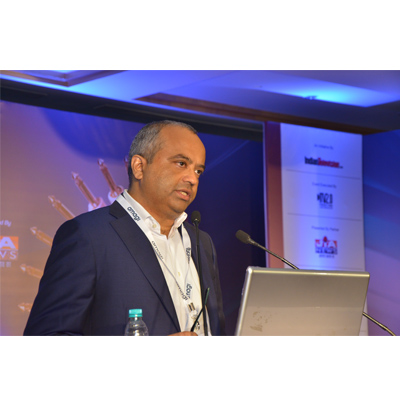
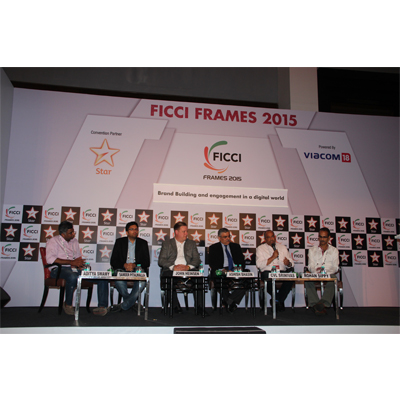
    Discussing the same were panelists namely Dentsu Aegis CEO Ashish Bhasin, GroupM South Asia CEO CVL Srinivas, Producers Guild of America CEO, Bunnygraph and VP, new media John Heinsen, Culture Machine CEO Sameer Pitalwalla and Viacom18 Media MTV EVP and business head Aditya Swamy.


    The panelist discussed the ingredients required to build a successful online brand presence. The session was moderated by film-maker Rohan Sippy.


    According to Srinivas, the world is moving towards programmatic buying and advertising. “Most of the advertising media is getting automated on digital. It has huge implications on the brands,” he said.


    Talking about brand’s engagement on the digital world, Bhasin feels that there is nothing different in the digital world earlier than the digital brands. He believes that many brands in today’s time are going wrong. “The principle of any brand is to identify the consumer’s needs and fulfil them,” he said adding that today many brands are getting caught between digital and technology.


    He believes that the key to success will be to retain factors like – maintaining the principles of brand building and secondly speed of response accelerated to deliver a lot more basis on the consumer’s needs.


    Heinsen opined that brands on digital platforms are the best combination. It gives visibility to brands even more. A successful brand building is the convergence of three things – traditional media, advertising and technology. According to him, integrating these things are needed to build a brand. “As content creators and story-tellers, if we have all these factors only then can you entertain, engage and influence the audiences.”


    According to Pitalwalla, brands face two challenges on the digital platforms. One, there are multiple platforms and each of them comes with their own rules and have a lot more content than traditional media. Second, there is a fragmentation of content. He believes that TV commercials have become just one format in a way people are interacting with the brand.


    Swamy has a different story to tell. He asserted that if people are not talking about your brand, it is considered that your brand has not made it to the heart and minds of consumers. He feels that brand management has now become a 24×7 and 365 days activity.


    As a broadcaster and content creator, Swamy believes that everyone is messing with the format. “People are just playing with all kinds of formats. There is not one fixed formula to it, but people are just experimenting and waiting for it to hit the right chord.”


    Swamy added that dialogue conversation with the digital audiences is very important to keep the brand healthy and live. He stated the example of Roadies. “When Roadies was launched, we noticed that there was buzz only for that time of the period till it was on-air. Offline, there were no conversations at all. To keep the brand alive, we launched a digital series, which is accessible throughout the year and now the digital has become a base and TV show just compliments it. That is the power of digital,” he informs.


    Bhasin believes that today’s consumers have matured. Earlier, people consumed whatever was shown on television. “Now the consumers are telling us what to do. They are dictating the tonality to which we can pass message through our brand,” he said.


    Heinsen believes in the power of conversations. “As a content creator, you should be able to create a content that can spark off conversations. And that’s where social media platforms come into play.”

  • Q3-15: Marico marketing spends up 14%, PAT up 18%

    Q3-15: Marico marketing spends up 14%, PAT up 18%

    BENGALURU:  Indian consumer products company in the beauty and wellness space Marico Limited (Marico) spent 14.1 per cent more towards advertisement and sales promotion (ASP, marketing) in the quarter ended December 31, 2014 (Q3-2015, current quarter) at Rs 153.02 crore (10.5 per cent of net Total Income from Operations or TIO) as compared to the Rs 134.08 core (11.2 per cent of TIO) corresponding year ago quarter (Q3-2014), but 8.6 per cent lower than the Rs 167.47 crore (11.7 per cent of TIO) in the immediate trailing quarter (Q2-2015).

    Notes: 100,00,000=100 Lakhs = 1 crore = 10 million

    During the 12 quarter period starting Q4-2014 until the current quarter, the highest amount spent by the company towards ASP was in Q1-2015 at Rs 192.18 crore (11.8 per cent of TIO). The company’s highest ASP spend in terms of percentage of TIO was in Q3-2013 at 14.1 per cent (Rs 152.82 crore). While in absolute rupees, ASP shows a linearly increasing trend during the 12 quarters under consideration, in terms of percentage TIO, the trend declines linearly during the same period. Please refer to Fig A below.

    Marico’s TIO in Q3-2015 at Rs 1452.23 crore was 21 per cent higher than the Rs 1200.69 crore in the year ago quarter and was 1.5 per cent more than the Rs 1431.17 crore in Q2-2015. The highest TIO reported by the company during the 12 quarters under consideration was in Q1-2015 at Rs 1623.13 crore. TIO shows an increasing linear trend during this period. Please refer to Fig B below.


    PAT in Q3-2015 at Rs 159.88 crore (11 percent of TIO) was 18.1 per cent more than the Rs 135.37 crore in Q3-2014 and 35.2 percent more than the Rs 118.26 crore (8.3 percent of TIO) in the previous quarter.  During the 12 quarters under consideration, PAT shows an increasing linear trend both in terms of absolute rupees and in terms of percentage of TIO.

  • LuxHub focus: Luxury super brands still dominate for luxury consumers

    LuxHub focus: Luxury super brands still dominate for luxury consumers

    MUMBAI: A global survey from LuxHub, Havas Media Group’s newly launched luxury consulting boutique, takes in the views of the notoriously hard-to-reach affluent luxury goods customers, all within the top 10 per cent of the household income bracket in each of the USA, UK, China, Russia, France, Italy, Germany, Spain and Saudi Arabia/UAE markets.


    The survey looked at luxury trends for personal spend across retail, travel, home furnishings, auto, jewellery and art and analysed 40 of the top global brands.


    Luxury ‘super brands’ still have the edge


    Global luxury power brands are preferred to niche brands by 64 per cent of respondents. Geographical differences show that in China 83 per cent prefer super brands (the most widely recognised brands being Louis Vuitton and Chanel), and in the US 73 per cent prefer them (top brands being Mercedes and Chanel) vs. only 43 per cent in Spain.


    Quality matters more to people in the UK vs. other markets


    The swings in both brand ranking and preference by country can be explained by differing cultural definitions of luxury. UK luxury shoppers, with an average spend of ?28,243, defined luxury in terms of quality (78 per cent vs. a global average of 63 per cent) and personal reward (44 per cent vs. a global average of 26 per cent). When it comes to luxury products conferring social status, this was important for only 20 per cent in the UK vs. an average of 37 per cent across the markets.


    Germany, Italy and Spain were the only three countries out of the nine to define luxury as exclusivity over quality. Overall luxury perceptions are driven by quality, exclusivity and the desire to express taste and style.


    Average personal spend on personal luxury across the nine markets is ?21,126.


    The affluent luxury consumer spent an average of ?21,126 on luxury in the past year. The highest spend was seen in Russia at ?36,078, UK at ?28,243 and France third, spending on average ?27,402 per year. 


    Among men and women combined, the most popular category for luxury shoppers is clothing and accessories purchased by 89 per cent last year, with an average spend of ?1,625. This is followed by travel, purchased by 87 per cent with an average spend of ?3,791. While only 30 per cent purchased an automobile, average spend among those who did buy one was ?27,630.

    Amount spent on the categories studied shows significant differences according to the country. For example, the average spend on cars is ?27,629 whereas in France it is just over ?10,000 higher at ?38,492. The average spend on travel is as high as ?6,356 in the UK and as low as ?2,121 in China.


    Luxury spend to rise by seven per cent


    Overall growth rate forecast for the industry of seven per cent (33 per cent expecting to spend 28 per cent more, eight per cent expect to spend 36 per cent less and 59 per cent expect to spend the same amount as they did last year). This growth of luxury is in line with the growth projection of GDP for China in 2015 (seven per cent) and non-oil GDP growth in Saudi Arabia (five – six per cent) but considerably higher than the low single digit GDP projections in Europe and the UK.


    When looking at these results however, some very positive indicators can be found. For example, amongst the 33 per cent who expect to spend more on luxury, 44 per cent say this is largely due to seeing more items that they want – demonstrating that the supply side of luxury is a key driver for the sector’s share of wallet. The leading driver is an expectation of increased disposable income (49 per cent).


    Shopping in physical stores is still the favoured method for shopping for luxury goods for 49 per cent of respondents, while 24 per cent shop mainly online. Statistics show that the move by a quarter of the respondents to shop online is not being matched by competency from the brands. Over half of respondents (57 per cent) felt that luxury brands should engage with social media, mainly because they feel that this is how brands in general are communicating nowadays.


    Millennials are more comfortable engaging with and buying luxury goods in the digital sphere. Among Millennial consumers aged 20-34, 72 per cent felt luxury brands should engage with social media, versus 51 per cent of those 35 to 54 years of age. About 29 per cent of Millennials prefer to shop for luxury online versus 19 per cent of the 35 to 54 year age group, and only 44 per cent of millennials prefer to shop for luxury in physical stores, versus 50 per cent of those aged 35 to 54.


    Discounting trend highest in US, Germany


    Over half of those surveyed revealed that they purchase luxury goods at a discount rate, including sales and outlets. The UK luxury shopper shows the highest percentage of full price purchase with 55 per cent purchasing at full price, equal with niche brand loving Spain. This compares to the US luxury shoppers who purchase an average of 67 per cent of their luxury goods at a discount.


    LuxHub Global executive director Tammy Smulders, who oversaw this research, said, “This discounting culture shown in the survey is one that interests many of our clients. The fact is, there are simply more luxury products available in the market today. As a reaction to the recent economic challenges, we saw many luxury brands introducing accessible diffusion lines with different styles and price points, creating something for everyone. In addition, the trend of introducing new lines came as a reaction to the globalisation of luxury and the need for more accessible entry price points for the emerging luxury consumer.”


    “The discounting culture came into common practice, and now the global trend for discounting is here to stay. Despite this, our survey also points to an optimistic future for luxury with a projected increase in spend of 7 percent. It is our view that this discounting culture, coupled with more sophisticated targeting, data management through CRM and storytelling is actually stimulating shopping and there are a wealth of opportunities out there for agile, smart luxury brand marketers,” Smulders added.


    LuxHub global CEO Isabelle Harvie-Watt said, “This global survey highlights differences between cultures, which show how important is to personalise the shopping experience for people in their own countries. What is now critical is the ability to implement culturally relevant strategies that also work in the actual locations where customers engage with the brand. For example, today more than half of the luxury purchases from the Chinese consumers are made outside of China, mostly in Europe and USA. This means luxury brands need to create culturally tailored content, services and experiences that can be implemented anywhere in the world.”

  • Brands eye live sports events for promotions: Procam International

    Brands eye live sports events for promotions: Procam International

    KOLKATA: With improved sentiments in the economy and companies exploring alternative ways to generate brand recognition, the concept of sponsoring sports events, though at nascent stage, has become popular in Kolkata too. And an example of this is Tata Steel becoming the title sponsor for India’s premiere 25K run event to be held in Kolkata. 


    Joining the steel maker, are brands like Oberoi Grand as hospitality partner, Reebok as sportswear and training partner, Himalayan as water partner, Nestle as food and beverage partner and Radio Mirchi 98.3 FM as radio partner among others.


    Procam International, a sports management company involved in the promotion of national and international sporting events, sports consultancy and live television programming, which is also organising the first edition of the Tata Steel Kolkata 25K on 28 December 2014, feels that the company has good sponsorship from both sports and non-sports companies.


    The city will run as one under the following race categories – the 25K (elite and amateurs), Open 10K (amateurs), Ananda Run (6 km), Sr. Citizens’ Run (4 km), and Champions with Disability (4 km).


    “Sports events have become an important element for some businesses to promote their campaigns in other regions of India. It is common to see non-sport brands taking strategic decisions to sponsor sporting events,” said Procam International CEO Dilip Jayaram.


    In 1988, with a vision to provide a more holistic spend to the advertising rupee and a burning desire to ameliorate the prevailing professional standards for sportsmen, Anil and Vivek B. Singh created Procam International. The organisation has based its corporate philosophy on an open culture, with an emphasis on values and integrity. Procam International has promoted and conducted over 45 world events, which have elicited player participation of the highest caliber, as well as huge public interest.


    The Tata Steel Kolkata 25K event will give thousands of individuals a new opportunity to celebrate the birth of a sporting event that salutes perseverance and self-belief and makes lives brighter and better. “Kolkata’s runners can now lace up and join the running revolution that is not just engulfing India’s towns and cities but attracting the attention of the world’s finest runners,” said Jayaram.


    “We aim to ink a number of new sponsorship deals with other brands also. We are looking for a medical partner,” he said adding that for this event, Radio Mirchi will run 18-20 promos every day.


    Talking about below-the-line (BTL) activities, he said that Procam International has put up 37 hoardings and 30 bus shelters.


    About 15,000 people are expected to participate in the five events to be organised through the day. The route for TSK 25K is in the process of being finalised under the guidelines set by the West Bengal Athletic Association and Kolkata Traffic Police.


    Film actor, producer and television presenter Jeet, well known for his passion for fitness, will be TSK 25K’s ‘Face of the Event’.


    In its first edition, the event will recognise the efforts of participants by offering total prize money of Rs 21,54,000. The top ten Elite athletes (men and women) in the 25K category stand to win attractive prizes. While the winner will receive Rs 2,50,000, Rs 1,75,000 is up for grabs for second place while third place finishers will receive Rs 1,00,000. Dividing amateur runners into six segments based on their age – 18 to under 30, 30 to under 40, 40 to under 50, 50 to under 60, 60 to under 70, and 70 and above – TSK Kolkata 25K will also award the top three amateur runners (men and women) in each of the above segments with prizes of Rs 12,000, 10,000 and 5,000 respectively.


    “We urge people of Kolkata and beyond to come and experience the joy of running this December,” Jayaram said.


    According to a city based marketing expert, sports as a property will attract major interest from corporates looking at increasing their marketing spends in Kolkata. “The value of these sponsorship deals is generally high,” the expert concluded.

  • Music is a natural fit for brands

    Music is a natural fit for brands

    MUMBAI: One cannot deny the strong connection between brands and music in the ever evolving music industry. More and more labels, artists and musicians are becoming aware about brand association that could help them attain a more successful outcome. The second day of the 6th edition of MixRadio Music Connects in Mumbai had CNBC TV-18 editor storyboard Anant Rangaswami lead a panel discussion called “The brand story”. Through this panel, the audience got to learn about the importance of brands in the music ecosystem. The invited panelists included Viacom18 EVP media and business head MTV and MTV Indies Aditya Swami, Bacardi India general manager marketing Ali Imran and Vivanta by Taj GM Manojeet Bhujabal.

    The panel discussed the role of brand partnerships within the music industry. The session started with Branded co founder and CEO and Music Matters president Jasper Donat and indiantelevision.com group founder, CEO and editor in chief Anil Wanvari present an award to Imran, for Bacardi’s excellent brand association with music.

    The key point of the discussion began with understanding how brands develop their strategies when collaborating with music.

    Speaking about Taj’s music connect, Bhujabal elaborated: “Music is a primordial expression for us. Our hotels are well-known but we want to present an alternative life outside the realm of hotels.  It was tough to initially develop a notion for Vivanta.  We started on a basic level through house music. We went onto present Urban Tease, Barn Fest, Divas of Rock and Urban Folk. We also developed the Vivanta Sound Lab series and we look forward to discover emerging talents with fresh content.”

    Imran felt there is no straight substitute for music. He commented, “Music is like oxygen for us. It reaches humans in a way that probably no other passion does. For Bacardi, music is a natural fit considering what the brand stands for, its lineage of parties and celebrating the human spirit.”

    Providing his perspective as a channel head on why brands get associated with a music channel, Aditya Swami explained, “Digital has become a key part of the consumer ecosystem. It has allowed brands to talk to consumers in the language of music. We have attracted brands that want to create conversations and we have successfully done so over the years”.

    Swami added that the presentation of music is of paramount importance in the industry, today. He said, “With brands supporting us, we have managed to showcase original music in the best way possible. Today, a brand like Pepsi is a partner of MTV Indies, a dedicated destination for non-film, non-mainstream music. We have given Pepsi a great platform for people to talk about what the brand is doing for the youth. Music is the voice of youth. It’s not just TV ratings that matters now. Traditional metrics are changing and there is a need to build brand love. Platforms like music are fantastic for this”.

    Swami elaborated further that the music industry has an opportunity to develop within the area of music and brand partnerships. He said, “In the last 12 months, every interesting music idea that we have taken to the market has had at least a brand that is interested, as opposed to taking an idea of a reality show or TV soap where the market has become very saturated. Today, retail and lifestyle products are also part of the music ecosystem”.

    At this point, Rangaswami added that brands might have a set of guidelines that would help attain a more successful outcome. He asked the panel how do the brands decide what kind of music to select when working on a campaign?

    To that, Bhujabal replied: “We initially work with content partners who know the domain well. We enunciate what are the idioms and what to bring on the floor. We look at the audience and decide who we are targeting. After that, it is the job of the content creator to curate”. Bhujabal also emphasised on the importance of social media and social engagement to see how many people are engaged and liking their association with that selected genre of music.

    Ending the panel discussion with some food for thought, Swami commented:  “Today, I do not see enough brands or content players doing interesting cuts of our pop music industry. The content guys need to come up with interesting ideas and content relevant for brands around pop music industry. That is a huge space for us to tap into”.


  • Share of news channels in total AdEx is encouraging: CVL Srinivas

    Share of news channels in total AdEx is encouraging: CVL Srinivas

    NOIDA: “Indian news industry is as vibrant as the different cultures of India,” said GroupM south Asia CVL Srinivas as he presented the keynote on Innovations in news selling at the 7th Indian News Television Summit.


    Srinivas, sharing a media agency’s perspective on news and brands, added that the news industry today needs a lot of balance especially in terms of reportage, content for different audiences across platforms. 


    As for the AdEx, he informed that in the country the advertising expenditure for television stood at Rs 16,000 crore. “The news channels take 13 per cent share of the pie which is encouraging as the viewership of news channels stood at 10 per cent,” he stressed upon.


    Talking about the ad spend growth in the country, he informed that the television medium was growing at a rate of 14 per cent overall. The Hindi news genre was growing at 15 per cent, closely followed by regional news at 10 per cent while English news genre stood at seven per cent.


    Moving then onto brand research, Srinivas felt that today brand research is undergoing a radical change and old measurement methods are being questioned. Throwing some light on GroupM’s one such initiative, Social Command Centre, he said, “It is a virtual conference room that monitors the digital space and provides rich insights about consumers and brands.” And stated the example of Nestle which uses the tool to monitor chatter and gather buzz around the brand digitally. 


    Honda using the popular comedian Kapil Sharma to launch a series of campaign online, which garnered 1.5 million hits, was another example, he highlighted upon. He went on to say that cause-based marketing should be initiated and brands should ask themselves, how do we evolve ourselves to become more meaningful entities?  “Once brands are able to answer the same, there will be a lot of headroom for improvement and growth,” he opined. Providing another example, he said an agency called Crayon Data was able to come up with tastegraphs that showed the purchasing and behavioural pattern of different audiences in well-segmented clusters.


    He further went on to add that the evolving Indian digital space sees 220 million Indians active on the digital front spending  almost 200 minutes a day online either checking mails or watching videos. “This implies that the new medium cannot be ignored,” he informed.


    According to Srinivas, news broadcasters need to keep in mind a few things for the future such as co creating socially responsible agendas with brands, invest more in digital, adopt new metrics such as consumer sentiment, social buzz, social impact, viewers’ profile and lastly getting into big data.


    In his closing remarks, he said that while the upcoming digital environment has caused a big disruption to some it will provide a huge opportunity to the news industry and sky is the limit.

  • Brands woo Mumbai voters with offers

    Brands woo Mumbai voters with offers

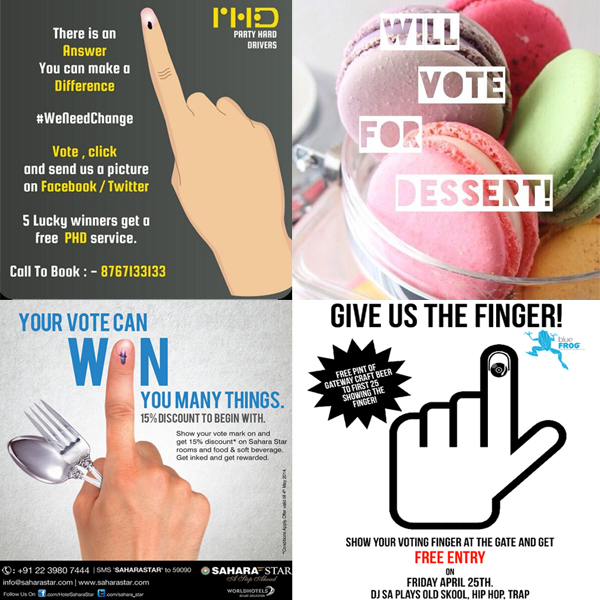
    MUMBAI: Political parties may have succeeded in getting Mumbaikars to step out and cast their vote but brands are taking a step further in wooing all those who fulfilled their duty on voting day. Here’s looking at what’s on offer for inked customers:

    Vote today, party tomorrow

    Today being a dry day, DDB Mudra Max, which has been running an interesting initiative titled ‘Operation Black Dot’ for the last few months, is hosting what it calls a ‘voters’ party’ tomorrow for first-time voters at one of the suburban outlets of Hard Rock Café. While Myra Wines is serving a complimentary glass of wine at restaurants such as The Table, Salt Water Café and Smoke House Deli in SoBo. Blue Frog is offering free entry tomorrow. The pub has also asked those who voted to take selfies with a pint of GBC beer and post them on their social pages. The first 25 to do so will be getting the second pint free.

    Food for vote

    Just flash your inked finger and avail some cool offers at places like Sun-N-Sand, Sahara Star, Dominos, KFC, Ice Cream Works, Le 15 Patisserie, Bistro Café, Ramada Goa Portuguesa, 6th Street Yogurt, Cream Centre, Grain & Bagel Café, Debonairs Pizza, Spaghetti Kitchen, Bombay Blue, Noodle Bar, Copper Chimney and The Little Door.

    Go shop

    The likes of Spykar, bYSI and It’s our Studio are offering discounts on apparel and other products.

    Pamper your hair

    Lakme Salon is offering a 50 per cent discount at all outlets across the city while Trinity Salon is offering free haircuts to those who come flaunting their ‘Kaala Teeka’. Taj salons across Taj properties have come up with cool offers as well.

    While brands took the initiative to ensure good voter turnout, seems like Mumbaikars were not wooed enough to go and vote.

  • Marketing, the Dove way!

    Marketing, the Dove way!

    MUMBAI: There has been some exemplary advertising from Dove from the house of Unilever for over a decade now. The brand has endeavored to define beauty in a meaningful manner through its communication strategies.

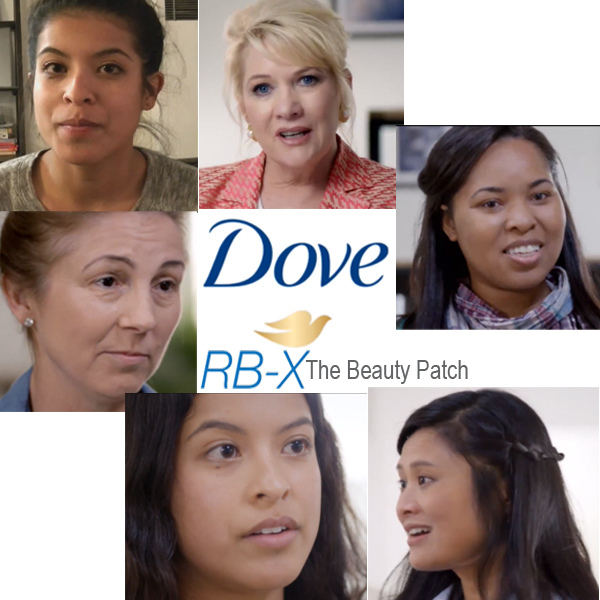
    The latest is a digital film which goes on to say that “Beauty is just a state of mind”. It features a two week-long social experiment by New York Times bestselling author, psychologist and body image expert, Dr Ann Kearney-Cooke, inviting women to wear a custom-made ‘beauty patch’ to help them feel more beautiful. The ladies give personal accounts of how the patch variously made them feel ‘more confident’, ‘refreshed’ and so on. At the end of the experiment, the patch is revealed to contain nothing, proving that beauty is more than just skin deep. Not surprisingly, the film which is running on YouTube garnered more than 15 million views within one week.

    Not just the digital film but most of Dove’s advertising carries significant marketing lessons for other beauty brands. Here’s looking at some of them…

    Stories win hearts

    Advertising with a strong storyline always works. Consumers connect with a product line if it is endorsed by people with a story. Dove has successfully taken care of this aspect locally and globally.

    Be constant

    For people to remember advertising, it is essential for brands to be consistent in the way they project their ideas through communication. Dove over the past few campaigns has gone digital and this has helped them get greater reach.

    Have a clear line of thought

    Projecting an idea sharply helps. One of the reasons why Dove pops up in people’s minds is that it almost always supports a strong line of thought.

    Take the video route

    In the age of social media, creating visual campaigns is a plus. More importantly, videos can be shared and help measure feedback instantly. Tracking the success of the campaign becomes that much easier, and Dove seems to have got that right!

    Use subtle marketing plug-ins

    While rolling out digital films, brands need to go subtle on plug-ins. Two things that work best on digital platforms are curiosity and a good amount of hype. Dove has got just the right amount of both.

    Click here to watch the video

  • Glaxosmithkline Consumer promotion expenses 19% of Oct-Dec Op Income

    Glaxosmithkline Consumer promotion expenses 19% of Oct-Dec Op Income

    BENGALURU: Nutritional products and OTC drug major Glaxosmithkline Consumer Healthcare spent Rs 164.78 crore or 18.96 per cent of Income from operations in the quarter ended 31 December  towards advertisement and promotion. This was the highest amount spent on advertising and promotion by the company in terms of percentage of operating income as well as in value terms over seven consecutive quarters starting quarter ended 30 June, 2012.

    Note : (1) GCHL’s fiscal ends on December 31, however in keeping with standard conventions in India, the following periods have been used in this report:
    Q1-2013 is the Quarter ended June 30, 2012; Q2-2013 is the quarter ended September 30, 2012
    Q2-2013 is the quarter ended December 31, 2012 ; Q4-2013 is the quarter ended March 31, 2013
    Q1-2014 is the quarter ended June 30, 2013 ; Q2-2014 is the quarter ended September 30, 2013 and Q3-2014 is the quarter ended December 31, 2013.
    (2)Rs 1 Crore  = Rs 100,00,000 = Rs 100 lakhs = 10 million

    The company’s nutritional products brands include Horlicks, Boost, Foodles , while its OTC drugs brands include Crocin, Eno and Iodex.

    Let us look at the company’s results over the seven quarters under consideration:

    Figure A shows that Linear PAT as percentage of Op Inc is trending downwards. Ad Exp as both percentage of Op Inc and Total Expense (Total Exp) is trending upwards linearly. The company explains the lower PAT to high inflation in milk and milk powders and dilution in PAT growth due to higher tax rates. GHCL plans to partially offset this by renewed focus on various cost control initiatives.

    However, as per Figure B below, in value terms, PAT trend is almost flat linearly over the seven quarters, with GCHL reporting maximum PAT in quarter ended 31 March 2013 at Rs 156.41 crore, the lowest being Rs 69.65 crore in Q3-2013. The company reported PAT at Rs 79.79 crore in Q3-2014. Operating Income peaked in quarter ended 30 September, 2013 at Rs 1014.08 crore, with Rs 734.51 crore in quarter ended 31 December 2012 being the lowest operating income over the seven quarters under consideration. Operating income in the quarter ended 31 December, 2013 was Rs 869 crore.

    As mentioned above, the company’s Ad Exp in quarter ended 31 December, 2014 was the highest, both in terms of percentage of operating income and in rupee value. As figure C shows, the company’s q-o-q change in percentage terms for Op Inc as well as Ad Exp have been zigzag lines, however the linear rate of change tending downwards for both.

    GCHL says that it has had a good overall performance with Health Food Drinks (HFD) and Foods growing at 17 per cent and 29 per cent respectively in quarter ended 31 December, 2014. Its domestic volume growth has been 11 per cent, while exports grew by 36 per cent. It claims that GHCL continues to hold second position in Oats; Horlicks Kesar Badam launched during the quarter.

    The company claims that its HFD brands comprising Horlicks and Boost grew 17 per cent, while its packaged foods brands comprising of Horlicks biscuits, Horlicks Nutribics, Foodles (noodles), Horlicks Oats and Boost Biscuits grew 29 per cent during the period.

  • Bajaj Corp posts highest percentage spend toward ASP in Q3-2014

    Bajaj Corp posts highest percentage spend toward ASP in Q3-2014

    BENGALURU: In the last seven quarters starting Q1-2013 till Q3-2014, Bajaj Corp Limited (Bajaj Corp) reported the highest ever spend in percentage terms towards Advertisement and Sales Promotion (ASP) in Q3-2014 at 17.85 per cent of Income from Operations (Op Inc).
    It may be noted that Bajaj Corp’s ASP spend comprises both Advertisement (Ad Exp) and Sales Promotion (SP). While ASP figures have been obtained from presentations over various quarters to company investors, Ad Exp has been taken from the firm’s financial results. Consequently, SP has been derived by deducting Ad Exp from ASP. All figures are taken as approximate. Significantly, Rs 100 lakh = Rs 100,00,000 = Rs 1 crore = Rs 10 million.
     On 22 August, 2013, Bajaj Corp acquired the ‘Nomarks’ brand and entered a non-compete agreement with the seller for a period of three years. The management inter alia considered the non-compete period and estimated the useful life of the brand as three years. As per Accounting Standards (AS) 26 – Intangible Assets, the acquisition cost of the brand and non-compete needs to be amortized over the estimated useful life of three years. Accordingly, a pro-rata (for Q3) amount of Rs 11.75 crore has been amortized during the quarter ended December 31, 2013. The same has been shown under exceptional items. Whereas in Q2-2014, a pro-rata (for 40 days) amount of Rs 5.10 crore had been amortized and shown under exceptional items.
    Here’s looking at the figures reported by Bajaj Corp from Q1-2013 to Q3-2014.
    As mentioned earlier, in percentage terms, the company’s ASP spend was the highest at 17.85 per cent of Op Inc or Rs 28.31 crore in Q3-2014. However in value terms, it was the highest at 16.42 per cent of Op Inc or Rs 30.24 crore in Q4-2013. Also, ASP spend in Q1-2014 was slightly higher in value terms at Rs 28.53 crore but at 16.76 per cent of Op Inc. Over the last seven quarters, Bajaj Corp’s ASP has increased both in value and percentage of Op Inc terms.
     Its Ad Exp trend is almost flat while SP is trending upward. Fact is, in Q3-2014, the company spent the lowest amount toward Ad Exp at 5.43 per cent of Op Inc or Rs 8.611 crore as compared to Q1-2014, when it spend the highest amount toward Ad Exp at 8.8 per cent of Op Inc or Rs 14.9847 crore.
    Correspondingly, the company’s SP spend has been increasing steadily from an all-time low of 5.45 per cent of Op Inc or Rs 7.5308 crore in Q1-2013, to the highest across seven quarters in terms of percentage and value at 12.42 per cent of Op Inc or Rs 19.6989 crore in Q3-2014.
    Trends for ASP, Ad Exp, and SP in terms of percentage of Total Expense and percentage of Op Inc are almost similar. The company’s Ad Exp proportion has been going down while its SP has been increasing progressively.
     Overall, ASP has been going up with the share of SP growing. From a high of 56.62 per cent of ASP or Rs 9.8282 crore in Q1-2013, Ad Exp in Q3-2014 has been the lowest at 30.42 per cent of ASP or Rs 8.6111 crore.

    Please refer to figures A, A-1 and B below.

    Figures B  and C indicate that Bajaj Corp’s Ad Exp proportion has been going down, while its SP has been increasing progressively. Overall, ASP has been going up with the share of SP growing. From a high of 56.62 per cent of ASP, (Rs 9.8282 crores) in Q1-2013, Ad Exp in Q3-2014 has been the lowest at 30.42 per cent of ASP (Rs 8.6111 crores).

    Over the seven quarters under consideration, both Op Inc and Total Expense show an upward trend while PAT shows a downward trend. PAT peaked in Q4-2013 at Rs 47.014 crore and was the lowest at Rs 29.1003 crore in Q3-2014. PAT has been affected on account of Bajaj Corp having amortized its ‘Nomarks’ acquisition, as mentioned earlier. Also, in Q1-2014 and Q3-2014, ‘change in inventories of finished goods, work-in-progress and stock in trade’ added to expense as compared to the reduction in expense in Q2-2014 and Q4-2013. Further, the company purchased 44.85 per cent higher stock-in-trade in Q3-2014 at Rs 16.27 crore vis-a-vis Rs 11.23 crore in Q2-2014 and 53.31 per cent more than Rs 10.61 crore in Q3-2013. In the event Bajaj Corp repeats its Q4-2013 performance in the last quarter of this year, the PAT trend is likely to swing upward.
     
    Op Inc too peaked in Q4-2013 at Rs 184.182 crore, moving up from Rs 136.017 crore in Q2-2013, later falling over Q1-2014 and Q2-2014 to reach a low of Rs 158.4016 crore in Q2-2014. Q3-2014 has seen a slight improvement in Op Rev at Rs 158.5762 crore. If it duplicates or improves upon the performance of Q4-2013, the Op Inc upward trend would be even steeper.

    About Bajaj Corp
    Bajaj Corp’s mother brand is Bajaj with sub-brands or products such as Bajaj Almond Drops Hair Oil, Bajaj Kailash Parbhat Cooling Oil, Bajaj Brahmi Amla Hair Oil, Bajaj Amla Shikakai, Bajaj Jasmine Hair Oil, Bajaj Kala Dant Manjan and creams, soaps, face washes and face scrubs under the brand name, ‘Nomarks’.