Tag: brand strategy

  • Maulik Kalamthekar to lead consumer engagement strategy for WolfzHowl

    Maulik Kalamthekar to lead consumer engagement strategy for WolfzHowl

    Mumbai: Brand strategy consultancy Wolfzhowl Strategic Instigation has brought on board Maulik Kalamthekar as the lead of consumer engagement strategy. This is Maulik’s second stint at the behaviour change strategy firm.

    “Strategy is about devising the best plan for winning. The wolves are mavericks in strategy craft. As we create robust strategies, we also want to focus on helping our clients execute our winning strategy with candour and creativity. Super pumped to be returning to do some rainmaking work for brands,” said Kalamthekar who carries over seven years of experience in advertising and digital marketing across functions, agencies, and brands. In his previous brief stint at The Glitch, Kalamthekar was the group head of strategy for the WPP agency and content division – Flux.

    “At Wolfzhowl, we are constantly strengthening our team, bringing in diversity, improving our skill-sets. This time we have Maulik, who joins us back at a crucial juncture in our journey,” Wolfzhowland head of culture, partner Renuka Asnani said. “As a Strategic Consultancy, we are increasingly focusing on providing final mile engagement solutions that bolster our strategy craft that lead to better business outcomes. Maulik’s consumer and culture first thinking along with his expertise in new-age platforms, especially using data, will give us an edge to deliver not just effective strategy but also delightful creative engagement solutions.”

  • Wellbeing Nutrition collaborates with TING for launch of new product

    Mumbai: TING, a fully integrated creative and digital advertising agency, has conceptualised and executed the end-to-end branding and packaging duties of Melts Oral Thin Strips, a newly launched product by Wellbeing Nutrition. The agency was responsible for the entire branding activity which included, visualization, packaging, branding, positioning, creatives, website designing to the social media launch.

    The branding and messaging of the newly launched Melts focus on how there’s a need in today’s day and age to rethink the intake of nutrition supplements.


    Speaking on the launch, Wellbeing Nutrition’s founder Avnish Chhabria said, “To build a brand targeting the young audience of today, the digital-savvy youth, we wanted to work with someone who truly understands that generation. As a brand that offers nutrition solutions, with Melts® we wanted to go all out and reach out to as many people as possible. We are very happy with the way TING has handled and executed our entire brand identity. All our suggestions and our company vision were kept in mind while executing, and we look forward to escalating the brand presence to higher levels with them.”

    TING co-founder & creative director Shruti Dhadda said, “While we have been associated with Wellbeing Nutrition for a while, it gives us immense pleasure to work with the core team in building the entire brand for Melts®. Creativity and packaging play a very vital role in attracting customers and our team ensured the correct messaging was conveyed. As an agency, we always consider inputs and suggestions shared by clients and accordingly formulate the best results, with our potions of creativity and strategic planning. We are thankful that Wellbeing Nutrition believed in us and gave us this opportunity to work alongside.”

  • 82.5 Communications appoints Anirban Mozumdar as chief strategy officer

    82.5 Communications appoints Anirban Mozumdar as chief strategy officer

    Mumbai: Ad agency 82.5 Communications on Tuesday appointed Anirban Mozumdar as chief strategy officer in Mumbai. He replaces Rishabha Nayyar, who is moving on from the agency to pursue his interest in academics. 

    Prior to this, Mozumdar was the CEO of Mumbai-based Chlorophyll brand and communications consultancy.

    82.5 Communications chairman and CCO, Sumanto Chattopadhyay said, “His vast planning experience across categories and countries, his entrepreneurial ability and his understanding of behavioural science are just a few of the assets with which, I am sure, he will enrich our people and our brands.”

    An alumnus of Mudra Institute of Communications (MICA), Mozumdar has over 24 years of brand building and strategy experience, across India and the South Asian region, in agencies like Leo Burnett, Publicis, DDB, Y&R and ITSA. He has worked extensively across the b2c, b2b and d2c sectors and on brands like P&G (Tide, Rejoice, Whisper), Nestle (Maggi, Nestea), Wrigley’s, Philips, Bajaj Auto, Indian Oil, Emami, Thums Up and Maruti Suzuki said the agency on Tuesday.

    Co-chairman and CEO, Kapil Arora said, “Anirban has a love for the business that reflects in an almost immediate connection over stimulating conversations, passionate idea exchanges and loud laughs. We’re lucky to have a person of his pedigree and passion join us, to partner our clients and the 82.5 family, in our growth journey.”

    Talking about his new role, Mozumdar said, “It’s thrilling to be in the thick of brand-building and advertising in these fast-changing times. With a team that makes creativity potent with passion and grit.  I am looking forward to working with Sumanto, Kapil and the entire team at 82.5 Communications, to build business and value for a really exciting set of brands.”

  • Guest column: Post pandemic, advertising shifts focus to brand building

    Guest column: Post pandemic, advertising shifts focus to brand building

    NEW DELHI: Do you remember TV commercials that featured fans at crowded football games, or that focused around cities choked with people, or with celebrities doing every possible thing to woo their audience? You may call them the “before coronavirus” commercials/ads that no longer work in today’s scenario. With the onset of the pandemic, everything changed in a matter of hours, and TV commercials of various brands were no exception. As the Covid-imposed lockdown continues, Indian advertisers are completely relying on media-led brand building to reap long term benefits.

    The rise of ad flexibility

    As major live events, where TVCs played a pivotal role, were cancelled keeping in mind to curb the spread of the Coronavirus, advertisers had to regulate themselves according to their new programming slate. This has also been changing according to the scenario outside, making the ads more compassionate and caring towards their customers. Since the airing of many programs was also cancelled due to the pandemic, the TVCs mostly aired during the news broadcast or in the news channel. 

    Advertising in digital content

    With the remote working and stay at home guidelines, the viewership of TV and OTT platforms is seeing an explosive growth. Though the advertising demand during this phase is being subdued due to the current situation, advertisement in certain categories like essentials, health and hygiene worked like never before. Brands across industries have responded to this situation quite promptly and started investing in TVC and campaigns for essentials and health and hygiene products across media. Whereas, non-essential categories didn’t fall behind and rather started their communications in digital medium by tagging alongside essential categories. Few companies have shifted to the basics and once again emphasised on brand building by highlighting their efforts towards combating the situation through their advertisements. 

    Brand building is the new focus

    With a stepped-up viewership of TV and OTT platforms, lessened advertiser clutter and potentially lower rates due to lower demand, brands have realised that this is the perfect time to invest in brand building by emphasising more on the brand’s core values. Brands have once again started earmarking for BTL so that it can be redirected to deploy on media and have put consumer promos, offers among others on a backseat. They executed brand building by exploring higher ACDs (average commercial durations) and consumer-relatable storytelling. 

    New industries, new advertisers

    As we have entered a much dreaded second phase of the Covid2019 pandemic, there is no clear timeline by when we will emerge out of the unprecedented situation. Therefore, brands need to engage in rigorous scenario-based planning, where they have to make an imaginary timeline of recovery, changes in consumer behaviour and upgraded budgets. The digital-first approach should be the first line of advertising for a brand in this ‘new normal’ situation. Brand’s media plans also need to be aligned with business strategy so that a balance can be made between opportunity and reality. One needs to keep in mind that whenever there is an extended lockdown, there is a downward pressure on consumer purchasing power and planned purchases will be on the lower side.

    (The author is director, Bonn Group of Industries. The views expressed in this column are his own and Indiantelevision.com may not subscribe to them.)

  • Authentic brand promoters are far more rare and influential than sharers: Research

    Authentic brand promoters are far more rare and influential than sharers: Research

    MUMBAI: Brands often boast about the number of “likes”, “followers” and “tweets” they garner, but are these measures of brand advocacy too crude? Are people that “like” and “follow” everything true brand promoters?


    As companies grapple with the meaning and impact of social media on brands, Social@Ogilvy and SurveyMonkey join forces for a second year to study how to transform supporters into real, long-lasting advocates, who carry on the brand voice and promote it to others.


    Just as last year’s study showed that brands producing high quality content is critical to engage with social media users, this year’s global, 11-country online survey of more than 5,000 social media users shows that just because people are saying positive things about your brand, doesn’t mean they are real brand advocates. But, if one uses the right approach and techniques, they can be, and this global research sheds light on how.


    “Sharers”, “followers” and “retweets” are crude measures of true brand advocacy


    Majority of users are actively noticing and engaging with brands via social media, with the research showing that 84 per cent of respondents across the 11 markets say they had “liked” or “followed” a brand, product or service. Of those that have “liked” or “followed” a brand, 58 per cent have interacted directly with a brand and 79 per cent received a response back (shout out to social media managers everywhere!).


    The research did not observe any shortage of “social sharers” who not only follow a brand, but who proactively share their experiences: 58 per cent of respondents have communicated either positive or negative opinions about a brand with others.


    These social addicts, who typically stay glued to the likes of Facebook, YouTube and Twitter on a daily basis, exhibit similar behaviors but there are still key differences and steps to transforming “sharers” into brand promoters – those respondents who self-identified as being extremely likely to recommend brands and products to friends.


    While 58 per cent respondents are “sharers”, only 19 per cent are true brand promoters


    Authentic brand promoters are far more rare and influential than sharers, with the global research revealing notable differences to watch out for between them when looking to identify the profile of a promoter. 


    How do promoters interact via social media?


    .   They are intrinsically more active followers: 66 per cent follow brands on a regular basis, compared to only 52 per cent of sharers.

    .    Promoters follow brands in order to interact directly with them. 42 per cent of sharers do this compared to 52 per cent of promoters.


    Why do promoters interact with brands?


    .    A prime reason they follow brands is to be associated with them which 39 per cent do, versus only 28 per cent of sharers

    .    46 per cent also believe a brand’s reputation is important, compared to only 36 per cent of sharers

    .     They prefer to link a brand to their own personal identity, with 45 per cent saying they feel better about themselves after using a brand; only 35 per cent of sharers say the same


    What action do they evoke?


    .   The friends of promoters talk about brands much more: 59 per cent of promoters see their networks regularly mention brands and products, while only 47 per cent of sharers do the same

    .   They are much more likely to respond to their friends’ interaction with brands; 35 per cent would purchase a product if it was mentioned by a friend, compared to just 24 per cent of sharers


    Globally, these promoters share broadly similar characteristics


    True promoters have similar reasons for liking or following a brand, for example: 77 per cent want to hear about products, offers, or news, followed closely by 53 per cent who want to give direct feedback and 52 per cent who want to interact directly with an organisation. Promoters tend to surround themselves by like minds when it comes to their attitude towards brand interaction on social media: 91 per cent say their friends’ mentions of brands are largely positive.


    Quality is paramount with virtually everyone (91 per cent) saying this is why they would be extremely likely to recommend a particular brand or product to friends or colleagues. And, it’s the main reason why 61 per cent promoters would not recommend a brand or product.


    What brands should be careful of


    While both sharers and promoters have posted about a great brand experience on social media, 71 per cent of sharers and 60 per cent of promoters have also discussed terrible brand experiences online.


    Emerging economies breed a higher percentage of promoters


    Countries with the highest percentage of promoters live in emerging economies, like Brazil and India, where 42 per cent and 33 per cent respectively, fall into this category. Japan revealed the smallest percentage by far with just 1 per cent of promoters, followed by Germany and France (14 per cent each), and UK, Indonesia and Australia (15 per cent each).


    However, important cultural nuances are likely to be at play. For instance, Indonesia has a low number of promoters despite 70 per cent of respondents saying they’ve shared great brand experiences on social media. This could suggest that the more passive approach of advocacy via social sharing may be more popular in Asian countries. Equally, a low number of Japanese promoters could be attributed to the formal, more private culture – making them less willing to make personal recommendations online. To that effect, the majority of Japanese respondents (43 per cent) report in-person brand or product recommendations are most trustworthy.


    While it is clear people are more connected than ever – demonstrated by the sheer breadth of networks available to us – the research from SurveyMonkey and Ogilvy shows that it is the depth of connections that change our lives and the world around us.  


    Ultimately, brands need to build relevance and trust through content and connections if they wish to use social media to transform their brand, business and reputation. 


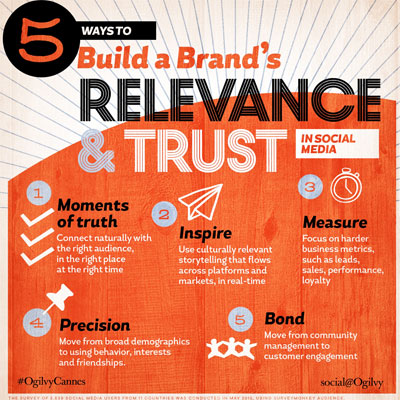
    5 steps that the research insists to garner brand relevance and trust in social media 


    1 .  Precision: Move from broad demographics to using behaviour, interests and friendships


    2.   Moments of truth: Connect naturally with the right audience, in the right place at the right time


    3.   Inspire: Use culturally relevant storytelling that flows across platforms and markets, in real-time


    4.   Bond: Move from community management to customer engagement


    5.   Measure: Focus on harder business metrics, such as leads, sales, performance, loyalty 


    “Companies need to move beyond collecting likes and retweets with meaningless content. Through genuine interaction and content designed to connect with true advocates, companies can drive forward their brand, business and reputation in ways not possible before this era of social media,” said Social@Ogilvy global managing director Thomas Crampton. 


    “Social media addicts may look like your most engaged consumers, but marketers need to stop looking at their data in silos to find their true advocates, By applying the Net Promoter Score methodology to social media users across the globe, we better understand the profile of a brand promoters: those who are extremely likely to recommend brands to friends and colleagues. To appeal to promoters, brands need to not only focus on quality but also reputation among friends or colleagues and that sense of worth that comes from being associated with a brand,” added SurveyMonkey vice president of marketing communications Bennett Porter.