Tag: Bollywood

  • Eros Intnl’s music downloads on Apple iTunes, Real Rhapsody

    Eros Intnl’s music downloads on Apple iTunes, Real Rhapsody

    MUMBAI: Eros International, an integrated media and entertainment Company,announced that tracks from its recent Bollywood music albums- Omkara, I See You, Kudiyon Ka Hain Zamana and Namastey London will now be available for download on Apple’s iTunes on a worldwide basis and on Real Network’s Rhapsody for North America.

    Eros International Plc chairman & CEO Kishore Lulla said, “This is a significant milestone as far as our new media distribution is concerned. We remain focused on identifying and securing strategic distribution partners to showcase our Bollywood content to a wider audience.”

    He further added, “The Mauj Telecom deal for mobile content license announced this January and now the iTunes and Real Rhapsody deals make our recent move into music publishing all the more exciting. We remain positive about the opportunities presented by new media in this digital era.”The original sound tracks from Eros’s forthcoming film Eklavya, a Vinod Chopra Films Production, releasing in cinemas on February 16 will also be available for download.

    Eros launched the Bollywood video on demand services with cable giants Comcast and Rogers cable and has online movie download services with Movielink and RTL.
     

  • Bollywood goes mobile with Barcelona launch

    Bollywood goes mobile with Barcelona launch

    MUMBAI: The world’s largest film industry joined forces with the global mobile communications world today in spectacular fashion – as Bollywood premiered its first feature films for mobile viewers at the 3GSM World Congress (February 12-15) in Barcelona.

    The Congress marks the start of the adaptation of thousands of vibrant Bollywood productions for the mobile screen – a development that could have a huge impact on the global mobile entertainment market, already worth some $US23 billion.

    The Bollywood Mobile Initiative is driven by Roamware, the global leader in roaming and mobile connectivity solutions; Hungama Mobile, the world’s largest aggregator, developer and publisher of Indian entertainment and Bollywood content; Sanjay Gupta, a leading Bollywood director; and the GSM Association (GSMA), the global trade association for mobile operators.

    Roamware’s Media Call technology is providing the capability to integrate the cinematic content into the everyday mobile experience for film fans.

    “Media Call redefines mobile communications from voice to visual media, enabling the sharing and promotion of film clips to accelerate the growth of the mobile movie market,” said Bobby Srinivasan, CEO of Roamware.

    Two Bollywood short films “Zahir” & “Matriomony” were premiered in Barcelona today. These films are a part of the feature film ‘Dus Kahaniyaan’ (10 Stories) produced by Sanjay Gupta of White Feather Films, starring more than 20 leading Bollywood stars including Dia Mirza, Suneil Shetty, Sanjay Dutt, Neha Mandira Bedi, Aftab Shivdasani and many others. Sanjay Gupta is one of Bollywood’s leading filmmakers who has produced and directed many hugely popular movies such as Kaante, Musafir and Zinda.

    The films demonstrate the viral potential for Bollywood movies on the ‘fourth screen’ –the mobile device. Set pieces with action and dialogue scenes interspersed with song and dance make the vibrant, fast moving movies a compelling entertainment experience for the mobile viewer.

    “Bollywood today is the world’s largest movie industry, producing more than a thousand movies a year with an audience of more than two billion viewers across 127 countries. Formatting that content for the mobile audience and ensuring simplicity of delivery and accessibility provides staggering reach and revenue possibilities,” said Bobby Srinivasan, CEO and Chairman, Roamware.

    “The GSMA is delighted to welcome the stars and directors from the Bollywood world to the world’s largest mobile event,” said Bill Gajda, Chief Marketing Officer of the GSMA. “We are excited by the tremendous potential for Bollywood entertainment on mobile phones, and delighted to support the efforts of Roamware and Hungama Mobile in their commitment to bringing a rich array of Indian film entertainment to the fourth screen for a global audience of millions.”

    “India is the fastest growing market in the mobile world, and the world’s fourth largest market. It has the potential to be the largest market globally by 2010. It is the most logical market from which to launch the mobile movie industry and present a brand new avenue of cinematic entertainment for mobile users everywhere. The potential is truly amazing. Hungama Mobile has already launched a Bollywood channel directly on operator decks around the world in nearly 30 countries, with over 70 operators. This channel contains music, imagery, video and games from Bollywood. Showcasing Bollywood movies on mobile is a natural extension both as a tremendous new marketing opportunity as also revenue for all the stakeholders,” said Neeraj Roy, Managing Director & CEO, Hungama Mobile.

    Hungama Mobile’s content assets and a two year foray in taking Bollywood to the mobile world, coupled with Roamware’s global reach, holds huge promise for the mobile market. The dramatic evolution of communications technology, from download speeds and battery life to compact form factors, screen sizes and resolution, as well as memory enhancements, means mobile devices are now capable of delivering a compelling, high quality and uniquely personal viewing experience.

    Bollywood is one of the fastest growing entertainment industry segments and has an appeal not only for the 150 million mobile phone users in India but for markets across all continents. Indian cinema is now dubbed in over 35 languages and accounts for as much as 16.5% of theatrical business in markets such as UK. Indian films have made it into the top 10 charts in markets such as USA, UK, Germany, Australia, Singapore and South Africa. More than 3.6 billion admission tickets are sold each year, across the world and now Hungama Mobile and Roamware will take this to some 2.5 billion mobile screens.


  • Hungama Mobile ties up with T-Series for music download

    Hungama Mobile ties up with T-Series for music download

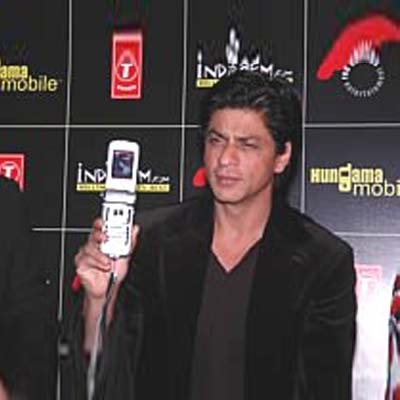
    MUMBAI: Hungama Mobile in association with T-Series launched the Kar Le kar Le Koi Dhamaal music for mobile. This is the first time in Asia that the music will be available for downloading on mobile before it is available in music stores.

    Several other add on features like ‘Full Music’ monophonic ringtones, polytones, ringback tones wallpaper will also be available, suitable for every type of mobile phones.

    The star at the launch of the music was ofcourse Shah Rukh Khan who has performed in the music video. Talking about the product he said, “When I personally downloaded the music it was a great experience hearing it on my own phone. Hungama Mobile is providing a new platform by giving a new experience to the audience. The Gen X is definitely going to be excited with such exciting features and I can say now mobile will be the next new destination, for music.”

    Hungama Mobile managing director and CEO Neeraj Roy said, “We sincerely appreciate the support of Shahrukh, who in his own way encouraged this step. Experiencing the success and looking at the potential in mobile content market, we are delighted to partner with T-series. Through this initiative we can reach out to a vast audience across the globe.”

    Speaking on the occasion T-Series managing director .Bhushan Kumar said, “Considering our long association with Hungama Mobile, we are delighted to take it one step further for the mobile content industry. Seeing the success of previous projects like the Krrish, added to which this time we have SRK himself. This combination makes us confident of this initiative being a great success!”

    Hungama Mobile also owns Bollywood portal, www.indiafm.com and has worked on over 1000 films on the mobile and the online space.

    To download the music one can SMS SRK to 4646 and it will be made available through Hungama Mobile distribution network with over 77 Wireless Carriers in 30 plus countries.

    Hungama Mobile has exclusive worldwide rights to India’s largest music label T-Series and in addition has over 100 content alliances with companies as diverse as Warner Bros, Sony Pictures etc.

  • Channel 4 postpones sex shows after Shetty controversy

    Channel 4 postpones sex shows after Shetty controversy

    MUMBAI: Following the criticism of racism on its show Celebrity Big Brother which saw Bollywood actress Shilpa Shetty win, UK broadcaster Channel 4 has decided to postpone a series of shows on sex.

    The series of programmes were to be themed around masturbation. One show media reports state was a documentary about a charity ‘masturbate-athon’. Another programme called Virgin School, was to feature a 40-year-old former vicar being taught sex techniques in Amsterdam

    A spokesperson for the channel though was quoted saying that they will evenutually air. Clearly the channel does not want to air content that has the potential to lead to more negative publicity.

    Meanwhile the row over Celebrity Big Brother continues to make headlines.

    Reports state that one of Shetty’s three alleged tormentors, glamour model Danielle Lloyd, has met police for a three-hour discussion about the race row.

  • ‘Radio will certainly see consolidation next year’ : Apurva Purohit – Radio City CEO

    ‘Radio will certainly see consolidation next year’ : Apurva Purohit – Radio City CEO

    The radio industry is poised to make its next big leap as radio stations gear up to implement the Phase 2 licenses. The metros have been covered and it is now the turn of the smaller cities to experience FM magic. Radio City has been a pioneer in the FM boom with the first ever FM station in India- Radio City, Bangalore set up in 2001.

    Five years on Radio City CEO Apurva Purohit details the changes in this dynamic industry and all the challenges it’s yet to face in an interview with Sujatha Shreedharan from Indiantelevision.com

    Excerpts:

    The Phase 2 bidding has seen the major networks, including Radio City, expanding their footprints to cover mini metros. What are the unique challenges one would face when it comes to setting base in a small local setting?
    Clearly, when we had decided to go in for the second phase of bidding we had decided to restrict ourselves to metros and mini metros only. Essentially what we were saying is that we will go for the top 15 cities where we have over 70 per cent of the advertising revenue and they are in certain tone and manner and feel similar to the large towns we have been operating in.The only exception is the whole Maharashtra belt which includes Ahmednagar and the smaller stations. And this is a call that we took because networking is allowed only in these cities which means you set up your network in Ahmednagar and run Sangli and Nanded from that station. We took that call because we wanted a network station in our portfolio. Also Maharashtra is a rich state and works from the advertisers perspective. We also believe that our SEC A and B market are not dramatically different in these regions whether it is in terms of sophistication, exposure to media or even exposure to FM. They may be at different life stages but in terms of consumer, percentage of SEC AB population, income level or education or even ethos they are broadly similar. Also you must remember that we have been running the Lucknow FM station for five years. We have the experience of running a FM station in a mini metro and we hope to translate this experience into other smaller cities.

    What about the language and flavor of these upcoming FM stations?
    Radio City does believe in typically adapting itself to the local flavor. At the same time you must remember that we are positioned as a premium, up market SEC AB kind of stations. Therefore our language mix does tend to be different from the typical mix than a mass station is concerned. For instance in Bangalore we do run a lot of English, Hindi and Kannada whereas the other stations are typically Kanada stations. In Chennai, we are very much English and Tamil. In that sense, the kind of RJ talk will be focused on the premium market.

    What about a city like Pune?
    You know Pune is culturally very similar to Mumbai, so that is the kind of mix one is likely to find. Of course it will be adapted to the local culture of Pune which is rich in theatre or Marathi music.

    With the setting up of stations in mini metros, Radio City will now look at dual competition – from existing network players who are also setting up their stations as well as from single city players. How will you tackle that?
    Certainly the local players have taken a single city or selected a particular city because of various reasons like their already established status in say print or publishing. So they are very focused and are able to get into a mass position because they are local. Besides radio while it may have a national brand, does tend to also try to be local. So there is competition. Big, small, single city networks – they are equal competition. The other thing is that I think the position we have taken which has evolved over the last five years is differentiated not only from single city players who are local or mass but also the network player. What I am trying to say is that single city players tend to take the bottom end of the pyramid – local, regional, SEC ABC, while network players have taken the SEC AB kind of position which is mass but on a network level. Direct competition is therefore the network players, while local stations tend to be competition to players like RED FM.

    What about advertising revenue accruing from mini metro stations?
    In fact content is where you could say that differentiation gets greyer. As far as revenue is concerned, that’s a no-brainer since we are trying to get ads from the corporate clients and large national players. In that sense the local players are no competition. The question to ask is – Is the advertiser trying to buy radio because you also have print or is the advertiser trying to buy a good network which is either number one or two. We are very clear that we as a network focus on the right kind of network in 15 of the top cities. In revenues there is no competition. As far as content goes, there will be competion with local players.

    A few years ago, differentiators were perhaps easy to identify within the few radio players. With the numbers growing how does one still hold on to or reinvent that differentiator?
    I think the whole industry is in a state of flux. My opinion is that now, when the newer players come in they will have to recognize that if they want to grow the listenership pie they better come in with different options. The newer guys have to come in with different languages or different formats and personally if you ask me that is not happening right now. All the newer guys have really not lived up to our expectations of trying to build a differentiator and as you are rightly saying therefore today there is a mass of similar feel players. You could also say that there are certain brands which have been there for five years and therefore they have equity and there are others which are just entering the market and they are broadly similar. You must also remember that the investments in brand building have happened only recently. Before this the whole industry was struggling to find its own feet. In that sense the industry is still very nascent in terms of trying to build an image for itself. Given those kind of issues and challenges, we have been trying to portray Radio City as a brand, say, which is different from a Radio Mirchi perceived as a more aggressive and in your face – teeny bop kind of station to our more softer, slightly older 25- 30 years, premium listenership. And that has developed over a period of time and is becoming clearer only over the past year or so. Sure, the differentiation worked in a non competing market. Today, however, you have to take it to the next level and we at Radio City are doing exactly that- pushing this whole process of identifiable branding to the next level.

    Could you explain how you plan to do so?
    It is a little premature to say that, except that the intent is very much there. But if you had to look at international examples certainly there are differentiations that could be built in at the psychographic and demographic segment. Even demographically, what an 18-year-old youngster wants is different from what a 25- year-old youth wants although they may fall under the similar youth category. So if there is a difference in the kind of music they aspire to hear, they must be given that. And the radio that pushes this difference will be the radio station that stands out in the long run. I think where people have failed is that they have tinkered with the branding or marketing story but have done nothing different with the product. At Radio City we are very clear that we will only talk about the differentiation when we can actually demonstrate it in the product. No one has made that differentiation although we have tried various innovations. With Mughal-e- Azam or Babbar Sher or more chat shows. But we believe that we can really fine tune the product far far better.

    Is there a sense that this overdependence on Bollywood by all FM stations is the real cause of similarity in programming?
    I think that there is Bollywood and then there is an equally vibrant music industry although we tend to put them all in the same basket. But if you remove the animal out of the Bollywood cage, then you will realize that there is almost a 100 years worth of beautiful music. It’s just that a lot of it happens to be mostly from Hindi cinema. Ultimately it’s the music of the nation. All of us are using popular music and that is a fact of life. We are ultimately mass stations aren’t we? If we were niche stations we would have jazz. But it’s not fair to say that Indian radio stations are equal to Bollywood and therefore ‘Che!’ They are not different. Internationally also all mass stations do look at popular music. Almost 80 per cent of international stations play popular music except that they are able to differentiate themselves in terms of appealing to a particular target group or by playing only a particular ‘sound’. Unfortunately in India, we are yet to go to that second level. This can be due to various reasons- nascent industry, unsound policies. Besides how old is this industry? About five years old. Out of which four years we spent struggling to stay afloat. It’s very easy to beat up this industry with the ‘Bollywood tag’. But we’ve barely stabilized over the past two years. So there’s no doubt that the differentiation has to come and will come. And it will be led by pioneers like Radio City. If you ask me, even within the context of popular music you can differentiate.

    How long do you think this process of evolution will take place?
    According to me FM started evolving last year when the government announced regulatory corrections and a fresh package. Look at the growth since then. We have grown in stations. The number of players in each city has also increased and even in terms of content – you have an Indigo which plays English music or a Fever FM which experiments with format radio. So one phase of evolution has already happened. The second phase of evolution will start now where players like us really chart out our different positions which will happen in the coming six months. Then there will be an era where there will be more consolidation and regrouping. Some players will fall by the wayside, some players will push ahead. In the next year there will certainly be a lot of consolidation. Then there is the station setup, scaling up. A year ago radio city had about 100 people. We are now looking at having about 300-500 people in the next few months. Isn’t that a spurt? The natural evolution in any other industry would have been ten years; we have done that in three years.

    ‘The natural evolution in any other industry would have been ten years; we have done that in three years’

    Do you believe that there is bound to be a clutter with the number of radio stations coming in?
    I don’t think there will be a clutter, but in the frenzy to launch radio stations I believe that learning will not happen as it should. Learning and qualitative inputs. There is no luxury to actually test market a product or try a pilot launch. Now you say, lets launch first and we’ll figure out in the market if it needs to be changed.

    There is a huge debate over the tools used to measure listenership and advertising on radio. What does Radio City turn to?
    Of course the first thing that this industry needs to do is set up a robust currency to determine advertising and listenership. There is a strong movement towards it and sooner rather than later it will have to evolve. We prefer to use NRS and then we have Synovate which does our brand research for the last three quarters. We are just waiting for the industry to stabilize before we declare these findings publicly. We are looking at listenership understanding, listenership pattern in different cities, psychographic and demographic pattern.

    Is the industry complaining about the FDI regulation in radio which allows for only 20 per cent foreign equity?
    Currently we are happy with whatever the government has allowed considering we spent five years working hard to convince them. We are quite ecstatic about what we got. I think the government itself needs to realize that the industry is in a state of buoyancy and it must give whatever impetus it can – news and current affairs license, networking, multiple frequencies or FDI. Quite honestly, the first three rather than FDI.

    Is Radio City looking at multiple licenses and what kind of stations would you be interested in?
    Yes we would. But for now it would be like blue sky gazing. We would look at news and current affairs, different genres of music, spirituality or even different languages.

    Is there a worry about lack of a sizeable talent pool to choose from?
    Talented and skilled people is something all radio stations are worried about. Where does one get trained people from? You have to do your own training. Fortunately we realized sometime ago and we have invested reasonably in increasing the skill set. Since we’ve been here for five years, we have had a large number of people working for us. Even then it has been a challenge for us.The other problem is of course being attractive enough as an employer for a talent pool to come to us. We try to build ourselves as a brand which is informal or a fun place to work. Very ‘un media’ is how I would describe it.

    What does the re entry of Star mean to Radio City?
    It is purely an investment decision at a shareholder level. At the operational level of the company it has zero impact. And besides we have alliances with most networks as clients or media partners – DNA, Zee, Sony and Star. So there won’t be any special content tie ups with Star. So operationally nothing, it’s purely an investment decision.

    Can you give a comparative understanding of how radio looks – 2006 versus 2007?
    In terms of the ad pie there has been no dramatic change. While there has been a 30 to 40 per cent growth, there will be no big change since the new stations have not been all set up and operational. Between 2005 and 2008 one is looking at doubling the industry. It will grow from 2.5 to a minimum 5 per cent simply due to geographical coverage area. In fact we would have more than doubled if there were far more genres on offer. It won’t go up to a 60 per cent unless people start segmenting and providing different products. If I were a new player, that’s a question I would ask.

    What about the revenue and listenership growth at Radio City in the past year?
    Revenue wise we have clocked a 40 per cent growth last year. As for listenership, if I were to give a Bangalore example it has grown from 1.5 million to about 2.5 million listeners which is almost 60 per cent growth.
    Radio City has also jumped on the bandwagon to have celebrity RJs on air?
    We are very clear that a celebrity won’t work unless it’s what the programme wants or what the brand wants. Using a celebrity just for the heck of it won’t work. Taking a TV star and putting him on radio is just gimmicky. We concentrate on RJs in terms of their music understanding power. Sonu Nigam speaks about Mohammed Rafi, Roop Kumar Rathod talks about ghazal maestros. In so far as the celebrity enhances the music experience on our audience, we’ll entertain the concept. And this is the case for all radio stations, not just Radio City.
    What about the music industry and the high rate of fees it charges radio stations?
    Somewhere we will have to understand that radio will only help drive their CD and DVD sales.The cost of purchasing music must be justified. We as a large network may deal with it but what about smaller stations.
    Radio City recently tied up with Vibgyor Brand Services for on ground activation? What kind of details have been discussed since the launch?
    We are in the process of client briefings with various advertisers. We are already offering one level of on ground activity. But our clients are asking us for more than just sales promotions. They want more exciting ways of integrating our client’s needs.
    What according to you would be the next fillip for radio?
    The next fillip is of course the launch of stations in 91 cities. After that, the sky is the limit. How we use radio with net, outdoors, events, with new age media will also come under sharp focus. Look at radio and mobile. Radio used mobile much better than television. We receive 2-3 million text messages from one city, while television sees that number nationally. As for us, currently we are in the process of setting up our stations in Gujarat – Surat and Ahmedabad – and are in the process of employing people.
  • DD, Mike Pandey launch a brave green series

    DD, Mike Pandey launch a brave green series

    NEW DELHI: Three-time “Green Oscar” winner environmental filmmaker Mike Pandey says there is a great scope for a film like “Al Gore” which seems to have transformed the American environmental conscience leading up to massive pressure on the retrogressive Bush administration, but says Bollywood has not grown up and there is no money for that kind of endeavour.

    Speaking to indiantelevision.com ahead of the launching his latest series for Doordarshan, “Earth Matters” in its second avatar, Pandey said: “I’d love to do that kind of a film, but where is the money? Bollywood still spends money only on crass commercial ventures and ignores real issues.”
    Pandey added: “I still make these films though there is very little money in it.”The series will be telecast from February 4, and Director General LD Mandloi told indiantelevision.com: “We have paid Rs six lakh per episode, but the cost could have been higher for the filmmaker,” corroborating Pandey’s version.

    Interestingly, he said, “This is the first time an environmental series is being made in India in Hindi.” The earlier series of the same title was in English.

    Mandloi said: “We had received major appreciation for the first series and thus decided to do this new series. Unfortunately, everything nowadays is seen in terms of ‘marketability’, but as a public broadcaster have a different agenda.”

    The second series will be of 26 episodes and shown every Sunday at 11 am on DD. Mandloi said that DD is committed to such environmental programmes, despite the fact that consciousness on such issues in the country is not as high as it is in the west.

    He quoted fabled Hindi poet Muktibodh: the world must become much better and cleaner that it is today and for that we need a good sweeper.

    Mandloi said that the last figures for DD viewership was 800 million (realistically put, around 350 million) and for this new venture, 321 AIR radio centres and 30 channels of DD would be pressed into service for a massive awareness campaign, and also that billboards would be put up at all DD and AIR stations.

    The series – shown in snippets as a preview at the Indian Habitat Centre today – has captured a wide range of sensitive issues and veers right away from the rather puerile attempts to indulge in jargonistic poster-films that mark novice enterprises in the field. From the unseen Andamanese tribes and their lives – they actually seem straight out of Africa and make the audience feel they are seeing something foreign – to dances of Manipur and the relationship of such dances and rituals with the inherent lifestyle of the native people who live amidst nature, the series has some major surprises.

    There are episodes also on other countries like places in Africa and Sri Lanka. Pandey said there is need for people across the share their experiences and help coexist. Pandey, addressing the media later, Pandey said that people in India should be aware of issue such as the ones he has filmed on. There is need for understanding and thatcomes from education.

    He revealed that as a comparison, at a recent film festival on environment abroad each 40-minute film cost Rs 22 crore. That is the kind of investment people make abroad on such issues.

    “We do not realise that our lives depend on just two insects: the butterfly and honeybee, which pollinate 87 per cent of the plants and give us the food and fruits we survive on. Long ago, education was taken away from us. The emphasis was on how to survive. But that has changed and now we need to take heed of how to keep the earth green.” This is the message that Pandey feels should go out to the Indian vernacular audience needs to see.

    Pandey has also delved on issues like stem cell research and on our scientists and their IPR related progress.

    Mandloi, however, said that the series will also be dubbed in English and shown across the country where Hindi is not understood and across various places in the world at a later date. Pandey said that these are archival series that can be played again and again and will ever remain important, though the making was extremely tough. On the impact of such films in India, Pandy gave one stark example, of how a film on destruction of the vulture population in India was seen by the Prime Minister and only then a decision was taken to stop production of a drug that had wiped out 87 million vultures in the country.

  • Eros Intl acquires global distribution rights for ‘Namastey London’

    Eros Intl acquires global distribution rights for ‘Namastey London’

    MUMBAI: Bollywood media and entertainment firm Eros International has acquired the global distribution rights for Namastey London.

    It has been directed and produced by Vipul Shah and co-produced by Ad Labs.

    The film stars Akshay Kumar as Arjun, a tough but fun loving farmer from Punjab who is trying to make a success of his arranged married to sophisticated English Rose Jasmeet Singh. Jasmeet, aka Jazz, played by the beautiful Katrina Kaif, is determined to cherish her love for her British boyfriend Charlie Brown.
    Namastey London is an emotional drama told in a light vein is love about giving or taking? Will Indian values surrender to Western upbringing and whether Jazz or Jasmeet will prevail?

    Eros’ first co-production Waqt – A Race Against was also a Vipul Shah directorial venture.

    Eros will also release the soundtrack for Namastey London as well. It has 18 tracks including lounge remix versions. Music director Himesh Reshammiya has given music to the film.

    Eros will release the film globally on 9 March, 2007. After the success of the Othello inspired Omkara, Eros has three global releases in the run up to March 2007 – Salaam-E-Ishq, Eklavya and Namastey London.

  • Shilpa Shetty trots away with ‘Big Brother’ win

    Shilpa Shetty trots away with ‘Big Brother’ win

    MUMBAI: Bollywood contestant Shilpa Shetty emerged as the winner of Channel 4’s reality show Big Brother on Sunday. Following a heated controversy sparked by alleged racial comments hurled at Shetty by inmates of the Big Brother house, earned her a lions share of the public vote of 67 per cent.

    In the last leg of the show Shetty beat MJ’s big brother Jermaine Jackson and was reportedly paid in excess of 40,000 pounds for her participation. Touted as the ‘hot favourite’ by bookies, the win seemed to have been an expected outcome for the Bollywood star.

    The racial slurs did not only have repercussions for the professional careers of those in question, namely Jade Goody, but also cost the show the withdrawal of one its biggest sponsors Carphone Warehouse, which said it did notwant bto e associated with claims of racist bullying.

    Both the broadcaster Channel 4 and television regulator Ofcom were said to have received more than 21,000 complaints in support of Shetty. The matter was further taken to the House of Commons by British Prime Minister Tony Blair, in response to NRI MP Keith Vaz statements.

    As opposed to this, the Indian adaptation of Endemol’s reality format Bigg Boss crowned Rahul Roy as victor awarding him Rs 5,000,000. However, Shilpa’s teary eyed incidents seemed to have over-shadowed the ‘drama’ in the celebrity enclosure back home.

  • Eros Intl claims Rs 500 mn opening weekend gross for ‘Salaam-e-Ishq’

    Eros Intl claims Rs 500 mn opening weekend gross for ‘Salaam-e-Ishq’

    MUMBAI: London-listed Eros International has announced that its film Salaam-E-Ishq, which was released worldwide on 25 January on an impressive 1200 screens, has grossed over Rs 500 million in its opening weekend.
    Eros India director Viki Rajani said, “With Salaam-e-Ishq enjoying such a fantastic opening response, the film has superseded our expectations. It’s evident that audiences have saluted the flavours of love and appreciated the film worldwide.”

    With over 3.1 billion tickets being sold in India every year and the accelerated growth in multiplex cinemas which are driving ticket prices up, Bollywood is well and truly sustaining its 21 per cent CAGR growth. As part of its strategy, Eros is taking a larger slice of the Indian box office and has set up its own distribution offices in Mumbai and Delhi.
    In line with Eros’s strategy to broaden the audience for Bollywood films beyond the expatriate community, Salaam-E-Ishq was released with local language subtitles in markets like Germany, Belgium and Holland through mainstream multiplex chains.

    Eros International director Sunil Lulla said, “We are delighted with the audience response to Salaam-E-Ishq. Our strategy is a combination of leveraging our distribution network and marketing muscle globally and looking for opportunities to open new markets. We remain focused on this core thread of our business and are excited about our release pipeline”.

    After the success of Omkara and Salaam-e-Ishq, Eros’s global release pipeline up to April includes Vidhu Vinod Chopra’s Eklavya, Vipul Shah’s Namastey London, Chinni Kum starring Amitabh Bachchan, Aishwarya Rai’s Provoked and India’s first 3D animation film Friends Forever.

  • B4U bags exclusive rights to 3 Bachchan movies

    B4U bags exclusive rights to 3 Bachchan movies

    MUMBAI: B4U network has bought the global exclusive screening rights to three major Bollywood films – Abhishek Bachchan and Aishwarya Rai starrers Umraon Jaan and Guru and the yet to be released film from RGV stable starring Amitabh Bachchan Nishabd.

    “We are absolutely delighted to have acquired exclusive rights for these three movies featuring the biggest names in the industry. It’s almost like a Bachchan movie festival. We are grateful to our loyal viewers and they can expect more exciting news like this from us in the coming months” said B4U Network CEO Sunil Rohra.

    B4U a Bollywood television network was incorporated in 1999 and launched B4U Music and B4U Movies simultaneously in UK. The channel went on to expand its operations in the US & UAE before launching in India in May 2000. The B4U network is available on more than 8 different satellites in over 100 countries including the US, UK, Europe, Middle East, Africa, Mauritius Canada and India. B4U Movies was launched in India on 2 October 2001.