Tag: bloom

  • Zepto gets to the root of fresh supply with farmer-first new playbook

    Zepto gets to the root of fresh supply with farmer-first new playbook

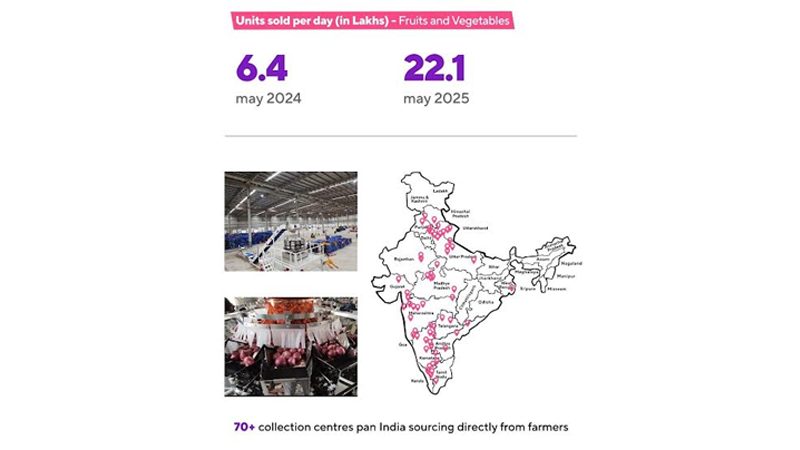
     MUMBAI: From mandi mayhem to farm-fresh flair, Zepto’s shaking up the supply chain. Zepto co-founder and CEO Aadit Palicha has revealed how the quick commerce player is rewriting the rules of India’s fragmented fresh produce market, one collection centre at a time. In a detailed post, he shared how the startup has quietly scaled its fresh category by 4x in just 12 months, leaping from 6.4 lakh to 22.1 lakh units sold per day.

    What’s behind this massive growth spurt? A shift away from the traditional mandi-led chaos to a tech-powered, decentralised model built on trust with farmers and rapid movement of goods. Zepto now sources directly from thousands of farmers across 70-plus Collection Centres hyperlocal hubs where fruits and vegetables are graded, packed, and dispatched within 12 hours of harvest.

    A key weapon in Zepto’s fresh arsenal is the Bloom app, the startup’s proprietary sourcing platform that turns real-time mandi price tracking, vendor scoring, and dynamic procurement into a science. The result? Better price visibility for farmers, automated planning for Zepto, and a win-win loop that cuts out intermediaries and reduces waste.

    This model isn’t just about speed, it’s also about dignity and predictability. “For the first time, Indian farmers are becoming part of a demand-driven, digital-first ecosystem,” Palicha noted. Through Bloom, they gain access to live market benchmarks, input support, and assured offtake features unheard of in India’s informal agri-supply chains.

    Even last-mile delivery hasn’t been spared a makeover. Zepto has invested in smart handling systems that preserve freshness while slashing delivery timelines. Combined with direct relationships with farmers, this allows the company to keep quality high and prices sharp, something traditional retail has long struggled with.

    In a sector long marred by price volatility and perishability, Zepto’s fresh strategy is a rare blend of logistics, localisation, and digital insight. The real disruptor here isn’t just tech, it’s trust.

  • Bold Care hits the pleasure button, launches massager line

    Bold Care hits the pleasure button, launches massager line

    MUMBAI: India’s numero uno sexual wellness disruptor, Bold Care, is going full throttle into the pleasure lane. The Ranveer Singh-backed brand has launched a brand-new lineup of intimate massagers — five under its booming women’s vertical, Bloom by Bold Care, and two for men — in a move that repositions the massager not as a secret indulgence, but as a daily dose of joyful self-care.

    The new drop isn’t just a product launch — it’s a cultural shft. Branded under the philosophy of “Big Pleasure,” Bold Care is flipping the script on self-pleasure from shame to self-empowerment.

    Launched just five months ago, Bloom by Bold Care has clocked over 1.5 lakh orders across Amazon, Flipkart, Nykaa, Myntra, and its own D2C platform. It’s already 4x ahead of Bold Care’s initial growth curve — and what’s more, it’s profitable. That’s pleasure, powered by science.

    The new line-up blends medical-grade silicone with sleek, ergonomic designs, long-lasting rechargeable batteries, and whisper-quiet tech. A 360-degree rotating head, a 365-day free replacement warranty (best-in-class, the brand claims), and affordable pricing give this range serious mass appeal. Products are available via Blinkit, Zepto, Swiggy Instamart, and leading e-tailers.

    The woman’s pleasure-giver range is as follows:

    * Rush (Rs 1,599): Compact bullet massager
    * Tempt (Rs 1,799): Classic wand with powerful vibes
    * Arouse (Rs 1,899): Dual-ended delight
    * Rhythm (Rs 899): Full-body wand for everyday ease
    * Sparkle (Rs 1,499): Travel-sized mini bullet

    And men have two varieties  in the Bold Care range to opt for, making the choice easier:

    * Masterstroke Stroker (Rs 1,499): Textured grip stroker
    * Stroke of Genius (Rs 1,899): Vibrating stroker with 10 custom modes
     

    “It is time we start recognising personal pleasure as an essential part of our health. With this launch, we are not just introducing products — we are opening a new chapter in how India approaches intimacy,” says Bold Care co-fouunder & CEO Rajat Jadhav. “Massagers should no longer be hidden or stigmatised, but embraced as essential tools of self-care. At Bold Care and Bloom, we are not just responding to demand, we are leading a shift in culture.”

    Since launching in July 2020, Bold Care has been rewriting the rulebook on men’s sexual health — offering science-backed treatments for erectile dysfunction (ED)  and premature ejaculation (PE), alongside India’s fastest-growing condoms and lubes. Bloom extends that same science-meets-sensibility playbook to women’s health, tackling root-cause issues from PCOS to menopause.

    Massagers are no longer hush-hush. With this bold new range, Bold Care is inviting Indians to indulge in their own pleasure –  guilt-free. 

  • FCB makes ties with in-laws bloom over AV tea

    FCB makes ties with in-laws bloom over AV tea

    MUMBAI: AVT Premium Tea, a brand that enjoys leadership status in Kerala and Tamil Nadu, is being strengthened through a commercial created by FCB Ulka Bangalore.

    The commercial is a nice portrayal of how the brand is passed on from one generation to the next, drawing a parallel to how the mantle of responsibility for the house is passed on from one generation to the next.

    AVT Consumer Products general manager – marketing Debendra Prasad M, said, “In the new commercial, the brand helps forge a bond between a mother and her new daughter-in-law, with the former handing over the tea to her daughter-in-law.”

    The TVC captures the changing hues of the mother-in-law & daughter-in-law relationship, and dwells on how today the two generations are forging new bonds and coming together in friendship. The brand marks the blossoming of this bond between the two generations.

    FCB Ulka Bangalore national creative director Mahendra Bhagat said, “The best way to demonstrate how a taste has in some sense, stood the test of time, is to show how generations have enjoyed it.”

    FCB Ulka Bangalore vice president Menaka Menon said, “Given the context of how relationships are evolving and changing in today’s world, the brand had an opportunity to become a sort of relationship marker. AVT in the new ad becomes representative of the passing on of the mantle of responsibility from the mother to her daughter-in-law.”

  • FCB makes ties with in-laws bloom over AV tea

    FCB makes ties with in-laws bloom over AV tea

    MUMBAI: AVT Premium Tea, a brand that enjoys leadership status in Kerala and Tamil Nadu, is being strengthened through a commercial created by FCB Ulka Bangalore.

    The commercial is a nice portrayal of how the brand is passed on from one generation to the next, drawing a parallel to how the mantle of responsibility for the house is passed on from one generation to the next.

    AVT Consumer Products general manager – marketing Debendra Prasad M, said, “In the new commercial, the brand helps forge a bond between a mother and her new daughter-in-law, with the former handing over the tea to her daughter-in-law.”

    The TVC captures the changing hues of the mother-in-law & daughter-in-law relationship, and dwells on how today the two generations are forging new bonds and coming together in friendship. The brand marks the blossoming of this bond between the two generations.

    FCB Ulka Bangalore national creative director Mahendra Bhagat said, “The best way to demonstrate how a taste has in some sense, stood the test of time, is to show how generations have enjoyed it.”

    FCB Ulka Bangalore vice president Menaka Menon said, “Given the context of how relationships are evolving and changing in today’s world, the brand had an opportunity to become a sort of relationship marker. AVT in the new ad becomes representative of the passing on of the mantle of responsibility from the mother to her daughter-in-law.”

  • Young Indian agencies begin to bloom in 2011

    Young Indian agencies begin to bloom in 2011


    The scene isn‘t scary yet for the bigger agencies. But 2011 is touted as the year when younger Indian creative agencies made their presence more visible as they took away accounts like the high-profile Pepsi World Cup campaign (Taproot), Godrej Hair Colour and Freshners (Creativeland Asia) and Tata Mutual Fund (11 Brandworks).

    Considering that many of the start-ups have got project-based accounts, the majority of the business still rests with the bigger agencies. Says JWT CEO Colvyn Harris, “Big agencies don‘t get affected if some project is handed over to any young agency. They are more credible and that‘s why clients stick with them for long. Also, there can be many reasons why the client gives a particular project to some other agency. They might not want to spend much on the campaign or they might like the idea presented by the other agency more. This is the way it works in the industry.”

    True, the biggies have not been majorly impacted. But somewhere, the pride hurts when Taproot wins PepsiCo‘s World Cup campaign project while JWT continues to be the AoR and handles most of the brands from the food and beverages major.

    Clearly, India is seeing a second wave of creative entrepreneurship. Taproot India, the most talked about young agency in 2011, was floated in 2009 and then followed others like Curry-nation and Scarecrow.

    “The timing was brilliant for the Indies to emerge as the Indian brands like Tata, ITC and Bharti were looking for creative agencies that understood them and their sensibilities and there was a lot of professionals who wanted to breakaway from the processes of the bigger agencies and start an enterprise of their own,” says Law and Kenneth MP and CEO Anil Nair.

    The first wave of creative independent Indian entrepreneurship started in the ‘80s but eventually fell prey to the global agencies. Chaitra became Leo Burnett, Sistas changed to Saatchi and Saatchi, and many other Indian agencies changed ownership.

    Explains Leo Burnett NCD KV Sridhar, “The last renaissance of creative entrepreneurship was with Enterprise, Contract, Ambience which can be called the golden era for creative entrepreneurship. Ravi Gupta set up Trikaya around that time while Gopi Kukde and his Onida campaign also happened simultaneously.”

    So how is the market environment different this time around? “The biggest difference is that media is now segregated from the creative agency function. This makes it even easier for the smaller agencies to flourish since the need for capital and financial discipline is lower,” says Contract Advertising EVP Kumar Subramaniam.

    One of the main pulls of young and independent agencies is the accessibility of top management. Curry Nation director Priti Nair explains, “You don‘t really deal with organisations, you deal with people. If the same people that you dealt with before and were happy with what they delivered for you, then how does it matter if they are in a small or a large agency?”

    Was pricing a major factor in helping the young guns win accounts? While the popular belief is that the Indies have managed to get accounts based on lower pricing, they insist that they do not come cheap in any case.

    Says Scarecrow Communications founder and director Raghu Bhat, “Ad agency fees are a mere fraction of the marketing spend. Clients are not idiots. Neither are they penny wise, pound foolish. Clients want more creativity, more involvement, and more passion. If they get all this in a network agency, why would they move to a smaller agency? Barring a few exceptions, today the choice is between lousy creativity at a higher cost and good creativity at a lower or equal cost. That is a very easy decision. Once the recession ends, I don‘t think clients will suddenly develop a desire to pay more for lousy creativity.”

    11 Brandworks founder director Prateek Bhardwaj says, “Clients working with young agencies aren‘t doing so because we are cheaper. We are not. They work because they get a more responsive team and better creative output. The economic slowdown hurt us as much as the larger agencies. Once the market is bullish, we expect business to grow even more as clients increase their budgets.”

    What are the challenges the newer agencies face? Says O&M NCD Abhijit Avasthi, “While sometimes being small helps in being nimble, big network agencies do have the advantage of a larger pool of resources and experience. Some small agencies, no doubt, had a good run in 2011. The challenge for them is to continue with their success. Consistency is the name of the game. The marketing problems are a lot more complex and layered today. This calls for a wider skill set and a deeper knowledge base to tackle the problems on ground.”

    Taproot India co-founder and CEO Agnello Dias believes the younger agencies will have to focus on consolidating their businesses in 2012. “The challenge is that there can only be so many clients/assignments/brands that can benefit from this. Beyond a certain number the waiting period may be too long or the talent/output may once again start spreading itself too thin. The year 2012 will see certain calls being taken. Enthusiasm and initial excitement having worn off, it will perhaps be consolidation-based calls,” he says.

    Since the agencies are run by experienced creative people, the creative output is consistently, of a high calibre. Bhat says, “The challenges that agencies face are – financial planning, the reluctance of big brands to hire small agencies and, of course, talent retention. Having said that, small agencies are not all that small any more. Just like some big agencies aren‘t that big any more.”

    Survival in the long run is a big challenge. Says Harris, “With time, more and more agencies will come up but surviving in the marketplace will be tough for them. Like in past, the smaller agencies will sell out to the bigger multinational agencies.”

    Bhardwaj feels it is a cyclic process. “To achieve a truly large scale, a tie-up with an MNC does seem necessary. An international partner offers a larger playing field, greater access to MNC brands, more acceptability with brand managers, and, of course, funds for rapid expansion. And then, you are back where you started – working in a big MNC, with an itch to go Indie!”

    Avasthi, however, has a slightly different view. “If the younger Indian agencies are keen to build a long-term brand, they will try to retain a unique flavour that will allow them to hold on. Of course, a lot depends on how good their financial health is,” he says.