Tag: BJP

  • After Congress and BJP, AAP enters ‘outdoor’ fray

    After Congress and BJP, AAP enters ‘outdoor’ fray

    MUMBAI: Barely days for the city to go to polls, and a party which had hitherto relied on unconventional methods such as word-of-mouth, foot soldiers and dharnas to gain popularity, has finally taken refuge in mainstream advertising, albeit out-of-home (OOH).


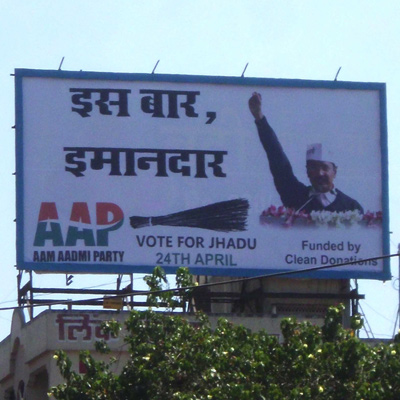
    Indeed, the Aam Aadmi Party (AAP) and its most public face, Arvind Kejriwal, are the latest to find their way to a string of hoardings plastered across Mumbai in the lead-up to voting day on 24 April.


    In the hoardings, Kejriwal is seen asking Mumbaikars for votes, alongside slogans in Hindi which read: “Jitne Sitam Karna Hai Kar Lo, Lekin Desh ko Badal kar Rahenge”, “Is baar Imaandaar” et al.


     According to Global Advertisers, which has the mandate for the main political parties, while BJP and Congress are utilizing 17 to 20 per cent and 25 to 27 per cent of the total outdoor hoardings, respectively, AAP is utilizing only 7 to 8 per cent.


    In terms of monies spent, “If Congress is spending around Rs 50 crore and BJP about Rs 20 crore on outdoor, AAP, which does not have as much money as BJP and Congress, should be spending much less than Rs 3 to 5 crore. However, it is important to note here that unlike Congress and BJP that are creating a very strong presence through TV and print advertising, AAP’s advertising backbone comprises just outdoor and word-of-mouth,” informs Global Advertisers managing director Sanjeev Gupta.


     For AAP, the outdoor agency is currently focusing on Mumbai’s high-visibility regions such as Worli, Andheri, Dadar and Thane. Despite having been approached at the nth hour, the agency’s media planning and buying teams have selected some of the best sites for the party.


    In this election year, Indian advertising is expected to witness an overall boost of around Rs 1,000 crore from political advertising, with outdoor advertising expected to see a 10 per cent rise within that. “We at Global expect to witness as much as a 30 per cent rise in our revenues just from political advertising,” says Gupta.


    While TV and print exude national presence, outdoor is very important for parties to reach out to masses who stay in the country’s hinterland. “And since the 2014 elections are being considered to be one of the toughest elections of all time, parties are more than willing to dig deep into their pockets and spend on advertising, especially outdoor, since their vote bank lies within these tier 2, 3, 4 markets,” Gupta points out.

  • Political advertising in India – social media and the first-time voter

    Political advertising in India – social media and the first-time voter

    If you’ve always wondered why and what’s the point of political advertising when the candidates get enough coverage around their sheninagans on a regular basis, then read on.

    The primary purpose of political advertising is to swing the perception of people who have ‘CONFUSION’ written all over their faces in capital letters, and ultimately, to win votes. Because for a larger percentage of the politicians, it’s all about obtaining and retaining power, fuelled by money and greed.

    Past demeanours do not count, and most political parties have cracked the seven deadly sins of Indian voters. To elaborate, here goes:

    1. The Indian public has extremely short-term memory

    2. Over time we learn to tolerate anything

    3. Nothing comes above religion and caste

    4. Political ignorance, even amongst the educated

    5. Petty appeasement through freebies

    6. Indians love to hate each other

    7. Need to hero worship and follow dynasties

    Courtesy: Ishaan Mohan Bagga, Editor, Indian Exponent. http://indianexponent.com/24298/7-weaknesses-of-indian-voter.html

    The economics of 2014 elections

    Having mentioned money, Reuters reports that ‘Indian politicians are expected to spend around US $5 billion (Rs 30,000 crores) on campaigning for elections next month (April 2014) – a sum second only to the most expensive US presidential campaign of all time – in a splurge that could give India’s floundering economy a temporary boost.

    India’s campaign spend, which can include cash stuffed in envelopes as well as multi-million-dollar ad campaigns, has been estimated at Rs 300 billion (US $4.9 billion) by the Centre for Media Studies, which tracks spending.

    That is triple the expenditure the Centre said was spent on electioneering in the last national poll in 2009.’

    Media is the largest beneficiary in the arsenal; and all related advertising, turns into a medium to deliver promises, attack and counter-attack opponents, and function as the political game changer. Swirling on a delicate ideological spindle – ‘A lie told often enough becomes the truth’ – Vladimir Lenin. Also successfully used by Hitler’s Propaganda minister Joseph Goebbels, who also served as chancellor for a day, following Hitler’s death.

    So couple greed with the seven deadly sins of Indian voters, stir in tonnes of cash and engage some of India’s leading advertising-PR-social media conglomerates to churn out propaganda and you have a volcanic blitz of media madness; where even educated, otherwise analytical minds can’t distinguish between hell or high water.

    The year 2014 is a very interesting year for India as the majority of the audience that will be voting this year will be very young. At a news conference in New Delhi, the election commission said that the process of voting in the sixteenth Lok Sabha will see the largest ever population of eligible voters, led by over 814 million voters, 100 million more than in 2009. This time round, more than 23 million voters are aged between 18 and 19. For the first time in a general election in India, voters will be allowed to cast a ballot for “None of the Above.”

    To the extent that the ultimate decision might also be in the hands of India’s youth because of the existing majority, the marketer has set up shop in the marketplace, i.e., political advertisers have looked into reaching out to the audience where they currently ‘hang out’.

    With advertising and communication being churned out faster than widgets, there is no thinking time for the creators; hence they all narrate versions of the same story, with a different overtones, over different platforms.

    The story goes something like this –

    Cause

    Here’s the starting point: what does the party stand for? Why does this party exist? What does the prime minister candidate stand for? There are many causes on offer: secular, development, safety, jobs, prices, pride, honesty and governance.

    The first-time voter is young, idealistic and seeks a motivating argument to come and vote. The best argument to this group is economic: the promise of jobs and a brighter future.

    Constituency

    Similar to brand marketing campaigns, the candidate who presents the best chance in the constituency is a combination of optimising many variables and micro-targeting, i.e., “Think national but choose local” being one of the most commonly used engagement strategies right now.

    Comparison

    By creating syndromes of fear, uncertainty and doubt amongst the people, political advertising portrays competitors in an unfavourable manner, thereby benefitting the attacking candidate and not marring his image; eventually leading to winning more votes.

    Celebrities

    Everyone from TV presenters, to actors, to former diplomats and government servants, will start offering their endorsements for the benefit of the voter. Such endorsements will multiply gradually in this election. Parties will rope in influential social commentators and feed them with talking points to build preference, especially among undecided voters.

    This election is therefore truly at the mercy of first-time voters and social media targeting, which will decide its outcome; since reliable stats reveal that over than half of the total youth audiences are on social websites. 

    According to a research by Autumn worldwide, ‘out of a million conversations on social media on elections in September 2013, first-time voters (overall 150 million) led 40 per cent of chats. They discussed the rupee, prices, women’s safety, governance and jobs. Their idea of accountability in politics will define India over the next 20 years’. So 2014 is the start…

    What’s important here is not which party wins the elections this time, but the power of crowd-sourcing and influencing opinion on the Indian social scene. This of course calls for a social and cultural mindset change, which is slowly experiencing what theologians call an ‘eschatological breaking in’, or a foretaste of things to come before they actually occur.

    Talk about bringing colour to Indian politics. While the political camps pore over rivals’ speeches looking for historical inaccuracies and discrepancies in political manifestos, a parallel analysis is unfolding across homes, public and individual spaces alike.

    Politics and the youth in India have never seemed to have had a liking for each other so far, the relationship between the two being pre-dominantly passive. But of late, with candidates like Meera Sanyal being active on social networks and using their personal pages to promote their ‘brand’ and reach out to the users by actually informing them about what they intend to do or what they are currently doing at the moment which helps them create a following amongst the dominant and previously dormant majority.

    This adoption of new media by Indian politicians, even though late provides a personal connect between the aspiring leaders and the junta making the game a little more complicated than it previously was keeping the users aware about the actual story instead of depending on paid media for biased information.

    There is another side to the story as well. Where there’s any form of advertising there are advertising agencies and this time they come with all guns blazing on the digital front too!

    The best example for this would be Narendra Modi who has managed to carve up a decent spot for himself in the cyberspace by making complete use of social networks along with the help of his agency by keeping the audience informed about his actions as well as sharing his opinions over different issues. Mr. Modi’s social pages also boast of web applications which look towards gathering volunteers for various causes as well as send festive audio greetings to his fans on the web.


    A bit too much you said? You be the judge, but you cannot undermine the fact that these are the reasons why the 2014 elections are so exciting.

    The future of the country is yet to be determined but advertising expenditure is enabling emulation of the likes of Lenin and Goebbels…

    Long live the Indian (r)evolution and heil to its leaders.

    Hello, anybody (with a conscience) home?

    (These are purely personal views of  Raising iBrows digital and engagement strategist Carl Noronha and indiantelevision.com does not subscribe to these views)

  • QW Naqvi quits as India TV editorial director

    QW Naqvi quits as India TV editorial director

    MUMBAI: Just six months after he took office with India TV as the editorial director after a year long sabbatical, well known journalist Qamar Waheed Naqvi has resigned from the company.


    Through an official statement, India TV confirmed that he had indeed taken the decision to leave the channel. Said India TV MD and CEO Ritu Dhawan, “We have accepted his resignation and asked Naqvi to serve his notice period.”


    “We are surprised at the reasons being attributed to it in the social media. Any such reasons are baseless, and we condemn the effort being made to use it for political gains,” said Dhawan.


    Sharma said, “There is a continuous attempt by some people to defame electronic media which has been officially condemned by broadcasters. We in the news media have covered several elections in the past and will cover many more, we cannot allow our industry to become a tool in the hands of interested parties during elections.”


    Naqvi joined India TV in October last year prior to which he was a known name at Aaj Tak.

  • Madison Media still holds the digital mandate for Airtel brand and media

    Madison Media still holds the digital mandate for Airtel brand and media

    MUMBAI: Contrary to reports that appeared in the media yesterday, Madison Media continues to handle the digital mandate for Airtel brand and media. The agency however does not handle “search marketing” for airtel.in.


    Madison Media Group CEO Gautam Kiyawat in a statement says: “Digital is a very important element within Madison Media and our attempt has been to offer clients a holistic media strategy encompassing all media to achieve their brand’s business objectives”.


    Madison Media today works with many marquee clients in the digital space including Airtel, Mondelez/Cadbury, Marico, Levis, Budweiser, Asian Paints, BJP, Raymond, Yatra.com, Fiama diWills, and many other clients. The agency has a strong 60 member digital team most of them embedded in large teams that handle the media accounts of large marquee clients.


    Madison Media has won several awards in the digital and mobile domain with the latest one being The Festival of Media Global Award and Asia Pacific Award for Parachute Advansed Ayurvedic Hair Oil for convincing consumers to become the brand’s sales force leveraging the power of Mobile. The agency also won a Yahoo Big Idea Chair for its campaign on Airtel, Har ek Friend Zarori Hai.  At the Emvies Awards held last year, Madison Media also won a Gold for Best Innovation in Digital (Video) for Cadbury Celebrations – Lonely Maa.


    Madison Media Group handles media planning and buying for blue chip clients including Airtel, Godrej, Mondelez/Cadbury, ITC, General Motors, Marico, McDonald’s, Raymond, Piramal Healthcare, TVS, Levis, SpiceJet, Domino’s, Bharti Axa, Max Life Insurance, Asian Paints, Pidilite, Tata Salt, Acer, Lafarge Cement, Dish TV, Times Television Network, Indian Oil, Cafe Coffee Day and many others.  The agency claims to have gross billings of over Rs 3000 crore.

  • Film stars hope to make hay by joining the political fray

    Film stars hope to make hay by joining the political fray

    NEW DELHI: Films like ‘Satta’, ‘Nayak’ and ‘Rajneeti’ in recent years, have shown the Bollywood filmmakers’ interpretation of the way politics works in this country. Not to forget movies like ‘Sarkar’ that exposes the links of the underworld with politicians.


    Perhaps this exposure to politics and largely the anti-corruption wave that swept the country in the wake of Anna Hazare’s movement has resulted in probably the largest number of film personalities enter the fray for the 2014 polls.


    Although all political parties have not made public their complete list, around 40 actors from across the country are in the election arena – revealing perhaps the largest participation from Bollywood and north India, since the participation of the film industry from south India has already been quite good.


    But for the film industry, five constituencies are going to be worth watching as they have actors pitted against each other. Perhaps the most glamorous poll fights is in Chandigarh, which will see actor former Miss India Gul Panag of the Aam Aadmi Party (AAP) pitted against her senior and very versatile actor Kirron Kher who has taken up cudgels for the Bharatiya Janata Party (BJP). Though Panag was born in Sangrur, she has continued to live in Chandigarh, while the Chandigarh-born Kher has come into fray from this city though she lives in Mumbai.


    The not-so-‘khamosh’ Shatrughan Sinha is once again representing the BJP from Patna Saheb in Bihar where he will face Bhojpuri actor Kunal Singh of the Congress. Singh has stated that he is prepared to take up the challenge because he does not feel Sinha has done enough for the constituency.


    Mumbai North West will see a triple star fight: the verbose Kamal R Khan who often gets into controversies for his utterances is pitted as an independent against equally controversial star Rakhi Sawant who represents the Rashtriya Aam Party, and Mahesh Manjrekar who represents the Maharashtra Navnirman Sena (MNS).

    In Birbhum, the fight is between actor Satabdi Roy of the Trinamool Congress and actor Joy Banerjee of the BJP which has generally not done well in West Bengal and hopes star power may help.


    Singer Indranil Sen from TMC will take on actor Sidhanth Mahapatra of the Biju Janata Dal from Behrampur.


    In fact, the BJP has attracted the largest number of film personalities, particularly from Bollywood and north India. Some other film personalities representing the party are George Baker in Howrah, Nimu Bhowmik in Raiganj, versatile singer Bablu Supriya in Asansol, senior actor Hema Malini in Mathura, Hindi and Bhojpuri actor Manoj Tiwari in North East Delhi, music maestro Bappi Lahiri from Serampore, versatile actor Paresh Rawal from Ahmedabad East, veteran Vinod Khanna from Gurdaspur, and television actress Smiriti Irani from the high-profile constituency Amethi. 


    The Congress has roped in Kannada heroine Ramya in Mandya, actor Aparajita Mohanty in Cuttack, veteran Oriya film actor Bijay Mohanty from Bhubaneswar, Hindi and Bhojpuri actor Ravi Kishan from Jaunpur, petite actress Nagma in Meerut, actor Jayasudha in Secunderabad, the high-profile Raj Babbar from Ghaziabad, Union Minister D Napoleon from Perambalur in Tamil Nadu, and actor Vijaya Shanthi from Medak.


    The Trinamool Congress is not far behind, with glamorous actor Moon Moon Sen in Bankura, reigning Bengali star Deb in Ghatal, Sandhya Sen in Midnapore, actor Soumitra Roy from Malda North, actor Arpita Ghosh in Balurghat, former Bollywood star Biswajit (Chatterjee) from New Delhi and actor Tapas Paul in Krishnagar.


    The AAP has roped in TV actress Rina Rani to contest from Maharajganj and the actor-dancer Javed Jaffery (son of former comedy actor Jagdeep) from Lucknow.

    Actor Innocent will represent the Communist Party of India (Marxist) from Chalakkudy in Kerala, renowned award-winning director will fight for the Janata Dal (United) from West Champaran in Bihar, former actor Jayaprada will be fighting this time on behalf of Rashtriya Lok Dal from Bijnor.


    Jayaprada initially represented the Telugu Desam Party, later switching to the Samajwadi Party and then moving to RLD after her friend Amar Singh was forced to leave SP.


    Rakhi Sawant says she is contesting the elections on the plank of restoring women’s safety in the metropolis. “I was offered a BJP ticket from Srirampur in West Bengal. But I am from Mumbai and know Hindi and Marathi. I don’t know the local language of West Bengal, so why should I stand from there?” she said while announcing her candidature.


    Actor Ramya (Divya Spandana) is the first female star from Karnataka to enter the Lok Sabha. Ramya joined the Youth Congress in 2011 and had campaigned for the party in the assembly elections.


    The final list is yet to come out, and so Punjabi pop singer Rabbi Shergil who has joined the AAP is also expected to contest, even as actor Murali Mohan is eyeing the Rajahmundry seat. Pawan Kalyan who formed the Jana Sena is hoping to contest from Kakinada.


    Some actors or film personalities who have got elected to Parliament in the past or are presently in the Rajya Sabha as elected or nominated members include Prakash Jha, Amitabh Bachchan, Govinda, Dharmendra, Shekhar Suman, singer Hans Raj Hans, Babu Mohan, Murli Mohan, Krishnam Raju, Nafisa Ali, late Sunil Dutt, Jaya Bachchan, late Rajesh Khanna, late N T Rama Rao, Vyjayanthimala Bali, late Dr Raj Kumar and K Chiranjeevi. The nominated members include Nargis Dutt, Lata Mangeshkar, Shabana Azmi, Rekha, and Javed Akhtar.


    Babu Mohan has joined the Telengana Rashtra Samiti to fight the assembly elections, while in Tamil Nadu, Jayalalitha will again represent the AIADMK in the assembly. Actor Jeevitha who joined the BJP is hoping to get an assembly seat, actor Nandamuri Balakrishna is also looking for a seat in Andhra Pradesh, while comedian Ali from the south and actor Ambreesh are not far behind in their quest. Vijay Kanth of the DMDK and U V Krishnamraju from the BIP are others in the fray for state assemblies.


    Almost all the film personalities in the fray have some controversy attached to their lives or their present campaign. Kamal Khan who is known to be outspoken had in one of his films added dialogues attacking the MNS announcements about outsiders in Mumbai, while actor Nagma has had to face people who have not just tried to grope her but Congress MLA Gaj Raj Sharma grabbed and kissed her during one of her campaigns. She has even been manhandled.


    Kirron Kher was met with black flags when she first came to Chandigarh and had to convince voters that she was indeed from Chandigarh, while actor-dancer Hema Malini has been booed for not daring to step out of her Audi as she moves around Mathura. And if she does peep out of the sun-shade of her car, it is only for a brief glimpse and visits to temples are in the midst of bouncers.

      
    Manoj Tiwari had earlier contested the national elections from the SP ticket in 2009 and is now representing BJP.


    Raj Babbar had won from Firozabad for a fourth term by defeating Dimple Yadav, wife of Akhilesh Yadav and daughter-in-law of Mulayam Singh Yadav, but has now been shifted to Ghaziabad.


    The versatile Aamir Khan has become the national icon of the Election Commission after the last episode of the second edition of Satyamev Jayate. A team from Doordarshan, EC’s official partner was rushed to shoot a video with Aamir Khan. Apart from the video, Khan has shot for an audio spot, urging the people to cast their votes. He says, “Rukey nahin, chookey nahin…vote zaroor daalein.


    Singer Anoop Jalota will campaign for the BJP while Kapil Sharma and Soha Ali Khan will campaign for the Congress.


    While Bollywood has generally not been very successful in north India, the southern film industry is rich with examples of film-politicians. Since 1957 when actor S S Rajendran (SSR) entered the fray in Theni during the assembly elections to the then Madras State Legislative Assembly polls, the DMK and its 1972-offshoot AIADMK led by popular hero M G Ramachandran, have in most elections given tickets to stars.


    In the post-MGR era, the AIADMK, the DMK and other parties had fielded actors in Parliamentary and assembly elections since 1998, barring the 2004 Lok Sabha polls.


    The outgoing 15th Lok Sabha had two actor MPs, D Napoleon and Ritheesh, of the DMK. Now they have switched loyalties to suspended DMK leader M K Alagiri. Napoleon had earlier represented the Villivakkam Assembly constituency during 2001-06 and lost to comedian S V Shekhar in Mylapore in 2006.


    This time, the ruling AIADMK and DMK have trusted lawyers, businessmen, doctors and others than trying actors though initially there were speculations that yesteryear heroine Khushboo and Radhika Sarathkumar could fight it out in a constituency in Chennai.


    While the connection between Tamil cinema and politics goes back to the 1940s when DMK founder C N Annadurai and its present chief M Karunanidhi were script writers, SSR known as a ‘Latchiya Nadigar’ (Ambitious Actor), was the first screen star to join the fray. He had lost the 1957 election by 6,781 votes to a Congress candidate.


    However, in the 1962 assembly polls he created history by winning from Theni on a DMK ticket thus becoming the first actor in the world to enter an elected legislative body. In later years, he was nominated to the Rajya Sabha and also won from the Andipatti Assembly constituency (MGR’s last represented constituency) in 1980 as an AIADMK candidate.


    MGR entered electoral politics only in 1967, winning from St Thomas Mount, while chief minister J Jayalalithaa became a Rajya Sabha member in 1984. The same year, the Congress had successfully fielded yesteryear actor Vyjayanthimala from the South Madras Lok Sabha constituency and she sprung as a surprise by defeating veteran politician Era Sezhiyan.


    But popular Sivaji Ganesan, one of the greatest actors in the world, had a failed political career though the Congress once made him a Rajya Sabha member. The Thamizhaga Munnetra Munnani, which he launched after MGR’s death, failed to take off and he did not make it big as president of the Janata Dal (Tamil Nadu) unit either.


    Actor Sarathkumar was defeated in 1998 from the Tirunelveli Parliamentary constituency on a DMK ticket. Subsequently, he entered the Rajya Sabha and is now a MLA. In contrast, another actor Ramarajan, whose popularity was on the wane, got elected to the Lok Sabha from Tiruchendur as an AIADMK candidate in 1998.


    Another yesteryear MGR film heroine Latha lost her deposit when she contested from Dindigul in 1998 Lok Sabha polls on a MGRADMK ticket. The following year, voters of the constituency rejected DMK candidate actor S Chandrasekar.


    Similarly, in Periyakulam, villain Mansoor Ali Khan fielded by Puthiya Tamilagam, came third in 1999 but polled over 87,000 votes.


    Some of the Tollywood actors who made it to the assembly and Parliament (including Rajya Sabha) are: villain Radharavi (AIADMK), comedian S S Chandran (AIADMK), Vijayakant (DMDK), Arun Pandian (DMDK rebel), versatile film personality T Rajendar (DMK) and comedian Isari Velan (AIADMK).
  • Campaigning with a purpose

    Campaigning with a purpose

    MUMBAI: The countdown to the ‘who will claim the kursi’ has started and finally after spending enough and more moolah on advertising and campaigning, the world’s largest democracy will vote for its 16th Lok Sabha.

    Indiantelevision.com brings to you a roundup of all the television commercials launched by Congress and Bharatiya Janata Party (BJP) to woo the voters – young or old, man or woman – and what was the message the parties wanted to convey through these.

    Campaigns by Congress

    India’s transformation

    Storyboard: The ad focuses on one man who is taken aback with no ATMs, no flyovers or no mobile phones. Only to be woken up to the reality which is quite different. He is relieved to see that the amenities, which have become an integral part of our lives today, are back. He laughs off the dream and is happy about how our lives have changed in the past 10 years, thanks to all the development.

    Purpose of the ad: The adverts show the progress the country has made in the last 10 years i.e. under the UPA regime. Be it telecom, infrastructure or other facilities, everything has become a part of our lives.

    Click here to watch the video

    The video highlights the inclusive growth, economic development and social equity achieved through the various welfare schemes of the Central Government. It underscores the impact of policy decisions at the ground level for participatory governance within the right framework.

    Bharat Nirman

    Click here to watch the video

    Storyboard: A police jeep enters a busy street where street vendors are galore. The police hawaldar screams on top of his voice from the jeep telling the vendors to shut their shops as it is not allowed. However, one vendor (selling golguppas) refuses to bow down to the halwaldar’s dhamkis of shifting his cart to some other place. He proudly tells the policeman that he has a government approved licence to work and that it is his right.

    Purpose of the ad: Through this campaign, Congress wants to highlight the scheme which helps street vendors. The Street Vendors (Protection of Livelihood and Regulation of Street Vending) Bill, 2014 which was passed by the Lok Sabha on 6 September 2013, provides for protection of livelihood rights and social security of street vendors.

    Kattar Soch Nahi, Yuva Josh

    Click here to watch the video

    Storyboard: The TVC revolves around a youngster (Hasiba Amin, a youth congress representative) who says that since India is a young country where 50 per cent of the population is under 30 years, only a party which can understand their beliefs, expectations, mindset, problems and dreams needs to come to power. And the party which does so is none other than Congress. So, under the leadership of young Rahul Gandhi, the youngsters can grow. The mantra is ‘not extremist thinking, but youthful energy’.

    Purpose: To bring forward Rahul Gandhi’s ideology of approaching the youngsters to come together and work for the betterment of the country. RaGa’s vision suggests that we are young minds and should not believe in fanaticism but youthfulness.

    Har Haath Shakti, Har Haath Tarakki

    Click here to watch the video

    Storyboard: Again in this TVC, a youngster (Shabbir Ahmad, a youth congress supporter) is shown talking about his credence in Rahul Gandhi’s vision that we need to bring a change in our country with RTI, Food Security Bill, Lokpal Bill and Employment guarantee. He supports the vision for future which is to have ‘more equal, more caring society.’

    Purpose:  The ad highlights the need for the society to stand together. It also says that it is under Congress’ guidance/ hand that the whole nation will develop. The ad also highlights how the party has given a common man the power through its various schemes and bills. And this will empower them.

    Congress Ke Mazboot Haath

    Click here to watch the video

    Storyboard: Congress leaders like Sachin Pilot, Nirupam Roy, Jyotiraditya Scindia and many more can be seen sitting and discussing matters which concerns the nation and what can be done to address them. In the background, a song plays which symbolizes these politicians as Congress’ strong hands and it is they who will ensure that India moves forward.

    Purpose: Moving towards a stronger India, Congress soldiers will always ensure people’s betterment and it will continue its efforts to provide a happy and prosperous life for all.

    Bharatiya Janta Party (BJP): campaigns at a glance

    Ab Ki Baar, Modi Sarkar

    Click here to watch the video

    Storyboard: The black and white advert highlights how even though the country has progressed and people have sent there girls for higher education and work in other cities, they are not at ease. The woman/mother in the ad, stresses on the fact that the country isn’t safe in current government’s hands as women aren’t safe.

    Purpose: After the Delhi gang rape case and many more that followed it, the campaign highlights the fact that the government has failed to provide safety to the women of the country and worse, hasn’t been able to punish the culprits.

    I will Choose BJP, My Vote for Modi

    Click here to watch the video

    Storyboard: A cobbler is shown reciting how a party headed by a dynasty has ruled the country for years and has filled its own pockets, while the poor has remained stagnant. He goes on to say that this time he for his self-respect, will choose BJP and vote for Modi.

    Purpose: To showcase how poor have remained poor in the country while the politicians and others have filled their pockets.

    Vote for BJP

    Click here to watch the video

    Storyboard: The animated ad shows an umpire and a cricketer being disturbed by people who want their wishes to be fulfilled. People are shown screaming ‘humari maange poori karo’ while demanding petty things.

    Purpose: These ads were launched during the T20 World Cup, and hence revolves around cricket (umpire and cricketers). The ads take a dig at Congress and Aam Aadmi Party (AAP).

    BJP Anthem

    Click here to watch the video

    Storyboard: The anthem shows BJP prime ministerial candidate Narendra Modi swearing by the motherland that he will not let her get destroyed and everyone will get his/her due. People from different socio-economic backgrounds are shown highlighting their concerns – no jobs, no safety, no economic growth etc.

    Purpose: To bring to focus the scams and other issues concerning the common man to foreground. Through the anthem, the BJP is trying to give out a strong message to the voters, that if Modi comes to power, he will take the country to an upward growth.  

  • ‘Social Tracker’ to track LS elections

    ‘Social Tracker’ to track LS elections

    MUMBAI: With elections just a couple of days away, the debate over the role social media will play in these Lok Sabha elections has just got intensified.


    A plethora of politicians, political parties and their supporters have taken over the social media to reach out to the urban youngsters. The common man too has taken on to the digital world to express their views on various issues related to the general elections. The reason is simple: social media is free and democratic. One has the freedom to voice their opinion as well as get others involved in the information.


    This year’s FICCI Frames too explored the medium when it left the forum open for discussion on ‘Internet and Democracy: Interloper or Catalyst.’ The panelists during this forum discussed how Obama’s election campaign exploited the power of the social media to spread the word, garner support and get people engaged and how Indian politicians can also take a cue from it.


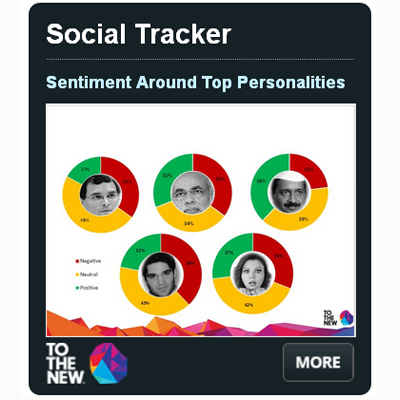
    To monetise on the trend, ‘To The New’, a social and mobile first digital service provider has launched a real-time tracker that evaluates digital conversations. The free-to-all ‘Social Tracker’ currently available on IBN Live gives people an insight on what conversations are happening on the general elections.


    “Thanks to mobile penetration and the free nature of social media, a lot of youngsters are on the medium apart from others who are following the elections closely. This tool will help not only the news portals, but also common man to know what is everyone talking about,” says Thoughtbuzz COO Ashok Patro.


    He adds, “Political parties and politicians too have realized the importance social media has and that is the reason why they are so active in the virtual world this time around.”


    The digital agency uses its expertise to track what is happening across social media platforms – blogs, forums, twitter, facebook etc. And this is what separates them from the likes of Google trends or twitter trends, boasts Patro.


    Currently, ‘Social Tracker’ works on a dashboard, Omnio and has three panelists analysing these trends 24*7.  “While currently we are available on IBN Live, we have also been approached by other news portals and the discussion for the same is on,” says Patro when asked where all will it be available in the future. However, he clarifies that each portal will get something different because like various polls and surveys conducted by channels and research firms, they all want something different to offer to their viewers.


    Parties, personalities/politicians, in general conversations and trends on LS elections is what the tracker focuses on.   “The conversations keep changing, but we always focus on top five parties. Out of this, Congress, BJP and AAP (in no particular order) form the top three while the other two vary on issues discussed on a particular day,” informs Patro.


    Apart from daily analysis, there is a weekly analysis done as well for the weekends.

  • Want to woo youngsters? Depend on youth channels

    Want to woo youngsters? Depend on youth channels

    MUMBAI: In-branding is not unusual today as we see superstars selling the brands they endorse even in their films. Remember Chennai Express and how Shah Rukh Khan endorsed the features of the new Nokia mobile (of which he is also a brand ambassador) in the film. And if you thought it was just him, then you are wrong. Hrithik Roshan starrer Krrish 3 had a host of FMCG products being promoted through the movie. 


    The phenomenon has not spared the small screen as well. Right from the brands to film stars, the small screen has become a popular destination for promotion. However, this time around there is a twist.


    With the nation gearing for the upcoming elections, the political parties are doing all that they can to get voters to get inked. This election season the parties are finding innovative ways to connect with the audiences, especially the youth. And if you watch Channel V India, a youth entertainment channel, you would know what we are hinting at.


    The main characters of various shows on the channel can be seen talking about how prices have risen in the past years or how it is the time to bring change. This, while a ticker/astrix runs with BJP’s symbol and message.


     The political parties – Congress and Bharatiya Janta Party (BJP) – both in their mission to woo the first-time voters are now targeting youth channels.


    “Youth channels are the best way to catch the attention of first-time voters and since we are using different strategies, we thought of trying this as well,” says a source from the media agency handling BJP’s mandate.


    The source goes on to say that it is a “different” way to reach our audience. And, one will see a lot of astrixs and L- shaped advertisements on various GECs as well as news channels till the elections commence.


    While BJPs in-branding campaign on shows started last week, the Congress had bought ad-spots on Channel V I almost a month back.


    Channel V, itself, through various initiatives, is encouraging youngsters to go out and vote. “This doesn’t mean we support a particular party over the other. These are just commercial deals which we sign with agencies handling the parties. There is no association with any party,” clarifies Channel V India, GM & channel head Prem Kamath.


    So, the next time you tune in to shows like Sadda Haq or Dil Dosti Dance, on Channel V, do not miss out on the message from the lead characters to go out and vote.

  • Narendra Modi gets chatty with ETV

    Narendra Modi gets chatty with ETV

    JAIPUR: BJP’s Prime Ministerial candidate Narendra Modi, while for the first time giving a long interview to ETV, during the electioneering environment, has expressed that in the Indian politics this will be an election of hope. Because, the people have lost faith not only on Congress Party and its Prime Minister, but also on the system named government. That is why the first priority should be to get back the faith of the people.

    The interview of Narendra Modi has been telecast on all ETV channels. It will be re-telecast at 8.30 pm during Central Hall Programme. Head of ETV News Network, Jagdish Chandra on this occasion said that during the Lok Sabha Elections, the channel has started a series of programmes for bringing national issues and opinions of national leaders on those issues to the common people. This series has started with the interview with Narendra Modi. Narendra Modi is believed to be very near to be the next Prime Minister. Nearly 240 channels’ applications are pending with Narendra Modi for getting his interview. But, to make reach his voice to 35 crore viewers, he chose first ETV.

    For ETV’s programme “Central Hall”, Senior Journalist Harishankar Vyas took interview of  Narendra Modi. In reply to his question on “Congress Free India”, Modi said that it means Corruption free India, Dynasty free India, Free from Undemocratic methods, Free from misuse of constitutional agencies of India, Free from price rise and free from threat to India. Because, Congress has become a medium for all these. Hence Congress Free India call has been given. When, he is saying Congress free India, that means he is calling to free from the work culture that has been developed in India over sixty years by Congress. And also for the free from vote bank policy adopted by Congress.

    On a question that previously some non-Congress governments also functioned similar to Congress during their tenure, Modi replied that except Atal Bihari Vajpayee, all others heading non-Congress governments, were having Congress Gotra (lineage). They had been groomed in Congress. Only due to personal differences or for any other political reasons they had been separated from Congress.

    Narendra Modi also said that he has a clear picture in mind on what will be his priorities after forming government. Administrative system has to be revived to uplift the poor. Modi asserted that he doesn’t consider himself as Hero. His commitment is for the poor, farmer, youth, women and jawans.

    Narendra Modi during his 66 minutes interview openly discussed on National and International issues, safety and army related issues and also on economic reforms issues. In between, the interview, ETV News Network Head Jagdish Chandra presenting the reviews said that Modi wants to implement the Gujarat Model across the nation, which will be a big challenge before him. In addition to this, Modi tried to refute the allegations labeled against him by highlighting economic issues. Assuring to spread Atal Bihari Vajpayee’s ambitious project of inter linking rivers, Modi hinted of bringing a new turn in economic system. Modi during the discussion also hinted that RSS life vision can be seen in his work style.

    Commenting on UPA government, Narendra Modi said that their policies are of vote bank policies. They run the government to win  the elections and we want to run the government to empower the people. For them, grabbing power is everything, and we want to empower the people. Vote bank based policies empty the government treasury and term these as economic reforms. There is a need to weed out huge obsolete laws. Even after the files complete 40 Dhams (holy places), it never completes the journey. Modi also expressed his views on development of agriculture, Shipping Industry and tourism. On replying to a question, Modi said that his think tank will be 125 crore public.

    Narendra Modi, showed interest in Mahatma Gandhi and Lal Bahadur Sashtri. Replying a question on Health issues, Modi said that Gandhiji had always talked about hygiene, but we couldn’t teach our children about those culture. We will present a Clean India on Gandhiji’s 150th anniversary. We should think on being healthier than suffer from diseases. We want to set up one medical colleges in each district. Modi cleverly avoided the reservation issue and said that he raised the number of seats in Engineering and Medical Colleges to such an extent that everyone can get opportunity to study. He gave priority to increase job opportunities for youths.

    Narendra Modi, during his interaction with ETV, for the first time spoke about his personal life and interests. He said that he likes to listen music, especially instrumental music. He also likes to trek in mountains and Himalaya is his favorite place. He used to read lot of books in his village library during childhood. But, now he doesn’t get time to read. He also said that he never dreamed of being something, and never told young people to dream to become someone. But, yes, he dreams to do something and advises the young to dream of doing something. And he left home, left family, and left village, only to do something for Mother India. Not to be something.