Tag: Bimal Julka

  • TDSAT adjourns DTH licence fee case to 22 May

    TDSAT adjourns DTH licence fee case to 22 May

    NEW DELHI: The petition by private direct-to-home (DTH) operators challenging the notice of the government for clearing arrears of licence fees was adjourned by the Telecom Disputes Settlement and Appellate Tribunal (TDSAT) to 22 May.
     

    The DTH operators were given time by chairman Aftab Alam and Kuldeep Singh to file their rejoinders following the reply by the government.


    TDSAT also noted that the earlier assurance by the government that it will not pressurise the operators in this regard till the case is taken up for hearing will continue.

      
    Even as the petitioners have alleged that the demand by the Information and Broadcasting Ministry is contempt of court as the matter in this regard is pending in the Supreme Court, I&B secretary Bimal Julka had earlier told indiantelevision.com that the apex court had not issued any stay order.

     
    However, conscious that the TDSAT or the Supreme Court may be moved in the matter, a caveat had been filed by the Ministry in this regard.

     
    The Ministry had recently sent a notice to the six private DTH operators with regard to licence fee dues amounting to Rs 2,066 crore. The private operators are Tata Sky, Dish TV, Airtel Digital TV, Reliance Big TV, Sun Direct and Videocon d2h.

    According to the notice, the six private operators had been asked to pay the amount within 15 days.

     
    However, most of the operators contacted said they had cleared the dues of licence fee.

     
    The operators say the licence fee as demanded under the rules is on gross revenue (GR) whereas they have been asked to pay the fee on the basis of Actual Gross Revenue (AGR). The operators have said the fee should be only on subscription revenue and not on allied earnings such as dividend and interest income. 


    Meanwhile, Tata Sky late last month made a payment of Rs 383 crore to the Ministry to cover its license fee and other dues. A demand draft of the amount was submitted to the Ministry. Even as other operators had said that they would prefer to wait till the next hearing.

     
    This amount covers license fee for the year 2013-14 according to the rate specified for license as well as past dues, for which the Ministry had raised a demand note recently.


    TataSky MD and CEO Harit Nagpal had earlier said in a statement: “We hope that this will end the long standing dispute on the subject and pave the way forward for a constructive rationalisation of taxes with the support of our parent Ministry.” 

  • AIR, DD to give live coverage National Film Awards ceremony

    AIR, DD to give live coverage National Film Awards ceremony

    NEW DELHI: The 61st National Film Awards for 2013 will be presented by President Pranab Mukherjee on 3 May, the date on which India’s first feature film ‘Raja Harishchandra’ by D G Phalke was released commercially in 1913.


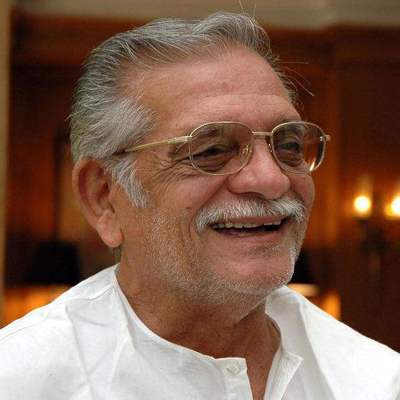
    The Dadasaheb Phalke Award to the eminent poet, lyricist, and filmmaker Gulzar will also be presented the same day.


    Both Doordarshan and All India Radio will have live broadcast of the awards ceremony from the stately Vigyan Bhavan from 5.45 pm on that day on their national channels.


    Prior to that, All India Radio will carry an interview of Directorate of Film Festivals director Shankar Mohan at 8.15 pm on 1 May on its national hook-up.


    It will have a featurised programme as the curtain-raiser to the awards on 2 May at 8.15 pm with an interview with Information and Broadcasting Ministry secretary Bimal Julka.


    Later on 3 May at 9.30 pm, AIR will broadcast a report on the award ceremony on its national hook-up.

  • It came at the right time – in the birth centenary year of Dadasaheb Phalke: Gulzar

    It came at the right time – in the birth centenary year of Dadasaheb Phalke: Gulzar

    NEW DELHI: Later this year, eminent director-screen writer-lyricist Gulzar will be honoured with the prestigious Dadasaheb Phalke Award (2013) by President Pranab Mukherjee along with the National Film Awards (2013). Gulzar will be the third lyricist after Majrooh Sultanpuri (1994) and Kavi Pradeep (1998) to win the award.


    According to Information & Broadcasting Ministry Secretary, Bimal Julka, the seven-member selection committee was unanimous in its recommendation of Gulzar for what is the nation’s highest award in cinema.


    “I am particularly happy since the choice was made by an independent committee, though set up by the Government,” said Gulzar. While many feel the honour was bestowed on him rather late, he only said, “This was special, as it came at the right time- in the birth centenary year of Dadasaheb Phalke.”


    An institution into himself, Gulzar has not only penned several Hindi film songs and dialogues but also directed a clutch of notable films. As one of the greatest authorities in the history of song in Indian cinema, he has given talks on the subject, both in India and abroad. Often accused of selecting other people’s novels/stories for adaptation, there’s no denying his talent for optimally adapting the same to Indian/Hindi film audiences.


    Biography


    Gulzar was born as Sampooran Singh Kalra to Makhan Singh Kalra and Sujan Kaur in Dina, Jhelum district, in undivided India, in what is now Pakistan. Sampooran started off as a car mechanic in a garage in Mumbai but went on to become a writer, assuming the pen name, Gulzar Deenvi. His father rebuked him for becoming a writer saying, “As a writer, you will have to depend on your brothers”. He started his film career as a lyricist, going on to write dialogues and screen plays, and later, even directing many critically acclaimed films.


    Gulzar began as a songwriter with music director Sachin Dev Burman in the movie Bandini (1963) with the song, Mora Gora Ang Lai le picturised on Nutan. Gulzar’s most successful songs as a lyricist came out of his association with S D Burman’s son, Rahul Dev Burman, whom he described as the anchor in his life. Gulzar’s lyrics were special in that they formed part of the narrative. As a lyricist, he also had award-winning associations with music directors Salil Chowdhury (Anand, Mere Apne), Madan Mohan (Mausam) and more recently Vishal Bhardwaj (Maachis, Omkara, Kaminey), A. R. Rahman (Dil Se.., Guru, Slumdog Millionaire, Raavan) and Shankar–Ehsaan–Loy (Bunty aur Babli).


    Some of Gulzar’s more notable songs are: Maine Tere Liye Hi from the film Anand; Bole Re Papihara Papihara from the film Guddi; Koii Hota Jisko Apna, a nostalgic number from Mere Apne; Aanewala Pal Janewala (Golmaal); Sun Sun Sun Didi (Khubsoorat); Ae Zindagi Gale Laga Le (Sadma); Roz Roz Aankhon Tale (Jeeva); Tum Aa Gaye Ho Noor and Tere Bina Zindagi Se from the film Aandhi; Saare ke saare gaama ko lekar gaate chale (Parichay); and Dil Dhoondhta hai (Mausam).

    Gulzar won international fame when he was awarded the prestigious Oscar Award (with A R Rehman and Sukhwinder Singh) for writing the Best Original Song  Jai Ho from the film, Slumdog Millionare. He was also honoured with the Grammy Award for Best Song Written for a Motion Picture, Television or Other Visual Media.


    Apart from films, he has written ghazals for ghazal king (late) Jagjit Singh’s albums “Marasim” and “Koi Baat Chale”. Both albums were a great success.


    For the peace campaign (Aman ki Asha) jointly flagged off by leading media houses from India and Pakistan, he wrote the anthem “Nazar Main Rehte Ho”, which was recorded by Shankar Mahadevan and Rahat Fateh Ali Khan.


    Gulzar’s poetry is partly published in three compilations: Chand Pukhraaj Ka, Raat Pashminey Ki and Pandrah Paanch Pachattar (15-05-75).


    Gulzar also wrote dialogues and screen plays for films like Aashirwad, Anand, Khamoshi and more. His short stories are published in Raavi-paar (also known as Dustkhat in Pakistan) and Dhuan (smoke). He has penned dialogues and lyrics for several Doordarshan serials including Jungle Book, Alice in Wonderland, Guchche, Hello Zindagi, Potli Baba ki and more recently, the children’s audio-book series, Karadi Tales.


    Fluent in several languages and dialects, Gulzar has written in Braj Bhasha, Khariboli, Haryanvi and Marwari though he primarily writes in Hindustani (Hindi-Urdu) and Punjabi.


    He forayed into direction with Mere Apne(1971). The film was a remake of Tapan Sinha’s Bengali film Apanjan (1969), where Meena Kumari played the lead role of Anandi Devi, an old widow caught between the local fights of unemployed and tormented youngsters. Anandi Devi’s death in one of the fights makes the youth realise the futility of violence. The film was rated “Above Average” at the Box Office.


    He then directed Parichay and Koshish, with the former based on a Bengali novel Rangeen Uttarain by Raj Kumar Maitra and inspired by the Hollywood classic, The Sound of Music. Whereas Koshish, written by Gulzar, depicts the struggle of a deaf and dumb couple. Sanjeev Kumar won the National Film Award for Best Actor for his performance in the film. The year 1973 saw another directorial venture from Gulzar named Achanak, inspired by the real-life sensational 1958 murder case K M Nanavati vs State of Maharashtra. The story writer, Khwaja Ahmed Abbas, earned a Filmfare nomination for Best story.


    Gulzar’s Aandhi, based on the Hindi novel “Kaali Aandhi” by the renowned writer Kamleshwar, told the story of a separated couple against the backdrop of politics and was often believed to be based on the story of Indira Gandhi though it was actually based on the life of Tarkeshwari Sinha. Along with various wins and nominations, the film also won the Filmfare Critics Award for Best Movie. During the emergency in 1975, the film was banned from theatres. Gulzar’s next, Khushboo, was inspired by Sharat Chandra Chattopadhyay’s Pandit Mashay. While his other film, Mausam, won the National Award for second Best Feature Film, Filmfare Best Movie and Filmfare Best Director awards, along with other six Filmfare nominations. It was loosely based on the story “Weather” from the novel, The Judas Tree, by A.J. Cronin. Sharmila Tagore for her roles of Chanda and Kajli received The Silver Lotus Award at the 23rd National Film Festival.


    Gulzar’s 1982 film Angoor was taken from William Shakespeare’s play, The Comedy of Errors. In his Maachis, a young Punjabi boy becomes a terrorist only to realise the futility of it. While Hu Tu Tu dealt with corruption and one man’s fight against it. Flashback has been an important tool of narration in Gulzar’s films including Aandhi, Mausam, Ijaazat, Machis and Hu Tu Tu among others.


    On the small screen, Gulzar created the popular series Mirza Ghalib and Tahreer Munshi Premchand ki among others. 


    Gulzar, who will turn 80 on 18 August this year, was awarded the Sahitya Akademi Award in 2002 and the Padma Bhushan in 2004. He has won a number of National Film Awards and 20 Filmfare Awards. In 2012, he received the Indira Gandhi National Integration Award.

  • DTH operators to challenge I&B Ministry’s notice on arrears

    DTH operators to challenge I&B Ministry’s notice on arrears

    NEW DELHI: Operators of private direct-to-home (DTH) platforms, who recently received a notice from the government with regard to licence fee dues amounting to Rs 2,066 crore, plan to challenge the notice on the ground that the matter is subjudice and is pending in the Supreme Court.


    However, the DTH Operators Association of India is yet to decide whether the challenge will be in the form of a reply to the Ministry or an application in Court.


    According to the notice sent earlier this week, the six private operators have been asked to pay the amount within fifteen days.


    However, most of the operators contacted by indiantelevision.com said they had cleared the dues of licence fee.


    The operators say the licence fee as demanded under the rules is on gross revenue (GR) whereas they have been asked to pay the fee on the basis of actual gross revenue (AGR). The operators have said the fee should be only on subscription revenue and not on allied earnings such as dividend and interest income.


    When the operators insisted that they had been paying the licence fee on the GR, the government went to the Supreme Court on the issue and the matter has been pending for the past four years and is now expected to come up early next month.


    However, Information and Broadcasting Ministry secretary Bimal Julka told indiantelevision.com that the Ministry was justified in sending the notices since the apex court had not levied a stay order in the matter. Asked about possible action after 15 days, he said this would be done according to the provisions of the licensing rules.


    Tata Sky MD & CEO Harit Nagpal said that the demand of Rs 2,066 crore is the differential between the GR and the AGR.


    He also said that I&B Ministry had itself asked the Finance Ministry to reduce the fee from 10 per cent to six per cent but the latter had not taken a decision on this so far.


    According to the notices sent to the operators, Dish TV has to pay Rs 625 crore while Tata Sky has been told to pay Rs 620 crore. Airtel Digital TV has to pay Rs 298 crore, while Sun Direct has to clear Rs 230 crore. The Videocon-owned d2h has to pay Rs 157 crore while Reliance Digital TV has to pay Rs 136 crore.


    While DTH companies provide for 10 per cent licence fee on overall revenue in their profit and loss account, they pay less (only on subscription revenue net of content cost) at about five per cent of overall revenue. The rest is booked as a provision in the balance sheet, along with applicable interest.


    As of 31 March 2013, Dish TV’s closing provision pertaining to regulatory dues (including interest) stood at Rs 653.66 crore.


    Some of the DTH operators were hopeful that the Telecom Regulatory Authority of India would bring down the licence fee from 10 per cent to six per cent, as proposed by the I&B Ministry to the Finance Ministry. TRAI itself had recommended last year that the actual gross revenue should be brought down to eight per cent.


    Meanwhile, the Parliament was told in April last year that the six private DTH operators paid Rs 307.8 crore as licence fee to the government for the year 2011-12, compared to Rs 177.8 crore in 2010-11 and Rs 126.2 crore in 2009-10.


    The revenue in 2008-09 was Rs 89.3 crore from four operators, since both Airtel Digital TV (Bharti Telemedia) as well as Videocon d2h (Bharat Business Channel) had not commenced services.


    The other DTH players are Dish TV, Tata Sky, Sun Direct TV, and Reliance Big TV.    


    Under the agreement with the government, the platforms pay a non-refundable entry fee of Rs 10 crore and an annual fee equivalent to 10 per cent of its gross revenue every financial year. Thus, the platforms have paid Rs 60 crore as one-time entry fee.


    According to figures furnished in the reply to the Parliament, Tata Sky paid licence fee of Rs 79.3 crore in 2011-12 as against Airtel Digital’s Rs 61.87 crore and Dish TV’s Rs 30 crore. Sun Direct paid Rs 36 crore, Reliance Big TV paid Rs 9.5 crore, and Videocon d2h paid Rs 5 crore.


    DTH services are governed by the DTH guidelines and terms and conditions issued by the I&B Ministry on 15 March 2001 and amended from time to time.    


    The seven DTH players in the country including Doordarshan’s free-to-air Freedish cover around 3.5 crore TV homes. Freedish currently has 59 slots including 22 of its own and which it hopes to increase to 97 by the end of this year and ultimately to 250 slots over the next two years.

  • “Broadcasters still haven’t got the benefit of digitisation”

    “Broadcasters still haven’t got the benefit of digitisation”

    MUMBAI: It’s been a chaotic couple of years for the media and entertainment industry marked by a lack of clarity – be it digitisation, ad cap or other regulations.


    Not surprisingly, this was the subject of a panel discussion on day one of FICCI FRAMES 2014, the 15th chapter of the annual convention.


    The panel – comprising Star India CEO Uday Shankar; Viacom18 Group CEO Sudhanshu Vats; FCC commissioner Ajit Pai; MIB secretary Bimal Julka; and Discovery Networks Asia-Pacific senior VP and general manager South Asia and head of revenue, pan-regional ad sales and South East Asia Rahul Johri and moderated by NDTV Group CEO Vikram Chandra – discussed ways and means by which the industry can overcome regulatory hurdles.


    The panel felt there should be clarity as to why regulations are needed in the first place and stressed on long-term solutions vis-a-vis short-term remedies. “The regulators need to know that there are certain ailments but immediate fixing is not a solution without knowing what the consequences will be,” said Shankar.


    Adding to this, Vats spoke about finding the purpose of regulations. “Media is in the consumer business and needs to run by what the consumer wants. Apart from this, there has to be transparency of data, accountability as well,” he said.


    Julka expressed the view that the media has come a long way from ‘license raj’ and is now moving towards partnerships and collaborations. “We must not forget that for us, our core target group is our viewers and listeners and we have to keep them in mind. So, whatever regulations we come up with, they have to benefit them. We don’t want to get into the revenue model or the business model. That’s TRAI’s jurisdiction and I think it is doing a fair job,” he said.


    Completing phases I and II of digitisation was a huge challenge considering the country’s demographics, he informed. “Thirty million set top boxes (STBs) have been installed and 110 million are yet to be seeded. It is a huge challenge for the industry as a whole. The government is just a facilitator.”


    However, Shankar countered Julka and said, “What is the objective of digitisation? When we started with the process, we all thought that it will increase the bandwidth, giving more space for channels and increase transparency as well. The only thing that has happened is that MSOs have placed boxes in certain households. The broadcasters still haven’t got the benefit of it.”


    Pointing out that the carriage fee is too high and the subscription rate too low, Shankar recalled the time he was heading Aaj Tak, “When I was heading AajTak, the carriage fee was zero but today, to run a channel, especially a news channel, one has to pay a huge carriage fee, which in turn harms the content on television.”


    Vats seconded Shankar and said, “The fundamental reason is addressability and that is far from over.”


    Johri drew attention to the fact that several developments were taking place, all at the same time, which should not be the case. “Digitisation needs to be completed first before other things are looked into,” he said. Readers may recall that indiantelevision.com had earlier reported how several people from the industry had said that matters like ad cap needed to be looked into after completion of the digitisation process by December 2014.


    While complimenting the government for pushing hard on finishing phases I and II of digitisation, moderator Chandra asked the panel for suggestions on how the industry can better overcome regulatory hurdles.


    To this, Vats suggested looking into the licensing issue first that would help get newer and better content players into the market. Secondly, he said digitisation needs to be completed at the earliest to settle the issue of addressability. Thirdly, he said the industry needs to give a second look to carriage fee. “There has to be transparency regarding the carriage fee and the amount needs to be open,” he said.


    Johri highlighted the need for an ecosystem that will nurture innovation. “Once digitisation is over, everything will fall in place,” he assured.

  • I&B in talks with ISRO to resolve transponder issue: Bimal Julka

    I&B in talks with ISRO to resolve transponder issue: Bimal Julka

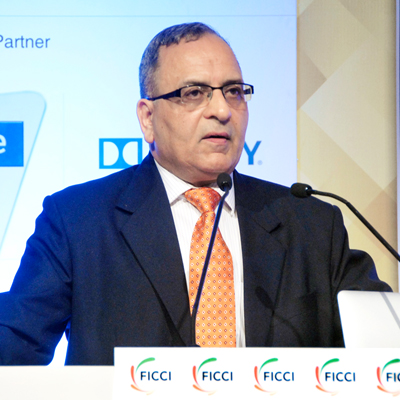
    MUMBAI: Day one of FICCI FRAMES 2014, the 15th chapter of the annual convention, witnessed a couple of significant announcements by Information & Broadcasting Secretary Bimal Julka.


    “DTH operators have complained that the limited transponder capacity has led them to completely depend on the Ku band. We are engaged in discussions with ISRO (Indian Space Research Organization) and the Department of Space to ensure this problem is resolved at the earliest,” said Julka in an assurance that the I&B Ministry was seriously looking at DTH operators’ demand for more transponders.


    With taxes levied on DTH platforms currently including an average of 10 per cent of entertainment tax, licence fees, additional customs duty on set top boxes (STBs), service tax and spectrum charges, Julka touched upon DTH players’ demand for rationalizing taxes so as to help them boost investment in infrastructure development and customers’ activation. “We are in talks with the Ministry of Finance and a consultation on this is on its way. We should be able to resolve the issue soon,” he said.


    On the subject of applications for launching new channels pending with the Ministry, Julka said, “An inter-ministerial committee has been set up under the I&B Ministry to look at granting permissions. There are around 800-odd channels currently, while 245 applications are pending for grant of permission. On one side, we get complaints that there are not enough revenues for broadcasters, while on the other side, we are flooded with applications for grant of permission for channels.” He said that in times to come, there would be a large number of mergers and acquisitions among broadcasters. The I&B Ministry is also in talks with the Ministries of Home Affairs, Corporate Affairs and External Affairs to ensure a more smooth process for granting permissions. “At least now, the Ministry of Home Affairs has granted permission and security clearance for channels-to-be for a period of 10 years,” he said.


    During his speech, Julka highlighted the strong partnership the Ministry shares with various stakeholders. “We have come out with policies that bring in a paradigm shift in the Media and Entertainment (M&E) industry. We are at the cusp of a major change with digitization, and this will help India put its best foot forward. The change has to be supported by liberal progressive policies that will encourage investment and ensure sustainable business models, promote entrepreneurship and create innovations,” he said. India has 77 million cable TV homes, of which 29 per cent are serviced by DTH operators while Doordarshan’s Free Dish reaches out to nearly 9 million homes. There are roughly 396 non-news channels and 60,000 cable TV operators, 6000 multi system operators (MSOs) and approximately 360 broadcasters; he informed, pointing out that the first two phases of cable TV digitization had been completed in about 42 cities with over 30 million STBs installed. “This was a mammoth task which has been undertaken with the coordination of all stakeholders,” Julka said. “About 110 million STBs are required to be installed in phases III and IV of DAS. Unless these phases are completed, we will not be able to fully harness the fruits of digitization. This is an excellent industry for employment generation.” Lavishing praise on digitization, he said, “It will change the way television is consumed. It will put India in the league of advanced countries.”


    On entertainment tax, he informed that preliminary data from state governments reveals a two to three-fold increase in collection of entertainment tax. “The data from news broadcasters shows approximately 30 per cent reduction in carriage fees in phase I cities and data from MSOs shows increase in subscription fees of about 35 per cent to broadcasters,” he said. Stressing on the need to fill in consumer application forms (CAFs), he said, “This is an ongoing exercise. I hope that the MSOs and LCOs are engaged in this exercise and will soon finish it.”


    While digitization would bring in transparency which in turn would bring in foreign direct investment (FDI) in broadcasting, Julka didn’t shy away from acknowledging the challenges. “Filling of CAFs, choice of a la carte channels, computerized billing to consumers, and the revenue sharing module between MSOs, LCOs and broadcasters is taking some time, but I am sure it will be resolved soon,” he assured, adding that the government would step in at any time it deems fit. On the ongoing issue of credible ratings, he said, “We are glad that the BARC has been set up. I will request BARC to speed up its process so that we can generate ratings without any delay.”

    Julka stressed the importance of digitization. “We need to see complete digitization throughout the country. Also, there are issues of registration of MSOs, monopoly restriction on MSOs and LCOs, and content monitoring. While vertical monopoly and cross media holding is a big issue, it is also engaging the MIB. We will consult the stakeholders before taking a decision on this,” he said on a concluding note.

  • Filmmakers in India and Canada to explore co-productions

    Filmmakers in India and Canada to explore co-productions

    NEW DELHI: Filmmakers in India and Canada are expected to benefit in pooling their creative, artistic, technical, financial and marketing resources for the co-production in the years to come.


    This follows the signing of an India and Canada Audio-Visual Co-Production Agreement that will enable Indian and Canadian film producers to utilise a platform for collaboration on various facets of film making.


    The agreement is expected to lead to the transparent funding of Film Production and will boost export of Indian Films into the Canadian Market.


    The agreement is expected to deepen the engagement between the critical sectors of the film industries of both countries there by providing a new chapter of collaboration. The agreement was signed by Information and Broadcasting Ministry Secretary Bimal Julka and Canadian High Commissioner to India Stewart Beck.


    The agreement will also lead to exchange of art and culture among the two countries and create goodwill and better understanding among the people of both the countries which will boost cultural ties between the two countries.


    The agreement will provide an opportunity to create and showcase India’s ‘Soft Power’ and lead to employment generation among artistic, technical and non-technical human resources engaged in the film production including post-production and its marketing.


    Since the agreement is expected to boost the utilisation of Indian locales for shooting, it will increase the visibility/prospects of India as a preferred film shooting destination across the globe and will lead to the inflow of Foreign Exchange into the country.


    In the past, similar agreements have been signed with Italy and the United Kingdom in 2005, Germany and Brazil in 2007, France in 2010, New Zealand in 2011, and Poland and Spain in 2012.


    The co-production agreements signed so far seek to achieve economic, cultural and diplomatic goals. For filmmakers, the key attraction of a treaty co-production is that it qualifies as a national production in each of the partner nations and can access benefits that are available to the local film and television industry in each country. Benefits accruing from such agreements include government financial assistance, tax concessions and inclusion in domestic television broadcast quotas.


    India’s co-production agreements are unique for international producers as the country offers technically qualified film crew at reasonable rates, a large pool of talented actors and the multitude of shooting locations. The other benefits are that the co production is treated at par as a national film and is eligible for the National Film Awards and the Indian Panorama section of International Film Festival of India. Such films also get the opportunity to be released through the Indian distribution network, and hence co production opens up the Indian consumer market to the foreign producer.

  • 10 Indian films in Berlinale, Bimal Julka meets stakeholders to promote India as film destination

    10 Indian films in Berlinale, Bimal Julka meets stakeholders to promote India as film destination

    NEW DELHI: The Information and Broadcasting (I&B) Ministry is to enter into negotiations with countries for promoting the platform of Co-production Audio Visual Agreements in an effort to ensure that India emerges as a viable Filming Destination.


    While a number of agreements had been signed, the broad framework of outlining such agreements had been shared with a number of countries, I&B Secretary Bimal Julka said in his deliberations with key stakeholders representing different film platforms at the Berlin Film Festival. 


    In his interaction with various film bodies and makers, Julka gave an overview of the Single Window Clearance mechanism drawn up in view of constraints faced by agencies for obtaining permission for film shooting in India. Julka said this platform had been created with the objective to establish a single window for film makers seeking permission for filming of feature films, short films and TV programmes. A Standard Operating Procedure had been put in place to facilitate the process and discussions were on to establish a dedicated web portal for this mechanism. 


    Julka said India’s co-production agreements were unique as they offered multiple benefits to foreign film producers. Any agreement to this effect enabled foreign producers to harness the strengths of India’s film prowess namely its technically qualified manpower, pool of talented actors and a multitude of shooting locations.


    Co-production agreements also enabled the films to be treated as National Films and thereby be eligible for National Film Awards and the Indian Panorama Section of the International Film Festival of India. The release of such films through Indian distribution network enabled coproduction to open up to Indian consumer market to the foreign producers. The Indian films industry also benefited by the profiling of shooting locations, generation of direct employment and encouragement to film tourism. 


    On the objective of participation and showcasing the industry at the India pavilion, Julka said it was to promote Indian films across linguistic cultural and regional diversity so as to forge an increasing number of international partnerships in the realms of distribution, production, filming in India, script development and technology, thereby accelerating the growth of film sector in India. Several networking sessions keeping in mind the future roadmap of the film industry had been planned. These included coproduction, single window clearance for filming in India, animation, gaming and visual effects, role of film schools in development of cinema and documentary movement in India. 


    Regarding the India Film Guide released during the Festival, he said the publication was an effort to brand the identity of the Indian film industry and commemorate the celebration of 100 years of Indian Cinema. It provided an opportunity for various stakeholders to understand the nuances of the Indian film industry and international players at the European film market. This publication was an effort to reiterate the role of the Ministry as a facilitator keeping in mind the liberal policies in the media and entertainment industry. The publication also outlined the key policy initiatives and processes under the ambit of the film sector. 


    Ten Indian films will be screened in the 64th Berlin International Film Festival. Indian films screened officially at Berlinale include Imtiaz Ali`s Highway (Panorama), Jayan Cherian`s Papilio Buddha (Panorama), Pushpenra Singh`s Lajwanti (Forum), Jessica Sadana and Samarth Dixit`s Prabhat Pheri (Forum), Avinash Arun`s Killa (Generation), Gaurav Saxena`s Rangrez (Native), and two films Mount Song, Blood Earth (Forum Expanded) among others. The iconic Satyajit Ray`s Nayak (Berlinale Classics) and Mani Kaul`s Ghasiram Kotwal (Forum) will be screened at Berlin in restored prints. In addition, Overdose is in the Co-Production Market and three people in the Berlinale Talent section. 

  • Niche channels to dominate TV in future

    Niche channels to dominate TV in future

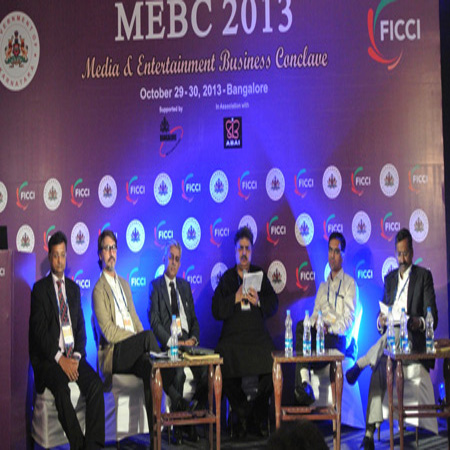
    BENGALURU: At the opening ceremony of the FICCI MEBC (Media and Entertainment Business Conclave) – South, which was held on 29 and 30 October, Ministry of Information and Broadcasting Secretary, Bimal Julka highlighted the fact that digitisation is at a growing trajectory in the country and by the end of the next year we shall all be living in digital homes.

    According to data provided by a FICCI Deloitte report on media and entertainment in south India, television constitutes 56 per cent of the market share with Rs 13,470 crore out of the total of Rs 23,900 crore. Digitisation is going to help the segment grow at a CAGR of 20 per cent in the next four years.

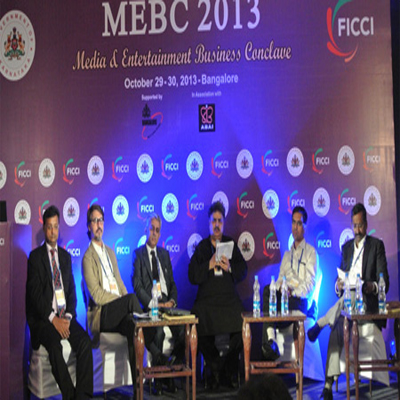
    (L-R) Sugato Banerjee, Raman Kalra, K Subramanian, Pradyuman Maheswari, Srinivasan K A and C R Rajagopal

    While the digital world is changing phenomenally, we wonder how the broadcasting industry is adapting to the change. This, and various other points were discussed in a session on “the broadcasting ecosystem in the digital era” which included BECIL chairman K Subramanian, IBM global services head (media and entertainment) and ED Raman Kalra, Deloitte Coimbatore partner-audit C R Rajagopal, Amagi Media Labs co founder Srinivasan K A and Whats on India COO Sugato Banerjee formed the panelists, while MXM India CEO and editor in chief Pradyuman Maheshwari moderated the session.

    The session kick started with Subramaniam highlighting the humongous task that was undertaken in DAS (Digital Addressable System) phase I to install about 75 lakh STBs and led to nearly 95 per cent digitisation in 38 cities. Five out of 38 are in South India, according to the report. He added that in all this DTH had taken a backseat except for Chennai where the DTH penetration is about 40 per cent and digitisation is lagging due to political turmoil.

    Banerjee also supported it by saying that phase I and II saw DTH take a step back and digital penetrate strongly in Mumbai, Delhi and Kolkata.

    Banerjee also highlighted certain issues that popped up during the process of digitisation. “In a city like Mumbai where people live in buildings, having a cable run through the building is easy. With DTH, the dish needs to be facing the satellite. In places where houses are far away from each other, cost of running the cable from home to home is higher and more efforts are needed. If some of these places don’t even get electricity for hours why would they want to pay for STBs?” he remarked.

    There was a time when there was a scarcity of channels but now they are in abundance. According to Banerjee, there are about 700 working channels in the country but it is unrealistic to have so many channels in the digital arena. The rising number of channels has led to narrowing down of viewership. “Five years ago there was no food channel in the country and now there are five. The long tail will give more choice to viewers and fringe channels have benefitted due to digitisation especially in the urban cities,” said Banerjee.


    At the same time, the growing number of channels will put pressure on its visibility. “Now, the issue would be to bring one’s channel to viewers notice,” said Srinivasan.
    Viewership will be segmented leading to an increase in the number of niche channels.  “Broadcast is a term that doesn’t seem to suit the current scenario. Now it is time to ‘narrow-cast’,” said Srinivasan.

    According to Kalra, their IBM global survey on consumer insight has shown that people don’t want to be categorised in demographics. “Consumers want content tailor-made for them. The biggest challenge in the future will be to get direct content for people and then make them spend for it,” he said.

    At the inaugural session of the event, Film Federation of India president Ravi Kottarakara raised the issue of service tax being a big hindrance on the industry. The same was also brought up by Rajagopal at the session. “Not having enough capital is a challenge for the industry to create things. Taxation needs to be looked into as well as interesting financial modules need to open up,” he said.

    At the same time, there is also the issue of paying for individual channels in future as consumers are used to paying a small amount for a big pack of channels. But Kalra pointed out that a person who could pay Rs 300 for a movie now, as compared to Rs 25 a few years ago, will definitely have the capacity to pay more for TV.

    However, Banerjee chose to disagree and said, “There is a difference between making them pay and the willingness to pay.”

    Although carriage fees will disappear in the digitised world, Banerjee said it will reappear in another form of placement fees as to which channel will appear first. According to industry sources, carriage fees range from Rs 3-5 lakhs. The industry also lacks advertising funding as compared to print. “Print has about 2 lakh advertisers but TV has just 12,000,” said Subramaniam.

    TV consumption on multiple screens is also set to grow. As on March 2013, 143 million users in India were mobile internet users (according to the FICCI Deloitte report). Its analysis report also showed that video consumption had increased from two hours to three hours from 2010 to 2012. “There will be monetisation of content as more connected devices emerge. Only then we will know which genre is being seen and its statistics,” said Subramaniam.

  • Niche channels to dominate TV in future

    Niche channels to dominate TV in future

    BENGALURU: At the opening ceremony of the FICCI MEBC (Media and Entertainment Business Conclave) – South, which was held on 29 and 30 October, Ministry of Information and Broadcasting Secretary, Bimal Julka highlighted the fact that digitisation is at a growing trajectory in the country and by the end of the next year we shall all be living in digital homes.


    According to data provided by a FICCI Deloitte report on media and entertainment in south India, television constitutes 56 per cent of the market share with Rs 13,470 crore out of the total of Rs 23,900 crore. Digitisation is going to help the segment grow at a CAGR of 20 per cent in the next four years.


    While the digital world is changing phenomenally, we wonder how the broadcasting industry is adapting to the change. This, and various other points were discussed in a session on “the broadcasting ecosystem in the digital era” which included BECIL chairman K Subramanian, IBM global services head (media and entertainment) and ED Raman Kalra, Deloitte Coimbatore partner-audit C R Rajagopal, Amagi Media Labs co founder Srinivasan K A and Whats on India COO Sugato Banerjee formed the panelists, while MXM India CEO and editor in chief Pradyuman Maheshwari moderated the session.


    The session kick started with Subramaniam highlighting the humongous task that was undertaken in DAS (Digital Addressable System) phase I to install about 75 lakh STBs and led to nearly 95 per cent digitisation in 38 cities. Five out of 38 are in South India, according to the report. He added that in all this DTH had taken a backseat except for Chennai where the DTH penetration is about 40 per cent and digitisation is lagging due to political turmoil.


    Banerjee also supported it by saying that phase I and II saw DTH take a step back and digital penetrate strongly in Mumbai, Delhi and Kolkata.


    Banerjee also highlighted certain issues that popped up during the process of digitisation. “In a city like Mumbai where people live in buildings, having a cable run through the building is easy. With DTH, the dish needs to be facing the satellite. In places where houses are far away from each other, cost of running the cable from home to home is higher and more efforts are needed. If some of these places don’t even get electricity for hours why would they want to pay for STBs?” he remarked.


    There was a time when there was a scarcity of channels but now they are in abundance. According to Banerjee, there are about 700 working channels in the country but it is unrealistic to have so many channels in the digital arena. The rising number of channels has led to narrowing down of viewership. “Five years ago there was no food channel in the country and now there are five. The long tail will give more choice to viewers and fringe channels have benefitted due to digitisation especially in the urban cities,” said Banerjee.


    At the same time, the growing number of channels will put pressure on its visibility. “Now, the issue would be to bring one’s channel to viewers notice,” said Srinivasan.
    Viewership will be segmented leading to an increase in the number of niche channels.  “Broadcast is a term that doesn’t seem to suit the current scenario. Now it is time to ‘narrow-cast’,” said Srinivasan.


    According to Kalra, their IBM global survey on consumer insight has shown that people don’t want to be categorised in demographics. “Consumers want content tailor-made for them. The biggest challenge in the future will be to get direct content for people and then make them spend for it,” he said.


    At the inaugural session of the event, Film Federation of India president Ravi Kottarakara raised the issue of service tax being a big hindrance on the industry. The same was also brought up by Rajagopal at the session. “Not having enough capital is a challenge for the industry to create things. Taxation needs to be looked into as well as interesting financial modules need to open up,” he said.


    At the same time, there is also the issue of paying for individual channels in future as consumers are used to paying a small amount for a big pack of channels. But Kalra pointed out that a person who could pay Rs 300 for a movie now, as compared to Rs 25 a few years ago, will definitely have the capacity to pay more for TV.


    However, Banerjee chose to disagree and said, “There is a difference between making them pay and the willingness to pay.”


    Although carriage fees will disappear in the digitised world, Banerjee said it will reappear in another form of placement fees as to which channel will appear first. According to industry sources, carriage fees range from Rs 3-5 lakhs. The industry also lacks advertising funding as compared to print. “Print has about 2 lakh advertisers but TV has just 12,000,” said Subramaniam.


    TV consumption on multiple screens is also set to grow. As on March 2013, 143 million users in India were mobile internet users (according to the FICCI Deloitte report). Its analysis report also showed that video consumption had increased from two hours to three hours from 2010 to 2012. “There will be monetisation of content as more connected devices emerge. Only then we will know which genre is being seen and its statistics,” said Subramaniam.