Tag: Bharti Airtel

  • Net mobile subscribers decline in May: TRAI

    Net mobile subscribers decline in May: TRAI

    Mumbai: India’s telecom market saw a 6.2 million net decline in mobile subscribers at the end of May, according to the latest monthly subscription data released by Telecom Regulatory Authority of India (TRAI).

    Reliance Jio was the only wireless access service provider that added 3.5 million mobile subscribers. Previous data shows that the telecom company added 4.7 million mobile subscribers in April.
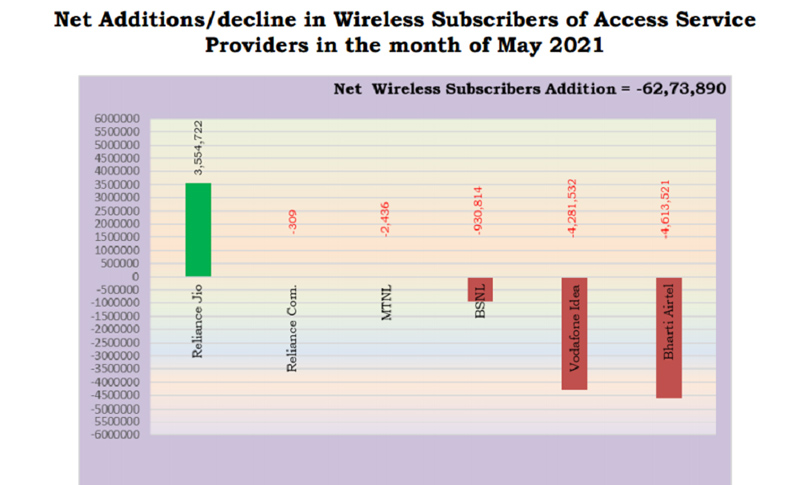
    Bharti Airtel saw its mobile subscribers reduce by 4.6 million (including the subscribers of Tata Teleservices), the highest loss, followed closely by Vodafone Idea which lost 4.2 million customers. This is several multiples higher than the subscriber decline reported in April which stood at 0.51 million and 1.8 million for Bharti Airtel and Vodafone Idea, respectively.

    Similarly, the number of telephone subscribers came down from 1,203.47 million at the end of April to 1,198.50 million at the end of May, at a monthly decline rate of 0.41 per cent. TRAI had reported a monthly growth rate of 0.19 per cent and 1.12 per cent for telephone subscribers in the preceding months of April and March, respectively. Also, Urban and rural telephone monthly subscription decline rates for May stood at 0.47 per cent and 0.34 per cent, respectively.

    The overall tele-density in India decreased from 88.27 per cent at the end of April to 87.84 per cent at the end of May. The share of urban and rural subscribers out of total number of subscribers stood at 55.17 per cent and 44.83 per cent, respectively.

    As per reports received from 438 operators in May, the number of broadband subscribers decreased from 782.86 million at the end of April to 780.27 million at the end of May with a monthly decline rate of 0.33 per cent, according to TRAI data. While mobile subscribers and fixed wireless subscribers.
    (Wi-Fi, Wi-Max, Point to Point Radio & VSAT) saw monthly decline rates of 0.38 per cent and 2.45 per cent respectively, wired subscribers grew to 22.74 million from 22.42 million at a 1.43 per cent monthly growth rate.

    The top five service providers made up 98.80 per cent of the market share of the total broadband subscribers including wired and wireless at the end of May. These included Reliance Jio Infocomm (434.23 million), Bharti Airtel (192. 73 million), Vodafone Idea (119.64 million), BSNL (22.4 million) and Atria Convergence (1.87 million).


  • Bharti Airtel announces Amrita Padda as chief people officer

    New Delhi: Telecom giant Bharti Airtel on Wednesday announced the appointment of Amrita Padda as its chief people officer, with effect from 1 October. She will report to Bharti Airtel MD and CEO, Gopal Vittal.

    Padda was previously associated with Hindustan Unilever for over two decades, where she handled the entire spectrum of human resources roles. In her new role, she will be responsible for Airtel’s people strategy as the company transforms into a digital services provider, as per an official statement.

    Commenting on the appointment, Gopal Vittal said, “I am delighted to welcome Amrita to Airtel. Our People and culture of empowerment are our biggest strengths that enable us to deliver world-class experiences to our customers. I am confident that Amrita will add immense value to Airtel’s exciting journey, help build new capabilities and ensure the company continues to be a magnet for top talent from across the world.” 

    Amrita takes on the baton from Samit Deb, who has decided to pursue entrepreneurial opportunities outside of Airtel. “I would like to thank Samit for his contribution to Airtel and strengthening our people practices. On behalf of everyone at Airtel, I wish him the very best in all his future endeavours,” Vittal added.

  • Bharti Airtel restructures to focus on digital assets

    Bharti Airtel restructures to focus on digital assets

    NEW DELHI: Telecom giant Bharti Airtel has tweaked its corporate structure in a bid to sharpen its focus on digital opportunities while enabling it to unlock value. 

    Under the new structure, Airtel Digital will merge with the listed entity Bharti Airtel, and it will now house all digital assets of the company including Wynk Music, Airtel X stream, Airtel Thanks, Mitra Payments platform used by a million retailers, Airtel Ads, Airtel IQ, Airtel Secure, Airtel Cloud and all future digital products and services. 

    The move is expected to be instrumental in attracting strategic and financial investors as well as scale up the digital business. With this, the company has set its sights on ramping up digital business revenue to more than Rs 1,000 crore from Rs 100 crore now.

    From now, the telecom business of the company will be housed in a new entity, Airtel Limited – a wholly-owned subsidiary of Bharti Airtel Ltd. Bharti Telemedia, the arm operating DTH services of the company, will be housed alongside Airtel Limited. 

    On the other hand, Airtel Payments Bank will remain a separate entity under Bharti Airtel. The conglomerate’s infrastructure businesses that include Nxtra and Indus Towers will continue to remain separate entities as they are now. 

    "The new structure sets the exciting future course for Bharti Airtel and provides focus on the four distinct businesses – digital, India, international and infrastructure, each, in a razor-sharp way,” said Bharti Airtel chairman Sunil Mittal in a statement. “We believe this will provide agility, expertise, and operational rigour to serve our customers brilliantly while providing flexibility to unlock value for our shareholders. This structure will serve us well over the coming years and is a win-win for all stakeholders."

    The statement from Airtel revealed that the company is intending to "eventually fold the DTH business into Airtel Limited to move towards the NDCP vision of converged services to customers." 

  • Disney+ Hotstar & Netflix dominate India’s SVoD market: Omdia

    Disney+ Hotstar & Netflix dominate India’s SVoD market: Omdia

    MUMBAI: Now here’s further research confirming Netflix and Disney+ Hotstar’s dominance of the Indian streaming market. Research firm Omdia’s  2021 Online Video Market and Consumer Trends Report released on 31 March states that the two streaming giants accounted for 50 per cent of all subscription video on demand (SVoD) signups in India in 2020. This was on the back of the pandemic and nationwide lockdown which saw SVoD revenues spurt 142 per cent from $265 million to $639 million by end 2020. The duo accounted for 78 per cent of that final tally, meaning about $498.42 million.

    While Disney+ Hotstar trebled its subscriber base from eight million to 25.6 million in 2020, Netflix nearly doubled its subs from 2.4 million in 2019 to 4.4 million in the same period. The Indian streamer’s growth partly came from the  bundling of Disney+ and Hotstar, as well as the postponement of the start of the thirteenth  season of the Indian Premier League (IPL) from April to September, as well as competitive pricing plans and exclusive rights to foreign content such as Game of Thrones.

    One of the key factors for the growth of subscriptions for online video is the aggressive pricing models of both Disney+ Hotstar and Netflix, with the latter launching mobile only subscription packages in 2019, reflecting the Indian consumption habits. 82 per cent of online video services are accessed through smartphones with only 39 per cent accessing content through dedicated TV apps (data from Omdia’s 2020 consumer survey).

    Disney+ Hotstar on the other hand offers three specific content packages. The VIP plan (Rs 399 per year) offers dubbed local languages while Premium (Rs 299 per month) offers both English and dubbed version of content. In terms of device access, the VIP plan only allows its subscribers to watch on one screen in HD while Premium allows subscribers to watch on two screens simultaneously in full HD.

    By offering affordable streaming plans and partnering with large telcos such as Reliance Jio, Bharti Airtel and Vodafone India, Omdia expects that mobile-only subscriptions will continue to grow over the next couple of years. However, mobile-only subscriptions will face challenges from traditional pay TV services as pay TV services aggregate OTT video services with their core pay TV plans.

    Whilst retaining premium rights to foreign titles and sporting events have contributed to significant growth in revenues and subscribers, over the past few years there has been an increased focus on investing in original Indian language content, Omdia noted.

    In 2021, Amazon Prime and Netflix will continue their large investment in original Indian content, with the two major US services set to invest around $340 million, representing 52 per cent of the total investment in 2021. Omdia expects that close to 400 original titles (mostly series and films) will be produced in 2021 by the global and Indian OTT services.

    Most of the investment being made is directed towards original content in Hindi, around 65 per cent  of total spending, according to the Omdia report.

    “The online video (OTT) market of India is steadily growing its foothold in every direction,” says Omdia principal analyst – TV & online video, consumer Constantinos Papavassilopoulos. “The Covid2019 pandemic accelerated the growth rate of an already dynamic and robust OTT market. The basic elements that will propel the market to further growth in the near future are already there: very affordable mobile broadband prices, high penetration of smart-phones, a population eager to consume more content, an ever-growing investment in Indian originals and a plethora of choices with more than 40 OTT services operating in the country.”

  • Bharti Airtel revenues jump 22 per cent in Q2

    Bharti Airtel revenues jump 22 per cent in Q2

    NEW DELHI: Telecom operator Bharti Airtel announced its highest ever consolidated quarterly revenue, reporting a 22 per cent jump driven by higher tariffs and a rise in data usage from a Covid2019-fuelled shift to remote working. 

    India revenues for the quarter ended 30 September was at Rs 18,747 crore year on year while mobile revenues grew by 26 per cent. As a result, average revenue per user for the quarter rose to Rs 162, from Rs 128 last year. 

    Consolidated net loss for the quarter came in at Rs 763 crore, compared with a loss of Rs 23,045 crore a year earlier.

    The company has continued to garner a strong share of the 4G net adds in the market. 4G data customers increased by 48.1 per cent to 152.7 million compared to the previous year while traffic increased to 77.3 PB/day vs 48.9 PB/day in the corresponding quarter last year. Consolidated mobile data traffic was at 7,403 PBs in the quarter with a healthy YoY growth of 58.8 per cent. 

    As for engagement parameters, average data usage per data subscriber stood at 16.0 GBs/month; while voice usage was at 1,005 mins per user per month.

    Homes business segment witnessed a revenue growth of 7.3 per cent YoY. The company added over 129,000 customers during the quarter to reach a total base of 2.58 million. It re-calibrated its offering and launched Xstream bundled with content and unlimited internet to accelerate penetration. The company signed on many more LCO partnerships in non-wired cities, extending the model to 48 cities. The company also focused on fast-track network expansion by rolling out fibre home passes and upgrading existing copper network during the quarter.  

    Airtel Business clocked a growth rate of 7.5 per cent YoY, driven by data demand across global business and enterprise and government business. To further leverage growth from “Work from Home”, Airtel BlueJeans, Airtel Secure, Airtel Cloud and Airtel IQ were launched to meet the specific needs of B2B customers.

    Airtel MD & CEO India & South Asia Gopal Vittal said, “Despite being a seasonally weak quarter, we delivered a strong performance with revenue growing at 22 per cent YoY. In the mobile segment, we added over 14 million 4G customers and grew revenues by 26 per cent. Our data consumption grew by 58 per cent YoY which reflects strong  engagement of customers on our network. Other lines of business also continued with steady  growth momentum, with Airtel Business growing 7.5 per cent YoY.”

    Digital TV witnessed a growth of 1.9 per cent YoY on an underlying basis, on the back of strong customer additions of 549,000 during the quarter. Airtel continued to expand its channel portfolio and is also working with educational institutions to broadcast classes to students to ensure education is not disrupted.

    In the digital services segment, Airtel now has 160 million digitally engaged users. On Wynk, it’s now #1 in terms of MAUs (59.3 million in Q2’21) with an addition of 9 million during the quarter; Thanks platform has 81.6 million MAUs in Q2, with an addition of 8 million and Airtel Xstream is at 33.7 million MAUs, addition of 8 million users during the  quarter. 

     Consolidated EBITDA witnessed an increase of 32.6 per cent YoY to Rs 11,848 crore in Q2’21. This led to an improvement in EBITDA margin from 42.3 per cent in Q2’20 to 46.0per cent in Q2’21. Incremental EBITDA margins across businesses remained healthy, with mobile services EBITDA improving from 36.3 per cent in Q2’20 to 42.6 per cent in Q2’21. 

  • Airtel Digital TV operating revenue up as bottom line dips for first quarter

    Airtel Digital TV operating revenue up as bottom line dips for first quarter

    BENGALURU: The digital TV services segment from Sunil Mittal’s Bharti Airtel Ltd (Airtel), Airtel Digital TV, which provides direct to home (DTH) satellite television services, reported growth of 0.8 percent in operating revenue at Rs 744.8 crore for the quarter ended 30 June 2020 (Q1 2020, quarter or period under review) as compared to Rs 738.9 crore for the corresponding quarter of the previous year Q1 2019 (y-o-y). However, this is not a true oranges-oranges comparison, since as of 1 March 2020, Airtel Digital TV services has implemented new guidelines of NCF (Network Carriage Fees) under the new tariff order (NTO) from Telecom Regulatory Authority of India (TRAI). The company says in a media release that Airtel Digital TV revenue witnessed a growth of 9.3 percent y-o-y on an underlying basis, on the back of strong customer additions.

    Airtel Digital TV operating profit for the quarter under review declined 23.5 percent to Rs 276.2 crore (37.1 percent of operating revenue) as compared to Rs 361.2 crore (48.9 percent of operating revenue) for Q1 2020. Airtel reported 1.3 percent growth in Assets to Rs 3,462 crore for Q1 2021 from Rs 3,417.4 crore in Q1 2020. However, Assets in Q1 2021 were 12.9 percent lower than the Rs 3,794.9 crore in the immediate trailing quarter (Q4 2020). The segment’s liabilities for Q1 2021 grew 11.6 percent to Rs 4000.5 crore from Rs 3,585.2 crore in Q1 2020. Liabilities in the quarter under review were however 3 percent lower than the Rs 4,122.4 crore in the immediate trailing quarter Q4 2020.

    The company reported a 5.1 percent y-o-y increase in net DTH subscribers in Q1 2021 at 1.68 crore as compared to 1.6 crore in the corresponding quarter of the previous year.

    Bharti Airtel’s consolidated revenue for Q1 2021 grew 15.4 percent on an underlying basis to Rs 23,939 crore as compared to the year ago quarter. Consolidated EBIDTA for the quarter under review was Rs 10,639 crore (44.4 percent margin). India revenue at Rs 17,589 crore were up 14.6 percent and up 15.1 percent on an underlying basis y-o-y.

    An earnings media release for Q1 2021 quotes Airtel MD and CEO, India & South Asia Gopal Vittal: “We are going through an unprecedented crisis caused by COVID. Despite this, our teams have served the country well and kept our customers connected. Data traffic growth surged by ~73 percent y-o-y even as 4G net additions slowed down to 2 Million caused by supply chain shocks in the device ecosystem. Revenues grew by 15% Y-o-Y and performance was satisfactory across all segments. Our flagship “War on Waste” program, helped improve EBITDA margin by 1.6 percent over the previous quarter. To serve our customers even better, we have launched a company-wide program to improve our customer experience. We continue to invest in the best of emerging technologies to make our networks future ready. We have made rapid strides in our digital business, with nearly 155 million monthly active users across Airtel Thanks, Wynk, Xstream and our payments platforms. Today, 60 percent of Airtel’s entire business goes through its digital channels. We are most excited about the string of partners we are attracting in order to build greater stickiness and ultimately growth from our digital assets.”

    Follow Tellychakkar for the consumer facing news & entertainment

  • Airtel Digital TV adds 1.2 mn subscribers in FY20

    Airtel Digital TV adds 1.2 mn subscribers in FY20

    KOLKATA: While Mukesh Ambani’s Jio has made quite a buzz for its innovation and acquisitions to expand its Jio Fiber business, Sunil Mittal’s Bharti Airtel is scaling up its DTH and broadband business. Airtel Digital TV added 1.2 million subscribers in FY 20 thanks to its premium HD content. 

    The DTH service has 16.6 million subscribers as of 31 March 2020 compared to 15.4 million subscribers in FY 19. Although the subscriber base went up, the revenue fell by 29 per cent. It has reported Rs 29,238 million for the year as compared to Rs 41,001 million in the previous year (an increase of 16 per cent on an underlying basis).

    The company introduced Airtel Xstream services in FY 20 for its broadband and DTH customers with a 360 Degree campaign ‘Don’t just watch TV on your TV.' Moreover, its converged proposition of integrated home offering has been launched in ten cities as on 31 March 2020. Under the new offering, customers can opt for multiple services from Airtel i.e., postpaid, broadband and DTH under one bill. 

    “With an aim to widen our DTH market, we adopted an inclusive approach to empower our Rural Sales Fraternity, wherein freelancer technicians (electricians) and other workers were encouraged to sell and install new DTH connections at customer premises. In FY 2019-20, there were 4,099 active DOST executives across the country, engaged and empowered to drive new DTH activations,” it said in its annual report.

    Airtel currently provides fixed-line telephone and broadband services for homes in 111 cities across India. The Homes business had 2.4 million customers as on 31 March 2020 up by 6.3 per cent as compared to 2.3 million at the end of the previous year. Revenues from this segment stood at Rs 22,451 million for the year as compared to Rs 22,391 million in the previous year, an increase of 0.3 per cent. 

    Follow Tellychakkar for the consumer facing news & entertainment

  • NODWIN Gaming and Airtel announce partnership to take e-sports in India to the next level

    NODWIN Gaming and Airtel announce partnership to take e-sports in India to the next level

    MUMBAI: NODWIN Gaming, South Asia’s leading e-sports company, announced a partnership with Bharti Airtel to further grow e-sports in India. The partnership has been kicked off with the launch of Airtel India ESPORTS TOUR, which is the first and largest property of its kind in this segment.

    Airtel India ESPORTS TOUR will also have a national ranking and awarding system for Indian e-sports players based on their year-long performance across top tournaments, and this will be used as a base to create a points table for all participants, an official press statement states.

    Airtel India ESPORTS TOUR will initially cover all NODWIN tournaments across gaming titles of PUBG Mobile, CS:GO, Clash of Clans, FIFA, etc. The coverage will extend to all iconic NODWIN tournaments such as the India Premiership by NODWIN, DreamHack India, The Northeast Cup, KO Fight Nights, and PAN Fest. This will also cover NODWIN operated tournaments such as the PUBG Mobile Pro league in India.

    NODWIN Gaming founder and managing director Akshat Rathee says, “NODWIN Gaming believes that by binding the elements of independent tournaments into a single storyline we will give rise to a new culture in the competitive world of Indian e-sports. The teams and players will now look up to perform throughout the year rather than focusing on a few big standalone tournaments in a year.”

    At the end of the annual tour, the final leader-board across games will be presented to recognise and reward the winners at an award show celebrating the key players in the ecosystem, the e-sports athletes, the teams, the talent, the best plays, etc. 

    The broadcast of the Airtel India ESPORTS TOUR will be available on Airtel’s digital platforms and help with taking this emerging format to newer audiences.

    Bharti Airtel chief product officer Adarsh Nair says: “We are thrilled to partner with NODWIN to unlock the potential of e-sports in India. Airtel is an enabler of digital lifestyles in emerging India and youth are at the core of our brand proposition. We look forward to a deep and long term collaboration with NODWIN as we embark on this exciting digital journey.”

    Initially, the Airtel India ESPORTS TOUR will be seeded by NODWIN in its extensive tournament network and will aspire to be a platform where all tournaments will carry an agreed weightage independent of the organizer. The ecosystem will allow the flexibility of choice for players to play what they want and when they want.

  • Airtel digital TV revenue up 16.9% in Q4

    Airtel digital TV revenue up 16.9% in Q4

    MUMBAI: Bharti Airtel on Monday posted its fourth quarter results for the fourth quarter of financial year 2019-20. While revenue was up seven per cent at Rs 23,723 crore on a quarter-on-quarter basis, it has registered a consolidated loss of Rs 5,237 crore year-on-year. Mobile services revenue has increased 21.8 per cent YoY and 16 per cent quarter to quarter.

    Airtel's journey as a digital business continued strongly in Q4’20. The company has over 160 million Monthly Active Users across digital assets – Airtel Thanks, Wynk and X Stream. It has over 1.1 million retailers transacting and making payments every day on our Mitra App.

    Today over 60 per cent of its entire business goes through digital channels, and with share of AirtelThanks platform growing strongly to now become the second largest platforms for user payments online.

    Digital TV revenue witnessed strong growth of 16.9 per cent YoY on an underlying basis, on the back of strong customer additions.

    While overall customer base stood at 423 million across 16 countries, EBITDA stood at Rs 10,326 crore, up 51.7 per cent YoY.

    Voice usage per customer increased to 965 million against 898 million for the telecom service operator, showing an increase of 7.5 per cent quarter to quarter.

    The mobile ARPU in India business was at Rs 154 against Rs 135 QoQ, a growth of 14 per cent.

    The company had posted a profit of Rs 107.2 crore in the same period a year ago. It registered a consolidated revenue of Rs 23,722.7 crore during the reported quarter against Rs 20,602.2 crore in the corresponding quarter of 2018-19.

    The company has undertaken a capex investment of Rs 25,359 crore on a consolidated basis during the year to ensure superior customer experience besides front ending some investment to ensure seamless services during the ongoing pandemic.

    Airtel Business witnessed a double digit revenue growth of 12.4 per cent YoY led by increased focus on connecting large enterprises, SMEs besides providing innovative solutions. Homes business continues to remain resilient and shows significant long-term promise in the wake of the new normal of work from home and social distancing established post the Covid2019 situation.

    Gopal Vittal, MD-CEO, India & South Asia, said: “These are unprecedented times for every one across the world as we battle the impact of Covid2019 and its consequent impact on livelihoods. Even in this difficult time, it is our investments in network technologies coupled with our culture of customer obsession that has allowed us to keep the nation connected and serve our customers. It is abundantly clear today that telecom has played an essential role in keeping the country going. We are therefore hopeful that the government will implement the recommendations of the TRAI and the intent of the New Telecom Policy and bring down the high levels of regulatory levies and taxes that the sector is subjected to. The quarter gone by saw healthy revenue growth of 14.4 per cent YoY with mobile business growing at 21.8 per cent. This was driven by two factors – sustained momentum of 4G customer additions of over 12.5 million coupled with improved tariffs. We continue to witness strong data traffic growth of 74.1 per cent YoY. Going forward we remain committed to delivering a best in class customer experience even as we leverage our platform to build new revenue streams.”

  • Airtel collaborates with Cisco to launch India’s first automated ethernet over fibre network

    Airtel collaborates with Cisco to launch India’s first automated ethernet over fibre network

    MUMBAI:  Bharti Airtel (Airtel), India’s largest integrated telco, today announced its collaboration with Cisco to launch India’s largest 5G-ready, 100G IP and optical integrated network designed to enhance network availability, capacity and scale. The deployment is part of Airtel’s initiative to build a 5G ready network that continues to serve the growing demand for high speed data services in the country.

     India is currently the world’s second-largest telecommunications market with a subscriber base of 1.17 billion. Cisco’s recent Annual Internet Report forecasts there will be 67.2 million 5G connections in India by 2023 (4.9 per cent of total mobile connections), and 66 per cent of all devices will be mobile-connected by 2023, (34 per cent will be wired or connected over Wi-Fi).

     Airtel’s network serves over 280 million mobile subscribers across 4G and 2G technologies. This new IP over ethernet over fibre network is the largest hyper-complex brownfield network transformation of its kind in India, collapsing multiple legacy domains to build a flatter, simpler and automated 5G-ready IP network for enhanced customer experiences. It integrates Cisco IP and optical solutions along with segment routing to more easily extend services in rural communities while significantly improving network availability and creating cost efficiencies.

    The simple, flexible and self-healing architecture is built with an agile, programmable and software-defined platform to deliver exponential mobile internet growth. It has already realized significant speeds with scale to enable new, advanced B2B and B2C services. The open standards architecture with automation brings in efficiencies for new and legacy infrastructure, eliminating manual touchpoints in a brownfield environment.

    “Airtel continues to transform its network to ensure greater availability and reach across India to deliver best-in-class mobile experience for our customers,” Bharti Airtel CTO Randeep Sekhon said. “Our ongoing collaboration with Cisco is critical in helping us to be 5G-ready, collapsing multiple legacy domains to build a flatter, simpler and automated network with more bandwidth to support internet services and the endless growth in consumer and business applications people rely on every day,” he added.

    “Airtel is transforming its network to be modern, adaptable and scalable to accommodate the phenomenal mobile growth in India,” Cisco Service Provider Business, India and SAARC managing director Anand Bhaskar said. “Together we are delivering a highly-scalable IP and optical network throughout India that enables broader mobile access to connect more people and more businesses who can do more with the internet."