Tag: Bharti Airtel

  • Jio announces new unlimited plans, hikes prepaid mobile tariffs by 21 per cent

    Jio announces new unlimited plans, hikes prepaid mobile tariffs by 21 per cent

    Mumbai: After Bharti Airtel and Vodafone India, Reliance Jio on Sunday has announced upto 21 per cent hike in its prepaid tariffs effective next month. The new unlimited plans will go-live on 1 December.

    “In line with its commitment to further strengthen a sustainable telecom industry, where every Indian is empowered with a true digital life, Jio has announced its new unlimited plans,” the largest mobile operator said in a statement. “These plans will provide the best value in the industry. Jio customers will continue to be the biggest beneficiaries.”

    The tariff hikes cover the Jio Phone plan, unlimited plans, as well as data add ons.

    Despite the increase in rates, Jio has kept the price of plans lower than its competitors Airtel and Vodafone Idea, who had hiked up their prepaid plans by upto 25 per cent last week. The company has kept its lowest rate for 28 days’ validity plan at Rs 91 for Jio phone users which is the lowest among private telecom operators. Bharti Airtel and Vodafone Idea have hiked the entry-level plan with 28 days validity to Rs 99.

    The tariff hikes were announced across 15 plans, which include one for Jio phone users, 11 in unlimited category and three in data top up category. The popular unlimited category plan offering 1.5 GB daily data usage plan with 84 days’ validity will go up by about 20 per cent to Rs 666 from Rs 555 at present.

    While the annual unlimited category plan offering 2 GB daily usage at 4G speed will be priced at Rs 2,879 instead of Rs 2,399 at present.

  • Reliance Jio lost 19 million wireless subscribers in September: Trai

    Reliance Jio lost 19 million wireless subscribers in September: Trai

    Mumbai: Reliance Jio lost 19.02 million wireless subscribers in the month of September, according to Telecom Regulatory Authority of India (Trai) subscription data. Bharti Airtel added 0.27 million subscribers and Vodafone Idea lost 1.07 million subscribers in the same period.

    Total wireless subscribers decreased from 1186.72 million to 1166.02 million. Wireless subscription from urban areas decreased from 650.39 million to 637.89 million. In rural areas, wireless subscription decreased from 536.33 million to 538.13 million.

    In terms of active base, there were 995.67 million wireless subscribers with Reliance Jio having the largest base of active users at 355.37 million followed by Bharti Airtel at 346.88 million and Vodafone Idea at 235.73 million.

    The number of telephone subscribers decreased from 1209.58 million to 1189.15 million. Urban telephone subscription decreased from 671.31 million to 659.09 million. Rural subscription decreased from 538.28 million to 530.06 million.

    Trai received information from 522 operators in September compared to 499 operators last month. The total number of broadband subscribers decreased from 813.47 million to 794.88 million. Mobile device users decreased from 787.94 million to 769.22 million. Wired subscribers increased marginally from 24.29 million to 24.39 million. Fixed wireless subscribers increased from 1.24 million to 1.28 million.

    The top five service providers were Reliance Jio Infocomm (428.78 million), Bharti Airtel (207.30 million), Vodafone Idea (122.37 million), BSNL (24.15 million), and Atria Convergence (1.96 million).

    The top five wired broadband service providers were BSNL (5.05 million), Reliance Jio Infocomm Ltd (3.94 million), Bharti Airtel (3.85 million), Atria Convergence Technologies (1.96 million), and Hathway Cable & Datacom (1.08 million).

    The top five wireless broadband service providers were Reliance Jio Infocomm Ltd (424.84 million), Bharti Airtel (203.45 million), Vodafone Idea (122.36 million), BSNL (19.10 million), and Tikona Infinet Ltd. (0.30 million).

    The total wireline subscribers increased from 22.86 million to 23.13 million and saw a net increase of 0.27 million. Reliance Jio added 237,411 subscribers followed by Bharti Airtel at 126,937 and Vodafone Idea at 3100.

  • Bharti Airtel hikes mobile tariffs effective 26 November

    Bharti Airtel hikes mobile tariffs effective 26 November

    Mumbai: Bharti Airtel has announced its new mobile tariffs that will come into effect from 26 November. The telecom service provider has hiked its tariffs by 20-25 per cent across its offerings.

    The company in a statement said, “Airtel has always maintained that the mobile average revenue per user (ARPU) needs to be at Rs 200 and ultimately at Rs 300, so as to provide a reasonable return on capital that allows for a financially healthy business model.”

    “We also believe that this level of ARPU will enable the substantial investments required in networks and spectrum. Even more important, this will give Airtel the elbow room to roll out 5G in India,” it added.  

    In August, Bharti Airtel chairman Sunil Mittal has expressed his concern that the telco business in India is unsustainable at the current ARPUs. He observed that Indians were consuming on average 16 Gb of wireless data per month yet revenue realisation of telcos per Gb of data remains very low.

  • Airtel’s mobile services revenue grew by 20.3 per cent in Q2’22

    Airtel’s mobile services revenue grew by 20.3 per cent in Q2’22

    Mumbai: Bharti Airtel Ltd (Airtel) has announced its audited consolidated second quarter results for the quarter ended on 30 September. The telecom company’s India revenues grew by 18.3 per cent year-on-year (YoY) to reach Rs 19,890 crore and mobile revenues grew by 20.3 per cent YoY on the basis of increase in ARPU and strong 4G customer addition.

    “The ARPU for the quarter came in at Rs 153 compared to Rs 143 in Q2’21 on a comparable basis, validating our strategy of focusing on quality customers,” the company said in a statement on Tuesday.

    The consolidated revenues for Q2’22 at Rs 28,326 crore grew 18.8 per cent YoY on a comparable basis and 13.0 per cent YoY on a reported basis. Consolidated mobile data traffic at 10,943 PBs in the quarter with a healthy YoY growth of 47.8 per cent.

    “The company continues to gain a strong share of the 4G customers in the market” it said. 4G data customers increased by 26.1 per cent YoY to 192.5 million. Over the last four quarters, the company has added 39.9 million 4G customers to its network. “ARPU continues to be the best in industry, average data usage per data customer at 18.6 GBs/month and voice usage per customer at 1,053 mins /month,” a statement further said.

    Airtel has rolled out additional ~3,500 towers and ~56K mobile broadband base stations in the quarter. Several initiatives have also been undertaken to improve network quality – leveraging digital tools/probes to monitor and improve customer experience and scaling up Vo-Wi-Fi adoption to improve indoor experience. “We now have over 33 million customers using our Vo-Wi-Fi services,” it said.

    Homes business segment witnessed a revenue growth of 21.3 per cent YoY with highest ever customer net additions of ~467K during the quarter to reach a total base of 3.8 million. It said, “We continued to expand our offering at a fast pace to non-wired cities through the LCO model. We now live in 436 cities through this model, with overall operations in 523 cities.”

    Airtel Business saw 11.5 per cent YoY growth, driven by demand for connectivity, connectivity related solutions and CPaaS (Communication Platform as a Service) across global business and domestic businesses, said the company.

    Airtel announced investment of Rs 5,000 crore on ‘Nxtra by Airtel’ network of hyperscale and edge data centres by tripling the data centre capacity to over 400MW by 2025 to meet the surging demand.

    Digital TV witnessed a revenue growth of 5.7 per cent YoY and continued to strengthen its leadership position with a customer base of 18 million at the end of quarter.

    The digital services offerings of Airtel have a customer base of over 180 million MAUs across key digital assets – Thanks, Wynk, Xstream. “There are over 1.2 million retailers transacting and making payments every day on Mitra App,” said the company.

    During the quarter, Airtel Payments Bank turned profitable with a strong total customer base of over 115 million and highly engaged Monthly Transacting Users (MTU) base of over 31 million.

    “We welcome the reforms announced by the government for the telecom industry and believe this will add to the ability of the industry to invest so as to drive India’s digital story,” said Bharti Airtel Ltd managing director and chief executive officer for India and South Asia Gopal Vittal. “We hope the reforms momentum will continue and all longstanding issues impacting the industry will be addressed.”

    “Our strategy of focusing on quality customers has been validated by the strong price flow and ARPU increase that we have seen in our wireless business. The step up in performance of our enterprise and homes business reflects the resilience and strength of our overall portfolio. Even more exciting is the way our new businesses – Airtel Payments Bank, Data Centres and revenues from digital services are shaping up. With a future proofed 5G network, we are well positioned to build a strong Airtel of the future,” he added.

  • Airtel rolls out #5Gforbusiness with global firms and leading brands

    Airtel rolls out #5Gforbusiness with global firms and leading brands

    Mumbai: Bharti Airtel has rolled out the #5Gforbusiness initiative to demonstrate a wide range of enterprise-grade use cases using high speed and low latency networks.

    As part of the initiative, Airtel is joining forces with leading global consulting and technology companies such as Accenture, AWS, CISCO, Ericsson, Google Cloud, Nokia, Tata Consultancy Services (TCS) to work with industry-leading brands such as Apollo Hospitals, Flipkart, and several leading manufacturing companies to test 5G based solutions.

    These solutions will be deployed on the 5G test spectrum allotted to Airtel and include use cases like smart factory, smart healthcare, 5G powered quality inspection, digital twin, connected frontline workforce, and AR/VR based use cases amongst others. The use case demonstrations will be conducted both at end-user locations and at Airtel’s advanced 5G lab in the network experience centre at Manesar (Gurgaon).

    “The 5G ecosystem will open limitless possibilities for enterprises to enhance productivity and serve their customers even better with digitally enabled applications,” said Bharti Airtel chief technology officer Randeep Singh Sekhon. “We are delighted to work with our strategic technology partners and some of our enterprise customers to start testing real-life 5G applications of the future. This also offers tremendous learnings across the value chain and lays a solid foundation for future application roadmap.”

    Earlier this year Airtel demonstrated India’s first 5G experience over a live 4G network. It has also demonstrated India’s first rural 5G trial as well as the first cloud gaming experience on 5G. Airtel is also spearheading the O-RAN Alliance initiatives in India to build 5G solutions. It has already announced partnerships with Tata Group, Qualcomm, Intel, Mavenir, and Altiostar.

  • DTH subscribers grow in June quarter, Tata Sky maintains lead in pay TV genre: Trai

    DTH subscribers grow in June quarter, Tata Sky maintains lead in pay TV genre: Trai

    Mumbai: The number of pay DTH subscribers has increased from 68.57 million to 68.86 million during the April-June quarter in addition to subscribers of DD Free Dish, said Telecom Regulatory Authority of India (Trai) in its latest ‘Indian Telecom Services Performance Indicators’ report.

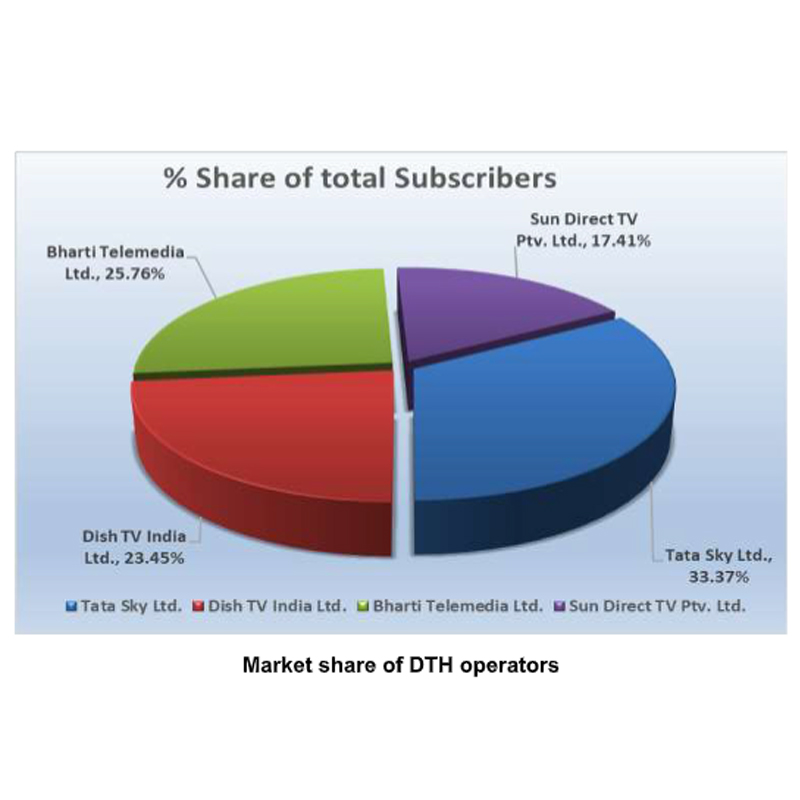
    Tata Sky continued to maintain the lead in the pay-TV genre with a share of 33.37 per cent, followed by Bharati Telemedia with 25.76 per cent, Dish TV India with 23.45 per cent and Sun Direct TV with 17.41 per cent. 

    According to the report, Reliance Jio Infocomm was the market leader in the access provider segment with 440.59 million subscribers and 36.64 per cent market share. It added 14.34 million telephone subscribers at the end of June.

    Bharti Airtel saw a marginal decline in subscribers from 357.17 million to 357.05 million. Vodafone Idea subscriber base also declined from 284.23 million to 273.88. Similarly, BSNL, MTNL, Tata Teleservices, Reliance Communication, and Quadrant lost subscribers in the quarter.

    The internet subscriber base in India grew from 825.30 million to 833.71 million at the end of June. This internet user base comprises 23.58 million wired subscribers and 810.13 million wireless subscribers. Out of the total internet base, 97.09 per cent are using mobile devices and 95.09 per cent are using broadband services to access the internet.

    BSNL is the leader in wired internet subscribers with a 25.57 per cent market share and 6.03 million subscribers followed by Bharti Airtel with 3.37 million subscribers. Reliance Jio holds a 59.901 per cent market share in the wireless internet subscriber base with 436.69 million subscribers followed by Bharti Airtel with a 26.76 per cent share.

    The top five service areas in terms of internet subscriptions (wired+wireless) are Maharashtra (71.21 million), Andhra Pradesh including Telangana (64.38 million), U.P.(East) (63.50 million), Bihar (56.81 million), and Tamil Nadu (56.41 million).

    The broadband internet subscriber base increased from 778.09 million to 792.78 million between March-June. Narrowband internet subscriber base decreased by 13.30 per cent from 47.21 million to 40.93 million.

    The top five broadband (wired+wireless) service providers in terms of subscribers are Reliance Jio (439.91 million), Bharti Airtel (197.10 million), Vodafone Idea Ltd (121.42 million), BSNL (22.69 million), and Atria Convergence (1.91 million).

    The top five narrowband (wired+wireless) service providers in terms of subscriber base are Bharti Airtel (23.05 million), Vodafone Idea Ltd (14.72 million), BSNL (3.01 million), MTNL (0.09 million), and You Broadband (0.01 million).

    In the wired narrowband segment, You Broadband India Pvt Ltd holds 26.23 per cent market share with 0.01 million subscribers followed by Foxtel Telecommunications Pvt. Ltd. with 0.007 million subscribers. In the wireless narrowband segment, Bharti Airtel holds a 56.40 per cent market share with 23.05 million subscribers followed by Vodafone Idea Ltd with 14.72 million subscribers.

    The total number of VSAT subscribers decreased from 293,632 to 289,392. Hughes Communication Limited continues to be the market leader with 44.83 per cent share in VSAT with a subscriber base of 129,724 followed by Tatanet Services with 74,704. Hughes Communication Ltd, added the maximum number of VSAT subscribers at 2344 whereas Bharti Airtel, BSNL, and Infotel Satcom saw a decline in their VSAT subscribers during the quarter.

    The number of private satellite TV channels increased from 901 to 915. The ministry of information and broadcasting has granted 16 channels permission for uplinking only, 70 for downlinking only and 829 for both uplinking and downlinking. There are 346 pay channels out of which 252 are standard definition and 94 are high-definition channels. The remaining 569 channels are free-to-air.

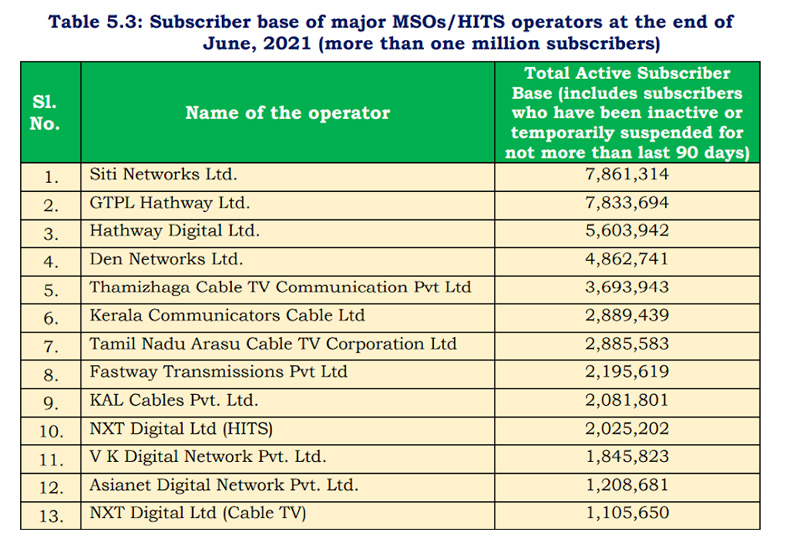
    There are 1731 MSOs registered with Trai out of which only 12 MSOs and one HITS operator have a subscriber base greater than 1 million.

  • Vodafone Idea lost 0.83 million wireless subscribers in Aug: Trai

    Vodafone Idea lost 0.83 million wireless subscribers in Aug: Trai

    Mumbai: Vodafone Idea lost 0.83 million wireless subscribers in August, according to Telecom Regulatory Authority of India (Trai) subscription data. Reliance Jio and Bharti Airtel have added 0.64 million and 0.13 million wireless subscribers, respectively.

    Total wireless subscribers decreased from 1,186.84 million to 1,186.72 million seeing a net subscriber decline of 1.1 million. Wireless subscriptions in urban areas increased from 650.10 million to 650.39 million, however, wireless subscriptions in rural areas decreased from 536.74 million to 536.33 million, revealed the data.

    Out of 1,186.72 million wireless subscribers, 991.71 million were active. Reliance Jio reported 350.63 million active wireless subscribers, Bharti Airtel stood at 346.84 million, and Vodafone Idea at 236.49 million.

    The number of telephone subscribers increased from 1,209.45 million to 1,209.58 million. Urban telephone subscriptions increased from 670.75 million to 671.31 million, however, the rural subscription decreased from 538.70 million to 538.28 million.

    Trai received information from 499 operators in August versus 455 operators in July and reported that the total broadband subscribers increased from 808.60 million to 813.47 million. Mobile device users grew from 783.39 million to 787.94 million, wired subscribers grew marginally from 24.01 million to 24.09 million and fixed wireless subscribers grew marginally from 1.19 million to 1.24 million.

    The top five service providers constituted 98.75 per cent market share of the total broadband subscribers. These were Reliance Jio Infocomm Ltd (447.57 million), Bharti Airtel (205.96 million), Vodafone Idea (123.53 million), BSNL (24.28 million), and Atria Convergence (1.95 million).

    The top five wireless broadband service providers were Reliance Jio Infocomm Ltd (443.86 million), Bharti Airtel (202.27 million), Vodafone Idea (123.52 million), BSNL (18.19 million), and Tikona Infinet Ltd (0.30 million).

    The top five wired broadband service providers were BSNL (5.49 million), Reliance Jio Infocomm Ltd (3.71 million), Bharti Airtel (3.69 million), Atria Convergence Technologies (1.95 million), and Hathway Cable & Datacom (1.08 million).

    The total wireline subscribers increased from 22.61 million to 22.86 million, a net subscriber increase of 0.25 million. Reliance Jio and Bharti Airtel led the growth by adding 0.25 million and 0.10 million subscribers, respectively. Vodafone Idea added 7870 subscribers whereas BSNL, MTNL, Tata Telecommunications, Reliance Communications, and Quadrant lost subscribers.  

  • Airtel launches CPaaS solution ‘Airtel IQ Video’ to democratise video streaming

    Airtel launches CPaaS solution ‘Airtel IQ Video’ to democratise video streaming

    Mumbai: Communication solutions provider Bharti Airtel (Airtel) on Tuesday announced the launch of its video platform as a service (CPaaS) ‘Airtel IQ Video’ that will allow businesses to build world-class video streaming products for large and small screens with minimal investment in infrastructure and technology. The solution has been developed by Airtel’s in-house engineering teams.

    Airtel IQ Video is an end-to-end managed solution that brings convenience along with cost benefits. It encompasses a variety of features ranging from app development, content hosting, curation, and lifecycle management to search and discovery, analytics, and monetisation models (advertising, subscriptions, transactions).

    “Airtel IQ Video brings an easy-to-use platform that can enable anyone to quickly build and scale their business in video streaming. This will encourage enterprises to focus on content while Airtel IQ Video anchors the end-to-end technology ensuring a great viewing experience for customers,” stated Bharti Airtel – chief product officer Adarsh Nair. “With Airtel IQ Video, we expect to see more content startups and traditional content companies coming online and directly engaging with consumers digitally.”

    Airtel IQ Video is a cloud-based omni-channel communications platform that enables brands to deepen engagement with customers through timely and secure communication. It eliminates the need for multiple communication platforms for different channels while allowing businesses to embed communication services such as voice, SMS, IVR, and video in their applications and digital properties across desktop and mobile, all through a unified platform, said the statement.

    According to RBSA Advisors, India’s video OTT market is expected to touch $12.5 billion by 2030 from the current $1.5 billion. The report also highlighted that the next wave of growth in the OTT landscape will come from tier 2, 3 and 4 cities and regional languages at the centre of this growth story. Keeping these changing trends in sight, existing regional OTTs are looking to scale their technology platforms to accommodate the rising number of users. Traditional content providers such as regional TV broadcasters are looking to digitise their content libraries through OTT applications.

    During the beta phase, Airtel IQ Video has also been deployed by Eros Now and CG Telecom of Nepal. Airtel is expecting to onboard 50+ brands on the platform in the coming year as interest from the market has been high.

    “We have cherished our partnership with Airtel over the years and are now excited about our technology collaboration. Their robust infrastructure and extensive network coverage have been helping us deliver blockbuster content seamlessly to the end consumers,” shared Eros Now- CEO Ali Hussein. “Airtel’s latest ‘Airtel IQ Video’ platform is an innovative offering that is built to scale and can assist Eros Now in reinforcing its value proposition to the rapidly expanding video subscriber base.” 

  • Reliance Jio added 6.5 million mobile subscribers in July: Trai

    Reliance Jio added 6.5 million mobile subscribers in July: Trai

    Mumbai: Reliance Jio added 6.5 million mobile subscribers in July, according to the latest data shared by the Telecom Regulatory Authority of India (Trai). Airtel added 1.9 million mobile subscribers and Vodafone Idea lost 1.4 million subscribers, the telecom regulator said.

    BSNL lost 1.01 million subscribers as well. MTNL and Reliance Communication lost a few thousand subscribers. Net mobile subscribers grew by 6 million.

    Total wireless subscribers grew from 1180.83 million to 1186.84 million at a monthly growth rate of 0.51 per cent. Wireless subscriptions in urban areas increased from 646.29 million to 650.10 million. In rural areas, it increased from 534.54 million to 536.74 million.

    Out of total wireless subscribers, 989.34 were active mobile subscribers. Reliance Jio had 346.49 million active subscribers, Bharti Airtel had 346.07 and Vodafone Idea had 238.39.

    Total telephone subscribers increased from 1202.57 million to 1209.45 million at the end of July. Urban telephone subscriptions increased from 666.10 million to 670.75 million. Rural subscriptions increased from 536.47 million to 538.70 million.

    As per information received by 455 operators in July 2021 in comparison to 440 operators in June 2021, total broadband subscribers increased from 792.78 million to 808.68 million at a monthly growth rate of 2 per cent. Wired subscribers increased from 23.52 million to 24.01 million, mobile device users increased from 768.61 million to 783.39 million and fixed wireless subscribers increased from 0.65 million to 1.19 million.

    The top five service providers constituted 98.77 per cent market share of the total broadband subscribers at the end of July. These service providers were Reliance Jio Infocomm Ltd (446.69 million), Bharti Airtel (201.77 million), Vodafone Idea (123.97 million), BSNL (24.26 million), and Atria Convergence (1.93 million).

    The top five wired broadband service providers were BSNL (5.83 million), Bharti Airtel (3.54 million), Reliance Jio Infocomm Ltd (3.47 million), Atria Convergence Technologies (1.93 million), and Hathway Cable & Datacom (1.07 million).

    The top five wireless broadband service providers were Reliance Jio Infocomm (443.61 million), Bharti Airtel (198.23 million), Vodafone Idea (123.97 million), BSNL (17.89 million), and Tikona Infinet Ltd (0.31 million).  

    Wireline subscribers increased from 21.74 million to 22.61 million with a monthly growth rate of 4.04 per cent. The share of urban and rural subscribers stood at 91.32 per cent and 8.68 per cent. BSNL and MTNL held 47.93 per cent of the wireline market. Net wireline subscribers increased by 8.7 million. BSNL added 5.06 million, Reliance Jio added 0.25 million and Bharti Airtel added 0.12 million subscribers, respectively.

  • Mobile customer ARPUs to cross Rs 200 by end of the year: Sunil Mittal

    Mobile customer ARPUs to cross Rs 200 by end of the year: Sunil Mittal

    Mumbai: The board of Bharti Airtel on Sunday announced that it would raise Rs 21,000 crore through the issuance of equity shares available on a rights basis to eligible shareholders of the company. “This is the need of the hour for the company to accelerate from business as usual and capture a once-in-a-lifetime opportunity,” noted Bharti Airtel, chairman, Sunil Mittal.

    Mittal acknowledged that the company is loaded with extraordinary debt both from AGR and spectrum dues and they are raising capital not just to pay off the dues but also invest more in building 5G capability, gain market share in mobile services, grow FTTH business and expand data centre business. “In two-three years you will see Airtel become much more comfortable with the debt on its balance sheet,” he remarked.

    Mobile network expansion

    The company will continue to continue to upgrade spectrum which is the lifeline of the telecom industry and requires heavy capital commitment, said Mittal. The existing spectrum licenses need to be renewed in 2023 but their cost is marginal, he noted.

    “15 per cent of devices in India are 5G enabled and price points for 5G devices are coming down,”  he observed, adding that “The government should ensure that pricing of spectrum remains attractive so that the benefits can be passed down to the customer who may enjoy a robust 5G ecosystem.”

    According to Mittal the CapEx required to expand 4G capacity and upgrade existing capacity to 5G would not be very big. “We are largely done with our 4G capacity and only add extra capacity in high connectivity areas to cater to the surge in traffic. 5G capacities are huge and modular and upgrading to 5G in areas where there is higher traffic will be ideal,” he stated. 

    Sustainability in telco business

    While Airtel is positioned to capture the growth in the next two to three years, Mittal advocated that the economic model of the telecom business in the country needs to change and become viable for sustainable growth. 

    “We expect the government to respond with a lighter touch,” he said, noting that out of Rs 100 in revenues Rs 35 goes to the government in the form of levies.

    He said, “Indians are consuming 16 Gb of data on average per user every month and having an appropriate and decent return on capital is vital to the sustainability of the industry. We don’t see data consumption increasing exponentially from 16 Gb which is already a global record.”

    The company’s ARPUs stands at Rs 146 as reported in the last quarter results and “we need to quickly get it to Rs 200 and Rs 300 eventually,” he said.

    “At Rs 100, customers would be able to be on the network and be able to do a small amount of snacking, whereas at Rs 600-800 customers would be able to enjoy all benefits of data under the sun and it still would be the lowest tariffs in the world!” he said.

    In September 2016, when Reliance Jio was launched, the entire telco industry’s ARPUs dropped below Rs 100. “The industry has reached Rs 150 and soon is expected to cross the Rs 200 mark by the end of the year,” he noted.

    Broadband network expansion

    Regarding the growth of FTTH business, he said “millions of new homes and offices are enabled with FTTH broadband services and we have seen a lot of momentum in the last 12 months. Our last quarter results showed that the number of fixed broadband connections are rising exponentially.”

    The company’s home business segment added ~285,000 new customers during the last quarter to reach a 3.35 million customer base. Other than BSNL, Airtel has been in a rising position when it comes to broadband connectivity. Mittal said that CapEx allocation will be towards backhauling existing capacities and rolling out more fibre.

    Data centre business

    Regarding the data centre business, he said, “We have the right to win in this business as we know how to build data centres and have the domain expertise to run them efficiently. We have a significantly higher chance at success in this space than pureplay real estate players.”

    Nxtra Data Ltd, a wholly-owned subsidiary of Bharti Airtel is engaged in the data centre business and runs 10 large data centres and 120 edge data centres. Nxtra is building multiple large data centres across the country in Pune, Chennai, Mumbai and Kolkata to capture the significant growth opportunities in India. In July 2020, Carlyle announced that it would acquire a 25 per cent stake in Airtel’s data centre business at a valuation of $1.2 billion.

    DTH business

    Speaking about buying back its 20 per cent stake in Bharti Telemedia (D2H business) from Warburg Pincus, he said, “As we get wiser in hindsight, we realised that all our customer-facing businesses need to be in complete control of the mothership company Bharti Airtel. While infrastructure businesses like fibre and tower are different, all our go-to-market businesses need to be aligned as one. That’s why we’ve had tremendous success in the rollout of Airtel Black.”

    Digital business

    “It is difficult for companies from traditional backgrounds, even technology companies like ours to pick up on the digital momentum. It has taken Airtel four to five years to get to a point where we have got the right to call ourselves a digital company,” said Mittal. “In the coming quarters, we will talk a lot more about digital and our revenues coming from digital will also be fairly impressive.”