Tag: Bharti Airtel

  • Airtel digital TV provides SVOD to Disney India

    Airtel digital TV provides SVOD to Disney India

    MUMBAI:  Airtel digital TV, the DTH service arm of global telecommunications company Bharti Airtel has joined hands with Disney India to launch English Subscription Video on Demand (SVOD) Service – “Disney Family Movies”.


    It can be recalled that early in March this year, HBO had also launched its SVOD service on Tata Sky.


    The partnership between Airtel and Disney is aimed to enable the entire family with a never before experience of a one stop shop for popular Disney blockbusters. The new SVOD service on channel number 201 will showcase celebrated Disney movies including Hollywood classics, popular animation movies and live action titles like The Lion King, Aladdin, Pirates of the Caribbean series, Tangled, Alice in Wonderland along with award winning Disney PIXAR animation titles like UP, Toy Story, Cars and more.


    Under its SVOD portfolio, Airtel Digital TV showcases Regional, Bollywood and now Hollywood movies, making it one of the largest curators of movies offerings to its customers. The ‘Disney Family Movies’ will showcase English family entertainment movies back-to-back 24×7.


    To start with, the channel will showcase 20 new movies which will be replenished regularly. With the ongoing summer vacations, kids can enjoy a wide range of Disney’s celebrated classics, popular animation and live action titles at a subscription fee of only Rs 60 per month with only one ad break.

  • Watch your TV on the go with Airtel Digital TV’s Pocket TV

    Watch your TV on the go with Airtel Digital TV’s Pocket TV

    MUMBAI: Airtel Digital TV, the DTH service arm of the leading telecom operator Bharti Airtel, today announced the launch of Airtel ‘Pocket TV’ – a mobile app which will enable customers to watch their favorite TV programs while on the move.


    Loaded with over 150 Live TV channels and more than 10,000 hours of video content and over 13 channels on anytime TV available at an introductory pricing of just Rs. 60/- per month, Pocket TV now promises a never before library of video content which is available at an affordable price.


    The Airtel Digital TV app is available for download on the Android play store and is accessible to all smartphones and tablets with Android version 2.1 onwards. Within 1 month, the app will also be available on the iOS platform soon followed by other platforms. After installation of the app, customers have to activate the service by sending the SMS <ADD TV> to 54325 from their registered mobile number.


    The app is a convergence of the TV & mobile phone and its launch follows the success of Airtel Digital TV’s innovative offering of Twitter on TV which was the first ever global convergence of Twitter and TV. 


    For more details, please log on to: http://www.airtel.in/pocketTV

  • Bharti Airtel set to acquire Loop for Rs 700 crore

    Bharti Airtel set to acquire Loop for Rs 700 crore

    MUMBAI: India’s largest cellular carrier, Bharti Airtel, is set to acquire small mobile operator Loop Mobile for about Rs 300 crore, according to reports. This would be the first merger in six years in an industry long seen as ripe for consolidation.


    Loop, which operates only in Mumbai with about three million subscribers, was up for grabs as a potential acquisition as its spectrum licence lapses on 28 November.


    If Bharti completes the acquisition it will overtake Vodafone India and become the market leader in terms of customer numbers, although not by revenue in Mumbai – which is one of the biggest cellphone markets in India.


    The deal – if it happens – would also see Bharti take on Loop’s debt of nearly Rs 400 crore.


    Industry consolidation has been slow to take place in the world’s second-largest cellular market due to challenging merger rules, including a new requirement that the buyer pay separately for the target company’s airwaves based on prices determined at an auction.


    Loop Telecom, an associate company of Loop Mobile, lost its permits in 21 of India’s 22 teleco service areas after the Supreme Court order on the 2008 wireless permits. Loop has denied any wrongdoing.


    Loop’s main investor is Dubai-based Khaitan Holdings, whose founders are related to the founding family of Indian conglomerate Essar Group. Essar owns over a per cent in Loop.

  • Airtel and Apple launch India’s first 4G on mobile

    Airtel and Apple launch India’s first 4G on mobile

    MUMBAI: Bharti Airtel, a leading global telecommunications company with operations in 20 countries across Asia and Africa along with Apple recently launched India’s first 4G on mobile. Airtel customers in Bengaluru on Apple iPhone 5s or 5c will be able to experience 4G on their mobile at the current 3G prices for a ‘FLYing’ internet browsing experience while on the move. Customers have to just change their existing SIM to a 4G SIM to start enjoying 4G on mobile without any need to migrate from their existing data plan.

     
    Airtel mobile customers both prepaid and postpaid can experience 4G on mobile to experience never before capabilities like high definition video streaming with zero buffering, download 10 movies in less than 30 minutes, upload full holiday albums in less than five minutes by uploading two high quality photos per second and connect multiple devices without any experience constraint. 3G customers in Bengaluru on iPhone 5s or 5c can start enjoying 4G speeds at same price points as their existing 3G plan/pack.

    Customers on 2G/GPRS data plans/packs can also opt for any of the 3G plans/packs available and enjoy 4G speeds. In addition to these plans, for heavy data users, Airtel also announced the launch of a new 4G plan giving customers 10 GB 4G data for Rs 1000. While data browsing will be on 4G network, voice calls will be routed on 2G/3G seamlessly with the CSFB (circuit switched fall back) technology.

     
    Bharti Airtel India director – consumer business Srini Gopalan said: “Airtel has always set the technology trends in India and was the first operator to introduce 4G to the country. The Information Technology capital of India saw the advent of 4G in 2012 and today we are proud to announce the launch of the much awaited Airtel 4G services on mobile in partnership with Apple. We will together give customers in Bengaluru the power to upgrade to cutting edge 4G LTE technology at no additional cost. As a brand we are committed to enriching lives of millions by giving them the best user experience and invite our data savvy customers in the city to enjoy this world class data experience.”


  • Airtel DTH Q3-2014 yoy EBITDA up fivefolds; revenue up 26%; improved Arpu

    Airtel DTH Q3-2014 yoy EBITDA up fivefolds; revenue up 26%; improved Arpu

    BENGALURU: The DTH segment of India’s largest mobile services provider Airtel DTH reported earnings before interest taxes, depreciation, and amortisation (EBITDA) of Rs 97 crore for Q3-2014, 560 per cent more than the Rs 14.7 crore during Q3-2013 and 50.4 per cent more than the Rs 64.5 crore during the immediate trailing quarter.


    Airtel’s DTH segment reported a 25.8 per cent growth in revenue during Q3-2014 at Rs 538.4 crore as compared to the Rs 428 crore during Q3-2013 and 6.15 per cent more than the Rs 507.2 crore during Q2-2014.


    Overall, Arpu (Average revenue per user) improved by 11.29 per cent to Rs 207 during Q3-2014 as compared to the Rs 186 during Q3-2013 and was 4.55 per cent more than the Rs 198 during the immediate preceding quarter.


    The segment reported a 11.57 per cent y-o-y growth in total number of subscribers during Q3-2014 to 88.07 lakhs (100 lakhs = I crore = 1,00,00,000) with a net addition of 2.35 lakh new subscribers and a monthly churn of 0.8 per cent. During the corresponding period of last fiscal, the DTH segment had reported a subscriber base of 78.94 lakh with a net addition of 4.39 lakh and a monthly churn of 1.3 per cent. Corresponding figures for Q2-2014 were q-o-q growth of 2.74 per cent as compared to the 85.72 lakh customers in Q2-2013, with net addition of 1.2 lakh and a monthly churn of 1 per cent.


    Airtel DTH segment’s EBIT figures, though negative, also improved. The segment reported a Q3-2014 EBIT of Rs (-108.1) crore, which was 46.9 per cent better than the Q3-2013 EBIT of Rs (-182.8) crore and 26.7 per cent better than the Q2-2014 EBIT of Rs (-147.3) crore.


    Though the DTH segment contributed just 3.73 per cent to Bharti Airtel’s India revenues of Rs 14,443 crore during Q3-2014, the company invested 6.37 per cent of its capex spends of Rs 1742 crore in India.


    The company invested Rs 110.9 crore in capex for the DTH segment during Q3-2014, this figure was 17.91 per cent lower than the Rs 135.1 crore during Q3-2013, but 6.43 per cent more than the Rs 104.2 crore invested on capex in Q2-2014.


    Consequently, the company’s Operating free cash flow (EBITDA-Capex), though negative, improved more than eight fold (8.66 ties) to Rs (-13.9) crore in Q3-2014 as compared to the Rs (-120.4 crore) in Q3-2013 and by almost three times (2.85 times) the Rs (-39.7) crore during Q2-2014.


    Click here for full report

  • Telecom spectrum auction further delayed

    Telecom spectrum auction further delayed

    NEW DELHI: The spectrum auction which has been put off from time to time will begin on 3 February 2014. The Department of Telecom (DoT) had been asked to give clarifications to a number of questions from mobile phone companies like Bharti Airtel and Vodafone India on spectrum usage charges, option of withdrawing from auction and availability of contiguous spectrum but there is still no clarity on these issues.

    According to a notice issued today, the DoT will now give clarifications on the concerns raised by service providers on 2 January. The department has also extended the last date for operators to submit their applications to bid in the auction to 15 January.

    While DoT will announce the pre-qualification of bidders by 25 January, bidders will also be given an option to withdraw their applications, according to the changes in the auction schedule. Service providers had objected to DoT’s move to remove the option of withdrawing their bids, as was allowed in the last auction.

    Operators will now be allowed to withdraw their bids by 27 January and the final list of bidders will be announced on 29 January. A mock auction will be conducted over 30 and 31 January.

    Leading operators like Bharti Airtel and Vodafone India had warned DoT in a pre-bid conference held last week that they could stay away from the upcoming bandwidth auctions if the government continued with the present cascading spectrum usage charge (SUC) regime, instead of moving to a flat fee structure of 3 per cent.

    The government levies SUC between 3-8 per cent of revenue earned by telecom companies from telecom services, depending on the quantum of airwaves held.

    The telecom department is set to auction 403 Mhz in 1800 Mhz and 46 Mhz in the 900 Mhz bands in the next round of auctions, beginning 23 January. The government aims to raise Rs 40,874.5 crore from spectrum revenue this fiscal year ending 31 March 2014, including one-time spectrum fee, and has its hopes pinned on this round to raise funds to limit its budget deficit.

    Operators stayed away from the last two rounds held in November 2012 and March 2013 citing very high reserve prices and low spectrum availability. The government has set the reserve price in 1800 Mhz at Rs 1,765 per unit for pan-India airwaves, 25 per cent lower than the last auctions.

    DoT also lowered the reserve price for Delhi, Mumbai and Kolkata circles in 900 Mhz band by 53 per cent from last auctions to Rs 360 crore, Rs 328 crore and Rs 125 crore respectively.

  • TDSAT-TRAI ad cap: NBA finishes rejoinder

    TDSAT-TRAI ad cap: NBA finishes rejoinder

    MUMBAI: It was day two of the News Broadcasters Association (NBA) submission of its rejoinders in the hearings on the proposed Telecom Regulatory Authority of India (TRAI) ad cap regulation. NBA counsel Anup Bhambhani clarified that it was untrue that channels had tried to suppress documents, as everything related to teleport licence is in the public domain and hence easily accessible to the regulator. Channels had individual teleport licences while others were uplinking through Bharti Airtel or Essel Shyam which made them the licensees and not the channels.


    The counsel also pointed out that the TRAI had not informed the TDSAT that ads are of three types- commercial, social and programme promos. Not every ad is a paid ad and DAVP ad rates are also low.And the number of minutes of advertising does not take into consideration any of these facts; and hence is not reflected in these categories. He stated that the TRAI had gone overboard in describing the type, length and look of the adverts, in a consultation paper issued in 2012. And even though it was later dropped, it never had any mention of section 7 (11 )of the Cable TV Networks Regulation (CTN) act. Also, the proposed 10+2 regulation finally did not mention that TRAI was using section 11 of the TRAI act in order to enforce section 7 (11) of the CTN act.


    According to the NBA counsel, the 7 (11) argument was very ingenious in order to defend the TRAI regulation which was previously never mentioned. Assuming TRAI can regulate, the intention while framing was not keeping in mind this regulation. He pointed out that the ministry of information and broadcasting (MIB) is the authority for the news channels and not the TRAI.


    The NBA lawyer also clarified that the Bengal Cricket Association vs MIB and Doordarshan judgement does not apply to private broadcasters as is stated in para 79 of the case. Although the case was read against the channels, it claims that the argument that ‘airways are public property’ only applies when you are seeking a teleport licence for setting up a TV station. While thinking of granting a licence, Article 19 (1) of the Constitution that speaks about freedom of speech and expression, can be thought of but not after it has been granted.


    Mentioning the Sakaal papers case, the NBA counsel said that that case was contended because page numbers were restricted and similarly in the case of TV channels also ad duration is being controlled. It also stated that there is no need to prove a loss because even if there is a prospect that there may be a shutdown due to the restriction then it is a violation of Article 19.


    Another point argued was that when TRAI says it is laying down standards of quality under section 11 of the TRAI act, as per precedents it had itself set, it can only include technical aspects such as tariff regulation and never content. According to the NBA, duration is content.


    Addressing the point that the amicus curiae had made, the NBA counsel presented data supporting the fact that channels’ ad rates would need nearly 50 to 100 per cent increases, if losses due to lower air time are to be covered. To support the contention that TRAI only has recommendatory authority, the NBA lawyers pulled up SO 44 and 45 from the TRAI notifications which said “Broadcasting and cable services to be telecommunication services and showed that it is mentioned in it by the central government that TRAI only has a recommendatory function regarding duration of commercials.”


    SO 45E 1 b states “Without prejudice to the provisions contained in clause (a) of sub-section (1) of section 11 of the Act, to make recommendation regarding (b) the parameters for regulating maximum time for advertisements in pay channels as well as other channels”.


    Even though broadcasting has no correct definition, the NBA read from the TRAI explanatory memorandum 2012 where it mentioned broadcasting services to be ‘dissemination of signals.’


    Another argument was that TRAI couldn’t change a statutory law by changing ‘per hour’ to ‘clock hour’ and reporting authority as TRAI. Before coming up with the regulation TRAI didn’t even bother to serve a notice to broadcasters.


    TRAI’s argument that it was for the benefit of consumers that the regulation is being framed was countered by the NBA saying that viewers need choice. If they wanted channels free of ads they should be ready to pay more for the service or else they have an option to switch channels. The channels said they are happy to consider it post DAS is implemented which according to a KMPG report will make subscription and advertisements a 50:50 affair.


    A major point raised was the discrimination towards pay channels and bias towards the pubcaster Doordarshan which according to the NBA was also violating the regulation.


    Tomorrow the music channels are expected to give their rejoinders.

  • TRAI study reveals telecom sectors growing pains

    TRAI study reveals telecom sectors growing pains

    MUMBAI: With foreign promoters increasing their stakes or purchasing the stakes of Indian promoters in telecom companies such as Aircel, Unitech, Sistema Shyam, Bharti Airtel and Vodafone, the latter’s total shareholding of major telecom access providing companies has dropped from 59.77 per cent in the year 2007-08 to 40.42 per cent in 2011-12.  A study paper released today by the Telecom Regulatory Authority of India (TRAI) on shareholding, financing and capital pattern of Indian private telecom access service providers (TSPs) has revealed this.


    It attempts to provide an overview of the capital structures (deployment of funds in the form of owners’ equity and loan fund) of companies operating in the telecom sector based on the annual accounts and other information provided by 24 Private Telecom Access Service Providers.


    The study paper also points out that while the share of Indian promoters in the equity shareholding declined from 59.70 per cent in 2007-08 to 56.63 per cent in 2011-12, the share of the foreign promoters has increased from 5.30 per cent to 13.90 per cent in the same period. So while Unitech, Tata and Vodafone have reported a decline in Indian promoters’ equity, Bharti, Unitech, Tata, Sistema Shyam, Loop and Vodafone have seen an increase in the stake of foreign promoters in equity shareholding.


    The study paper is a comparative study of facts in the year 2007-2008 and 2011-2012. The trend indicates that the preference shareholding of Indian promoters and others has declined from 60.89 per cent (2007-08) to 2.62 per cent (2011-12). This decline is mainly in the case of the Tata group. The share of the foreign promoters in the total preference shareholding has gone up sharply from 0.59 per cent to 95.84 per cent. The increase in foreign promoter’s shareholding is Rs 5,988 crore and is mainly in the Aircel group.


    Foreign currency loans for these companies have gone up from Rs 13,929 crore in 2007-08 to Rs 40,045 crore in 2011-12. The increase in foreign currency loans in 2008-09 over the previous year was attributed to the borrowings by Reliance Communications and Idea Cellular.  Reliance, Tata, Bharti Airtel and Idea have the major share (88 per cent) in foreign currency loans/bonds outstanding at the end of year 2011-12.


    The study shows that Bharti, Vodafone and Reliance have not shown any change in their share capital.  Idea’s share capital has increased 26 per cent from Rs 2,635 crore in 2007-08 to Rs 3,309 crore in 2011-12, making it the only TSP showing that kind of growth. Total reserves and surplus in respect of Vodafone have declined from Rs 9,991 crore to Rs 2,975 crore, whereas the total reserves and surplus of other companies have shown an increase.  As on 31 March 2012, while Bharti, with Rs 50,470 crore had the highest reserves and surplus; Tata showed negative reserves and surplus of Rs 4,748 crore.


    As on 31March 2012, Vodafone had the highest debt of Rs 45,332 crore followed by Reliance at Rs 31,195 crore and Tata at Rs 23,986 crore. Vodafone and Tata have shown persistent increase in debt during the past five years whereas the other three service providers have shown fluctuating trends in debt.


     The study also highlights the fall in EBITDA margins for almost all the TSPs over the past five years.  Bharti’s EBITDA has gone up from Rs 11,447 crore in 2007-08 to Rs 15,441 crore in 2011-12; however as a margin it has fallen from 41.96 per cent to 33.82 per cent. Vodafone’s and Reliance’s EBITDA has declined from Rs 6,247 crore and Rs 5,175 crore in 2007-08 to Rs 4,248  crore and Rs 3,018 crore in 2011-12 respectively.


    Vodafone’s PBIT has declined very sharply from Rs 3,473 crore in 2007-08 to Rs 27 crore in 2011-12 while Tata’s has been negative throughout the period and has declined progressively from a negative Rs 1,194 crore to a negative Rs 2,275 crore over the past five years.  Ditto with Reliance which has seen its PBIT fall during 2008-09 and become negative in 2009-10 and 2010-11; however it has improved and become positive in 2011-12.


    The study talks about the problems plaguing the TSP sector.  It says that “After their initial success, the Indian telecom companies are confronted today with serious growth challenges. The sector is characterised by mounting competition, declining average revenue per user (ARPUs) and rising costs. All these factors have put tremendous pressure on operating margins. The main reason cited by telecom service providers for declining profitability are their inability to pass on cost inflation due to hike in the price of power and fuel, debt servicing burden and the declining value of the rupee. This has been further aggravated by the prevalent tariff competition.”


    It goes on to add:  “Each telecom service provider is endeavoring to focus on growth and investment, improvement of profitability and cost control without compromising on the quality of service to the customer.  Of the several strategies being adopted by the sector to witness growth include: focus on development of network and eco-system for 3G and 4G services; shifting towards outsourcing model where various medium and long term leasing arrangements for towers and other network infrastructure have been made with the third party operators or equipment vendors; maximising share of passive infrastructure in the short-term and initiating efforts to share active infrastructure over the longer term etc.”


    The study concludes that the low market tariffs and the presence of large number of service providers in each licence service area have caused profitability to decline and made the telecom sector less attractive for infusion of equity.


    New investments are therefore being financed through debt. Sector indebtedness is growing.  However, the sector’s debt-equity ratio has not as yet reached alarming proportions. On the other hand, the declining profitability of the sector, which lies at the root of the inability to attract fresh investment, is a cause for deep concern.


    The study also indicates that some portion of debt is being utilised for interest payments and other liabilities rather than for acquisition of new assets, which potentially places the companies in a debt trap. Replacing debt financing by equity financing could help increase profitability by reducing the interest burden.


    The report published by the TRAI also says that in order to turn around the financing pattern and the deteriorating profitability position of the sector, apart from measures and strategies of individual companies, clarity needs to emerge on the following policy issues and optimal utilization of resources:


     · Emergence of an enabling environment for mergers and acquisitions to aid in market consolidation;


    · Permission and policy framework for sharing, trading and sale of underutilised or unutilised spectrum by service providers so that spectrum is optimally utilised;


     · Liberalisation of spectrum usage to enable flexibility in deployment of alternative technologies;


     · Improvement in the availability of power to run telecom networks so that network operations require less fuel and captive power generation.

  • Marginal growth in broadband connectivity between August and September 2013

    Marginal growth in broadband connectivity between August and September 2013

    NEW DELHI: The total broadband subscriber base increased from 15.28 million at the end of August to 15.36 million at the end of September 2013, thus showing a monthly growth of 0.52 per cent.

    The yearly growth in broadband subscribers is 1.90 per cent during the last one year (September 2012 to September 2013).

    As on 30 September, there are 158 internet service providers (ISPs) which are providing broadband services in the country. 

    Out of these, 95 ISPs have provided broadband subscription data for the month of September 2013, for the rest of the ISPs data from previous month has been retained.

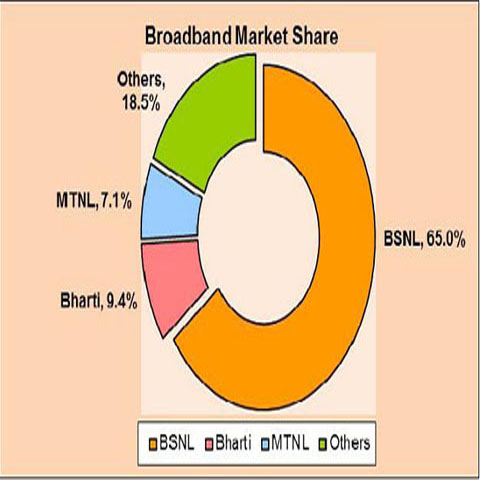
    The top five ISPs in terms of market share (based on subscriber base) are: BSNL (9.98 million), Bharti Airtel (1.44 million), MTNL (1.10 million), Hathway (0.37 million) and You Broadband (0.33 million).

  • Airtel to acquire Warids Congo Brazzaville Operations

    Airtel to acquire Warids Congo Brazzaville Operations

    MUMBAI: Bharti Airtel (Airtel), a leading global telecommunications services provider with operations in over 20 countries across Asia and Africa, has entered into a definitive agreement with the Warid Group (Warid) to fully acquire Warid Congo SA. The agreement is subject to regulatory and statutory approvals.


    The agreement marks the second in-country acquisition by Airtel in Africa. It had acquired Warid’s Uganda operations earlier this year. The latest acquisition will make Airtel the largest mobile operator in Congo Brazzaville with around 2.6 million customers. At present, Airtel is the second largest operator in the country with over 1.6 million customers, while Warid is the third largest with around one million customers.


    The agreement looks at bringing together the strengths of Airtel and Warid in Congo Brazzaville and benefit customers in the form of affordable tariffs, superior 2G/3G network, affordable voice and data services and superior customer care. In addition, existing Warid customers in Congo Brazzaville will join Airtel’s global network of over 280 million customers and enjoy the benefits of ‘One Airtel’ network with affordable roaming rates across Africa and South Asia, besides other exciting bouquet of innovative 2G and 3G services.


    Speaking on the agreement, Bharti Airtel MD and CEO (International) Manoj Kohli says: “This acquisition is in line with our stated strategy of strengthening our market position through in-country acquisitions, as and when suitable opportunities come along. We are at an advance stage of successfully integrating Waird’s Uganda operations with that of Airtel and look forward to a similarly swift transition in Congo Brazzaville as well. As already demonstrated in Uganda, the merger will bring more value for the customers in the form of affordable data and roaming tariffs, innovative products, Airtel Money, world-class networks and customer care. We would like to express our deep gratitude to the government and look forward to its support to this deal.”


    Speaking on the agreement Warid, Congo Brazzaville board member Sriram Yarlagadda says: “This agreement creates a win–win situation for the customers and provide them with an opportunity to be part of one of the largest mobile services providers in the world. The customers can look forward to enjoy affordable voice tariffs and 3G data services on the most extensive network. On this occasion, we would also like to express our sincere gratitude to the government for its support and look forward to its continued cooperation towards a successful transaction.”


    With presence across 17 African countries, Airtel is the largest telecom service provider across the continent in terms of geographical reach and had over 66 million customers at the end of quarter ended September, 2013. Globally, Airtel is ranked as the fourth largest mobile operator in terms of subscribers.