Tag: Bharat Nirman

  • Over Rs 400 crore spent on Bharat Nirman campaign in three years

    Over Rs 400 crore spent on Bharat Nirman campaign in three years

    NEW DELHI: The United Progressive Alliance (UPA) spent a total amount of Rs 411.91 crore between 2011-12 and 2014-15 through the Information and Broadcasting Ministry to publicise Bharat Nirmal programmes.


    The amount spent in 2014-15 was only Rs 32.23 crore as against Rs 188.88 crore for the previous year. The amount spent in 2011-12 was Rs 87.78 crore and that in 2012-13 was Rs 103.02 crore.


    I&B Minister Prakash Javadekar told the Lok Sabha today that there was no plan at present to undertake any campaign under the umbrella of Bharat Nirman.


    The promotion through I&B Ministry was part of the media outreach strategy under the plan sub-scheme titled “People’s Empowerment through Development Communication Conception and Dissemination” by the Directorate of Advertising and Visual Publicity.


    While a sum of Rs 48 crore was spent covering 6444 newspapers and Rs 96.19 crore was spent on 125 television channels in 2013-14, no campaign was launched in 2014-15 as the Model Conduct had come into force in view of the General Elections in May.


    I&B Ministry sources said that the amount of Rs 32.23 crore for 2014-15 related to old bills.

  • Campaigning with a purpose

    Campaigning with a purpose

    MUMBAI: The countdown to the ‘who will claim the kursi’ has started and finally after spending enough and more moolah on advertising and campaigning, the world’s largest democracy will vote for its 16th Lok Sabha.

    Indiantelevision.com brings to you a roundup of all the television commercials launched by Congress and Bharatiya Janata Party (BJP) to woo the voters – young or old, man or woman – and what was the message the parties wanted to convey through these.

    Campaigns by Congress

    India’s transformation

    Storyboard: The ad focuses on one man who is taken aback with no ATMs, no flyovers or no mobile phones. Only to be woken up to the reality which is quite different. He is relieved to see that the amenities, which have become an integral part of our lives today, are back. He laughs off the dream and is happy about how our lives have changed in the past 10 years, thanks to all the development.

    Purpose of the ad: The adverts show the progress the country has made in the last 10 years i.e. under the UPA regime. Be it telecom, infrastructure or other facilities, everything has become a part of our lives.

    Click here to watch the video

    The video highlights the inclusive growth, economic development and social equity achieved through the various welfare schemes of the Central Government. It underscores the impact of policy decisions at the ground level for participatory governance within the right framework.

    Bharat Nirman

    Click here to watch the video

    Storyboard: A police jeep enters a busy street where street vendors are galore. The police hawaldar screams on top of his voice from the jeep telling the vendors to shut their shops as it is not allowed. However, one vendor (selling golguppas) refuses to bow down to the halwaldar’s dhamkis of shifting his cart to some other place. He proudly tells the policeman that he has a government approved licence to work and that it is his right.

    Purpose of the ad: Through this campaign, Congress wants to highlight the scheme which helps street vendors. The Street Vendors (Protection of Livelihood and Regulation of Street Vending) Bill, 2014 which was passed by the Lok Sabha on 6 September 2013, provides for protection of livelihood rights and social security of street vendors.

    Kattar Soch Nahi, Yuva Josh

    Click here to watch the video

    Storyboard: The TVC revolves around a youngster (Hasiba Amin, a youth congress representative) who says that since India is a young country where 50 per cent of the population is under 30 years, only a party which can understand their beliefs, expectations, mindset, problems and dreams needs to come to power. And the party which does so is none other than Congress. So, under the leadership of young Rahul Gandhi, the youngsters can grow. The mantra is ‘not extremist thinking, but youthful energy’.

    Purpose: To bring forward Rahul Gandhi’s ideology of approaching the youngsters to come together and work for the betterment of the country. RaGa’s vision suggests that we are young minds and should not believe in fanaticism but youthfulness.

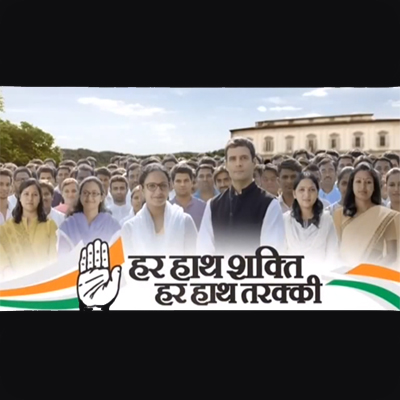
    Har Haath Shakti, Har Haath Tarakki

    Click here to watch the video

    Storyboard: Again in this TVC, a youngster (Shabbir Ahmad, a youth congress supporter) is shown talking about his credence in Rahul Gandhi’s vision that we need to bring a change in our country with RTI, Food Security Bill, Lokpal Bill and Employment guarantee. He supports the vision for future which is to have ‘more equal, more caring society.’

    Purpose:  The ad highlights the need for the society to stand together. It also says that it is under Congress’ guidance/ hand that the whole nation will develop. The ad also highlights how the party has given a common man the power through its various schemes and bills. And this will empower them.

    Congress Ke Mazboot Haath

    Click here to watch the video

    Storyboard: Congress leaders like Sachin Pilot, Nirupam Roy, Jyotiraditya Scindia and many more can be seen sitting and discussing matters which concerns the nation and what can be done to address them. In the background, a song plays which symbolizes these politicians as Congress’ strong hands and it is they who will ensure that India moves forward.

    Purpose: Moving towards a stronger India, Congress soldiers will always ensure people’s betterment and it will continue its efforts to provide a happy and prosperous life for all.

    Bharatiya Janta Party (BJP): campaigns at a glance

    Ab Ki Baar, Modi Sarkar

    Click here to watch the video

    Storyboard: The black and white advert highlights how even though the country has progressed and people have sent there girls for higher education and work in other cities, they are not at ease. The woman/mother in the ad, stresses on the fact that the country isn’t safe in current government’s hands as women aren’t safe.

    Purpose: After the Delhi gang rape case and many more that followed it, the campaign highlights the fact that the government has failed to provide safety to the women of the country and worse, hasn’t been able to punish the culprits.

    I will Choose BJP, My Vote for Modi

    Click here to watch the video

    Storyboard: A cobbler is shown reciting how a party headed by a dynasty has ruled the country for years and has filled its own pockets, while the poor has remained stagnant. He goes on to say that this time he for his self-respect, will choose BJP and vote for Modi.

    Purpose: To showcase how poor have remained poor in the country while the politicians and others have filled their pockets.

    Vote for BJP

    Click here to watch the video

    Storyboard: The animated ad shows an umpire and a cricketer being disturbed by people who want their wishes to be fulfilled. People are shown screaming ‘humari maange poori karo’ while demanding petty things.

    Purpose: These ads were launched during the T20 World Cup, and hence revolves around cricket (umpire and cricketers). The ads take a dig at Congress and Aam Aadmi Party (AAP).

    BJP Anthem

    Click here to watch the video

    Storyboard: The anthem shows BJP prime ministerial candidate Narendra Modi swearing by the motherland that he will not let her get destroyed and everyone will get his/her due. People from different socio-economic backgrounds are shown highlighting their concerns – no jobs, no safety, no economic growth etc.

    Purpose: To bring to focus the scams and other issues concerning the common man to foreground. Through the anthem, the BJP is trying to give out a strong message to the voters, that if Modi comes to power, he will take the country to an upward growth.  

  • Mission 2014: The rise of the political campaign

    Mission 2014: The rise of the political campaign

    While the two-horse race hasn’t disappointed so far, what with all the mudslinging, sloganeering, crowd-pleasing and promising, there seems to be not a marked difference between the election strategies of the main opponents.


    The Congress Party has flagged off its Rs 500 crore advertising and publicity campaign to promote leading light Rahul Gandhi. With a slogan that reads ‘Har haath shakti, har haath tarakki’, the blitzkrieg mirrors the idea of power and progress to each and every person while focusing on the progress made by the nation in the past decade, albeit with the Congress at the helm of affairs. One of the ads even features a young, Muslim party member, Hasiba Amin, urging the youth to join RaGa along with the tagline ‘Kattar Soch Nahi, Yuva Josh’.


    Apart from this, the ruling alliance has initiated a Rs 100 crore Bharat Nirman campaign, which is being handled by ad agency Percept and run from the Information and Broadcasting Ministry’s budget headed by Manish Tewari.


    What’s more, recently, Times Now Editor-in-chief Arnab Goswami grilled the Gandhi scion in his first ever television interview since his political debut in 2004. RaGa answered questions including whether he is a reluctant politician and what are his views on the multiple scams facing UPA 2 but his answers elicited a mixed response where some found him frank and others felt he needed growing up, politically speaking.  


    Not far behind the Congress, the BJP is close to finalising the ad agency to kick-off its Rs 400 crore campaign around prime ministerial candidate Narendra Modi. It is learnt that McCann Worldgroup led by adman-lyricist Prasoon Joshi and WPP agency Contract Advertising are in the fray to grab the hotly-contested account.


    This – after the recent furore over Congress’ initial campaign slogan “Main nahin, hum”, which the party claimed had been lifted from NaMo’s tagline during the 2011 Gujarat Chintan Shivir. So much so, the Congress was forced to drop the tagline even after AICC media head Ajay Maken refuted BJP’s allegations by tweeting a picture featuring the slogan at a mushaira of Congress workers in Indore in 2010.


    So while the Congress and the BJP gear up for battle in the media space, it remains to be seen how much of this will translate into votes for their prime-ministerial hopefuls. Historically speaking, in 2004, the then ruling party, BJP, had run a similar campaign ‘India Shining’ highlighting all its good work but the aam junta wasn’t swayed. One of the main reasons for the failure of the campaign was people’s inability to relate to it.


    Whether things will work out differently this time one can’t really say but it might do well for both parties to take a cue from AAP’s unique strategy.


    Unlike its traditional parties, AAP has largely stuck to communicating through outdoor activation programs and social media while steering clear of mass media campaigns.


    The rookie party won 28 out of 70 seats in the Delhi Assembly Elections and went on to form the government in the national capital sans any campaigning worth writing home about.


    In establishing a door-to-door (person-to-person) connect with the common man in buses, trains, autos, juggis and bastis, the party’s volunteers stayed true to its one agenda – the aam aadmi.


    As Delhi Chief Minister, Arvind Kejriwal’s recent dharna won him (and the party) more brickbats than bouquets as it is unheard for a constitutional head in a democracy to resort to such means. However, it helped AAP become the darling of the masses at no humungous cost, allegations of using the media to advantage notwithstanding.


    Whether the junta will fall for the publicity and hype created by Congress and BJP or will give its nod to the AAP-brand of democracy, is highly debatable. Our only hope is let the best man (party) win!

  • Percept/H rolls out the next phase of Bharat Nirman Campaign

    Percept/H rolls out the next phase of Bharat Nirman Campaign

    MUMBAI: The second phase of the Bharat Nirman Campaign is out and it has been received well by everyone. The ad has been conceptualised by Percept/H.

    These films are produced and filmed by Pradeep Sarkar and his Apocolypso Filmworks team.

    In the first phase of the campaign, the creative agency has created seven TVCs focusing on citizen‘s rights launched last year. This year, the agency is coming up with six TVCs.

    This time, the TV commercials will be focused on the education, secularism, infrastructure, mobile, telephone, government schemes and policies. A thematic film that ties them all together is also part of the mix.

    The campaign will be promoted via television, cinema halls and print. The TV commercials will be focused on the revolutionary schemes that have been launched over the past few years. The team at Percept/H focused on people-driven stories and treated the campaign like they would do a regular brand campaign.

    Percept/H executive creative director Rajiv Agarwal said, “This is a people’s campaign, people’s point-of-view. The idea was to translate the brief/schemes into people stories in a classic storytelling format so that people engaged and identified with the campaign. And why should ‘sarkari work look sarkari?’ The whole idea was to treat it like any other brand campaign, so that when the govt logo appears at the end, it should be a surprise. There’s an insight behind every story. The motive behind these TVCs to make the protagonist and hence the consumer feel empowered.”

    Percept/H VP Kausar Anjum said, “We talked about the difference one could make to one’s life through the proper utilization of these schemes, irrespective of whether its urban or rural India. As always the logistical challenges of executing the TVCs were immense: five TVCs and one overarching TVC, four language masters for each. Making it a total of 24 master films and dubs in seven languages of each film, making it 35 dubs. So at the end their will be 59 films.”

    Percept/H has won the creative duties of Bharat Nirman, the campaign initiated by the central government for the development of rural India in a multi-agency pitch which was held in July 2012.

  • Percept/H wins Bharat Nirman creative biz

    MUMBAI: Percept/H won the creative duties of Bharat Nirman, the set of flagship programmes initiated by the central government for the development of rural India. The win is an outcome of a seven-agency pitch in July that included Dentsu, Grey and Concept.

    Bharat Nirman was launched around six years back. So far, the communication had always projected the schemes as an opportunity to improve and empower the lives of people. The focus this year is to project the change that people have experienced in their lives through these schemes.

    The agency has already started work on the account and has rolled out the first campaign for the client.

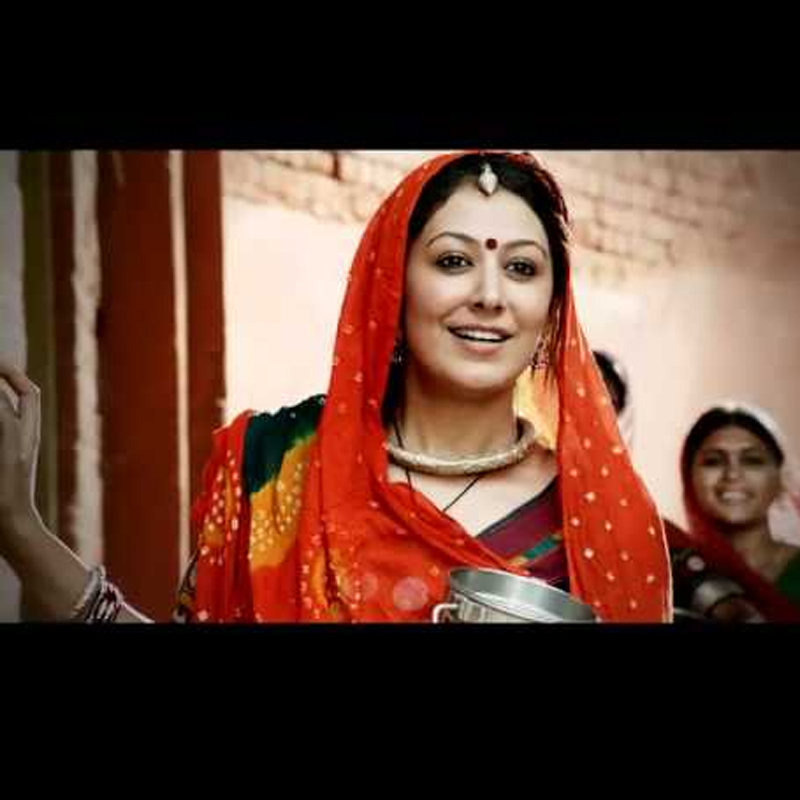
    The agency was asked to project the Bharat Nirman programs as the ‘right‘ or ‘haq‘ of people provided by the central government. In order to communicate this, the agency decided to show the change in people‘s life once they demanded their “haq” and which once they got, empowered them to impact their lives in a positive manner. The idea was to portray the moment of transition from the underdog to a person who knows his or her rights and the feeling of ‘pride‘ associated with the sense of achievement.

    The campaign is being executed through a complete 360 degrees approach with print, TVCs and radio. The logistical challenges of executing the TVCs were immense: 7 programme TVCs and one overarching jingle TVC, 4 language masters for each, making it a total of 32 master films and dubs in 7 languages of each film, making it 56 dubs. In all, a total of mind boggling 88 films.

    The campaign used a jingle “Bharat ke is Nirman pe haq hai mera”. It is directed by Paresh and Naresh Kamath and sung by Kailash Kher and Neha Bhasin. It aims to embody the emotions of people who have taken their rightful “haq” and which everyone should demand. It reflects the pride associated with the positive change that the people of India are empowered to bring about in their lives.

    The campaign includes initiatives in TV, print and radio. The idea was not just about reaching the rural masses in every nook and corner of this country by the width of its media usage and reach through multiple use of TV and radio channels and maximizing newspaper. There was equal focus on the way this campaign has been creatively conceived, designed and produced so as to connect with rural masses, relate to them, impact and involve them.

    The campaign covers the seven programs offered by Bharat Nirman through film, print and radio along with a 90 sec film. The film has been created in a way that covers every region and every language by separately creating an edition for different regions, in different languages, bringing out the authentic and real environment and setting and all the local nuances so as to connect better with local people of any region.

    These films have been extremely sensitively produced and filmed by Pradeep Sircar and his Apocolypso team with Joydeep Sircar directing all the films. The communication initiative by Bharat Nirman and Percept H is unique because no other brand in the social, government or corporate (national or multinational) sector has ever attempted a massive and authentic communication and production.

    Percept/H executive creative director Rajiv Agrawal said, “Till now, over the last few years, the Bharat Nirman campaign has really been from the POV of the Govt., and not from the POV of the people. This is what we corrected. It‘s a people‘s campaign this time around and exhorts them to claim their right. It‘s classic storytelling which attempts to engage the audience in the warm, aggressive campaign. Also, the look-feel is deliberately different, non-sarkaari. I believe that social campaigns should not be any different in look-feel from brand campaigns. The principle remains the same: you are trying to engage your audience by providing them a sound reason-to-believe”.

    Percept H COO (North) Amitava Mitra said, “Bharat Nirman has always been an extremely prestigious project for us since its launch, and this year too, it was a matter of great pride for us to win it. The complexities involved in the execution of the campaign were extremely challenging with multiple programs, languages etc. But at the end of it is a hugely gratifying and satisfying experience.”

  • More than 2 lakh lines per day added to the telecom network

    MUMBAI: The New Year started with the addition of about 6.78 million phones in the number of telecom subscribers during the month of January 2007 – an average daily addition of more than two lakh lines. As a result, the total number of telephones in the country, now has gone up to 196.7 million thereby registering a growth of 3.5%.

    Almost the entire growth registered during the month was in the wireless segment – with GSM contributing 4.99 million and CDMA contributing 1.79 million. With this, the overall teledensity now stands at 17.45%. However, it may be noted that there was a marginal decrease of about five thousand subscribers in the fixed line segment.

    Andhra Pradesh, Maharashtra and Gujarat telecom circles added more than 3.7 lakh each in the GSM segment, followed by the Karnataka circle (3.5 lakh). In the CDMA segment, the total subscriber base registered a growth of 3.9% with a net addition of 1.73 million subscribers. Maharashtra telecom circle contributed the maximum to this addition. Andhra Pradesh and Maharashtra circles added more than 5 lakh subscribers each during the month.

    The growth of broadband connections improved further and at the end of December 2006, about 2.03 million broadband connections were provided and coverage of broadband connectivity by public sector service providers has reached 762 cities. The total number of existing ISP licencees is 385.

    Under Bharat Nirman Programme, out of the 66,822 villages, so far 38795 villages have been provided with Village Public Telephones (VPTs). The remaining 28027 villages are to be covered by November, this year.