Tag: Bharat Khatri

  • 64% Indian streamers are more receptive to ads on streaming platforms than social media: Magnite report

    64% Indian streamers are more receptive to ads on streaming platforms than social media: Magnite report

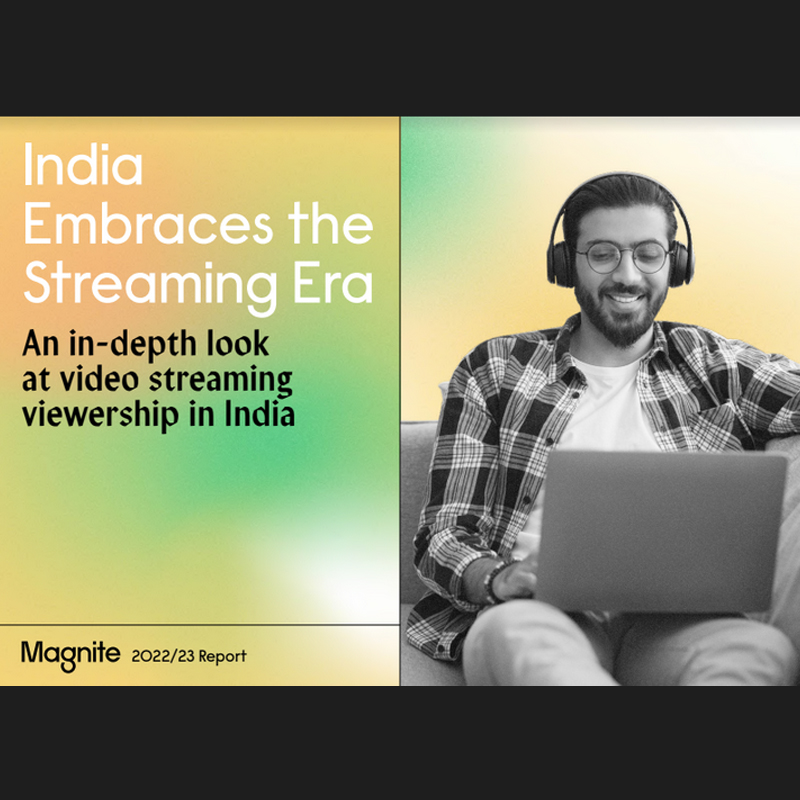
    Mumbai: Magnite, the independent omnichannel sell-side advertising platform, on Tuesday released a study entitled “India Embraces the Streaming Era” that found ads on streaming platforms capture more attention than ads on social media. Nearly two-thirds of India’s streamers (64 per cent) are more responsive to advertising on streaming platforms, with many stating they often search for the product (48 per cent) and make a purchase (33 per cent) after the fact.

    The study also found that free or ad-supported content is preferred to paying for an ad-free experience. 80 per cent of streamers prefer to watch ad-supported content versus subscribing to an ad-free platform for a monthly fee.

    “OTT is unmatched in its ability to engage viewers, and we commissioned this study to better understand consumption patterns across the rapidly growing Indian streaming audience,” said Magnite managing director, Asia Gavin Buxton. “One of the study’s key findings shows that OTT advertising outperforms other mediums like social media when it comes to attention and purchasing power. With three-quarters of video viewers streaming more now than a year ago, advertisers should be actively exploring this channel to reach the right audiences.”

    According to the study, two thirds of streamers prefer to watch streaming services over traditional TV, and streamers rank the quality of content, platform usability, and content discovery as the top factors driving their decision to stream. The majority (75 per cent) of streamers are streaming more video content than a year ago, and 66 per cent expect to stream more next year.

    “We are witnessing the next stage in streaming’s evolution—one where the lines between SVoD, AVoD, and FAST are being blurred as we see audiences continue to fragment,” said Samsung Ads, India senior director Prabhvir Sahmey. Whilst globally we’re seeing the major streaming giants introduce ad-funded and hybrid models, locally we’ve seen the adoption of these freemium models in India gain considerable viewership. It is exciting to see such a promising future for ad-supported streaming confirmed both recently in our TV ad engagement study and validated in this new report from Magnite.”

    “The migration of audiences from linear TV to streaming signals an opportunity for our clients who are looking to invest in CTV and incorporate TV buys into their overall advertising strategies with screen-agnostic planning,” said Omnicom Media Group chief digital officer, APAC Bharat Khatri. “With the breadth of available inventory increasing and the preference for streaming across India according to Magnite’s research findings, advertisers should take note of where viewership is moving and invest in OTT to reach highly engaged viewers watching their favourite shows. At the same time, we are seeing a big shift happening on the measurement front, with viewability amounting to three seconds or half of an ad flashed on rapidly scrolling screens. It’s easy to see a growing gap between the opportunity to be seen and actually being seen, thus the need of the hour is to start optimising based on attention to generate incremental value across creative, media planning, and buying, and in turn improve brand health and performance.”

    Additional key findings from Magnite’s study include:

     ●  Mobile commands the majority of streamers’ time, and 88 per cent of viewers reported a positive viewing experience on smartphones, comparable to the number that reported a positive viewing experience on TV screens.

    ●  Mobile is the top streaming device, but time spent streaming on CTV is growing as smart TVs are introduced into Indian homes. 59 per cent of streamers are now watching CTV and spending an average of eight hours per week streaming content on a big screen.

    ●  Live streaming is becoming mainstream. Nearly all streamers (86 per cent) said they watch live content through streaming platforms, with streaming being particularly prevalent across news, sports, and reality content. Streamers are more likely to watch live programming on streaming platforms than on traditional TV.

    Check the full report here. ( https://www.magnite.com/research/india-streaming-era/).

  • OMG appoints Bharat Khatri as chief digital officer, APAC

    OMG appoints Bharat Khatri as chief digital officer, APAC

    Mumbai: Omnicom Media Group (OMG) has brought on board Bharat Khatri as chief digital officer for its operations across APAC. Khatri will be based in India and report to OMG APAC, chief investment officer, Paul Shepherd.

    In his new role, Khatri will oversee leading digital marketing operations, productisation, commercials, and governance efforts for the network in the region. He will partner with OMG leaders in APAC to accelerate the adoption of integrated digital strategy, with a focus on leveraging technology to drive efficiency and creativity at scale across digital channels, said the company in a statement.

    “Bharat has a stellar track record and his astute business acumen in identifying and converting digital marketing opportunities into unique creative solutions will help unlock value for our clients in this region,” said Shepherd. “Combined with his experience in driving actionable, measurable, and revenue-generating business outcomes, I couldn’t be more excited having him on the team.”

    A strategic digital marketer with more than a decade of experience across digital and sales domains, Khatri was previously with Xaxis India as country head, where he oversaw the agency’s programmatic desk and collaborated with over 150 active advertisers across multiple industries.

    “I am incredibly thrilled & honoured to join Omnicom Media Group at this pivotal time while our industry goes through a massive shift to a more fragmented, privacy-first & precision second eco-system,” said Khatri. “OMG’s strong roots in analytics and a big appetite for innovation are key assets for the next phase of digital transformation, and I feel privileged to be part of this growth and transformation journey in the region.”

  • The challenges and benefits facing martech in India

    The challenges and benefits facing martech in India

    NEW DELHI: Martech sounds like quite a jargonistic word to many. But, put simply, it is the tech stack run by backroom geeks in glasses who use software and web-based services to manage, automate, or execute marketing tasks and processes. Data and analytics lie at the heart of martech, giving companies better customer and market insights, helping them to respond accordingly. 

    Globally, it is a booming business touching Rs 739,200 crore ($121 billion) in 2019, according to a report by advisory and research firm BDO and WARC in conjunction with the University of Bristol. In India, it is coming out of  its infancy  with marketers just about waking up to its utility, though the software development  sector has bitten a sizable piece of the global pie.

    Earlier this year,  WPP group company  Mirum India released its Martech Survey 2020 report, which did not give any indications of the sector’s size and scale, but it revealed that  marketers across India are bullish, with as many as 80 per cent of those surveyed expecting their organisation’s spends on these technologies to increase over the next five years. 

    Xaxis India country lead Bharat Khatri told Indiantelevision.com that there has been a significant rise in the investments that Indian brands and marketers are making in the martech space. “Around one-fourth of the overall marketing pie is being directed towards martech right now and this shift has occurred within the past few years only. Earlier, we were getting a minuscule share in the marketing pie, and it is definitely bound to grow further.” 

    However, according to him, despite growth in adoption, the core challenge for the industry remains that most of the people who are investing in the technologies are not aware of how it is benefiting them. “Around 50 per cent of the marketers today don’t know the exact functions of martech. There is a great need to educate the industry.” 

    Business head of a leading insurance company acknowledges in the Mirum India report that the biggest challenge is that there are too many hands involved in the martech implementation broth, thus leading to delays. “Adding to this is the pressure caused by marketers evaluating solutions only after they identify a specific business need, which leaves them with little time to plan before arriving at a decision,” he adds. He also points out to problems of integrating the martech tools with existing technologies in an organization and the pushback from internal stakeholders towards adopting change. 

    Another issue stifling  the sector’s growth is marketing budgets, which are limited. 
    Khatri explains that martech’s limitation, in the Indian context, is that one cannot instantaneously get to know if the investment being poured into it is worth it.

    “It takes two to three  years to understand the kind of impact the martech tools have had and the ROI. Now, for some marketers, it gets difficult to get the budgets sanctioned, and with a pandemic like Covid-19, when everyone is holding back their budgets, it is creating a big problem,” he says. 

    However, the industry believes that Covid2019 pandemic has certainly opened up newer and exciting opportunities for martech, and it will be wiser for the brands to latch on to it. 

    “COVID2019 has impacted consumer behaviour a lot and accentuated some of the consumer trends too. In the past four months, we have seen how the adoption and usage of online channels have increased,” says Logicserve Digital founder &  CEO Prasad Shejale. “Consumer journeys have changed significantly and have also affected brand loyalty. This is actually a great opportunity, and smart marketers are investing in analytics tools to understand changing customer behaviour.” 

    Adds Khatri:  “What brands are using martech for most is understanding the consumer behaviour and their journeys –  what they like, where and when they shop, etc. This has resulted in marketing being market-driven instead of sales-driven. This has resulted in great demand for technologies like customer data platforms (CDMs), tools for customer relationship management (CRM), and mobile phone data.”

    Shejale agrees: “The most important tools right now are the combination of analytics-insights-CRM/CDP. These tools, along with a focused approach on the consolidation of consumer data to understand them better, are important to provide better service to the consumers across their journeys, whether online or offline. For a smooth and convenient journey across online and offline channels, CRM tools can be very effective. They can also assist in sending the right communication to your audience at the right time through the right channels.” 

    Another interesting trend that is, arguably, impacting the growth of martech in India is global domination in the arena. The Indian industry is currently dotted by a lot of foreign players who have been active in the space for a long time. Khatri suggests that platforms like Salesforce are quite popular. 

    In a e previous episode of the Media Minds  2, Zoo Media & FoxyMoron co-founders Suveer Bajaj and Pratik Gupta had said, “India, by virtue of the fact that we have been a tech hotspot so as to speak, with big boys at Infosys, Wipro  and TCS setting the agenda, is globally acting as a back office for a lot of martech and a lot of adtech companies for generations. It’s funny though, like for example, even if you look at programmatic, we are about 18 months behind and what the rest of the world is.” 

    But Indian players are also catching up fast. 

    “India has a big advantage in making technology in-house and there are a lot of independent firms and also companies like ours who are a part of big global networks investing great time and energy in creating tools and technologies here. For example, last year we launched Xaxis Places, a completely homegrown technology and now 30 plus  markets across the globe are using it,” Khatri shares.

    Adds Zoo Media’s Pratik Gupta:  “We are struggling as an agency to be able to wrap our heads around all of the marketing tech and adtech that exists pretty much out there (but) there are a lot of things that we are doing. For example, there is a marketing technology and ad technology platform that we are building inside of Instagram, which is a landing page solution providing first-party data on e-commerce.” 

    Ambient, C Lab, ROOH, Brandscope director Deepak Kumar, also sheds some light on the in house technologies that the agency is working on. “We created a tool called Star Metrics, which helps identify the geographical heat map indicating where the fanbase of a particular star is and where the consumers of a brand are. If those heat maps match, a darker hotspot is created indicating the perfect fitment of both, ensuring maximum engagement.”

    He also mentions that the team is about to launch another technology to complement this in the coming weeks. 

    According to Khatri,  many independent firms are also getting active in this space. Albeit one problem that these players might face in the coming few months is  the market sentiment that has been created due to the pandemic, but he is sure that this is temporary. 

    Indeed, with the tide now rising for martech in India, it won’t be too long before it washes over many more who have been playing a wait and watch game.  
     

  • What you should know before pressing ‘I Agree’ button

    What you should know before pressing ‘I Agree’ button

    NEW DELHI: 'Data is the new oil' is what we have been hearing for a long time now and observing how the marketing industry is relying on this pool of numbers to guess user behaviour, identify target consumers and customer-centric marketing campaigns. One mode of reaching out to prospective customers has been the use of programmatic advertising, using buying and selling of data using artificial intelligence.

    While this gives the marketers and advertisers great power in hand to grow their business, it also raises pertinent questions about the pressing topic of consumer data protection, too.

    In a virtual press meet, organised by Xaxis India, country head Bharat Khatri addressed the issue. While there are options for the consumers to protect their data and limit access they give to the apps and browsers, the lag remains in making them aware about these choices.

    “To give you a quick example, you can use the settings option on your android device to opt-out of ad personalisation, which means stop sharing your advertising ID with any of the apps, or on a music streaming platform like Spotify, you can see and monitor all the data you are sharing with them,” Khatri said.

    He added, “Yes, in a country like India, there is a lot that can be done to make the consumers aware of these options. There needs to be education around this.”

    In a separate telephonic conversation with Indiantelevision.com, IdeateLabs MD Amit Tripathi also stated that data privacy is a big issue as digital grows. “Data is not very safe online. With every “I Agree” button you click, you are sharing lots of personal information with the platform. It makes sense from a business perspective, as to provide you with free services, they will have to get the advertisers’ money coming in.”

    While all these digital platforms, the apps or browsers, give the users the option to opt-out of data sharing, limiting access to personal information, etc., is a cumbersome procedure. People need to be educated about this.

    “I think there is a vast opportunity for entrepreneurs to work in this field and I believe that in future, not so distant, we will have actual training for how to protect your data online, or how to deal with cyber bullying. There are a lot of progressive schools that are already teaching the latter, and I think, in future, it is going to be even more rampant,” Tripathi commented.

    He continued that only drafting policies might not be a solution as in a big country like India, it will take some time to get it implemented. “For example, even for setting a cybercrime cell, you need trained manpower, hackers to compete with hackers, people who understand data; and this force can’t be created overnight. We obviously will need to train people and set up a system.”