Tag: BBC Global News

  • India will shape mobile innovation: Ajit Mohan

    India will shape mobile innovation: Ajit Mohan

    MUMBAI: The digital consumer is on his way to become the king of media and entertainment. It is he who will dictate future content trends, platform specifics and most importantly revenue flows. How can the vast media and entertainment ecosystem channelise its vision towards a sustainable revenue system reaping off the all encompassing digital landscape – overhauling payment gateways, broadband speed and consumer sensitisation?


    Seeking answers to these questions, a panel discussion was held in FICCI Frames 2015 moderated by BBC Global News presenter Matthew Amroliwala. The panel comprised Star India digital head Ajit Mohan, Yahoo India MD Gurmit Singh, UCWeb India MD Kenny Ye and Airtel global voice and data business CEO and director Srinivasan Gopalan.


    The digital platform is yet to have a concrete revenue model and most of the content available now is free content. Mohan said, “India is going to shape innovation in mobile and not the United States and hence we need to have our own model and cannot refer to any other. My observation is that consumers are underserved and they are absolutely ready for real and fresh content in the VOD platform. It is a mass market and quality content will find recognition and appreciation.”


    Yahoo’s Singh added, “Yahoo is a 20 years old company that has seen technological evolution. Every 10 years, we have a new technology, which shapes the processing and the same will happen when 4G and 5G comes in. All the existing devices will talk to each other, complement each other and advertisers will have a choice of platform. The advantage of digital is that proper analysis can be done, which makes reaching the target audience easy and accurate. This will also ensure higher returns.”


    Talking about the Indian circumstances, UCWeb India’s Ye said, “The government of India launched a digital India campaign, which is highly encouraging and mobile will play a very important role in making India digital. The revenue model is yet to be figured out and a lot of that will be decided by development in infrastructure in the near future. Better online payment infrastructure and more credit and debit card holders will make the revenue model easier.”


    The online ventures need communications and carriers to carry the signal from provider to consumer. Airtel’s Gopalan asserted, “About 93 per cent of internet usage is in mobile and it’s high time that content makers and service providers collaborate in order to make things more efficient and revenue generating. We should bundle content and put it in a package for the consumers. And data is not expensive in India and it’s mobile data, which is expensive and there are different reasons behind it.”


    Star India’s digital platform Hotstar was free and it got a lot of encouragement in terms of viewership. Commenting on the success of the venture, Mohan said, “Hotstar is not free. The content needs data and the consumers are paying premium rates to see content and hence the myth is baseless.”


    It remains to be seen what revenue model the digital platforms accept and if the formula of content is king is followed.

  • Indian pubcaster needs to re-invent in era of digital advancement

    Indian pubcaster needs to re-invent in era of digital advancement

    MUMBAI: While the general consensus on the role of a public service broadcaster (pubcaster) is that it provides not much “newsy” content, the BBC definitely remains a role model, even for private news channels.


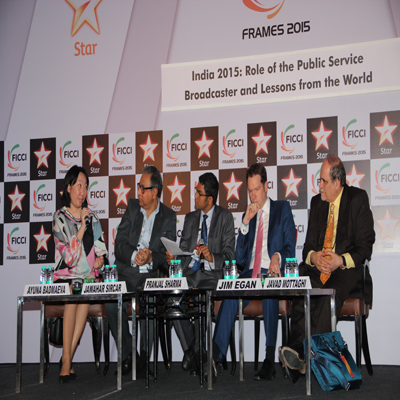
    This was the underlying theme that was discussed on a panel discussion titled ‘India 2015: Role of the Public Service Broadcaster and Lessons from the World’ at FICCI Frames 2015.


    The panel comprised Prasar Bharati CEO Jawhar Sircar, BBC Global News CEO Jim Egan, ABU secretary general Javad Mottaghi and VGTRK Digital Television Russia deputy CEO Ayuna Badmaeva. The session was moderated by Zee Network’s The Appointment host and FICCI advisor Pranjal Sharma.


    The session began with Sircar speaking on the role of Prasar Bharati in the country so far. According to him, the pubcaster had been able to streamline the entire country’s emotional unity together in a multi culture nation. It also played the heritage aspect role as it broadcast mythological shows like the Ramayana. “Show me a single broadcaster, who covers every island of the country across its geographical spectrum. India’s cultural unity was achieved because of a public service broadcaster,” he emphasised.


    Elaborating on how her network functions in Russia and on its role, Badmaeva informed that the network had 18 brands under its umbrella. “We started in 2009 with a factual entertainment channel. We work across Russia and our role is to fill the gap where other networks do not cover its citizens,” she said.


    Egan added, “What is most important for a public service broadcaster is to make the good popular and make the popular good. It is very important that a pubcaster reaches out to every citizen.”


    Posing a question, Sharma asked whether the government should decide what’s good for the public? Mottaghi replied saying that the first word “public” of Public Service Broadcaster referred to all groups of society. Hence its duty was to serve the public. “It has to be public oriented content versus commercial oriented content. We talk about issues such as health, culture, education and what society needs, which is not so much part of commercial news channels,” he opined.


    On being questioned by Sharma as to how Doordarshan ensures that it gets viewers to watch its content, Sircar conceded the fact that DD’s content was definitely not at par as compared to what the BBC was known for world over.


    For Sircar, the issue was related to both creativity and funding. “If the BBC could use 75 per cent of its funding on content, India could use only 10 per cent,” he said.


    Throwing an insightful statistic, which governed the theme of the discussion that followed, Sircar said, “While internationally, double digits dollars were spent per person for creating content. However, in India only 40 cents per person is spent on creating content. If you spend 40 cents, you get content worth 40 cents too.”


    Badmaeva then spoke on how the pubcaster tried remaining relevant in Russia in the ever-evolving digital age. She said, “While linear TV ratings are going down, people consumed content via smartphones and tablets. People also bought their content from cable operators. For us, our network is driven by both profit and reach.” She went on to add the Russian pubcaster has in recent time produced a documentary, which delivered the same rating as the Winter Olympics.


    Egan informed on how the BCC stayed relevant in a dynamic media space. “Every household is driven by a $20 subscription. The idea is about universality. While a part of it to remain relevant is about content, it is also about access, technology and reach. We innovate based on demand. In the digital age, it is how audiences engages with the content,” he said. He then added that around 270 million of the BBC’s audiences was out of the United Kingdom.


    Speaking on the now banned documentary India’s Daughter, which was a joint co-production between various production houses and the BBC, Egan said, “It had the highest values of journalism and the challenge is to avoid being ghettotised as just a pubcaster.”


    Sircar added that DD Sahayadri too had much of its content produced by private production houses. “Own it, don’t stone it,” he said. He also mentioned that when the pubcaster decided to air the Aamir Khan-helmed show Satyamev Jayate, he was questioned by ministers if a show where people washed their dirty linen in public was good for the channel. Sircar was of the opinion that because the show touched public issues, the pubcaster should air it.


    Touching upon the case of Star Sports, which went to court over the pubcaster airing the ICC Cricket World Cup, Sircar said that the pubcaster just followed a court order, which stated that in addition to profit making, the people of India are to be allowed to watch games via cable through terrestrial means. “Because of a very small cartel, which has a few channels, it will lead to monopolising of sports events,” he highlighted.


    Sircar informed that his goal was now focussed on two things. Firstly, increasing the number of channels on Free Dish from the current 50 to 112 and secondly, to use DD’s 1400 transmitters to create FM bands. “If FM has to reach mobiles, smaller circles of 50 kilometers will be created,” he said.


    He went on to add that a process was underway where 15 out of 20 channels could be auctioned. However, he refused to share details.


    Touching upon Sircar’s “40 cent” remark, Egan concluded the session saying, “In a country like India with a large population, 40 cents could add up to $500 million a year. It is a question about a national strategic choice. In some countries a pubcaster would weep tears of joy with this amount of money.”

  • FICCI Frames: The roadmap for success in broadcasting

    FICCI Frames: The roadmap for success in broadcasting

    MUMBAI: In its three decades of existence, the promising broadcast narrative in India continues to be challenged on issues such as transparency, pricing, taxation, consumer choice and lack of a coherent regulatory and policy framework.


    To find a solution to these and similar questions, a panel anchored by media analyst, author and columnist Vanita Kohli Khandekar highlighted a session on the Future of Vision 2020 – laying a transformative roadmap for Indian broadcasting. The panelists stressed issues for unlocking value in Indian broadcasting on the first day of the FICCI Frames convention held on 25 March in Mumbai.


    Speakers who shared their opinion and views were I&B Ministry additional secretary JS Mathur, TRAI principal advisor SK Gupta, BBC Global News CEO Jim Egan, Siti Cable CEO VD Wadhwa, Star India COO Sanjay Gupta, Tata Sky CEO Harit Nagpal, Viacom 18 Group CEO Sudhanshu Vats and Discovery Networks Asia-Pacific south Asia and southeast Asia GM and executive VP Rahul Johri.


    According to Wadhwa, in order for the media and entertainment sector to grow, digitisation should be completed. “Digitisation must be completed and that will bring in transparency. Secondly, we need to work together to see how can we monetise the business far better.”


    It may be recalled that in phase I and II of digitisation, average revenue per user (ARPU) had witnessed a significant jump in places where people were consuming cable broadband. In response to that, Nagpal said, “We can either have monopolies or regulations but one has regulation where there are monopolies. I believe that I am digging my own grave if I am not serving my customers and as a regulator, we need to make sure that he is getting adequate infrastructure to do his job well.”


    Sharing his views on the media and entertainment sector, Star’s Gupta said that today the industry size is close to Rs 30,000 crore and the big challenge going forward will be on how to make it a Rs 300,000 crore industry. Gupta opined that the one fundamental issue that plagues the industry is that they have regulated the industry from a wrong perspective. “You need to get the capital to invest high, while creating innovation for consumers. That’s how industries have grown. However, that is the challenge for the M&E industry.”


    When on the one hand broadcasters believe that regulation is not required, on the other hand TRAI’s Gupta had a different opinion. “If regulation is not required then what is required? Is it that we are required to keep quiet on the customer front if they are not getting any choice?” he questioned.


    He went on to add that the country has 30 million DTH customers, 30 million DAS customers and 10 million addressable systems. However, the question was how many consumers have the choice of individual channels? “If I ask a consumer if he/she is watching all the channels given to them, the answer will be a big no. Therefore the price can be deregulated and total selection of the channel should be given to the consumer at the desired price. And for this to happen certain broad guidelines should be created and this should be done soon.”


    Picking up points from Sanjay and S K Gupta, Vats said that in order to drive the size of the pie, pricing is the difficult thing. “If we focus on the price of the analogue cable, in some way, we are constraining the ‘X’ to increase and my request is that if we become open to it, we will allow the ‘Y’ to increase. The moment we allow the ‘Y’ to increase, I think we will define the problem collectively better between LMOs, MSOs, broadcasters etc.”


    Vats was of the view that competition needs to be encouraged, even though there is enough competition in the media and entertainment industry. “Competition itself will ensure that we are reaching out to every possible Indian, outside India as well. It happens in every industry, why has it not happened here?”  A firm believer of  a free market, Vats is confident that it will drive the industry and take it to the next level.

  • FICCI FRAMES: Prasar Bharati CEO Jawhar Sircar to speak on pubcaster & revenue

    FICCI FRAMES: Prasar Bharati CEO Jawhar Sircar to speak on pubcaster & revenue

    NEW DELHI: Prasar Bharati chief executive officer Jawhar Sircar will be addressing the annual FICCI FRAMES convention commencing in Mumbai on how a public broadcaster can still earn revenue.


    Sircar’s talk is on “India 2015: Role of the Public Service Broadcaster and Lessons from the World.”


    The three day convention from 25 – 27 March will extensively cover discussions on various issues related to the media sector centred around the theme – how to make India a Global Entertainment Superpower.


    Sircar said, “There is no nation in the world that does not have a decent public broadcaster and some of them like BBC or NHK Japan or the Korean Broadcasting System are legends, mainly because their nations, people and their governments wanted them to be so and help them succeed. India cannot be an exception as it is the only public broadcaster, which operates from the icy peaks of Kargil to our lonely borders in Arunachal, right down to Andaman and every possible corner of India: without ever looking at short-term commercial gains.”


    This panel discussion is scheduled on the second day of the entertainment and media conclave and will be moderated by business journalist Pranjal Sharma featuring BBC Global News CEO Jim Egan and Russia’s largest media corporation and public broadcaster – VGTRK deputy CEO Ayuna Badmaeva.


    The other key participant is Asia Pacific Broadcasting Union (ABU) secretary general Javad Mottaghi, who is a special invitee at FICCI FRAMES 2015.


    FICCI secretary general Dr A Didar Singh said, “The discussion would provide greater clarity on how to maximise the efforts of public service broadcasting, and also how institutions like Prasar Bharati can balance their programming mandate with effective revenue generation, and remain relevant in the digital era.”


    The session will explore the relevance, importance and space for Public Service Broadcasting in today’s ‘always connected’ world which offers a multitude of choices by way of content, delivery platforms and engagement channels.


  • BBC Global News appoints Naveen Jhunjhunwala as India COO

    BBC Global News appoints Naveen Jhunjhunwala as India COO

    MUMBAI: Last month, indiantelevision.com broke the news that BBC Global News India COO Preet Dhupar had decided to move out of her 14 year stint with the company. Now, the global broadcaster has found a person to fill the space in Naveen Jhunjhunwala.


    Jhunjhunwala was previously with Turner International India for 15 years as vice president for corporate finance and administration, looking after the financial functions for distribution, ad sales and marketing of CNN International, Cartoon Network, POGO and HBO in India, Pakistan, Sri Lanka, Maldives, Bangladesh, Nepal and Bhutan.


    Speaking on his new role Jhunjhunwala said, “I am delighted to be joining the BBC. I am looking forward to taking up my new role and to being part of the talented team at one of the world’s most renowned news operations. The BBC is an iconic brand and carries a special position for the Indian audience and in today’s dynamic market place, with digitisation, growing online penetration and the BBC’s special focus on India, it has exceptional potential for growth in both television and online space.”


    At Turner, he helped launch the company’s India operatons including the CN subscription business, launch of new channels like HBO, POGO and WB. He also helped set up the Zee Turner distribution JV, including MediaPro as well as CNN-IBN. Prior to Turner, he was with Ernst & Young in New Delhi.


    The role of COO for India was created last year to better organise the company’s business operations in a growing Indian market. Apart from looking at finance, Jhunjhunwala will also be responsible for determining BBC’s commercial priorities and targets for news across the country as well as ad revenue, content distribution and audience growth.


    “I’m pleased to welcome Naveen on board at such an exciting time for the BBC’s news interests in India.  Naveen brings with him a wealth of experience and will be a real asset to the BBC, building on the successful work to date of our teams in Delhi and Mumbai,” said BBC Global News CEO Jim Egan.


    “India is a country we are proud to have been broadcasting to and from for more than seven decades and we remain committed to our audiences here. We have featured India in two dedicated programming seasons on BBC World News already this year, have recently launched a new Indian edition of bbc.com/mobile and are mid-way through our most comprehensive coverage ever of the Indian general election. I am sure Naveen will be invaluable as we work to develop even further in this exciting and dynamic market,” he added.


    Naveen will take up his position in Delhi on 1 May. He replaces Preet Dhupar who left the organisation earlier this month.

  • Preet Dhupar to quit BBC Global News

    Preet Dhupar to quit BBC Global News

    MUMBAI: With elections just around the corner and one of the world’s renowned news channels BBC Global News promising to provide in depth news regarding India during the elections, comes a news that BBC Global News chief operating officer for India Preet Dhupar has decided to quit the organisation.


    Confirming the news to indiantelevision.com, Dhupar says, “Yes I have decided to leave but I’m around in BBC for some time.”


    BBC too has confirmed the news and revealed that the management is currently looking for a suitable replacement for Dhupar.


    Dhupar has been associated with BBC for 14 years. She joined the channel in 2000 as director of finance and operations and was elevated to COO in 2013.

  • BBC World News appoints Jonah Fisher as first ever Myanmar correspondent

    BBC World News appoints Jonah Fisher as first ever Myanmar correspondent

    MUMBAI: It was in December 2013 that BBC News had got permission from the Ministry of Information of Myanmar (Burma) to open up a bureau in the country. Now, as the new year has arrived, the channel has appointed its first ever correspondent in the country – Jonah Fisher.


    Fisher has been with BBC News for the last 10 years and has covered events for the channel in places like Eritrea, Sudan, London, South Africa, Nigeria and most recently Thailand. He will be reporting for television, radio as well as the network’s online platforms.


    Speaking on his appointment BBC Global News director Peter Horrocks said: “The appointment of Jonah Fisher marks another important milestone in the rapid welcome changes taking place in Burma/Myanmar. Censorship and repression are being replaced with a new media environment where the BBC can freely broadcast trusted and impartial news. The BBC’s charity BBC Media Action will continue its work to help train the next generation of Burma/Myanmar journalists which will further contribute to the country’s transition towards media freedom. These investments are part of our commitment to our audiences in Burma/Myanmar and we look forward to covering the historic elections in 2015. ” BBC Media Action and the BBC Burmese Service already have a presence in Myanmar.


    Fisher has reported on issues involving Burma’s Rohingya Muslim community’s fights with the Buddhist monks amongst several other ones.


    Burma has always been a highly censored country and it was only in 2012 that the country announced its decision to stop censoring content before publication leading to several private publications commencing operations. 

  • “There’s a lot of mileage in pay TV news”:BBC GLOBAL NEWS CEO JIM EGAN

    “There’s a lot of mileage in pay TV news”:BBC GLOBAL NEWS CEO JIM EGAN

    As the country sheds tears over  onion prices, cringes about the skyrocketing cost of LPG, cribs for a better system in place for tackling the ever-growing crime incidents and hopes for the 2014 general elections to change things, the news channels are gearing up to catch all the action live. 

    And when all the international and domestic news channels are at it, why should the Beeb – the world’s biggest pubcaster that reaches over 360 million households globally; 12 per cent of which are from India – miss a chance to report on the political battle of the world’s so-called largest democracy? 

    BBC Global News CEO Jim Egan, who was in Mumbai to launch its India Direct series, reveals that the channel is looking at grabbing more eyeballs during the election season. The channel plans to scale up the coverage on India in the coming months. 

    And he gave some time to Indiantelevision.com’s Vishaka Chakrapani on the sidelines of the launch, to talk about the BBC World News’ India gameplan, its global digital push wherein it aims to melt the barriers between broadcast and online news. Egan emphasised that India is an important market for BBC in terms of pay TV and digital advertising.

    Excerpts from the interview:

    What is the benefit of investing in the news business in India?

    When I say investment I’m not talking about corporate investment, it’s about editorial investment. It’s been a good year for us in India. Digitisation has been broadly good for us and we are seeing our household penetration increase. 

    What is the growth in reach that you have experienced due to digitisation?

    It has grown steadily in single digit millions and has reached 30 million now, which means one in four homes. Digitisation is moving at a different pace in different parts of India. We would like to be bigger but we are addressing a relatively niche population in the English language and thus we are never going to be a mainstream news channel in the country. 

    With so many international channels making a mark in India, how will BBC World News differentiate itself and stay on top?

    We are looking at doing product and editorial investments to the extent we can afford it. Other operators are well resourced such as CCTV in China is well financed, so is Al Jazeera. If we are going to get into a spending arms race, BBC won’t be able to get there. We will capitalise on our reputation and emphasise on being different. Being successful is not about spending a lot as some qualities cannot just be bought.

    Why has the industry been hit with a bout of layoffs happening across the world?

    The last five to 10 years have been very difficult for journalism. It’s coming to terms with internet and digitisation. In  print, it has been a very difficult time, but not so much in India. A lot of broadcast journalism has been buffeted by the internet, particularly in international news. You see lots of retrenchment and people closing bureaus. BBC is slightly different because we have both public and commercial funding that has helped us expand and maintain ourselves. We are swimming against the tide but we are doing it deliberately because we think having a well funded and well resourced international network of correspondents is what success is about.  

    What about the entry of many international news channels in the market? Could that also be a reason that’s leading to increased competition?

    There’s been a bit of fragmentation but I don’t see demand for news going down. Demand for news is going in different directions. But as long as you are prepared from the editorial and corporate points, there’s good business to be made. It’s just at slightly different places these days.  


    We would like to be bigger but we are addressing a relatively niche population in the English language and thus we are never going to be a mainstream news channel in the country…

    In the future, would having multilingual skills be an important criteria for journalists?

    That’s an interesting one. I don’t think we would hire someone just because they can speak many languages but the ability to broadcast and write digital content in those languages is something we are seeking to develop and nurture. We are going to have a dedicated Asian edition of our website with front page stories about India and China. There will be global programmes to improve the profile and output of bilingual journalists such as the ones in India. We are producing more relevant and easier to find content for our websites.  

    How important is India on a global scale for BBC World News?

    India has been and will be important for us. There is huge digital consumption that is growing in the mobile sector here. India is the fourth biggest market in terms of traffic, the first three being the US, Australia and Canada in that order. We need a big English speaking market to do well for us, and I’m leaving the UK out of this. One thing particularly exciting about India is that in the other markets digital penetration is nearing saturation point but in India there is a lot of room for growth in the mobile sector.

    In the recent years, the budget of BBC has been cut by 20 per cent. Does that affect the investment?

    The 20 per cent cut is due to TV licence fee being frozen for a period of five years, taking inflation into account. Internationally, we are funded through advertisements while domestically we are run by public money which is an involuntary payment of about $200 a year. We have the challenge and the freedom to earn commercial revenues.  

    Original content on mobile is what people seem to be asking for. Is that something you are looking to cash on?

    We are not doing that in mobile because on this platform the key for us is about following news from screen to screen. It’s about trying to make news consumption something that people can take with them with their screens and stay up to date on their mobile phones. That’s the editorial idea. The product idea is to get more video content on mobile. One line growing more steeply than mobile is ‘video on mobile’ as people’s devices become better, internet packs get cheaper and network availability becomes more reliable.  From the commercial point of view, it is working with the advertising community for digital. 

    How big is mobile advertising given that mobile marketing forms a relatively small part of the marketing budgets in India?

    I don’t think mobile marketing in India is necessarily small compared to other countries. In most countries, mobile advertising has lagged behind mobile consumption of media. That’s another area where you are seeing rapid change and the amount of money we are generating from mobile globally has come a long way in the last four months. India is one of the biggest growth markets for mobile apart from sub Saharan Africa where mobile device consumption is also increasing.  

    Do you see threat from OTT in the country?

    When I’m in India I haven’t till date heard people worrying about OTT. TV adoption is still growing as well as pay TV penetration, although not so drastically. Too many people have written of TV news as something people want to consume and as well as pay for. But I think there’s quite a lot of mileage left in pay TV news.  

    How do you deal with carriage fees in the country?

    I’m glad to say we don’t pay for carriage but we rather earn from it. I wouldn’t say we haven’t had a problem with it but it’s been a business policy. We don’t think we should have to pay people to carry us. We are very proud of the quality of BBC World News. Our business policy is often questioned.

     When do we get to see BBC HD TV in India?

    One of the new features of the new office in London is its native HD transmission from glass to glass, ie camera to screen. In a number of markets in Asia we are introducing BBC World News in HD. We would love to launch in HD here but we don’t have any active discussions underway. The markets in the world where we are present in HD, like Singapore, have given us good feedback and we believe HD would be a good value addition to our distributors.


    We will capitalise on our reputation and emphasise on being different. Being successful is not about spending a lot as some qualities cannot just be bought…

     Looking at a possibility if FDI norms are eased in India, do you see a Hindi news channel from BBC?

    I don’t think we will set up a corporate vehicle here to be honest. We have a Hindi show called Global India on ETV so it is a content supply set of arrangement. We’d like to be bigger in Hindi and other languages but I don’t see us making a corporate investment in the Hindi news business.

    Do you see the possibility of a JV in India?

    We were examining a possibility of doing a JV in the Hindi language but it didn’t work out due to issues such as FDI regulations and MIB stipulation around editorial. The concept of editorial content is very hard to share.

    There is also a financial reason. We are not in a position to make capital investment into a JV that will be successful and have an impact in one of the world’s highly contested news landscape. We are never going to be better at covering Indian news than the Indian news providers themselves.

    We will cover Indian news to show them globally but not try to outdo the local competition. That is something that you cannot do because it is an extremely dangerous and expensive game. 

    Will we see BBC World News going regional?

    We always talk about relevance more than presence. Although we won’t be a part of the Indian domestic news landscape, we want to be relevant to audiences here. There are financial limitations to such a prospect too. We can’t tailor everything for 100 different markets around the world. So, instead we always think from our broadcast centres as to where is the peak audience at that point of time that will view the channel. 

    How many Indian advertisers do you have and how have they been doing lately?

    We have about 10-20 advertisers from India such as Karnataka tourism, Bharati Airtel, Micromax and airlines who want to reach an international audience through TV as well as online. Our Europe market was hit badly due to recession but Asia stayed better. However, this year has seen a slowdown from our Indian advertisers.

  • BBC World News eyes general election with India Direct

    BBC World News eyes general election with India Direct

    MUMBAI: With election process on in some of the Indian states, the domestic news channels have already got enough in their plates to report on. Now, with the general election on the anvil, while the channels in the home turf are all ready to report on it, it seems global giant BBC World News also doesn’t want to miss the big event. With a new series, India Direct, it is also looking to make the best of the opportunity.


    BBC Global News CEO Jim Egan launched the series on Tuesday in Mumbai. He says the series will be a mix of hardcore news and features with Indian emphasis on their regular bulletins. “India Direct will be showcased at a time when the attention is likely to be on India more so because of the general elections,” says Egan.


    The series that is slated to go on air from 8 February 2014 and will go on for two weeks will have a slew of election special programmes.


    Other shows in the series would include Working Lives that will showcase the diverse culture of Gujarat, its people and and the economic spectrum of the state. One Square Mile will highlight the game of football in Pune FC. Talking Movies will bring to the fore the culture and art of the country, especially regional movies. Fast: Track will be a travel news show displaying various places like Mumbai, Goa, Ahmedabad, Karnataka etc.


    “The shows are for our global audiences and not just our audiences in India,” emphasises Egan.


    Egan feels that although globalisation is a modern trend, BBC has been on the mission of bringing latest events that are impartial and independent from across the world since almost 90 years.  It is also looking at multimedia very seriously.


    BBC has done similar series earlier as well with a focus on countries like Singapore, Vietnam, Mozambique, Croatia, Canada, Georgia, Ecuador and Qatar.

  • BBC signs partnership with Twitter Amplify

    BBC signs partnership with Twitter Amplify

    MUMBAI: BBC Global News has announced a new partnership with Twitter Amplify, the social broadcast network service’s innovative video promotion tool.


    This is the first Twitter Amplify partnership with a global news broadcaster. Commenting on the same, BBC global news director of digital & technology James Montgomery said, “This new collaboration harnesses our global reach and newsgathering capabilities to bring our advertising partners clever and impressive products. Building on the efforts of BBC America’s partnership with Twitter, we’re thrilled to bring our ad partners with us at the cutting edge of news.”


    BBC Global News will provide the global Twitter community timely in-tweet video clips that complement its global newsgathering operation. This partnership offers BBC Global News and its future brand partners an integrated cross-platform tool to reach new audiences on Twitter. BBC Global News operates BBC World Service radio, BBC World News television, and bbc.com/news outside the UK.


    “What makes this partnership exciting is the amazing content Twitter users will get from BBC Global News, no matter where they are in the world,” said Twitter Amplify senior director Glenn Brown. “We look forward to working with BBC Global News to bring these programmes to market.”


    BBC.com has already begun production of a new in-Tweet broadcast, #BBCTrending, a new series of innovative short form video broadcasts that will be presented by Anne-Marie Tomchak (@AMTomchak) and will launch later this fall. The broadcast will give users the inside story behind the latest trending phenomena on social media that day. #BBCTrending is distributed to the 4.8 million followers of the BBC international news Twitter handle, @BBCWorld, and will be enhanced by Twitter Amplify.


    #BBC Trending will incorporate three key elements:


    1. The BBC’s international social media reach and 24-hour video production operation
    2. The BBC’s global newsgathering and monitoring operations, which provide both round the clock news reporting and monitoring of global TV, radio, press, internet and news agency sources, and
    3. Twitter Amplify’s innovative real-time video promotion tool.


    “Being a part of this new project is thrilling,” said Tomchak. As the face of #BBCTrending, Tomchak will be working with production units across the BBC to identify and build compelling conversations on what’s trending around the world. “On Trending, we’re tapping the most powerful internal insight tools and the massive BBC international newsgathering and language operations to decipher why and how trends are happening on social media around the world.”


    In April, BBC America signed a similar deal with Twitter Amplify to offer the first in-Tweet branded video synced to hit series, including Top Gear.