Tag: BARC

  • BARC week 26: Dangal TV retains leadership position in Hindi GEC

    BARC week 26: Dangal TV retains leadership position in Hindi GEC

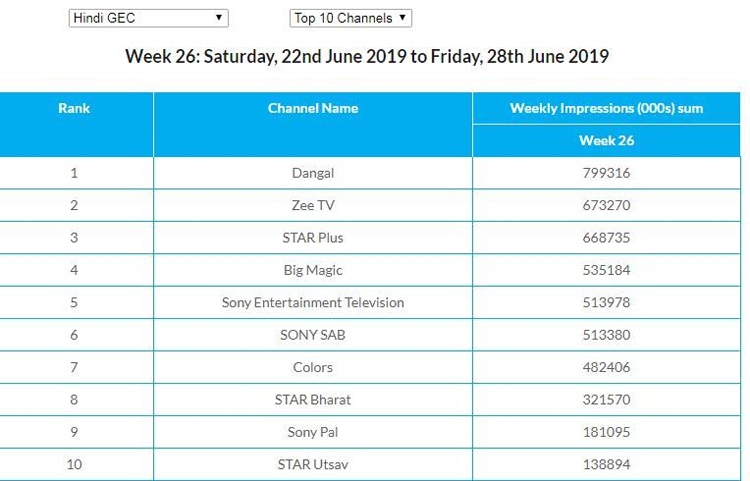
    MUMBAI: There has been no major change in Broadcast Audience Research Council India (BARC) data for week 26 of 2019. While &TV emerged as the new player in the space of Hindi Urban GEC in week 25.

    Hindi GEC (U+R)

    Dangal TV retained its first position this week and Zee TV and Star Plus stood at second and third positions respectively. Sony Entertainment Television has moved up the ladder to fifth position replacing Sony Sab while Colors also came down to seventh position. Star Utsav has come back to the chart at 10th position replacing &TV.

    Hindi rural GEC

    In rural areas, Dangal TV, Big Magic, Zee TV and Star Plus continued to be in first, second, third and fourth positions respectively. Colors, Sony Sab, Sony Entertainment Television, Star Bharat, Sony Pal and Star Utsav also retained earlier positions.

    Hindi urban GEC

    In urban areas, Star Plus retained its leadership position and Zee TV its second position. Sony Entertainment Television emerged in the third position replacing SONY SAB. Colors, Star Bharat, Dangal, Big Magic, &TV and Sony Pal retained their fifth, sixth, seventh, eighth, ninth and tenth positions respectively as compared to the last week.

  • GST cut on advertising & smartphones, focus on AI are M&E industry’s expectations from Union Budget 2019

    GST cut on advertising & smartphones, focus on AI are M&E industry’s expectations from Union Budget 2019

    MUMBAI: The interim budget of 2019 bolstered the preface of a ‘Digital India 2030’ with measures to aid the spread of digital technologies in India, getting positive responses from the industry insiders. With the budget announcement for the year today, the industry is now expecting the Modi government to extend the focus on these technologies and a reduction in the tax slab on electronic products to accomplish the digital-first mission efficiently.

    The ad world is expecting a tax cut on ad spends. Madison World executive director Lara Balsara Vajifdar is expectant of a boost to the economy. “Many sectors of the industry are reporting a slowdown, which is not good for the industry in particular and India in general. Hope the budget proposes active proposals to boost the economy. Whilst sops for the weaker sections are necessary, the only long term and sustainable solution is to have a fast-growing economy,” she said.

    Havas Group India CEO Rana Barua says, “Like all industries the media and entertainment industry is also looking forward to some key announcements that will give it a boost this year, like reduction of GST across mediums. An added focus on schemes to increase digital penetration in India (IT infrastructure improvement, fibre optic cable deployment, so that the last mile village also gets digitally connected). Special incentives for certain categories like automobiles, which are huge advertisers but have been seeing a slowdown for the last many months would also help boost these categories.”

    Dentsu Aegis Network CEO greater south and chairman & CEO India Ashish Bhasin wants the new budget to be growth-oriented, which can put more money in the pockets of the rural and urban consumers to propel spending. “Advertising is a very sentiment-driven business in India. Anything that drives GDP growth drives advertising growth even more. In fact, the rule of thumb is that for every 10 per cent growth in GDP, advertising grows by 1.5 per cent.”

    He adds, “Further, there is an urgent need for tax reforms. Direct tax rates for both corporate and individuals need to be brought down noticeably and immediately. GST on advertising at 18 per cent is just too high. It needs to be rationalised at 12 per cent and the process and procedures need to be simplified as they are cumbersome, unproductive and wasting a lot of time.”

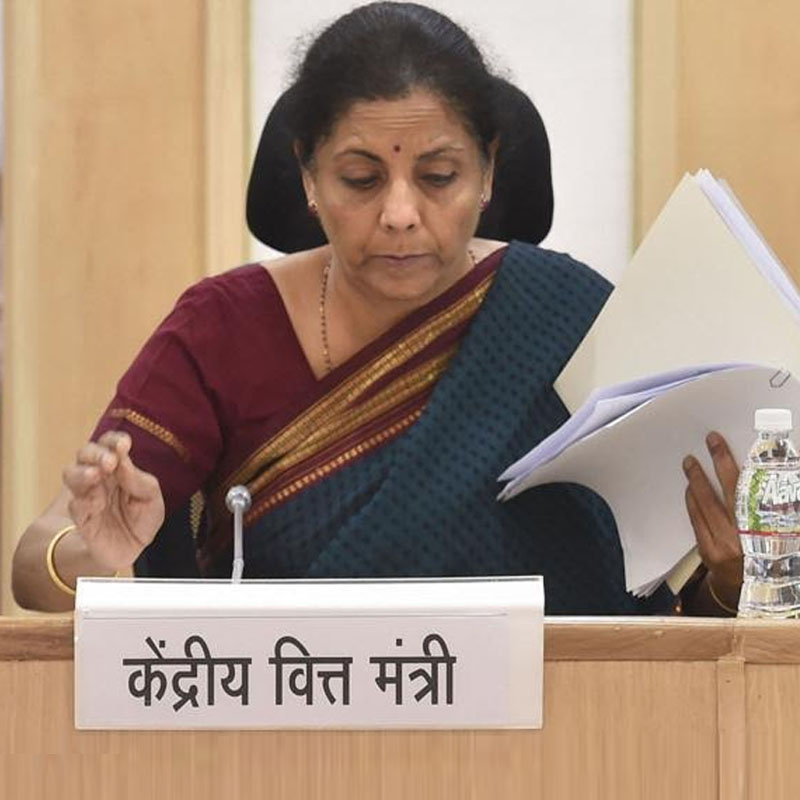
    The broadcasting industry is very positive towards the provisions expected to be announced by Nirmala Sitharaman on 5 July.

    Times Network MD and CEO MK Anand shares, “We expect some clear signals from the government to improve credit growth and investment cycle. There are signs of a slowdown which we expect this budget to address. That includes increased outlay on infrastructure and addressing a distressed farm sector urgently. The new tariff order has a positive impact in the long term. But in the immediate term consumers are complaining of change in price: value equation. There may be a case to look at reducing GST for a year. This will be a great solace to consumers and the industry.”

    BARC India CEO Partho Dasgupta mentions, “Over recent years, the broadcast sector has been experiencing dynamic changes. It has also become an aspirational sector for the youth of this country. Given the nature of the changes and the rising digitisation, we hope the investments by the government will not only result in creating jobs in the M&E sector but will also boost long-term growth for the industry which will also indirectly aide the social fabric of the economy. Additionally, being an insights company that works closely with big data, investments in R&D is an ongoing practice and therefore we are hopeful that provisions for exemptions are made since it will also fuel growth across the sector.”

    9X Media chief revenue officer Pawan Jailkhani says that the overall economic slowdown in the economy for the past 3-5 months calls for rationalisation of GST on advertisers spends, which in turn will help the broadcasting sector. “If the GST (on advertisers’ spends) goes down from 18 per cent to 12 per cent, it will encourage them to spend more,” he said.

    Jaikhani adds, “I also think that there should be some reduction and some relief on corporate tax. Another vertical should be that the government itself should allocate budget for promoting its own schemes and PSUs.”

    He also wants the government to infuse some economic growth steps to turn consumer sentiments positive as advertising is largely based on sentiments.

    Vertoz founder and chairman Hiren Shah is looking forward to newer policies from the government to encourage digital India and smart cities. He adds, “With the current discussions revolving around data security and data localisation, especially the Personal Data Protection Bill 2018 now in the spotlight, India will need to create a better digital infrastructure for the storage of the huge volumes of data. We hope that the upcoming budget encapsulates the importance of better digital infrastructure along with their focus on AI and big data.”

    He expects these moves will directly benefit the digital advertising sector as well, propelling the growth of programmatic as the go-to solution provider for the industry.

    ADOHM chief executive officer Kuldeep Chaudhary also feels the same. “I believe that the presence of technologies based on artificial intelligence can further increase the interaction between consumers and companies. The advertising industry is capable of fostering the growth of other sectors, and they are interconnected. Regarding the 2019 Budget, I hope to see an increase in incentives for the national program in artificial intelligence, at the same time an increase of points of Wi-Fi connection, making it possible to bring new users, then customers, to Indian companies. Also, discuss angel tax provisions in order to bring transparency into the angel funding process, something very important for startups, like us.”

    White Rivers Media chief executive officer and co-founder Shrenik Gandhi adds, “The government has realised the value of investing in digital technology for India to spearhead the ‘Industry 4.0’ globally. Increased fund allocation towards AI, robotics, and machine learning during the interim budget reflected the same. Budget 2019 should now specifically address the application of these accelerators across sectors, be it agri-tech, digi-payments, smart cities or digitised villages. Parallel to Digital India, tax reforms should be looked into to promote mobile manufacturing as it has been a key accelerator of the Make in India program and is also of strategic importance to develop India as a digital superpower."

    Vertoz founder and CEO Ashish Shah is also expecting the GST on mobile phones and laptops to be lowered from 12 and 18 per cent respectively. “Today, a mobile phone is no longer a luxury. It has rather become more of a necessity. Moreover, mobiles and laptops are fundamental digital touchpoints. With the government stressing on transforming India into a “Digital India”, we are expecting the GST rates on these products to be lowered in order to make them more affordable. This will help increase the mobile penetration in rural and semi-urban areas, which will in turn help realise the recently announced vision of digital villages.”

    Gaana CEO Prashan Agarwal is extremely positive of the newly appointed government's vision and efforts to give impetus to the OTT industry in India. “With a greater emphasis on artificial intelligence and lower data costs in the interim budget, this step in the right direction will nudge home-grown brands to launch disruptive products and services. Given the online user-base for music streaming is expected to reach 400 million by 2021, this potential influx of a wider set of internet users will encourage more advertisers to employ OTT platforms for audience segmentation and targeting to drive higher revenue.”

    He too shares the view that provisions to lower GST rates on mobiles, laptops, and related products would translate into more smartphone sales, thus providing significant impetus to Indian entrepreneurs working on digital-first products and boosting our digital economy at large.

    1702 digital group head legal, finance and human capital Aamir Aziz notes, “To make good on the promise of a ‘Digital India’, everyone needs to not only have access to but also be able to afford the services. If the GST rates on mobiles, laptops, as well as other related devices are slashed in this budget, the cheaper prices would be directly proportional to an increase in the sales of these devices and would attract more spending on the digital platforms. Slashing the GST rate is necessary as it would definitely help businesses in times of slow growth rate.”

    Tonic Worldwide CEO Chetan Asher says, “With Modi government’s second term there is hope that the focus on spurring economic growth will be strong. Economic growth will directly affect the growth of the advertising industry. I am also optimistic that we will see a renewed focus on growing digital infrastructure and smart cities. This will lead to faster digital adoption. Lastly, I wish taxation would be further simplified and angel tax is removed completely and there's enough provision to help India become the start-up capital of the world.”

    The industry’s main demand is a GST cut on equipment like mobile phones and laptops to facilitate digital penetration in India and boost growth.

  • BARC to now report viewership from pay, FTA platforms separately

    BARC to now report viewership from pay, FTA platforms separately

    MUMBAI: In what can be considered as a key new development, Broadcast Audience Research Council India (BARC) will now report viewership from pay and free-to-air (FTA) platforms separately. According to sources, the BARC board in its meeting on Thursday ratified the technical committee's proposal for the same.

    BARC provides several cuts for its urban viewership, which tends to be heterogeneous in nature. Reporting free platforms separately can be regarded as the first step in breaking up rural viewership, which is more homogeneous.

    BARC already provides separate urban and rural viewership of some key genres like Hindi GEC and news on its website. Now with pay/FTA reporting, the general public will get a more clear picture of leadership positions of channels in these two markets which have become more distinct after TRAI's tariff order implementation.

    With DD Free Dish flourishing, FTA viewership is now a sizable chunk. BARC's move to segregate pay and FTA channels is a positive one, and is bound to be welcomed by the industry, in particular, broadcasters.  

    The new pay/FTA reporting format for viewership on the BARC website and in its BMW software could be in the offing as early as week 27.

    Additionally, Indiantelevision.com has also been told by a broadcaster source that the much-debated landing page issue wasn't taken up for discussion by the board.

  • Crucial BARC India board meeting today under cloud of landing page issue

    Crucial BARC India board meeting today under cloud of landing page issue

    MUMBAI: The BARC India board is set to meet today in what can be considered as one of its more significant gatherings. The latest board meeting will be held in the backdrop of a series of controversial developments that have been triggered by TDSAT's order setting aside TRAI's directive on landing pages.

    The TV audience measurement body's approach post the TDSAT order has raised concerns from certain quarters of the industry. Indiatelevision.com has previously written about different perspectives from within the industry from a clarity and transparency standpoint.

    This is the first time the BARC India board will meet since it gave a nod to form a two-member committee to independently review its data validation and outlier policy that has drawn sharp opinions and observations from across the industry.

    The meeting comes a day after the Telecom Regulatory Authority of India (TRAI) hosted an open house discussion on review of television audience measurement and ratings in Mumbai on Wednesday where senior officials hoped the landing page issue would be addressed by the industry.

    Following TDSAT’s ruling, BARC had notified that it would include the ratings of channels placed on landing page in its weekly ratings data and while releasing the data of week 22, 2019 BARC correctly considered the channel available on landing pages.

    On 13 June BARC announced that it is reverting to its earlier method of filtering out outliers or abnormal reach from the landing page which BARC decided to do so, only after receiving some representations from industry players.

    With BARC again starting to exclude the outliers, several broadcasters have alleged that the data could be biased as the process of validating outliers for channels is manual.

    With several industry stakeholders keen to track the latest updates, this BARC board meeting is far from a routine affair.

  • TRAI’s SK Gupta on Independent TV troubles, BARC overhaul, landing page controversy & tariff order

    TRAI’s SK Gupta on Independent TV troubles, BARC overhaul, landing page controversy & tariff order

    MUMBAI: Top Telecom Regulatory Authority of India (TRAI) functionaries were in Mumbai on Wednesday for the second leg of the open house discussion (OHD) to review the television audience measurement and ratings system in India. In the audience were industry stakeholders spanning across broadcasters, advertisers, distribution platform operators (DPOs) and BARC representatives among others.

    “Ratings have to be unbiased, correct representation of the feelings of the people and should not be impacted by various methodologies being used to influence them,” said TRAI secretary Sunil K Gupta as he set the agenda.

    TRAI had received multiple comments and counter-comments from industry to its consultation paper, which featured a list of questions. In order to further deepen the engagement, Gupta recommended three additional topics be taken up for discussion.

    “What are the concerns and problems when it comes to return path data with set top boxes? Let us analyse and understand how we can increase the sample size of meters so that influencing data becomes difficult. Secondly, many broadcasters said in the Delhi OHD that data collected through such meters is filtered or manipulated to delete the outliers. They feel that the level of transparency in doing so is not there and in some cases they feel it is one of the tools to manipulate the TRP of a channel. Thirdly, is there any other alternative that can be adopted to make ratings more effective or more representative of viewership?” the secretary asked.

    However, despite the officials’ best efforts to initiate a conversation to highlight problems and suggest solutions, those present were rather conservative in their approach, side-stepping critical issues that continue to plague the broadcasting sector from a TV audience measurement standpoint. While regional broadcasters did argue in favour of a more representative sample to take into account multiple socio-cultural regions, major broadcasters failed to approach the discussion with their usual vigour.

    From BARC’s perspective, COO Romil Ramgarhia and chairman of its technical committee Shashi Sinha were rather frank and forthright, articulating their respective positions on all issues at hand quite candidly.

    In order to gain a better understanding of the regulator's viewpoint, Indiantelevision.com’s Dattaraj Thaly engaged the TRAI secretary in a quick chat on the sidelines of the OHD. 

    Edited excerpts follow.

    What compelled you to float a consultation paper on review of television audience measurement and ratings in India?

    We recommended the formation of an entity to rate the audience measurement for the TV sector and as per that recommendation, MIB came up with guidelines and then BARC was registered. Having said that, (BARC) working for the last three years, we just wanted to see how good the work is being done and there are different concerns of different stakeholders to improve the transparency of BARC rating. So, what are the concerns of stakeholders and how can we improve its functions was our objective.

    What are the specific functions you want improved? Is it credibility of the ratings, transparency of the system? What are the benchmarks for improvement?

    In fact it includes all the things. It is credibility, accuracy of the system and also to make it broad-based so that any attempt to tamper any information etc., should have minimum impact on rating given by the BARC.

    We know what the broadcasters’ concerns with BARC are. Can you tell us what the regulator’s view on the TV audience measurement body is?

    TRAI does not have any view of its own. We raise various issues to the stakeholders. We take oral as well as written comments of the stakeholders. We also analyse the international experiences, the issues raised by different people on what needs to be addressed and ultimately firmly take a view what should be done. So, one thing is very clear TRAI does not have its own view.

    You’ve now held two open house discussions (Delhi and Mumbai) to review our current TV audience measurement system. Have any key themes emerged from these consultations?

    One is that everybody wants BARC to give the ratings that are credible, transparent, not influenced by any of the stakeholders. They also want a broad-based rating pattern, so that chances of getting it influenced by few meters is reduced. Thirdly, they want to improve the transparency of the system.

    BARC’s data validation and outlier policy post the TDSAT order on landing pages has created quite a stir in the industry. What’s your view on this issue?

    You would have heard BARC clearly stating today that they do not have a method to identify landing page and therefore effectively address the issue.

    So, what is the way forward?

    You have yourself very clearly pointed out that there is a decision by TDSAT and we will look into it further and see what can be done. Also today you have heard that this is a call to be taken by the industry also.

    Are you satisfied with what you’ve accomplished in terms of the new tariff order roll-out?

    If you look at the preamble of the regulations and the tariff order issues, the objective raised over there were met to a great extent. So, we are satisfied.

    Two fundamental issues – consumer choice and transparency – were emphasised on by TRAI during the implementation of the new tariff order. Has the new regime addressed these two tenets?

    We have introduced giving the price of each channel in EPG, which has been appreciated by all of the stakeholders. As far as giving choice is concerned, we have checked different platforms and most of the platforms are complying and giving choice. What we have found is that there is a need to educate the consumers. Because consumers from the beginning have been given bouquets. Now awareness has been generated that options have been enabled to choose channels on a-la-carte basis. On this front, I think some more work is required.

    Has the broadcasting and cable services landscape settled down post the new tariff order implementation?

    The choice of customer is a dynamic situation and it will change from time to time and that is what we precisely feel like. The market will work once the consumer has got the options to exercise and it will depend on many things such as the type of programmes you are showing in your TV channel, the language, the awareness, etc. So, this is working very well on the ground and naturally it will take some time to settle. Saying that it has already settled may not be accurate, but yes it is going in the right direction.

    What’s your take on the Independent TV situation?

    Independent TV has been very recently given their license for DTH. The matter has been taken up with MIB and with the other enforcement arms of MIB, which is spread in the state and districts. We are looking into that.

    Is TRAI committed to light-touch regulation across the broadcasting and distribution sector?

    New tariff order is the right example of light-touch regulation (https://www.indiantelevision.com/regulators/trai/broadcasters-split-over-trai-s-directive-to-barc-on-tv-viewership-data-190226). We have given complete freedom to broadcasters to price their channels. We have given freedom to DPOs to carry out their business and get a certain committed revenue so that quality of the network can be upgraded and quality of the services can be given to the consumers. We are only prescribing the broad architecture and not micro-managing.

  • BARC week 25: Live cricket matches catapult Star Sports 1 Hindi to top spot across genres

    BARC week 25: Live cricket matches catapult Star Sports 1 Hindi to top spot across genres

    BENGALURU: The live telecast of the India Pakistan ICC cricket world cup match in week 25 of 2019 (Saturday, 15 June 2019 to Friday, 21 June 2019, week or period under review) was among the most watched sports programme on three channels – Star Sports 1 Hindi, Star Sports 2 and DD Sports. One ICC World Cup other match – the live telecast of the Australia-Bangladesh on Star Sports 1 Hindi was the fifth most watched programme in Broadcast Audience Research Council of India (BARC) weekly list of 5 most watched programmes during primetime during the week under review. Besides, the live telecast of Philips Hue Cricket on Star Sports 1 Hindi was the fourth watched sports programme during the week under review. These matches catapulted Star Sports 1 Hindi to first rank in BARC’s weekly list of top 10 channels across genre in week 25 of 2019.

    Sun TV Networks flagship Tamil GEC Sun TV pipped Dangal TV to second rank during the period under review, pushing the Hindi GEC to third rank. Seven Hindi GEC’s and one channel each from the Sports, Tamil and Telugu genres comprised BARC’s list of top 10 channels across genre in week 25 of 2019. From the network’s perspective, there were 3 channels from Star India, two channels each from Sony Pictures Network India (SPN) and Zee Entertainment Enterprises Limited (Zeel) and one channel each from Enterr 10 TV, Sun Tv Network and Viacom18 in BARC’s weekly list for week 25 of 2019.

    Climbing up a place to first rank in week 25 of 2019 was Star Sports 1 Hindi with 1,186.783 as compared to second rank and 763.962 million weekly impressions in week 24. Star Sports 1 Hindi was also ranked first in BARC’s weekly list of top 5 Hindi Sports channels and as mentioned above. Further, the three of five most watched sports programmes as mentioned above were broadcast on Star Sports 1 Hindi during the week under review.

    Also climbing up a place to second rank during week 25 of 2019 was Sun TV with 851.935 million weekly impressions as compared to third rank and 762.213 million weekly impressions in week 24. Sun TV also headed BARC’s weekly list of top 5 Tamil channels in the Tamil Nadu and Puducherry markets and four of the top 5 Tamil programmes in this market based on average rating across all original airings in the week were aired on Sun TV.

    Dropping two places to third rank in week 25 of 2019 was Enterr 10 TV’s Hindi GEC Dangal with 788.059 million weekly impressions as compared to first rank and 806.687 million weekly impressions in week 24. Dangal also headed BARC’s weekly lists of top 10 Hindi GECs’ in the combined urban and rural Hindi speaking market -HSM (U+R) and HSM (R).  Dangal was ranked seventh in HSM (U). An Indian mythology programmes– Mahima Shanidev Ki and a family drama Baba Aiso Var Dhundo on Dangal were in BARC’s list of  Top 5 Hindi GEC programmes based on average rating across all original airings in the week in HSM (R).

    Climbing up a rank to fourth place was Zeel’s flagship Hindi GEC Zee TV with 701.670 million weekly impressions in week 25 as compared to fifth rank and 680.603 million weekly impressions in week 24. Zee TV was ranked second in HSM (U+R), HSM (U) and third in HSM (R) in BARC’s weekly list if top 10 Hindi GECs’. The Balaji Telefilms produced Kumkum Bhagya, its spinoff  Kundali Bhagya and Tujhse Hai Raabta aired on Zee TV were among the top 5 Hindi GEC programmes based on average rating across all original airings in the week in HSM (U+R), HSM (R) and HSM (U).

    Also climbing up to fifth place in week 25 of 2019 was Star India’ flagship Hindi GEC Star Plus with 682.166 million weekly impressions as compared to seventh rank and 624.298 million weekly impressions in week 24. Star Plus was also ranked third and fourth in BARC’s weekly list of top 10 Hindi GECs’ in  HSM (U+R) and HSM (R) respectively and was ranked first in HSM (U). Yeh Rishta Kya Kehlata Hai on Star Plus was amongst BARC’s weekly list of top 5 Hindi GEC programmes on average rating across all original airings in the week in HSM (U+R) in HSM (U).

    Retaining its previous week’s sixth rank in week 25 of 2019 was Star India’s flagship Telugu GEC Star Maa with 663.013 million weekly impressions as compared to 626.797 million weekly impressions in week 25. Star Maa was also ranked first in BARC’s weekly list of top 5 Telugu GECs’ in the Andhra Pradesh/Telangana markets and all the five programmes in BARC’s weekly list of top 5 Telugu programmes based on average rating across all original airings in the week in these markets were aired on Star Maa.

    Dropping down three places to seventh rank in week 25 of 2019 was Zeel’s Hindi GEC Big Magic with 566.278 million weekly impressions as compared to fourth rank and 690.539 million weekly impressions in the previous week. Big Magic was ranked fourth and second in BARC’s weekly lists of top 10 Hindi GECs’ in HSM (U+R) and HSM (R) respectively. Big Magic was ranked eighth in BARC’s weekly list of top 10 Hindi GECs’ in HSM (U).

    SPN’s Hindi GEC Sony SAB also retained its previous week’s eighth rank in week 25 of 2019 with 536.918 million weekly impressions as compared to 552.626 million weekly impressions in the previous week. Sony SAB was ranked fifth, sixth and third in BARC’s weekly lists of top 10 Hindi GECs’ in HSM (U+R) and HSM (R) and (U) respectively. One of the longest running Indian sitcom – Taarak Mehta Ka Ooltah Chashma on Sony SAB was among BARC’s weekly list of top 5 Hindi GEC programmes on average rating across all original airings in the week in HSM (U+R) and HSM (U).

    Climbing up a rank to ninth place was Viacom18’s flagship Hindi GEC Colors in week 25 of 2019  with 513.035 million weekly impressions as compared to tenth rank and 521.025 million weekly impressions in week 24. Colors was ranked sixth in BARC’s weekly lists of top 10 Hindi GECs’ in HSM (U+R) and was ranked fifth in both HSM (R) in HSM (U).

    Re-entering BARC’s weekly list of top 10 channels across genre was SPN’s flagship Hindi GEC Sony Entertainment Television (SET) with 479.487 million weekly impressions in week 25 of 2019. SET was ranked seventh in BARC’s weekly  lists of top 10 Hindi GECs’ in HSM (U+R) and was ranked fourth in HSM (U)

  • BARC India’s approach post TDSAT’s landing page order draws concern from some stakeholders

    BARC India’s approach post TDSAT’s landing page order draws concern from some stakeholders

    MUMBAI: Questions and controversies around TDSAT’s ruling on landing pages and BARC India’s subsequent flip-flop over implementation of its data validation and outlier policy refuse to die down. In a bid to allay transparency fears of a section within India’s broadcast sector, the BARC board approved a recommendation to set up a two-member committee to review the TV audience measurement body’s outlier policy.

    “As you are aware, there has been a lot of confusion around the landing page in the market. Therefore in order to give confidence to the industry and the stakeholders, BARC board approved a recommendation to set a two-member committee. Mr Nakul Chopra and Mr Praveen Tripathi are industry leaders and their appointment only reiterates the BARC board’s reassurance to give confidence to the industry.

    “Though we at BARC India, have been requested by many stakeholders to continue with the outlier policy, an independent overview of the process and any recommendation to improve, are always welcome and we look forward to working with this committee. Also, recently Deloitte had done a detailed audit on this process and found it clean” a BARC India spokesperson told Indiantelevision.com.

    Despite the latest move being a step in the right direction, the naming of the two appointees hasn't really inspired "confidence" among some industry stakeholders. If the objective is to carry out an “independent overview”, those entrusted with the task should ideally be above suspicion of a potential or perceived conflict of interest irrespective of their calibre and competence, is a view expressed by several industry executives. While Chopra is a former BARC chairman, Tripathi as CEO of Magic9 Media and Analytics continues to be associated with BARC as a consultant/vendor. Tripathi's company had earlier helped BARC process data from barometers, identify outliers and project ratings.

    While it isn't the board's job to wade through the minutiae of everyday operations, the fact that BARC's data validation and outlier policy mechanism and implementation has assumed game-changing proportions for the ecosystem is an aspect that needs its serious consideration, say some industry watchers.

    "In the case of BARC, the problem is compounded as customers are also board members,” pointed out an industry source.

    Some broadcasters, however, have raised more fundamental issues, which go beyond the BARC board’s involvement or lack of it in the outlier policy implementation.

    “Is BARC circumventing the TDSAT order which allows landing pages as a legal practice?” questioned a senior news broadcasting executive.

    The need of the hour, say some, is transparency of BARC’s internal mechanism in weeding out outliers given that there is a degree of subjectivity attached to it.

    "As for the landing page, BARC has and does maintain that they cannot identify landing pages. The process can, however, identify reach outliers which could happen for landing pages in big cable networks for smaller viewed channels or when there is a distribution intervention like activation or improvement in availability. The same principle applies to content interventions also. Most analysts who keenly watch these numbers especially for genres like English news and business news do know this since the landing page discussions started some time back. At BARC, our mandate is to measure viewership with transparency and accuracy to provide a credible measurement," the BARC India spokesperson added.

    Broadcasters that compete for a small viewership base fight for every eyeball. In an environment such as this, the landing page saga has boxed them into a state of flux when it comes to a post-TDSAT order strategy. The outcome of the two-member committee’s findings is what they keenly await in the hope of some clarity and reassurance. 

  • BARC week 25: DD India back in second spot

    BARC week 25: DD India back in second spot

    BENGALURU: Pubcaster Doordarshan’s English news channel DD India was ranked second in Broadcast Audience Research Council of India’s (BARC) weekly list of top five English news channels in week 25 of 2019 (Saturday, 15 June 2019 to Friday, 21 June 2019, week or period under review). DD India made it to second spot after a hiatus of four weeks. Earlier the Doordarshan Network’s English news channel was involved in a dingdong battle for the pole position with the Arnab Goswami-headed Republic TV between weeks 13 and 19 of 2019 until Republic TV overtook it.

    There was a slight improvement in the combined total of the impressions garnered by the top 5 English news channels in week 25 as compared week 24. Many genres/channels ratings had plunged in week 23 when BARC reverted to a previous method of treating landed changes and outliers. Ratings of some channels/genres had plunged even further in week 24. It must be pointed out that around the same time (week 23 of 2019), ICC’s cricket World Cup 2019 being played at England and Wales commenced. Because of the difference in time zones, the second part of the matches overlapped and over shot primetime slots of most channels including news channels in India, hence probably impacting ratings.

    Earlier, BARC had stopped publishing ratings in the public domain for seven weeks starting week 6 of 2019 until week 12 to enable viewership stabilise after the implementation of the Telecom Regulatory Authority of India’s (TRAI) new tariff order.

    In week 25 of 2019, three channels from BARC’s weekly list of top 5 English news channels saw gains in ratings, while ratings of two fell. Republic TV continued to head BARC’s weekly list of English news channels with 0.572 million weekly impressions in week 25 of 2019 as compared to 0.556 million weekly impressions in the previous week. As mentioned above, DD India was ranked second with much improved ratings of 0.441 million weekly impressions as compared to 0.334 million weekly impressions and third rank in week 24.

    At third rank was Times Now with 0.402 million weekly impressions in week 25 of 2019 as compared to 0.418 million weekly impressions and second rank in week 24.  Moving up a place to fourth rank in the period under review was the India Today group’s English news channel India Today Television with 0.264 million weekly impressions as compared to 0.251 million weekly impressions in week 24 of 2019. Completing the quintet at rank 5 was CNN News18 with 0.261 million weekly impressions in week 25 of 2019 as compared to rank four and 0.289 million weekly impressions in the previous week.

  • B4U Kadak in the HSM market & B4U Bhojpuri in the regional market both leading in their respective genres

    B4U Kadak in the HSM market & B4U Bhojpuri in the regional market both leading in their respective genres

    MUMBAI: B4U Network, the global leader in Bollywood entertainment, added two new channels to its bouquet of offerings in the month of May 2019 – B4U Bhojpuri and B4U Kadak. While B4U Bhojpuri is a Bhojpuri movie channel, B4U Kadak is a premium channel in the Hindi Movie genre. 

    And going by the latest viewership figures of BARC, both the newly launched channels have created a big impact in their respective genres, ranking among the top players in the very first week of their release. 

    Launched on 15th May 2019, B4U Bhojpuri arrived with a unique offering of 2 WTP’s (World Television Premieres) every week along with a mix of music and devotional content in multiple time bands for the regional language audiences in the UP, Bihar & Jharkhand market. The programming struck a chord with the core Bhojpuri audience as the channel generated remarkable figures of 57 million impressions in Bihar/Jharkhand market (U+R) on NCCS 2+ Yrsin week 25, 2019 of BARC. 

    B4U Bhojpuri is all set for further growth as the content is going to get richer in the coming months. With its premium packaging, special festive programming during cultural events like Chatt, Navratri, Diwali & Holi, devotional content and unmatched library, including Dinesh Lal starrer Nirhua Hindustani 2, B4U Bhojpuri will capture the hearts and minds of Bhojpuri audience like never before.  

    The other newly launched channel, B4U Kadak, went on air on 31st May as a premium offering in the Hindi Movie genre. The channel arrived with an incredible promise of 101 WTP’s (World Television Premieres) with a mix of cherry picked Bollywood films and South Indian movies dubbed in Hindi. B4U Kadak’s library boasts of a number of award winning and critically acclaimed films, along with Original South Indian films which were successfully remade in Bollywood. 

    With such an impressive array of films, B4U Kadak was lapped up by the audience right after its launch, and the channel generated amazing figures of 427 million impressions in the HSM market (U+R) on NCCS 2+ Yrsin week 25, 2019 of BARC. With a number of incredible films making their WTP on B4U Kadak in the days ahead, the channel will climb up even higher on the ladder in the Hindi Movie genre.Along with B4U Movies, B4U Kadak will further expand the audience base of B4U among the Hindi movie lovers. 
     

  • Dettol Liquid Soap remains top brand in BARC week 25

    Dettol Liquid Soap remains top brand in BARC week 25

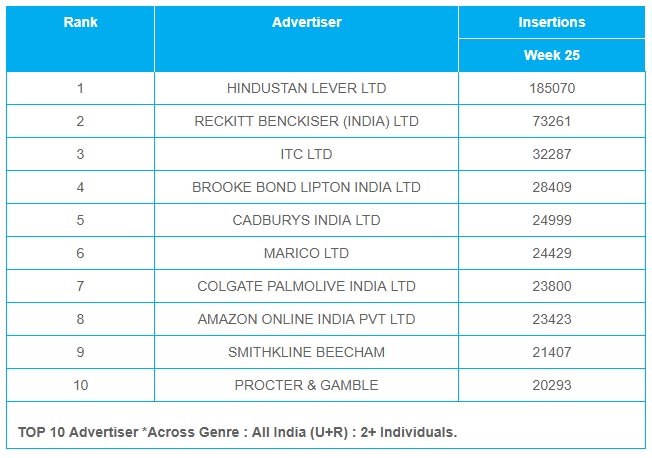
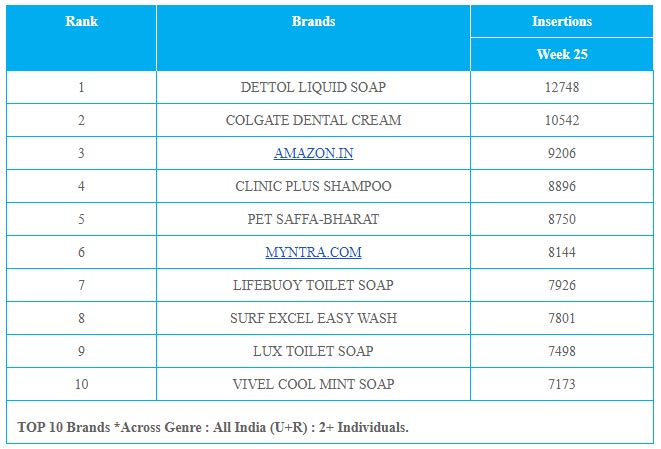
    MUMBAI: The Broadcast Audience Research Council (BARC) India has released its data for top advertisers and brands for the period between 15 June 2019 and 21 June 2019.

    The data reflects top 10 advertiser and brands across genre on Indian television, including OOH screen, (U+R): 2+, Individuals NCCS All, demonstrating ads that were inserted the most in week 25 of 2019.

    Top Advertisers:

    There were no changes in the top five advertisers in week 25 when compared to the BARC data from previous week. Hindustan Unilever Ltd, Reckitt Benckiser (India) Ltd, and ITC Ltd remain unmoved from the top three positions with 185070, 73261, and 32287 ad insertions, respectively.

    Brooke Bond Lipton India Ltd came in fourth with 28409 insertions followed by Cadburys India Ltd that had 24999 insertions.

    Top Brands:

    Some minor shuffles occurred in the week 25 rankings of top brands by BARC, as compared to the previous week. While Dettol Liquid Soap and Colgate Dental Cream remained on the top two positions with 12748 and 10542 insertions, respectively, Amazon.in replaced Trivago from the third position. Amazon.in, which ranked 6th in last week’s rankings, made 9206 insertions to claim its spot in the top 3 in week 25.

    Clinic Plus shampoo, which ranked seventh last week, climbed up a few spots to be in number four  position this time with 8896 insertions. It made Pet Saffa-Bharat slip from its postion the last week by a spot. It ranked fifth with 8750 insertions.