Tag: BARC

  • Changing dynamics in consumption of kids content

    Changing dynamics in consumption of kids content

    MUMBAI: Producing content to consume for today’s kids is no child’s play. Data and trends on kids content consumption across media-electronic and print goes a long way in impacting decisions made by commissioning editors and TV programmers. A panel at the just concluded FICCI Frames 2015 titled “Decoding Kids’s Content Consumption” presented such data and trends.


    On the panel were Eurodata TV Worldwide International senior sales manager Eric Lentulo, Viacom 18 Media EVP and GM Sonic and Nickelodeon India Nina Jaipuria, BARC chief business officer Romil Ramgarhia, IMRB International group business director Ashish Karnad and Stratagem Media CEO Sundip Nagpal. The session was moderated by FICCI AVGC Forum chairman Ashish Kulkarni. 


    Lentulo shared some crucial insights from various reports of studies conducted by the company. He said that kids in Asia were viewing less amount of kids content as compared to their US and European counterparts with an average viewing daily time of 2:32 minutes. In Germany, sports worked best for kids with nearly 95 per cent of the kids under the research having watched the FIFA World Cup Final. In Canada, the Super Bowl brought in large traction kids viewers. “Kids are watching content on smart phones as well as tablets but television is the firsts screen for children,” Lentulo observed. 


    Providing an Indian perspective, Nagpal said, “Younger kids spend just 30 per cent of their time watching kids channels in India, 35 per cent of GEC content, and the remaining 30 per cent of other content.” He went on add that TAM data showed that young mothers spend just six per cent of their time watching the content viewed by their wards. “The kids genre is popular across metros and one million plus towns and even in towns with population less than one lakh people. While Maharashtra and Gujarat were well performing markets for the genre, Kerala is missing out on children’s content.”


    On the other hand, as per Karnard’s study in 2013, two out of three kids seek entertainment primarily to reduce stress and tension from studies. The second primary reason was to seek information. “Three out of the four kids prefer watching content in Hindi rather than in English, while they love animated characters that help others. When they are alone, they would use mobile phones and computer games, they would utilise television to watch music and shows. On the other hand, when in company of their friends and family, they would play outdoor sports and watch movies and sports on television,” Karnard stated.


    Having the last word on the subject, Jaipuria said, “While kids today are consuming content on various devices, TV is here to stay for a while.” According to her, kids latched on to television for two reasons: 1) They were terribly bored and seek it as a form of entertainment value. 2) They wanted an escape route where they are able to run from a competitive world to one of fantasy. “Animation is the only medium that can transform them to an imaginative world,” she added.


    Highlighting an important point from the perspective of a kid’s broadcaster, she said that they were a safe genre and hence parents trusted the network for its content. Storytelling too was crucial along with quality dubbing and environmental sounds that together made up for solid content. “The primary factor that drives this category is the element of fun and being mischievous and kids are looking for honest values,” she said.


    The other elements that children looked for in a character were looks (dressing, style and smile), fantasy (talking about gadgets) and values that the characters stood up for. Throwing light on whether language made a difference, Jaipuria said, “It is the character, bond and relationships which brings them to TV. Language only breed familiarity. Local content is currently edged out because we started off late.”


    For the category that is growing at nine per cent and sees under two per cent ad revenue, Jaipuria informed that with carriage fees going down and subscription going up, there was space for further segmentation.


    Ramgarhia added that with the coming of BARC, the audience measurement platform would cover everything that India watched including the rural markets. “As more segmentation takes place, a lot of thrust will be placed on kids channels. Nine is the new 14,” he said, adding that moving ahead it would be their endeavour to expand the panel that monitors channels.

     

  • Is BARC all set for broadcasters and media agencies in Kolkata?

    Is BARC all set for broadcasters and media agencies in Kolkata?

    KOLKATA: While Broadcast Audience Research Council (BARC) seems all set to formally launch its much-awaited television audience measurement system in phase wise manner starting April, broadcasters and media agencies have begun to pull out from TAM India. If industry sources are to be believed, broadcasters like Star, Zee, Discovery, Star Sports, India TV and NDTV have already sent their termination notices to TAM.


    Regional media broadcasters specifically in West Bengal, however, have their own viewpoints. In Kolkata, broadcasters and media agencies expect to get a fair report with the introduction of BARC’s new TV ratings measurement system.


    At a time when agencies and broadcasters in Mumbai have already sent letters to TAM informing them that they are either not extending their subscription after 31 March, 2015 (in case their current subscription is expiring on that date) or terminating their subscription with the stipulated one-month notice period (in case their subscription runs till 31 December, 2015), Kolkata-based agencies and broadcasters have not yet got any detailed report on the pricing and policies of BARC.


    “BARC authorities came to Kolkata for one road show and with the lack of interest shown from people here and the absence of proper feedback, it hasn’t taken much initiative in Kolkata,” a city-based advertising agency executive said on condition of anonymity.


    Zee Entertainment Enterprises controlled 24×7 Bengali news channel 24 Ghanta will pull out from TAM along with the network’s others channels, said an executive from 24 Ghanta, adding that almost all channels in India are likely to do that. “With the arrival of BARC, it would make an even equation for all the stakeholders,” the channel executive added.


    When queried about the expectations from BARC, the executive said, “No tampering is possible as BARC will provide a wider audience reach. We also expect scientific and more detailed findings from untapped rural areas.”


    On the other hand, Aakash Aath director Eshita Surana said, “We have yet not decided, whether we will continue with TAM or no. We have not yet got the pricing policy from BARC.”


    However, Surana went on to add that the company has high hopes from BARC.


    On the initiatives being taken to establish strong communication, BARC CEO Partho Dasgupta said, “We have been constantly communicating through our newsletters, press interactions. website, twitter, roadshows and meetings. Pricing model details are on the website and all CEOs who watermarked the channels have been written to individually.”


    BARC, in the past three weeks, has been seeing an increasing rush from smaller broadcasters, both national and regional, who are now getting watermarked.  


    Speaking about expectation from BARC, a Kolkata-based GEC executive said that BARC’s report will at least not bring Kolkata TV’s teleshopping show in the top 20 programme list.


    Moreover, the number of peoplemeters that TAM had installed was 10,000 whereas BARC will be starting with 20,000 and then plans to gradually scale up the number by 10,000. “This will ensure more representation and data from these peoplemeters that will enable a more accurate understanding of stickiness, preference and even demography of every segment of viewers. BARC will even provide zip-code wise data on ratings, which will help advertisers in choosing the right TV channels to reach out to their TG,” brand and communications expert Mahul Brahma added.


    A media buying executive said that all stakeholders, including the media agencies, have invested in the new BARC system, and it is natural that all should move to this audience measurement system. “BARC is a joint industry body, and we are part of the industry. We believe that BARC will have a more accurate and better measurement. Our preference would be to go with the measurement which is more robust, transparent and accurate,” he said.

  • BARC India rolls out pricing philosophy

    BARC India rolls out pricing philosophy

    MUMBAI: As  Broadcast Audience Research Council (BARC) India reaches its last week of training sessions across Mumbai and Delhi, the team is in high spirits gauging the encouraging and positive response from all those who attended the BMW – User Software training programme.


    The Council is now reaching out to broadcasters and media agencies to inform them about the pricing philosophy. 


    BARC India has designed a standard pricing model for its principal stakeholders.


    While the industry as a whole will pay out roughly the same amount as it would have been paying, the way it works out to individual entities would be more scientific, objective and different.


    The pricing philosophy for broadcasters is a flat cess as a per cent of net TV advertising billing. This cess percentile will be constantly reviewed at periodic intervals to account for any change in the base cost due to change in sample size etc.  


    The philosophy for media agencies is based on the equaliser model which works on three parameters that distinguish one agency from the other.


    *Billing (Number of clients serviced by the agency).


    *Footprint (Markets being catered for planning & servicing e.g. All India, HSM, South etc).


    *Scale (Number of categories handled by the agency). 


    Weights have been assigned to each factor to arrive at the final pricing which has been designed and vetted by Ernst & Young. 


    Discounts on early payments, premium subscription packages, customised reports etc. have all been laid out for the customers to choose from.


    In continuation of its technical prowess, BARC India has designed a secured online pricing widget wherein both broadcasters and agencies fill their respective subscription details basis which proposals are sent out.  

  • IBF asked to file affidavit in Kantar case; matter put off to 12 May

    IBF asked to file affidavit in Kantar case; matter put off to 12 May

    NEW DELHI: The Indian Broadcasting Foundation (IBF) was today formally impleaded in the Kantar case in Delhi High Court and asked to file its affidavit in the matter.


    Thereafter, Kantar Market Research will file its rejoinder and the matter has been fixed by Justice Rajiv Shakder to 12 May.


    The case had been filed by Kantar Market Research challenging the Policy Guidelines for Television Rating Agencies in India, and in particular on the clause relating to cross-media ownership. The matter had come up last in September 2014.


    Meanwhile, the interim order on the case will continue that will allow Kantar’s subsidiary TAM Media Research to publish ratings till the verdict on the case is out.


    Although TAM and Broadcast Audience Research Council (BARC) were the only two applicants under the guidelines as of December 2013, TAM has still not received any response from the Information and Broadcasting Ministry on its application.


    The News Broadcasters Association (NBA) has been impleaded early in the case in favour of the guidelines.


    While declining to stay the Guidelines in February last year, Justice Manmohan had stayed sections 16.1 and 16.2 of the Guidelines, thus giving freedom to TAM to offer ratings to its clients.


    The sections relating to cross-holding, which state that the same company cannot hold shares in both TRP companies and the media are 1.7a and 1.7d.


    Kantar had argued that any action relating to Fundamental Rights had to be done through an act of Parliament and not by an executive order. Any attempt to regulate television rating agencies was tantamount to interfering with the freedom of speech and expression under Article 19(1)(a), it had argued. 

  • BARC to rollout Spot Monitoring Services from March

    BARC to rollout Spot Monitoring Services from March

    MUMBAI: The Broadcast Audience Research Council (BARC) India is all geared up to release its spot monitoring services earlier than expected. The council will be ready to rollout the services (like AdEx of TAM) by 1 March, 2015, a highly placed industry source tells Indiantelevision.com.


    “With talks of a rating dark period, the industry was a little worried as it would impact their billing business,” reveals the source on the reason for bringing ahead the date for releasing data.


    Currently, BARC is tracking 350 channels and hence can reveal the data without any hassle.

  • IBF is not ending TAM subscription: Punit Goenka

    IBF is not ending TAM subscription: Punit Goenka

    MUMBAI: The sword has been hanging on Television Audience Measurement’s (TAM) head for a long time now. From NDTV Group’s $1.3 billion lawsuit (though dismissed by courts) to Broadcast Audience Research Council India (BARC) likely to start releasing television ratings data by April, as reported earlier by Indiantelevision.com, things haven’t been hunky-dory for the measurement body for a while now.


    However, not only did the agency fight tooth and nail the allegations of poor quality TAM research data, it also complied with the guidelines set by Information and Broadcasting Ministry for a TV ratings agency in order to exist. For instance, TAM continues to increase the size of the panel to fulfill the minimum peoplemeter sample size of 20,000 homes guideline, set by the I&B Ministry.


    With a few months left for BARC to begin rolling out its data, there have been various speculations making rounds in the industry. “There is the cost issue. Why would one pay for both TAM and BARC subscription? Also, since both the measurement bodies have a different way of functioning, one needs to take a break before adopting the new one,” says an industry source on the reason for the ratings blackout, if indeed it ever happens.


    So much so, a few media reports have gone on record to say that the Indian Broadcasting Foundation (IBF) is planning to end its subscription with TAM leading to a period sans ratings. This in turn has created panic in the industry, as it awaits two major events namely the ICC Cricket World Cup 2015 and the eighth edition of the Indian Premiere League (IPL). As per sources, ad rates for WC are touted to be around Rs 4 lakh for 10 seconds and ad rates for IPL have seen an increase of around 10-15 per cent generating huge ad revenue for broadcasters.


    When questioned on the reports doing the rounds and how it would impact the industry in case the IBF decides to end its subscription from TAM, Kantar CEO Eric Salama laughs saying, “I don’t know about the intentions.”


    What’s more, an industry source  close to the development clarifies that so far the ratings agency had not heard from the IBF or anyone from the industry on the matter.


    To get further confirmation on the matter, Indiantelevision.com contacted IBF board member and BARC chairman Punit Goenka and he denied the report as well. “There is no such decision taken by the IBF,” he asserted.


  • Only TAM and BARC apply for registration for TV rating agencies

    Only TAM and BARC apply for registration for TV rating agencies

    NEW DELHI: The applications of TAM and the Broadcast Audience Research Council (BARC) for registration under the Policy Guidelines for Television Rating Agencies in India notified early this year is under process under established procedure/practices, Parliament has been informed.


    These are the only two agencies to have applied for registration under the guidelines issued on 16 January with the objective of creating a credible, transparent and accountable rating system in the country which , cover detailed procedure for registration of rating agencies, eligibility norms, terms and conditions of registration, cross-holdings, methodology for audience measurement , complaint redressal mechanism , sale and use of ratings, audit, disclosure, reporting requirements and action on non-compliance of guidelines etc.


    Minister of State for Information and Broadcasting Rajyavardhan Singh Rathore said all rating agencies shall require registration from the Ministry under the guidelines, which are also available at the Ministry’s website at www.mib.nic.in.


    These guidelines are based on recommendations made by the Telecom Regulatory Authority of India (TRAI) on “Guidelines for Television Rating Agencies” of 11 September 2013. The recommendations have been made by TRAI after holding wide-ranging consultations with various stakeholders. 

    Some of the provisions of these guidelines have been challenged by Kantar Market Research Services and another in Delhi High Court. The High Court has granted stay to some paras relating to restrictions on cross–holding of the company and its board members in rating agencies and generating and publishing ratings till the disposal of the writ petition. The matter is sub-judice.

  • “Govt needs to look at broadcast as an important sector”: Uday Shankar

    “Govt needs to look at broadcast as an important sector”: Uday Shankar

    MUMBAI: It was in September that Star India’s Uday Shankar was once again handed over the reins of Indian Broadcasting Foundation (IBF), and since then, he has been working on a three-point agenda.


    Says the man who has been very vocal about his views on digitisation in India, “When you are heading an organisation like IBF, there are three things that we all need to look at. First and foremost is digitisation. It is the most fundamental thing that the industry requires and so we need to ensure that we engage with government and put the digitisation road map back on track.”


    The second is the carriage fees for both big and small channels, particularly for niche channels which are dying under the weight of this. He points out that the investment done by niche channels on content is totally destroyed because they don’t have the money. “Most of them are going bankrupt and carriage fee is the single biggest destructive influence on the industry. The key objective of digitisation was that it would expand carriage capacity and the carriage fees will get substantially reduced or would go away. That has not happened. We need to work on that,” he says.


    Thirdly, the foundation needs to make sure that the new government looks at broadcast as an important sector. “The government is genuinely reviewing it also,” he adds.


    The view at the IBF , currently, is that broadcast will play a huge role in the Narendra Modi government’s agenda of creating more jobs, creating more opportunities, entrepreneurship and wealth for people. “We as IBF want to take the plan to the government and tell them the way we can carry forward the government’s agenda,” says Shankar.


     With a view to benefit the industry and the customer, the foundation aims to work closely with all its synergies as well as other bodies like BARC India.   

  • ISA elects Marico’s Saugata Gupta as chairman

    ISA elects Marico’s Saugata Gupta as chairman

    MUMBAI: The newly elected executive council of the Indian Society of Advertisers (ISA) met on 11 September and elected Marico’s managing director Saugata Gupta as its new chairman.


    He takes over from Hemant Bakshi as he relocates to Unilever Indonesia as the CEO.


    Gupta has been lending his support to the ISA for a long time as his colleagues from senior levels in marketing and media have been active in different committees of the ISA.  An MBA from IIM Bangalore, Gupta has rich FMCG experience of over two decades having worked through ascending career rung in Cadbury (India & UK), ICICI Prudential & Marico. Currently, MD of Marico, he believes in an empowering work culture that would create ownership and make a difference in to the entire business ecosystem.


    Gupta said, “Our focus would be on making industry partnership stronger and in particular to extend all support that is needed to help BARC come up as soon as possible with industry wide accepted and accurate TV audience research data representing viewers across the country. I am looking forward to the exciting times ahead for Advertisers, industry partners and fraternity associations to work as a stronger team to harness overall growth of advertising which in turn will help grow businesses and the Indian economy.”


    The ISA has advertiser members from across industries who contribute to over two-thirds of the country’s national non-governmental ad spends.  ISA, which is member of the World Federation of Advertisers (WFA), continues to partner with other industry bodies that connect to the advertisers such as initiating the formation of BARC.


    Other members of the Executive Council are:


    Tata Services Group Corporate Communications Corporate Affairs VP Atul Agrawal


    Thomas Cook (India) Marketing and Service Quality head and chief innovation officer Abraham Alapatt


    Agro Tech Foods director Narendra Ambwani


    Bajaj Corp Business Development director Jimmy R Anklesaria


    Infogain India director JC Chopra


    Raymond strategic advisor Paulomi Dhawan


    Procter & Gamble Hygiene and Health Care brand director Sonali Dhawan


    Aditya Birla Management Corporation Group Corporate Services and Strategy director Rajiv Dube


    Godrej Consumer Products chief operating officer – Sales, Marketing & SAARC Sunil Kataria


    Bajaj Electricals vice president & head advertising and brand development Beena Leji Koshy


    Tata Global Beverages managing director and CEO Ajoy K Misra


    Anisha Motwani, Director & Chief Marketing Officer, Max Life Insurance Co. Ltd.


    Mondelez India Foods Chocolate Category and Media director Siddhartha Mukherjee


    Birla Sun Life Asset Management independent director Bharat V Patel


    ITC divisional chief executive Sanjiv Puri


    Nestle India Communication head Chandrasekar Radhakrishnan


    Polycab Wires vice chairman, joint MD and group CEO R Ramakrishnan


    Hindustan Unilever Personal Care Products executive director Samir Singh


    Hawkins Cookers chairman Brahm Vasudeva

  • TAM or BARC, the market has to decide: Sir Martin Sorrell

    TAM or BARC, the market has to decide: Sir Martin Sorrell

    MUMBAI: They are known as the lions who go for the kill in their respective fields. One heads the world’s largest advertising communications group by revenue, which he has built up in around three decades. And the other is known for his innate ability to decimate almost every guest who dares to be a part of his nationally televised daily news show.


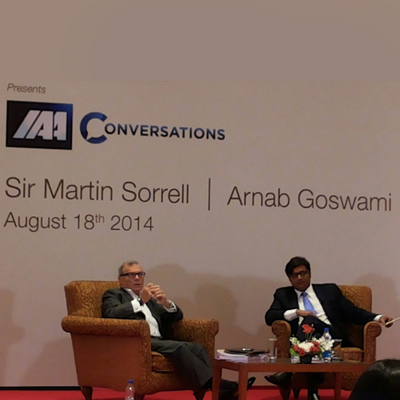
    Yes, we are talking about none other than WPP CEO Sir Martin Sorrell and Times Now editor-in-chief Arnab Goswami who got together on stage to have  a public chat under the umbrella of the Indian chapter of the International Advertising Association (IAA) in Mumbai.


    Before the IAA conversation between the two commenced almost all those assembled – the who’s who of the media industry – were hard pressed to second guess as to who would have the upper hand: the calulator (read: Sorrell, as The Economist had once labelled him, when he battled with David Ogilvy to take over O&M) or the microphone (read: Arnab).


    Their curiosity was laid to rest quickly  and it became clear that it would not be a “I’ll eat you up for high tea”  Arnab interview when it was Sorrell who fielded the first question, querying how the 2014 Lok Sabha elections went for him. Goswami laughingly responded saying that  not many know that the  Congress (I) took out an internal report to know the reasons for the debacle. And the number one reason in that report was Arnab Goswami as he was the only TV journalist to have interviewed the party’s vice president Rahul Gandhi.


    And with India’s sad performance during the ongoing Test series in England, cricket was bound to be spoken about. Talking about the recession of ‘91-‘92, Sorrell took the example of how he handled the situation comparing it to the crisis the Indian team was going through and how MS Dhoni should be handling it.


    So, do you still push yourself, asked Goswami. And yes, came the  prompt reply from the man who believes that with the development of the new technologies, the way people consumed media has changed over the years due to disruption. “If you see what consumers consume and what our clients invest in, there are two major differences. The first being the traditional media which consists of magazines and newspapers, 20 per cent is invested in it and on the other side, 46 per cent is invested on mobile,” said Sorrell. He  emphasised that though the study represents the west, India is also headed in the same direction.


    Responding to Goswami’s question about the position of Indian media in the next 20-30 years, Sorrell highlighted that with the economic changes taking place in the country under the new government, the country can only move forward.  “India is in a better position than the US because it leapfrogged from legacy media to smartphones. And the country will play an important role in  digital growth as well,” he asserted adding that the traditional businesses need to be digitised at the earliest, as Indian media needs to go with the flow.


    However, not everyone at the audience believed in Sorrell’s India digital growth design. Madison World chairman Sam Balsara believes that in the country where print and TV is still booming, digital cannot overtake the two here at least for some time now.


    A firm believer in data and gut, Sorrell also believes that media has to play the roles of both – influencing the market behavior and analysing it too.


    After a few more exchanges on what role data plays in Sorrell’s businesses, the conversation shifted from media and advertising to television and the ongoing case of television viewership ratings in India.


    Kantar Media, part of the WPP Group, the 50 per cent shareholder in Indian television ratings agency TAM Media Research had moved the Delhi High Court when the government, early this year, approved the regulations policy guidelines for TV rating agencies. According to it, no single entity can hold paid-up equity in excess of 10 per cent simultaneously in a rating agency and a broadcaster, advertiser or advertising agency and is compelled to increase the panel home size by 10,000 ever year until the size reaches 50,000 panel homes.


    “In a country of 1.2 billion, just a few thousand peoplemeters. The math doesn’t match up. Did you really need a regulation to tell you to increase the sample data?” asked Goswami who added that he has been waiting for 15 years to ask the question.


    To this, Sorrell said that the decision to increase the number of peoplemeters was taken long before the regulations came out. “One must not forget that the number of peoplemeters reflects the cost of science. Anywhere in the world, the industry has to pay for that cost. The research agency has three equal partners, that is, one-third is media agencies, one-third advertisers and one-third broadcasters. It involves cost and the industry needs to contribute to it.”


    He went on to add  that the way media is consumed is changing and so the media rating agencies too will have to change. He cited the example of TV networks in the US using ‘C7 ratings’, which includes same-day viewing plus seven additional days, as opposed to three, and how WPP was the first one to recognise that change.


    “The market had decided for the 10,000 peoplemeters then, and later on the government decided to increase that,” he added.


    Does Sorrell see TAM and BARC working together?


    “The market will have to decide that; if they are ready to pay for both then good. However, if we look elsewhere, the  market doesn’t pay for two rating currencies,” he said.


    To this BARC India CEO Partho Dasgupta smiled and said, “It’s good that he acknowledged that there can be only one currency.”


    The two-hour long conversation ended with Goswami asking Sorrell that if he would start his career all over again like he did at 40 then what would be on his mind. “I would have started maybe a little earlier, say 30-35 years of age, and gone private after collecting all my assets,” he replied.


    Spoken like a true number cruncher.