Tag: BARC Report

  • News18 India garners 12.8 per cent average market share during Week 27-30: Barc

    News18 India garners 12.8 per cent average market share during Week 27-30: Barc

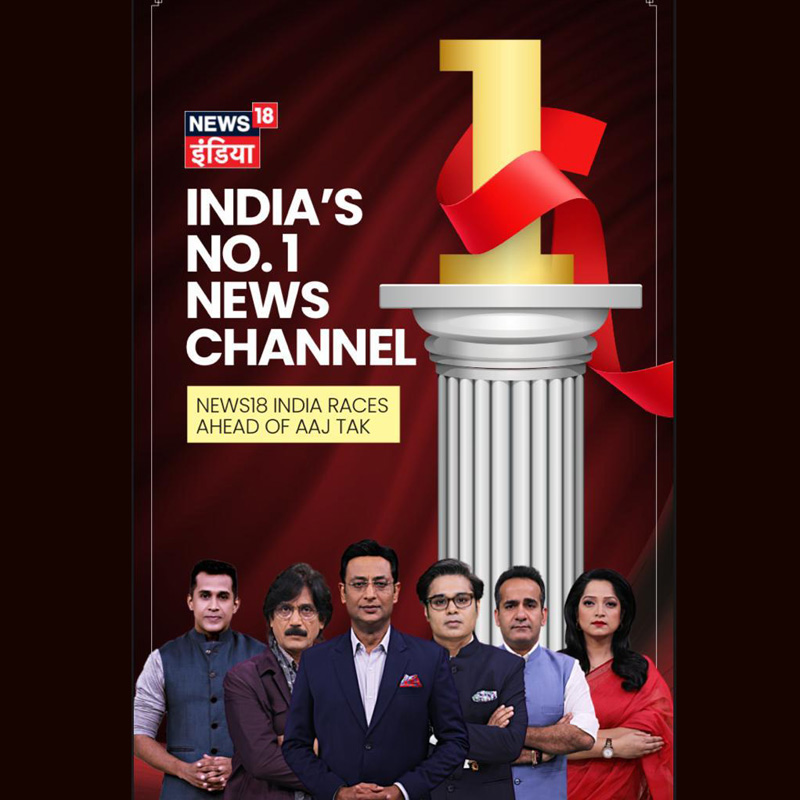
    Mumbai: News18 India has widened its lead in the Hindi-speaking 15+ market with 12.8 per cent market share during Week 27-30 as per Broadcast Audience Research Council (Barc) India data.

    As per Barc ratings released on Thursday, Aaj Tak garnered a 12.02 per cent relative share and India TV stood at 12.01 per cent.

    Republic Bharat had 11.2 per cent relative share, followed by TV9 Bharatvarsh with 9.8 per cent share, Zee News at 7.2 per cent, ABP News 6.6 at per cent, Times Now Navbharat at 6.4 per cent, News Nation at 5.8 per cent, Good News Today at 5.1 per cent and Zee Hindustan at 4.1 per cent.

    News18 India further strengthened its position during primetime hours between 1800-2400 hours with 13.6 per cent market share. Aaj Tak had a 12.1 per cent relative share, followed by Republic Bharat at 12.0 per cent, TV9 Bharatvarsh at 10.6 per cent, Zee News at 7.6 per cent, ABP News at 6.6 per cent and Times Now Navbharat at 5.7 per cent.

    Source: BARC data, TG: NCCS 15+ (All Viewership data based on TV only) Wk 27-30’22: 22nd July’22 to 29th July’22, All Days, 24 hrs Market Share – HSM – Urban + Rural

    In the last few months, News18 India has spruced up its content and programming strategy, coupled with new marketing initiatives.

    Network18 CEO Hindi Cluster Karan Abhishek Singh said, “Continuous dominance of News18 India as the country’s top news channel shows the kind of viewer’s affinity and trust the channel enjoys. Our robust line-up of shows and anchors also keeps us ahead in primetime. Our focus on news, unmatched perspective, insightful analysis, and debates are the key differentiating factors that keep us ahead of the competition.”

    The channel has not only performed well on TV, but its digital audience base has also seen steep growth.

    News18 India managing editor Kishore Ajwani said, “There are a multitude of reasons which have helped us become a daily household name across India. The strong line-up of story-driven shows, the diversity of content, debates that offer perspective, and our fast-paced information delivery, all of these offerings have contributed to the increase in engagement with the audience and resonance of the channel.”

  • BARC week 22: Dettol products top list of brands

    Mumbai: The Broadcast Audience Research Council (BARC) has released its week 22 report in which Dettol Range of Products is the advertising brands list topper with 474.53 (000 secs) ad volume. 

    Dettol Toilet Soaps also bagged the second spot with 423.92 (000 secs) ad volume followed by Amazon Prime Video with 385.97 (000 secs) and Veet Hair Removal System with 342.36 (000 secs) holding on to the third and fourth spots respectively. The BARC list for week 22 includes Harpic Bathroom Cleaner, Dettol Antiseptic Liquid, Surf Excel Easy Wash, Horlicks, and Dettol Liquid Soap. 

    Disinfectant cleaner Lizol is in the 10th spot with 273.47 (000 secs) ad volume. It should be noted that Lizol had topped the BARC’s list of most advertised brands last week with 573.05 (000 secs) ad volume. 

    Hindustan Lever Ltd topped the list of advertisers with 4234.36 ad volume. Reckitt Benckiser India which was on the top spot last week is in the second spot in week 22 with 4162.47 ad volume. 

    Other advertises named in this list released by BARC includes, Brooke Bond Lipton India Ltd (722.19), Colgate Palmolive India Ltd (520.71), Procter and Gamble (497.41), Amazon Online India Pvt Ltd (417.89), ITC Ltd (371.22), Wipro Ltd (363.72), Google (354.72), and Pepsi Co (330.45). 

  • Lizol tops BARC’s week 21 list of top brands.

    Mumbai: The Broadcast Audience Research Council (BARC) released its report for week 21, and Lizol has topped the list of brands with 573.05 (000 secs) of ad volume. The disinfectant cleaner is followed by streaming giant Amazon Prime Video which claimed the second spot with an ad volume of 526.66 (000 secs), after holding the sixth position in the BARC listing of most advertised brands last week.

    Veet Hair Removal System and Dettol Toilet Soaps are at third and fourth spots in the list accounting for 437.03 (000 secs) and 427.56 (000 secs) ad volumes respectively. The top list of brands released by BARC for week 21 is also dominated by personal and home hygiene products, where Dettol Antiseptic Liquid, Harpic Bathroom Cleaner, Dettol Liquid Soap, Dettol Intense Cool Soap, and Harpic were ranked fifth, sixth, seventh, eighth, and ninth respectively.

    Ed-tech platform Byju’s learning app grabbed the 10th spot in the list with 293.99 (000 secs) ad volume.

    Reckitt Benckiser India has topped the list of advertisers in week 21 by registering 4929.33 (000 secs) of ad volume, followed by Hindustan Lever Limited (4669.27 secs), Brooke Bond Lipton India Limited (747.88 secs), and ITC (658.22 secs) holding fort at second, third and fourth spots respectively.
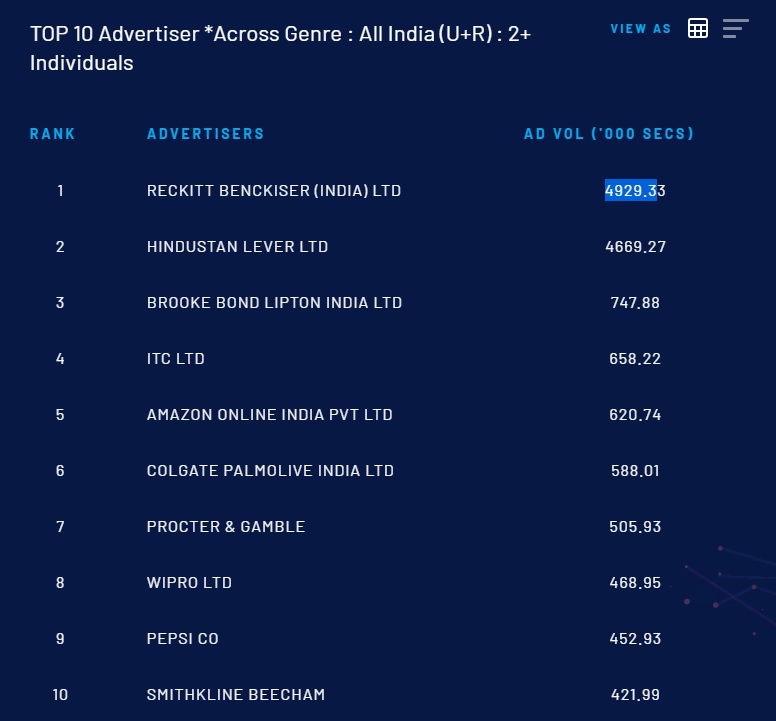
    Amazon Online India Private Limited grabbed the fifth rank on the BARC list with 620.17 (000 secs) of ad volume. Other advertisers who found a place in the top 10 include Colgate Palmolive India Limited (588.01 secs), Procter and Gamble (505.93 secs), Wipro Limited (468.95 secs), Pepsi Co (452.93 secs), and SmithKline Beecham (421.99 secs).

  • BARC week 20: Star Plus tops the list of Hindi GEC pay platforms

    BARC week 20: Star Plus tops the list of Hindi GEC pay platforms

    Mumbai: Star Plus has topped the list of pay platform channels in the report released by the Broadcast Audience Research Council (BARC) for week 20 (15 May to 21 May 2021). The Hindi GEC was ranked second with 2357.44 Average Minute Audience (AMA), followed by Sony SAB (2159.02) and Colors (1375.48) ranked second and third respectively. 

    Zee TV bagged the fourth spot with 1180.56 AMA, while Sony Entertainment Television (1132.23) and Star Utsav (928.8) grabbed the fifth and sixth spots respectively. The remaining channels in the top 10 list of Hindi GEC pay platforms are Star Bharat (701.35), Sony Pal (598.01), Dangal (422.79), and Colors Rishtey (419.06).

    Star Utsav topped the BARC’s free platform list of Hindi GECs with 2101.41 AMA. Zee Anmol, Colors Rishtey, and Sony Pal were listed on the second, third, and fourth spots with 1078.96, 1016.59, and 956.05 AMA respectively. 

    Dangal (737.22), The Q (708.76), Big Magic (360.83), Shemaroo TV (143.4), DD National (19.75), and DD Retro (18.12) are the other channels that find their spot in BARC’s list of most-viewed free platforms. 

    In the urban market, the top 10 channels were Star Plus, Sony SAB, Colors, Star Utsav, Sony Entertainment Television, Zee TV, Sony Pal, Star Bharat, Colors Rishtey, and Dangal. 

    The top 10 channels in the rural category were Star Utsav, Zee Anmol, Colors Rishtey, Sony Pal, Star Plus, Dangal, Sony Sab, The Q, Zee TV, and Colors. 

  • COVID-19 effect: Dettol Toilet Soap tops BARC list in week 20

    COVID-19 effect: Dettol Toilet Soap tops BARC list in week 20

    Mumbai: As people in India became more aware of personal and home hygiene due to the coronavirus pandemic, antiseptic soaps and cleaning liquid brands topped the advertising charts released by the Broadcast Audience Research Council (BARC). As per its data for top brands and advertisers between 15 May and 21 May, 2021 (Week 20), Dettol Toilet Soaps led the chart with 555.13 (000 secs) of ad volume, followed by Vanish Oxi Action in second place with 489.52 (000 secs) of ad volume.

    Disinfectant surface cleaner Lizol is in third spot with 489.43 (000 secs) of ad volume, while Dettol Liquid Soap and Dettol Antiseptic liquid bagged fourth and fifth spots with 474.86 (000 secs) and 448.53 (000 secs) of ad volume respectively. 

    While the list is purely dominated by antiseptic and disinfectant brands, streaming platform Amazon Prime Video garnered the sixth spot with 431.33 (000 secs) of ad volume. Unlike its competitors including Netflix and Disney+Hotstar, Amazon Prime Video has spent a lot on advertising, especially on general entertainment channels (GEC) over the past few months. 

    Dettol Intense Cool Soap, Harpic, and Moov Strong Diclofenac Gel bagged hours for the seventh, eighth, and ninth positions with 408.34, 3882.42, and 350.89 (000 secs) of ad volume respectively. Harpic Power Plus 10X Max Clean held on to the tenth spot with 330.86 (000 secs) in ad volume. 

    Reckitt Benckiser India led the advertiser’s list in week 20 by registering 5509.47 (000 secs) advertising volume followed by Hindustan Lever Limited with 4807.86 (000 secs) ad volume. The third position has been grabbed by Brooke Bond Lipton India Limited with 878.64 (000 secs) ad volume, while Colgate Palmolive India Limited stood at the fourth spot with 709.34 (000 secs) ad volume. 

    Other advertisers who bagged their spots in the top ten list are Procter & Gamble (629.21), ITC Limited (614.42), Cadburys India Limited (588.89), Pepsi Co (562.24), Amazon Online India Pvt Limited (541.51), and Smithkline Beecham (365.62). 

  • Indian sports viewership rides on expensive cricketing properties

    Indian sports viewership rides on expensive cricketing properties

    MUMBAI: In the media industry, the saying goes that if there is viewership, there are advertisements. However, this doesn't seem to be the case for the sports genre, if one were to go by BARC India's 2019 annual report. It mentions that sports as a segment has grown nearly 90 per cent in viewership in the last four years, but advertisement volumes are stagnant at one per cent during the same period. 

    Experts say cricket being the only most-watched sport in India along with expensive cricketing properties such as the Indian Premier League is the reason for the fewer ad volumes.

    Digitalkites senior vice-president Amit Lall says, “Unlike cricket and non-cricket sports category, India’s biggest domestic sporting event – Indian Premier League – has changed the whole ball game of the target audience. Sports which was seen as a male-target-audience-genre has now included a person of different age, gender, and class as their viewers due to the increasing popularity of IPL. Majority of brands are investing in cricket, especially in IPL. However, due to the massive viewership, the costing in IPL has gone up and brands with deep pockets are looking to leverage the other non-cricketing sports properties."

    A recent BARC report also mentioned that the female viewership in the sports genre has seen an 8 per cent rise, eating out of the forte of  Hindi GEC. As per an earlier BARC India data, sports genre's women viewership had 17.6 billion impressions in 2018 while the viewership grew by eight per cent to 19.1 in 2019.

    Despite all the data, cricket still leads. Lall says, “The co-sponsorship title of IPL which earlier could be bought for Rs 5 crore, is now sold for Rs 40-50 crore. However, the same co-sponsorship title in non-cricket property could be bought at just one-fourth the rate of IPL. The eyeballs on this property could be less but it will have maximum visibility if the target audience is bang-on.”

    Dentsu Aegis Network India chief executive officer Anand Bhadkamkar agrees that Indian sports is run mainly because of the popularity of cricket. "Advertisers are comfortable with cricket as there is sure-shot reach and returns. Naturally, spends done on cricket is high as compared to non-cricket properties due to its massive viewership.”  

    All said and done, the IPL has a lot working in its favour. Havas Media’s chief executive officer Anita Nayyar says: “Acquisition cost is higher in cricket, especially in IPL, as the tournament garners maximum eyeballs. IPL eats up 60-70 per cent sports ad spends of a brand. The cost that was Rs 5-6 lakh per 10 seconds in IPL has gone up to the Rs 8-10 lakh per 10 seconds, just because of the viewership rise of the tournament.”

    Judging by what the channel said, IPL 2019 saw a total reach of over 462 million across the Star network.

    However, despite an increase in viewership, sports other than cricket have hurdles. Nayyar adds, “Unlike cricket, which is watched pan-India, the other sports properties that are getting traction eventually are more regional in nature. Such as kabaddi is more of the north, football has keen enthusiasts in Kerala, West Bengal, and the Northeast region. These properties see the participation of regional advertisers and are reasonable as compared to pan-India-watched sports.”

    “A sports property like IPL is most-watched but has high costing, whereas a non-cricket sports property with meagre viewership has reasonable price and could be one of the reasons for the stagnant ad volumes in sports that BARC has mentioned in its 2019 report,” explains Nayyar.

    Bhadkamkar adds that apart from viewership on television, non-cricketing brands are indulging in non-traditional methods for promotion such as on-ground initiative, activations, etc. Moreover, apart from traditional sports, e-sports has become the talk of the town and brands do want to leverage it, too. Pro Kabaddi League is one of the non-cricketing sports that has been leveraging on-ground activations over traditional modes. 

    Unlike event-specific genres such as sports, the top three genres such as news, GECs and movies continue to account for over three-fourth of the total ad volumes in 2019, says the BARC 2019 viewership report.

  • Social govt ads, toilet soaps most advertised during festival

    Social govt ads, toilet soaps most advertised during festival

    MUMBAI: While spikes in viewership could be fuelled by unplanned happenings and topical events, there are special events where television plays the role of a common entertainer for the entire family through collective television viewing.

    Broadcasters on their part, make these days attractive for the viewers through compelling and clever programming and scheduling. Increase in viewers results in increase in advertisers as well. 

    Festivals form a part of India all through the year, but the September to December period is the euphoric period for Indians when most festivals are celebrated. There is Ganesh Chaturthi in Maharashtra, Durga Puja, Navratri and Dussehra celebrated across the country. Also, Diwali and Christmas have an additional bonus of kids’ vacations in most parts of India. There is a culture of buying new things, gifting to family and friends and communication on latest offerings, deals are welcomed by consumers in these festive months. The advertisers love this spending period and loosen their purse strings too. 

    Advertising volume during some of the important festival days always have more ads than the rest. Festivals which are celebrated at home with family gain more ad duration than the ones which are celebrated outside of home.

    As we step into the festive season, BARC India has launched its report on advertising during festivals that throws light on how the viewers and advertisers have evolved during festivals especially in the high decibel festival season between 2015-2018 for September to December. 

    The report shows that television viewership has been rising over the last three years where the average weekly viewership of ads in India is growing steadily each year. From 2016 to 2018, the advertising impressions have increased by a phenomenal 45 per cent from 521 billion to 755 billion with 2018 yet to witness its festive season.

    The growing viewership has seen endorsement from the advertising fraternity with average weekly advertising volume clocking 31 million seconds from January to August 2018

    The peaks in advertising coincides with planned tentpole events related to sports or national interest topics like budget and elections, or with the festive season.

    There is a definite impact of festivals on weekly advertising duration. India is a land of diversities and this diversity reflects in the way we Indians celebrate festivals too. Some are longer, bigger, brighter, high on fun quotient while others are a tad subtle.There are distinct trends in terms of quantum of advertising as well as viewership emergence depending on various factors like the duration of a particular festival or whether it is celebrated indoors or outdoors with family and friends.

    Online shopping, auto, telecom and chocolates sector continue to be the mainstays of the festival season where contribution of categories like internet services, jewellery, paints grow over the years and jewellery emerged as the close second category for the 2017 festive season, just below online shopping. 

    Online shopping portals now advertise all around the year and hence have reduced dependency on the festive season alone. Consumer durables maintains status quo with not much movement in advertising seconds across all years. 

    With more and more advertisers jostling for viewers' eyeballs, mind space and attention the festive season witnesses more and more action across years and the contribution from the usual suspects of festive advertising is reducing over the years.

    The broadcasters also strategically use the festive period for announcing special programming, blockbusters, festival omnibuses in addition to the regular programme line up. 

    But where does the viewership come from? Hindi! Most of the viewership on festival days comes from major Hindi speaking markets (HSM) across the year where Maharashtra, UP/Uttarakhand followed by Gujarat / D&D / DNH and MPCG and are the biggest contributors to viewership on festival days. Festival viewership is on the rise in 2018 as compared to 2017. For 2018, Holi and Janmashtami viewership in HSM markets have increased by 19 per cent and 29 per cent respectively.

    Hindi is the most preferred choice in the Hindi speaking markets on festival days too with over 70 per cent viewership coming from Hindi channels. But with the growing advent of regional channels, improvement in programming quality and television penetration growing in the bottom of the pyramid, there is an increased focus on regional language channels.