Tag: BARC India

  • DD gets watermarked

    DD gets watermarked

    MUMBAI: The pubcaster has finally got itself inked for ratings. Doordarshan’s 20 channels have got watermarked as per the Broadcast Audience Research Council (BARC) India’s standards for viewership ratings.

    Doordarshan, which has been a founding member of the measurement council, took a while to get the channels watermarked. As per sources, the cost of watermarking a channel costs around Rs 20 lakh and the pubcaster has spent close to Rs 4.5 crore to get the technology on board.

    The audience measurement company has already got on board 250 channels that have ordered for watermarking embedders. Half of this has already been installed.

    The watermarking technology has been taken from Netherlands based Civolution and field testing of the meters is underway for homologating them to Indian conditions. As BARC India has consistently maintained, the meters have been assembled in India at a fraction of the cost of global suppliers.

    Deals with 26 vendor partners such as Intel, Hansa, Mediametrie, Civolution, Markdata, Magic9Media across 12 processes have been finalised. It also claims that this is the largest such audience measurement system globally with cutting edge technology.

    The government has laid down policy guidelines that prescribe a minimum of 20, 000 homes, which BARC India feels isn’t enough in the long run. It has also opted for the harder and tougher method of assembling systems from various vendors to offer a superior and cost effective output.


  • BARC India adopts NCCS as new classification

    BARC India adopts NCCS as new classification

    MUMBAI: In its endeavour to interact, engage and share with its stakeholders – key developments and initiatives – Broadcast Audience Research Council (BARC) India has embarked upon itself to unravel the puzzle of TV audience measurement system in India.
    One of the biggest changes that the measuring body has adopted is the New Consumer Classification System (NCCS).  The ‘New SEC’ system as it is referred to in the MRSI documents was co-developed by Market Research Society of India (MRSI) and Media Research Users Council (MRUC) as the new classification system for industry use.
    The new SEC system, which has been in existence since 2008, was developed after rigorous research as a better discriminator of the purchasing power of a household compared to the SEC. “Research has to evolve over time; and so have systems. In the 80s, MHI was used to classify purchasing power, which gave way to a better system called the SEC in the 90s. It is now time to embrace the new age system,” points out BARC India CEO Partho Dasgupta.
    Alternative systems – a point-based system including education of CWE, press exposure of housewife, ownership of durables and usership of consumer goods; and a system considering ‘best type’ of consumer durables owned – were considered before settling on the present NCCS.
    It is based on the assumption that a system that throws up more inequalities is more discriminating.
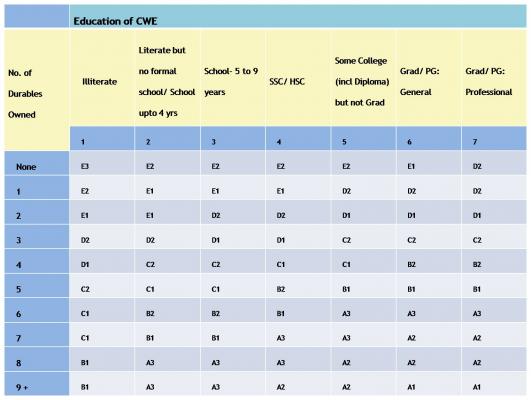
    The new SEC system is used to classify households in India and is based on two variables:  education of chief wage earner and number of consumer durables (from a predefined list) owned by the family.
    The 11 shortlisted durables (electricity connection, ceiling fan, gas stove, refrigerator, two wheeler, washing machine, colour TV, computer, four-wheeler, air conditioner, agricultural land (in rural areas) were identified as the best discriminators of the ‘purchasing power’ of a household after evaluating the series of variables, including education of housewife, type of dwelling (house), amenities, number of rooms, ownership of durables and usership of consumer goods.
    Dasgupta believes that the new system will be of great value to the industry due to various factors. “To name a few; (a) Advertisers do not discriminate between urban and rural India from their sales perspective; and the NCCS is a single system for urban and rural India, (b) It is not linked to only one individual in the household, but to the entire household, (c) It is dynamic, having the ability to change over time as discriminators change, and (d) It captures the affordability quotient of household and hence marketers can target more precisely.”
    NCCS v/s SEC – A Comparison:

    NCCS Grid has 12 grades ranging from A1 to E3:


  • BARC India likely to roll out weekly data

    BARC India likely to roll out weekly data

    MUMBAI: Industry led TV ratings measurement body BARC India has shed some more light on its operational format.


    The biggest question that has been answered is that of reporting frequency. In an official communication, BARC India has said that the frequency of reporting is likely to be weekly except for certain data types for which it might aggregate the data by period, time band or geography.


    It also says that since currently the number of households with multiple TV sets is low, it won’t be reporting this number separately but will still measure multiple TVs wherever it may be in sample households. At the same time it is aiming at releasing viewership data and adex data simultaneously.


    The upcoming ratings agency also claims to be future ready by having the technology that will allow it to report even time shift viewing from the first day.
     

    Addressing the concern about broadcasters switching off watermark, it says that such a step is not in the interest of the broadcaster. ‘But like any technology, such eventualities could happen due to various reasons. To arrest these instances stringent processes with escalation matrix across watermark monitoring agency, broadcaster and BARC India are in place. They will highlight even if a small bit of content is not watermarked,’ it says in the communiqué. This will dissuade media agencies from buying the channel, forcing the broadcaster to correct this.


    A stringent monitoring process is on the cards. BARC India is looking at appointing a senior police official for heading vigilance. But it says that the data collection format and technology that it uses makes it highly unlikely for tampering.


    Watermarking technology can also support capturing cable TV channels and if MSOs want their channels to be measured, they can invest in the embedding technology. However, no MSO biases would be considered for sampling as the panel would be a reflection of what people watch.


    For its extensive and advanced technology, it is looking at an ingenuous pricing model that will make affordable data available to the last mile.

  • BARC India to install 30% of total barometers in rural India

    BARC India to install 30% of total barometers in rural India

    MUMBAI: The Broadcast Audience Research Council India (BARC India) is ensuring that it accurately captures ‘what India watches’ and hence is putting in resources to cover not just urban, but rural India as well. In keeping with this, the research body is installing approximately 30 per cent of its ‘barometers’ (people meters) in rural India.


    But how will BARC India ensure credible ratings, considering the constant power cuts in rural India? Answers BARC India CEO Partho Dasgupta, “Our meters have an inherent capability to store data for up to two months, so in case there are power cuts, we are secure.” The research body is also planning to have 10 per cent buffer homes which will enable them to reduce data vagaries due to any such factor.   
     

    “It is obviously difficult to reach across the rural parts of India, however, it has been a mandate for BARC India to capture ‘what India watches’ and hence it is important to cover that part of India as well,” adds Dasgupta. 


    BARC India, is currently busy with its roadshows, where the body is meeting with broadcasters, advertisers, media agencies and consultants, clarifying their doubts and questions. “We are delighted with the positive feedback we have received. People are receptive to change to a system which they believe will be much more robust and reliable,” says Dasgupta.  
     

    The purpose of the roadshows being held in Delhi, Bengaluru, Chennai and Mumbai is to share with the larger group of stakeholders, BARC India’s current progress, thoughts on sample design and reporting structure. “These sessions enable us to understand the needs of our end customers more closely which will ensure us to fast track the last mile,” he informs.
     

    The roadshows saw discussions looming around the status of the project to-date, initial thoughts on reporting and broad sample designs being presented to the stakeholders.


    BARC India is currently testing meters across various parts of India in the most rugged conditions. So by when will the data be rolled out? “The data is being captured for our internal analysis and this will not be published,” he informs. 
     

    Talking about the feedback from the stakeholders, Dasgupta says, “We have got a very positive response. The proof of this lies in the fact that almost Rs 100 crore has been invested additionally by the broadcasters in installing embedders and related systems. They would not have done it if they didn’t believe in the technology selected.”

    BARC India is developing its system on a future ready technology “which is two generations ahead than what is being used currently,” he informs.
     

    The body has closed deals with 26 vendor partners across 12 processes involved in the broadcast measurement system, who will contribute to the different moving parts of the system. Giving an update on the current status of the measurement body, Dasgupta informs that most of the bigger networks and channels have ordered their watermark embedders and most of them are installed or being installed. The playout monitoring systems are being tested. The sampling design is almost complete. “We are taking feedback from the stakeholders through a series of roadshows that we are doing,” he says.  

    He further adds, “You will appreciate that this will be the largest such audience measurement system globally with cutting edge technology. This requires serious technology and process handshakes all over and then testing. All this is currently underway.”

    The audience measurement body which underwent a logo change recently has been subscribed by 250 channels already. “The numbers are going up every week and there has been a smooth progress on installations as well,” adds Dasgupta.


    BARC India will provide data to Doordarshan as well.
  • 250 channels sign up for BARC India’s watermarking technology

    250 channels sign up for BARC India’s watermarking technology

    MUMBAI: Even as signs of a delay from Broadcast Audience Measurement Council’s (BARC) side are doing the rounds, the audience measurement company has already got on board 250 channels that have ordered for watermarking embedders. Half of this has already been installed.

    The watermarking technology has been taken from Netherlands based Civolution and field testing of the meters is underway for homologating them to Indian conditions. As BARC India has consistently maintained, the meters have been assembled in India at a fraction of the cost of global suppliers.

    Deals with 26 vendor partners such as Intel, Hansa, Mediametrie, Civolution, Markdata, Magic9Media across 12 processes have been finalised. It also claims that this is the largest such audience measurement system globally with cutting edge technology.

    Very soon, it will start testing and validating the data from the system. The government has laid down policy guidelines that prescribe a minimum of 20, 000 homes, which BARC India feels isn’t enough in the long run. It has also opted for the harder and tougher method of assembling systems from various vendors to offer a superior and cost effective output.

    The measurement process undertaken by BARC India is as follows:


  • Romil Ramgarhia quits Zeel, joins BARC India

    Romil Ramgarhia quits Zeel, joins BARC India

    MUMBAI: Broadcast Audience Research Council (BARC) India has appointed Romil Ramgarhia as its chief business officer. This is a move to strengthen its core management team as the joint industry body moves closer to the launch of its services. In his new role, Ramgarhia will report to BARC CEO Partho Dasgupta.


    Ramgarhia brings with him more than 12 years of experience across media, telecom and manufacturing sector. In his last role, he was Zeel chief commercial officer. Before Zeel, he was also associated with Viacom18, Bharti Airtel, Asian Paints and ACC, in different capacities.


    Zeel MD and CEO and BARC chairman Punit Goenka said, “Romil has played a key role during his limited assignment at Zeel. It is unfortunate that he has quit the company, however I am confident that his rich experience will bring greater value to BARC India. As he now moves on to a new challenge in a new role and domain, I wish him luck for his continued success.”


    Dasgupta added, “BARC India is moving closer to launch. Romil has an excellent background in broadcast, in telecom and in other industries. He was already associated with BARC India as part of its commercial committee and hence is well initiated in the processes. With his great business acumen he will further strengthen the organisation.”


    Talking about his appointment, Ramgarhia said, “My assignment with Zeel and Viacom18 has been one of my most challenging as well as gratifying periods of my professional career. It is great to be a part of a start-up which is slated to be the biggest audience measurement system across the world.”