Tag: BARC India

  • Barc India: Star Maa No. 1 telugu entertainment TV channel

    Barc India: Star Maa No. 1 telugu entertainment TV channel

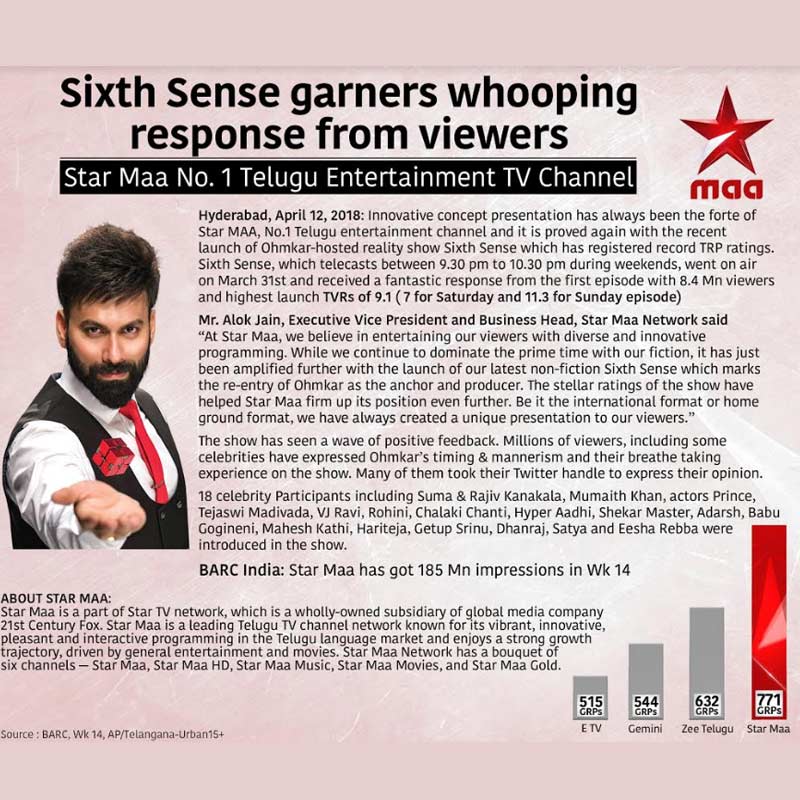
    MUMBAI: Innovative concept presentation has always been the forte of Star MAA, No.1 Telugu entertainment channel and it is proved again with the recent launch of Ohmkar-hosted reality show Sixth Sense which has registered record TRP ratings.

    Sixth Sense, which telecasts between 9.30 pm to 10.30 pm during weekends, went on air on March 31st and received a fantastic response from the first episode with 8.4 Mn viewers and highest launch TVRs of 9.1 (7 for Saturday and 11.3 for Sunday episode)

    Star Maa, Executive Vice President and Business Head, Mr. Alok Jain said “At Star Maa, we believe in entertaining our viewers with diverse and innovative programming. While we continue to dominate the prime time with our fiction, it has just been amplified further with the launch of our latest non-fiction Sixth Sense which marks the re-entry of Ohmkar as the anchor and producer. The stellar ratings of the show have helped Star Maa firm up its position even further. Be it the international format or home ground format, we have always created a unique presentation to our viewers.”

    The show has seen a wave of positive feedback. Millions of viewers, including some celebrities have expressed Ohmkar’s timing& mannerismand their breathe taking experience on the show. Many of them took their Twitter handle to express their opinion.

  • TRAI initiates consultation on landing page issue

    TRAI initiates consultation on landing page issue

    NEW DELHI: The Telecom Regulatory Authority of India (TRAI), the telecoms and broadcast regulator, now wants to discuss the issue of the landing page (the page that appears when one switches on the STB and the TV set) and its many uses and misuses with the industry stakeholders. The regulator issued a consultation paper in this regard today.

    Pointing out that the practice of running a channel on multiple logical channel numbers (LCNs) allegedly for influencing television rating was brought to the notice of the regulator, the TRAI statement said. Some TV channels allegedly, in collusion, with the distributors, placed some television channels on multiple LCNs (meaning at several places in different programming genres in the EPG), it added.

    “As the TV channel ratings measurement is done on the basis of a unique water mark ID of a channel, the data of viewership of all such multiple LCNs is aggregated and reflects in the final ratings,” the statement said, adding that on the receipt of complaints the TRAI intervened last year and acted as per the provision of existing regulations.

    The TRAI has gone on to say that alleged irregularities in trying to influence audience measurement and subsequent data later shifted to the landing page and that it received quite a few complaints regarding the same. 

    Some of the issues raised by the TRAI in its consultation paper on the landing page include the following:

    · Do you feel that the emerging concept of placing TV channels on

    the landing page can influence TRP ratings? Suggest the action,

    which may address the issue with justification.

    · Should the concept of a landing page be defined? If so, please

    suggest the definition of the landing page with justification.

    · Whether placing of a TV channel on the landing page increases

    television ratings? If yes, why TV channels whose TV ratings

    are released by a TV rating agency should not be barred from

    being placed on the landing page? If no, why are broadcasters eager to place their channels on the landing page?

    · What should be the criteria/consideration to put a TV

    channel on a landing page?

    · Can placing of TV channels on the landing page be mitigated through changes in measurement methodology of television ratings?

     · Should the landing page be used to place TV channels not

    having TRP rating or only to provide platform specific

    information? Give suggestions with justification.

  • BARC files FIR for meter tampering in Telangana

    BARC files FIR for meter tampering in Telangana

    MUMBAI: BARC India is taking the fight against panel home infiltrators very seriously. After lodging cases against people tampering with home metres in Karnataka, it has now filed a first information report (FIR) against culprits in Telangana.

    Five people have also been detained by the police. The FIR was filed by the police after BARC India’s vigilance team found out that the details of the households where BARC India’s BAR-O-Meters are installed were compromised. The FIR has been filed for manipulation, tampering, cheating and breach of trust.

    “BARC India over the years has taken a number of measures to curb panel home tampering. However, there are still pockets and people, who continue to indulge in such malpractices. We are continuously investing in technology and on-ground vigilance to curb these malpractices. BARC India has and will continue to take action against those who try and infiltrate our system,” said BARC India CEO Partho Dasgupta.

    BARC India has also set up a Disciplinary Council headed by Justice Mukul Mudgal to strengthen transparency and credibility of its measurement system. 

    In January, the Bengaluru police had acted on an FIR filed by BARC and nabbed five culprits indulging in the same tampering. The five, including a TV producer, went to homes where metres are installed and asked them to watch a particular show at a particular time in return for incentives.

    In September 2017, BARC had urged the TRAI and the MIB to bring in legislation making TV viewership data tamper-proof and stipulate stringent penalties for offenders.

    Also Read :

    BARC panel tampering: first arrests made

    BARC India to TRAI and MIB: Tweak legislation to make data tamper-proof

    BARC segments viewership data for South regional news from GECs

  • Doordarshan’s R-Day broadcast notches up record TV viewership

    Doordarshan’s R-Day broadcast notches up record TV viewership

    NEW DELHI: Pubcaster Doordarshan notched up record viewership of 38.3 million for the live telecast of India’s Republic Day celebrations, including the impressive parade by armed forces and civilian organisations, in the presence of special guests from 10 Asean countries, apart from bigwigs of the country’s political system.

    Not only did DD record high audience data for the R-Day telecast shown simultaneously across its 22 terrestrial and satellite TV channels, but the gross figure, too, stood at 45.4 million. The 90-minute odd show, conceptualised to celebrate the Indian republic and its evolution through the years since 1950, was captured via 38 cameras this year.

    According to DD’s parent Prasar Bharati Chairman A Surya Prakash, six cameras were deployed beyond central Delhi’s India Gate (the parade passes through some of the arterial roads from the India Gate roundabout) to capture a panoramic view for the telecast that was also beamed in HD format apart from the regular SD broadcast.

    After BARC India released its weekly audience data last week highlighting the pubcaster’s R-Day broadcast, DD Director-General Supriya Sahu in a series of tweets said: “India trusts Doordarshan, the Public Service Broadcaster with events of national importance. Undeniable proof of people’s faith and confidence. Thanks to all our viewers. Million thanks dear viewers for watching and appreciating DD coverage of the Republic Day parade. It’s your love and affection which drives our team to do their best. We are nothing without you.”

    Republic Day telecasts not only helped DD viewership soar, but also shored up audience data of English and Hindi-language TV news channels as many private channels re-telecast DD-generated feeds from various locations of the official celebrations.

    The impressive show by DD, which pulled out all the stops for the coverage and telecast of the R-Day 2018 celebrations beamed live on digital platforms, including YouTube, too, once again highlighting the pubcaster’s massive reach that continues to remain under-exploited and is reflected in the annual revenues generated by the national network.

    Over the last 24 months, however, under chief executive Shashi S Vempati, and Sahu, DD has been attempting a series of initiatives to not only modernise itself, but also infuse fresh programming ideas for the network channels to up generation of revenue too, apart from living up to its objectives as a pubcaster. 

    Also Read :

    TV channels ready Republic Day programming line-up

    Celebrate Republic Day special with ‘Beats of India’ only on MTV Beats

    Ensure full use of funds for schemes, house panel tells MIB


  • Zee Anmol leads Hindi GEC (U+R) in BARC week 1 2018

    Zee Anmol leads Hindi GEC (U+R) in BARC week 1 2018

    MUMBAI: Zee Anmol is back as the leader in the Hindi GEC (U+R) market after a gap of one week, dethroning week 52 (2017) leader Star Bharat, in the first week of 2018, according to Broadcast Audience Research Council’s (BARC) all India data. Star Utsav dropped two slots to sixth position this week from the fourth position last week in Hindi GEC urban + rural markets.

    Star Plus jumped to the second slot this week from third slot last week whereas Zee TV slipped to third slot this week in Hindi GEC urban market. Moreover, &TV and Star Utsav exchanged their ninth and tenth positions in GEC urban markets this week as against the previous week. In the GEC rural markets, Star Plus and Colors swapped their ninth and tenth positions, according to week 1 of BARC India data analysis as compared to  week 52.

    Hindi GEC (U+R)

    Zee Anmol garnered the top position in the genre with 685344 Impressions (000s) sum followed by Star Bharat on second position with 678228 Impressions (000s) sum.

    Colors stood at the third positions with 598060 Impressions (000s) sum, whereas Zee TV climbed to the fourth position with 569854 Impressions (000s) sum. Sony Pal jumped to the fifth position with 557297 Impressions (000s) sum from sixth slot last week and Star Utsav fell to sixth position with 546867 Impressions (000s) sum.

    Star Plus, Rishtey, Sony Entertainment Television and Sony Sab have retained their seventh, eighth, ninth and tenth spots with 545437 Impressions (000s), 455178 Impressions (000s), 422853 Impressions (000s) and 379657 Impressions (000s) sum, respectively.

    Hindi Rural GEC

    Zee Anmol, Sony Utsav, Sony Pal, Star Bharat and Rishtey retained their first, second, third, fourth and fifth slots with 513567 Impressions (000s) sum, 396160 Impressions (000s) sum, 378521 Impressions (000s) sum, 346269 Impressions (000s) sum and 323827 Impressions (000s) sum, respectively.

    Dangal TV, Zee TV and Big Magic stood at their sixth, seventh and eight positions with 258281 Impressions (000s) sum, 219205 Impressions (000s) sum and 171606 Impressions (000s) sum, respectively.

    Star plus and Colors interchanged their ninth and tenth slots with 159556 Impressions (000s) sum and 158773 Impressions (000s) sum.

    Hindi Urban GEC

    In urban GEC, Colors retained its lead position with 439287 Impressions (000s) sum. Star Plus jumped up one slot to the second position with 385880 Impressions (000s) sum, whereas Zee TV slipped to third position with 350649 Impressions (000s) sum.

    Star Bharat, Sony Entertainment Television, Sony Sab, Sony Pal and Zee Anmol retained their fourth, fifth, sixth, seventh and eighth positions with 331958 Impressions (000s) sum, 297308 Impressions (000s) sum, 286626 Impressions (000s) sum, 178776 Impressions (000s) sum and 171776 Impressions (000s) sum, respectively.

    &TV and Star Utsav swapped their ninth and tenth positions with 155992 Impressions (000s) sum and 150707 Impressions (000s) sum, respectively.

    Also Read:

    Most watched Hindi GEC primetime programmes by urbanites in 2017

    Zee TV leads Hindi GEC (R+U) & urban market: BARC week 44

    Star Bharat leads Hindi GEC (U+R) in BARC week 52

  • BARC week 51: Zee Anmol leads Hindi (R+U) & rural market

    BARC week 51: Zee Anmol leads Hindi (R+U) & rural market

    MUMBAI: Zee Anmol dominated two markets this week – by dethroning Star Bharat in the Hindi GEC (U+R) market and continued ruling in rural markets – according to Broadcast Audience Research Council (BARC) all India data.

    Colors continued to rule the urban markets with a slight fall in the impressions. Star Utsav and &TV exchanged their ninth and tenth positions in GEC urban markets this week as compared to the previous week.

    Star Utsav and Sony Pal swapped their fifth and sixth positions as compared to week 50 in the Hindi GEC (U+R) market.

    Dangal TV jumped to sixth and Zee TV fell to seventh in Hindi GEC rural market this week.

    Hindi GEC (U+R)

    Zee Anmol has emerged as the leader in the genre with 692817 impressions (000s) followed by Star Bharat at second position with 692427 Impressions (000s).

    Colors and Zee TV stood at the third and fourth positions with 598691 and 584373 impressions (000s) sum, respectively.

    Star Utsav jumped to fifth position with 568254 impressions (000s) sum, while Sony Pal fell to sixth position with 542658 impressions (000s) sum.

    Star Plus, Rishtey, Sony Entertainment Television and Sony Sab have retained their seventh, eighth, ninth and tenth spots with 531495 impressions (000s), 467713 impressions (000s), 403512 impressions (000s) and 371595 impressions (000s) sum, respectively.

    Hindi Rural GEC

    Zee Anmol garnered the leading position with 520761 impressions (000s) sum. Sony Utsav and Sony Pal retained their second and third slots respectively with 417285 impressions (000s) sum and 367643 impressions (000s) sum respectively.

    Star Bharat and Rishtey stood at the fourth and fifth position with 359720 impressions (000s) and 340623 impressions (000s), respectively.

    Dangal TV and Zee TV interchanged their slots with Dangal TV at sixth place with 232190 impressions (000s) sum and Zee TV on seventh slot with 229254 impressions (000s) sum this week.

    Colors, Star plus and Big Magic also retained their eighth, ninth and tenth positions respectively with 161018 impressions (000s), 155558 impressions (000s) and 153796 impressions (000s) sum.

    Hindi Urban GEC

    In urban GEC, Colors, Star Plus, Zee TV, Star Bharat and Sony Entertainment Television retained their first, second, third, fourth and fifth positions with 437673 impressions (000s), 375937 impressions (000s), 355119 impressions (000s) and 332706 impressions (000s) sum and 292281 impressions (000s) sum, respectively.

    Sony Sab, Sony Pal and Zee Anmol also retained their sixth, seventh and eight positions with 278135 impressions (000s), 175014 impressions (000s) and 172055 impressions (000s) sum, respectively.

    Star Utsav and &TV swapped their ninth and tenth positions with 150969 impressions (000s) and 143501 impressions (000s) sum, respectively.

    Also read: 

    Zee TV leads Hindi GEC (R+U) & urban market: BARC week 44

    Most watched Hindi GEC primetime programmes by urbanites in 2017

    Colors tops urban market: BARC week 43

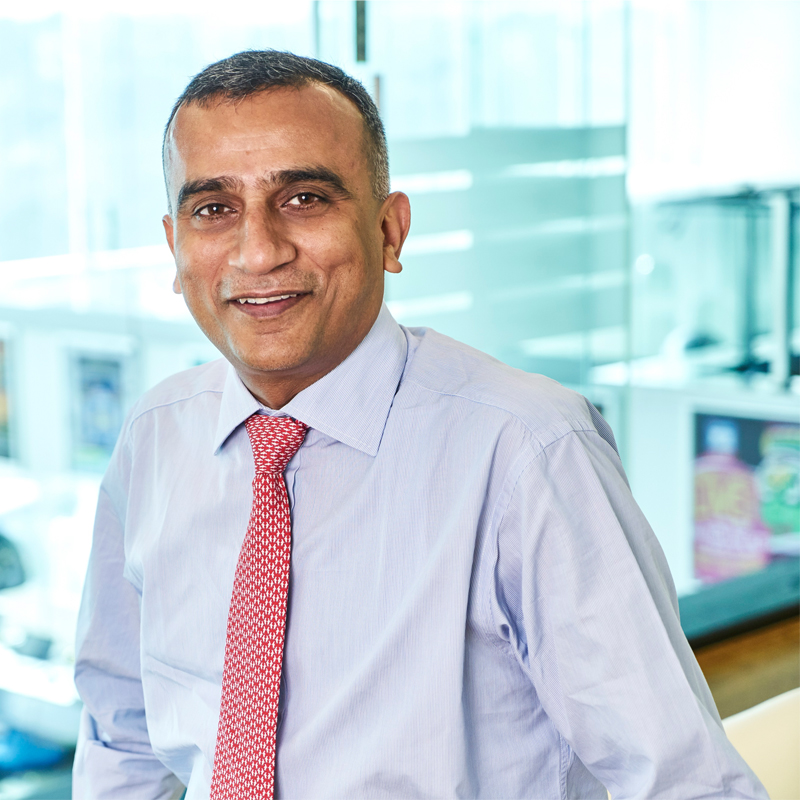
  • Sudhanshu Vats on Viacom18’s growth strategy and why data analytics is key

    Sudhanshu Vats on Viacom18’s growth strategy and why data analytics is key

    He goes by many names. The Laundry Man and The Marathon Man being two of the more popular monikers. The second one is self-explanatory given his passion for running, especially marathons of many hues all over the globe. It’s the former one that makes people, sometimes, stop and give a quizzical look. Its origins, according to Unilever folklore, can be traced back to his days at the global FMCG company where he was at the helm of the laundry division in South Asia. But Sudhanshu Vats, group CEO of Viacom18, doesn’t mind the aliases; rather, he refers to them himself, at times—like he did in November at CASBAA Convention 2017 in Macau,where he was featured as a keynote speaker. At the time,Vats explained that running a marathon and running a company had lots in common as they taught one about the importance of planning and breaking down longer plans or goals into shorter milestones.

    Five and a half years into his new role in one of the top media companies of India that is an equal JV between US’ Viacom and Reliance Industries-controlled Network18, Vats is considered a thought-leader within the complex maze of the Indian media and entertainment industryand in government circles. His social media savviness makes him articulate on a range of subjects from media to women empowerment to an individual’s role in the Clean India campaignto the importance of health and fitness.

    In a free-wheeling chat with Indiantelevision.com’s consulting editor AnjanMitra and deputy managing editor Satyam Nagwekar, Vats speaks on a number of issues related to the M&E sector, including the necessity of regulation in India (he sometimes holds contrarian views to the general sectoral outlook of his peers) and why it’s important for a media company to be equally alive to data analytics to derivestrategies.

    Edited excerpts from an interview that took place when he was few days away from completing hisannual tenure as the chairman of BARC India, a joint industry body entrusted with collating audience data in a highly fragmented and, at times, quirky Indian broadcast sector, wherein competition is cut-throat:

    Q: What would be the three major changes in the industry that you have witnessed over the years in the complex M&E industry of India after your switch to the media sector from FMCG?

    A: The first significant development is the entire digitisation of the cable. While digitisation of the signal has happened, allowing (the pipe) to carry more content, addressability needs to improve. Overall cable digitisation has enabled the pipe to carry more content and to improve the viewer experience. The second development is the rise of OTT services; delivering content on demand in addition to the existing linear delivery of content. The third development would be the increasing importance of live and experiential entertainment. The advent of quality multiplexes has certainly made a difference in viewing experience in cinemas. Similarly, in the sphere of live entertainment, experimentation with modern technology has dialed up consumer experience. We have also experimented with theatricals. What happens is that as kids develop a relationship with characters, it allows you to bring those characters alive in different forms outside of television. One can take them outside of television into theatricals, into experiential zones and merchandising.

    I would add a fourth important development and that is the evolution of BARC India. I think the joint industry body that we formed to measure ‘what India watches’ is a significant development. It’s a unique feature that industry bodies have come together for audience measurement in India.

    Q:Are Hindi general entertainment channels (GECs) the largest contributors to the Viacom18 revenue pie?

    A: Yes, they are.

    “About 59-60 per cent of India communicates in regional languages, about 39-40 percent in Hindi, and the balance one per cent in English. This 59 per cent is still under-indexed in viewership. As the viewership catches up with actual consumption, so would monetisation opportunities.

    Q: Keeping in mind what you said, how do you see the market for Viacom18 going forward over the next couple of years?

    A: The GECs will remain an important block (from the point of view of revenues), but I am very bullish on the regional piece, too. I personally feel that regional businesses are gaining traction and will continue to get dialed up significantly in the future. The reason for that is that in television, and arguably in all mediums of television, digital and films, the regional languages have been under-indexed from the point of viewership and monetisation.

    In my opinion,the genesis of this lies in the fact that the erstwhile measurement system was a bit skewed towards the Hindi-speaking urban audiences; perhaps as it too developed along with the cable movement in India in the 1990s, which started with the Hindi-speaking regions. However, in the last decade, language programming in other parts of India, especially South India, has developed considerably. With BARC’s arrival, these markets are being better represented. As we go deeper into India, the regional language play will keep getting dialed up. About 59-60 per cent of India communicates in regional languages, about 39-40 percent in Hindi, and the balance one per cent in English. This 59 per cent is still under-indexed in viewership. As the viewership catches up with actual consumption, so would monetisation opportunities.

    Why do I say this? There is an intuitive understanding — not entirely always incorrect — that the English consuming audience has a higher propensity to spend and that amongst the other language markets, Hindi-speaking markets (HSM), perhaps, have the highest propensity to spend. Equally importantly, regional markets like Tamil Nadu, Karnataka, Andhra Pradesh/ Telengana, Kerala, Maharashtra and Gujarat have higher per capita income (compared to India average) and would therefore have a higher propensity to consume advertising and brands. My hypothesis is that the affinity to one’s mother tongue will remain and India will continue to remain a multi lingual country (most Indians speak at least two languages and in some cases three or more). All three clusters of English, Hindi and regional will grow with regional leading the rate of growth for viewership and monetisation.

    At Viacom18, we will continue to build our portfolio of services in all the three language-clusters mentioned above, while significantly dialing up our regional language clusters. To illustrate this, let me share how our dependence on our flagship Hindi channel Colors is systematically coming down. When I joined Viacom18, we used to get 80 per cent of our ad sales from Colors standard definition channel. That number now is 50 per cent or may be a little lower.

    About 59-60 per cent of India communicates in regional languages, about 39-40 percent in Hindi, and the balance one per cent in English. This 59 per cent is still under-indexed in viewership. As the viewership catches up with actual consumption, so would monetisation opportunities.

    Q: As Colors is the biggest revenue earner, a lot of strategising must be done forprogramming. How do you slice and dice programming for appointment viewing for different parts of India and the HSM?

    A: Not just Colors, but for all our content engines we marry insight to gut in the way we strategise and develop content. At Viacom18, we started an ambitious data science project called Project Pi with the objective to provide information and insights to the users and establish one single version of truth in the company.

    The second leg to this is a free-flowing discussion that we have recently started`Content PeCharcha’ (discussion over content), inspired by PM Modi’s now famous `Chai PeCharcha’ (discussion over tea), primarily with Raj (Nayak, COO, Viacom18), Manisha (Sharma, content head, Colors) and some more team members. These are open sessions where we have a qualitative and free-flowing discussion on both macro content trends and specific current and future programme story arcs.

    Let me give you a couple of examples of how this works. When I joined people said mythologicals/historical dramas don’t work on Colors. But our research suggested that competitors were successfully running them and it was a white space that hadn’t been explored properly at our end. We came up with Ashoka and proved the naysayers wrong. In one of our early meetings, we figured comedy was a white space for us and we should actively explore it. While our first attempt didn’t work, the next one (Comedy Nights with Kapil) created history as it was based on our learning. We then experimented with the crime genre with shows like Code Red and Dev. A Hindi GEC is like a `thali’ (an Indian plate with a variety of food offerings): it needs to have a spread of flavor and taste. Balance, however, is the key to how your audiences perceive the spread to be.

    Q: Has the rise of mythological and historical shows on Viacom18 channels, as well as on other TV channels, increased after 2014 or are we reading too much into it?

    A: I am a firm believer—and I am keep saying it often—that the richness of the Indian culture is reflected a lot in some of our mythological and historical stories. Brilliant evergreen tales like `Ramayan’ and `Mahabharat’ can be told over and over again but there are so many other stories that need to be taken to the audiences. If you look at some of our mythological stories, India has long been telling superhero stories—both of superwomen and supermen. But to answer your question, yes there has been a definite rise in these stories (on TV channels) post 2014.

    “My assumption is that over the next five years, India will follow China’s example and 10 per cent of all internet video consumers will move behind a pay wall. Once this happens, it will create both advertising and subscription economies at scale.

    Q: Hanuman probably was the first super hero and remains till day one. Agree?

    A: Precisely. I personally feel that these are stories that lend themselves well to a variety of interpretations. Moving forward, production quality can make our stories richer and give the consumers a better experience.

    Q. Is the digital venture VOOT making money?

    A: If you are asking if we are monetising VOOT, then yes we do have a fair number of advertising brands on VOOT. But having said that, I’d say we, like most consumer digital businesses, have substantial distance to cover in our monetisation journey. 

    The digital VoD space is one that requires an extended gestation period for investment. Today there are300 million Indians consuming video on the internet. That number is poised to touch 600-700 million in the next three to five years time.Further, my assumption is that over the next five years, India will follow China’s example and 10 per cent of all internet video consumers will move behind a pay wall. Once this happens, it will create both advertising and subscription economies at scale.

    Q: So, is VOOT targeting 10 per cent of subs behind a pay wall in, say, three years’ time?

    A: Absolutely. Maybe, even more. We are planning to launch the subscription service of VOOT early next fiscal.

    India is a price sensitive market and, unlike the West, we do not have the price arbitrage advantage between cable and VoD. In the US, Netflix disrupted the market with its offering at USD8-10 versus a monthly cable bill of USD80-100. In India, we still get 300 channels at Rs 200-250 making linear television the economical entertainment option. But having said that, I believe the right pricing for data and content will continue to drive VoD in India. I think, it is fair to assume that the range of pricing for subscription VoDin India lies between USD 1-3 to begin with.

    Q: So you are working on a price model that is between USD 1-3/sub/month in India?

    A: Yes. If you want to look at large numbers, you need to keep prices competitive in India.USD 3 is approximately Rs 200, but it will also depend on how many people you want at what price and that will be determined on the price volume elasticity study underway.

    public://Sudhanshu V1.jpg

    Q: Does it help for a content owner and producer like Viacom18 to also have a group company like Reliance Jio, which is a platform that is practically giving data free to consumers?

    A: There are clear synergies and we complement each other.

    Q: Have you ruled out sports altogether?

    A: The business of sports,particularly cricket,is a high-investment and long-gestation game. In our current scheme of things,such an investment can be better utilised in a host of other opportunities and, hence, we are not looking at sports as of now.

    Q: What are your views on the evolution of BARC India and that some of the audience data and methodology has been questioned by some industry players?

    A: BARC has made a promising start. The measurement is clearly more robust, transparent and objective. The sample size has already been dialed up to 32k (almost four times the size of the erstwhile measurement system). We plan to further grow the sample size to 40k by next year and even further in the years to come.

    The sample has also become broader,holistic and reflects more accurately what India watches. Even rural consumption and regional languages are getting represented in a better way. The fidelity of data has improved considerably and tent-pole events on television — from a big TV channel launch to a new program introduction and all the way to an important news break event in an hour — are captured and show up with a very prominent spike. The areas where more work needs to be done by all stakeholders are the measurement of niche channels by BARC and management of volatility as high fidelity brings high volatility.

    The initiatives like return path data and premium panel will help improve the measurement of niche channels.

    Q: When is BARC likely to rollout digital measurement?

    A: BARC is in the process of getting all stakeholders aligned for rollout of digital measurement. There are debates around all digital players being a part of the measurement, equitable methods/process used for data capturing from all players and the more holistic India stack/dmp for representation and publishing of the data. All the stakeholders at BARC are debating these issues and the timeframe of publishing digital data will depend on the speed of alignment and approach taken by the stakeholders. Until these issues are resolved, it would be premature to commit to a timeline.

    Q: What is your take on net neutrality?

    A: It is quite a nuanced subject. My broad take is that NN is essential and net should be as neutral as possible because that’s in the best interest of a functional democracy. Essential services, depending upon the evolution of our society, will need to be looked at differently. In years to come, the internet would be a basic requirement for day to day life and therefore net neutrality is an imperative to offer equal opportunity to everybody.

    Q: What about legal and illegal content as the latter results in revenue losses for content owners like Viacom18?

    A: The issue of piracy is entirely different, and another elaborate subject on its own. Illegal content is a big challenge for any content owner. Piracy is a complex topic where different stakeholders need to play a part. My view is clear: illegal content should not be made available, but then enforcement is not always that easy. Having said that, consumers too are not clear on legal and illegal content when it comes to the digital world, at times. In my view piracy should be tackled through a three-pronged approach of legislation, enforcement and consumer awareness. In addition, if content is made available to consumers at competitive price points, it would be a big deterrent to piracy and, business models permitting, arguably the most effective way to tackle this menace.

    “Technology is causing disruptions almost daily and resultantly the very definition of a media company is changing. For any regulator anywhere in the world or any government, it is a challenge to keep abreast or even keep pace with such changes. As we move forward, we will need to evolve a mechanism where there is greater participation from all stakeholders.

    Q. Do you think powerful lobbies like global video-streaming services can have a bearing on legislations relating to NN? How do you see that playing out?

    A: I would not like to specifically comment on this. But there are two fundamental considerations here. The first is that every player will have its point of view and arguments on the subject. Second is that considering the width and complexity of these arguments, the government is best placed to examine in detail and take an overarching view after wide-ranging discussions with every stakeholder.

    Q: You are head of the CII entertainment committee, part of the IBF board, associated with BARC and also head one of the largest media networks in the country. What are your views on the regulatory regime in India as it’s considered a challenging market?

    A: I think the tricky piece, or rather the interesting piece, is that media and entertainment as an industry, both in India and globally, is evolving at a rapid pace. Technology is causing disruptions almost daily and resultantly the very definition of a media company is changing. For any regulator anywhere in the world or any government, it is a challenge to keep abreast or even keep pace with such changes. As we move forward, we will need to evolve a mechanism where there is greater participation from all stakeholders. As one cannot operate in isolation, there is a need for some regulatory framework that is akin to the ground rules of a game, if one wishes the industry to flourish. So, yes, in my opinion, light touch regulation always works well.

    What are your views on FTA vs pay TV considering many popular TV channels are on DD’s free-to-air DTH service FreeDish, taking advantage of DD’s reach and making money on advertising?

    A: I am a firm believer that India is an ‘and’ market. So, I don’t think it’s an `and’ ‘or’ equation between FTA and pay TV. Both will continue to flourish as there is significant headroom for growth for both. Now, coming to DD FreeDish, you’re right in identifying it as a platform as it is a means to carry content to the consumer and represents a very affordable option. Admittedly, it is a rapidly growing platform where many private channels are also present. However, all other platforms are cognizant of the opportunity that a low priced FTA channel bouquet provides. It is quite likely that alternate platform options will emerge if DD FreeDish decides to bar privately owned channels.

    ALSO READ:

    Viacom18 celebrations: Mukesh Ambani sets the roadmap for next 10 years

    Viacom18’s Sudhanshu Vats: Indian media’s growth will be similar to China

    Viacom18 showcases strong women characters content: Ajit Andhare, buys Mithali biopic rights

    Viacom18 & govt announce anti-piracy partnership
  • STB import duty doubled to 20%

    STB import duty doubled to 20%

    NEW DELHI: In a fresh bid to boost domestic production under the Make in India project, the Indian government has increased the import duty on set-top boxes (STBs) to 20 per cent, including a host of other electronic items such as TVs sets and smartphones.

    The duty hike from 10 per cent could impact the ongoing digitisation of TV services in India. Experts and stakeholders in the country’s broadcast and cable industry are still assessing the directive, including the fact whether the move is aimed at arresting imports from China.

    A ministry of finance notification dated 14 December 2017 stated the federal government was “satisfied” that the import duty on certain goods, including electronics, should be increased as “circumstances exist” that render it “necessary to take immediate action”.

    Though officially over, India’s digitisation of TV services is still a work in progress with many big MSOs admitting in private that the last and fourth phase is still far from over.

    A cable industry source highlighted that India’s DTH operators annually import about 10 million STBs, while an additional 20 million boxes approximately would still be needed to fully cover areas falling under phase IV of digitisation.

    While many India companies, including big companies like the Hero group, are manufacturing and/or assembling STBs in India, the supply, according to industry sources, isn’t enough to meet the demand. It is also expected that whenever the next round of survey is undertaken, the total number of TV homes in India would increase much beyond the figure of 183 million (as indicated by BARC India).

    Will this increase in import duty also up the cost of STBs for consumers via a mixed business model of rentals and outright purchase of the product? It’s still not clear.

    An industry source, however, said whether this government move would give a fillip to domestic manufacturing is not yet known. Most Indian DTH operators have already started importing STBs from countries like Thailand and Vietnam to take advantage of an ASEAN (Association of Southeast Asian Nations) trade pact, which is aimed at lowering trade barriers and help economic growth in general.

    STBs can be now imported by Indian companies from ASEAN countries at very low tax rate that is in the range of 2-3 per cent, the source elaborated.

    ALSO READ:

    Budget 2016: STBs exempt from basic customs duty

    DAS: Even official figures show digitization is incomplete

    DAS phase IV pace slack; MIB to make Indian STB makers


  • Debate on for digital India stack consensus: Sudhanshu Vats

    Debate on for digital India stack consensus: Sudhanshu Vats

    MUMBAI: Viacom18 group CEO Sudhanshu Vats is of the opinion that net neutrality is essential for the evolution of society but firmly believes that illegal and pirated content can’t be made available to all in the name of net neutrality.

    Vats, who also happens to be the present chairman of BARC India, said that the ratings organisation has made a solid beginning but will have to iron out some glitches (like niche channels’ measurements) as it continues to evolve and that the rollout of digital measurement would depend on how soon the industry stakeholders bring themselves on the same page on issues under debate, including formation of an Indian stack for benchmarking digital data.

    “Net neutrality is essential and the net should be as neutral as possible because that’s in the best interest of a functional democracy,” Vats told indiantelevision.com in an interview, adding, “My view is clear: illegal content should not be made available but then enforcement is not always that easy.”

    Viacom18, which spans businesses such as film production and distribution of content on TV and digital space, has been working extensively and intensively on anti-piracy issues along with the Indian government and other media companies in recent times.

    Elaborating on his views on tackling the menace of video and content piracy, which is becoming a headache for content owners globally, Vats said, “At times, consumers too are not clear on legal and illegal content… (and) in my view piracy should be tackled through a three-pronged approach of legislation, enforcement and consumer awareness.”

    Making a case for introducing economic disincentives for arresting flourishing piracy, Vats added that if content was made available to consumers at “competitive price points”, it would be a “big deterrent to piracy” and such business models.

    Speaking on BARC India, Vats highlighted fidelity of data has improved considerably and tent-pole events on television — from a big channel launch to a new program introduction and all the way to an important news break event in an hour — are captured and show up with a very prominent spike. “The areas where more work needs to be done are the measurement of niche channels by BARC and management of volatility (high fidelity brings high volatility) by all stakeholders,” he explained.

    The initiatives like return path data (RPD) and premium panel will help improve the measurement of niche channels, Vats said. BARC has announced one partnership with DEN Networks for collecting additional viewership data via RPD from the MSO’s consumer-premises STBs, and negotiations are on with some other DTH platforms and MSOs.

    Vats lauded the measurement agency’s role saying data is more robust, transparent and objective (compared to an earlier system). The sample size, which has already been dialed up to 32,000 (almost four times the size of the erstwhile measurement system), will be further bumped up to 40,000 by next year and even further in the years to come.

    Asked about the much-awaited rollout of digital data by BARC, Vats explained, “There are debates (happening presently) around all digital players being a part of the measurement, equitable methods /process used for data capturing from all players and the more holistic India stack/dmp for representation and publishing of the data. All the stakeholders at BARC are debating these issues and the time-frame of publishing digital data will depend on the speed of alignment and approach taken by the stakeholders.”

    Keep tuned in and watch this space for the full text of the interview with Vats where he speaks on a wide range of subjects, including the evolution of the Indian media and entertainment sector, regulations, Viacom18’s businesses, how programming strategies are conceptualized with the help of data crunchers, why it is important for media companies to have their own data analytics centers and much more.

    ALSO READ:

    TRAI releases recommendations on net neutrality 

    Comment: War on online video piracy, which matters, is here for India to fight

    BARC India to solve digital puzzle with ‘EKAM’ 

    Global digital platforms adapting locally for BARC’s EKAM 

  • The rise and fall of English news’ TV viewership

    The rise and fall of English news’ TV viewership

    NEW DELHI: Tongues have been wagging in the industry that the English news genre viewership levels and ratings have not only been yo-yoing but also declining. From a high of an average weekly viewership of 3788 (‘000) impressions in the Broadcast Audience Research Council (BARC) data from week 27-30, the figure has come down dramatically to 2514 (‘000) impressions in weeks 43-45.

    However, a quick analysis of viewership data reveals that there doesn’t seem to be any sinister reason or rocket science involved. Viewing, as experts say, is largely a seasonal affair for various genres. For example, during summer school holidays viewership of movie channels and general entertainment channels – and to some extent even factual entertainment or infotainment channels – see a spike in viewership only because kids and moms possibly get to do more TV watching.

    As far as English news genre is concerned, which forms a miniscule of the total viewership pie, questioning the fan following is not correct. In fact, the English news genre has seen a gradual growth in the period between BARC weeks 8-45; especially since the time the ratings agency rolled out the new TV universe estimate.

    The genre hit a high of 5.3 million impressions in week 11, but that was because of the crucial assembly poll results week. In a country where everyone has a political view, high viewership is understandable as most people would be searching for more political and election-related news and information, said an industry expert who has been tracking TV news channels in general.

    BARC India data available with Indiantelevision.com highlights that after the launch of Republic TV and the emergence of Arnab Goswami in a new avatar, the English news genre had hit levels of 4.6 million impressions, but has now settled at an average 2.3 millions impressions – levels English news genre was perched at prior to launch of Republic TV.

    public://f_4.jpg

    Source: BARC India. NB: Republic TV launched in week 19. Data: All India, Male 22+ AB; Average Weekly Impressions (in ‘000); period of consideration: Week 8-45

    Though competitors and critics of Arnab may not like to admit, data shows that after the launch of Republic TV the entire English news genre (including most existing players) saw a significant growth in viewership. As another industry observer pointed out, the reasons for this new-found love for English news could be for the following reasons:

    -When a much anticipated and promoted event occurs (launch of Republic and return of Arnab notably) inevitably viewer interest spikes that gets funnelled into the genre.

    – Also, the new channel launched with special content (stings, etc) led to the competition simultaneously airing special shows that were planned and canned earlier. All these again contributed to drive up viewership.

    – Such viewership spikes (led by events like elections, results or cricket matches featuring India) are inevitable and settle down to organic levels over the long term; even Republic TV ratings have fallen from dizzying heights at the time of its debut.

    That’s exactly what’s happening now with English news genre, the industry observer explained, driving home the point that TV channels should not jump to conclusions based on week-to-week swings. Earlier, there was one leader in the genre (notably Times Now), but now the category has two strong players. This too impacts viewership and rankings within the genre in the way as being witnessed now.

    “English news as a genre has always been a story of new challengers introducing disruptions and dethroning the existing leader. From NDTV 24×7 to CNN New18 to Times Now to Republic TV, the story has repeated itself reflecting also the swing in viewer preference as newer products are introduced in the market,” a TV critic said, adding that for niche genres like English news it’s always advisable to look at long-term trends, larger period clusters, rather than week on week insights.

    ALSO READ:

    BARC: English & Hindi News genres show decline in ratings

    Dominance of Republic TV continues as genre ratings plunge

    Industry needs to understand on-ground changes in distribution, not question flux in data, says Partho Dasgupta